Back
How to Prepare for NEET PG: The Honest, High-Yield Guide for 2026
Learn how to prepare for NEET PG with an active learning system that works. 6-month strategy, subject priorities, AI tools, and timeline from a topper's perspective. Start smart in 2026.

How to Prepare for NEET PG: The Honest, High-Yield Guide for 2026
Let's cut through the noise. You're probably drowning in generic NEET PG advice that sounds great but doesn't work. "Study smart, not hard." "Create a timetable." "Stay positive."
Here's what actually worked for toppers: active learning beats passive learning every single time.
I'm talking about the difference between watching lectures for 8 hours (passive) versus solving 200 MCQs with immediate explanations (active). Between reading pathology textbooks (passive) versus using spaced repetition flashcards that force recall (active).
This guide gives you the real system that works in 2026 — when AI has changed how to prepare for NEET PG forever.
What NEET PG Actually Tests (And Why Most Students Get This Wrong)
NEET PG doesn't test how comprehensively you know medicine. It tests pattern recognition and recall under pressure — 63 seconds per question, 200 questions, one shot.
Think about it: When you see "45-year-old male with crushing chest pain radiating to left arm," your brain needs to instantly fire: MI → ECG → troponins → dual antiplatelet therapy. Not recall the entire pathophysiology of atherosclerosis.
This is why students who memorize entire textbooks often score worse than those who've solved 10,000+ targeted MCQs. The exam rewards quick pattern matching, not deep theoretical knowledge.
The brutal truth: If you can't solve a question in 60 seconds, you don't know it well enough for NEET PG.
The 80/20 Rule: Subject Priority That Actually Matters
Stop treating all subjects equally. Here's the question distribution that determines your rank:
Subject | Questions | Priority Level |
|---|---|---|
Internal Medicine | 25-30 | Must dominate |
General Surgery | 20-25 | Must dominate |
Obstetrics & Gynecology | 15-18 | High priority |
Pathology | 15-20 | High priority |
Pharmacology | 15-18 | High priority |
Microbiology | 10-12 | Medium priority |
Pediatrics | 10-12 | Medium priority |
Remaining subjects | 60-70 | Fill the gaps |
Medicine and Surgery alone give you 45-55 questions. Master these first, then build outward.
Students who spend equal time on all 19 subjects score lower than those who dominate the top 5. This isn't about being unfair to smaller subjects — it's about mathematical reality.
Start with our detailed guides for high-yield subjects:
How Many Months to Prepare for NEET PG? (The Honest Answer)
6 months of active preparation beats 12 months of passive preparation.
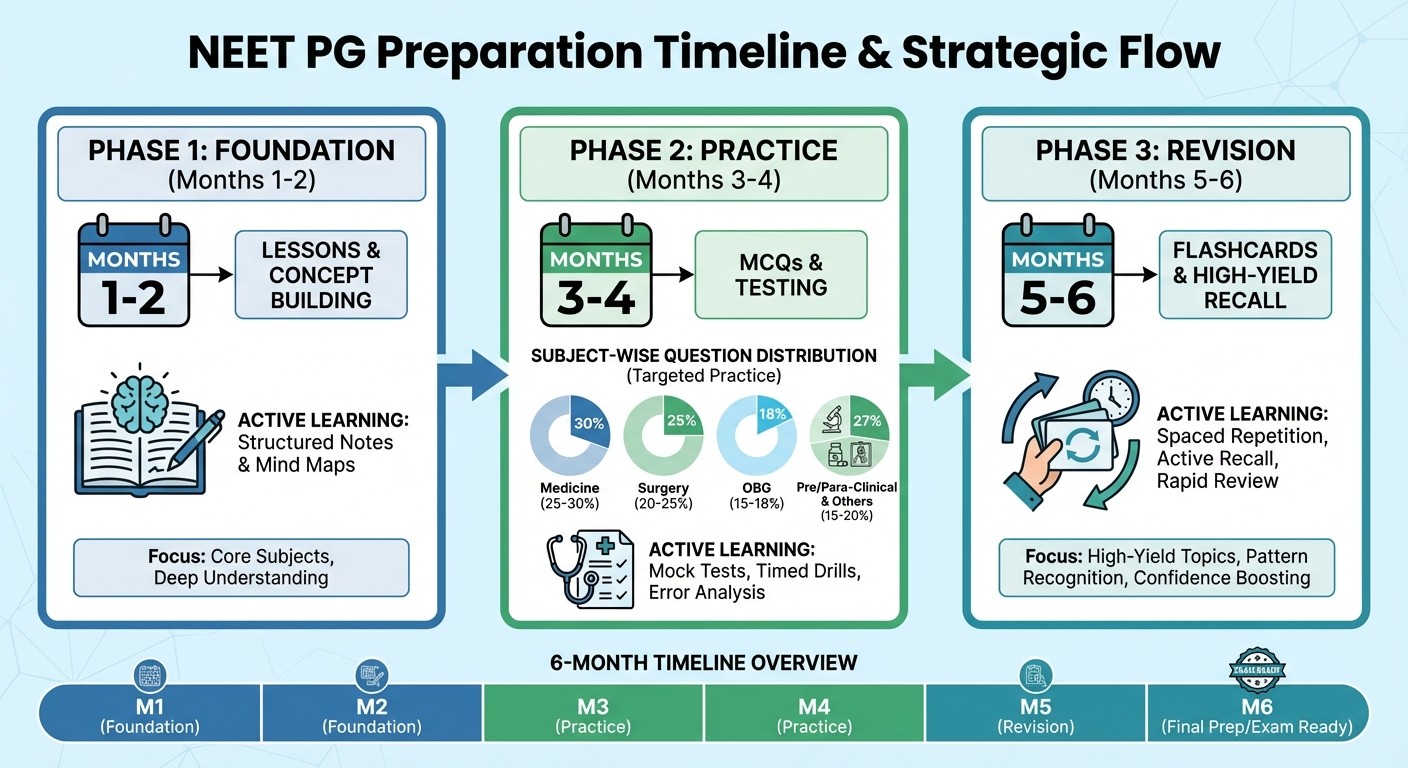
Here's the timeline that actually works:
6+ Months (Ideal)
3 months: Build foundation with lessons + immediate MCQ practice
2 months: Intensive revision with spaced repetition flashcards
1 month: Full-length tests + weak area targeting
3-4 Months (Possible with strong foundation)
1 month: High-yield lessons for top 5 subjects
1.5 months: MCQ marathon (300+ questions daily)
0.5 months: Rapid-fire revision with AI-adaptive flashcards
Less than 3 months (Crisis mode)
Focus only on Medicine, Surgery, OBG, Pharmacology, Pathology
Pure MCQ-based learning — no textbooks
Use AI to identify and plug knowledge gaps rapidly
The key: Start when you start, but make every day count with active learning.
When to Start NEET PG Preparation
3rd year: Perfect. You have time to build concepts alongside university exams. Final year: Realistic. Balance theory exams with MCQ practice. Internship: Most common. Here's the truth — internship is actually great for NEET PG prep because you're seeing diseases live. Connect what you see in wards with what appears in MCQs. After internship: Every month you wait, competition gets tougher. Start today, not tomorrow.
The best time to plant a tree was 20 years ago. The second-best time is today.
The Actual System: How to Crack NEET PG in 2026
Forget generic study schedules. Here's the system that works:
Phase 1: Foundation (Week 1-8)
1. 10-minute lessons first — Get the high-yield concepts clear 2. Immediate MCQ practice — 50 questions per topic after every lesson 3. Add to flashcard deck — Every concept you get wrong becomes a flashcard
Phase 2: Practice (Week 9-20)
1. 300+ MCQs daily — Mix of previous year and practice questions 2. Weak area tracking — Note which topics repeatedly trip you up 3. Spaced repetition — Review flashcards daily with adaptive scheduling
Phase 3: Mastery (Week 21-24)
1. Mock tests — Full-length exams every alternate day 2. Rapid revision — AI-powered flashcard marathons 3. Final plugging — Focus only on remaining weak areas
The magic happens in Phase 2 — when you're solving hundreds of questions daily and pattern recognition becomes automatic.
Practice with our comprehensive question banks:
How AI Changes NEET PG Prep in 2026
Generic ChatGPT knows medicine. Rezzy AI knows NEET PG.
Here's the difference that matters:
ChatGPT: "Atrial fibrillation is an irregular heart rhythm..." Rezzy AI: "In NEET PG, AF questions test: (1) Rate vs rhythm control (60% of questions), (2) Anticoagulation criteria (25%), (3) Cardioversion indications (15%). Want option-wise breakdown of last 3 years?"
Why Rezzy Beats Generic AI for NEET PG:
1. Exam pattern recognition: Knows which concepts appear most frequently
2. Option-wise analysis: Explains why each distractor is wrong
3. Adaptive question selection: Gives harder questions in your strong areas, easier in weak areas
4. Clinical reasoning: Uses "Clinical Rounds" to build diagnostic thinking, not just recall
Real Example:
Generic AI: Lists 15 causes of chest pain Rezzy: "NEET PG chest pain questions focus on 5 scenarios: MI (40%), PE (20%), aortic dissection (20%), pneumothorax (10%), others (10%). Here are the differentiating features that appear in exams..." Learn how to use Rezzy AI effectively for maximum preparation efficiency.
Subject-Wise High-Yield Strategy
Medicine (25-30 questions) — Your Rank Maker
Cardiology: Focus on ECG interpretation, heart failure, arrhythmias
Respiratory: Asthma/COPD management, lung cancers, TB
GI: Upper GI bleeding, IBD, liver diseases
Nephrology: AKI/CKD, electrolyte disorders
Endocrine: Diabetes, thyroid disorders
Master high-yield cardiology topics here
Surgery (20-25 questions) — High Scoring
GI Surgery: Appendicitis, hernias, bowel obstruction
Trauma: ATLS protocols, chest/abdominal trauma
Oncology: Common cancers and staging
Urology: Stones, BPH, cancers
OBG (15-18 questions) — Extremely High-Yield
Obstetrics: High-risk pregnancy, labor complications
Gynecology: PCOS, endometriosis, contraception
Oncology: Cervical, ovarian, endometrial cancers
Pathology (15-20 questions) — Pure Memory
General pathology: Inflammation, wound healing, neoplasia
Systemic pathology: Organ-specific diseases
Clinical pathology: Lab values, interpretations
Pharmacology (15-18 questions) — High ROI
Mechanism of action: For top 50 drugs
Side effects: Especially serious/life-threatening
Drug interactions: Common and dangerous combinations
Get the complete pharmacology strategy
Use our focused revision materials:
The Final Month: Revision That Actually Works
Your last 30 days decide everything. Here's what works:
Week 1-2: Full-length mock tests every alternate day. Focus on time management and stamina. Week 3: Pure flashcard marathons. Use spaced repetition to review everything you've learned. Week 4: Light revision only. Trust your preparation. Maintain confidence. Follow our detailed 30-day revision strategy for subject-wise final preparation.
Oncourse: Your Complete NEET PG Preparation System
Here's how Oncourse transforms your preparation:
1. Adaptive QBank (1 lakh+ questions)
Questions get harder in your strong subjects, easier in weak ones
Real-time difficulty adjustment based on your performance
Previous year questions with detailed explanations
2. Topper Flashcards with Spaced Repetition
40,000+ high-yield flashcards created by NEET PG toppers
AI schedules reviews when you're about to forget
Visual mnemonics for complex concepts
3. Concise High-Yield Lessons
10-minute lessons covering exactly what NEET PG tests
No fluff, no extra theory — pure exam-focused content
Interactive diagrams and clinical correlations
4. Rezzy AI Assistant
Trained specifically on NEET PG patterns and previous papers
Gives exam-specific explanations, not generic medical knowledge
Available 24/7 for doubt solving and concept clarification
5. Clinical Rounds
Case-based learning that builds diagnostic reasoning
Connects theoretical knowledge with clinical scenarios
Improves performance on case-based questions
6. Weak Area Tracking
AI identifies subjects where you consistently score low
Recommends targeted practice and focused revision
Progress tracking with detailed analytics
Free tier includes: Limited Rezzy AI chats, sample flashcards & questions, daily quizzes, unlimited learning games. Why 10,000+ students choose Oncourse: 4.8+ rating, comprehensive content, exam-specific AI, and proven results.
Download Oncourse free on Android and iOS to start your NEET PG preparation today.
Frequently Asked Questions
What is the 80/20 rule for NEET PG preparation?
Focus 80% of your time on the 5 subjects that give maximum questions: Internal Medicine (25-30 questions), Surgery (20-25), OBG (15-18), Pathology (15-20), and Pharmacology (15-18). These subjects alone account for 110+ questions out of 200.
How many months are needed to crack NEET PG?
6 months of active preparation is ideal. 3-4 months is possible with a strong foundation and intensive study (300+ MCQs daily). Less than 3 months requires crisis mode focusing only on top 5 subjects.
When should I start NEET PG preparation?
Start as early as possible: 3rd year is perfect, final year is realistic, internship is common. Every month of delay makes competition tougher. The key is starting with active learning methods regardless of when you begin.
What is a good NEET PG rank?
A rank under 2,000 gives you good chances for preferred branches in government colleges. Under 500 opens most branches including radiology, anesthesia, dermatology. Under 100 guarantees your choice of branch and college.
How to study for NEET PG during internship?
Use clinical exposure to your advantage — connect what you see in wards with MCQ patterns. Study 4-6 hours daily focusing on MCQs and flashcards. Use mobile apps for practice during breaks. Prioritize high-yield subjects first.
Is 6 months enough for NEET PG preparation?
Yes, 6 months is sufficient if you follow active learning methods: immediate MCQ practice after concepts, spaced repetition flashcards, and consistent daily practice of 200+ questions. Quality of preparation matters more than duration.
Your Next Step
NEET PG preparation in 2026 isn't about studying harder — it's about studying with the right system. Active learning, AI-powered practice, and strategic subject prioritization will get you the rank you deserve.
Start with the subjects that matter most. Use tools that adapt to your learning. Track your weak areas and fix them systematically.
Download Oncourse today and begin your transformation from NEET PG aspirant to NEET PG topper.
Your medical career depends on the next 6 months. Make them count.
---
Ready to transform your NEET PG preparation? Download Oncourse and access 40,000+ flashcards, 1 lakh+ practice questions, and Rezzy AI — your 24/7 NEET PG mentor. Free tier available.