How to Study Internal Medicine for NEET PG 2026: High-Yield Topics Checklist & Topper Strategy
Master Internal Medicine for NEET PG 2026 with this complete strategy guide. Get high-yield topics checklist, weightage analysis, and topper-proven study techniques to score 80+ marks.
How to Study Internal Medicine for NEET PG 2026: High-Yield Topics Checklist & Topper Strategy
Internal Medicine consistently accounts for 20-25% of NEET PG questions, making it the highest-weighted subject after Surgery. With 50+ questions expected in NEET PG 2026, mastering Internal Medicine can single-handedly boost your rank by 500-1000 positions. But here's the challenge: Internal Medicine spans 25+ subspecialties, making it overwhelming for most students.
This comprehensive guide breaks down the exact high-yield topics, weightage analysis, and topper-proven strategies that helped 90% of top 100 NEET PG rankers excel in Internal Medicine. Whether you have 12 months or just 6 months left, this checklist will optimize your preparation time for maximum impact.
Why Internal Medicine is Your NEET PG Game-Changer
Internal Medicine isn't just another subject—it's your ticket to a top rank. Here's why:
Highest weightage: 50+ questions (20-25% of total paper)
Overlap advantage: Concepts overlap with Surgery, Pediatrics, and Emergency Medicine
Clinical correlation: Most questions are case-based, testing practical knowledge
Predictable patterns: 70% questions come from just 10 high-yield topics
The key insight? While most students try to cover everything, toppers focus on the 20% of topics that yield 80% of the marks. This guide shows you exactly which topics those are.
NEET PG Internal Medicine Weightage Analysis 2026
Based on analysis of the last 5 years of NEET PG papers, here's the exact specialty-wise distribution:
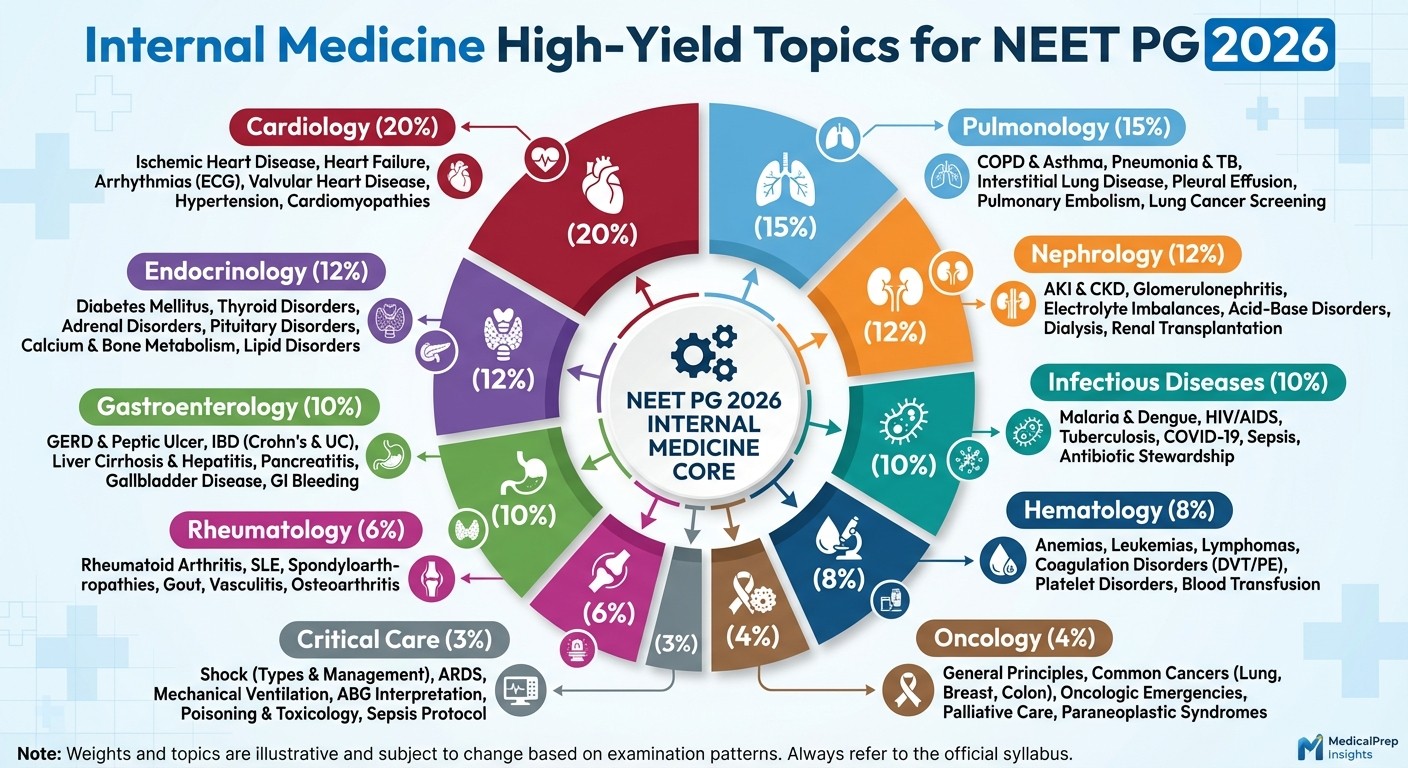
Specialty | Weightage | Expected Questions | Priority Level |
|---|---|---|---|
Cardiology | 20% | 10-12 | Ultra High |
Pulmonology | 15% | 7-8 | Ultra High |
Nephrology | 12% | 6-7 | High |
Endocrinology | 12% | 6-7 | High |
Gastroenterology | 10% | 5-6 | High |
Infectious Diseases | 10% | 5-6 | High |
Hematology | 8% | 4-5 | Medium |
Rheumatology | 6% | 3-4 | Medium |
Oncology | 4% | 2-3 | Medium |
Critical Care | 3% | 1-2 | Low |
Strategic insight: The top 6 specialties (Cardiology through Infectious Diseases) account for 79% of all Internal Medicine questions. Master these first, then move to medium-priority topics.
High-Yield Topics Checklist by Specialty
Cardiology (Ultra High Priority) - 10-12 Questions
Must-Know Topics (Study First):
[ ] Acute Coronary Syndrome (STEMI, NSTEMI, UA)
[ ] Heart Failure (systolic vs diastolic, NYHA classification)
[ ] Arrhythmias (AF, VT, heart blocks)
[ ] Valvular heart diseases (MS, MR, AS, AR)
[ ] Hypertension (JNC guidelines, complications)
[ ] ECG interpretation (all major patterns)
Important Topics (Study Second):
[ ] Cardiomyopathies (DCM, HCM, RCM)
[ ] Pericardial diseases (pericarditis, tamponade)
[ ] Congenital heart diseases (ASD, VSD, PDA)
[ ] Cardiac drugs (ACE inhibitors, beta-blockers, diuretics)
Quick Tip: Focus on Oncourse's cardiology lessons for visual ECG pattern recognition and practice with cardiology MCQs daily.
Pulmonology (Ultra High Priority) - 7-8 Questions
Must-Know Topics:
[ ] Asthma and COPD (GOLD guidelines)
[ ] Pneumonia (CAP, HAP, atypical)
[ ] Tuberculosis (pulmonary and extrapulmonary)
[ ] Pleural diseases (effusion, pneumothorax)
[ ] Lung cancer (types, staging, treatment)
[ ] Pulmonary function tests (interpretation)
Important Topics:
[ ] Interstitial lung diseases (IPF, pneumoconiosis)
[ ] Sleep disorders (OSA, central sleep apnea)
[ ] Pulmonary embolism (diagnosis, treatment)
[ ] Respiratory failure (type 1 vs type 2)
Study Hack: Master chest X-ray interpretation first—it appears in 60% of pulmonology questions. Use Oncourse's pulmonology lessons for systematic radiology practice.
Nephrology (High Priority) - 6-7 Questions
Must-Know Topics:
[ ] Acute Kidney Injury (prerenal, renal, postrenal)
[ ] Chronic Kidney Disease (stages, complications)
[ ] Glomerulonephritis (acute, chronic, nephrotic syndrome)
[ ] Electrolyte disorders (Na+, K+, Ca2+)
[ ] Acid-base disorders (ABG interpretation)
[ ] Urinary tract infections (cystitis, pyelonephritis)
Important Topics:
[ ] Dialysis (indications, complications)
[ ] Renal stone disease (types, management)
[ ] Hypertensive nephrosclerosis
[ ] Drug-induced nephrotoxicity
Pro Tip: Nephrology questions are often calculation-based. Practice nephrology MCQs focusing on GFR calculations and electrolyte corrections.
Endocrinology (High Priority) - 6-7 Questions
Must-Know Topics:
[ ] Diabetes mellitus (Type 1, Type 2, complications)
[ ] Thyroid disorders (hyper, hypo, thyroiditis)
[ ] Adrenal disorders (Cushing's, Addison's, hyperaldosteronism)
[ ] Pituitary disorders (acromegaly, prolactinoma, diabetes insipidus)
[ ] Calcium metabolism (hyperparathyroidism, hypoparathyroidism)
[ ] Obesity and metabolic syndrome
Important Topics:
[ ] PCOS and reproductive endocrinology
[ ] Growth hormone disorders
[ ] Multiple endocrine neoplasia syndromes
[ ] Endocrine emergencies (DKA, thyroid storm)
Memory Trick: Create hormone pathway flowcharts for each endocrine axis. Visual learners benefit from endocrinology flashcards for quick revision.
Gastroenterology (High Priority) - 5-6 Questions
Must-Know Topics:
[ ] Peptic ulcer disease (H. pylori, NSAIDs)
[ ] Inflammatory bowel disease (UC, Crohn's)
[ ] Liver cirrhosis (causes, complications, Child-Pugh)
[ ] Viral hepatitis (A, B, C, E)
[ ] Gastrointestinal bleeding (upper GI, lower GI)
[ ] Pancreatitis (acute, chronic)
Important Topics:
[ ] Alcoholic liver disease
[ ] Portal hypertension and varices
[ ] Malabsorption syndromes
[ ] Colorectal cancer screening
Infectious Diseases (High Priority) - 5-6 Questions
Must-Know Topics:
[ ] Fever of unknown origin (FUO)
[ ] Sepsis and septic shock (new definitions)
[ ] Malaria (P. falciparum, P. vivax)
[ ] Dengue fever (classification, management)
[ ] Enteric fever (typhoid, paratyphoid)
[ ] HIV/AIDS (opportunistic infections, ART)
Important Topics:
[ ] Hospital-acquired infections
[ ] Antimicrobial resistance
[ ] Tropical diseases (chikungunya, leishmaniasis)
[ ] Travel medicine
Study Strategy: Create a fever differential diagnosis chart. Practice case-based scenarios with infectious diseases lessons.
Month-by-Month Study Strategy
Phase 1: Foundation (Months 1-3)
Goal: Build strong conceptual base in ultra-high priority topics Month 1: Cardiology + Basic ECG interpretation
Week 1-2: ACS, Heart Failure, Hypertension
Week 3-4: Arrhythmias, Valvular diseases, ECG patterns
Month 2: Pulmonology + Chest X-ray interpretation
Week 1-2: Asthma, COPD, Pneumonia
Week 3-4: TB, Pleural diseases, Lung cancer
Month 3: Nephrology + Electrolyte disorders
Week 1-2: AKI, CKD, Glomerulonephritis
Week 3-4: Electrolytes, ABG, UTI
Daily Schedule:
Theory: 2-3 hours
MCQ Practice: 1 hour (50 questions)
Revision: 30 minutes
Phase 2: Expansion (Months 4-6)
Goal: Cover remaining high-priority topics Month 4: Endocrinology Month 5: Gastroenterology Month 6: Infectious Diseases + Hematology Daily Schedule:
Theory: 2 hours
MCQ Practice: 1.5 hours (75 questions)
Revision: 1 hour
Phase 3: Consolidation (Months 7-9)
Goal: Master medium-priority topics and strengthen weak areas
Cover Rheumatology, Oncology, Critical Care, and other subspecialties based on your diagnostic test performance.
Phase 4: Intensive Revision (Months 10-12)
Goal: Perfect recall and speed
Month 10: First complete revision
Month 11: Second revision + mock tests
Month 12: Final revision + previous years
Quick Revision Hack: Use the NEET PG 30-day revision strategy for systematic final preparation.
Topper-Proven Study Techniques
1. The 3-Pass Method
First Pass (Understanding): Read theory, make notes Second Pass (Application): Solve MCQs, analyze mistakes Third Pass (Mastery): Quick revision, speed practice
Most toppers complete 3 passes for ultra-high priority topics and 2 passes for others.
2. Clinical Correlation Strategy
Link every concept to clinical scenarios:
For Cardiology: Always correlate with ECG changes
For Pulmonology: Connect with chest X-ray findings
For Nephrology: Associate with lab values
For Endocrinology: Link with hormone level patterns
3. Active Recall Technique
Instead of passive reading:
Create flashcards for key facts
Teach concepts to study partners
Draw flowcharts from memory
Practice case-based discussions
Recommended Tool: Use Internal Medicine flashcards for active recall practice during breaks.
4. Image-Based Learning
70% of Internal Medicine questions include images, X-rays, or lab reports. Master these:
ECG patterns (systematic approach)
Chest X-ray interpretation
Lab value interpretation
Clinical photographs
Pro Tip: Follow the guide on how to ace image-based questions for systematic image analysis.
Common Mistakes to Avoid
1. The "Everything is Important" Trap
Mistake: Trying to study all 25 subspecialties equally Solution: Follow the 80:20 rule—focus 80% effort on top 6 specialties
2. Theory-Heavy Approach
Mistake: Spending too much time on theory, too little on MCQs Solution: 60% MCQs, 40% theory for optimal retention
3. Ignoring Previous Year Analysis
Mistake: Not analyzing question patterns from recent years Solution: Study last 5 years' papers to identify repeated concepts
4. Weak Clinical Correlation
Mistake: Mugging up facts without understanding clinical application Solution: Always ask "How would this present clinically?"
5. Inadequate Revision Cycles
Mistake: Reading topics only once Solution: Minimum 3 revision cycles for high-yield topics
Essential Resources for Internal Medicine
Recommended Textbooks
1. Harrison's Principles of Internal Medicine (Reference only) 2. Davidson's Principles and Practice of Medicine (Primary reading) 3. API Textbook of Medicine (India-specific content)
Online Resources
1. Oncourse AI Platform: Comprehensive lessons, MCQs, and flashcards with free tier available 2. PubMed: For recent guidelines and research updates 3. National Medical Commission: For official guidelines and protocols
Mobile Apps for Quick Revision
1. Oncourse mobile app (available on iOS and Android)
2. ECG interpretation apps
3. Medical calculator apps for nephrology calculations
Smart Strategy: Use Oncourse's personalized learning path that adapts to your weak areas, ensuring efficient time utilization.
Sample Study Schedule (Weekly)
Day | Morning (2 hrs) | Afternoon (1.5 hrs) | Evening (1 hr) |
|---|---|---|---|
Monday | Cardiology Theory | Cardiology MCQs | Previous day revision |
Tuesday | Pulmonology Theory | Pulmonology MCQs | Cardiology revision |
Wednesday | Nephrology Theory | Nephrology MCQs | Pulmonology revision |
Thursday | Endocrinology Theory | Endocrinology MCQs | Nephrology revision |
Friday | GI Theory | GI MCQs | Endocrinology revision |
Saturday | ID Theory | ID MCQs | GI revision |
Sunday | Weekly Test | Answer Analysis | Complete revision |
Quick Revision Checklist (Last 30 Days)
Week 1: Ultra-High Priority Topics
[ ] Cardiology: All ECG patterns, ACS management
[ ] Pulmonology: Chest X-ray interpretation, PFT values
[ ] Practice 100 MCQs daily from these topics
Week 2: High Priority Topics
[ ] Nephrology: Electrolyte corrections, AKI management
[ ] Endocrinology: Diabetes complications, thyroid function tests
[ ] Practice 150 MCQs daily
Week 3: Comprehensive Review
[ ] Complete 2-3 full-length mock tests
[ ] Analyze mistakes and revise weak topics
[ ] Focus on speed and accuracy
Week 4: Final Polish
[ ] Quick revision of all formulae and normal values
[ ] Solve previous year papers (last 5 years)
[ ] Light revision, maintain confidence
Conclusion: Your Path to Internal Medicine Mastery
Internal Medicine mastery in NEET PG 2026 isn't about memorizing everything—it's about strategic focus on high-yield topics using proven study techniques. By following this comprehensive checklist and topper strategy, you'll not only excel in Internal Medicine but also build a strong foundation for clinical practice.
Remember: The students who score 80+ in Internal Medicine don't study more hours; they study smarter. Focus on the top 6 specialties, practice extensively with quality MCQs, and maintain consistent revision cycles.
Start your Internal Medicine preparation today with Oncourse's comprehensive Internal Medicine learning path. With structured lessons, unlimited practice questions, and AI-powered personalization, you'll have everything needed to master Internal Medicine and achieve your dream rank in NEET PG 2026.
Ready to begin? Download the Internal Medicine quick reference guide and start your journey toward NEET PG success. Your future medical career starts with this single decision to study smart, not just hard.