How to Revise All 19 NEET-PG Subjects in 30 Days: The Ultimate Checklist
Master all 19 NEET-PG subjects in just 30 days with this proven revision strategy. Complete subject-wise study schedule, high-yield topics checklist, and expert tips for exam success.
How to Revise All 19 NEET-PG Subjects in 30 Days: The Ultimate Checklist
With NEET-PG approaching, you're likely feeling overwhelmed by the massive syllabus spanning 19 subjects. The good news? It's absolutely possible to effectively revise all subjects in just 30 days with the right strategy. This comprehensive guide provides a proven framework that thousands of successful NEET-PG candidates have used to maximize their scores.
According to the National Board of Examinations, NEET-PG tests knowledge across 19 core medical subjects. The key isn't to study everything equally, but to prioritize high-yield topics and create a systematic revision schedule that ensures no subject is left behind.
Understanding the Complete NEET-PG Syllabus
Before diving into the 30-day strategy, let's outline all 19 NEET-PG subjects you need to cover:
Basic Science Subjects (6 subjects)
1. Anatomy - Including gross anatomy, histology, and embryology 2. Physiology - Human body functions and mechanisms 3. Biochemistry - Molecular basis of health and disease 4. Pathology - Disease processes and pathophysiology 5. Pharmacology - Drug mechanisms and clinical applications 6. Microbiology - Bacteria, viruses, fungi, and parasites
Clinical Subjects (13 subjects)
7. Internal Medicine - Adult medical conditions 8. Surgery - Surgical procedures and pre/post-operative care 9. Obstetrics & Gynecology - Women's health and reproductive medicine 10. Pediatrics - Child health and development 11. Orthopedics - Musculoskeletal system disorders 12. Ophthalmology - Eye disorders and vision 13. ENT - Ear, nose, and throat conditions 14. Dermatology - Skin, hair, and nail disorders 15. Psychiatry - Mental health and behavioral disorders 16. Anesthesiology - Perioperative medicine and pain management 17. Radiology - Medical imaging and diagnostics 18. Forensic Medicine - Legal aspects of medicine 19. Community Medicine/PSM - Public health and preventive medicine
The Strategic 30-Day Framework
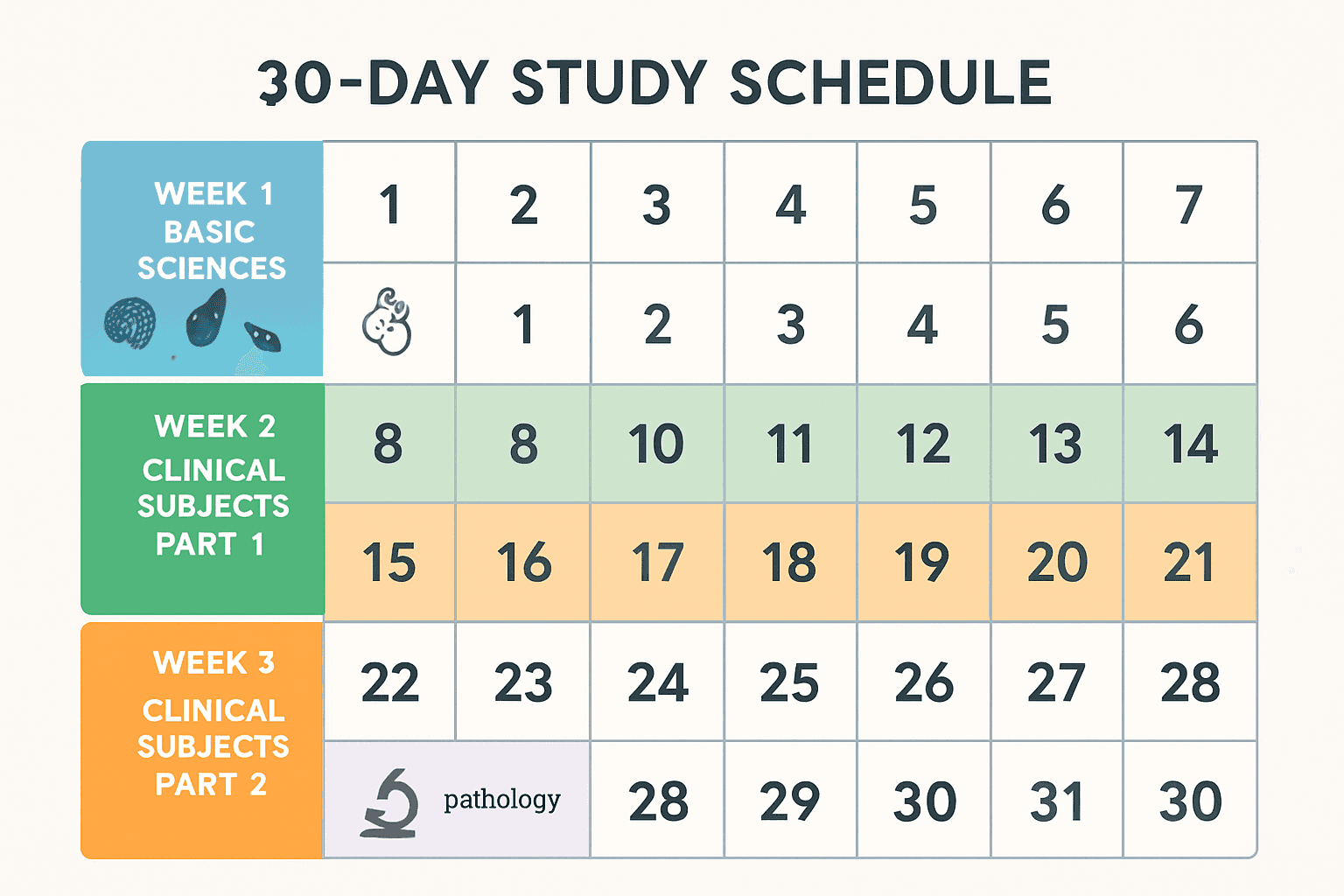
Week 1: Foundation Building (Days 1-7)
Focus: Basic Science Subjects Day 1-2: Anatomy & Physiology
Morning (4 hours): High-yield anatomy topics
- CNS anatomy (brain, spinal cord)
- Cardiovascular anatomy
- Respiratory system
Afternoon (3 hours): Essential physiology
- Cardiac physiology
- Respiratory physiology
- Neurophysiology
Day 3-4: Pathology & Pharmacology
Morning (4 hours): Core pathology concepts
- Cell injury and death
- Inflammation and healing
- Neoplasia
Afternoon (3 hours): High-yield pharmacology topics
- Autonomic nervous system drugs
- Cardiovascular drugs
- Anti-microbial agents
Day 5-6: Biochemistry & Microbiology
Morning (3 hours): Essential biochemistry
- Enzyme kinetics
- Metabolism pathways
- Clinical biochemistry
Afternoon (4 hours): Core microbiology
- Bacteriology
- Virology
- Medical mycology
Day 7: Basic Science Integration
Full day review and integration
Practice 100 MCQs covering all basic sciences
Identify weak areas for future revision
Week 2: Major Clinical Subjects (Days 8-14)
Day 8-9: Internal Medicine
Cardiology: MI, heart failure, arrhythmias
Pulmonology: COPD, asthma, pneumonia
Gastroenterology: PUD, IBD, liver diseases
Endocrinology: Diabetes, thyroid disorders
Day 10-11: Surgery & Orthopedics
General surgery: Trauma, GI surgery
Emergency surgery protocols
Orthopedic trauma and common fractures
Joint diseases and arthritis
Day 12-13: OB-GYN & Pediatrics
Obstetrics: Normal labor, complications
Gynecology: Menstrual disorders, cancers
Pediatric emergencies and growth disorders
Vaccination schedules and development
Day 14: Clinical Integration
Review major clinical cases
Practice differential diagnosis
Mock test covering clinical subjects
Week 3: Specialized Clinical Subjects (Days 15-21)
Day 15-16: Specialized Medicine
Psychiatry: Mood disorders, psychosis, therapy
Dermatology: Common skin conditions, infections
Anesthesia: Pharmacology and monitoring
Day 17-18: Sensory Specialties
Ophthalmology: Glaucoma, cataracts, retinal disorders
ENT: Hearing loss, sinusitis, head-neck cancers
Day 19-20: Support Specialties
Radiology: X-ray interpretation, CT/MRI basics
Forensic medicine: Medico-legal aspects
Community medicine: Epidemiology, biostatistics
Day 21: Specialty Integration
Case-based learning
Image-based questions practice
Specialty-specific MCQs
Week 4: Intensive Revision & Testing (Days 22-30)
Day 22-24: Subject-wise Rapid Revision
Day 22: Basic sciences rapid review
Day 23: Major clinical subjects review
Day 24: Specialties quick revision
Day 25-27: Mock Tests & Analysis
Full-length mock tests daily
Detailed performance analysis
Focus on weak areas identified
Day 28-30: Final Polish
Last-minute high-yield facts
Previous year questions
Exam day strategy practice
Daily Study Schedule Template
Morning Session (6:00 AM - 10:00 AM)
6:00-6:30 AM: Quick revision of previous day's topics
6:30-8:30 AM: New topic study (theoretical)
8:30-9:00 AM: Break
9:00-10:00 AM: MCQ practice on studied topics
Afternoon Session (2:00 PM - 6:00 PM)
2:00-4:00 PM: Second subject/continuation
4:00-4:15 PM: Break
4:15-5:15 PM: Image-based questions/case studies
5:15-6:00 PM: Notes review and consolidation
Evening Session (7:00 PM - 10:00 PM)
7:00-8:00 PM: Weak area focus
8:00-9:00 PM: Cross-subject integration
9:00-10:00 PM: Daily revision and next day planning
Subject-wise High-Yield Topics Checklist
Anatomy (Weight: 8-10%)
[ ] Central nervous system anatomy
[ ] Heart and circulation
[ ] Respiratory tract
[ ] GI tract anatomy
[ ] Urogenital system
[ ] Embryology basics
Physiology (Weight: 8-10%)
[ ] Cardiovascular physiology
[ ] Respiratory physiology
[ ] Renal physiology
[ ] Neurophysiology
[ ] Endocrine functions
[ ] GI physiology
Pathology (Weight: 10-12%)
[ ] Cell injury and inflammation
[ ] Neoplasia and cancer biology
[ ] Cardiovascular pathology
[ ] Pulmonary pathology
[ ] GI pathology
[ ] Hematological disorders
Pharmacology (Weight: 10-12%)
[ ] CNS drugs
[ ] Cardiovascular drugs
[ ] Antimicrobial therapy
[ ] Anti-cancer drugs
[ ] Endocrine drugs
[ ] Emergency drugs
Microbiology (Weight: 8-10%)
[ ] Staphylococcus and Streptococcus
[ ] Mycobacterium
[ ] Viral hepatitis
[ ] HIV and opportunistic infections
[ ] Hospital-acquired infections
[ ] Antiviral and antifungal drugs
Medicine (Weight: 12-15%)
[ ] Acute coronary syndromes
[ ] Heart failure management
[ ] COPD and asthma
[ ] Diabetes complications
[ ] Thyroid disorders
[ ] Infectious diseases
Surgery (Weight: 10-12%)
[ ] Acute abdomen
[ ] Trauma management
[ ] GI surgery principles
[ ] Thyroid and breast surgery
[ ] Wound healing
[ ] Surgical infections
OB-GYN (Weight: 8-10%)
[ ] High-risk pregnancy
[ ] Labor complications
[ ] Menstrual disorders
[ ] Infertility workup
[ ] Gynecological cancers
[ ] Family planning
Pediatrics (Weight: 8-10%)
[ ] Growth and development
[ ] Pediatric emergencies
[ ] Congenital heart disease
[ ] Infectious diseases in children
[ ] Nutritional disorders
[ ] Immunization schedule
Effective Study Techniques for Rapid Revision
1. Active Recall Method
Instead of passive reading, test yourself constantly:
Cover the text and explain concepts aloud
Create flashcards for high-yield facts
Teach concepts to study partners
2. Spaced Repetition System
Review topics at increasing intervals
Use the 1-3-7-21 day rule for retention
Prioritize weak areas for more frequent review
3. Visual Learning Integration
Use flowcharts for complex processes
Create mind maps for differential diagnoses
Draw anatomical structures from memory
4. Case-based Integration
Link basic science to clinical scenarios
Practice clinical reasoning daily
Focus on common presentations
Technology Tools for Efficient Revision
The right study platform can significantly accelerate your revision. OnCourse offers AI-powered personalized learning that adapts to your strengths and weaknesses, making it the most efficient way to cover all 19 subjects systematically.
Key features for NEET-PG revision:
Subject-wise practice with instant feedback
Adaptive learning algorithm
Progress tracking across all subjects
High-yield topic identification
Mock tests with detailed analytics
Other useful tools include:
Anki for spaced repetition flashcards
Notion for organized note-taking
Pomodoro timer apps for focused study sessions
Mock Test Strategy
Week 1-2: Subject-specific Tests
Take daily 50-question tests
Focus on one subject at a time
Analyze incorrect answers immediately
Week 3: Cross-subject Integration Tests
Mixed subject tests (100 questions)
Time yourself strictly
Practice image-based questions
Week 4: Full-length Simulations
Complete 3-hour mock exams
Simulate actual exam conditions
Focus on time management
Common Mistakes to Avoid
1. Neglecting Basic Sciences
Many students focus only on clinical subjects, but basic sciences carry significant weight and are often easier to score.
2. Unequal Time Distribution
Don't spend 3 days on medicine and 1 hour on psychiatry. Allocate time based on subject weightage.
3. Ignoring Previous Years
NEET-PG often repeats concepts. Solve at least 5 years of previous questions.
4. Perfectionism Trap
Don't aim to master everything. Focus on high-yield, commonly asked topics.
5. Skipping Mock Tests
Mock tests are crucial for time management and identifying weak areas.
Weekly Progress Tracking
Week | Subjects Covered | Mock Test Score Target | Focus Area |
1 | Basic Sciences (6) | 60-70% | Foundation |
2 | Major Clinical (4) | 65-75% | Application |
3 | Specialties (9) | 70-80% | Integration |
4 | All Subjects | 75-85% | Optimization |
Managing Stress and Maintaining Health
Physical Health
Maintain 6-7 hours of sleep
Take 30-minute breaks every 2 hours
Include light exercise or walking
Eat regular, nutritious meals
Mental Health
Practice 10 minutes of meditation daily
Stay connected with supportive friends
Avoid negative news and social media
Maintain perspective on the exam outcome
Final Week Strategy (Days 25-30)
Day 25-27: Intensive Practice
Take full-length tests under exam conditions
Review all incorrect answers
Make final revision notes
Day 28-29: Light Revision
Go through quick revision notes only
Solve easy questions to build confidence
Avoid learning new concepts
Day 30 (Exam Day - 1)
Light revision of formulae and facts
Relax and prepare mentally
Organize exam day materials
Exam Day Checklist
[ ] Admit card and ID proof
[ ] Reach center 1 hour early
[ ] Light breakfast and water bottle
[ ] Positive mindset and confidence
[ ] Time management strategy ready
How to Measure Success
Success in this 30-day revision isn't just about the final exam score. Track these metrics:
1. Daily Goals Completion: Aim for 90% daily target achievement
2. Mock Test Progression: 5-10% improvement week over week
3. Weak Area Improvement: Convert 2-3 weak subjects to average
4. Confidence Level: Subjective measure of preparedness
Conclusion: Your Path to NEET-PG Success
Revising all 19 NEET-PG subjects in 30 days is challenging but entirely achievable with systematic planning and dedicated execution. The key is maintaining consistency, focusing on high-yield topics, and using effective study techniques.
Remember, this intensive month is your final push toward achieving your postgraduate medical dreams. Stay focused on your goals, trust the process, and maintain confidence in your preparation.
Ready to start your 30-day transformation? Begin today with our comprehensive NEET-PG course that provides structured learning paths for all subjects, adaptive practice questions, and expert guidance to maximize your revision efficiency.
Your future specialty awaits – make these 30 days count!