High-Yield NEET PG Cardiology Topics 2026: ECG Interpretation, Congenital Heart Diseases, Arrhythmias and Valvular Disorders Complete Guide
Master high-yield NEET PG cardiology topics for 2026: ECG interpretation, congenital heart diseases, arrhythmias & valvular disorders. Complete study guide with clinical pearls.
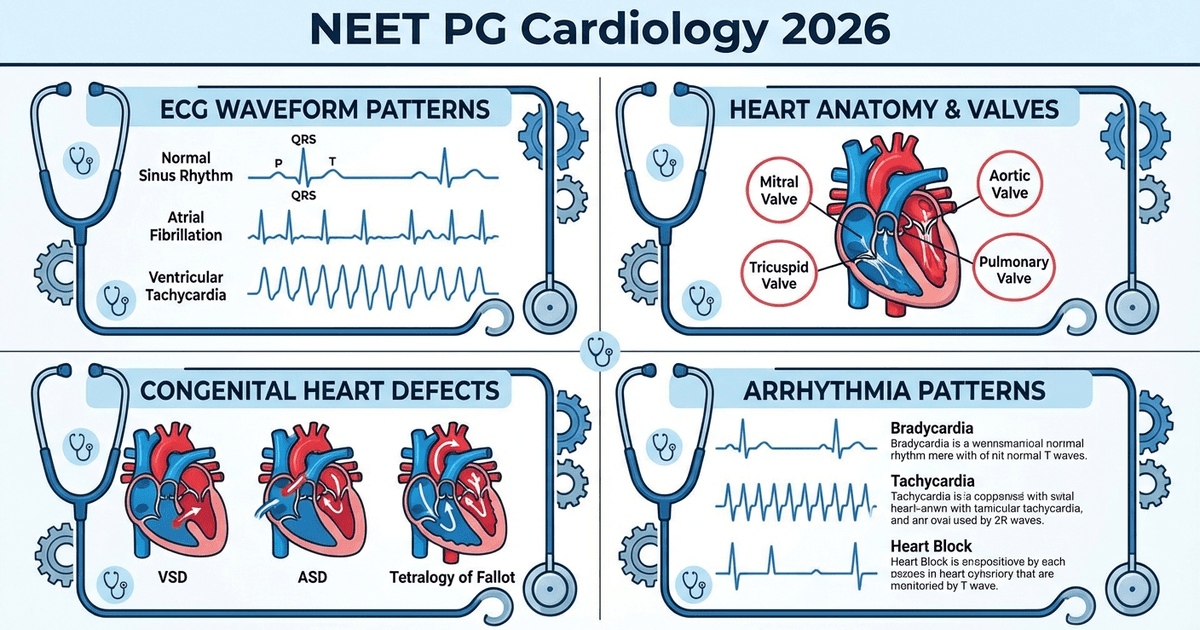
High-Yield NEET PG Cardiology Topics 2026: ECG Interpretation, Congenital Heart Diseases, Arrhythmias and Valvular Disorders Complete Guide
Cardiology consistently accounts for 12-15% of NEET PG questions, making it one of the highest-scoring subjects in internal medicine. With over 180 questions appearing from cardiology topics in the past five years, mastering these four core areas—ECG interpretation, congenital heart diseases, arrhythmias, and valvular disorders—can significantly boost your NEET PG score in 2026.
Recent NEET PG trends show increasing emphasis on image-based questions, particularly ECG strips and echocardiography findings. The National Board of Examinations has also introduced more clinical scenario-based questions that test practical application rather than rote memorization.
Why These Four Topics Are NEET PG Gold Mines
Topic | Question Frequency | Difficulty Level | Score Potential |
|---|---|---|---|
ECG Interpretation | 25-30 questions/year | High | 8-10 marks |
Arrhythmias | 20-25 questions/year | Medium-High | 7-9 marks |
Congenital Heart Disease | 15-20 questions/year | Medium | 6-8 marks |
Valvular Disorders | 18-22 questions/year | Medium | 7-9 marks |
ECG Interpretation: The Ultimate NEET PG Scorer
Mastering ECG Basics for NEET PG Success
ECG interpretation questions are virtually guaranteed in every NEET PG exam. The key to scoring lies in systematic approach and pattern recognition rather than memorizing isolated facts.
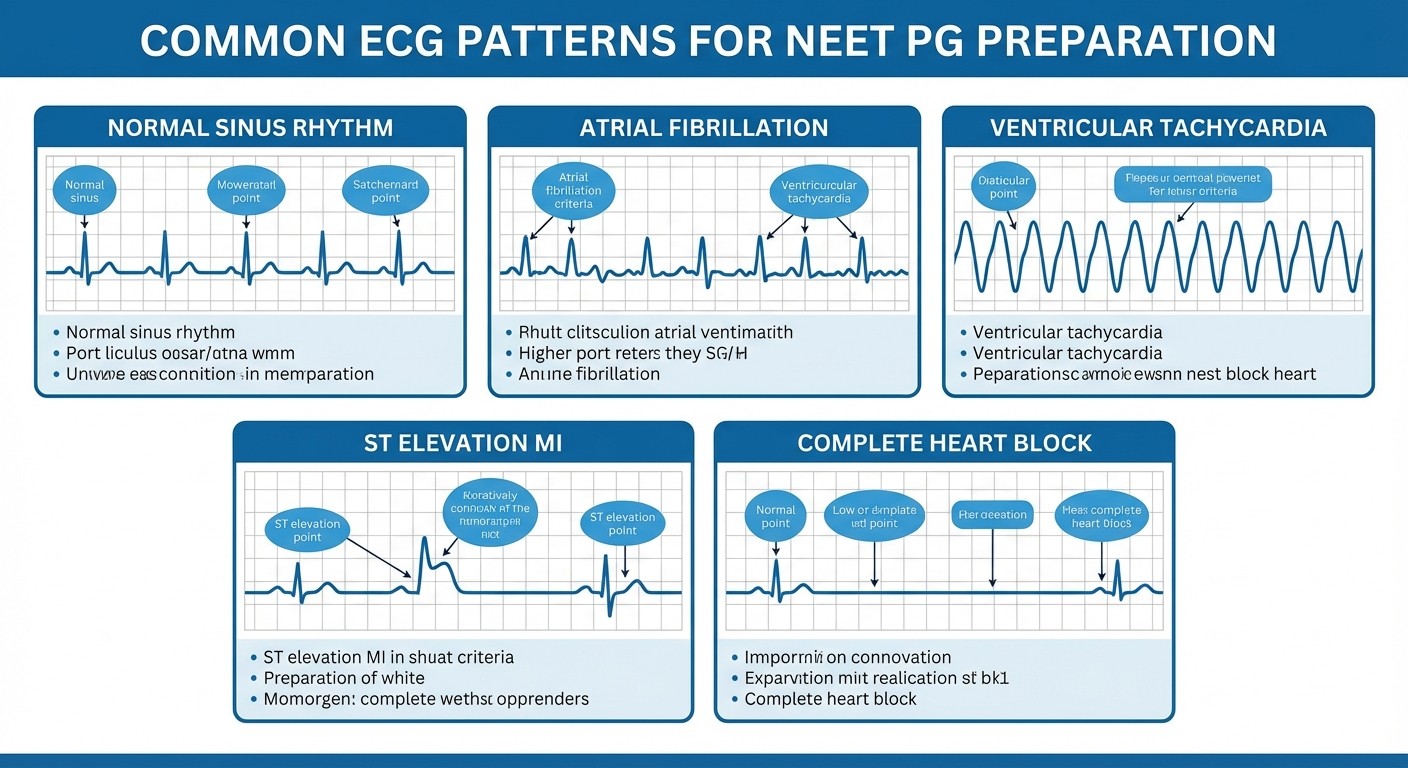
Essential ECG Parameters to Master:
Rate Calculation: 300/number of large squares between R-R intervals
Rhythm Analysis: Regular vs irregular, P-wave morphology
Axis Determination: Lead I and aVF quadrant method
Interval Assessment: PR (120-200ms), QRS (<120ms), QT (varies with rate)
ST Segment Changes: Elevation, depression, and morphology
High-Yield ECG Findings for NEET PG
ST Elevation Myocardial Infarction (STEMI) Patterns:
Anterior STEMI: V1-V6 leads, LAD territory
Inferior STEMI: II, III, aVF leads, RCA territory
Lateral STEMI: I, aVL, V5-V6 leads, LCX territory
Posterior STEMI: Tall R waves in V1-V2, reciprocal changes
Arrhythmia Recognition on ECG:
Atrial Fibrillation: Irregularly irregular rhythm, absent P waves
Atrial Flutter: Sawtooth pattern, 2:1 or 3:1 conduction
Ventricular Tachycardia: Wide QRS (>120ms), AV dissociation
Complete Heart Block: P waves and QRS complexes independent
Pro Tip: Practice ECG interpretation using Oncourse's cardiology lessons which include interactive ECG cases with detailed explanations.
ECG Interpretation Strategy for NEET PG
1. Rate and Rhythm (5 seconds)
2. P Wave Analysis (10 seconds)
3. PR Interval and QRS Width (10 seconds)
4. ST Segments and T Waves (15 seconds)
5. Overall Pattern Recognition (10 seconds)
Master these timing guidelines to efficiently tackle ECG questions within NEET PG's time constraints.
Congenital Heart Diseases: Pattern Recognition Mastery
Cyanotic vs Acyanotic Classification
Understanding the hemodynamic principles behind congenital heart diseases is crucial for NEET PG success. Questions often present clinical scenarios requiring differentiation between cyanotic and acyanotic lesions.
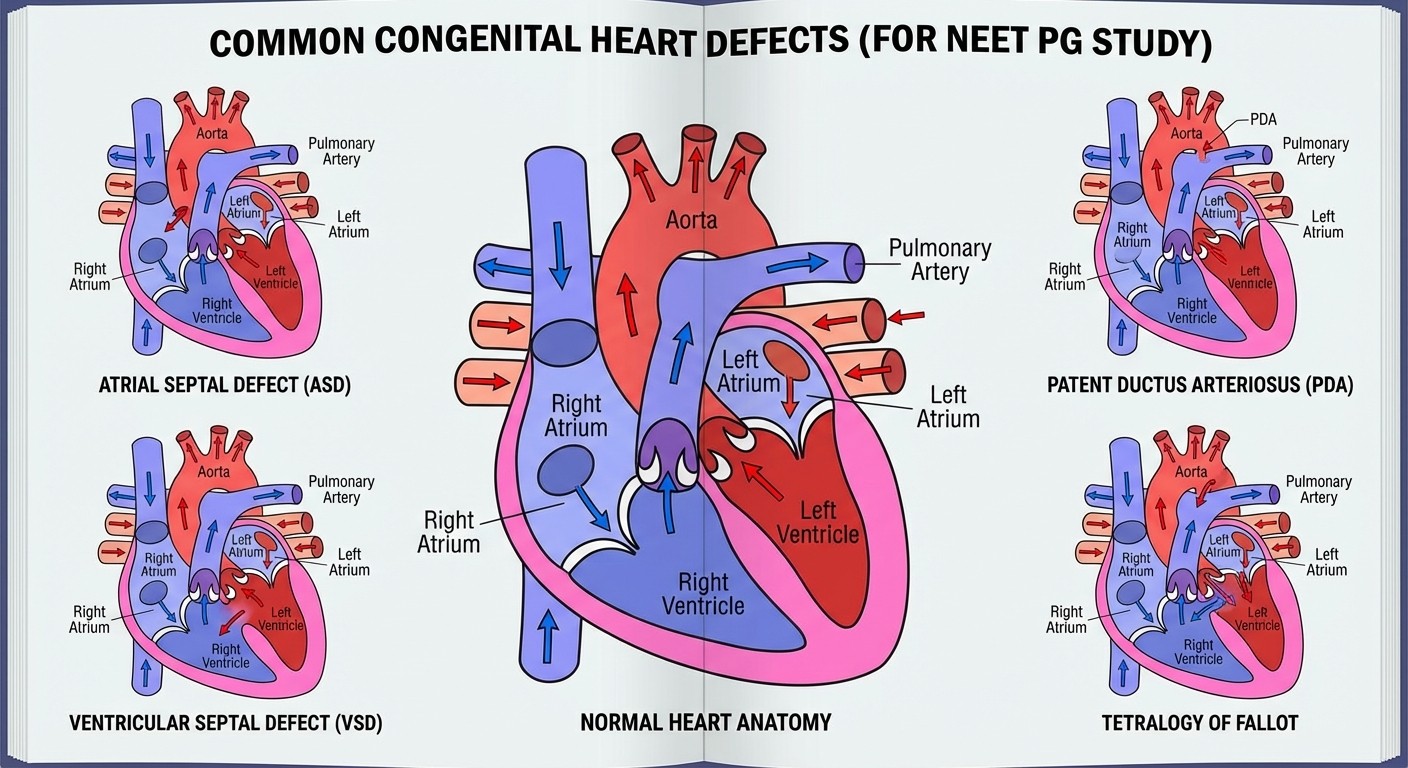
High-Yield Acyanotic Lesions
Ventricular Septal Defect (VSD) - Most Common CHD:
Clinical Features: Holosystolic murmur at LLSB, failure to thrive
Complications: Eisenmenger syndrome, infective endocarditis
Management: Small VSDs close spontaneously, large require surgical repair
NEET PG Focus: Shunt calculation, timing of surgery
Atrial Septal Defect (ASD):
Ostium Secundum (80%): Mid-septal location, fixed S2 splitting
Ostium Primum (15%): Associated with mitral regurgitation
Sinus Venosus (5%): Associated with partial anomalous pulmonary venous return
Patent Ductus Arteriosus (PDA):
Classic Finding: Continuous "machinery" murmur
Treatment: Indomethacin for closure in neonates, surgical ligation if medical therapy fails
High-Yield Fact: PDA keeps patent by PGE2, closes with indomethacin (PGE inhibitor)
High-Yield Cyanotic Lesions
Tetralogy of Fallot (TOF) - Most Common Cyanotic CHD:
Four Components: VSD, pulmonary stenosis, overriding aorta, RVH
Pathophysiology: Right-to-left shunt through VSD
Clinical: Tet spells, clubbing, squatting posture
Surgery: Complete repair between 6 months to 2 years
Transposition of Great Arteries:
Anatomy: Aorta from RV, pulmonary artery from LV
Survival: Requires mixing (ASD, VSD, or PDA)
Immediate Management: PGE2 infusion to maintain ductal patency
Definitive Treatment: Arterial switch operation
Strengthen your understanding with Oncourse's congenital heart disease lessons and test your knowledge using practice questions.
Arrhythmias: Mechanism-Based Learning
Supraventricular Arrhythmias
Atrial Fibrillation Management Strategy:
Rate Control: Beta-blockers, calcium channel blockers, digoxin
Rhythm Control: Cardioversion (electrical/pharmacological)
Anticoagulation: CHA2DS2-VASc score for stroke risk assessment
Novel Anticoagulants: DOACs preferred over warfarin in most cases
NEET PG High-Yield CHADS2-VASc Scoring:
Congestive heart failure (1 point)
Hypertension (1 point)
Age ≥75 years (2 points)
Diabetes (1 point)
Stroke/TIA history (2 points)
Vascular disease (1 point)
Age 65-74 years (1 point)
Sex category (female) (1 point)
Score ≥2: Anticoagulation recommended
Ventricular Arrhythmias
Ventricular Tachycardia Classification:
Monomorphic VT: Same QRS morphology, usually due to reentry
Polymorphic VT: Varying QRS morphology, torsades de pointes
Treatment: Hemodynamically stable - amiodarone; unstable - cardioversion
Torsades de Pointes Prevention:
Avoid QT-prolonging drugs: Quinidine, sotalol, haloperidol
Correct electrolytes: Magnesium, potassium
Emergency treatment: IV magnesium sulfate
Practice arrhythmia recognition and management with Oncourse's cardiac arrhythmias module and interactive flashcards.
Valvular Disorders: Hemodynamic Understanding
Aortic Valve Disease
Aortic Stenosis Severity Assessment:
Mild: Valve area >1.5 cm², gradient <25 mmHg
Moderate: Valve area 1.0-1.5 cm², gradient 25-40 mmHg
Severe: Valve area <1.0 cm², gradient >40 mmHg
NEET PG Clinical Correlation:
Classic Triad: Dyspnea, angina, syncope
Physical Findings: Harsh systolic murmur, delayed carotid upstroke
Surgical Indications: Symptoms + severe AS, or asymptomatic with LVEF <50%
Aortic Regurgitation Signs:
Austin Flint Murmur: Functional mitral stenosis due to severe AR
Water Hammer Pulse: Rapidly rising and falling arterial pulse
Quincke's Sign: Capillary pulsations in nail beds
Mitral Valve Disease
Mitral Stenosis Pathophysiology:
Etiology: Rheumatic heart disease (most common cause globally)
Valve Area: Normal 4-6 cm², severe MS <1.0 cm²
Complications: Pulmonary hypertension, atrial fibrillation, systemic embolization
Mitral Regurgitation Assessment:
Acute MR: Sudden onset, cardiogenic shock, papillary muscle rupture
Chronic MR: Gradual onset, compensated LV dysfunction
Surgical Timing: Symptoms or LVEF ≤60% or LVESD ≥40mm
Key NEET PG Differentiators:
Valve Disease | Murmur | S2 Character | Pulse Pressure |
|---|---|---|---|
Aortic Stenosis | Harsh systolic | Paradoxically split | Narrow |
Aortic Regurgitation | Diastolic | Single S2 | Wide |
Mitral Stenosis | Diastolic rumble | Loud S1 | Normal |
Mitral Regurgitation | Holosystolic | Wide split S2 | Normal |
Enhance your valvular disease knowledge with Oncourse's comprehensive valvular heart disease lessons and assess your understanding with targeted practice questions.
NEET PG 2026 Preparation Strategy
Month-by-Month Study Plan
Months 1-2: Foundation Building
Master basic ECG interpretation principles
Understand hemodynamic concepts in CHD
Learn classification systems for all four topics
Months 3-4: Clinical Application
Practice image-based questions extensively
Focus on differential diagnosis scenarios
Master treatment algorithms and guidelines
Months 5-6: Integration and Revision
Solve previous year NEET PG questions
Take topic-wise mock tests
Review high-yield facts and mnemonics
Essential Resources for NEET PG Cardiology
Recommended Study Materials: 1. Oncourse Platform: Comprehensive cardiology lessons, practice questions, and flashcards with detailed explanations 2. Harrison's Principles of Internal Medicine: Gold standard for conceptual understanding 3. Previous Year NEET PG Papers: Pattern recognition and question style familiarity
Quick Revision Mnemonics
ECG Lead Territories (LADI):
Lateral: I, aVL, V5, V6
Anterior: V1-V4
Diaphragmatic/Inferior: II, III, aVF
Indeterminate: aVR
Tetralogy of Fallot (PROVE):
Pulmonary stenosis
Right ventricular hypertrophy
Overriding aorta
VSD
Everything blue (cyanosis)
Advanced NEET PG Tips
High-Yield Clinical Scenarios
ECG Questions Strategy:
Always check calibration first (standard: 25mm/sec, 10mm/mV)
Look for obvious abnormalities before detailed analysis
Remember that 95% of NEET PG ECG questions have clear, textbook findings
Congenital Heart Disease Approach:
Determine if cyanotic or acyanotic from clinical description
Identify the primary defect and associated complications
Consider natural history and surgical timing
Arrhythmia Management:
Assess hemodynamic stability first
Wide complex tachycardia = VT until proven otherwise
Know antiarrhythmic drug classifications and mechanisms
Common NEET PG Cardiology Mistakes to Avoid
1. Overanalyzing normal variants in ECGs
2. Confusing similar murmurs without considering timing and location
3. Missing classic combinations like AF with mitral stenosis
4. Ignoring hemodynamic consequences of structural defects
5. Forgetting age-specific considerations in CHD presentations
Conclusion: Your Path to NEET PG Cardiology Success
Mastering these four high-yield cardiology topics requires systematic study, extensive practice, and clinical correlation. Focus on understanding underlying mechanisms rather than memorizing isolated facts. The key to NEET PG success lies in pattern recognition and quick decision-making under time pressure.
Remember that cardiology questions often integrate multiple concepts—an ECG showing atrial fibrillation might be associated with mitral stenosis, requiring knowledge of both arrhythmias and valvular disease. Practice with Oncourse's integrated cardiology modules to develop this multidimensional thinking.
With consistent effort and the right resources, these challenging topics can become your strongest scoring areas in NEET PG 2026. Start with the fundamentals, progress to clinical applications, and maintain regular revision to ensure long-term retention.
Ready to master NEET PG cardiology? Start with Oncourse's comprehensive cardiology course featuring interactive lessons, thousands of practice questions, and spaced repetition flashcards designed specifically for NEET PG success.