Back
How to Prepare Biochemistry for NEET PG: High-Yield Topics and Exam Strategy
Master biochemistry for NEET PG 2026 with this complete preparation guide. Learn high-yield topics, memory techniques, and strategic MCQ practice to boost your score.
How to Prepare Biochemistry for NEET PG: High-Yield Topics and Exam Strategy
Here's the truth most NEET PG aspirants don't want to hear: biochemistry is the most underestimated subject that costs students easy marks. While everyone obsesses over medicine and surgery, biochemistry quietly contributes 8-12 questions worth 32-48 marks in NEET PG 2026. That's enough to shift your rank by thousands of positions.
As a NEET PG topper who secured AIR 127, I've seen brilliant students lose out on their dream colleges because they treated biochemistry as a "scoring subject" without proper strategy. The reality? Biochemistry NEET PG preparation demands the same systematic approach as clinical subjects.
In this comprehensive guide, I'll share the exact biochemistry preparation strategy that helped me and hundreds of my mentees crack NEET PG with confidence. You'll learn the high-yield topics that appear repeatedly, proven memory techniques, and how to leverage AI-powered tools for effective practice.
Why Most Students Struggle with Biochemistry in NEET PG
Before diving into the strategy, let's understand why biochemistry becomes a stumbling block:
The Overconfidence Trap: Students assume biochemistry is "easy" because they studied it in first year MBBS. This leads to inadequate preparation time allocation. Memory Overload: Biochemistry involves numerous metabolic pathways, enzyme names, and vitamin functions. Without proper mnemonics, students get overwhelmed. Lack of Clinical Context: NEET PG biochemistry questions increasingly test clinical applications rather than rote facts. Students who memorize without understanding struggle with these. Inconsistent Practice: Unlike clinical subjects, students often skip regular MCQ practice for biochemistry, leading to poor question-solving speed on exam day.
The solution? A structured approach that treats biochemistry with the respect it deserves.
NEET PG 2026 Biochemistry Syllabus Breakdown
Understanding the weightage helps prioritize your study time effectively. Here's the topic-wise distribution based on the last 5 years of NEET PG papers:
Topic | Questions per Year | Importance |
|---|---|---|
Enzymes & Clinical Enzymology | 2-3 | High |
Carbohydrate Metabolism | 2 | High |
Lipid Metabolism | 1-2 | High |
Protein & Amino Acid Metabolism | 1-2 | Medium |
Vitamins & Coenzymes | 2-3 | High |
Molecular Biology & Genetics | 1-2 | High |
Clinical Biochemistry | 1 | Medium |
Nutrition | 1 | Medium |
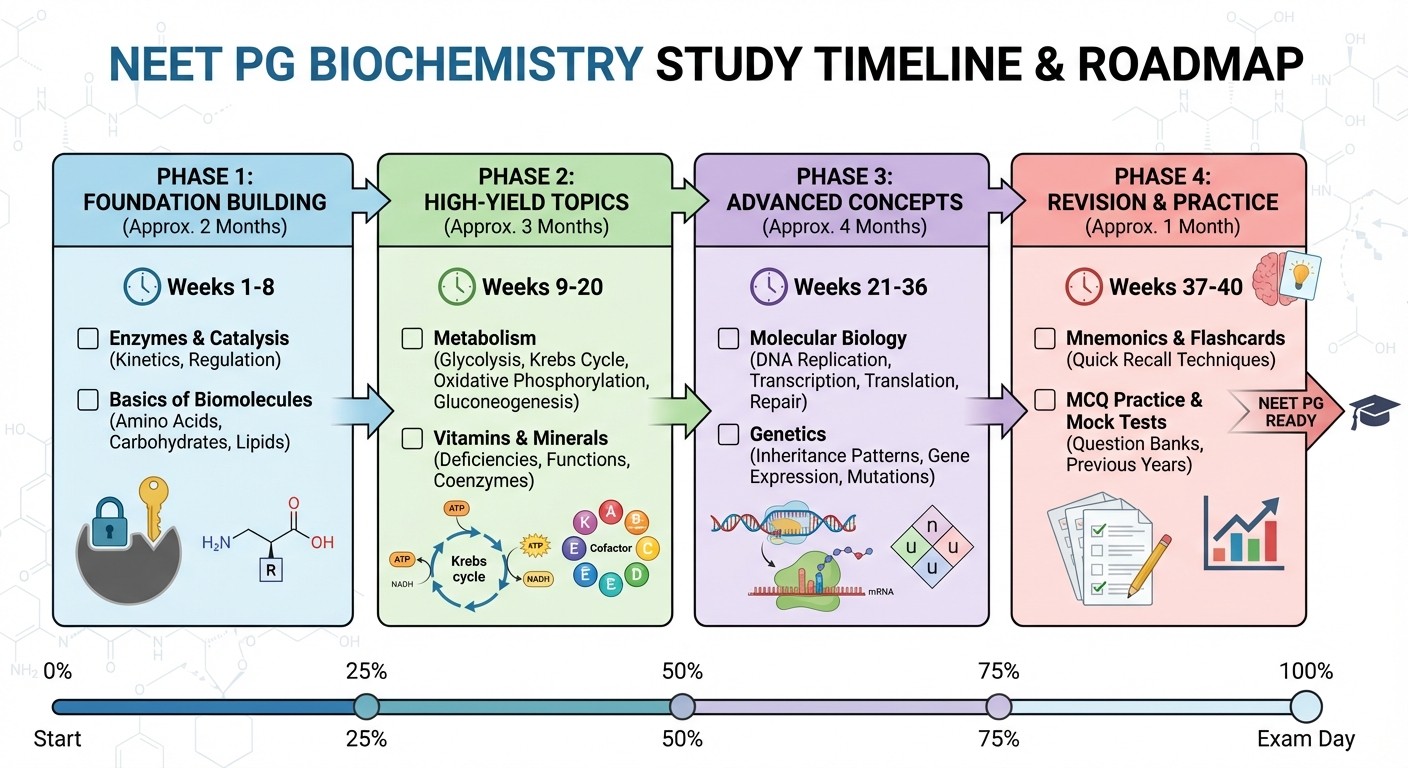
Phase 1: Foundation Building (Weeks 1-4)
Start with Enzyme Fundamentals
Enzymes form the backbone of biochemistry questions. Master these concepts first:
Core Topics to Cover:
Enzyme kinetics (Michaelis-Menten equation)
Types of enzyme inhibition (competitive, non-competitive, uncompetitive)
Enzyme regulation (allosteric, covalent modification)
Clinical enzymes (CPK, LDH, ALT, AST, ALP)
Memory Hook for Enzyme Inhibition: "CoNu UnCo"
Competitive: Km increases, Vmax same
Non-competitive: Vmax decreases, Km same
Uncompetitive: Both Km and Vmax decrease
Competitive: Can be overcome by increasing substrate
Practice Strategy: Start with Oncourse's enzyme lessons to build conceptual clarity, then move to enzyme MCQ practice.
Build Your Vitamin Arsenal
Vitamins account for 15-20% of biochemistry questions. Create a systematic approach:
Fat-Soluble Vitamins (A, D, E, K):
Vitamin A: Night blindness, xerophthalmia
Vitamin D: Calcium metabolism, rickets
Vitamin E: Antioxidant, hemolytic anemia
Vitamin K: Coagulation cascade
Water-Soluble Vitamins (B complex, C):
B1 (Thiamine): Beriberi, Wernicke's encephalopathy
B2 (Riboflavin): Angular cheilitis, glossitis
B3 (Niacin): Pellagra (4 D's: Diarrhea, Dermatitis, Dementia, Death)
B6 (Pyridoxine): Sideroblastic anemia
B12 (Cobalamin): Megaloblastic anemia, subacute combined degeneration
Memory Technique for B Vitamins: "Tender Rats Need Folic Pyridine Cobalamin"
T - Thiamine (B1), R - Riboflavin (B2), N - Niacin (B3), F - Folic acid, P - Pyridoxine (B6), C - Cobalamin (B12)
Strengthen your vitamin knowledge with Oncourse's comprehensive vitamin lessons and practice with vitamin MCQs.
Phase 2: High-Yield Topic Mastery (Weeks 5-8)
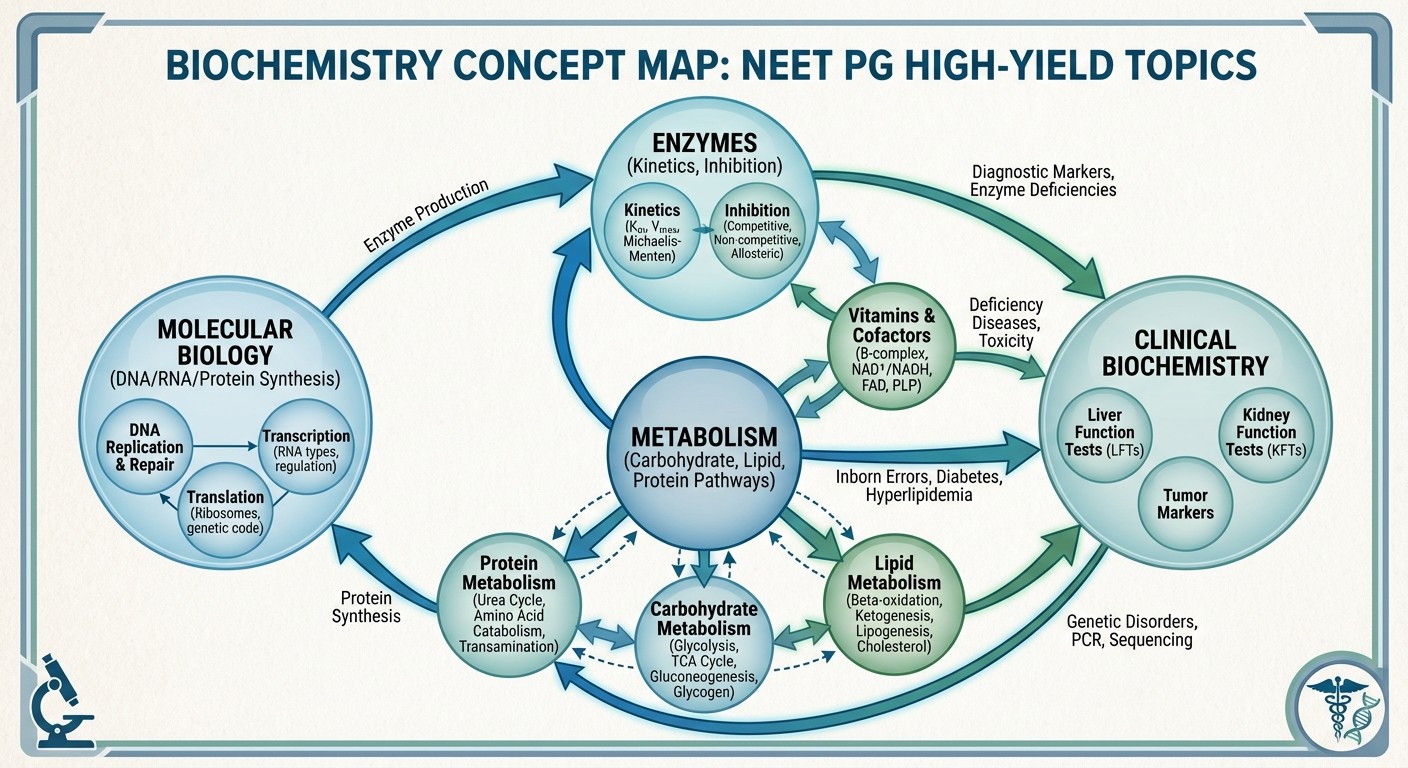
Carbohydrate Metabolism Deep Dive
This is where most students lose marks due to pathway confusion. Focus on these key areas:
Glycolysis:
Key enzymes: Hexokinase, PFK-1, Pyruvate kinase
Regulation points and their significance
ATP yield: 2 net ATP per glucose
Memory Trick for Glycolysis: "Girls Can't Flirt Properly; Boys Don't Generally Ask Pretty Girls"
G - Glucose, C - G6P, F - F6P, P - F1,6BP, B - DHAP, D - 1,3BPG, G - 3PG, A - 2PG, P - PEP, G - Pyruvate
Gluconeogenesis:
Key enzymes: PEPCK, F-1,6-bisphosphatase, G6Pase
Substrates: Alanine, lactate, glycerol
Reciprocal regulation with glycolysis
HMP Pathway:
NADPH production for fatty acid synthesis
G6PD deficiency and hemolytic anemia
Clinical Correlations:
Diabetes mellitus and glucose metabolism
Glycogen storage diseases
Lactose intolerance
Practice metabolic pathway questions using carbohydrate metabolism MCQs to reinforce your understanding.
Lipid Metabolism Essentials
Lipid metabolism questions often involve β-oxidation and fatty acid synthesis:
β-Oxidation:
Location: Mitochondrial matrix
ATP yield: 147 ATP from palmitic acid
Carnitine shuttle mechanism
Fatty Acid Synthesis:
Location: Cytoplasm
Rate-limiting enzyme: Acetyl-CoA carboxylase
Regulation by citrate and palmitoyl-CoA
Cholesterol Metabolism:
HMG-CoA reductase as rate-limiting step
Statin mechanism of action
Familial hypercholesterolemia
Ketogenesis:
During fasting states
Acetoacetate, β-hydroxybutyrate, acetone
Diabetic ketoacidosis
Master these concepts with lipid metabolism lessons and test yourself with targeted practice questions.
Protein and Amino Acid Metabolism
Focus on these high-yield areas:
Amino Acid Catabolism:
Transamination reactions
Urea cycle and its disorders
Phenylketonuria and maple syrup urine disease
Protein Synthesis:
Central dogma: DNA → RNA → Protein
Ribosomal protein synthesis
Post-translational modifications
Hemoglobin and Porphyrin Metabolism:
Heme synthesis pathway
Porphyrias and their clinical features
Hemoglobin variants
Enhance your understanding with amino acid metabolism resources and practice questions.
Phase 3: Molecular Biology and Genetics (Weeks 9-10)
Modern NEET PG increasingly tests molecular biology concepts:
DNA Structure and Function
Key Concepts:
DNA replication (semiconservative)
DNA repair mechanisms (mismatch repair, excision repair)
Telomeres and telomerase
DNA mutations and their types
RNA and Protein Synthesis
Transcription:
RNA polymerase II promoter elements
Transcription factors and enhancers
RNA processing (5' capping, 3' polyadenylation, splicing)
Translation:
Ribosome structure and function
Initiation, elongation, and termination
Protein folding and quality control
Memory Technique for Genetic Code:
Start codon: AUG (Methionine)
Stop codons: UAG (amber), UAA (ochre), UGA (opal)
"You Are Great, You Are Awesome, You Go Away"
Dive deeper into these topics with molecular biology lessons and related practice questions.
Clinical Genetics
High-Yield Topics:
Mendelian inheritance patterns
X-linked disorders (hemophilia, color blindness)
Chromosomal abnormalities (Down syndrome, Klinefelter)
Epigenetic modifications
Phase 4: Clinical Integration and Practice (Weeks 11-12)
Clinical Biochemistry Focus Areas
Liver Function Tests:
ALT, AST patterns in hepatic vs. cardiac injury
Alkaline phosphatase elevation patterns
Bilirubin metabolism and jaundice classification
Kidney Function:
Creatinine vs. urea as markers
GFR calculation
Proteinuria significance
Cardiac Markers:
Troponin I and T
CK-MB kinetics
BNP in heart failure
Diabetes Management:
HbA1c interpretation
Glucose tolerance test
Diabetic ketoacidosis vs. hyperosmolar state
Memory Techniques for Complex Pathways
Krebs Cycle Memory Hook: "Can I Keep Selling Seashells For Money, Officer?"
C - Citrate, I - Isocitrate, K - α-Ketoglutarate, S - Succinyl-CoA, S - Succinate, F - Fumarate, M - Malate, O - Oxaloacetate
Fat-Soluble Vitamin Functions: "All Dogs Eat Kale"
A - All-trans retinal (vision), D - Dogs (calcium absorption), E - Eat (antioxidant), K - Kale (coagulation)
How Oncourse AI Transforms Biochemistry Preparation
Traditional biochemistry preparation involves reading textbooks and solving random MCQs. Oncourse revolutionizes this approach with AI-powered personalized learning:
Smart Question Bank
Oncourse's biochemistry question bank contains over 3,000+ high-yield MCQs with detailed explanations. The AI analyzes your performance patterns and identifies weak areas for targeted practice.
Key Features:
Topic-wise question distribution matching NEET PG pattern
Difficulty progression from basic to advanced
Detailed explanations with memory techniques
Performance analytics to track improvement
Rezzy AI: Your Personal Biochemistry Tutor
Rezzy AI acts as your 24/7 study companion for biochemistry doubts:
Instant Doubt Resolution: Get immediate explanations for complex metabolic pathways
Memory Technique Generation: Rezzy creates custom mnemonics for difficult enzyme sequences
Clinical Correlation: Links biochemistry concepts to real clinical scenarios
Revision Planning: Suggests optimal revision schedules based on your learning pace
Spaced Repetition Flashcards
The biochemistry flashcard system uses scientifically-proven spaced repetition to ensure long-term retention:
Active Recall: Forces you to remember rather than recognize
Adaptive Intervals: Increases review intervals as you master concepts
Visual Memory: Incorporates pathway diagrams and molecular structures
Access these powerful tools through biochemistry flashcards and other specialized modules.
NEET PG Biochemistry MCQ Strategies
Question Pattern Analysis
Most NEET PG biochemistry questions follow these patterns:
1. Direct Factual (30%): "Which enzyme is deficient in galactosemia?"
2. Clinical Application (40%): "A patient with muscle weakness and elevated CPK likely has..."
3. Mechanism-based (20%): "The rate-limiting step of cholesterol synthesis is..."
4. Comparative (10%): "Unlike DNA, RNA contains..."
Time Management Tips
Biochemistry questions should take 45-60 seconds each:
First 15 seconds: Read and understand the question
Next 20 seconds: Apply knowledge and eliminate wrong options
Final 10 seconds: Double-check and mark answer
Common Trap Avoidance
Beware of These Common Mistakes: 1. Pathway Confusion: Don't mix up glycolysis and gluconeogenesis enzymes 2. Vitamin Mix-ups: B12 vs. folate deficiency symptoms 3. Location Errors: Cytoplasm vs. mitochondria for metabolic processes 4. Units Confusion: mg/dL vs. g/dL in clinical values
30-Day Biochemistry Revision Strategy
Week 1-2: Core Concept Review
Day 1-3: Enzymes and kinetics
Day 4-6: Vitamins and coenzymes
Day 7-9: Carbohydrate metabolism
Day 10-12: Lipid metabolism
Day 13-14: Protein metabolism
Week 3: Molecular Biology Intensive
Day 15-17: DNA structure and replication
Day 18-19: RNA and transcription
Day 20-21: Protein synthesis and genetics
Week 4: Clinical Integration
Day 22-24: Clinical biochemistry
Day 25-26: Pathological correlations
Day 27-28: Previous year question practice
Day 29-30: Full-length mock tests
Practice this revision strategy using Oncourse's comprehensive biochemistry lesson library and track your progress with AI-powered analytics.
Common Biochemistry Mistakes to Avoid
Mistake 1: Ignoring Clinical Correlations
Wrong Approach: Memorizing enzymes without understanding their clinical significance Right Approach: Link every enzyme deficiency to its disease manifestation Example: Don't just memorize "G6PD deficiency causes hemolysis." Understand why NADPH depletion makes RBCs vulnerable to oxidative stress.
Mistake 2: Overlooking Regulation
Wrong Approach: Focusing only on pathway steps Right Approach: Emphasize rate-limiting enzymes and their regulation Example: In glycolysis, knowing that PFK-1 is inhibited by ATP and citrate is more important than memorizing all 10 steps.
Mistake 3: Weak Memory Techniques
Wrong Approach: Trying to memorize everything through repetition Right Approach: Use visual mnemonics, acronyms, and story-based memory techniques Example: For amino acid classification, use "FILM GAP TV" for essential amino acids instead of rote memorization.
Mistake 4: Inadequate MCQ Practice
Wrong Approach: Reading theory without sufficient question practice Right Approach: Solve at least 50-100 MCQs per topic with detailed analysis
Use Oncourse's vast MCQ database to avoid this critical mistake.
How Many Months to Prepare Biochemistry for NEET PG?
The ideal timeline depends on your current biochemistry foundation:
For Students with Strong Foundation (Good MBBS marks):
Minimum: 3 months with 2-3 hours daily
Optimal: 4-5 months with 1-2 hours daily
For Students Needing Foundation Building:
Minimum: 4-5 months with 3-4 hours daily
Optimal: 6-8 months with 2-3 hours daily
Timeline Breakdown:
Months 1-2: Foundation topics (enzymes, vitamins, basic metabolism)
Month 3: High-yield pathways (detailed metabolism, molecular biology)
Month 4: Clinical correlations and integration
Final Month: Intensive revision and mock tests
Remember: consistency matters more than intensity. 1 hour daily for 6 months beats 6 hours daily for 1 month.
Is 6 Months Enough for NEET PG Biochemistry?
Absolutely, yes! Six months is more than adequate for biochemistry if you follow a structured approach: Month-wise Plan for 6-Month Preparation: Months 1-2: Build strong foundations
Complete enzyme kinetics and clinical enzymology
Master vitamin functions and deficiency diseases
Understand basic metabolic pathways
Months 3-4: Deep dive into metabolism
Detailed carbohydrate, lipid, and protein metabolism
Molecular biology and genetics concepts
Clinical biochemistry applications
Months 5-6: Integration and practice
Solve previous year questions topic-wise
Take full-length mock tests
Focus on weak areas identified through AI analytics
Success Factors for 6-Month Plan: 1. Daily Consistency: Study biochemistry for at least 90 minutes daily 2. Active Learning: Use spaced repetition and active recall techniques 3. Technology Integration: Leverage AI-powered platforms like Oncourse for personalized learning 4. Regular Assessment: Weekly mock tests to track progress
Advanced Study Techniques for Biochemistry
Visual Learning Strategies
Pathway Mapping: Create visual flowcharts for complex metabolic pathways. Use different colors for different types of reactions (oxidation, reduction, phosphorylation). 3D Molecular Visualization: Use online tools to visualize enzyme structures and understand their mechanism of action. Clinical Photography: Associate biochemical disorders with their clinical photographs for better retention.
Memory Palace Technique
Create mental maps for complex topics:
For Krebs Cycle: Imagine walking through your house, placing each intermediate at different locations. Your kitchen table = citrate, living room sofa = isocitrate, etc. For Amino Acids: Create character stories. "Phil (Phenylalanine) and Ty (Tyrosine) are aromatic friends who love hanging out."
Spaced Repetition Schedule
Follow the proven spaced repetition intervals:
Day 1: Learn new concept
Day 3: First review
Day 7: Second review
Day 21: Third review
Day 60: Final review
Oncourse automates this process with AI-powered flashcards that adjust intervals based on your performance.
Integration with Other Subjects
Biochemistry doesn't exist in isolation. Smart students connect biochemistry with other NEET PG subjects:
Biochemistry + Pathology Connections
Diabetes mellitus: Link glucose metabolism disorders with pancreatic pathology
Atherosclerosis: Connect cholesterol metabolism with vascular pathology
Cancer: Understand metabolic reprogramming in oncology
Biochemistry + Pharmacology Synergy
Enzyme inhibitors: Statins (HMG-CoA reductase), ACE inhibitors, PDE inhibitors
Vitamin supplements: Understand biochemical basis for therapeutic use
Drug metabolism: Cytochrome P450 enzyme systems
Biochemistry + Medicine Integration
Acid-base balance: Henderson-Hasselbalch equation in clinical practice
Liver function: Connect enzyme elevations with clinical presentations
Endocrine disorders: Hormone biochemistry and metabolic consequences
Technology Tools for Biochemistry Mastery
Essential Apps and Resources
Oncourse AI Platform:
Complete biochemistry lesson library
3,000+ practice questions with AI explanations
Personalized study plans based on performance analytics
Spaced repetition flashcard system
Supplementary Tools:
PDB Protein Data Bank: For 3D protein structure visualization
KEGG Pathway Database: Interactive metabolic pathway maps
Anki: For creating custom flashcards with spaced repetition
Creating Your Digital Study Environment
Organization Strategy: 1. Main Platform: Use Oncourse as your primary study platform 2. Note-taking: Digital notes with searchable keywords 3. Progress Tracking: Weekly analytics review on Oncourse dashboard 4. Backup Resources: Bookmark reliable online databases for reference
Mock Test Strategy for Biochemistry
Progressive Difficulty Approach
Week 1-4: Topic-wise mini tests (10-15 questions, 15-20 minutes) Week 5-8: Subject-wise tests (50-60 questions, 60-75 minutes) Week 9-12: Full-length mocks with all subjects (200 questions, 3.5 hours)
Performance Analysis Framework
After each test, analyze:
1. Accuracy Rate: Aim for >85% in biochemistry sections
2. Time per Question: Should average 45-60 seconds for biochemistry
3. Topic-wise Performance: Identify consistently weak areas
4. Mistake Patterns: Classify errors as conceptual, silly, or knowledge gaps
Using AI Analytics for Improvement
Oncourse's AI provides detailed performance insights:
Strength Assessment: Topics where you consistently score >90%
Improvement Areas: Topics requiring additional focus
Learning Curve: Progress tracking over time
Comparison Metrics: Performance relative to other NEET PG aspirants
Final 30 Days: Biochemistry Mastery Plan
Week 1: Comprehensive Review
Days 1-3: Enzyme kinetics and regulation
Days 4-5: Complete vitamin review with mnemonics
Days 6-7: High-yield pathway revision
Week 2: Metabolism Deep Dive
Days 8-10: Carbohydrate metabolism with clinical correlations
Days 11-12: Lipid metabolism and disorders
Days 13-14: Protein metabolism and genetic diseases
Week 3: Molecular Biology and Clinical
Days 15-17: DNA/RNA structure, replication, transcription
Days 18-19: Protein synthesis and regulation
Days 20-21: Clinical biochemistry lab values
Week 4: Practice and Polish
Days 22-25: Previous 5 years' NEET PG biochemistry questions
Days 26-28: Full-length mock tests with biochemistry focus
Days 29-30: Quick revision using flashcards and weak area practice
Your Next Steps: Start Your Biochemistry Transformation
Biochemistry NEET PG preparation isn't about memorizing thousands of facts—it's about building a systematic understanding that connects molecular mechanisms to clinical applications. The students who excel are those who treat biochemistry with the same strategic approach they apply to medicine and surgery.
Here's your immediate action plan:
1. Download Oncourse AI: Start with the free tier to explore biochemistry lessons and questions
2. Complete Initial Assessment: Take a diagnostic test to identify your current level
3. Create Your Study Schedule: Allocate daily time slots for biochemistry preparation
4. Begin with Enzymes: Start your foundation building with enzyme kinetics and clinical enzymology
5. Track Your Progress: Use AI analytics to monitor improvement and adjust your strategy
Remember, biochemistry can be your competitive advantage. While other students struggle with last-minute cramming, you'll confidently tackle those 8-12 biochemistry questions that could determine your NEET PG rank.
The tools, strategies, and resources are all available. The only question is: are you ready to give biochemistry the attention it deserves and transform those "easy marks" into guaranteed scores?
Your NEET PG success story starts with smart preparation choices. Make biochemistry one of them.
Ready to master biochemistry with AI-powered precision? Download the Oncourse app today and join thousands of NEET PG aspirants who've transformed their biochemistry scores. With comprehensive lessons, smart practice questions, and Rezzy AI as your study companion, you'll never feel lost in the world of enzymes, pathways, and molecular mechanisms again.
Start your biochemistry transformation today—your future self will thank you when you're celebrating your NEET PG success!