Back
USMLE Step 1 Exam Preparation: Complete Guide for IMGs (2026)
Complete USMLE Step 1 preparation guide for international medical graduates. 12-16 week study plan, resource selection, and exam strategies specifically designed for IMGs from India, Nigeria, Pakistan, Philippines.
USMLE Step 1 Exam Preparation: Complete Guide for IMGs (2026)
You are probably staring at a mountain of USMLE prep resources right now, wondering how to make sense of it all. Most guides assume you have the structured curriculum and clinical exposure of a US medical student. You dont.
As an IMG from India, Nigeria, Pakistan, Philippines, or elsewhere, you face unique challenges: limited hands-on clinical experience, overwhelming resource choices, and no built-in school structure to guide your timeline. You need a strategy built specifically for your starting point.
This guide comes from what actually worked for thousands of IMGs who passed Step 1 with solid scores. No fluff, no hedging — just the exact roadmap that bridges the gap between your medical school background and what Step 1 demands.
What USMLE Step 1 Actually Tests (And Why Your Starting Point is Different)
Step 1 tests 280 questions over 8 hours, but here is what it really evaluates: your ability to connect basic science concepts to clinical scenarios under time pressure. Each question gives you a clinical vignette and asks you to identify the underlying mechanism, predict outcomes, or choose the best next step.
The problem for IMGs? Most of your medical school training focused on theoretical knowledge and factual recall. Step 1 demands clinical reasoning skills you might not have developed yet.
For example, your biochemistry course probably covered the Krebs cycle in detail. Step 1 will give you a patient with muscle weakness and ask which enzyme deficiency explains their symptoms. You need to connect the biochemical pathway to the clinical presentation instantly.
This gap isnt insurmountable — it just means your prep strategy needs to emphasize clinical integration from day one, not just content review.
The IMG Timeline: 12-16 Weeks That Actually Work
Most IMG success stories follow a similar timeline: 12-16 weeks of focused preparation. Shorter timelines work if you have strong clinical exposure already. Longer timelines often lead to burnout and diminishing returns.
Here is the proven breakdown:
Weeks 1-4: Foundation Building
Complete First Aid cover-to-cover once
Start UWorld in tutor mode (40 questions/day)
Begin spaced repetition with high-yield topics
Establish your weak areas early
Weeks 5-10: Deep Integration
Second pass through First Aid with question correlation
Increase UWorld to 60-80 questions/day
Add subject-specific resources for weak areas
Take first practice exam (NBME or UWorld)
Weeks 11-14: Pattern Recognition
Third targeted pass through weak topics only
Complete UWorld second pass in timed mode
Take practice exams every 3-4 days
Fine-tune test-taking strategies
Weeks 15-16: Final Sprint
Review missed questions only
Maintain question-solving rhythm
Light review of high-yield facts
Mental preparation and rest
This timeline assumes full-time study (8-10 hours/day). If you are working part-time, extend each phase proportionally but dont exceed 20 weeks total.
Resource Selection: What to Use and What to Skip
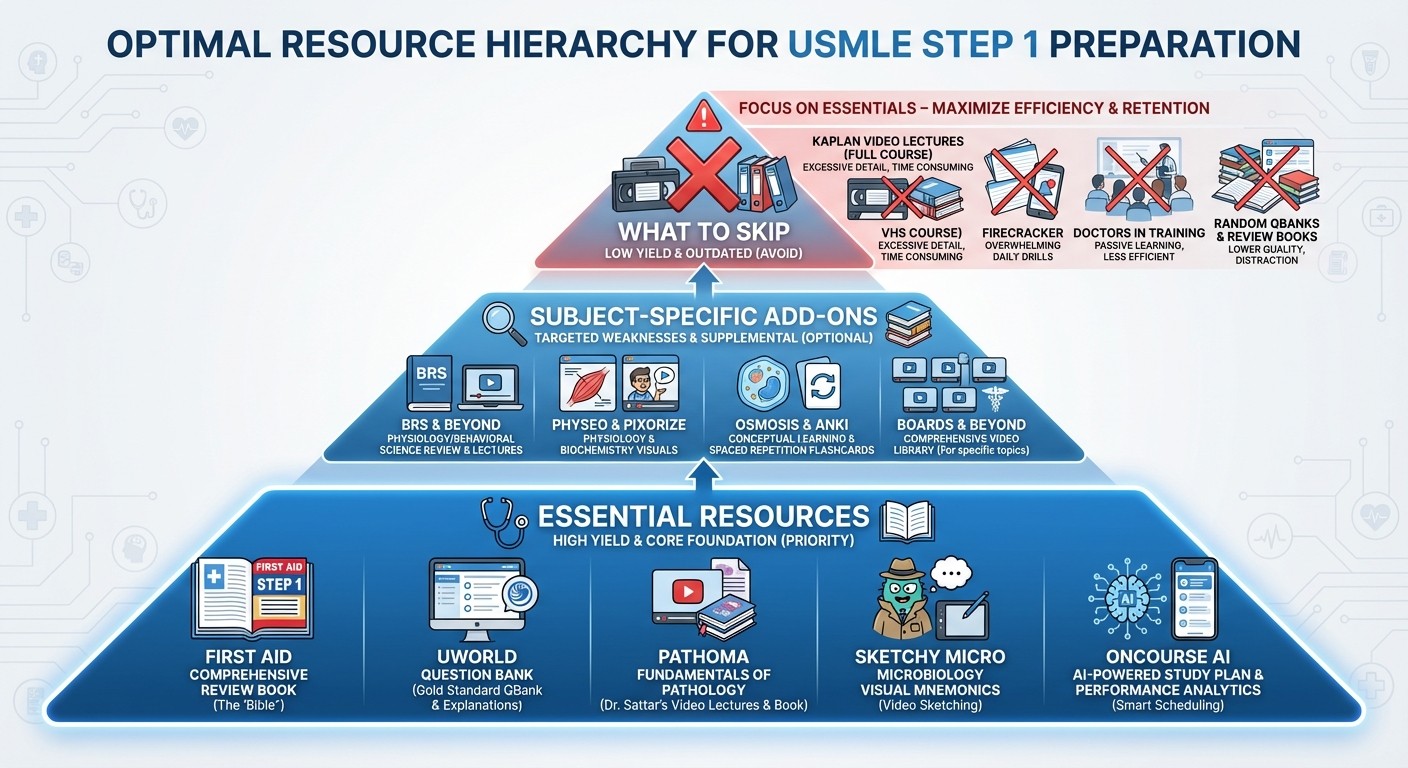
The biggest mistake IMGs make? Using too many resources. You need depth, not breadth. Here is the core stack that works:
Essential Resources (Must-Have)
First Aid for the USMLE Step 1: Your primary textbook
UWorld Question Bank: The gold standard for practice questions
Pathoma: For pathology concepts and clinical correlation
Sketchy Micro: For microbiology memorization
Oncourse AI: For adaptive MCQs with AI explanations that identify gaps fast
Subject-Specific Add-Ons (Use Selectively)
Physiology: Costanzo or BRS Physiology
Pharmacology: Sketchy Pharm or Katzung
Anatomy: High-yield only through UWorld explanations
Biochemistry: First Aid + UWorld is sufficient
What to Skip Entirely
Multiple question banks beyond UWorld
Video courses longer than 20 hours per subject
Any resource that takes more than 2 weeks to complete
"Comprehensive" textbooks (Harrison's, Robbins full editions)
The key insight: Oncourse AI works perfectly as your adaptive layer. While UWorld gives you the standard question practice, Oncourse identifies your specific weak areas and generates personalized daily plans that adjust based on your performance. Think of it as the smart overlay that makes your other resources more efficient.
Subject Priority Order: Where to Focus Your Energy
Not all Step 1 subjects carry equal weight. Here is the high-yield priority order based on actual exam patterns:
Tier 1 (35-40% of exam): Master These First
1. Pathology: Highest yield subject. Every system pathology appears heavily 2. Pharmacology: Mechanism of action + side effects for major drug classes 3. Physiology: Cardiovascular, respiratory, and renal pathophysiology 4. Microbiology: Infectious disease mechanisms and antimicrobial therapy
Tier 2 (25-30% of exam): Solid Understanding Needed
5. Biochemistry: Metabolic pathways + genetic disorders 6. Immunology: Autoimmune conditions + immunodeficiencies 7. Embryology: Congenital anomalies + development
Tier 3 (15-20% of exam): Know the High-Yield Facts
8. Anatomy: Clinical correlations only (skip pure anatomy) 9. Histology: Pathologic changes, not normal histology 10. Behavioral Science: Ethics + statistics basics
This doesnt mean you skip Tier 3 subjects — it means you allocate time proportionally. Spend 2-3 weeks mastering pathology before moving to anatomy review.
For targeted practice, check out our pathology MCQs and physiology flashcards to reinforce these high-yield topics through active recall.
The Right Study Method: Active Recall + Spaced Repetition
Reading and re-reading doesnt work for Step 1. You need active retrieval practice from day one. Here is the method that consistently produces 240+ scores:
Daily Study Structure (8-10 hours)
Morning (3-4 hours): Question Practice
40-80 UWorld questions in timed mode
Review every explanation thoroughly
Note weak areas for targeted review
Use Oncourse AI to practice similar question types
Afternoon (2-3 hours): Targeted Content Review
Review only the topics you missed in questions
Use First Aid + subject-specific resources
Create active recall notes (not passive highlights)
Focus on understanding mechanisms, not memorizing facts
Evening (2-3 hours): Spaced Repetition
Review previously learned material using flashcards
Oncourse AI automatically schedules your review sessions
Focus on connecting concepts across subjects
Light practice questions to maintain rhythm
The key insight from cognitive science research shows that testing yourself (retrieval practice) produces better long-term retention than any other study method.
How Oncourse AI Accelerates This Process
Traditional study plans follow fixed schedules that dont adapt to your performance. Oncourse AI monitors your question accuracy and automatically adjusts your daily plan. Weak in cardiology pathophysiology? It increases cardiac questions and adds targeted lessons. Strong in microbiology? It reduces micro practice and allocates time to your gaps.
The AI explanations turn every wrong answer into a learning moment. Instead of just reading "incorrect," you get a personalized explanation that connects the concept to related topics you have studied. This builds the clinical reasoning patterns Step 1 demands.
Learn more about implementing spaced repetition for medical subjects in your study routine.
Practice Test Strategy: How to Interpret Your Scores
Practice tests predict your readiness, but only if you use them correctly. Most IMGs take too many practice tests or misinterpret their scores.
Practice Test Timeline
Week 6: First NBME (baseline assessment) Week 9: UWorld Assessment 1 Week 12: NBME + UWorld Assessment 2 Week 14: Final practice test Week 15: Light practice only
Score Interpretation for IMGs
First practice test: Expect 180-200 if you have decent foundation
Target progression: +15-20 points every 3 weeks
Ready to test: Consistently scoring 220+ on last 2 practice tests
Dont test if: Scoring below 200 on recent practice tests
Your practice test scores will likely start lower than US students because you are building clinical reasoning skills from scratch. Focus on the trend, not the absolute number.
What Practice Tests Actually Measure
Practice tests dont just predict your score — they reveal your test-taking patterns. Track these metrics:
Questions missed due to knowledge gaps vs careless errors
Time management (finishing with 10-15 minutes remaining)
Subject-wise performance trends
Question types that consistently trip you up
Use this data to adjust your final weeks of preparation.
Common IMG Mistakes and How to Avoid Them
After working with thousands of IMGs, these patterns emerge consistently:
Mistake 1: Resource Overload
What IMGs do: Buy 10 different question banks and try to complete them all What works: Master UWorld completely + use Oncourse AI for targeted weak area practice Fix: Stick to the core resource stack and go deep, not wide
Mistake 2: Passive Content Review
What IMGs do: Read First Aid 5 times without testing recall What works: Question-driven study where you review content only after missing questions Fix: Spend 70% of study time on questions, 30% on content review
Mistake 3: Ignoring Clinical Correlation
What IMGs do: Focus on memorizing isolated facts What works: Always connect basic science to clinical scenarios Fix: For every concept, ask "How would this present in a patient?"
Mistake 4: Poor Time Management
What IMGs do: Spend months in preparation without a clear timeline What works: Set a test date early and work backward Fix: Book your exam date before you feel "ready"
Mistake 5: Underestimating Weak Areas
What IMGs do: Avoid subjects they struggle with What works: Spend disproportionate time on weakest subjects Fix: Use Oncourse AI analytics to quantify your weak areas objectively
The common thread? Most mistakes come from avoiding discomfort. The subjects you hate studying are probably your biggest opportunities for score improvement.
Final 2-Week Sprint: What Actually Matters
Your final two weeks determine whether months of preparation translate into exam success. Here is what works:
Week 15: Pattern Recognition
Review only missed questions from UWorld second pass
Take one practice test to maintain timing
Focus on frequently missed question types
Week 16: Mental Preparation
Light review of high-yield facts only
Maintain question-solving rhythm (20-30 questions/day)
Focus on sleep schedule and stress management
Avoid learning new concepts entirely
The Night Before
Review high-yield facts for 1-2 hours maximum
Get 7-8 hours of sleep (non-negotiable)
Prepare exam day logistics (ID, confirmation, directions)
Trust your preparation — cramming helps nobody
Exam Day Strategy
Arrive 30 minutes early to settle in
Use breaks strategically (5 minutes every 2 blocks)
If you dont know an answer in 90 seconds, make your best guess and move on
Finish each block with 5-10 minutes remaining to review marked questions
Remember: Step 1 is a marathon, not a sprint. Pacing yourself through all 280 questions matters more than perfectionism on individual questions.
Advanced Study Techniques for IMGs
Integration Across Systems
Instead of studying subjects in isolation, connect them. When you learn about heart failure in cardiology, review:
Pathophysiology (decreased cardiac output)
Pharmacology (ACE inhibitors, diuretics)
Clinical presentation (dyspnea, edema)
Diagnostic tests (echocardiogram, BNP)
This approach mirrors how Step 1 questions are written — they rarely test pure knowledge from one subject.
Using Clinical Vignettes Effectively
Every UWorld question teaches you a clinical pattern. When you see "65-year-old man with chest pain and ST elevations," you should immediately think:
STEMI (pathology)
Coronary anatomy (which vessel affects which wall)
Treatment timeline (door-to-balloon time)
Complications (cardiogenic shock, arrhythmias)
Train this pattern recognition systematically. Oncourse AI helps by showing you similar clinical scenarios when you miss questions, building these mental frameworks faster.
Memory Techniques for High-Yield Facts
Some information requires pure memorization. Use these proven techniques:
Mnemonics: Create memorable phrases for drug side effects, enzyme deficiencies
Visual associations: Use Sketchy Micro/Pharm visual stories
Spaced repetition: Let algorithms schedule your review sessions
Active construction: Build your own mnemonics rather than memorizing others
For systematic memory techniques, explore how Oncourse AI creates personalized mnemonics based on your learning patterns.
Building Clinical Reasoning Skills
The biggest advantage US medical students have? Clinical exposure that teaches them to think like doctors. You can build these skills through deliberate practice:
Question Analysis Framework
For every UWorld question, ask:
1. What is the key clinical finding? (fever, chest pain, lab values) 2. What systems are involved? (cardiac, pulmonary, renal) 3. What is the underlying mechanism? (ischemia, infection, autoimmune) 4. How do I rule out alternatives? (differential diagnosis thinking) 5. What would I expect to see next? (disease progression, treatment response)
This framework transforms passive question-solving into active clinical reasoning practice.
Cross-Reference Learning
When you learn about myocardial infarction, simultaneously review:
Related conditions: unstable angina, heart failure, arrhythmias
Connected concepts: atherosclerosis, lipid metabolism, anticoagulation
Similar presentations: pulmonary embolism, aortic dissection, anxiety
This builds the comprehensive understanding Step 1 demands.
For structured approaches to clinical subjects, check out our guide on studying physiology for Step 1.
Technology and Study Tools
Effective Use of Oncourse AI
Oncourse AI works best when integrated into your daily routine:
Morning diagnostic: Take the daily adaptive quiz to identify focus areas
Targeted practice: Use AI-generated question sets for your weak topics
Review sessions: Let spaced repetition algorithms schedule your flashcard reviews
Progress tracking: Monitor your improvement across subjects objectively
The key is consistent daily use, not sporadic intensive sessions.
Digital vs Analog Study Methods
Use digital tools for:
Question banks and practice tests
Spaced repetition flashcards
Progress tracking and analytics
Video lectures and visual content
Use analog methods for:
Active note-taking during content review
Drawing pathways and mechanisms
Creating concept maps
Quick calculations and scratch work
The most successful IMGs combine both approaches strategically.
Frequently Asked Questions
How long should IMGs study for USMLE Step 1?
12-16 weeks of full-time preparation works for most IMGs. Extend to 20 weeks maximum if working part-time. Shorter preparation rarely allows enough time to build clinical reasoning skills from a primarily theoretical background.
Can IMGs pass Step 1 without clinical experience?
Yes, but you need to compensate through question-based learning. Focus heavily on clinical vignette questions and always connect basic science concepts to patient presentations. Use resources like UWorld and Oncourse AI that emphasize clinical correlation.
What score should IMGs target for Step 1?
Target 220+ for most competitive specialties, 240+ for highly competitive ones like dermatology or orthopedic surgery. Remember that Step 1 is now pass/fail, but many programs still use practice test scores for early screening.
Is 6 months too long to prepare for Step 1?
Yes, for most IMGs. Preparation longer than 4-5 months often leads to burnout and diminishing returns. You forget early material while learning new concepts. Stick to focused 3-4 month timelines.
Should IMGs take Step 1 before or after clinical experience?
Take Step 1 before extensive clinical rotations if possible. Clinical experience helps more with Step 2 CK and Step 3. Step 1 focuses on basic science knowledge that may fade during clinical years.
What if I fail Step 1 on my first attempt?
Analyze your weak areas systematically using practice test breakdowns. Typically, failed attempts result from inadequate clinical correlation, not knowledge gaps. Focus your retake preparation on question-based learning and pattern recognition rather than content review.
---
Prepare smarter with Oncourse AI — adaptive MCQs, spaced repetition, and AI explanations built for USMLE Step 1. Download free on Android and iOS.