The Science of Retrieval Practice: Why Testing Yourself is the Most Powerful Study Technique for Medical Students in 2026
Discover why retrieval practice beats passive reading by 2-3x for medical students. Learn the testing effect, forgetting curve, and how to implement active recall for NEET PG, USMLE, and INICET success.
The Science of Retrieval Practice: Why Testing Yourself is the Most Powerful Study Technique for Medical Students in 2026
Picture this: Two medical students preparing for NEET PG spend equal time studying cardiology. Student A re-reads their notes three times, highlighting key points in multiple colors. Student B reads once, then tests themselves repeatedly with MCQs and flashcards. Three weeks later, Student B scores 65% higher on a cardiology exam. This isn't luck—it's the power of retrieval practice medical students can leverage to transform their preparation.
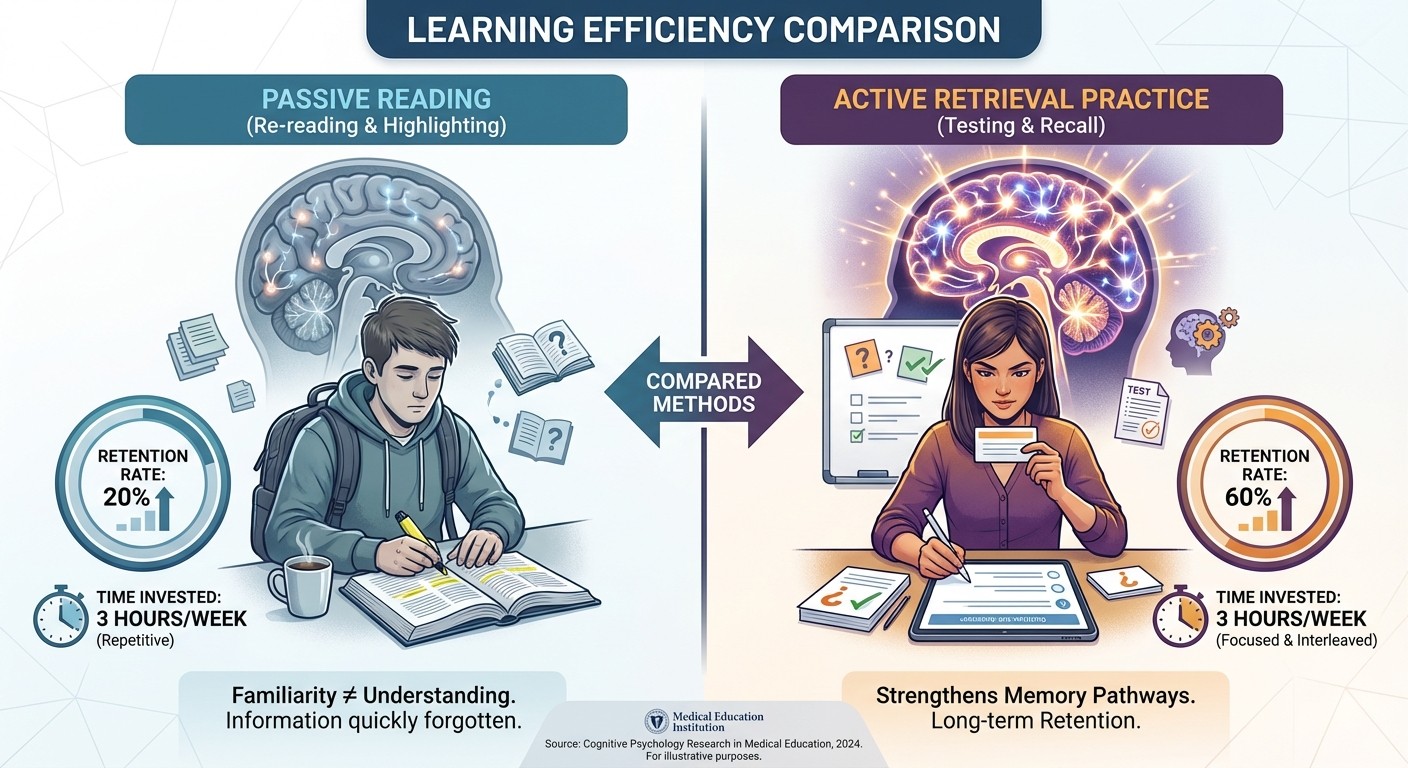
If you're like most medical students, you probably spend hours re-reading notes, watching lectures repeatedly, or creating elaborate mind maps. While these techniques feel productive, cognitive science reveals a shocking truth: passive review methods lead to only 20% retention after one week, while retrieval practice achieves 60-80% retention over the same period.
In this comprehensive guide, we'll explore why testing yourself isn't just helpful—it's the most scientifically proven study technique for medical education success. From the groundbreaking research on the testing effect to practical implementation strategies for NEET PG, USMLE, and INICET preparation, you'll discover how to study effectively using retrieval practice.
What is Retrieval Practice and Why Does it Work?
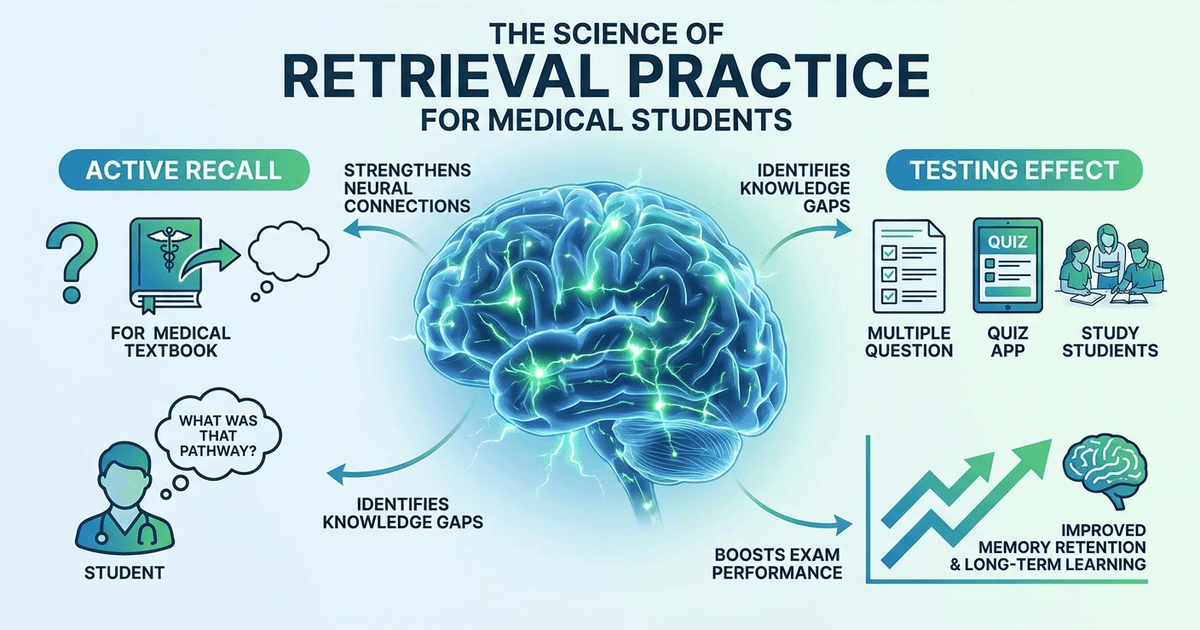
Retrieval practice, also known as active recall, is the process of actively bringing information from memory without looking at study materials. Instead of passively re-reading your pharmacology notes, you'd close the book and try to recall drug mechanisms, side effects, and contraindications from memory.
The mechanism behind retrieval practice's effectiveness lies in how our brains encode and strengthen memories. When you actively retrieve information, you:
1. Strengthen neural pathways: Each successful retrieval strengthens the synaptic connections associated with that memory
2. Identify knowledge gaps: Failed retrieval attempts highlight what you don't know, directing future study efforts
3. Create retrieval cues: The act of searching memory creates multiple pathways to access information during exams
4. Build metacognitive awareness: You develop better judgment about what you actually know vs. what feels familiar
The Testing Effect: Landmark Research
The testing effect was first rigorously studied by Hermann Ebbinghaus in the 1880s, but modern research by Henry Roediger and Jeffrey Karpicke has revolutionized our understanding. Their 2006 study published in Psychological Science compared students who either:
Re-studied material multiple times
Studied once then took repeated tests
The results were stunning: students who took tests without feedback scored 50% higher on final exams administered one week later. Even more remarkably, the testing group outperformed the re-study group even when the re-study group spent twice as much time with the material.
Active Recall vs Passive Reading: The Medical Student's Dilemma
Medical education presents unique challenges that make retrieval practice even more critical. Unlike other disciplines, medicine requires:
Massive factual knowledge: Drug dosages, anatomy, pathophysiology
Pattern recognition: Diagnosis based on symptom clusters
Application under pressure: Real-time clinical decision-making
Long-term retention: Information must remain accessible throughout your career
Why Passive Reading Fails Medical Students
Traditional study methods feel productive but create dangerous illusions of knowledge:
Highlighting and Re-reading: Creates familiarity, not understanding. You recognize information when you see it but can't retrieve it when needed. Passive Video Watching: Provides the illusion of learning without engaging memory retrieval mechanisms. Summarizing: Helps organize information but doesn't test your ability to recall it independently.
Research by cognitive scientist Jeffrey Karpicke shows that students consistently overestimate their learning when using passive methods. They feel confident because information seems familiar, but this fluency doesn't translate to exam performance.
The Power of Active Recall for Medical Concepts
Consider learning the management of diabetic ketoacidosis (DKA). A passive approach might involve reading guidelines multiple times. An active approach would involve:
1. Free recall: Write everything you remember about DKA management without references
2. MCQ practice: Test yourself on diagnostic criteria, treatment protocols, and complications
3. Case application: Work through patient scenarios requiring DKA diagnosis and management
4. Flashcard drilling: Use spaced repetition to cement key facts like insulin protocols
This active approach forces you to reconstruct knowledge from memory, exactly what you'll need during exams and clinical practice.
The Forgetting Curve: Why Timing Matters in Retrieval Practice
Hermann Ebbinghaus discovered that we forget information exponentially without reinforcement. His famous forgetting curve shows that we lose 50% of new information within one hour and 70% within 24 hours.
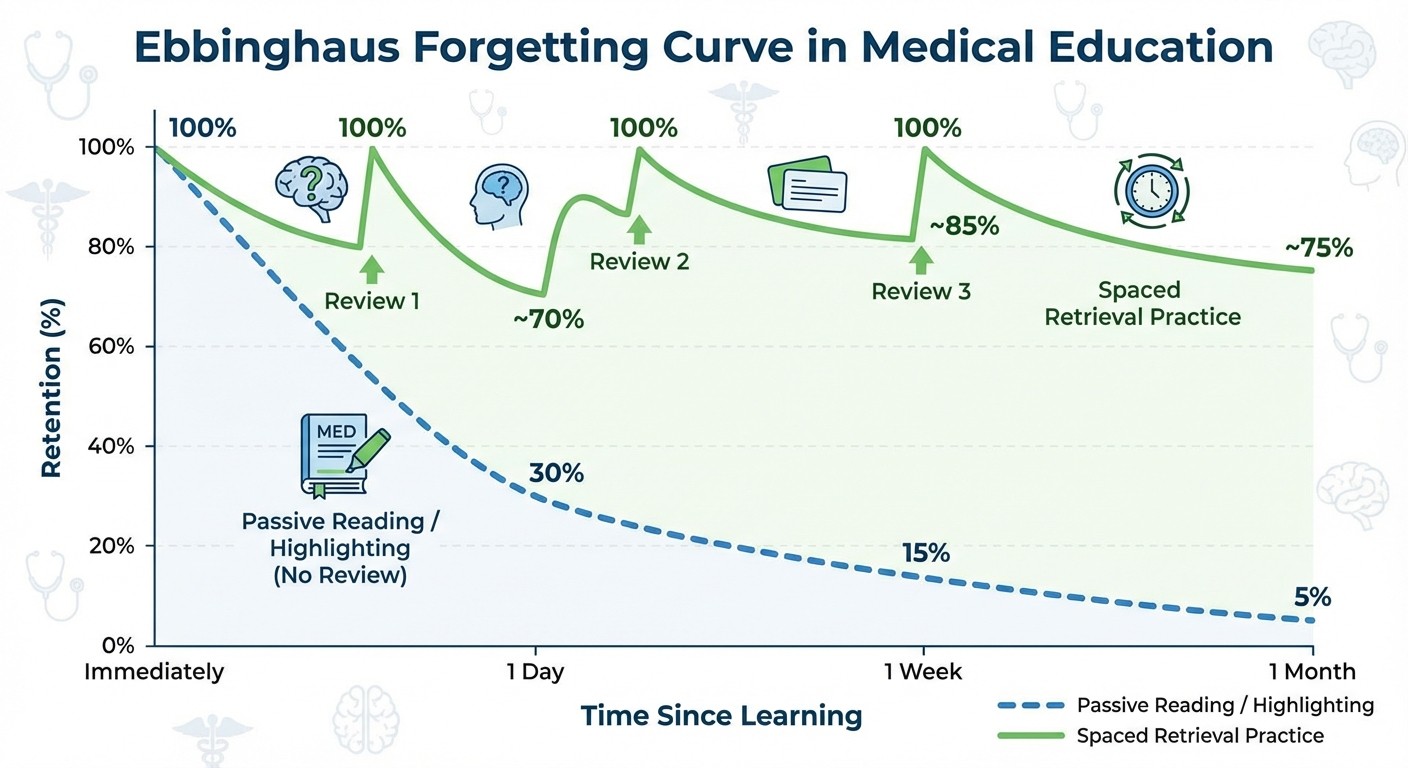
However, each time you successfully retrieve information, you slow this forgetting process. The key insight for medical students: when you retrieve information matters as much as how you retrieve it.
Optimal Spacing for Medical Content
Research suggests these intervals for maximum retention:
First retrieval: 1-2 days after initial learning
Second retrieval: 5-7 days later
Third retrieval: 2-3 weeks later
Fourth retrieval: 1-2 months later
For high-yield NEET PG topics like cardiology or pharmacology, this spacing ensures information moves from short-term to long-term memory, then becomes readily accessible for exam day.
Why MCQ Practice Beats Reading for Medical Exams
Multiple-choice questions aren't just assessment tools—they're the most effective retrieval practice method for medical students. Here's why MCQ practice outperforms passive reading:
1. Mimics Exam Conditions
NEET PG, USMLE, and INICET are all MCQ-based exams. Practicing retrieval in the same format you'll be tested creates what psychologists call "transfer appropriate processing." Your brain learns to retrieve information in the specific way required for exam success.
2. Provides Immediate Feedback
Quality MCQ practice includes detailed explanations that teach you not just the correct answer, but why wrong answers are incorrect. This immediate feedback strengthens correct associations while weakening incorrect ones.
3. Builds Pattern Recognition
Medical diagnosis relies heavily on pattern recognition. MCQ practice exposes you to thousands of clinical presentations, helping you recognize patterns that indicate specific conditions.
4. Identifies Knowledge Gaps
Unlike passive reading, where you can fool yourself into thinking you know material, MCQ practice ruthlessly exposes what you don't understand. This metacognitive feedback is crucial for directing study efforts.
How to Implement Retrieval Practice in Your Daily Medical Study Routine
Successfully implementing retrieval practice requires systematic changes to your study habits. Here's a practical framework:
Phase 1: Initial Learning (20% of study time)
Start with minimal passive review to establish basic familiarity:
Read once through new material
Watch key video lectures
Review essential diagrams and charts
Phase 2: Active Retrieval (60% of study time)
This is where the real learning happens:
Free Recall Sessions: Set a timer for 10-15 minutes and write everything you remember about a topic without references. For example, after studying myocardial infarction, write all the diagnostic criteria, management steps, and complications from memory. MCQ Practice: Use high-quality question banks that match your exam format. Aim for 50-100 questions daily, focusing on immediate review of explanations. Don't just check if you got it right—understand why each option is correct or incorrect. Flashcard Drills: Create active flashcards that require thinking, not just memorization. Instead of "What is the normal heart rate?" use "A 65-year-old patient presents with chest pain and this ECG. What is your immediate management?" Teaching Out Loud: Explain concepts aloud as if teaching a junior student. This forces you to organize information logically and identify gaps in understanding.
Phase 3: Spaced Review (20% of study time)
Use spaced repetition to maintain long-term retention:
Review previously tested topics at increasing intervals
Focus extra attention on questions you got wrong
Maintain a cumulative review schedule for high-yield topics
Desirable Difficulty: Why Harder Retrieval Makes You Stronger
Cognitive scientist Robert Bjork introduced the concept of "desirable difficulty"—the idea that learning should feel challenging to be effective. When retrieval feels easy, you're not creating strong memories.
For medical students, this means:
Embrace Struggle During Practice
If you can easily recall information, you're not learning optimally. Instead:
Wait longer between study sessions and retrieval attempts
Test yourself on more challenging applications
Practice retrieving information in different contexts
Use Interleaving
Instead of studying one topic extensively before moving to the next, interleave different subjects. Practice cardiology MCQs, then pharmacology, then pathology. This forces your brain to actively distinguish between different types of problems.
Vary Question Types
Practice with different question formats:
Direct recall questions
Application-based scenarios
Comparison questions
Integrated multi-system cases
Retrieval Practice and Spaced Repetition: The Perfect Combination
While retrieval practice determines how you study, spaced repetition optimizes when you study. The combination creates the most powerful learning system available to medical students.
The Spacing Effect in Medical Education
Research consistently shows that information reviewed at spaced intervals is retained far longer than information crammed in a single session. For medical students juggling thousands of facts, this isn't just helpful—it's essential.
A typical medical school curriculum covers roughly 10,000 discrete facts. Using cramming, you might retain 30% for exams. Using spaced retrieval practice, you can retain 70-80% long-term.
Implementing Spaced Retrieval
Create a system that automatically schedules retrieval practice:
1. Daily practice: 50-100 new questions plus review of previously missed questions
2. Weekly review: Comprehensive practice tests on topics studied 1-2 weeks ago
3. Monthly assessment: Full-length mock exams covering all previously studied material
4. Continuous refinement: Increase frequency for weak areas, decrease for mastered topics
Learn more about optimizing your spacing intervals in our comprehensive guide to spaced repetition for medical subjects.
Common Mistakes Medical Students Make with Retrieval Practice
Even students who understand retrieval practice often implement it incorrectly. Avoid these common pitfalls:
1. Looking at Answers Too Quickly
The moment you look at an answer or hint, you've converted active recall into passive recognition. Force yourself to really struggle with retrieval before checking answers.
2. Practicing Only Easy Material
It feels good to answer questions you know, but this creates false confidence. Spend more time on challenging topics and questions you've missed before.
3. Focusing Only on Correctness
Getting the right answer isn't the only goal. Understanding why wrong answers are incorrect often provides more learning value than simply knowing the right answer.
4. Inconsistent Practice
Sporadic retrieval practice is much less effective than consistent daily practice. Better to do 30 minutes daily than 3.5 hours weekly.
5. Ignoring Metacognition
Pay attention to your confidence before answering questions. Students who are miscalibrated—overconfident when wrong and underconfident when right—need to adjust their study strategies.
How Oncourse AI Harnesses Retrieval Practice for Medical Student Success
Understanding the science of retrieval practice is one thing—implementing it consistently is another. This is where Oncourse AI becomes invaluable for medical students preparing for NEET PG, USMLE, and INICET.
Adaptive Question Banks Built on Retrieval Science
Oncourse's 40,000+ high-yield questions aren't just randomly assembled—they're systematically designed to optimize retrieval practice:
Spaced Repetition Algorithm: Our AI automatically schedules question review based on your performance and the forgetting curve, ensuring optimal spacing for long-term retention. Difficulty Calibration: Questions adapt to your knowledge level, maintaining desirable difficulty without becoming overwhelming. Comprehensive Explanations: Each question includes detailed explanations that teach concepts, not just correct answers.
Personalized Learning Through Retrieval Analytics
Oncourse tracks your retrieval performance to optimize your learning:
Knowledge Gap Analysis: Identify exactly which topics need more retrieval practice
Confidence Calibration: Learn to accurately judge what you know vs. what feels familiar
Performance Prediction: Get data-driven insights into your exam readiness
Practice with our extensive question banks for NEET PG internal medicine or challenge yourself with USMLE behavioral science questions to experience retrieval practice in action.
Rezzy AI: Your Retrieval Practice Coach
Our AI tutor Rezzy doesn't just answer questions—it guides optimal retrieval practice:
Question Generation: Create custom MCQs for any topic to test your recall
Study Schedule Optimization: Get personalized recommendations for when and what to review
Learning Strategy Coaching: Receive evidence-based advice on improving your retrieval practice
Discover how to maximize your study efficiency with Rezzy AI for NEET PG and USMLE preparation.
Flashcards That Actually Work
Our medical flashcard system goes beyond simple question-answer pairs:
Active Recall Design: Cards require thinking and application, not just memorization
Spaced Repetition: Automatic scheduling based on your retrieval performance
Contextual Learning: Cards connect isolated facts to clinical applications
Measuring Your Retrieval Practice Success
How do you know if your retrieval practice is working? Track these key metrics:
Learning Efficiency Indicators
Question Accuracy Over Time: Your percentage correct should steadily increase, even as question difficulty adapts upward. Speed of Retrieval: You should answer familiar questions faster while maintaining accuracy. Transfer Performance: Success on new, unseen questions indicates genuine understanding rather than rote memorization.
Long-term Retention Markers
Mock Exam Performance: Regular full-length practice tests show whether knowledge sticks long-term. Cross-topic Integration: Ability to answer questions requiring knowledge from multiple subjects. Confidence Calibration: Your confidence in answers should correlate with actual correctness.
The Future of Medical Education: Beyond Individual Retrieval Practice
As medical knowledge expands exponentially, the principles of retrieval practice become even more critical. The future medical student won't just memorize facts—they'll master the skill of efficient knowledge retrieval and application.
Integration with Clinical Practice
The same retrieval principles that help you pass exams will make you a better clinician:
Diagnostic Reasoning: Quick recall of differential diagnoses
Treatment Protocols: Immediate access to management guidelines
Drug Information: Rapid retrieval of pharmacological facts during patient care
Lifelong Learning Skills
Medicine requires continuous learning throughout your career. Students who master retrieval practice in medical school develop skills that serve them throughout residency and beyond.
Evidence-Based Study Success: Your Next Steps
The science is clear: retrieval practice produces 2-3x better learning outcomes than passive reading for medical students. But knowledge without action remains powerless.
Immediate Implementation Strategy
Week 1: Replace 50% of your passive reading with active recall sessions. Use free recall and basic MCQ practice. Week 2: Introduce spaced repetition. Begin reviewing previously studied topics at optimal intervals. Week 3: Add interleaving. Mix different subjects within study sessions rather than studying one topic extensively. Week 4: Optimize difficulty. Ensure your practice feels appropriately challenging without being overwhelming.
Long-term Excellence Plan
Daily Practice: Maintain consistent retrieval practice for 60-90 minutes daily
Weekly Assessment: Take comprehensive practice tests to measure progress
Monthly Calibration: Adjust your study plan based on performance data
Continuous Improvement: Stay updated on learning science research and optimize your methods
Transform Your Medical Education with Science-Based Learning
Every day you spend with passive reading instead of retrieval practice is a day of suboptimal learning. Medical school is too demanding and competitive to use inefficient study methods.
The students who excel in NEET PG, USMLE, and INICET aren't necessarily the most naturally intelligent—they're the ones who study most effectively. They've embraced the science of learning and made retrieval practice the foundation of their preparation.
Start Your Retrieval Practice Journey Today
Ready to experience the power of scientifically-optimized medical education? Download Oncourse and access:
40,000+ high-yield MCQs designed for optimal retrieval practice
AI-powered spaced repetition that adapts to your learning
Comprehensive flashcard systems for all major medical subjects
Rezzy AI coaching to optimize your study strategies
Performance analytics to track your learning efficiency
Join over 10,000 medical students who've already transformed their preparation with evidence-based learning methods. Your future self—whether taking NEET PG next month or treating patients in five years—will thank you for making this choice today.
The science of retrieval practice isn't just about passing exams. It's about building the learning skills that will make you an exceptional doctor. Start implementing these techniques today, and experience firsthand why testing yourself is the most powerful study technique for medical students in 2026.