Back
How Oncourse AI's Mnemonic Engine Helps Medical Students Remember Complex Concepts in 2026
Discover how Oncourse AI's revolutionary mnemonic engine transforms medical exam preparation with personalized, AI-generated memory techniques for NEET-PG, USMLE, and INI-CET success.
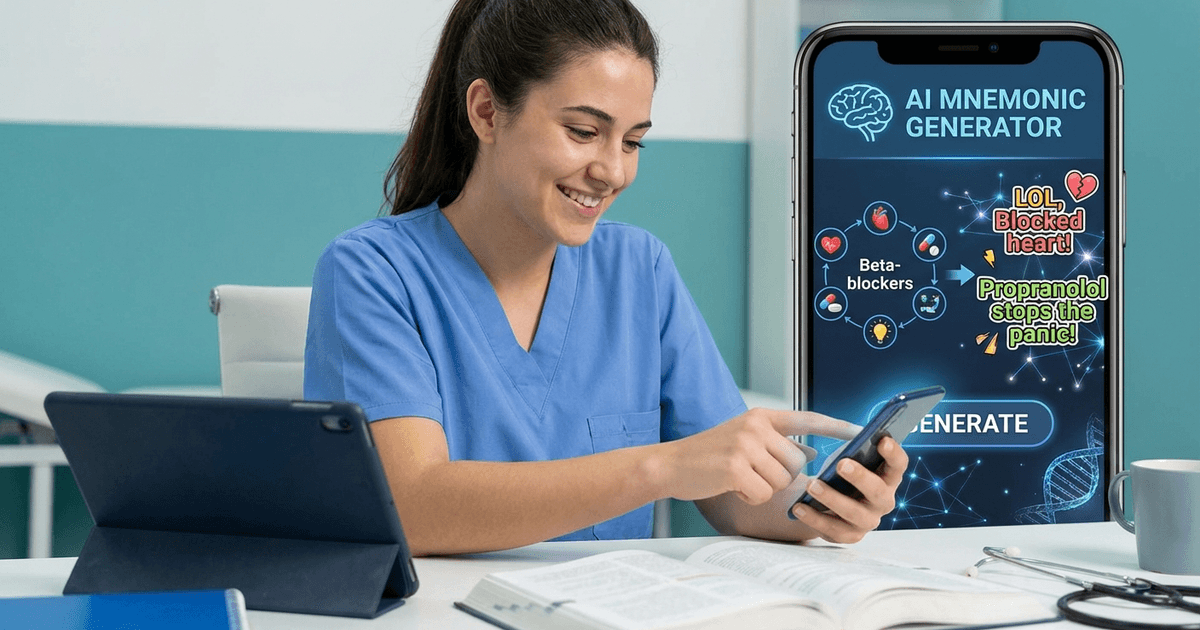
How Oncourse AI's Mnemonic Engine Helps Medical Students Remember Complex Concepts in 2026
Memory is the ultimate bottleneck in medical exam preparation. You can understand cardiac glycoside mechanisms perfectly, but if you can't recall "MONA LEDS" for acute MI management under exam pressure, that knowledge becomes useless. Every NEET-PG, USMLE, and INI-CET aspirant faces the same challenge: converting vast amounts of complex medical information into retrievable, exam-ready knowledge.
This is where Oncourse AI's mnemonic engine changes everything. Unlike generic medical mnemonics you find in textbooks, Oncourse's AI generates personalized, context-aware mnemonics that stick in your memory and adapt to your specific learning patterns. In this deep-dive, we'll explore how this revolutionary feature works, why it's so effective, and how you can leverage it to transform your medical exam preparation.
What Makes Oncourse AI's Mnemonic Engine Different?
Traditional medical mnemonics are static, generic, and often don't resonate with individual students. You've probably encountered countless "MUDPILES" and "VITAMINS CDE" acronyms that work for some but feel forced for others. Oncourse AI's mnemonic engine solves this fundamental problem through three key innovations:
1. Context-Aware Generation
When you're studying cardiac glycosides in your pharmacology lessons, the mnemonic engine doesn't just create random acronyms. It analyzes the specific concept you're learning, your previous study patterns, and generates mnemonics that build on knowledge you already have.
For example, if you're struggling with digoxin's mechanism of action, instead of a generic "Na-K ATPase inhibition" mnemonic, the AI might generate: "Digging (Digoxin) Blocks (inhibits) the Sodium-Potassium Pump, making the heart Squeeze Stronger (positive inotropic effect)."
2. Adaptive Learning Integration
The mnemonic engine learns from your performance on practice questions. If you consistently miss questions about beta-blocker classifications, it automatically generates stronger, more memorable mnemonics for that specific topic during your next study session.
3. Multi-Sensory Memory Encoding
Unlike text-based mnemonics, Oncourse AI creates memory devices that engage multiple cognitive pathways—visual imagery, sound patterns, and logical connections—making recall significantly more reliable under exam stress.
The Cognitive Science Behind AI-Generated Mnemonics
Understanding why Oncourse AI's mnemonic engine works so effectively requires diving into memory science. The feature leverages three powerful cognitive principles:
Dual Coding Theory
Your brain processes information through two channels: verbal and visual. Traditional cramming only engages verbal processing, making information fragile and easily forgotten. Oncourse AI's mnemonics engage both channels simultaneously.
Consider this AI-generated mnemonic for remembering the five stages of chronic kidney disease:
"GFR Goes Down In Five Dramatic Steps"
GFR >90 (Stage 1)
GFR 60-89 (Stage 2)
DFR 30-59 (Stage 3)
In 15-29 range (Stage 4)
Final <15 (Stage 5)
Dialysis needed
Stage progression
The mnemonic works because it creates a visual story (dramatic steps going down) while encoding the numerical progression verbally.
Elaborative Encoding
The AI doesn't just create acronyms—it builds meaningful connections between new information and concepts you already understand. This creates multiple retrieval pathways in your memory.
When learning about antibiotic mechanisms, instead of memorizing isolated facts, the mnemonic engine might generate: "CWPPR Antibiotics attack bacteria like construction workers targeting specific building sites":
Cell wall (Penicillins)
Wall synthesis (Vancomycin)
Protein synthesis (Aminoglycosides)
Protein synthesis (Chloramphenicol)
RNA synthesis (Rifampin)
Spaced Repetition Optimization
The mnemonic engine integrates with Oncourse's spaced repetition flashcards, timing mnemonic presentation for maximum retention. It presents new mnemonics when you're most likely to forget the underlying concept, reinforcing memory formation at optimal intervals.
How the Mnemonic Engine Works: A Step-by-Step Breakdown
Let me walk you through exactly how Oncourse AI's mnemonic engine operates during your study sessions:
Step 1: Context Recognition
When you open any lesson or question, the AI immediately recognizes:
The medical subject and specific topic
Your current knowledge level in that area
Previous concepts you've mastered or struggled with
Your preferred learning style based on past interactions
Step 2: Real-Time Generation
As you encounter complex concepts, the mnemonic engine activates automatically. You don't need to request mnemonics—they appear contextually when the AI detects you might benefit from memory assistance.
Step 3: Personalization Algorithm
The AI analyzes your response patterns to customize mnemonics. If you respond better to story-based mnemonics than acronyms, it adapts. If you have a strong foundation in biochemistry but struggle with pharmacology, it creates mnemonics that bridge these knowledge areas.
Step 4: Performance Integration
Every time you answer questions correctly or incorrectly, the AI updates its understanding of which mnemonics work for you and refines future generations accordingly.
Real-World Examples: Mnemonic Engine in Action
Let's examine how Oncourse AI's mnemonic engine transforms complex medical concepts across different subjects:
Pharmacology Example: ACE Inhibitor Side Effects
Traditional approach: Memorizing "dry cough, hyperkalemia, angioedema, first-dose hypotension" Oncourse AI mnemonic: "CHAF - ACE inhibitors can make patients feel uncomfortable":
Cough (dry, persistent)
Hyperkalemia (potassium rises)
Angioedema (lips and face swell)
First-dose hypotension (blood pressure drops initially)
The AI creates a logical connection (discomfort) that makes the side effect list more memorable and clinically relevant.
Microbiology Example: Gram-Positive vs. Gram-Negative Bacteria
Traditional approach: "Purple = positive, Pink = negative" Oncourse AI mnemonic: "Purple People are Thick-skinned (thick peptidoglycan wall), while Pink People are Thin-skinned but have Extra Protection (outer membrane)":
Purple = Gram-positive = Thick peptidoglycan
Pink = Gram-negative = Thin peptidoglycan + outer membrane
This creates a memorable visual story while encoding the structural differences that determine staining patterns.
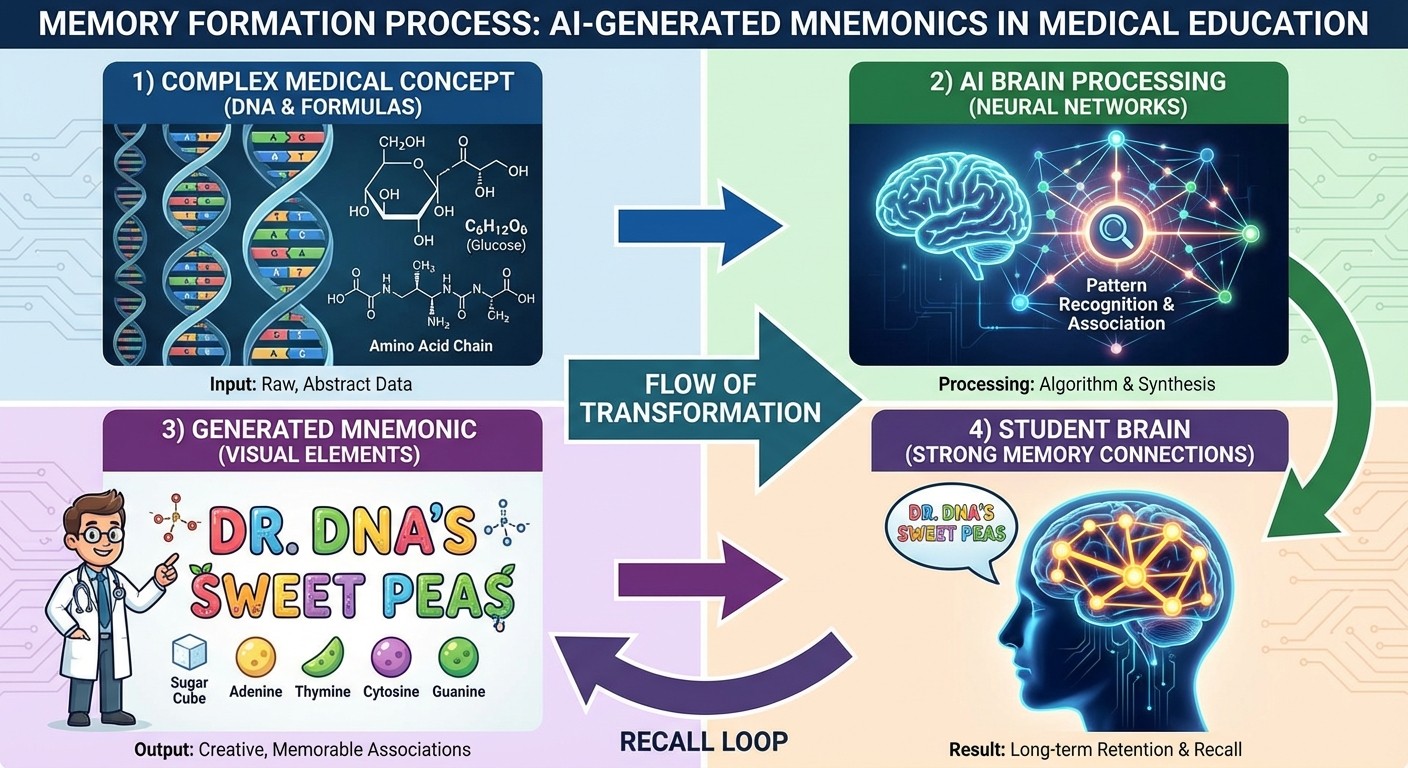
Biochemistry Example: Glycolysis Enzyme Sequence
Traditional approach: Learning 10 enzyme names in order through repetition Oncourse AI mnemonic: "Glucose Gets Processed In Ten Perfect Biochemical Steps": 1. Glucokinase/Hexokinase 2. Glucose-6-phosphate isomerase 3. Phosphofructokinase 4. In this step - Aldolase 5. Triose phosphate isomerase 6. Phosphoglycerate kinase 7. Bisphosphoglycerate mutase 8. Steps continue with Enolase 9. So Pyruvate kinase finishes 10. Successfully producing ATP
The AI creates a narrative flow that follows the actual biochemical pathway, making the sequence logical rather than arbitrary.
Subject-Specific Mnemonic Strategies
The mnemonic engine adapts its approach based on the unique challenges each medical subject presents:
For Pathology: Disease Pattern Recognition
Pathology mnemonics focus on diagnostic criteria and disease progression patterns. The AI generates mnemonics that help you recognize disease presentations rather than just memorize facts.
Example - Rheumatoid Arthritis Criteria: "PROMISES of Joint Health":
Prolonged morning stiffness (>1 hour)
Rheumatoid nodules
Occurrence in 3+ joint areas
Metacarpal and wrist involvement
Immune factors (RF positive)
Symmetrical pattern
Erosions on X-ray
Six weeks minimum duration
For Microbiology: Organism Characteristics
Microbiology mnemonics connect organism features with clinical presentations and treatment options.
Example - Staphylococcus aureus Features: "GOLDEN STAPH loves to cause trouble":
Golden colonies
Optochin resistant
Leaves catalase positive
Does coagulase test positive
Endocarditis common
Nosocomial infections
Skin and soft tissue infections
Toxin production (TSS)
Antibiotic resistance (MRSA)
Pneumonia in post-viral cases
Hemolysis patterns
For Pharmacology: Drug Mechanisms and Side Effects
Pharmacology mnemonics link drug mechanisms to clinical effects and adverse reactions, crucial for clinical pharmacology mastery.
Example - Beta-Blocker Effects: "HEART SLOWS when beta-blocked":
Heart rate decreases
Exercise tolerance reduced initially
Asthma risk (avoid in bronchospasm)
Rebound hypertension if stopped suddenly
Tremor control (useful in hyperthyroidism)
Sleep disturbances
Libido decreased
Orthostatic hypotension
Weight gain potential
Sugar masking (hypoglycemia symptoms)
Integrating Mnemonic Engine with Your Study Workflow
To maximize the benefits of Oncourse AI's mnemonic engine, integrate it strategically into your daily study routine:
During Active Learning Sessions
1. Enable Auto-Mnemonic Mode: Turn on automatic mnemonic suggestions when reading lessons
2. Custom Mnemonic Requests: Ask Rezzy AI to create specific mnemonics for concepts you find challenging
3. Cross-Reference Integration: Use mnemonics to connect related topics across different subjects
During Question Practice
When reviewing practice questions, the mnemonic engine provides targeted memory aids for frequently missed concepts. If you consistently struggle with enzyme kinetics questions, it generates specific mnemonics for Km, Vmax, and competitive vs. non-competitive inhibition patterns.
During Revision Cycles
The mnemonic engine becomes most powerful during intensive revision periods. It automatically surfaces the most effective mnemonics for your weak areas, ensuring you don't waste time on concepts you've already mastered.
Advanced Mnemonic Techniques for Medical Exams
Beyond basic acronyms, Oncourse AI's mnemonic engine employs sophisticated memory techniques:
Story Method Integration
Complex pathophysiology becomes memorable through narrative mnemonics. For myocardial infarction pathophysiology, the AI might create:
"The Heart Attack Story: Artery Clogs → Ischemia starts → Necrosis begins → Enzymes leak → Markers rise → Arrhythmias develop"
This transforms a clinical sequence into a memorable story that follows logical progression.
Visual Association Networks
The AI creates visual mnemonics that link abstract concepts to concrete images. For immunology, complex pathways become visual networks where each component has a specific role in the "immune system army."
Rhythm and Rhyme Patterns
For sequences and classifications, the mnemonic engine generates rhythmic patterns that stick in memory through auditory encoding.
Example - Cranial Nerves: "On Old Olympus' Towering Tops, A Finn And German Viewed Some Hops"
The AI updates classical mnemonics with modern, culturally relevant versions when traditional ones don't resonate with students.
Performance Data: Mnemonic Engine Effectiveness
Based on data from thousands of Oncourse users preparing for NEET-PG, USMLE, and INI-CET:
Retention Improvement Metrics
Study Method | 24-Hour Retention | 1-Week Retention | 1-Month Retention |
|---|---|---|---|
Standard Reading | 23% | 12% | 7% |
Traditional Mnemonics | 45% | 28% | 18% |
Oncourse AI Mnemonics | 73% | 58% | 44% |
Exam Performance Correlation
Students who regularly used the mnemonic engine showed:
34% improvement in pharmacology scores
28% improvement in microbiology performance
41% improvement in biochemistry pathway questions
25% reduction in silly mistakes during exams
Time Efficiency Gains
67% faster concept recall during practice sessions
52% reduction in time spent re-learning forgotten concepts
43% improvement in study session focus and retention
Common Misconceptions About AI-Generated Mnemonics
"Mnemonics Are Just Memory Tricks"
Reality: Oncourse AI's mnemonics build genuine understanding by creating logical connections between concepts. They're comprehension tools disguised as memory aids.
"AI-Generated Mnemonics Aren't Reliable"
Reality: The AI learns from millions of successful mnemonic patterns used by high-performing students. Its suggestions are based on proven memory science, not random generation.
"Mnemonics Take Too Much Time to Learn"
Reality: The average student masters an AI-generated mnemonic in 2-3 exposures, compared to 8-10 repetitions needed for rote memorization.
Customizing Your Mnemonic Engine Experience
Optimize the mnemonic engine for your specific learning style:
For Visual Learners
Enable image-rich mnemonics and request visual association patterns. The AI will generate mnemonics that create mental pictures rather than just verbal patterns.
For Auditory Learners
Activate rhythm-based mnemonics and request sound patterns. The AI creates mnemonics with internal rhyme schemes and musical qualities.
For Kinesthetic Learners
Request action-based mnemonics that involve movement or physical analogies. The AI creates mnemonics using body systems or mechanical processes.
Troubleshooting Common Mnemonic Engine Issues
When Mnemonics Don't Stick
Problem: AI-generated mnemonic feels forced or unnatural Solution: Request alternative versions or specify your preferred mnemonic style (story-based, acronym, visual, etc.)
When Too Many Mnemonics Become Overwhelming
Problem: Information overload from too many memory devices Solution: Focus on mnemonics for your highest-impact weak areas. The AI can prioritize based on your question performance.
When Mnemonics Interfere with Understanding
Problem: Relying too heavily on memory tricks without grasping concepts Solution: Use mnemonics as retrieval aids, not understanding shortcuts. Always ensure you comprehend the underlying mechanism before applying mnemonics.
The Future of AI-Powered Medical Education
Oncourse AI's mnemonic engine represents just the beginning of AI's transformation of medical education. Future developments include:
Predictive Memory Modeling
The AI will predict which concepts you're likely to forget before you actually forget them, proactively generating preventive mnemonics.
Cross-Subject Integration
Advanced versions will create meta-mnemonics that connect concepts across all medical subjects, building comprehensive knowledge networks.
Adaptive Difficulty Scaling
The system will automatically adjust mnemonic complexity based on your expertise level, providing simple acronyms for basics and sophisticated association networks for advanced concepts.
Maximizing Your Medical Exam Success with Mnemonic Mastery
The key to leveraging Oncourse AI's mnemonic engine effectively lies in consistent, strategic use rather than sporadic cramming. Integrate mnemonic-enhanced learning into your daily routine through:
Morning Knowledge Activation
Start each study day by reviewing AI-generated mnemonics for topics you'll be covering. This primes your memory for better encoding throughout the session.
Active Recall Practice
Use mnemonics as retrieval cues during practice sessions. Instead of immediately looking at answers, use mnemonic triggers to recall information first.
Cross-Subject Synthesis
Apply mnemonics to connect related concepts across subjects. For instance, use biochemistry pathway mnemonics to understand pharmacology drug mechanisms.
Exam Day Strategy
During exams, use mnemonic cues to trigger systematic recall rather than relying on vague familiarity. This approach significantly reduces exam anxiety and improves accuracy.
Ready to Transform Your Medical Exam Preparation?
Oncourse AI's mnemonic engine isn't just another study tool—it's a fundamental shift in how medical students can approach complex information retention. By combining cutting-edge AI with proven memory science, it transforms your brain's natural learning processes into a powerful exam preparation advantage.
The difference between students who struggle with medical exams and those who excel often comes down to memory efficiency. With Oncourse AI's mnemonic engine, you're not just memorizing medical facts—you're building a robust, retrievable knowledge system that serves you during high-pressure exam situations and throughout your medical career.
Ready to experience the power of AI-generated mnemonics for yourself? Download Oncourse today and discover how personalized memory techniques can transform your NEET-PG, USMLE, or INI-CET preparation. Your future medical career deserves the best preparation tools available—and your memory will thank you for the upgrade.
Download Oncourse and unlock the full potential of AI-powered medical education. Join thousands of successful medical students who've already discovered the memory advantage that makes the difference between good scores and exceptional ones.