Anatomy
1 questionsWhat is the anatomical significance of the Rhinion in relation to the osseocartilaginous junction?
NEET-PG 2012 - Anatomy NEET-PG Practice Questions and MCQs
Question 321: What is the anatomical significance of the Rhinion in relation to the osseocartilaginous junction?
- A. Nasion
- B. Rhinion (Correct Answer)
- C. Radix
- D. Columella
Explanation: ***Correct Answer: Rhinion*** - The **rhinion** is the **most prominent anterior point of the nasal bone**, often palpable as a slight bump or angulation on the dorsum of the nose. - It marks the anatomical location of the **osseocartilaginous junction** of the nasal dorsum, where the bony nasal framework transitions to the cartilaginous framework. - This is the key anatomical landmark that defines the transition from bone to cartilage in the external nose. *Incorrect: Nasion* - The **nasion** is located at the **root of the nose**, specifically at the most anterior and superior point of the nasofrontal suture. - It is a bony landmark and does not directly relate to the osseocartilaginous junction of the nasal dorsum. *Incorrect: Radix* - The **radix** (or nasal root) refers to the **uppermost part of the nose**, corresponding to the nasion. - It defines the point where the nose begins to project from the forehead and is a bony landmark, not directly related to the osseocartilaginous junction. *Incorrect: Columella* - The **columella** is the **fleshy, narrow strip of tissue that separates the nostrils**. - It forms the inferior segment of the nasal septum and is composed of skin, soft tissue, and the medial crura of the alar cartilages, thus having no direct relation to the osseocartilaginous junction of the nasal dorsum.
Biochemistry
5 questionsThe anticodon region is an important part of which type of RNA?
Which of the following pairs of compounds has the highest standard reduction potential?
Fluoroacetate inhibits?
Which of the following is required for fatty acid synthesis ?
Which hormone inhibits hormone-sensitive lipase?
NEET-PG 2012 - Biochemistry NEET-PG Practice Questions and MCQs
Question 321: The anticodon region is an important part of which type of RNA?
- A. r-RNA
- B. m-RNA
- C. t-RNA (Correct Answer)
- D. hn-RNA
Explanation: **t-RNA** - The **anticodon region** is a critical component of **transfer RNA (tRNA)**, responsible for recognizing and binding to the complementary codon on mRNA during protein synthesis. - This interaction ensures that the correct **amino acid** is delivered to the growing polypeptide chain according to the genetic code. *r-RNA* - **Ribosomal RNA (rRNA)** is a structural and enzymatic component of **ribosomes**, which are the cellular machinery for protein synthesis. - While rRNA plays a crucial role in forming **peptide bonds** and facilitating translation, it does not possess an anticodon region. *m-RNA* - **Messenger RNA (mRNA)** carries the **genetic code** from DNA to the ribosomes in the form of codons, which specify the sequence of amino acids for protein synthesis. - mRNA molecules have codons, but they do not have an **anticodon region**; instead, they are read by the anticodons of tRNA. *hn-RNA* - **Heterogeneous nuclear RNA (hnRNA)** is a precursor to mRNA in eukaryotic cells, containing both exons and introns. - It undergoes extensive processing, including **splicing**, to become mature mRNA, but it does not have an **anticodon region**.
Question 322: Which of the following pairs of compounds has the highest standard reduction potential?
- A. NADH/NAD+
- B. Succinate/Fumarate
- C. Ubiquinone/Ubiquinol
- D. Fe³⁺/Fe²⁺ (Correct Answer)
Explanation: ***Fe³⁺/Fe²⁺*** - The **Fe³⁺/Fe²⁺ couple** has a **standard reduction potential (E'0)** of **+0.77 V**, making it the highest among the given options. - A higher positive E'0 indicates a stronger tendency for the oxidized form to accept electrons and be reduced. *NADH/NAD+* - The **NADH/NAD+ couple** has a **standard reduction potential** of **-0.32 V**, indicating it is a strong reducing agent. - Its negative reduction potential means it readily donates electrons during metabolic processes. *Succinate/Fumarate* - The **succinate/fumarate couple** has a **standard reduction potential** of **+0.03 V**. - This pair is involved in the **TCA cycle**, where succinate is oxidized to fumarate, releasing electrons. *Ubiquinone/Ubiquinol* - The **ubiquinone/ubiquinol couple** has a **standard reduction potential** varying around **+0.05 to +0.10 V**, depending on the specific state. - It acts as a mobile electron carrier in the **electron transport chain**, accepting electrons from NADH and FADH2.
Question 323: Fluoroacetate inhibits?
- A. Citrate synthase
- B. Succinate dehydrogenase
- C. Alpha-ketoglutarate dehydrogenase
- D. Aconitase (Correct Answer)
Explanation: ***Aconitase*** - **Fluoroacetate** is metabolically converted to **fluorocitrate**, which is a potent competitive inhibitor of **aconitase**. - **Aconitase** is the enzyme responsible for converting **citrate to isocitrate** in the **Krebs cycle**, and its inhibition blocks the cycle. *Citrate synthase* - This enzyme is responsible for the formation of **citrate** from **acetyl-CoA** and **oxaloacetate**. - While fluoroacetate indirectly affects the cycle, it does not directly inhibit **citrate synthase**. *Succinate dehydrogenase* - This enzyme is part of the **Krebs cycle** and the **electron transport chain**, converting **succinate to fumarate**. - **Malonate** is a competitive inhibitor of succinate dehydrogenase, not **fluoroacetate**. *Alpha-ketoglutarate dehydrogenase* - This enzyme catalyzes the conversion of **alpha-ketoglutarate to succinyl-CoA** in the **Krebs cycle**. - Specific inhibitors of this enzyme include **arsenite** and **mercury compounds**, but not fluoroacetate.
Question 324: Which of the following is required for fatty acid synthesis ?
- A. NADPH (Correct Answer)
- B. NADH
- C. FADH₂
- D. None of the options
Explanation: ***NADPH*** - **NADPH** is crucial for fatty acid synthesis, providing the **reducing power** needed for the successive reduction steps. - The enzymes involved, such as **fatty acid synthase**, utilize **NADPH** for the conversion of keto groups to hydroxyl groups and then to saturated methylene groups. *NADH* - **NADH** plays a primary role in **oxidative phosphorylation** and the electron transport chain to generate ATP. - It is generally produced during **catabolic reactions** and is not primarily used as a reducing agent in anabolic processes like fatty acid synthesis. *FADH* - **FADH2** (reduced form of FAD, not FADH) is a coenzyme involved in redox reactions, particularly in the **Krebs cycle** and beta-oxidation of fatty acids. - Like NADH, it is mostly involved in **catabolic processes** that generate energy, rather than anabolic processes requiring reducing equivalents for synthesis. *None of the options* - This option is incorrect because **NADPH** is indeed required for fatty acid synthesis, serving as the essential reducing agent. - The other coenzymes mentioned (NADH, FADH) have different metabolic roles, primarily in energy production rather than biosynthesis.
Question 325: Which hormone inhibits hormone-sensitive lipase?
- A. Insulin (Correct Answer)
- B. GH
- C. ACTH
- D. Thyroid hormone
Explanation: ***Insulin*** - **Insulin** is a key anabolic hormone that promotes energy storage and inhibits catabolic processes, including the breakdown of triglycerides. - It directly inhibits **hormone-sensitive lipase (HSL)** activity, thus reducing the release of free fatty acids from adipose tissue. *Thyroid hormone* - **Thyroid hormones** (T3 and T4) generally promote catabolism and increase metabolic rate, including the mobilization of lipids. - They tend to **stimulate rather than inhibit** hormone-sensitive lipase expression and activity. *GH* - **Growth hormone (GH)** has lipolytic effects, meaning it promotes the breakdown of fats to provide energy. - GH typically **stimulates HSL activity** and increases the release of free fatty acids from adipocytes. *ACTH* - **Adrenocorticotropic hormone (ACTH)** primarily stimulates the adrenal cortex to produce cortisol. - **Cortisol** can have lipolytic effects in certain contexts and does not directly inhibit HSL; instead, catecholamines act as direct stimulators of HSL.
Pharmacology
1 questionsWhat is the primary mechanism by which epinephrine reduces insulin secretion?
NEET-PG 2012 - Pharmacology NEET-PG Practice Questions and MCQs
Question 321: What is the primary mechanism by which epinephrine reduces insulin secretion?
- A. Predominantly through beta action
- B. Through both alpha and beta actions
- C. Through muscarinic receptors
- D. Predominantly through alpha action (Correct Answer)
Explanation: ***Predominantly through alpha action*** - **Epinephrine** primarily reduces insulin secretion by stimulating **alpha-2 adrenergic receptors** on pancreatic beta cells. - Activation of these receptors leads to a decrease in **cAMP levels** and an inhibition of insulin release. *Predominantly through beta action* - **Beta-2 adrenergic receptor activation** on pancreatic beta cells typically **stimulates** insulin secretion, which is opposite to epinephrine's overall effect. - While epinephrine has both alpha and beta effects, the **alpha-2 inhibition** of insulin release predominates in this context. *Through both alpha and beta actions* - Although epinephrine exerts both alpha and beta effects, the **alpha-2 receptor-mediated inhibition** of insulin secretion is the dominant mechanism. - The **beta-2 receptor-mediated stimulation** of insulin release is overridden by the stronger inhibitory alpha-2 effect. *Through muscarinic receptors* - Muscarinic receptors are part of the **parasympathetic nervous system** and are involved in stimulating insulin secretion. - **Epinephrine** acts on adrenergic receptors, not muscarinic receptors, to influence insulin release.
Physiology
3 questionsGas exchange in tissues takes place at?
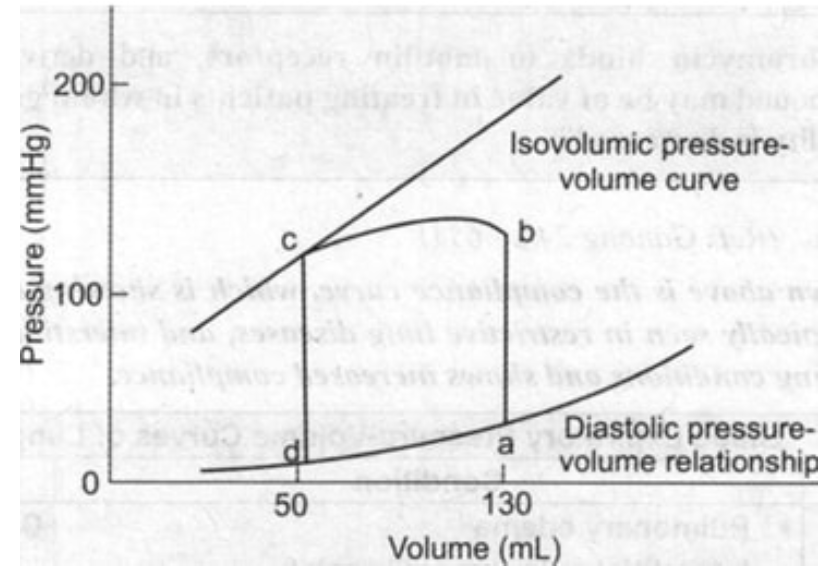
From the given pressure-volume curve, identify the end-diastolic volume (EDV) and end-systolic volume (ESV), then calculate the ejection fraction using the formula EF = (EDV - ESV)/EDV × 100%.
Insulin is essential for glucose entry in?
NEET-PG 2012 - Physiology NEET-PG Practice Questions and MCQs
Question 321: Gas exchange in tissues takes place at?
- A. Artery
- B. Capillary (Correct Answer)
- C. Vein
- D. Venules
Explanation: ***Capillary*** - **Capillaries** are the smallest and most numerous blood vessels, with very thin walls (only one cell thick), which facilitates the efficient exchange of gases, nutrients, and waste products between blood and tissues. - Their extensive network ensures close proximity to nearly every cell in the body, maximizing the surface area and minimizing the diffusion distance for **gas exchange**. *Artery* - Arteries carry **oxygenated blood** away from the heart to the tissues but have thick, muscular walls designed for high pressure and transport, not for direct exchange with tissues. - They branch into smaller arterioles, which then lead to capillaries, making them a conduit rather than an exchange site. *Vein* - Veins carry **deoxygenated blood** back to the heart from the tissues and have relatively thin walls compared to arteries but are still too thick for efficient gas exchange. - They primarily serve as blood return vessels and reservoirs. *Venules* - Venules are small blood vessels that merge from capillaries and eventually combine to form veins; they primarily function in collecting blood from capillary beds. - While slightly more permeable than larger veins, their main role is still collection and transport, not the extensive gas exchange facilitated by capillaries.
Question 322: From the given pressure-volume curve, identify the end-diastolic volume (EDV) and end-systolic volume (ESV), then calculate the ejection fraction using the formula EF = (EDV - ESV)/EDV × 100%.
- A. 40%
- B. 50%
- C. 55%
- D. 60% (Correct Answer)
Explanation: ***60%*** - From the pressure-volume loop, the **end-diastolic volume (EDV)** is the volume at point 'a', which is **130 mL**. - The **end-systolic volume (ESV)** is the volume at point 'd', which is **50 mL**. - Using the formula EF = (EDV - ESV) / EDV × 100% = (130 mL - 50 mL) / 130 mL × 100% = 80 mL / 130 mL × 100% = **61.5%**, which rounds to **60%** (the closest option). *40%* - To obtain an ejection fraction of 40%, the ESV would need to be higher, or the EDV lower, than what is indicated by the points 'a' and 'd' on the graph. - (130 - ESV) / 130 = 0.40 => 130 - ESV = 52 => ESV = 78 mL. This isn't consistent with the graph. *50%* - An ejection fraction of 50% would mean that the heart ejected half of its EDV. - (130 - ESV) / 130 = 0.50 => 130 - ESV = 65 => ESV = 65 mL. This value for ESV is not depicted at point 'd'. *55%* - For an ejection fraction of 55%, the calculation would yield a different ESV than what is presented in the curve. - (130 - ESV) / 130 = 0.55 => 130 - ESV = 71.5 => ESV = 58.5 mL. This is not the ESV at point 'd'.
Question 323: Insulin is essential for glucose entry in?
- A. Muscle cells (Correct Answer)
- B. Beta cells of pancreas
- C. Cortical neurons
- D. Renal tubular cells
Explanation: ***Muscle cells*** - **Insulin** promotes glucose uptake into **muscle cells** by stimulating the translocation of **GLUT4 transporters** to the cell surface. - In the absence of insulin, **glucose uptake** into quiescent muscle cells is significantly reduced. *Cortical neurons* - **Neurons** in the brain, including cortical neurons, primarily utilize **GLUT1** and **GLUT3 transporters** for glucose uptake, which are **insulin-independent**. - This ensures a constant supply of glucose to the brain, even during periods of low insulin. *Beta cells of pancreas* - **Pancreatic beta cells** use **GLUT2 transporters** for glucose uptake, which are **insulin-independent** and have a high capacity. - This allows beta cells to sense glucose levels and regulate insulin secretion accordingly. *Renal tubular cells* - **Renal tubular cells** reabsorb glucose primarily through **sodium-glucose co-transporters (SGLTs)** and **GLUT2 transporters**, both of which are **insulin-independent**. - Their primary role is in maintaining glucose homeostasis by preventing glucose loss in urine.