
Cardiology — MCQs

On this page
A 65-year-old man presents to his primary care physician for a pre-operative evaluation. He is scheduled for cataract surgery in 3 weeks. His past medical history is notable for diabetes, hypertension, and severe osteoarthritis of the right knee. His medications include metformin, hydrochlorothiazide, lisinopril, and aspirin. His surgeon ordered blood work 1 month ago, which showed a hemoglobin of 14.2 g/dL, INR of 1.2, and a hemoglobin A1c of 6.9%. His vital signs at the time of the visit show BP: 130/70 mmHg, Pulse: 80, RR: 12, and T: 37.2 C. He has no current complaints and is eager for his surgery. Which of the following is the most appropriate course of action for this patient at this time?
A 34-year-old Caucasian female presents at the ER with fever and sharp pain in her chest upon coughing and inhalation. Three weeks earlier she presented to her rheumatologist with a butterfly rash, joint pain and fatigue and was given a diagnosis of systemic lupus erythematosus. A friction rub is present upon physical exam. Which of the following do you most suspect in this patient?
A 52-year-old man presents to the emergency department because of pain and swelling in his left leg over the past few hours. He traveled from Sydney to Los Angeles 2 days ago. He has had type 2 diabetes mellitus for 10 years and takes metformin for it. He has smoked a pack of cigarettes daily for 25 years. His temperature is 36.9°C (98.4°F), the blood pressure is 140/90 mm Hg, and the pulse is 90/min. On examination, the left calf is 5 cm greater in circumference than the right. The left leg appears more erythematous than the right with dilated superficial veins. Venous duplex ultrasound shows non-compressibility. Which of the following best represents the mechanism of this patient’s illness?
A 53-year-old man is brought to the emergency department following an episode of loss of consciousness 1 hour ago. He had just finished micturating, when he fell down. His wife heard the noise and found him unconscious on the floor. He regained consciousness after 30 seconds and was able to talk normally with his wife immediately. There was no urinary incontinence. On arrival, he is alert and oriented. Cardiopulmonary examination shows no abnormalities. Neurologic examination shows no focal findings. Serum concentrations of glucose, creatinine, and electrolytes are within the reference range. An electrocardiogram shows no abnormalities. Which of the following is the most likely diagnosis?
A 35-year-old woman with type 1 diabetes mellitus comes to the emergency department for evaluation of a 1-month history of fever, fatigue, loss of appetite, and a 3.6-kg (8-lb) weight loss. She has also had a cough for the last 2 months. She reports recent loss of pubic hair. The patient immigrated from the Philippines 7 weeks ago. Her mother has systemic lupus erythematosus. She has never smoked and does not drink alcohol. Her only medication is insulin, but she sometimes misses doses. She is 165 cm (5 ft 5 in) tall and weighs 49 kg (108 lb); BMI is 18 kg/m2. She appears lethargic. Her temperature is 38.9°C (102°F), pulse is 58/min, and blood pressure is 90/60 mm Hg. Examination shows decreased sensation to touch and vibration over both feet. The remainder of the examination shows no abnormalities. Serum studies show: Na+ 122 mEq/L Cl- 100 mEq/L K+ 5.8 mEq/L Glucose 172 mg/dL Albumin 2.8 g/dL Cortisol 2.5 μg/dL ACTH 531.2 pg/mL (N=5–27 pg/mL) CT scan of the abdomen with contrast shows bilateral adrenal enlargement. Which of the following is the most likely underlying mechanism of this patient's symptoms?
A 47-year-old female with a history of hypertension presents to your outpatient clinic for numbness, tingling in her right hand that has been slowly worsening over the last several months. She has tried using a splint but receives minimal relief. She is an analyst for a large consulting firm and spends most of her workday in front of a computer. Upon examination, you noticed that the patient has a prominent jaw and her hands appear disproportionately large. Her temperature is 99 deg F (37.2 deg C), blood pressure is 154/72 mmHg, pulse is 87/min, respirations are 12/min. A fasting basic metabolic panel shows: Na: 138 mEq/L, K: 4.1 mEq/L, Cl: 103 mEq/L, CO2: 24 mEq/L, BUN: 12 mg/dL, Cr: 0.8 mg/dL, Glucose: 163 mg/dL. Which of the following tests would be most helpful in identifying the underlying diagnosis?
A 71-year-old man comes to the emergency department because of a 2-month history of severe muscle cramps and back pain. He says that he is homeless and has not visited a physician in the past 20 years. He is 183 cm (6 ft 0 in) tall and weighs 62 kg (137 lb); BMI is 18.5 kg/m2. His blood pressure is 154/88 mm Hg. Physical examination shows pallor, multiple cutaneous excoriations, and decreased sensation over the lower extremities. Serum studies show: Calcium 7.2 mg/dL Phosphorus 5.1 mg/dL Glucose 221 mg/dL Creatinine 4.5 mg/dL An x-ray of the spine shows alternating sclerotic and radiolucent bands in the lumbar and thoracic vertebral bodies. Which of the following is the most likely explanation for these findings?
A 40-year-old woman comes to the physician because of a 1-week history of fatigue, dark urine, and a feeling of heaviness in her legs. Two weeks ago, she returned from a vacation to Brazil, where she spent most of her days exploring the city of Rio de Janeiro on foot. She also gained 3 kg (7 lb) during her vacation. She has systemic lupus erythematosus. Her only medication is hydroxychloroquine. Her temperature is 37.5°C (99.5°F), pulse is 78/min, and blood pressure is 162/98 mm Hg. Physical examination shows 2+ pretibial edema bilaterally. Urinalysis shows: Blood 3+ Protein 1+ RBC 6–8/hpf with dysmorphic features RBC casts numerous WBC 8/hpf WBC casts rare Bacteria negative Which of the following is the most likely cause of this patient's leg findings?
A 32-year-old woman presents to her primary care physician for a general wellness appointment. The patient has no complaints currently and just wants to be sure that she is in good health. The patient has a past medical history of asthma, hypertension, and anxiety. Her current medications include albuterol, fluticasone, hydrochlorothiazide, lisinopril, and fexofenadine. Her temperature is 99.5°F (37.5°C), blood pressure is 165/95 mmHg, pulse is 70/min, respirations are 15/min, and oxygen saturation is 98% on room air. On exam, you note a healthy young woman with a lean habitus. Cardiac exam reveals a S1 and S2 heart sound with a normal rate. Pulmonary exam is clear to auscultation bilaterally with good air movement. Abdominal exam reveals a bruit, normoactive bowel sounds, and an audible borborygmus. Neurological exam reveals cranial nerves II-XII as grossly intact with normal strength and reflexes in the upper and lower extremities. Which of the following is the best next step in management?
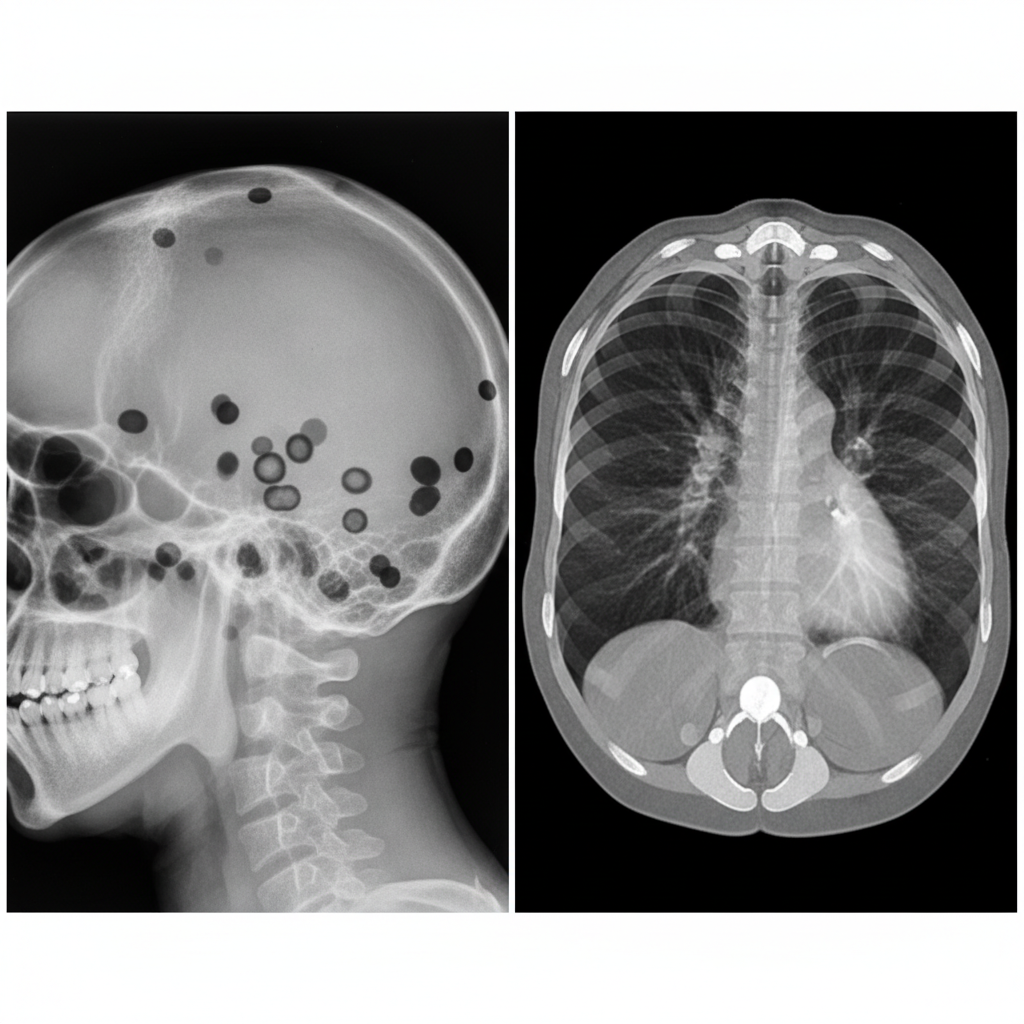
A 68-year-old woman is brought to the emergency department because of fever, productive cough, and dyspnea for 3 days. She has had upper back pain for 3 months, which is worse after activity. She takes ibuprofen for pain relief. She has no history of smoking. The temperature is 39.5°C (103.1°F), the blood pressure is 100/70 mm Hg, the pulse is 95/min, and the respirations are 22/min. Lung auscultation shows rales in the left lower lobe area. Painful lymph nodes (1 × 1 cm) are palpated in the left axillary and cervical regions. There is point tenderness along several thoracic vertebrae. Laboratory studies are pending. A skull X-ray and lung window thoracic computed tomography scan are shown. Which of the following disorders most likely played a role in this patient’s acute condition?
Practice by Chapter
Hypertension diagnosis and management
Practice Questions
Stable coronary artery disease
Practice Questions
Peripheral arterial disease
Practice Questions
Aortic diseases
Practice Questions
Valvular heart disease
Practice Questions
Pericardial diseases
Practice Questions
Adult congenital heart disease
Practice Questions
Cardiac tumors
Practice Questions
Cardiac manifestations of systemic diseases
Practice Questions
Pre-operative cardiac risk assessment
Practice Questions
Cardiac imaging modalities
Practice Questions
Preventive cardiology
Practice Questions
Cardiac rehabilitation
Practice Questions
Want unlimited practice?
Get full access to all questions, explanations, and performance tracking.
Scan to download app