Anatomy
1 questionsImpaired gag reflex is seen due to a lesion in which cranial nerves?
NEET-PG 2024 - Anatomy NEET-PG Practice Questions and MCQs
Question 251: Impaired gag reflex is seen due to a lesion in which cranial nerves?
- A. CN V&VI
- B. CN X & XI
- C. CN IX & X (Correct Answer)
- D. CN VII & VIII
- E. CN XI & XII
Explanation: ***Correct: CN IX & X*** The **gag reflex (pharyngeal reflex)** is a protective reflex involving two cranial nerves: - **Afferent limb**: **CN IX (Glossopharyngeal nerve)** provides sensory innervation to the posterior third of the tongue, oropharynx, and pharyngeal walls - **Efferent limb**: **CN X (Vagus nerve)** provides motor innervation to the pharyngeal muscles (via the pharyngeal plexus) that contract during the reflex **Clinical correlation**: Testing the gag reflex helps assess brainstem function and the integrity of CN IX and X. Impairment suggests lesions affecting these nerves or their nuclei in the medulla. *Incorrect: CN V & VI* - CN V (Trigeminal) provides facial sensation and motor to muscles of mastication, not involved in gag reflex - CN VI (Abducens) controls lateral rectus muscle for eye abduction *Incorrect: CN X & XI* - While CN X is involved, CN XI (Accessory nerve) innervates sternocleidomastoid and trapezius muscles, not pharyngeal muscles *Incorrect: CN VII & VIII* - CN VII (Facial) controls facial expression and taste from anterior 2/3 of tongue - CN VIII (Vestibulocochlear) is involved in hearing and balance, not the gag reflex *Incorrect: CN XI & XII* - CN XI (Accessory) innervates SCM and trapezius - CN XII (Hypoglossal) provides motor to intrinsic and extrinsic tongue muscles, not pharyngeal muscles involved in gag reflex
Biochemistry
1 questionsAn adult tall male presents with a long arm span, pectus excavatum, and cardiac abnormalities. What is the most likely defective protein?
NEET-PG 2024 - Biochemistry NEET-PG Practice Questions and MCQs
Question 251: An adult tall male presents with a long arm span, pectus excavatum, and cardiac abnormalities. What is the most likely defective protein?
- A. Fibrillin (Correct Answer)
- B. Elastin
- C. Collagen
- D. Myosin
- E. Laminin
Explanation: ***Fibrillin*** - The constellation of **tall stature**, **long arm span**, **pectus excavatum**, and **cardiac abnormalities** (e.g., aortic dissection or mitral valve prolapse) is classic for **Marfan syndrome**. - Marfan syndrome is caused by a defect in the *FBN1* gene, which codes for **fibrillin-1**, a glycoprotein essential for the formation of elastic fibers in connective tissue. *Elastin* - Defects in **elastin** are associated with conditions like **supravalvular aortic stenosis** (due to **Williams syndrome**) or cutis laxa, which have different phenotypic presentations. - While both elastin and fibrillin are components of elastic fibers, the specific features of Marfan syndrome point to fibrillin as the primary defect. *Collagen* - Defects in **collagen** (especially type I, III, or V) are associated with conditions such as **osteogenesis imperfecta** (brittle bones) or **Ehlers-Danlos syndrome** (hypermobility, skin hyperextensibility). - These conditions typically present with different clinical manifestations, lacking the specific combination of features seen in this patient. *Myosin* - **Myosin** is a fibrous protein primarily involved in **muscle contraction** and is not directly implicated in widespread connective tissue disorders affecting skeletal and cardiovascular systems in this manner. - Defects in myosin are more commonly associated with various forms of **cardiomyopathy** or skeletal muscle myopathies, not Marfan-like features. *Laminin* - **Laminin** is a major component of the **basement membrane** and plays a role in cell adhesion, migration, and tissue architecture. - Laminin defects are associated with certain forms of **muscular dystrophy** (e.g., congenital muscular dystrophy) and **epidermolysis bullosa**, not the specific skeletal and cardiovascular features of Marfan syndrome.
ENT
3 questionsIn a patient with right vestibular neuronitis, what will be the finding on the head impulse test?
A patient presents with conductive hearing loss, pulsatile tinnitus, and a positive Phelps sign. Based on the CT scan image provided, what is the most likely diagnosis?

A patient with chronic nasal obstruction underwent a procedure 3 months ago and now presents with recurrent epistaxis, crusting, and the clinical image showing a septal perforation. What procedure was most likely carried out?

NEET-PG 2024 - ENT NEET-PG Practice Questions and MCQs
Question 251: In a patient with right vestibular neuronitis, what will be the finding on the head impulse test?
- A. Head turned to right, corrective saccade to the left (Correct Answer)
- B. Head turned to left, corrective saccade to the right
- C. Head turned to right, no corrective saccade
- D. Head turned to left, no corrective saccade
Explanation: ***Head turned to right, corrective saccade to the left*** - In **right vestibular neuronitis**, the right vestibular apparatus is impaired, affecting the **vestibulo-ocular reflex (VOR)** on that side. - During the head impulse test, when the head is rapidly turned **to the right** (toward the affected side), the impaired VOR cannot maintain eye fixation on the target. - The eyes initially move **with the head** (to the right), then a visible **corrective saccade** (catch-up saccade) brings them **back to the left** to refixate on the target. - This corrective saccade is the **hallmark positive finding** in head impulse test for right vestibular dysfunction. *Head turned to left, corrective saccade to the right* - This would indicate a **left vestibular lesion**, not right vestibular neuronitis. - When turning the head to the left with left vestibular dysfunction, a corrective saccade to the right would be observed. *Head turned to right, no corrective saccade* - This would indicate **normal VOR function** on the right side. - A normal response shows no corrective saccade because the eyes maintain fixation throughout the head turn. - This is the **opposite** of what is expected in right vestibular neuronitis. *Head turned to left, no corrective saccade* - This indicates normal VOR function on the left side. - In right vestibular neuronitis, turning the head to the left (away from the affected side) typically shows **normal VOR** with no corrective saccade needed.
Question 252: A patient presents with conductive hearing loss, pulsatile tinnitus, and a positive Phelps sign. Based on the CT scan image provided, what is the most likely diagnosis?
- A. Glomus Jugulare (Correct Answer)
- B. Glomus Tympanicum
- C. Acoustic Neuroma
- D. Cholesteatoma
Explanation: ***Glomus Jugulare*** - The symptoms of **conductive hearing loss**, **pulsatile tinnitus**, and a **positive Phelps sign** (destruction of the bone separating the carotid artery from the jugular bulb on CT) are classic for a glomus jugulare tumor. - The CT scan image, showing a destructive lesion in the **jugular foramen** region, further supports this diagnosis, as these tumors originate from the paraganglia of the jugular bulb. *Glomus Tympanicum* - While it can cause conductive hearing loss and pulsatile tinnitus, a glomus tympanicum tumor is typically **confined to the middle ear cavity** and does not involve bone erosion of the jugular foramen as indicated by a positive Phelps sign. - The CT findings would show a mass in the middle ear, often behind an intact tympanic membrane, rather than extensive bone destruction in the jugular region. *Acoustic Neuroma* - This tumor, also known as a **vestibular schwannoma**, primarily causes **sensorineural hearing loss**, **tinnitus** (often non-pulsatile), and **balance issues**, not conductive hearing loss or pulsatile tinnitus. - An acoustic neuroma is located in the **cerebellopontine angle** and internal auditory canal, and the CT scan would show a mass in this specific location, not necessarily bone erosion of the jugular foramen. *Cholesteatoma* - A cholesteatoma is a **destructive, expanding growth of keratinizing squamous epithelium** in the middle ear or mastoid, typically presenting with **conductive hearing loss**, **otorrhea**, and sometimes headaches. - It does not typically cause pulsatile tinnitus unless it's very large and vascularized, nor does it present with the characteristic destruction of the jugular foramen seen with a positive Phelps sign.
Question 253: A patient with chronic nasal obstruction underwent a procedure 3 months ago and now presents with recurrent epistaxis, crusting, and the clinical image showing a septal perforation. What procedure was most likely carried out?
- A. FESS (Functional Endoscopic Sinus Surgery)
- B. Caldwell-Luc's procedure
- C. Submucosal resection (SMR) (Correct Answer)
- D. Turbinate reduction surgery
Explanation: ***Submucosal resection (SMR)*** - **SMR** involves removing cartilage or bone from the nasal septum while preserving the septal mucosa. If both mucosal flaps are inadvertently damaged or devitalized during the procedure, it can lead to a **septal perforation** as a complication. - The symptoms of **recurrent epistaxis** and **crusting** are classic signs associated with compromised septal integrity and airflow changes due to a septal perforation, which commonly occurs weeks to months after such a procedure. *FESS (Functional Endoscopic Sinus Surgery)* - **FESS** is primarily used to treat chronic sinusitis by opening and ventilating the sinuses; it does not directly involve the nasal septum in a way that typically causes perforation. - While complications are possible, a septal perforation is not a common or direct consequence of FESS, which focuses on ethmoid, maxillary, frontal, or sphenoid sinus drainage pathways. *Caldwell-Luc's procedure* - The **Caldwell-Luc procedure** involves an incision above the canine fossa to access the maxillary sinus. - It is specifically aimed at the maxillary sinus and does not involve surgical manipulation of the nasal septum that would lead to a septal perforation. *Turbinate reduction surgery* - **Turbinate reduction** procedures target the inferior turbinates to improve nasal airflow by reducing their size. - These procedures do not involve the nasal septum itself, so a septal perforation would not be a direct or common complication.
Internal Medicine
2 questionsA patient presents with headaches, palpitations, hypertension, and urine VMA positivity. The biopsy findings are shown in the image. Which of the following statements is correct?

A 32-year-old female presents with a 2-month history of progressive, painless swelling in the left side of her neck. She also reports low-grade fever, night sweats, and unintentional weight loss. Physical examination reveals a firm, non-tender, immobile mass in the left cervical region, and multiple smaller lymph nodes in the supraclavicular area. Chest X-ray shows mediastinal widening, and a lymph node biopsy confirms the presence of Reed-Sternberg cells. What is the most appropriate management for this patient?
NEET-PG 2024 - Internal Medicine NEET-PG Practice Questions and MCQs
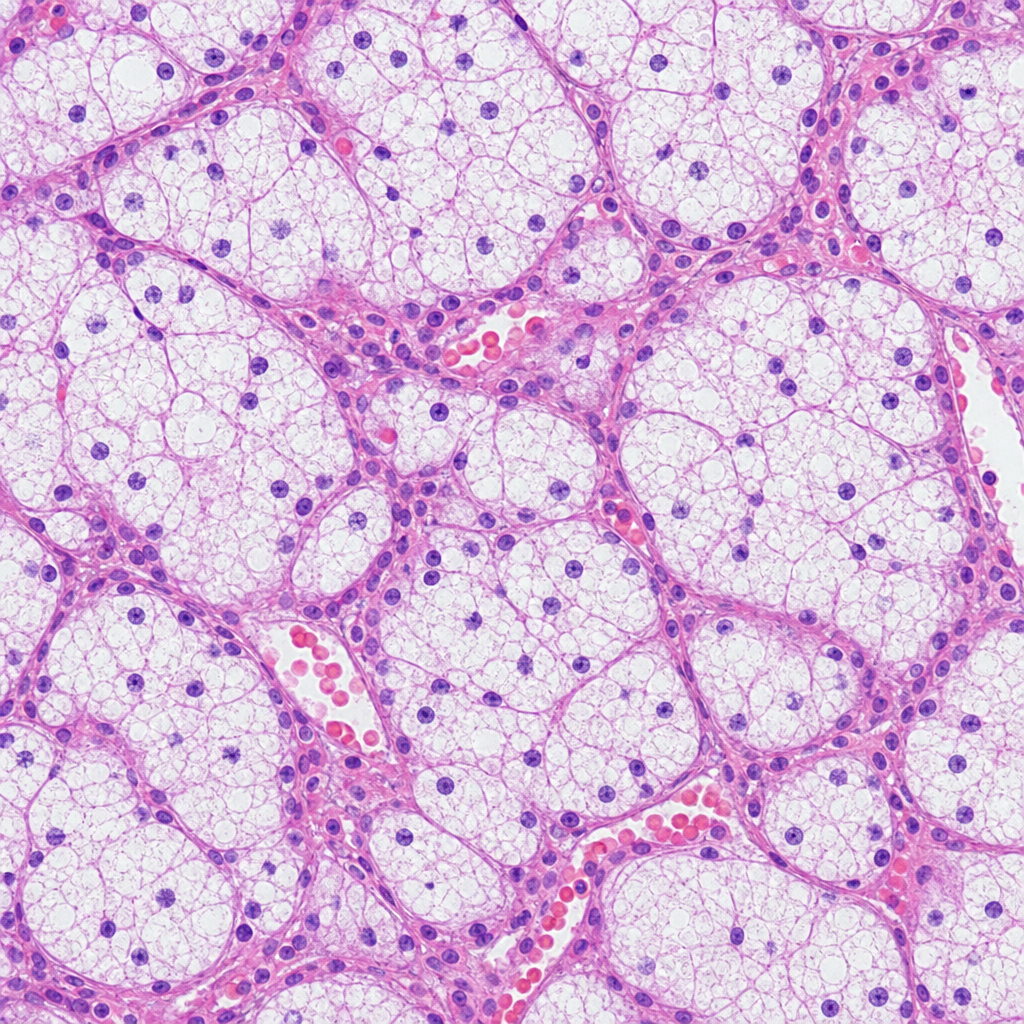
Question 251: A patient presents with headaches, palpitations, hypertension, and urine VMA positivity. The biopsy findings are shown in the image. Which of the following statements is correct?
- A. Mostly malignant
- B. Mostly in children
- C. Mostly bilateral
- D. Associated with MEN 2A (Correct Answer)
Explanation: ***Associated with MEN 2A*** - The clinical presentation (headaches, palpitations, hypertension) and positive **urine VMA (vanillylmandelic acid)** strongly suggest a **pheochromocytoma**. - Pheochromocytomas are tumors of the adrenal medulla that secrete catecholamines and are frequently associated with **Multiple Endocrine Neoplasia Type 2A (MEN 2A)**, along with medullary thyroid carcinoma and primary hyperparathyroidism. *Mostly malignant* - Pheochromocytomas are generally benign, with approximately **10% being malignant** ("rule of 10s"). - Malignancy is difficult to predict based on histology alone and is usually defined by the presence of **metastases**. *Mostly in children* - While pheochromocytomas can occur at any age, they are **more common in adults**, typically between 30 and 50 years old. - When they do occur in children, they are more often bilateral, extra-adrenal, or associated with genetic syndromes. *Mostly bilateral* - The majority of pheochromocytomas (approximately **90%**) are **unilateral**. - Bilateral pheochromocytomas are often seen in genetic syndromes such as **MEN 2**, von Hippel-Lindau disease, and neurofibromatosis type 1.
Question 252: A 32-year-old female presents with a 2-month history of progressive, painless swelling in the left side of her neck. She also reports low-grade fever, night sweats, and unintentional weight loss. Physical examination reveals a firm, non-tender, immobile mass in the left cervical region, and multiple smaller lymph nodes in the supraclavicular area. Chest X-ray shows mediastinal widening, and a lymph node biopsy confirms the presence of Reed-Sternberg cells. What is the most appropriate management for this patient?
- A. NHL with a highly aggressive chemotherapy regimen
- B. Hodgkin Lymphoma with the ABVD regimen (Correct Answer)
- C. NHL with Rituximab
- D. Hodgkin Lymphoma with surgical excision only
- E. Hodgkin Lymphoma with radiation therapy only
Explanation: ***Hodgkin Lymphoma with the ABVD regimen*** - The presence of **Reed-Sternberg cells** in a lymph node biopsy, along with **painless lymphadenopathy**, **mediastinal widening**, and **B symptoms** (fever, night sweats, weight loss), is characteristic of **Hodgkin Lymphoma**. - **ABVD chemotherapy** (Adriamycin, Bleomycin, Vinblastine, Dacarbazine) is the standard frontline treatment regimen for Hodgkin Lymphoma, especially in advanced stages or with B symptoms. *NHL with a highly aggressive chemotherapy regimen* - This patient's symptoms and especially the presence of **Reed-Sternberg cells** are pathognomonic for **Hodgkin Lymphoma**, not Non-Hodgkin Lymphoma (NHL). - While some NHLs require aggressive chemotherapy, the specific findings in this case point away from an NHL diagnosis. *NHL with Rituximab* - **Rituximab** is a monoclonal antibody targeting the **CD20 antigen** found on B-cells and is primarily used in the treatment of **B-cell Non-Hodgkin Lymphomas**. - Since the diagnosis here is Hodgkin Lymphoma, characterized by Reed-Sternberg cells (which are atypical B cells that typically lack CD20), rituximab is not an appropriate primary treatment. *Hodgkin Lymphoma with surgical excision only* - **Hodgkin Lymphoma** is a systemic disease, as evidenced by mediastinal widening and B symptoms, indicating spread beyond a localized area. - **Surgical excision alone** is not curative for Hodgkin Lymphoma; systemic chemotherapy, often combined with radiation therapy, is essential for effective treatment. *Hodgkin Lymphoma with radiation therapy only* - While **radiation therapy** plays a role in Hodgkin Lymphoma treatment, it is typically used in **combination with chemotherapy** (combined modality therapy) or reserved for **early-stage, favorable-risk disease without B symptoms**. - This patient presents with **advanced disease** (mediastinal involvement, B symptoms, multiple lymph node regions), which requires **systemic chemotherapy** as the primary treatment modality. - Radiation alone would be inadequate for achieving optimal disease control and cure in this clinical scenario.
Pathology
1 questionsWhich of the following is an intracellular marker or deposition found in Alzheimer's disease?
NEET-PG 2024 - Pathology NEET-PG Practice Questions and MCQs
Question 251: Which of the following is an intracellular marker or deposition found in Alzheimer's disease?
- A. Tau protein (Correct Answer)
- B. A β 40 / 42 (Amyloid-beta 40/42)
- C. Alpha-synuclein
- D. TDP-43
Explanation: ***Tau protein*** - **Tau protein** forms **neurofibrillary tangles** within the neurons, which is a hallmark intracellular lesion in Alzheimer's disease [1]. - These tangles disrupt neuronal transport systems, leading to **synaptic dysfunction** and cell death [1]. *A ̢ 40 / 42 (Amyloid-beta 40/42)* - **Amyloid-beta** peptides aggregate to form **extracellular amyloid plaques**, not intracellular deposits, in Alzheimer's disease [2]. - While central to the pathology, these **plaques** are found outside of the neurons in the brain parenchyma [2]. *Alpha-synuclein* - **Alpha-synuclein** is the primary component of **Lewy bodies**, which are intracellular inclusions characteristic of Parkinson's disease and Lewy body dementia. - It is not a primary marker for Alzheimer's disease pathology. *TDP-43* - **TDP-43 (TAR DNA-binding protein 43)** inclusions are characteristic of **frontotemporal lobar degeneration (FTLD)** and amyotrophic lateral sclerosis (ALS). - While sometimes co-occurs with Alzheimer's, it is not a primary or defining intracellular marker for Alzheimer's disease itself. **References:** [1] Kumar V, Abbas AK, et al.. Robbins and Cotran Pathologic Basis of Disease. 9th ed. The Central Nervous System, pp. 1292-1294. [2] Kumar V, Abbas AK, et al.. Robbins and Cotran Pathologic Basis of Disease. 9th ed. The Central Nervous System, pp. 1290-1292.
Surgery
2 questionsA nasal surgery was carried out with the incision shown in the image. What was the procedure likely carried out?

Which of the following procedures would be difficult to perform based on the given Chest X-ray?

NEET-PG 2024 - Surgery NEET-PG Practice Questions and MCQs
Question 251: A nasal surgery was carried out with the incision shown in the image. What was the procedure likely carried out?
- A. Submucosal resection (SMR)
- B. FESS (Functional Endoscopic Sinus Surgery)
- C. Open rhinoplasty (Correct Answer)
- D. Caldwell-Luc's procedure
Explanation: ***Open rhinoplasty*** - The image displays a **transcolumellar incision** (typically inverted V or W-shaped), which is the hallmark approach for **open rhinoplasty**. - This incision allows for direct visualization of the underlying nasal cartilages and bones, enabling precise reshaping of the nose. *Submucosal resection (SMR)* - SMR is a procedure to correct a **deviated nasal septum** by removing cartilage or bone from beneath the mucoperichondrial flaps. - It involves an **intranasal incision**, usually along the septal mucosa, not an external transcolumellar incision. *FESS (Functional Endoscopic Sinus Surgery)* - FESS is a minimally invasive procedure used to treat **chronic sinusitis** and other sinus conditions. - It is performed entirely **endoscopically through the nostrils**, with no external incisions on the nasal columella. *Caldwell-Luc's procedure* - This procedure accesses the **maxillary sinus** through an incision in the upper gum beneath the lip. - It is used for drainage of the maxillary sinus or removal of foreign bodies/tumors, and does not involve an external nasal incision.
Question 252: Which of the following procedures would be difficult to perform based on the given Chest X-ray?
- A. Tracheostomy (Correct Answer)
- B. Laryngeal mask airway insertion
- C. Ryle's tube insertion
- D. Intubation
Explanation: ***Tracheostomy*** - The chest X-ray shows the presence of a **large thyroid mass** (appearing as a soft tissue density in the neck and upper mediastinum), which would displace the trachea and obscure anatomical landmarks, making a tracheostomy technically challenging and increasing the risk of complications. - A tracheostomy requires clear access to the anterior tracheal wall, which would be **directly obstructed** by the prominent thyroid hypertrophy visible on the X-ray. - This makes tracheostomy the **most difficult** procedure among the options, with significant risk of bleeding from engorged thyroid vessels and difficulty identifying the trachea. *Laryngeal mask airway insertion* - Laryngeal mask airway (LMA) insertion primarily involves placing a device over the **laryngeal inlet** and is not significantly affected by a mass lower in the neck impacting the trachea. - The LMA is a supraglottic device, and its placement does not require direct access to the trachea itself or the deeper structures of the neck. *Ryle's tube insertion* - Ryle's tube (nasogastric tube) insertion involves passing a tube from the **nose or mouth into the esophagus and stomach**. - This procedure is generally unaffected by a thyroid mass, as it primarily involves the gastrointestinal tract, which is anatomically separate from the trachea in the neck region. *Intubation* - Intubation (endotracheal intubation) involves placing a tube into the **trachea via the mouth or nose**, usually past the vocal cords. - While a large retrosternal thyroid mass can cause tracheal deviation and compression that may complicate intubation, it is generally **less difficult than tracheostomy** in this scenario. - Intubation can often be achieved with experienced anesthesia techniques (videolaryngoscopy, fiberoptic intubation), whereas tracheostomy faces direct surgical field obstruction by the thyroid mass itself. - The primary challenge for intubation is visualization and navigation past the vocal cords, not the direct anatomical obstruction at the surgical site that makes tracheostomy particularly difficult.