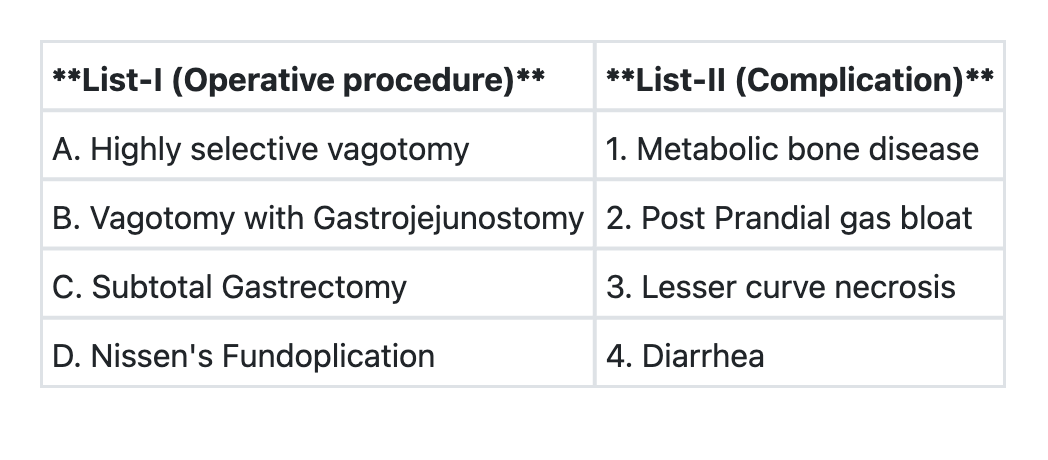
Match List-I with List-II and select the correct answer using the code given below the Lists: **List-I (Procedure)** A. Highly selective vagotomy B. Vagotomy with gastrojejunostomy C. Subtotal gastrectomy D. Nissen's fundoplication **List-II (Complication)** 1. Metabolic bone disease 2. Post-prandial gas bloat 3. Lesser curve necrosis 4. Diarrhea **Code:**
An electrical contact burn is considered to be:
A 52 year old male patient comes with history of rectal bleeding, alteration in bowel habits and tenesmus. The ideal investigation would be:
What is the treatment of choice in a patient with Crohn’s disease, where inflamed appendix was found on exploration?
On second day following femoral embolectomy, the leg is found to be tender, tense and dusky with feeble dorsalis pedis pulse. The most appropriate management would be:
A colonic carcinoma involving muscularis propria, with one or two nodes involved with a solitary metastasis in the liver, the TNM stage would be:
After undergoing surgery, for carcinoma of colon, a patient developed single liver metastasis of 2 cm. What would be the next treatment?
Which one of the following parts of intussusception is most susceptible to ischaemia and perforation?
A 30 year old lady comes with history of bloody discharge from her right nipple while taking bath. On examination, there is a cystic swelling in the subareolar region. The clinical diagnosis would be:
Which of the following is not true regarding ‘no scalpel’ vasectomy?
UPSC-CMS 2014 - Surgery UPSC-CMS Practice Questions and MCQs
Question 11: Match List-I with List-II and select the correct answer using the code given below the Lists: **List-I (Procedure)** A. Highly selective vagotomy B. Vagotomy with gastrojejunostomy C. Subtotal gastrectomy D. Nissen's fundoplication **List-II (Complication)** 1. Metabolic bone disease 2. Post-prandial gas bloat 3. Lesser curve necrosis 4. Diarrhea **Code:**
- A. A→2 B→1 C→4 D→3
- B. A→2 B→4 C→1 D→3 (Correct Answer)
- C. A→3 B→1 C→4 D→2
- D. A→3 B→4 C→1 D→2
Explanation: ***A→2 B→4 C→1 D→3*** - **Highly selective vagotomy** (HSV) aims to reduce gastric acid secretion by denervating only the parietal cell mass, sparing the antrum and pylorus. A potential complication due to altered gastric motility and emptying can be **post-prandial gas bloat** or fullness. - **Vagotomy with gastrojejunostomy** involves severing the vagus nerve, which can lead to altered gastrointestinal motility and malabsorption. **Diarrhea** is a common complication due to accelerated transit time and bacterial overgrowth. - **Subtotal gastrectomy** involves the removal of a significant portion of the stomach. This procedure can lead to malabsorption of nutrients, including calcium and vitamin D, resulting in **metabolic bone disease**. - **Nissen's Fundoplication** is a procedure to treat gastroesophageal reflux disease (GERD) by wrapping the gastric fundus around the lower esophageal sphincter. **Lesser curve necrosis** is a rare but severe complication that can occur due to devascularization during the procedure. *A→2 B→1 C→4 D→3* - This option incorrectly associates vagotomy with gastrojejunostomy with metabolic bone disease and subtotal gastrectomy with diarrhea. While diarrhea can occur after gastrectomy, metabolic bone disease is a more specific and significant long-term complication of subtotal gastrectomy due to malabsorption. - Furthermore, this option suggests that metabolic bone disease is a complication of vagotomy with gastrojejunostomy, which is not a primary or common complication of this procedure. *A→3 B→1 C→4 D→2* - This option incorrectly links highly selective vagotomy with lesser curve necrosis and vagotomy with gastrojejunostomy with metabolic bone disease. Lesser curve necrosis is a specific complication linked to Nissen's fundoplication, not HSV. - It also misassociates subtotal gastrectomy with diarrhea as the primary unique complication, and Nissen's fundoplication with post-prandial gas bloat, which is more typical of vagotomy. *A→3 B→4 C→1 D→2* - This option incorrectly pairs highly selective vagotomy with lesser curve necrosis, similar to one of the previous incorrect options. Lesser curve necrosis is a known specific complication of Nissen's fundoplication, not vagotomy. - It also incorrectly links Nissen's fundoplication with post-prandial gas bloat, which is a symptom more commonly associated with procedures that affect gastric emptying, such as vagotomy, rather than fundoplication.
Question 12: An electrical contact burn is considered to be:
- A. Superficial partial thickness burn
- B. Full thickness burn (Correct Answer)
- C. Superficial scalding with blisters
- D. Deep partial thickness burn
Explanation: ***Full thickness burn*** - Electrical contact burns are characterized by **high heat** generated at the point of contact, leading to **deep tissue destruction** that extends through the entire dermis and often into subcutaneous fat, muscle, or bone - The current pathway through the body causes additional damage internally, but the contact point itself typically reflects a **third-degree (full thickness) injury** due to intense localized heat - Entry and exit wounds from electrical burns characteristically show **charred, dry tissue** with central necrosis *Superficial partial thickness burn* - This type of burn involves only the **epidermis and superficial portion of the dermis**, typically presenting with blistering and redness - Electrical burns, especially contact burns, rarely result in such shallow injury due to the **intense and deep nature** of the energy transfer - The high voltage and current density at contact points cause damage far beyond superficial layers *Superficial scalding with blisters* - **Scald burns** are caused by hot liquids or steam and are typically **superficial or superficial partial thickness** - An electrical contact burn is distinct in its mechanism (electrical current) and the **severity of tissue damage** it causes, which extends far beyond the superficial layers - The mechanism of injury is fundamentally different from thermal scalding *Deep partial thickness burn* - Deep partial thickness burns extend into the **deeper dermis**, causing fluid-filled blisters and often mottled or waxy white areas - While electrical burns can involve deeper structures, the direct point of contact in an electrical contact burn usually causes damage that is **full thickness or beyond**, going past just the deep dermis - The concentrated heat and current flow at entry/exit sites result in complete destruction of all skin layers
Question 13: A 52 year old male patient comes with history of rectal bleeding, alteration in bowel habits and tenesmus. The ideal investigation would be:
- A. Contrast-enhanced CT scan
- B. Fecal occult blood test
- C. Colonoscopy (Correct Answer)
- D. Ultrasonogram
Explanation: ***Colonoscopy*** - **Colonoscopy** is the gold standard for investigating symptoms like rectal bleeding, altered bowel habits, and tenesmus, as it allows for direct visualization of the entire colon and rectum. - It enables **biopsy of suspicious lesions** for histopathological diagnosis, which is crucial for confirming conditions like colorectal cancer or inflammatory bowel disease. *Contrast-enhanced CT scan* - A **contrast-enhanced CT scan** is primarily used for **staging known malignancies** and assessing for distant metastases, not as a primary diagnostic tool for initial symptoms. - While it can identify large masses, it might miss smaller lesions and does not allow for tissue biopsy. *Fecal occult blood test* - A **fecal occult blood test** screens for blood in the stool, which indicates gastrointestinal bleeding but does not pinpoint the source or cause. - It has **low sensitivity and specificity** for diagnosing underlying conditions like colorectal cancer or inflammatory bowel disease and is mainly a screening tool. *Ultrasonogram* - An **ultrasonogram** is generally not effective for evaluating the colon and rectum due to bowel gas interference. - It is more commonly used for investigating abdominal organs like the liver, gallbladder, and kidneys, or for pelvic pathology, but not the primary investigation for these colorectal symptoms.
Question 14: What is the treatment of choice in a patient with Crohn’s disease, where inflamed appendix was found on exploration?
- A. Appendectomy
- B. Closing the abdomen and starting medical treatment
- C. Right hemicolectomy
- D. Ileo–colic resection and anastomosis (Correct Answer)
Explanation: ***Ileo-colic resection and anastomosis*** - This is the treatment of choice when an inflamed appendix is found during exploration in a patient with Crohn's disease, as the disease typically affects the **terminal ileum** and **right colon**. - The inflamed appendix is often a manifestation of Crohn's disease involving the **cecal base** and surrounding bowel. - **Ileo-colic resection** ensures removal of the diseased segment, including the inflamed appendix and involved bowel, thereby preventing future complications such as **fistulas** (risk up to 65% with simple appendectomy) and **strictures**. - If the cecal base is involved with Crohn's disease, simple appendectomy is contraindicated due to poor healing and high fistula risk. *Appendectomy* - Performing a simple appendectomy in the context of Crohn's disease carries a high risk of **fistula formation** and **poor wound healing** due to the underlying inflammatory process. - When the disease involves the **base of the appendix** and surrounding **cecum** (which is common), appendectomy alone is insufficient and dangerous. - Appendectomy may only be considered safe if the cecal base is completely **normal and uninvolved**, which is uncommon in this clinical scenario. *Closing the abdomen and starting medical treatment* - While medical treatment is crucial for managing Crohn's disease, an **inflamed appendix** found during exploration suggests an acute process that requires **surgical intervention**. - Delaying surgery by closing the abdomen could lead to complications such as **perforation** and **peritonitis**, especially if inflammation is severe. - Medical therapy alone is insufficient for acute complications requiring exploration. *Right hemicolectomy* - Right hemicolectomy is a more extensive resection than necessary for most cases of ileocecal Crohn's disease with appendiceal involvement. - **Ileo-colic resection** (removing terminal ileum, cecum, and ascending colon up to the hepatic flexure) is adequate and preferred as it is less extensive while addressing the pathology. - Right hemicolectomy would be reserved for more extensive colonic involvement beyond the typical ileocecal distribution.
Question 15: On second day following femoral embolectomy, the leg is found to be tender, tense and dusky with feeble dorsalis pedis pulse. The most appropriate management would be:
- A. Dye studies
- B. Doing re-embolectomy
- C. Fasciotomy (Correct Answer)
- D. Anticoagulant therapy
Explanation: ***Fasciotomy*** - The symptoms (tender, tense, dusky leg with feeble dorsalis pedis pulse) occurring after revascularization strongly suggest developing **compartment syndrome**. - **Fasciotomy** is the most appropriate management to relieve pressure, restore blood flow, and prevent irreversible muscle and nerve damage. *Dye studies* - While imaging like angiography (dye studies) can assess vascular patency, they are not the immediate solution for suspected **compartment syndrome**. - Delaying definitive treatment for compartment syndrome for imaging can lead to **irreversible tissue damage**. *Doing re-embolectomy* - The problem is unlikely to be a persistent or recurrent embolus given the prior embolectomy and the presentation suggesting **compartment syndrome**, not ongoing arterial occlusion. - Repeating the procedure without addressing the underlying compartment pressure would be ineffective and potentially harmful. *Anticoagulant therapy* - Anticoagulation is crucial for preventing new clots or re-thrombosis but does not resolve the acute mechanical compression and ischemia of **compartment syndrome**. - It's part of the overall management but not the primary intervention for the immediate life-threatening limb condition described.
Question 16: A colonic carcinoma involving muscularis propria, with one or two nodes involved with a solitary metastasis in the liver, the TNM stage would be:
- A. T2 N1 M1 (Correct Answer)
- B. T1 N2 M1
- C. T1 N1 M1
- D. T2 N2 M1
Explanation: ***T2 N1 M1*** **(Correct Answer)** - **T2** indicates the tumor invades the **muscularis propria** in the TNM classification for colorectal cancer. - **N1** signifies involvement of **one to three regional lymph nodes**, which corresponds to "one or two nodes involved" in the question. - **M1** denotes the presence of **distant metastasis**, specifically a "solitary metastasis in the liver" as described. *T1 N2 M1* - **T1** describes a tumor that invades the **submucosa** but not the muscularis propria, which is less advanced than the scenario described. - **N2** would imply involvement of **four or more regional lymph nodes**, contradicting the "one or two nodes involved" stated in the question. *T1 N1 M1* - **T1** indicates invasion into the **submucosa**, not reaching the muscularis propria as specified in the case description. - The **N1** and **M1** components are consistent with the nodal involvement and distant metastasis, but the **T stage** is incorrect. *T2 N2 M1* - While **T2** is correct for invasion into the muscularis propria, **N2** incorrectly implies involvement of **four or more regional lymph nodes**. - The question states "one or two nodes involved," making **N1** the appropriate nodal classification.
Question 17: After undergoing surgery, for carcinoma of colon, a patient developed single liver metastasis of 2 cm. What would be the next treatment?
- A. Radio frequency ablation
- B. Chemo-radiation
- C. Acetic acid injection
- D. Resection (Correct Answer)
Explanation: ***Resection*** - For a **single, resectable liver metastasis** from colorectal carcinoma, surgical **resection offers the best chance of cure** and is the gold standard of treatment. - The size of the metastasis (2 cm) is well within the criteria for surgical removal, and the absence of multiple lesions or widespread disease makes it a prime candidate for curative surgery. *Radio frequency ablation* - **RFA** is typically considered for patients with **unresectable liver metastases** or those who are not surgical candidates. - While it can be effective for small lesions, it is generally preferred when resection is not possible due to factors like lesion location (e.g. adjacent to major vessels), patient comorbidities, or multiple lesions. *Chemo-radiation* - **Chemoradiation** is more commonly used in the treatment of the **primary colorectal cancer** itself, especially in locally advanced rectal cancer, or for palliative purposes in metastatic disease. - It is **not the primary curative treatment** for an isolated, resectable liver metastasis. *Acetic acid injection* - **Acetic acid injection** is a form of **chemical ablation** and is sometimes used for small liver tumors, particularly hepatocellular carcinoma. - It is generally considered **less effective and less predictable** than RFA or surgical resection for colorectal liver metastases and is not the preferred treatment for a resectable lesion.
Question 18: Which one of the following parts of intussusception is most susceptible to ischaemia and perforation?
- A. Apex (Correct Answer)
- B. Neck
- C. Intussuscipiens
- D. Intussusceptum
Explanation: ***Apex*** - The **apex** is the **leading edge** (distal tip) of the intussusceptum that protrudes furthest into the intussuscipiens. - It is the **most distal point** from its blood supply and experiences the **greatest degree of vascular compromise**. - The apex suffers from **pressure necrosis** due to compression against the intussuscipiens and maximal venous congestion. - This makes it the **most susceptible site for ischemia, necrosis, and perforation** in intussusception. - Clinically, when perforation occurs, it is **most commonly at the apex**. *Neck* - The **neck** is the constricted point where the intussusceptum enters the intussuscipiens. - While the neck does compress the **mesentery and blood vessels**, causing venous outflow obstruction that affects the entire intussusceptum, it is not itself the most susceptible site for perforation. - The neck causes the ischemia, but the apex suffers the most from it. *Intussuscipiens* - The **intussuscipiens** is the **outer receiving segment** that engulfs the intussusceptum. - Its blood supply remains relatively intact as it is not invaginated. - It is **not susceptible** to ischemia in the same way as the invaginated segment. *Intussusceptum* - The **intussusceptum** refers to the **entire invaginated inner segment**. - While the whole intussusceptum can become ischemic, the question asks for the **specific part** most susceptible. - Within the intussusceptum, the **apex is the most vulnerable point** for ischemia and perforation.
Question 19: A 30 year old lady comes with history of bloody discharge from her right nipple while taking bath. On examination, there is a cystic swelling in the subareolar region. The clinical diagnosis would be:
- A. Duct ectasia
- B. Fibrocystic disease
- C. Intraductal carcinoma
- D. Intraductal papilloma (Correct Answer)
Explanation: ***Intraductal papilloma*** - **Bloody nipple discharge**, especially unilateral and spontaneous, is the hallmark symptom of an **intraductal papilloma**. - The presence of a **subareolar cystic swelling** further supports this diagnosis, as papillomas are benign growths arising within the breast ducts. *Duct ectasia* - This condition typically presents with a **thick, sticky, multi-colored nipple discharge**, not usually bloody. - It is more common in **perimenopausal** or postmenopausal women and is often associated with inflammation and nipple retraction. *Fibrocystic disease* - Characterized by **cyclic breast pain**, tenderness, and multiple palpable masses, often bilateral. - Nipple discharge, if present, is usually **clear, green, or brown**, but rarely bloody. *Intraductal carcinoma* - While it can cause bloody nipple discharge, it is less common in this age group (30-year-old). - More likely to present with a **firm or hard palpable mass** rather than a cystic swelling, and often accompanied by skin changes or nipple retraction. - The benign cystic nature of the swelling makes intraductal papilloma more likely in this clinical scenario.
Question 20: Which of the following is not true regarding ‘no scalpel’ vasectomy?
- A. The failure rate is same as that of conventional vasectomy.
- B. Scrotal skin is cut with LASER to expose the vas. (Correct Answer)
- C. Special instruments are used to deliver the vas instead of cutting the skin.
- D. It is a very popular method in China.
Explanation: ***Scrotal skin is cut with LASER to expose the vas.*** - The "no-scalpel" technique specifically avoids cutting the scrotal skin with a **scalpel** or **LASER**. - Instead, a **small puncture** is made using a specialized instrument to access the vas deferens. *The failure rate is same as that of conventional vasectomy.* - The failure rate for no-scalpel vasectomy is generally very low and comparable to, or even slightly lower than, conventional vasectomy. - This is due to the precise identification and handling of the **vas deferens** through the small puncture. *Special instruments are used to deliver the vas instead of cutting the skin.* - This statement is true; the no-scalpel technique utilizes **specialized forceps** to puncture and stretch the scrotal skin. - This creates a small opening to access the vas deferens without needing a traditional incision. *It is a very popular method in China.* - The no-scalpel vasectomy technique was developed in China in 1974 by Dr. Li Shunqiang, where it gained widespread adoption. - Its popularity in China significantly contributed to its global recognition as a minimally invasive and effective method for male contraception.