Internal Medicine
2 questionsWhich one of the following statements is not correct regarding trichobezoar ( hair balls)?
Which one of the following is given a score of two in Alvarado score?
UPSC-CMS 2014 - Internal Medicine UPSC-CMS Practice Questions and MCQs
Question 31: Which one of the following statements is not correct regarding trichobezoar ( hair balls)?
- A. It is associated usually with psychiatric illness.
- B. It is usually associated with pyloric stenosis. (Correct Answer)
- C. It is more common in females.
- D. It is more common in young.
Explanation: ***It is usually associated with pyloric stenosis.*** - **Trichobezoars** are generally not associated with **pyloric stenosis**. The two conditions have distinct etiologies and pathophysiologies. - While both can present with gastric outlet obstruction symptoms, the presence of a hairball does not imply an underlying congenital or acquired narrowing of the pylorus. *It is associated usually with psychiatric illness.* - **Trichobezoars** are highly associated with **trichophagia** (compulsive hair eating), which is often a symptom of underlying psychiatric conditions like **trichotillomania** or **pica**. - These conditions involve an irresistible urge to pull out one's hair and/or consume non-nutritive substances, including hair. *It is more common in females.* - **Trichobezoars** are indeed more commonly found in **females**, especially young females [1]. - This increased prevalence is often linked to the higher incidence of **trichotillomania** and **trichophagia** in females. *It is more common in young.* - **Trichobezoars** are observed more frequently in **children and adolescents**, particularly among young girls [1]. - The behaviors of **trichotillomania** and **trichophagia** often develop during childhood or early adolescence [1].
Question 32: Which one of the following is given a score of two in Alvarado score?
- A. Leukocytosis (Correct Answer)
- B. Anorexia
- C. Pyrexia
- D. Rebound tenderness
Explanation: ***Leukocytosis*** - A **leukocyte count greater than 10,000/mm³** (leukocytosis) is assigned a score of **two points** in the Alvarado score. [2] - This parameter reflects the systemic inflammatory response often associated with acute appendicitis. [1] *Anorexia* - **Anorexia**, or loss of appetite, is a common symptom in acute appendicitis but is only assigned **one point** in the Alvarado score. - It is a non-specific symptom that can be present in numerous conditions. *Pyrexia* - **Pyrexia** (fever) is another indicator of inflammation, but in the Alvarado score, a **fever of 37.3°C or higher** is given only **one point**. - This symptom, while important, does not carry the same weight as a significant elevation in white blood cell count. *Rebound tenderness* - **Rebound tenderness** is a sign of peritoneal irritation and is given **one point** in the Alvarado score. [1] - While strongly correlated with appendicitis, it is a clinical finding rather than a laboratory marker.
Obstetrics and Gynecology
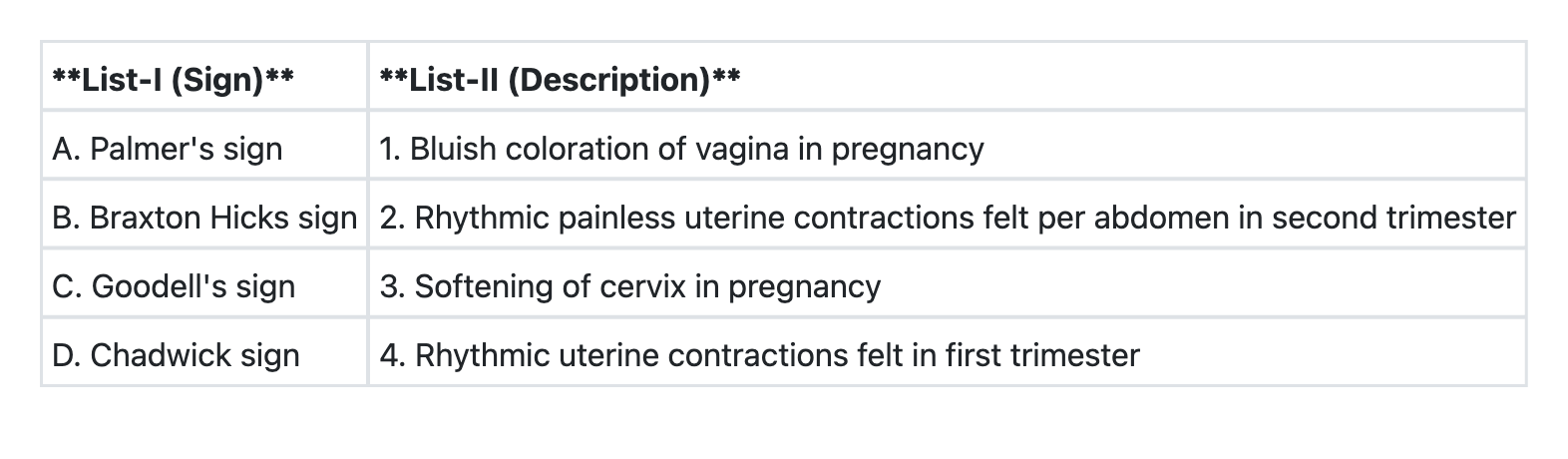
1 questionsMatch List-I with List-II and select the correct answer using the code given below the Lists:
UPSC-CMS 2014 - Obstetrics and Gynecology UPSC-CMS Practice Questions and MCQs
Question 31: Match List-I with List-II and select the correct answer using the code given below the Lists:
- A. A→1 B→2 C→3 D→4
- B. A→4 B→2 C→3 D→1 (Correct Answer)
- C. A→3 B→2 C→1 D→4
- D. A→2 B→3 C→1 D→4
Explanation: ***A→4 B→2 C→3 D→1*** - **Palmer's sign** refers to **rhythmic uterine contractions** felt by bimanual examination in the **first trimester** of pregnancy. This is often an early sign used to detect pregnancy. - **Braxton Hicks contractions** are characterized by **rhythmic, painless uterine contractions** that are felt per abdomen and typically occur in the **second and third trimesters** of pregnancy. They are often called "practice contractions." - **Goodell's sign** describes the **softening of the cervix** in early pregnancy due to increased vascularity and edema. - **Chadwick's sign** is the **bluish coloration of the vagina and cervix** in pregnancy, also due to increased vascularity and blood flow. *A→1 B→2 C→3 D→4* - This option incorrectly matches Palmer's sign with bluish coloration of the vagina, which is **Chadwick's sign**. - It also incorrectly matches Chadwick's sign with rhythmic uterine contractions in the first trimester, which is **Palmer's sign**. *A→3 B→2 C→1 D→4* - This option incorrectly matches Palmer's sign with softening of the cervix (**Goodell's sign**) and Goodell's sign with bluish coloration of the vagina (**Chadwick's sign**). - It also incorrectly matches Chadwick's sign with rhythmic uterine contractions in the first trimester (**Palmer's sign**). *A→2 B→3 C→1 D→4* - This option incorrectly matches Palmer's sign with Braxton Hicks contractions and Braxton Hicks sign with softening of the cervix, which is **Goodell's sign**. - It also incorrectly matches Goodell's sign with bluish coloration of the vagina (**Chadwick's sign**) and Chadwick's sign with rhythmic contractions in the first trimester (**Palmer's sign**).
Pediatrics
1 questionsConsider the following conditions: 1. Otitis media 2. Speech problems 3. Dentition abnormalities Which of the above is/are associated with cleft palate?
UPSC-CMS 2014 - Pediatrics UPSC-CMS Practice Questions and MCQs
Question 31: Consider the following conditions: 1. Otitis media 2. Speech problems 3. Dentition abnormalities Which of the above is/are associated with cleft palate?
- A. 1 and 3 only
- B. 2 and 3 only
- C. 1 only
- D. 1, 2 and 3 (Correct Answer)
Explanation: ***1, 2 and 3*** - All three conditions—**otitis media, speech problems, and dentition abnormalities**—are commonly associated with **cleft palate** due to anatomical and functional disruptions. - The abnormal palatal structure affects Eustachian tube function, speech articulation, and proper tooth development and alignment. *1 and 3 only* - This option incorrectly excludes **speech problems**, which are a very common and significant consequence of cleft palate. - The inability of the palate to close off the nasal cavity during speech leads to hypernasality and articulatory difficulties. *2 and 3 only* - This option incorrectly excludes **otitis media**, which is a frequent complication in individuals with cleft palate due to impaired **Eustachian tube function**. - The muscle attachments involving the soft palate and Eustachian tube orifice are often anomalous, leading to chronic middle ear fluid and infections. *1 only* - This option is incomplete as it only includes **otitis media**, while **speech problems** and **dentition abnormalities** are also major and well-documented sequelae of cleft palate. - The structural defect impacts multiple orofacial and auditory functions.
Radiology
1 questionsAn air fluid level with dilated oesophagus and “bird beak” appearance in a barium swallow is diagnostic of:
UPSC-CMS 2014 - Radiology UPSC-CMS Practice Questions and MCQs
Question 31: An air fluid level with dilated oesophagus and “bird beak” appearance in a barium swallow is diagnostic of:
- A. Carcinoma oesophagus
- B. Barrett's oesophagus
- C. Achalasia cardia (Correct Answer)
- D. Hiatus hernia
Explanation: ***Achalasia cardia*** - The classic radiographic features of achalasia on a barium swallow include a **dilated esophagus** with proximal food retention (leading to an **air-fluid level**) and a characteristic narrowing at the gastroesophageal junction, creating a **"bird-beak" appearance**. - This appearance is due to the failure of the lower esophageal sphincter to relax during swallowing, combined with absent esophageal peristalsis. *Carcinoma oesophagus* - Oesophageal carcinoma typically presents as an **irregular, constricting lesion** or a **filling defect** on barium swallow, often with mucosal irregularity or shelf-like margins, rather than a smooth "bird beak." - While it can cause dysphagia and possibly proximal dilation, the specific "bird beak" morphology is not characteristic of cancer. *Barrett's oesophagus* - Barrett's esophagus is a histological diagnosis involving **metaplastic changes** in the esophageal lining, usually due to chronic GERD. - It does not have a distinct radiographic appearance on barium swallow, though it might be associated with reflux changes or **ulcerations**, but not a "bird beak" sign. *Hiatus hernia* - Hiatus hernias are characterized by the **protrusion of a portion of the stomach into the chest cavity** through the esophageal hiatus of the diaphragm. - On a barium swallow, this appears as an **accumulation of barium above the diaphragm**, often with a wide opening at the esophagogastric junction, which is distinct from the narrowed "bird beak" of achalasia.
Surgery
5 questionsOn second day following femoral embolectomy, the leg is found to be tender, tense and dusky with feeble dorsalis pedis pulse. The most appropriate management would be:
A colonic carcinoma involving muscularis propria, with one or two nodes involved with a solitary metastasis in the liver, the TNM stage would be:
After undergoing surgery, for carcinoma of colon, a patient developed single liver metastasis of 2 cm. What would be the next treatment?
Which one of the following parts of intussusception is most susceptible to ischaemia and perforation?
A 30 year old lady comes with history of bloody discharge from her right nipple while taking bath. On examination, there is a cystic swelling in the subareolar region. The clinical diagnosis would be:
UPSC-CMS 2014 - Surgery UPSC-CMS Practice Questions and MCQs
Question 31: On second day following femoral embolectomy, the leg is found to be tender, tense and dusky with feeble dorsalis pedis pulse. The most appropriate management would be:
- A. Dye studies
- B. Doing re-embolectomy
- C. Fasciotomy (Correct Answer)
- D. Anticoagulant therapy
Explanation: ***Fasciotomy*** - The symptoms (tender, tense, dusky leg with feeble dorsalis pedis pulse) occurring after revascularization strongly suggest developing **compartment syndrome**. - **Fasciotomy** is the most appropriate management to relieve pressure, restore blood flow, and prevent irreversible muscle and nerve damage. *Dye studies* - While imaging like angiography (dye studies) can assess vascular patency, they are not the immediate solution for suspected **compartment syndrome**. - Delaying definitive treatment for compartment syndrome for imaging can lead to **irreversible tissue damage**. *Doing re-embolectomy* - The problem is unlikely to be a persistent or recurrent embolus given the prior embolectomy and the presentation suggesting **compartment syndrome**, not ongoing arterial occlusion. - Repeating the procedure without addressing the underlying compartment pressure would be ineffective and potentially harmful. *Anticoagulant therapy* - Anticoagulation is crucial for preventing new clots or re-thrombosis but does not resolve the acute mechanical compression and ischemia of **compartment syndrome**. - It's part of the overall management but not the primary intervention for the immediate life-threatening limb condition described.
Question 32: A colonic carcinoma involving muscularis propria, with one or two nodes involved with a solitary metastasis in the liver, the TNM stage would be:
- A. T2 N1 M1 (Correct Answer)
- B. T1 N2 M1
- C. T1 N1 M1
- D. T2 N2 M1
Explanation: ***T2 N1 M1*** **(Correct Answer)** - **T2** indicates the tumor invades the **muscularis propria** in the TNM classification for colorectal cancer. - **N1** signifies involvement of **one to three regional lymph nodes**, which corresponds to "one or two nodes involved" in the question. - **M1** denotes the presence of **distant metastasis**, specifically a "solitary metastasis in the liver" as described. *T1 N2 M1* - **T1** describes a tumor that invades the **submucosa** but not the muscularis propria, which is less advanced than the scenario described. - **N2** would imply involvement of **four or more regional lymph nodes**, contradicting the "one or two nodes involved" stated in the question. *T1 N1 M1* - **T1** indicates invasion into the **submucosa**, not reaching the muscularis propria as specified in the case description. - The **N1** and **M1** components are consistent with the nodal involvement and distant metastasis, but the **T stage** is incorrect. *T2 N2 M1* - While **T2** is correct for invasion into the muscularis propria, **N2** incorrectly implies involvement of **four or more regional lymph nodes**. - The question states "one or two nodes involved," making **N1** the appropriate nodal classification.
Question 33: After undergoing surgery, for carcinoma of colon, a patient developed single liver metastasis of 2 cm. What would be the next treatment?
- A. Radio frequency ablation
- B. Chemo-radiation
- C. Acetic acid injection
- D. Resection (Correct Answer)
Explanation: ***Resection*** - For a **single, resectable liver metastasis** from colorectal carcinoma, surgical **resection offers the best chance of cure** and is the gold standard of treatment. - The size of the metastasis (2 cm) is well within the criteria for surgical removal, and the absence of multiple lesions or widespread disease makes it a prime candidate for curative surgery. *Radio frequency ablation* - **RFA** is typically considered for patients with **unresectable liver metastases** or those who are not surgical candidates. - While it can be effective for small lesions, it is generally preferred when resection is not possible due to factors like lesion location (e.g. adjacent to major vessels), patient comorbidities, or multiple lesions. *Chemo-radiation* - **Chemoradiation** is more commonly used in the treatment of the **primary colorectal cancer** itself, especially in locally advanced rectal cancer, or for palliative purposes in metastatic disease. - It is **not the primary curative treatment** for an isolated, resectable liver metastasis. *Acetic acid injection* - **Acetic acid injection** is a form of **chemical ablation** and is sometimes used for small liver tumors, particularly hepatocellular carcinoma. - It is generally considered **less effective and less predictable** than RFA or surgical resection for colorectal liver metastases and is not the preferred treatment for a resectable lesion.
Question 34: Which one of the following parts of intussusception is most susceptible to ischaemia and perforation?
- A. Apex (Correct Answer)
- B. Neck
- C. Intussuscipiens
- D. Intussusceptum
Explanation: ***Apex*** - The **apex** is the **leading edge** (distal tip) of the intussusceptum that protrudes furthest into the intussuscipiens. - It is the **most distal point** from its blood supply and experiences the **greatest degree of vascular compromise**. - The apex suffers from **pressure necrosis** due to compression against the intussuscipiens and maximal venous congestion. - This makes it the **most susceptible site for ischemia, necrosis, and perforation** in intussusception. - Clinically, when perforation occurs, it is **most commonly at the apex**. *Neck* - The **neck** is the constricted point where the intussusceptum enters the intussuscipiens. - While the neck does compress the **mesentery and blood vessels**, causing venous outflow obstruction that affects the entire intussusceptum, it is not itself the most susceptible site for perforation. - The neck causes the ischemia, but the apex suffers the most from it. *Intussuscipiens* - The **intussuscipiens** is the **outer receiving segment** that engulfs the intussusceptum. - Its blood supply remains relatively intact as it is not invaginated. - It is **not susceptible** to ischemia in the same way as the invaginated segment. *Intussusceptum* - The **intussusceptum** refers to the **entire invaginated inner segment**. - While the whole intussusceptum can become ischemic, the question asks for the **specific part** most susceptible. - Within the intussusceptum, the **apex is the most vulnerable point** for ischemia and perforation.
Question 35: A 30 year old lady comes with history of bloody discharge from her right nipple while taking bath. On examination, there is a cystic swelling in the subareolar region. The clinical diagnosis would be:
- A. Duct ectasia
- B. Fibrocystic disease
- C. Intraductal carcinoma
- D. Intraductal papilloma (Correct Answer)
Explanation: ***Intraductal papilloma*** - **Bloody nipple discharge**, especially unilateral and spontaneous, is the hallmark symptom of an **intraductal papilloma**. - The presence of a **subareolar cystic swelling** further supports this diagnosis, as papillomas are benign growths arising within the breast ducts. *Duct ectasia* - This condition typically presents with a **thick, sticky, multi-colored nipple discharge**, not usually bloody. - It is more common in **perimenopausal** or postmenopausal women and is often associated with inflammation and nipple retraction. *Fibrocystic disease* - Characterized by **cyclic breast pain**, tenderness, and multiple palpable masses, often bilateral. - Nipple discharge, if present, is usually **clear, green, or brown**, but rarely bloody. *Intraductal carcinoma* - While it can cause bloody nipple discharge, it is less common in this age group (30-year-old). - More likely to present with a **firm or hard palpable mass** rather than a cystic swelling, and often accompanied by skin changes or nipple retraction. - The benign cystic nature of the swelling makes intraductal papilloma more likely in this clinical scenario.