Internal Medicine
2 questionsThe following are features of hypovolemic shock except:
A 45 year old man sustains trauma in a road traffic accident and develops engorgement of neck veins, pallor, rapid pulse rate, and chest pain. What is the most likely diagnosis?
UPSC-CMS 2014 - Internal Medicine UPSC-CMS Practice Questions and MCQs
Question 21: The following are features of hypovolemic shock except:
- A. Acidosis
- B. Oliguria
- C. Low Blood Pressure
- D. Bradycardia (Correct Answer)
Explanation: ***Bradycardia*** - Hypovolemic shock typically causes **tachycardia** (increased heart rate) as a compensatory mechanism to maintain cardiac output in the face of reduced blood volume [1]. - **Bradycardia** is generally not a feature of hypovolemic shock unless there are confounding factors or severe terminal stages. *Acidosis* - **Lactic acidosis** is a common feature of hypovolemic shock due to tissue hypoperfusion causing anaerobic metabolism [2]. - Reduced blood flow leads to inadequate oxygen delivery, forcing cells to produce lactic acid. *Oliguria* - **Oliguria** (decreased urine output) occurs in hypovolemic shock as the kidneys attempt to conserve fluid due to reduced renal perfusion. - The body prioritizes blood flow to vital organs, leading to decreased kidney function and urine production. *Low Blood Pressure* - **Hypotension** (low blood pressure) is a hallmark of shock, including hypovolemic shock, resulting from a significant reduction in circulating blood volume [1]. - The decrease in blood volume directly reduces venous return, stroke volume, and ultimately, systemic blood pressure.
Question 22: A 45 year old man sustains trauma in a road traffic accident and develops engorgement of neck veins, pallor, rapid pulse rate, and chest pain. What is the most likely diagnosis?
- A. Cardiac tamponade (Correct Answer)
- B. Haemothorax
- C. Pulmonary laceration
- D. Rupture of spleen
Explanation: ***Cardiac tamponade*** - The classic triad of **Beck's triad** (engorged neck veins, muffled heart sounds, and hypotension) along with **tachycardia** and **pallor** in a trauma setting is highly indicative of cardiac tamponade [1]. - **Chest pain** due to pressure on the heart and surrounding structures further supports this diagnosis. *Haemothorax* - While blunt trauma can cause **haemothorax**, it typically presents with **diminished or absent breath sounds** on the affected side and **respiratory distress**, not prominently with engorged neck veins unless it's very large and significantly compromises venous return. - The primary sign would be **hypotension** and **tachycardia** from hypovolemia, but without the JVD. *Pulmonary laceration* - A pulmonary laceration would primarily cause **pneumothorax** or **haemothorax**, leading to signs like **dyspnea**, **chest pain**, and potentially **subcutaneous emphysema**. - **Engorged neck veins** are not a primary feature unless the resulting pneumothorax is tension type, which would also present with tracheal deviation. *Rupture of spleen* - A ruptured spleen causes **internal bleeding** (hypovolemic shock) presenting as **abdominal pain**, **left upper quadrant tenderness**, **tachycardia**, and **hypotension**. - **Engorged neck veins** are not a characteristic symptom of splenic rupture because it is a source of blood loss leading to hypovolemia.
Orthopaedics
1 questionsIn a fracture of shaft of longbone, the component which contributes least in fracture healing is:
UPSC-CMS 2014 - Orthopaedics UPSC-CMS Practice Questions and MCQs
Question 21: In a fracture of shaft of longbone, the component which contributes least in fracture healing is:
- A. Blood vessels
- B. Periosteum
- C. Endosteum (Correct Answer)
- D. Matrix
Explanation: ***Endosteum*** - The **endosteum** is a thin vascular membrane that lines the inner surface of the bony tissue forming the medullary cavity of long bones. - While it has osteogenic potential, its contribution to callus formation and overall fracture healing is **less significant** compared to the richly vascularized periosteum and the surrounding musculature. *Blood vessels* - **Blood vessels** are crucial for delivering essential nutrients, oxygen, and cells (like **osteoblasts** and **osteoclasts**) to the fracture site, which are fundamental for callus formation and bone remodeling. - Their disruption can significantly impair healing, making them a **major contributor** to the process. *Periosteum* - The **periosteum** is a dense, fibrous membrane covering the outer surface of bones, except at articular surfaces, and is rich in **osteogenic cells** and blood vessels. - It plays a **dominant role** in forming the external callus, especially in long bone fractures, due to its **cambial layer** containing progenitor cells. *Matrix* - The **bone matrix** (both organic and inorganic components) is the framework upon which new bone is laid down during fracture healing. - While it provides structural support, the matrix itself does not actively *contribute* to the cellular processes of healing; rather, it is the **product of these processes** involving cells like osteoblasts.
Pathology
1 questionsWhich of the following pairs is not correctly matched?
UPSC-CMS 2014 - Pathology UPSC-CMS Practice Questions and MCQs
Question 21: Which of the following pairs is not correctly matched?
- A. Krukenberg tumour ……… Peritoneal seeding involving ovaries
- B. Virchow’s node ……… Palpable node in left supraclavicular space
- C. Blumer’s shelf ……… Secondary deposits in pelvic cul-de-sac
- D. Sister Joseph’s nodule ……… Solitary secondary deposit in the liver (Correct Answer)
Explanation: ***Sister Joseph's nodule ……… Solitary secondary deposit in the liver*** - **Sister Joseph's nodule** is a **periumbilical metastatic nodule**, not a solitary secondary deposit in the liver. - It signifies metastases, often from gastrointestinal or pelvic malignancies, via the **lymphatic system** to the umbilicus [1]. *Krukenberg tumour ……… Peritoneal seeding involving ovaries* - **Krukenberg tumors** are characteristic **metastases to the ovary**, typically originating from gastrointestinal carcinomas (e.g., stomach, colon) through **peritoneal dissemination** [1]. - They often present as **bilateral, solid ovarian masses**, characterized histologically by **signet-ring cells**. *Virchow's node ……… Palpable node in left supraclavicular space* - **Virchow's node** refers to a palpable, **enlarged lymph node in the left supraclavicular fossa**, which is a classic sign of metastatic cancer, especially from the **stomach or pancreas** [1]. - This node receives lymphatic drainage from the abdominal cavity through the **thoracic duct** [1]. *Blumer's shelf ……… Secondary deposits in pelvic cul-de-sac* - **Blumer's shelf** is a palpable **rectal shelf** caused by metastatic spread from an abdominal or pelvic malignancy to the **rectovesical or rectouterine pouch** (cul-de-sac) [1]. - These deposits settle in this lowest part of the peritoneal cavity due to **gravity**, forming a hard, nodular mass felt on digital rectal examination [1]. **References:** [1] Cross SS. Underwood's Pathology: A Clinical Approach. 6th ed. (Basic Pathology) introduces the student to key general principles of pathology, both as a medical science and as a clinical activity with a vital role in patient care. Part 2 (Disease Mechanisms) provides fundamental knowledge about the cellular and molecular processes involved in diseases, providing the rationale for their treatment. Part 3 (Systematic Pathology) deals in detail with specific diseases, with emphasis on the clinically important aspects., pp. 233-235.
Pediatrics
1 questionsOptimum age for surgery for a child with cleft lip is:
UPSC-CMS 2014 - Pediatrics UPSC-CMS Practice Questions and MCQs
Question 21: Optimum age for surgery for a child with cleft lip is:
- A. 3 - 6 months (Correct Answer)
- B. 4 weeks
- C. 4 - 6 weeks
- D. 6 - 18 months
Explanation: ***3 - 6 months*** - This age range allows the infant to **grow sufficiently** and gain weight, which is important for tolerating anesthesia and surgery. - It's also early enough to minimize the development of **feeding difficulties** and **speech problems** often associated with unrepaired cleft lips. *4 weeks* - At 4 weeks, infants are generally considered too young and **fragile** for cleft lip repair due to their small size and immature physiological systems. - The risk of **anesthesia-related complications** and surgical stress is higher in very young infants. *4 - 6 weeks* - Similar to 4 weeks, this period is still too early for optimal surgical outcomes, as the infant's facial structures are still developing and they may not have reached an adequate weight. - Waiting a few more months allows for better **wound healing** and reduces the overall risks associated with the procedure. *6 - 18 months* - While cleft lip repair can be done during this period, it's generally considered **later than optimal** for isolated cleft lip. - Delaying surgery beyond 6 months can increase the likelihood of developing **feeding and speech issues**, as well as potential psycho-social impacts.
Radiology
1 questionsIn an unconscious patient with multiple injuries, what is the best and reliable modality for assessment of cervical spine injury?
UPSC-CMS 2014 - Radiology UPSC-CMS Practice Questions and MCQs
Question 21: In an unconscious patient with multiple injuries, what is the best and reliable modality for assessment of cervical spine injury?
- A. MRI scan
- B. While doing CT scan of brain take extra cuts at the cervical spine region (Correct Answer)
- C. Full AP and lateral radiographs of spine
- D. Rely only on clinical examination
Explanation: **While doing CT scan of brain take extra cuts at the cervical spine region** - For an unconscious patient, **CT scan** is the most reliable and rapid method for assessing cervical spine injuries, especially in a trauma setting. It is highly sensitive for detecting **fractures** and **misalignments**. - Taking extra cuts during a brain CT is efficient and avoids additional patient movement or delay, providing crucial information for immediate management. *MRI scan* - **MRI** is excellent for soft tissue injuries (ligaments, discs, spinal cord), but it is time-consuming and often not immediately available in acute trauma settings, especially for an unstable patient. - While valuable, it is usually performed after initial stabilization and when neurological deficits are specifically suspected, not as the first-line assessment for bony injury in an acute, unstable trauma patient. *Full AP and lateral radiographs of spine* - **Plain radiographs** have significant limitations in visualizing all cervical spine structures, particularly the **C1-C2 junction** and the **cervicothoracic junction**, which can be obscured. - They have a lower sensitivity for detecting subtle fractures and ligament injuries compared to CT scans, and overlying structures can obscure important details. *Rely only on clinical examination* - In an **unconscious patient**, a reliable clinical examination for cervical spine injury is impossible due to the inability to assess pain, tenderness, or neurological function. - Relying solely on clinical examination in such a patient puts them at **significant risk** for further spinal cord injury if an unstable fracture is present and goes undetected.
Surgery
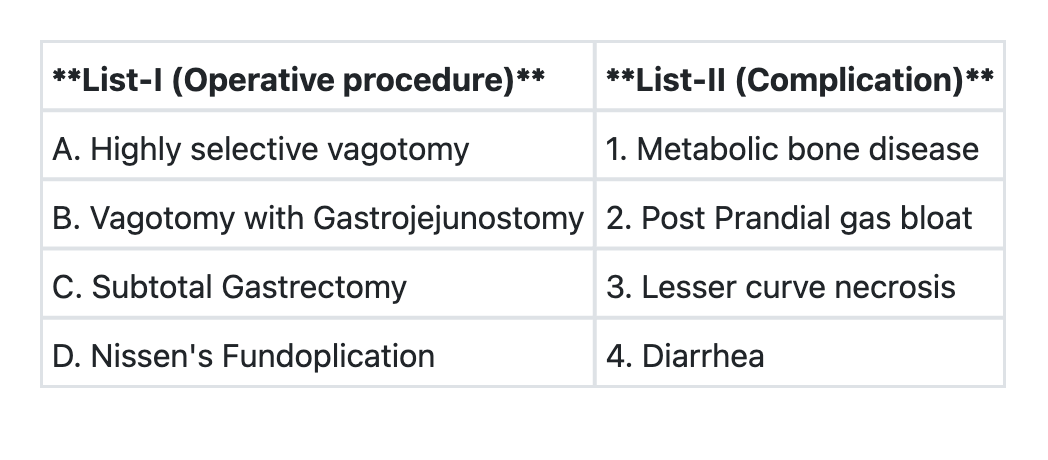
4 questionsMatch List-I with List-II and select the correct answer using the code given below the Lists: **List-I (Procedure)** A. Highly selective vagotomy B. Vagotomy with gastrojejunostomy C. Subtotal gastrectomy D. Nissen's fundoplication **List-II (Complication)** 1. Metabolic bone disease 2. Post-prandial gas bloat 3. Lesser curve necrosis 4. Diarrhea **Code:**
An electrical contact burn is considered to be:
A 52 year old male patient comes with history of rectal bleeding, alteration in bowel habits and tenesmus. The ideal investigation would be:
What is the treatment of choice in a patient with Crohn’s disease, where inflamed appendix was found on exploration?
UPSC-CMS 2014 - Surgery UPSC-CMS Practice Questions and MCQs
Question 21: Match List-I with List-II and select the correct answer using the code given below the Lists: **List-I (Procedure)** A. Highly selective vagotomy B. Vagotomy with gastrojejunostomy C. Subtotal gastrectomy D. Nissen's fundoplication **List-II (Complication)** 1. Metabolic bone disease 2. Post-prandial gas bloat 3. Lesser curve necrosis 4. Diarrhea **Code:**
- A. A→2 B→1 C→4 D→3
- B. A→2 B→4 C→1 D→3 (Correct Answer)
- C. A→3 B→1 C→4 D→2
- D. A→3 B→4 C→1 D→2
Explanation: ***A→2 B→4 C→1 D→3*** - **Highly selective vagotomy** (HSV) aims to reduce gastric acid secretion by denervating only the parietal cell mass, sparing the antrum and pylorus. A potential complication due to altered gastric motility and emptying can be **post-prandial gas bloat** or fullness. - **Vagotomy with gastrojejunostomy** involves severing the vagus nerve, which can lead to altered gastrointestinal motility and malabsorption. **Diarrhea** is a common complication due to accelerated transit time and bacterial overgrowth. - **Subtotal gastrectomy** involves the removal of a significant portion of the stomach. This procedure can lead to malabsorption of nutrients, including calcium and vitamin D, resulting in **metabolic bone disease**. - **Nissen's Fundoplication** is a procedure to treat gastroesophageal reflux disease (GERD) by wrapping the gastric fundus around the lower esophageal sphincter. **Lesser curve necrosis** is a rare but severe complication that can occur due to devascularization during the procedure. *A→2 B→1 C→4 D→3* - This option incorrectly associates vagotomy with gastrojejunostomy with metabolic bone disease and subtotal gastrectomy with diarrhea. While diarrhea can occur after gastrectomy, metabolic bone disease is a more specific and significant long-term complication of subtotal gastrectomy due to malabsorption. - Furthermore, this option suggests that metabolic bone disease is a complication of vagotomy with gastrojejunostomy, which is not a primary or common complication of this procedure. *A→3 B→1 C→4 D→2* - This option incorrectly links highly selective vagotomy with lesser curve necrosis and vagotomy with gastrojejunostomy with metabolic bone disease. Lesser curve necrosis is a specific complication linked to Nissen's fundoplication, not HSV. - It also misassociates subtotal gastrectomy with diarrhea as the primary unique complication, and Nissen's fundoplication with post-prandial gas bloat, which is more typical of vagotomy. *A→3 B→4 C→1 D→2* - This option incorrectly pairs highly selective vagotomy with lesser curve necrosis, similar to one of the previous incorrect options. Lesser curve necrosis is a known specific complication of Nissen's fundoplication, not vagotomy. - It also incorrectly links Nissen's fundoplication with post-prandial gas bloat, which is a symptom more commonly associated with procedures that affect gastric emptying, such as vagotomy, rather than fundoplication.
Question 22: An electrical contact burn is considered to be:
- A. Superficial partial thickness burn
- B. Full thickness burn (Correct Answer)
- C. Superficial scalding with blisters
- D. Deep partial thickness burn
Explanation: ***Full thickness burn*** - Electrical contact burns are characterized by **high heat** generated at the point of contact, leading to **deep tissue destruction** that extends through the entire dermis and often into subcutaneous fat, muscle, or bone - The current pathway through the body causes additional damage internally, but the contact point itself typically reflects a **third-degree (full thickness) injury** due to intense localized heat - Entry and exit wounds from electrical burns characteristically show **charred, dry tissue** with central necrosis *Superficial partial thickness burn* - This type of burn involves only the **epidermis and superficial portion of the dermis**, typically presenting with blistering and redness - Electrical burns, especially contact burns, rarely result in such shallow injury due to the **intense and deep nature** of the energy transfer - The high voltage and current density at contact points cause damage far beyond superficial layers *Superficial scalding with blisters* - **Scald burns** are caused by hot liquids or steam and are typically **superficial or superficial partial thickness** - An electrical contact burn is distinct in its mechanism (electrical current) and the **severity of tissue damage** it causes, which extends far beyond the superficial layers - The mechanism of injury is fundamentally different from thermal scalding *Deep partial thickness burn* - Deep partial thickness burns extend into the **deeper dermis**, causing fluid-filled blisters and often mottled or waxy white areas - While electrical burns can involve deeper structures, the direct point of contact in an electrical contact burn usually causes damage that is **full thickness or beyond**, going past just the deep dermis - The concentrated heat and current flow at entry/exit sites result in complete destruction of all skin layers
Question 23: A 52 year old male patient comes with history of rectal bleeding, alteration in bowel habits and tenesmus. The ideal investigation would be:
- A. Contrast-enhanced CT scan
- B. Fecal occult blood test
- C. Colonoscopy (Correct Answer)
- D. Ultrasonogram
Explanation: ***Colonoscopy*** - **Colonoscopy** is the gold standard for investigating symptoms like rectal bleeding, altered bowel habits, and tenesmus, as it allows for direct visualization of the entire colon and rectum. - It enables **biopsy of suspicious lesions** for histopathological diagnosis, which is crucial for confirming conditions like colorectal cancer or inflammatory bowel disease. *Contrast-enhanced CT scan* - A **contrast-enhanced CT scan** is primarily used for **staging known malignancies** and assessing for distant metastases, not as a primary diagnostic tool for initial symptoms. - While it can identify large masses, it might miss smaller lesions and does not allow for tissue biopsy. *Fecal occult blood test* - A **fecal occult blood test** screens for blood in the stool, which indicates gastrointestinal bleeding but does not pinpoint the source or cause. - It has **low sensitivity and specificity** for diagnosing underlying conditions like colorectal cancer or inflammatory bowel disease and is mainly a screening tool. *Ultrasonogram* - An **ultrasonogram** is generally not effective for evaluating the colon and rectum due to bowel gas interference. - It is more commonly used for investigating abdominal organs like the liver, gallbladder, and kidneys, or for pelvic pathology, but not the primary investigation for these colorectal symptoms.
Question 24: What is the treatment of choice in a patient with Crohn’s disease, where inflamed appendix was found on exploration?
- A. Appendectomy
- B. Closing the abdomen and starting medical treatment
- C. Right hemicolectomy
- D. Ileo–colic resection and anastomosis (Correct Answer)
Explanation: ***Ileo-colic resection and anastomosis*** - This is the treatment of choice when an inflamed appendix is found during exploration in a patient with Crohn's disease, as the disease typically affects the **terminal ileum** and **right colon**. - The inflamed appendix is often a manifestation of Crohn's disease involving the **cecal base** and surrounding bowel. - **Ileo-colic resection** ensures removal of the diseased segment, including the inflamed appendix and involved bowel, thereby preventing future complications such as **fistulas** (risk up to 65% with simple appendectomy) and **strictures**. - If the cecal base is involved with Crohn's disease, simple appendectomy is contraindicated due to poor healing and high fistula risk. *Appendectomy* - Performing a simple appendectomy in the context of Crohn's disease carries a high risk of **fistula formation** and **poor wound healing** due to the underlying inflammatory process. - When the disease involves the **base of the appendix** and surrounding **cecum** (which is common), appendectomy alone is insufficient and dangerous. - Appendectomy may only be considered safe if the cecal base is completely **normal and uninvolved**, which is uncommon in this clinical scenario. *Closing the abdomen and starting medical treatment* - While medical treatment is crucial for managing Crohn's disease, an **inflamed appendix** found during exploration suggests an acute process that requires **surgical intervention**. - Delaying surgery by closing the abdomen could lead to complications such as **perforation** and **peritonitis**, especially if inflammation is severe. - Medical therapy alone is insufficient for acute complications requiring exploration. *Right hemicolectomy* - Right hemicolectomy is a more extensive resection than necessary for most cases of ileocecal Crohn's disease with appendiceal involvement. - **Ileo-colic resection** (removing terminal ileum, cecum, and ascending colon up to the hepatic flexure) is adequate and preferred as it is less extensive while addressing the pathology. - Right hemicolectomy would be reserved for more extensive colonic involvement beyond the typical ileocecal distribution.