What is the most important test to assess the prevalence of tuberculosis infection in a community?
In a normal curve, the area between one standard deviation on either side of the mean will include:
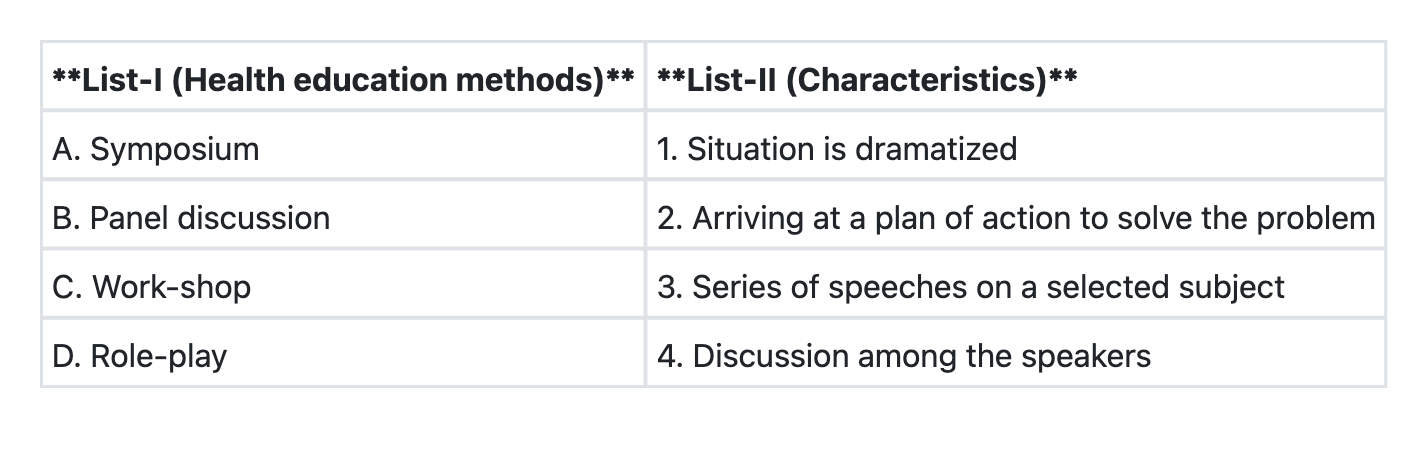
Match List-I with List-II and select the correct answer using the code given below the Lists:
Which of the following insecticides is not used as a larvicide?
An outbreak of Viral Hepatitis was reported from a town between June and August of a particular year. 60% of cases occurred in July. Exposure of the community to infection is from:
Which one of the following indicators is not included in Millennium Development Goals?
Severity of a disease is measured by:
‘Spot map’ in epidemiological studies refer to variation in the distribution of a disease at:
Specificity of a test is =
With reference to historical cohort study, which of the following statements is not correct?
UPSC-CMS 2014 - Community Medicine UPSC-CMS Practice Questions and MCQs
Question 11: What is the most important test to assess the prevalence of tuberculosis infection in a community?
- A. Mass miniature radiography
- B. Tuberculin test (Correct Answer)
- C. Sputum examination of AFB
- D. Clinical examination
Explanation: ***Tuberculin test*** - The **tuberculin skin test (TST)**, or Mantoux test, measures the delayed-type hypersensitivity reaction to tuberculin, indicating prior exposure to *Mycobacterium tuberculosis*. - A positive TST reflects **tuberculosis infection**, whether latent or active, making it a valuable tool for assessing prevalence in a community. *Mass miniature radiography* - This method, now largely replaced by digital radiography, primarily detects **active pulmonary tuberculosis** by identifying lung lesions like infiltrates or cavities. - It is less effective for detecting **latent tuberculosis infection (LTBI)**, which represents the majority of infected individuals in a community. *Sputum examination of AFB* - This test is crucial for diagnosing **active pulmonary tuberculosis** by identifying acid-fast bacilli (AFB) in sputum. - However, it only detects individuals who are actively shedding bacteria and may not capture the broader prevalence of **latent infection** in a community. *Clinical examination* - A clinical examination primarily identifies individuals with **symptoms of active tuberculosis**, such as persistent cough, fever, or weight loss. - It is not a reliable method for assessing the overall **prevalence of tuberculosis infection**, particularly asymptomatic latent cases, in a community.
Question 12: In a normal curve, the area between one standard deviation on either side of the mean will include:
- A. 70 – 85% of the values
- B. 95% of the values
- C. Approximately 68% of the values (Correct Answer)
- D. Less than 50% of the values
Explanation: ***Approximately 68% of the values*** - In a **normal distribution** (bell curve), approximately **68% of data points** fall within one standard deviation ($\pm1\sigma$) from the mean. - This is a fundamental property of the **empirical rule** (or 68-95-99.7 rule) in statistics. *70 – 85% of the values* - This range is too broad and does not accurately reflect the specific percentage for **one standard deviation**. - While it overlaps with the correct value, it is not the precise percentage associated with $\pm1\sigma$. *95% of the values* - This percentage refers to the data included within **two standard deviations** ($\pm2\sigma$) from the mean in a normal distribution, not one. - The **empirical rule** states that approximately 95% of data falls within two standard deviations. *Less than 50% of the values* - This is incorrect, as the range of **one standard deviation** on either side of the mean covers more than half of the data. - The mean itself divides the data into two 50% halves, so incorporating any deviation around it will cover more than 50%.
Question 13: Match List-I with List-II and select the correct answer using the code given below the Lists:
- A. A→1 B→2 C→4 D→3
- B. A→3 B→2 C→4 D→1
- C. A→3 B→4 C→2 D→1 (Correct Answer)
- D. A→1 B→4 C→2 D→3
Explanation: ***Correct Answer: A→3, B→4, C→2, D→1*** **Understanding Health Education Methods:** **A. Symposium → 3. Series of speeches** - A symposium is a formal meeting where multiple experts deliver **sequential speeches** on different aspects of a selected subject - Each speaker presents their perspective, typically without much interaction between speakers during the presentation **B. Panel Discussion → 4. Discussion among the speakers** - A panel involves **interactive discussion among panelists** (experts) on a particular topic - Characterized by dialogue and exchange of views between speakers, often followed by audience questions **C. Workshop → 2. Arriving at a plan of action** - A workshop is a **participatory, problem-solving session** designed to achieve practical outcomes - Participants actively engage in exercises and activities to develop concrete action plans or solutions **D. Role-play → 1. Dramatizing a situation** - Role-play involves **acting out scenarios** to experience different perspectives - Participants assume roles and dramatize situations to understand behaviors, emotions, and decision-making processes *Key Differentiation:* - Symposium = One-way presentations (speakers → audience) - Panel = Two-way discussion (speakers ↔ speakers) - Workshop = Participatory action planning - Role-play = Experiential learning through dramatization
Question 14: Which of the following insecticides is not used as a larvicide?
- A. Dichlorvos
- B. Paris green
- C. Abate
- D. Fenthion (Correct Answer)
Explanation: ***Fenthion*** - **Fenthion** is an **organophosphate insecticide** primarily used as an **adulticide** for **mosquitoes** and other flying insects. - While it can target adult mosquitoes, it is **not commonly used or recommended as a larvicide** due to its higher toxicity profile and environmental concerns compared to other dedicated larvicides. *Dichlorvos* - **Dichlorvos** (DDVP) is an organophosphate insecticide that has been used as a **larvicide**, particularly in situations where rapid knockdown of larvae is required. - It is known for its **quick action** and **fumigant properties**, making it effective against early mosquito stages. *Paris green* - **Paris green** (copper(II) acetoarsenite) is historically one of the **earliest larvicides** used to control mosquito larvae. - It acts as a **stomach poison** when ingested by mosquito larvae. *Abate* - **Abate** (temephos) is a widely used **organophosphate larvicide** known for its **low toxicity to mammals** and aquatic organisms at recommended doses. - It is effective against mosquito larvae in various breeding sites, including drinking water, making it a **preferred choice for public health programs**.
Question 15: An outbreak of Viral Hepatitis was reported from a town between June and August of a particular year. 60% of cases occurred in July. Exposure of the community to infection is from:
- A. Multiple sources over prolonged periods
- B. Multiple sources for a short period
- C. A common single source for prolonged periods
- D. A single source for a short period (Correct Answer)
Explanation: ***A single source for a short period*** - This describes a **point source outbreak**, the classic pattern seen in this scenario - **60% of cases in July** indicates exposure occurred over a **brief period** (likely days to weeks before July) - The 3-month span (June-August) represents the **distribution of cases around the incubation period** of viral hepatitis (typically 2-6 weeks for Hepatitis A) - Common examples: **contaminated water supply**, food at a community gathering, or other single exposure event - This is the **textbook presentation** of a point source epidemic with a characteristic sharp peak *Multiple sources for a short period* - This would produce **multiple peaks** or an irregular epidemic curve, not a single peak in July - Multiple sources would not create the concentrated 60% clustering observed - The pattern described is too uniform for multiple independent sources *A common single source for prolonged periods* - This describes a **continuous common source outbreak** with an extended epidemic curve - Cases would be **distributed more evenly** across June-August without a sharp peak - Example: ongoing contamination of a water supply over months - The 60% concentration in July rules out this pattern *Multiple sources over prolonged periods* - This would result in **endemic disease** or a very flat, prolonged epidemic curve - No sharp peak would be observed - The temporal clustering contradicts this pattern
Question 16: Which one of the following indicators is not included in Millennium Development Goals?
- A. Maternal mortality ratio
- B. Suicide rate per 100,000 population
- C. T.B. death rate per 100,000 children (0 – 4 years of age) (Correct Answer)
- D. Under five mortality rate
Explanation: ***T.B. death rate per 100,000 children (0 – 4 years of age)*** - While **tuberculosis** was addressed in **MDG 6** (Combat HIV/AIDS, malaria, and other diseases), this **specific age-stratified indicator** was not directly enumerated in the official MDG indicator framework. - The MDG indicators for TB included: **prevalence of tuberculosis**, **tuberculosis incidence rate**, **proportion of tuberculosis cases detected and cured under DOTS**, and general TB death rates - but NOT age-specific pediatric TB mortality rates for the 0-4 year age group. - This makes it the correct answer as it represents a specific metric formulation that was not part of the official MDG monitoring framework, despite TB being included in the broader goals. *Maternal mortality ratio* - The **maternal mortality ratio** was a **key indicator under MDG 5** (Improve Maternal Health). - Target 5.A specifically aimed to reduce the maternal mortality ratio by three-quarters between 1990 and 2015. - This was one of the core reproductive health indicators monitored globally. *Suicide rate per 100,000 population* - The **suicide rate** was not included in the Millennium Development Goals framework. - Mental health indicators, including suicide rates, were notably absent from the MDGs, which focused on infectious diseases, maternal and child health, poverty, education, and environmental sustainability. - However, among the options listed, the **TB death rate for children 0-4 years** is considered the answer because it represents a more specific technical distinction about indicator formulation within a disease area (TB) that WAS included in the MDGs, whereas suicide was entirely outside the MDG scope. *Under five mortality rate* - The **under-five mortality rate** was a **central indicator under MDG 4** (Reduce Child Mortality). - Target 4.A aimed to reduce the under-five mortality rate by two-thirds between 1990 and 2015. - This was measured as deaths per 1,000 live births before age five.
Question 17: Severity of a disease is measured by:
- A. Incidence rate
- B. Attributable risk
- C. Relative risk
- D. Case fatality rate (Correct Answer)
Explanation: ***Case fatality rate*** - The **case fatality rate (CFR)** directly measures the **severity** of a disease by indicating the proportion of individuals diagnosed with a disease who ultimately die from it. - A higher CFR implies a more lethal or severe disease. *Incidence rate* - The **incidence rate** measures the **frequency of new cases** of a disease in a population over a specified period. - It reflects how quickly a disease is spreading, not its severity. *Attributable risk* - **Attributable risk (AR)** quantifies the proportion of disease incidence in an exposed group that can be attributed to the exposure. - It measures the **public health impact** of an exposure, not the inherent severity of the disease itself. *Relative risk* - **Relative risk (RR)** compares the probability of an event (e.g., disease development) in an **exposed group** to the probability of the event in an **unexposed group**. - It indicates the **strength of association** between an exposure and a disease, not the severity of the disease in affected individuals.
Question 18: ‘Spot map’ in epidemiological studies refer to variation in the distribution of a disease at:
- A. International level
- B. Local level (Correct Answer)
- C. Rural – urban level
- D. National level
Explanation: ***Local level*** - A **spot map** is an epidemiological tool used to visualize the geographical distribution of disease cases within a **small, defined area**, such as a neighborhood or a single city. - It helps in identifying **clusters or hot-spots** of disease occurrence, which can be crucial for locating potential sources of infection or environmental hazards. *International level* - While disease distribution can be mapped internationally, a "spot map" specifically refers to a **finer-grain analysis** at a much smaller geographical scale, not across multiple countries. - Maps at the international level are often used for **global burden of disease** studies or pandemic tracking, which require broader summaries rather than individual case plotting. *Rural – urban level* - Mapping at the rural-urban level indicates differences between these two broad categories, but a spot map provides even more specific detail within those areas. - It shows the precise location of cases, allowing for insights into localized environmental or social factors, rather than just a general rural vs. urban comparison. *National level* - National-level mapping provides an overview of disease prevalence or incidence across an entire country, which is a much larger scale than a spot map. - A spot map is designed to highlight **precise locations** of cases within a more contained geographical area, making it less suitable for broad national-level trends.
Question 19: Specificity of a test is =
- A. (True positives X 100) / (True negatives + False positives) %
- B. (True positives X 100) / (True positives + False negatives) %
- C. (True negatives X 100) / (True negatives + False positives) % (Correct Answer)
- D. (True negatives X 100) / (True positives + True negatives) %
Explanation: ***(True negatives X 100) / (True negatives + False positives) %*** - **Specificity** measures the proportion of **true negatives** correctly identified by the test among all individuals who do not have the disease. - It reflects the test's ability to **correctly identify healthy individuals** and avoid **false positives**. * (True positives X 100) / (True negatives + False positives) %* - This formula is incorrect for specificity, as it uses **true positives** in the numerator which is characteristic of **sensitivity**, not specificity. - The denominator includes true negatives but incorrectly adds **false positives**, which would be appropriate for the total number of individuals without the disease. * (True positives X 100) / (True positives + False negatives) %* - This formula represents the **sensitivity** of a test, not its specificity. - **Sensitivity** measures the proportion of **true positives** correctly identified by the test among all individuals who actually have the disease. * (True negatives X 100) / (True positives + True negatives) %* - This formula incorrectly includes **true positives** in the denominator, which is not relevant for calculating specificity. - The denominator should represent all truly negative cases (true negatives + false positives).
Question 20: With reference to historical cohort study, which of the following statements is not correct?
- A. Duration of study is shorter as compared to current cohort study.
- B. Control subjects are selected from the current population without exposure. (Correct Answer)
- C. Experience of cohort is assessed from existing records.
- D. Outcomes have occurred before the start of the investigation.
Explanation: ***Control subjects are selected from the current population without exposure.*** - In a **historical cohort study**, all data, including information on both exposed and unexposed (control) groups, is collected retrospectively from existing records. Control subjects are not usually selected from the current population. - The defining characteristic of a historical cohort is that both exposure and outcome have already occurred and are recorded prior to the study's initiation. *Duration of study is shorter as compared to current cohort study.* - This statement is correct. Because historical cohort studies utilize **pre-existing data** and outcomes have already occurred, the **follow-up period** from the researcher's perspective is significantly compressed compared to a prospective (current) cohort study. - The actual exposure and outcome events may have spanned many years in the past, but the time taken by the researcher to conduct the study is often shorter. *Experience of cohort is assessed from existing records.* - This statement is correct. A hallmark of **historical cohort studies** is their reliance on **retrospective data collection** from existing sources like medical charts, employment records, or birth registries. - Researchers do not actively follow up with individuals but rather consult these documents to track exposure and outcome status. *Outcomes have occurred before the start of the investigation.* - This statement is correct. In a **historical cohort study**, both the defining exposure(s) and the subsequent health outcomes of interest have already transpired by the time the study is initiated. - The investigator looks back in time to identify cohorts based on past exposure and then ascertains their outcomes from records recorded in the past.