INI-CET 2018 — Ophthalmology
3 Previous Year Questions with Answers & Explanations
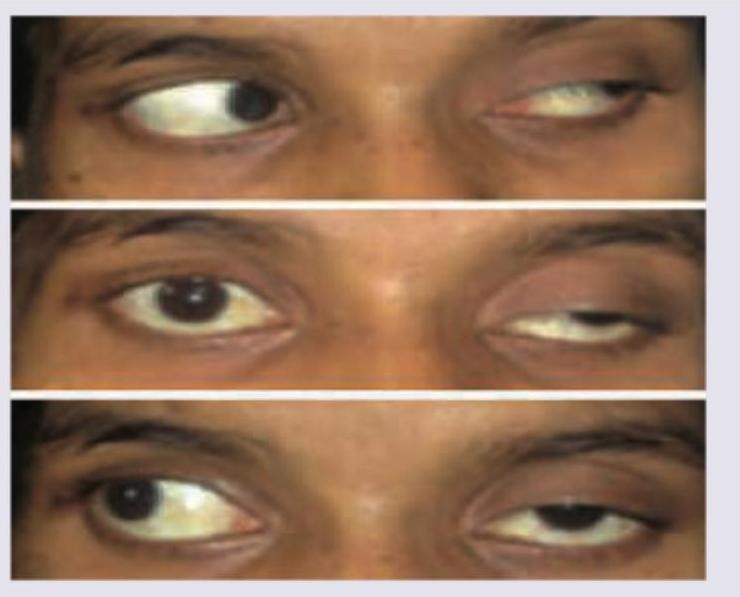
The given image shows which of the following conditions? (AIIMS Nov 2018)
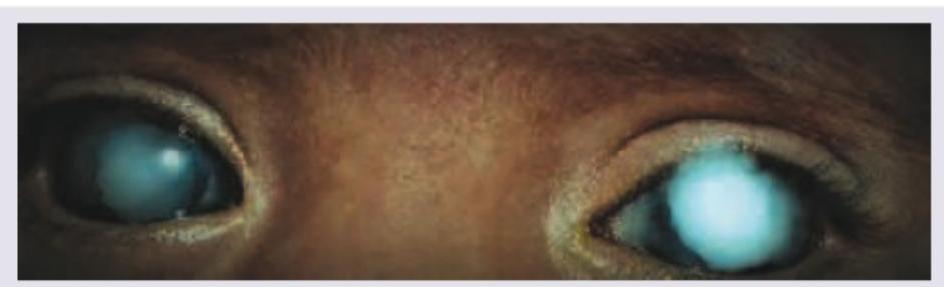
A 2-year-old child is brought with complaints of watering of eyes, photophobia and intermittently keeping eyes closed while watching TV. What may be the diagnosis? (AIIMS Nov 2018)
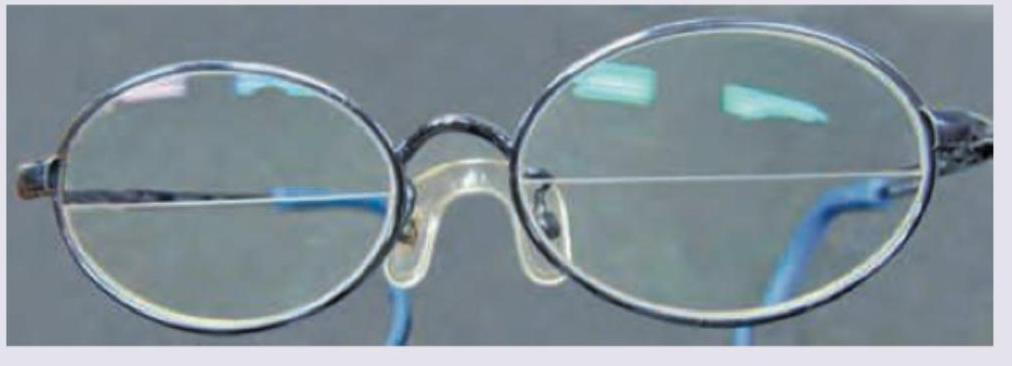
The following spectacle is used in? (AIIMS Nov 2018)
INI-CET 2018 - Ophthalmology INI-CET Practice Questions and MCQs
Question 1: The given image shows which of the following conditions? (AIIMS Nov 2018)
- A. Inter-nuclear ophthalmoplegia (Correct Answer)
- B. Oculomotor nerve palsy
- C. Lateral rectus palsy
- D. Trochlear nerve palsy
Explanation: ***Inter-nuclear ophthalmoplegia*** - The image shows that the **right eye** is **unable to adduct past the midline** when attempting to look left (middle image), which is a classic sign of internuclear ophthalmoplegia (INO). - The **left eye** shows **abducting nystagmus**, a common associated finding in INO due to damage to the **medial longitudinal fasciculus (MLF)**. *Oculomotor nerve palsy* - An oculomotor nerve (CN III) palsy would typically present with a **down-and-out deviation** of the affected eye, **ptosis**, and a **dilated pupil**, which are not seen here. - The patient would also have difficulty moving the eye medially, superiorly, and inferiorly, whereas here the right eye can move down and up, but not fully medially. *Lateral rectus palsy* - A lateral rectus (CN VI) palsy would cause an inability to **abduct** the affected eye and an **esotropia** (eye turning inward) at primary gaze. - The image shows impaired adduction, not abduction, of the right eye, ruling out lateral rectus palsy. *Trochlear nerve palsy* - A trochlear nerve (CN IV) palsy results in weakness of the **superior oblique muscle**, leading to **vertical diplopia**, especially when looking down and in, and a characteristic **head tilt** to compensate. - This presentation does not match the image, which primarily demonstrates a horizontal gaze abnormality with adduction deficit.
Question 2: A 2-year-old child is brought with complaints of watering of eyes, photophobia and intermittently keeping eyes closed while watching TV. What may be the diagnosis? (AIIMS Nov 2018)
- A. Congenital Glaucoma (Correct Answer)
- B. Retinoblastoma
- C. Congenital endothelial dystrophy
- D. Megalocornea
Explanation: ***Congenital Glaucoma*** - The triad of **watering of eyes (epiphora)**, **photophobia**, and **blepharospasm** (keeping eyes closed) is highly characteristic of **congenital glaucoma** in infants and young children. - The image also shows significantly enlarged and hazy corneas (buphthalmos), which are classic signs of increased intraocular pressure and corneal edema in congenital glaucoma. *Retinoblastoma* - While retinoblastoma affects children, its primary presentation is typically **leukocoria** (a white pupillary reflex) or strabismus. - It does not commonly present with watering of eyes, photophobia, or blepharospasm as prominent symptoms. *Congenital endothelial dystrophy* - Congenital endothelial dystrophy primarily causes **corneal edema** and haziness due to abnormal corneal endothelium. - While it can cause some photophobia and tearing, it generally does not present with the severe blepharospasm seen in glaucoma, and the corneal enlargement (buphthalmos) is not a feature. *Megalocornea* - Megalocornea is a condition characterized by an **enlarged cornea** but with normal intraocular pressure and clear corneas. - It is usually asymptomatic or associated with mild ametropia, and does not cause watering of eyes, photophobia, or corneal haziness.
Question 3: The following spectacle is used in? (AIIMS Nov 2018)
- A. Progressive glasses for presbyopia
- B. Bifocal glasses for presbyopia (Correct Answer)
- C. Bifocals for paediatric pseudo-phakia
- D. Bifocals for adult aphakia
Explanation: ***Bifocal glasses for presbyopia*** - The image clearly shows spectacle lenses with a visible **horizontal line separating two distinct optical powers**, which is characteristic of **bifocal lenses**. - **Presbyopia** is the condition where the eye's lens loses its ability to focus on near objects, requiring a different optical correction for near vision separate from distance vision, precisely what bifocals provide. *Progressive glasses for presbyopia* - **Progressive lenses** offer a gradual change in optical power from distance to near vision without a visible dividing line, unlike the spectacles shown. - They provide a continuous range of focus, but the absence of a visible segment in progressive lenses differentiates them from bifocals. *Bifocals for paediatric pseudo-phakia* - While pediatric pseudophakia (presence of an intraocular lens in a child) might require bifocals, the question asks for the primary use of the *pictured* bifocals, which commonly address **age-related presbyopia**. - Additionally, pseudophakia itself doesn't inherently imply a need for bifocals unless there's an accommodative issue, which is more typically associated with adult presbyopia. *Bifocals for adult aphakia* - **Aphakia** is the absence of the natural lens in the eye, which requires strong corrective lenses. While bifocals can be used in aphakia to provide both distance and near correction, the pictured bifocals are a standard design most commonly associated with correcting **presbyopia** in the general population. - Aphakic corrections generally involve much higher power lenses, which might appear thicker or have different characteristics than the standard bifocal shown.