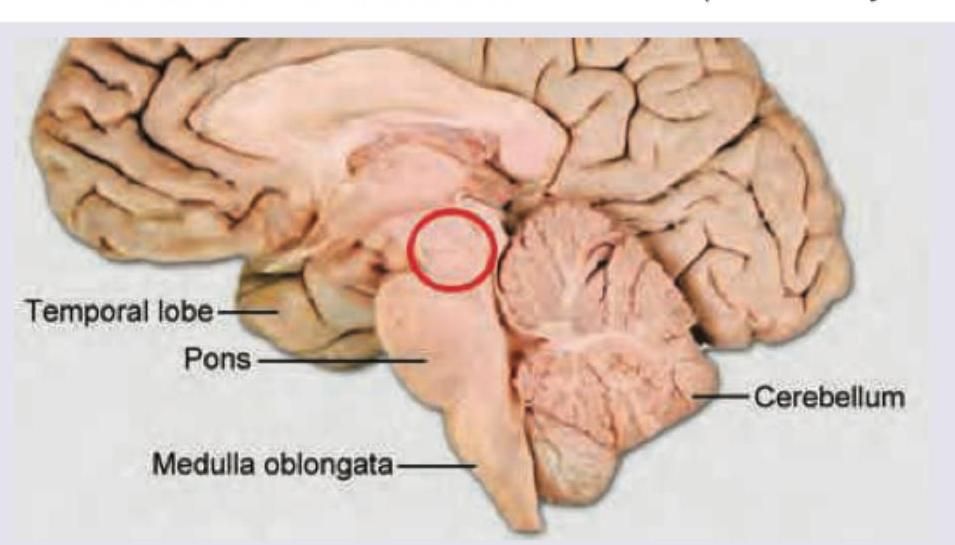
Question 1: Which disease occurs due to involvement of the structure marked in red? (AIIMS May 2018)
- A. Depression
- B. Alzheimer's disease
- C. Paralysis agitans (Correct Answer)
- D. Huntington's chorea
Explanation: ***Paralysis agitans***
- The red circle points to the **substantia nigra**, a key brain structure involved in producing **dopamine**.
- **Paralysis agitans**, also known as **Parkinson's disease**, is characterized by the degeneration of dopaminergic neurons in the substantia nigra, leading to motor symptoms like tremor, rigidity, and bradykinesia.
*Depression*
- Depression is a mood disorder associated with imbalances in various **neurotransmitters** (e.g., serotonin, norepinephrine, dopamine) and often involves brain regions such as the prefrontal cortex and limbic system, not primarily the substantia nigra.
- While dopamine pathways can be implicated in motivation and reward, the primary pathology of major depression is not direct degeneration of the substantia nigra.
*Alzheimer's disease*
- Alzheimer's disease is a neurodegenerative disorder primarily characterized by the accumulation of **amyloid plaques** and **neurofibrillary tangles**, leading to neuronal loss and brain atrophy, particularly in the hippocampus and cerebral cortex, not the substantia nigra.
- It results in progressive **memory loss** and cognitive decline, distinct from the motor symptoms seen in Parkinson's.
*Huntington's chorea*
- Huntington's chorea is a hereditary neurodegenerative disease caused by the degeneration of GABAergic neurons in the **striatum** (caudate and putamen).
- It is characterized by **involuntary movements** (chorea), cognitive decline, and psychiatric symptoms, which result from basal ganglia dysfunction but not specifically originating from the substantia nigra.