Neoplasia Indian Medical PG Flashcards - Medical Study Cards
Master Neoplasia with OnCourse flashcards. These spaced repetition flashcards are designed for medical students preparing for NEET PG, USMLE Step 1, USMLE Step 2, MBBS exams, and other medical licensing examinations.
Neoplasia Flashcard Deck - 248 Cards
Flashcard 1: The following image represents the _____ carcinoma subtype of invasive ductal carcinoma (breast):
hint: the circled area is lymphatics
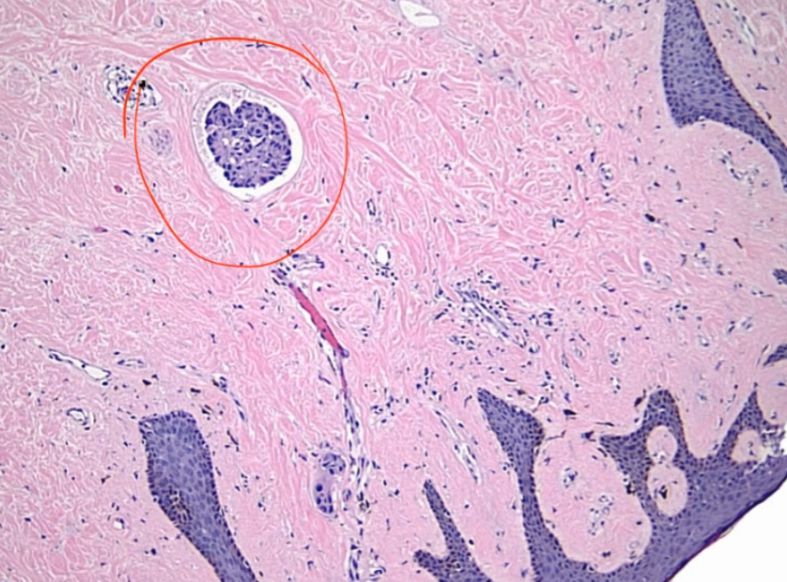
Answer: inflammatory
Flashcard 2: In HPV-_____ SCC of the oral cavity, patients generally present with large primary lesions with variable nodal disease.
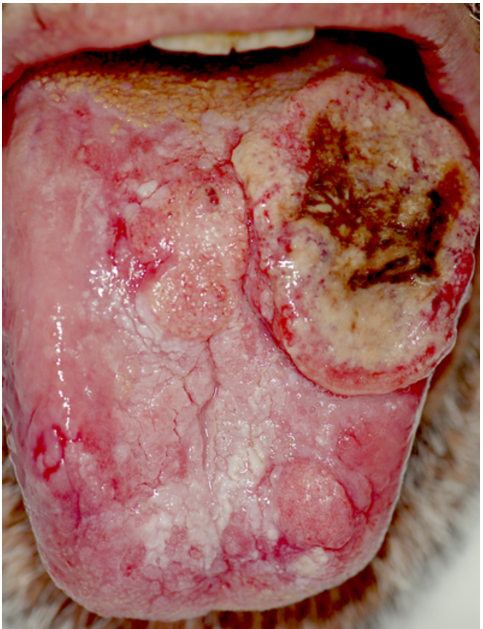
Answer: negative
Flashcard 3: What type of rhabdomyosarcoma is shown in the given image?
_____ **most common subtype
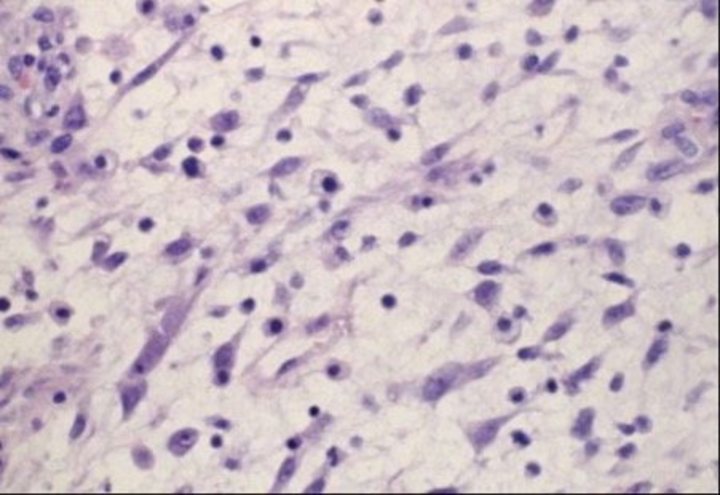
Answer: Embryonal
Flashcard 4: TNM classification of laryngeal carcinoma: No answer _____
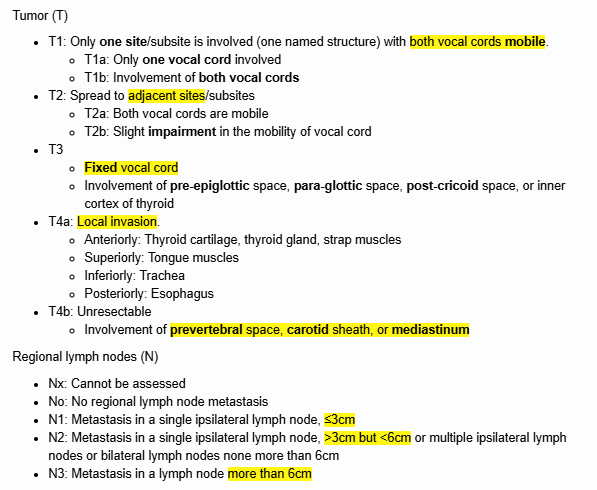
Answer: :)
Flashcard 5: What viral manifestation is seen below?
_____
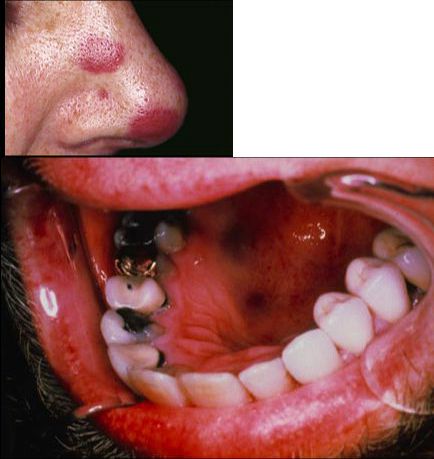
Answer: Kaposi sarcoma (HHV-8)
Flashcard 6: The following image represents the _____ carcinoma subtype of invasive ductal carcinoma:
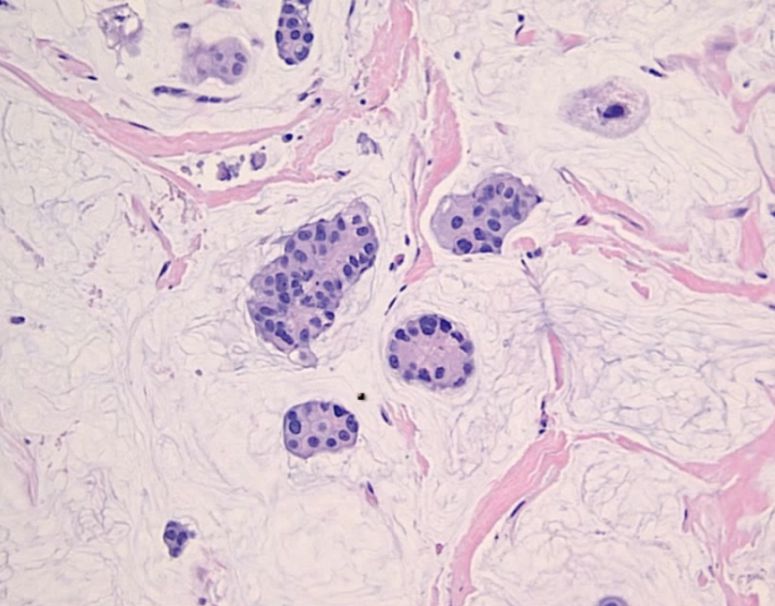
Answer: mucinous
Flashcard 7: The following image represents _____ carcinoma (breast):
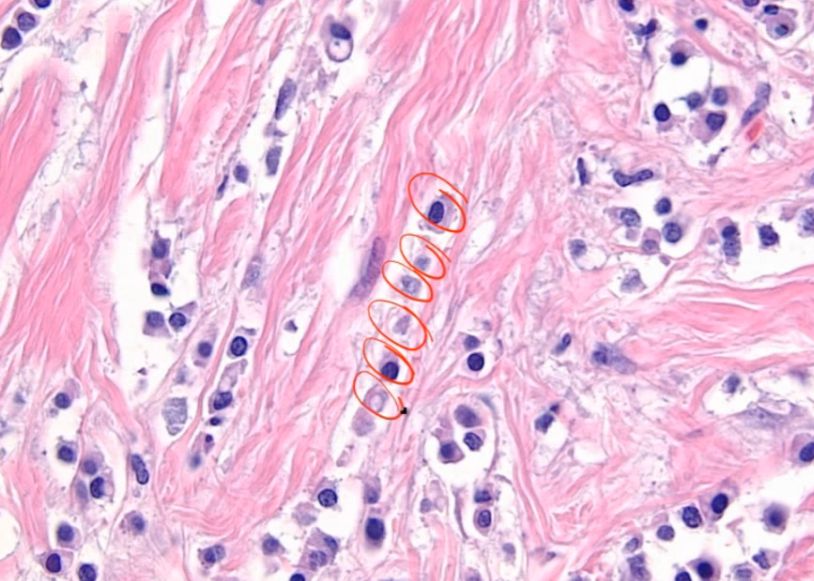
Answer: invasive lobular
Flashcard 8: Cytokeratin profiles of various primary tumors: No answer _____
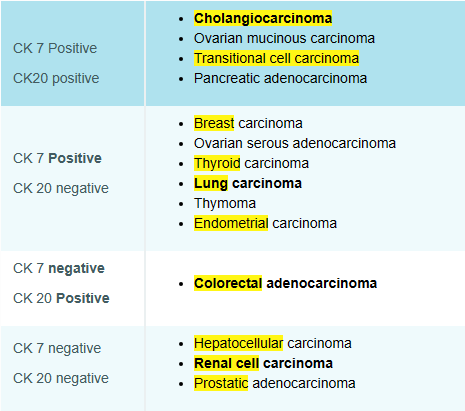
Answer: :)
Flashcard 9: Breast Cancer Assessment: The following is an immunohistochemical stain for the _____ receptor, which is located on the cell membrane
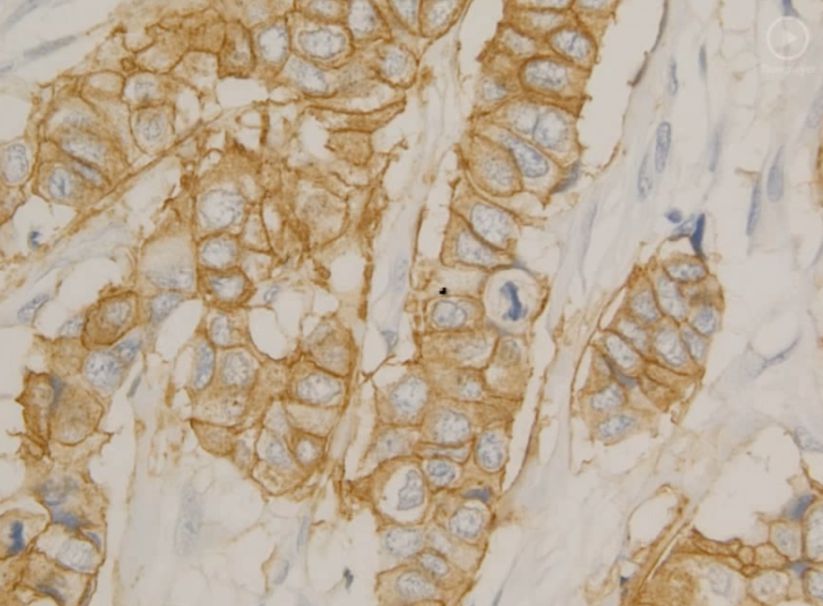
Answer: HER-2 (c-erbB2)
Flashcard 10: In regards to cervical epithelium, if the tissue sample on the left is normal, is the tissue sample on the right: mildly dysplastic, moderately dysplastic, or severely dysplastic / carcinoma in situ?
_____
VS
Answer: Mildly Dysplastic
Flashcard 11: _____ exposure can cause mesothelioma cancer
Answer: asbestos
Extra:
Flashcard 12: age distribution of hodgkins lymphoma is _____
Answer: bimodal
Extra:
Flashcard 13: _____ is a subtype of adenocarcinoma that typically arises from club (Clara) cells
Answer: Adenocarcinoma in situ
Flashcard 14: Most common malignant tumor of the _____ gland is Mucoepidermoid carcinoma
Answer: parotid
Flashcard 15: Two common familial cancer syndromes associated with adrenocortical carcinoma are _____ syndrome and Beckwith Wiedemann syndrome
Answer: Li-Fraumeni
Flashcard 16: Luminal B subtype of breast cancer can be ER/PR _____ve and Her2 -ve, with high (>14%) Ki67
Answer: +
Flashcard 17: Tumor cells can attach to _____ and destroy the basement membrane (type IV collagen) via collagenase
Answer: laminin
Flashcard 18: When performing Immunohistochemistry; Chromogranin A, Synaptophysin, NCAM (CD56), Neuron Specific Enolase (NSE) can all be used to identify _____ and Neuronal tumors
Answer: Neuroendocrine
Flashcard 19: Transitional cell (urothelial) carcinoma via the _____ pathway is associated with early p53 mutations
Answer: flat
Flashcard 20: Adenocarcinoma of the bladder may arise from _____, which is a columnar metaplasia in response to chronic inflammation
Answer: cystitis glandularis
Flashcard 21: HER2 (c-erbB2) is an _____ receptor found in certain types of breast and gallbladder carcinoma
Answer: epidermal growth factor
Flashcard 22: IgA antibodies of _____ of EBV are highly specific for nasopharyngeal cancer
Answer: EA (Early antigen)
Flashcard 23: _____ can produce anti-Tr antibodies which can cause Paraneoplastic Cerebellar Degeneration
Answer: Hodgkin Lymphoma
Flashcard 24: Biopsy of nasopharyngeal carcinoma usually reveals pleomorphic _____-positive epithelial cells in a background of lymphocytes
Answer: keratin
Flashcard 25: _____ is a cancer of the bladder that usually arises from a(n) urachal remnant
Answer: Adenocarcinoma
Flashcard 26: Lynch syndrome is associated with increased risk for _____, endometrial, ovarian, and skin cancers
Answer: colorectal
Flashcard 27: Blood vessels can give rise to a _____ (benign) and angiosarcoma (malignant)
Answer: hemangioma
Flashcard 28: Luminal A subtype of breast cancer is usually ER/PR _____ve and Her2 -ve, with {{c2::low (
Answer: +
Flashcard 29: What is the precursor lesion for leiomyosarcoma?_____
Answer: None -- arises de novo
Flashcard 30: Histopathology of mesothelioma will show tumor cells with numerous, long slender _____ and abundant tonofilaments
Answer: microvilli
Flashcard 31: The t(_____,14) translocation results in overexpression of Cyclin D1, which promotes the G1/S transition in the cell cycle, facilitating neoplastic proliferation
Answer: 11
Flashcard 32: HPV encodes E6 and E7 which promotes proteolysis of _____ and Rb.
Answer: p53
Flashcard 33: MEN 1 is associated with mutation of the _____ gene (menin), which is a tumor suppressor gene found on chromosome 11
Answer: MEN1
Flashcard 34: Tumors that cause a _____ can be remembered with the mnemonic: Paraneoplastic rise to high hematocrit levelsPheochromocytomaRenal cell carcinomaHepatocellular CarcinomaHemangioblastomaLeiomyoma
Answer: paraneoplastic polycythemia
Flashcard 35: Smooth muscle can give rise to a _____ (benign) and leiomyosarcoma (malignant)
Answer: leiomyoma
Flashcard 36: _____ carcinoma of the lung may produce PTHrP leading to hyper-calcemia
Answer: Squamous cell
Flashcard 37: Esophageal carcinoma in the middle third of the esophagus spreads to _____, tracheobronchial, or paratracheal lymph nodes
Answer: mediastinal
Flashcard 38: Hereditary leiomyomatosis and RCC is due to _____ gene mutation and presents with multiple, bilateral type 2 papillary RCC, collecting duct RCC, leiomyomas of the skin or uterus and uterine leiomyosarcomas
Answer: fumarate hydratase
Flashcard 39: Ovarian serous adenocarcinoma is CK 7 _____ and CK 20 negative
Answer: positive
Flashcard 40: _____ cystadenocarcinoma may present with pseudomyxoma peritonei, which is an intraperitoneal accumulation of mucinous material, usually from a GI, ovarian, appendiceal tumor
Answer: Mucinous
Flashcard 41: Most common _____ tumor of salivary gland in children is hemangioma
Answer: benign
Flashcard 42: _____ is a subtype of DCIS (breast) that is characterized by high-grade cells with dystrophic calcification in the center of ducts immediately surrounded by central necrosis
Answer: Comedocarcinoma
Flashcard 43: Which four carcinomas route hematogenously?_____ChoriocarcinomaRenal cell carcinomaHepatocellular carcinoma
Answer: Follicular thyroid carcinoma
Flashcard 44: Common sites of metastasis from lung cancer include the _____, brain, bone, and liver
Answer: adrenal gland
Flashcard 45: A translocation of _____ from chromosome 11 to 14 results in overexpression and ultimately Mantle cell lymphoma
Answer: cyclin D1
Flashcard 46: Li-Fraumeni Syndrome is also known as "SBLA" Syndrome, which stands for:S - _____B - Breast CancerL - LeukemiaA - Adrenal Gland tumor
Answer: Sarcoma
Flashcard 47: Invasive carcinomas become metastatic when they invade the _____ or blood
Answer: lymphatics
Flashcard 48: ER/PR-_____, HER2-negative cancers is the most common subtype of breast cancer in individuals who inherit germline mutations in BRCA2
Answer: positive
Flashcard 49: _____ is the assessment of the size and spread of a cancer
Answer: Staging
Flashcard 50: _____ carcinoma, a subtype of invasive ductal carcinoma, is characterized by cancer within dermal lymphatics
Answer: Inflammatory
Flashcard 51: Ovarian carcinoma is associated with '_____', which occurs from seeding of the peritoneum with layers upon layers of tumor cell growth
Answer: omental caking
Flashcard 52: The HER2/neu proto-oncogene encodes for the HER2 receptor, which when activated leads to cell _____This is a growth factor receptor found commonly in breast cancer
Answer: proliferation
Flashcard 53: Almost all _____ are calretinin positive, which is negative in most carcinomas
Answer: mesotheliomas
Flashcard 54: _____ is a cystic salivary gland tumor with abundant lymphocytes and germinal centers
Answer: Warthin tumor
Flashcard 55: Luminal B subtype of breast cancer can be ER/PR _____ve and Her2 +/-ve, with variable Ki67
Answer: +
Flashcard 56: Borderline tumors have _____ prognosis than clearly malignant tumors, but still carry metastatic potential
Answer: better
Flashcard 57: _____ is a dysplastic pre-cancerous lesion of the cervixthat commonly manifests following the loss of the tumour suppressors p53 and Rb following HPV infection.
Answer: Cervical Intraepithelial Neoplasia (CIN)
Flashcard 58: Carney's triad consists of gastric _____, extra- adrenal paraganglioma and pulmonary chondroma
Answer: GIST
Flashcard 59: Pleomorphic adenoma is a slow growing _____ tumor that is potentially malignant
Answer: benign
Flashcard 60: _____ is due to an inherited mutation in the APC gene on chromosome 5q
Answer: Familial adenomatous polyposis (FAP)
Flashcard 61: Squamous cell carcinoma is CK 7 _____ and CK 20 negative
Answer: negative
Flashcard 62: Metastasis to the lung is most often from _____, colon, prostate, and bladder cancer
Answer: breast
Flashcard 63: The classic location for _____ cell carcinoma is the lower lip
Answer: squamous
Flashcard 64: Elevated hCG can be a paraneoplastic syndrome, such as in _____ or large cell carcinoma of lung
Answer: pinealomas
Flashcard 65: Embryonal carcinoma may have increased levels of _____ and normal or elevated levels of AFP
Answer: hCG
Flashcard 66: Which type(s) of cells line the fibrovascular projections of a papillary carcinoma of the breast? _____
Answer: Only epithelial cells
Flashcard 67: 10% to 15% of individuals do not have the elevation of the CA 19-9 level in CA pancreas, a finding that has been associated with blood _____ antigennegative status.
Answer: Lewis
Flashcard 68: Adenomatous polyps with a _____ histology have less malignant potential than villous histology (tubular or villous)
Answer: tubular
Flashcard 69: Mutations that cause _____ of the PDGFB proto-oncogene can precipitate development of an Astrocytoma by creating an autocrine loop
Answer: overexpression
Flashcard 70: Histological examination of oncocytoma reveals large _____ophilic cells (owing to an abundance of mitochondria) arranged in distinct nests.
Answer: eosin
Flashcard 71: Breast Cancer Assessment: The following is an immunohistochemical stain for the _____ receptor, which is located on the cell membrane
Answer: HER-2 (c-erbB2)
Flashcard 72: _____ is the malignant proliferation of cells in the ducts of the breast with no invasion of the basement membrane
Answer: Ductal carcinoma in situ (DCIS)
Flashcard 73: Bleeding may occur as a paraneoplastic syndrome in Wilm's tumor due to acquired deficiency of _____ factor or factor VII deficiency.
Answer: von Willebrand
Flashcard 74: _____ -sided colorectal carcinoma usually grows as a raised (exophytic) mass
Answer: Right
Flashcard 75: High malignant potential in GIST is determined by _____ cm size; >5 mitoses/50 HPF or 5-10cm size; >5 mitoses/50 HPF
Answer: >10
Flashcard 76: The t(_____,14) translocation results in overexpression of c-myc, which promotes growth
Answer: 8
Flashcard 77: Progression of colonic adenoma to carcinoma occurs with mutations in the _____ or loss of heterozygosity in the region that encodes for SMAD 2 / 4
Answer: p53
Flashcard 78: Oral _____ and erythroplakia are precursor lesions to squamous cell carcinoma
Answer: leukoplakia
Flashcard 79: Most common malignant tumor of _____ salivary glands is Adenoid cystic carcinoma
Answer: minor
Flashcard 80: Categories of proto-oncogenes include:_____2) Growth factor receptors3) Signal transducers4) Nuclear regulators5) Cell cycle regulators
Answer: 1) Growth factors
Flashcard 81: Tumor cells can evade apoptosis / immune surveillance by downregulating expression of _____ or alternative splicing of the Fas receptor
Answer: MHC class I
Flashcard 82: Paragangliomas most commonly occur at the _____, known as a carotid paraganglioma
Answer: neck
Flashcard 83: Duke s classification is based on the _____ of tumor and lymph node status.
Answer: depth
Flashcard 84: Retinoblastoma is due to mutation in Rb gene located on chromosome _____q14
Answer: 13
Flashcard 85: Benzidine is a carcinogenic aromatic amine found in _____ associated with Transitional Cell Carcinoma of the Bladder
Answer: textile dyes
Flashcard 86: _____ cancer produces pure osteolytic secondaries.
Answer: Renal
Flashcard 87: Transitional cell carcinoma may arise via two distinct pathways: _____ and papillary
Answer: flat
Flashcard 88: The RAS family of _____ encode for GTP-binding signal transducers that when stimulated leads to cell proliferationThis is a signal transducer found commonly in carcinomas, lymphoma, and melanoma
Answer: proto-oncogenes
Flashcard 89: To remember the most common neoplasias that spread _____Embryonal carcinomaHepatocellular carcinomaSarcomaChoriocarcinomaRenal cell carcinomaFollicular carcinoma of the thyroid
Answer: hematogenously (Every Hematogenous Spreading Cancer Reigns Foolishly)
Flashcard 90: Breast, thyroid and Lung carcinoma is CK 7 _____ and CK 20 negative
Answer: positive
Flashcard 91: Neoplasia is new tissue growth which has three characteristics that distinguish it from hyperplasia and repair:1 - It is _____ 2 - It is irreversible3 - Generally speaking, it is monoclonal*
Answer: unregulated
Flashcard 92: _____ is a tumor suppressor gene that encodes p16 which blocks the G1 to S phase of the cell cycle
Answer: CDKN2A
Flashcard 93: Order of metastasis of Papillary thyroid carcinoma:_____>liver>bone>brain
Answer: Lung
Flashcard 94: Gastric carcinoma may spread and involve the _____, also known as a Krukenberg tumor
Answer: bilateral ovaries
Flashcard 95: IgA antibodies against _____ and VCA should be done for screening of patients for nasopharyngeal cancer.
Answer: EA
Flashcard 96: The Carcinoembryonic antigen (CEA) is a serum tumor marker that has minor associations with _____, breast, and medullary thyroid carcinomas
Answer: gastric
Flashcard 97: Inverted papilloma is also known as transitional cell papilloma or _____ tumor or Schneiderian papilloma
Answer: Ringertz
Flashcard 98: _____ lung carcinoma may produce the anterior pituitary hormone ACTH leading to Cushing syndrome
Answer: Small (oat) cell
Flashcard 99: Patients with a germline Rb mutation will typically develop a _____ Retinoblastoma, with an increased risk of osteosarcoma and pinealoblastoma ("trilateral" retinoblastoma)
Answer: bilateral
Flashcard 100: Tumors that present with PSaMMoma bodies are:P_____SomatostatinomaMeningiomaMalignant MesotheliomaOvarian serous papillary cystadenocarcinomaMilk (prolactinoma)
Answer: apillary carcinoma of thyroid
Flashcard 101: Some _____ secrete PTH-related peptide (PTH-rp), which is structurally homologous with the PTH secreted by the parathyroid glands
Answer: malignant tumors
Flashcard 102: The KIT _____ encodes for the Stem Cell Factor receptor, which when bound leads to cell growthThis is a growth factor receptor found commonly in GI stromal tumor
Answer: proto-oncogene
Flashcard 103: One subtype of invasive ductal carcinoma (breast) is _____ carcinoma, which is characterized by an erythematous and swollen breast that does not resolve with antibiotics
Answer: inflammatory
Flashcard 104: The tumor suppressors encoded by the CDKN2A gene enforce the G1-->S restriction point by:(1) - inhibiting CDK_____/6 (2) - relieving inhibition of P53
Answer: 4
Flashcard 105: Epithelial tumors that grow _____ are known as papillomas when benign and papillary carcinoma when malignant
Answer: exophytically
Flashcard 106: _____ syndrome is a combination of familial adenomatous polyposis with osteomas and fibromatosis
Answer: Gardner
Flashcard 107: _____ is a tumor suppressor gene whose product inhibits hypoxia inducible factor 1- (HIF-1)
Answer: VHL
Flashcard 108: _____ lung carcinoma arises from neuroendocrine (Kulchitsky) cells, which are small, dark blue cells
Answer: Small (oat) cell
Flashcard 109: Invasive lobular carcinoma grows in a _____ pattern due to lack of E-cadherin encoded by gene CDH-1
Answer: single-file
Flashcard 110: The T of TNM staging for renal cell carcinoma represents the tumor _____ and involvement of the renal vein
Answer: size
Flashcard 111: Acoustic neuromas are _____ whereas glomus tumors are encapsulated (capsulated/nah)
Answer: non-capsulated
Flashcard 112: _____ disease is an inherited disease associated with increased risk for renal cell carcinoma and hemangioblastoma of the cerebellum
Answer: Von Hippel-Lindau
Flashcard 113: Prostatic adenocarcinoma often has _____ metastases, which is indicated by lower back pain
Answer: osteoblastic
Flashcard 114: The cells of _____ tumors contain amine precursor uptake decarboxylase (APUD)
Answer: neuroendocrine
Flashcard 115: A characteristic of the transformation from normal cells to dysplastic cells is that there is is an increased _____ to cytoplasmic ratio
Answer: nuclear
Flashcard 116: _____ subtype is a triple-negative breast cancer with low expression of E-cadherin, with a poor prognosis
Answer: Claudin low-molecular
Flashcard 117: _____ is the malignant proliferation of cells in the lobules of the breast with no invasion of the basement membrane
Answer: Lobular carcinoma in situ (LCIS)
Flashcard 118: _____ syndrome is a combination of: 1. Wilms tumor 2. Early-onset nephrotic syndrome 3. Male pseudohermaphroditism (gonadal dysgenesis)
Answer: Denys-Drash
Flashcard 119: Tumor staging is based on _____ (c) or pathological (p) findings
Answer: clinical
Flashcard 120: Loss of copies of a tumor suppressor gene (knudson two-hit hypothesis) arise from _____ (inherited) or somatic (sporadic) mutations
Answer: germline
Flashcard 121: _____ carcinoma of the lung is characterized by positive staining for chromogranin A, neuron-specific enolase, synaptophysin, and NCAM (CD56)
Answer: Small (oat) cell
Flashcard 122: Neurofibromatosis type I is associated with mutations in the _____ tumor suppressor gene on chromosome 17
Answer: NF1
Flashcard 123: The two most important prognostic factors in colon cancer are the _____ and the presence of lymph node metastases.
Answer: depth of invasion
Flashcard 124: Which immunohistochemical markers are seen in embryonal carcinoma?_____ and CD30
Answer: Cytokeratin
Flashcard 125: Following APC mutation (adenoma-carcinoma sequence), _____ mutations lead to polyp formation (adenoma)
Answer: KRAS
Flashcard 126: _____ is the microscopic assessment of differentiation in a cancer
Answer: Grading
Flashcard 127: _____ is a malignant germ cell tumor composed of mononuclear cytotrophoblasts and multinuclear syncytiotrophoblasts, but with absent villi
Answer: Choriocarcinoma
Flashcard 128: _____ carcinoma is a urinary tract cancer associated with aniline (azo) dyes
Answer: Transitional (urothelial) cell
Flashcard 129: _____ spread is characteristic of carcinomas, while Hematogenous spread is characteristic of sarcomas
Answer: Lymphatic
Flashcard 130: Is angiofibroma benign or malignant?_____
Answer: Benign
Flashcard 131: _____ is a non-invasive breast cancer characterized by dyscohesive cells due to lack of E-cadherin protein
Answer: Lobular carcinoma in situ (LCIS)
Flashcard 132: One subtype of invasive ductal carcinoma (breast) is _____ carcinoma, which is characterized by large, high-grade malignant cells growing in sheets with lymphocytic infiltrate
Answer: medullary
Flashcard 133: Metastasis oncogenes such as _____ and TWIST encode transcription factors whose primary function is to promote epithelial-to-mesenchymal transition (EMT).
Answer: SNAIL
Flashcard 134: _____ tumor is metastatic mucinous tumor that involves both ovaries; most commonly due to metastatic gastric carcinoma (diffuse type)
Answer: Krukenberg
Flashcard 135: _____ carcinoma of the lung may secrete the hormone -hCG
Answer: Large cell
Flashcard 136: _____ is a malignant salivary gland tumor composed of mucinous and squamous cells *what is the most common mutation?
Answer: Mucoepidermoid carcinoma
Flashcard 137: _____ is a salivary gland tumor composed of chondromyxoid stroma and epithelium
Answer: Pleomorphic adenoma
Flashcard 138: Gorlin syndrome is associated with a high risk of _____ carcinoma and medulloblastoma.
Answer: basal cell
Flashcard 139: Chronic irritation of the bladder can cause _____ metaplasia, which may progress to squamous cell carcinoma
Answer: squamous
Flashcard 140: ER/PR-_____, HER2-negative cancers is the most common subtype of breast cancer in individuals who inherit germline mutations in BRCA1
Answer: negative
Flashcard 141: Small cell carcinoma is characterized histologically by _____ differentiated small cells and is thus very aggressive
Answer: poorly
Flashcard 142: Uncertain or low malignant potential in GIST is determined by _____ cm size; >5 mitoses/50 HPF
Answer: 2
Flashcard 143: Wilms tumor is caused by "loss of function" mutations of tumor suppression genes _____ or WT2 on chromosome 11
Answer: WT1
Flashcard 144: 2-Napthylamine is a carcinogenic aromatic amine found in _____ associated with Transitional Cell Carcinoma of the Bladder
Answer: cigarette smoke
Flashcard 145: A follicular lymphoma due to Bcl-2 overexpression results from a _____ mutation
Answer: t(14
Flashcard 146: Birt-Hogg-Dube syndrome is due to _____ mutation and presents with multiple oncocytomas, chromophobe RCCs, facial fibrofolliculomas, lung cysts and spontaneous pneumothorax
Answer: BHD gene: folliculin
Flashcard 147: -fetoprotein (AFP) is a serum tumor marker elevated in (mnemonic: HE-MAN is the alpha male)- H_____- Endodermal sinus (yolk sac) tumor- Mixed germ cell tumor- Ataxia-telangiectasia- Neural tube defects
Answer: epatocellular carcinoma
Flashcard 148: Her2 enriched subtype of breast cancer usually has a _____ Ki67
Answer: high
Flashcard 149: Peutz-Jeghers-Touraine syndrome is due to loss-of-function mutation of _____ gene
Answer: serine/threonine kinase (STK11)
Flashcard 150: IHC score is said to be 1+ if the breast cancer is HER2 _____
Answer: negative
Flashcard 151: Which hormone is considered to play a role in etiopathogenesis of angiofibroma?_____
Answer: Testosterone
Flashcard 152: Which subtype of breast cancer has been removed from the TNM classification according to AJCC 8th edition?_____
Answer: LCIS
Flashcard 153: What is the most important prognostic factor in infiltrating urothelial carcinoma?_____
Answer: Stage of the tumor
Flashcard 154: Nitrosamine and amides are _____directly acting carcinogens
Answer: in
Flashcard 155: Verrucous carcinoma is a well-differentiated _____ cell carcinoma.
Answer: squamous
Flashcard 156: The _____ variant of embryonal rhabdomyosarcoma has the best prognosis
Answer: botryoid
Flashcard 157: The most common mediastinal tumor overall is _____.
Answer: thymoma
Flashcard 158: Loss-of-function mutation in _____ is responsible for bladder carcinoma.
Answer: TP53
Flashcard 159: What is the prognosis of spermatocytic tumor?_____
Answer: Good
Flashcard 160: IHC score is said to be 2+ if the breast cancer is HER2 _____
Answer: equivocal
Flashcard 161: Stauffer syndrome is hepatic dysfunction secondary to RCC due to high levels of _____
Answer: IL-6
Flashcard 162: Brisk tumor infiltrating lymphocyte response is a _____ prognostic factor in melanoma
Answer: favourable
Flashcard 163: _____ thyroid carcinoma is the most common thyroid malignancy in iodine-deficient areas
Answer: Follicular
Flashcard 164: What is the route of spread of synovial sarcomas?_____
Answer: Lymphatic
Flashcard 165: Most common sinus involved in adenocarcinoma in workers of furniture industry is _____ sinus and upper nasal cavity
Answer: ethmoid
Flashcard 166: Epithelioid _____ is a rare malignant vascular tumor of the liver
Answer: hemangioendothelioma
Flashcard 167: What age group is commonly affected by glomus tumor?_____
Answer: 40-50 years
Flashcard 168: WHO Classification of NPC based on Histopathology:Type _____ Keratinizing Squamous cell carcinoma
Answer: I
Flashcard 169: According to the T category under AJCC classification of breast cancer, inflammatory carcinoma is _____
Answer: T4d
Flashcard 170: Fundic gland polyps of the stomach are associated with _____
Answer: familial adenomatous polyposis (FAP) (cancer syndrome)
Flashcard 171: Documented increase in size of an adenomatous polyp in a person aged >_____ years is a risk factor for malignancy
Answer: 60
Flashcard 172: Appendiceal neuroendocrine tumors are _____ likely to metastatize compared to ileal NETs
Answer: less
Flashcard 173: In non-seminomatous germ-cell tumors (NSCGT), _____ enzyme is directly related to tumor burden
Answer: LDH
Flashcard 174: Chromosomal translocation t(12;15)(p13;q25) is characteristic of which tumor?_____
Answer: Infantile fibrosarcoma
Flashcard 175: Pleomorphic adenoma is _____
Answer: radioresistant (radioresistant/sensitive)
Flashcard 176: What is the most important prognostic factor for carcinoid tumor of intestine?_____
Answer: Size
Flashcard 177: Is neurotization seen in melanoma?_____
Answer: No
Flashcard 178: The _____ variant of papillary thyroid cancer is associated with -catenin mutation (APC)
Answer: cribriform
Flashcard 179: Which component of phyllodes tumor can metastasize (epithelial/stromal)?_____
Answer: Stromal
Flashcard 180: Triple negative subtype of breast cancer usually has a _____ Ki67
Answer: high
Flashcard 181: WHO Classification of NPC based on Histopathology:Type _____ nonkeratinizing differentiated Squamous cell carcinoma
Answer: IIa
Flashcard 182: Zollinger-Ellison syndrome may predispose to development of _____ tumors
Answer: carcinoid
Flashcard 183: Is inverted papilloma benign or malignant?_____
Answer: Pre-malignant
Flashcard 184: Tumors exceeding bowel wall, with lymph node invasion are classified as _____ according to Modified Duke's classification
Answer: C2
Flashcard 185: The diagnosis is _____ carcinoma of the lung.
Answer: large cell
Flashcard 186: The _____ variant of embryonal rhabdomyosarcoma has the worst prognosis
Answer: pleomorphic
Flashcard 187: Nickel refining workers are more likely to develop _____ variety of sinonasal carcinoma
Answer: squamous cell and anaplastic (2 histological)
Flashcard 188: The most specific marker for gastrointestinal stromal tumor (GIST) is _____
Answer: DOG-1
Flashcard 189: What is the most sensitive marker for GIST?_____
Answer: CD117
Flashcard 190: The definitive diagnosis of malignancy in pheochromocytomas is based exclusively on the presence of _____
Answer: metastases
Flashcard 191: Immature ganglion cells of the sympathetic nervous system on microscopy are pathognomonic of _____
Answer: neuroblastoma
Flashcard 192: All cases of breast cancer showing IHC _____+ should be subjected to FISH to determine gene amplification status
Answer: 2
Flashcard 193: Hereditary papillary RCC is due to _____ proto-oncogene mutation and presents with multiple, bilateral type 1 papillary RCC
Answer: c-met
Flashcard 194: Kaposi sarcoma and hemangioendothelioma are _____ grade neoplasms
Answer: intermediate
Flashcard 195: Which prepubertal germ cell tumors do not arise from germ cell neoplasia in situ (GCNIS)?_____
Answer: Prepubertal yolk sac tumor and prepubertal teratoma
Flashcard 196: Spermatocytic tumor is a rare, slow growing germ cell tumor that affects individuals aged _____ years
Answer: >65
Flashcard 197: According to the T category under AJCC classification of breast cancer, tumor size _____ mm is T3
Answer: >50
Flashcard 198: Breast implants increase the risk of _____ lymphoma in scar tissue
Answer: anaplastic large cell
Flashcard 199: Earliest site of metastasis in osteosarcoma is to the _____.
Answer: lungs
Flashcard 200: Familial gastric cancer is strongly associated with germline loss-of-function mutations in the tumor suppressor gene _____
Answer: CDH1
Flashcard 201: Which microfilament stain is positive in synovial sarcoma?_____
Answer: Cytokeratin
Flashcard 202: Seminomatous germ cell tumors use the _____ route to metastasize
Answer: lymphatic
Flashcard 203: Intraepithelial biliary neoplasias, mucinous cystic neoplasms, and intraductal papillary biliary neoplasia are precursor lesions for _____
Answer: cholangiocarcinoma
Flashcard 204: _____ is a IHC marker seen with Breast carcinoma, urothelial carcinoma, salivary duct carcinoma and choriocarcinoma
Answer: GATA3
Flashcard 205: What gene overexpression is associated with more aggressive clinical behavior in Phyllodes tumor?_____
Answer: HOXB13
Flashcard 206: Good prognosis in neuroblastoma is associated with _____diploidy.
Answer: hyper
Flashcard 207: What variant of rhabdomyosarcoma is seen in adults?_____
Answer: Pleomorphic
Flashcard 208: Woodworkers are more likely to develop _____ variety of sinonasal carcinoma
Answer: adenocarcinoma (histological)
Flashcard 209: Most common tumor of the parotid gland is _____
Answer: pleomorphic adenoma
Flashcard 210: E-cadherin overexpression is a hallmark of _____ breast carcinoma
Answer: inflammatory
Flashcard 211: Kaposi sarcoma has a _____ grade malignant potential
Answer: low
Flashcard 212: In Wilms tumour, metastasis to the _____ occurs early
Answer: lungs
Flashcard 213: Hepatoblastoma has been associated with the _____ syndrome
Answer: familial adenomatous polyposis (FAP) (cancer)
Flashcard 214: The biologic behaviour of chondrosarcoma directly correlates with the _____ of tumor
Answer: grade
Flashcard 215: WHO Classification of NPC based on Histopathology:Type _____ basaloid Squamous cell carcinoma
Answer: III
Flashcard 216: _____ is associated with carcinoma of the Ampulla of Vater of the CBD
Answer: Familial adenomatous polyposis (Cancer syndrome)
Flashcard 217: Angiosarcoma and hemangiopericytoma are _____ grade neoplasms
Answer: malignant
Flashcard 218: Two-thirds of fibroadenomas harbor driver mutations in _____ gene
Answer: MED12
Flashcard 219: Pure fetal histology in hepatoblastoma is associated with a _____ prognosis
Answer: good
Flashcard 220: _____ refers to a lack of differentiation.
Answer: Anaplasia
Flashcard 221: Retinoblastoma is composed of small _____philic cells (retinoblasts), with large hyperchromatic nuclei and scanty cytoplasm.
Answer: baso
Flashcard 222: Tumors confined to the muscle layer, no lymph node invasion are classified as _____ according to Modified Duke's classification
Answer: B2
Flashcard 223: What is the most common site of metastatic neoplasms?_____
Answer: Lung
Flashcard 224: The suffix -oma attached to a cell type from which a tumor originates is suggestive of a benign _____ tumor.
Answer: mesenchymal
Flashcard 225: The most common site of rhabdomyosarcoma in adults is _____
Answer: genitourinary tract
Flashcard 226: Lung metastasis is more common in _____ thyroid carcinoma.
Answer: anaplastic and papillary
Flashcard 227: Extragonadal germ cell tumor is most commonly seen in _____.
Answer: mediastinum
Flashcard 228: What type of rhabdomyosarcoma carries the worst prognosis?_____
Answer: Pleomorphic
Flashcard 229: The most important determinant of prognosis in Wilms tumor is _____.
Answer: histology
Flashcard 230: The most important determinant of prognosis in Wilm's tumor is its _____
Answer: histology
Flashcard 231: IHC score is said to be 3+ if the breast cancer is HER2 _____
Answer: positive
Flashcard 232: The most common EBV-associated tumor is _____ malignancy.
Answer: gastric
Flashcard 233: HER2 overexpression is associated with _____ survival in breast cancer
Answer: poorer
Flashcard 234: What is the most important prognostic factor for Wilms tumor?_____
Answer: Anaplastic histology
Flashcard 235: _____-acting carcinogens require metabolic conversion to become carcinogenic
Answer: Indirectly
Flashcard 236: WHO Classification of NPC based on Histopathology:Type _____ nonkeratinizing undifferentiated Squamous cell carcinoma
Answer: IIb
Flashcard 237: What is the most common variant of rectal carcinoma?_____
Answer: AdenoCA
Flashcard 238: _____ hemangiomas are the most common type of hemangiomas
Answer: Capillary
Flashcard 239: The most common cause of myelophthisic anemia is _____
Answer: metastatic cancer
Flashcard 240: Non-seminomatous germ cell tumors use the _____ route to metastasize
Answer: hematogenous
Flashcard 241: What are the 3 types of RAS oncogenes?_____
Answer: K-RAS, N-RAS and H-RAS
Flashcard 242: Paget's cells are ER-_____, malignant cells arising from underlying DCIS
Answer: negative
Flashcard 243: Marjolin's ulcer is a _____ grade squamous cell carcinoma
Answer: low
Flashcard 244: Masaoka staging system is used for staging _____
Answer: thymoma
Flashcard 245: In HPV-_____ SCC of the oral cavity, patients generally present with _____ primary lesions with variable nodal disease.
Answer: negative; large
Flashcard 246: In HPV-_____ SCC of the oral cavity, patients generally present with _____ primary lesions with variable nodal disease.
Answer: negative; large
Flashcard 247: _____ tumors are associated with colonic polyps.
Answer: Desmoid
Flashcard 248: Thymomas are cytologically _____ and may be invasive or non invasive
Answer: benign
Keywords: Neoplasia flashcards, medical flashcards, NEET PG preparation, USMLE Step 1 flashcards, Anki alternative, spaced repetition medical, OnCourse flashcards