Hematopathology Indian Medical PG Flashcards - Medical Study Cards
Master Hematopathology with OnCourse flashcards. These spaced repetition flashcards are designed for medical students preparing for NEET PG, USMLE Step 1, USMLE Step 2, MBBS exams, and other medical licensing examinations.
Hematopathology Flashcard Deck - 428 Cards
Flashcard 1: Which of the following is a discrete tumor mass arising from lymph nodes?
_____
Answer: Lymphoma
Flashcard 2: What form of non-Hodgkin lymphoma is seen in the image below?
_____
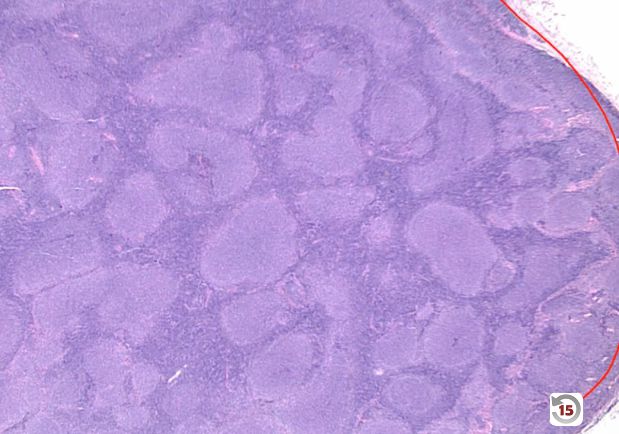
Answer: Follicular lymphoma
Flashcard 3: What type of cell is represented in the image below?
_____
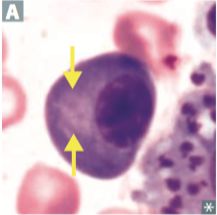
Answer: Plasma cell
Flashcard 4: The given peripheral smear shows abnormal _____ cells with fine hair-like cytoplasmic projections characteristic of hairy cell leukemia.
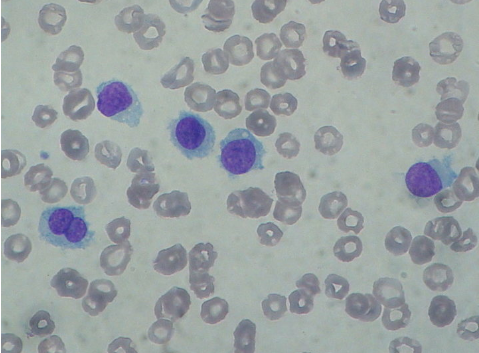
Answer: B
Flashcard 5: Tumor cells with multilobulated nuclei (“cloverleaf” or “flower” cells) is characteristic of _____
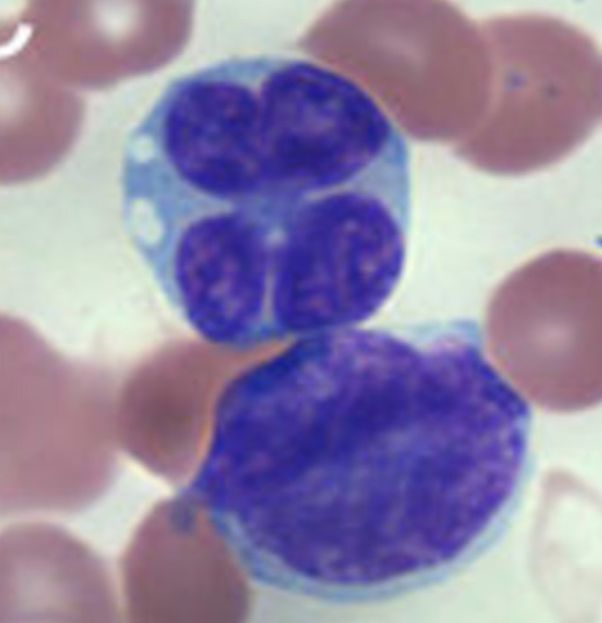
Answer: Adult T-Cell Leukemia/Lymphoma
Flashcard 6: Patients with the O blood type cannot receive which blood types?
_____
Answer:
Flashcard 7: What unique antibodies in plasma do patients with the B blood type have?
_____
Answer:
Flashcard 8: Tumor cells with multilobulated nuclei (“cloverleaf” or “flower” cells) which is characteristic of _____ Leukemia/Lymphoma.
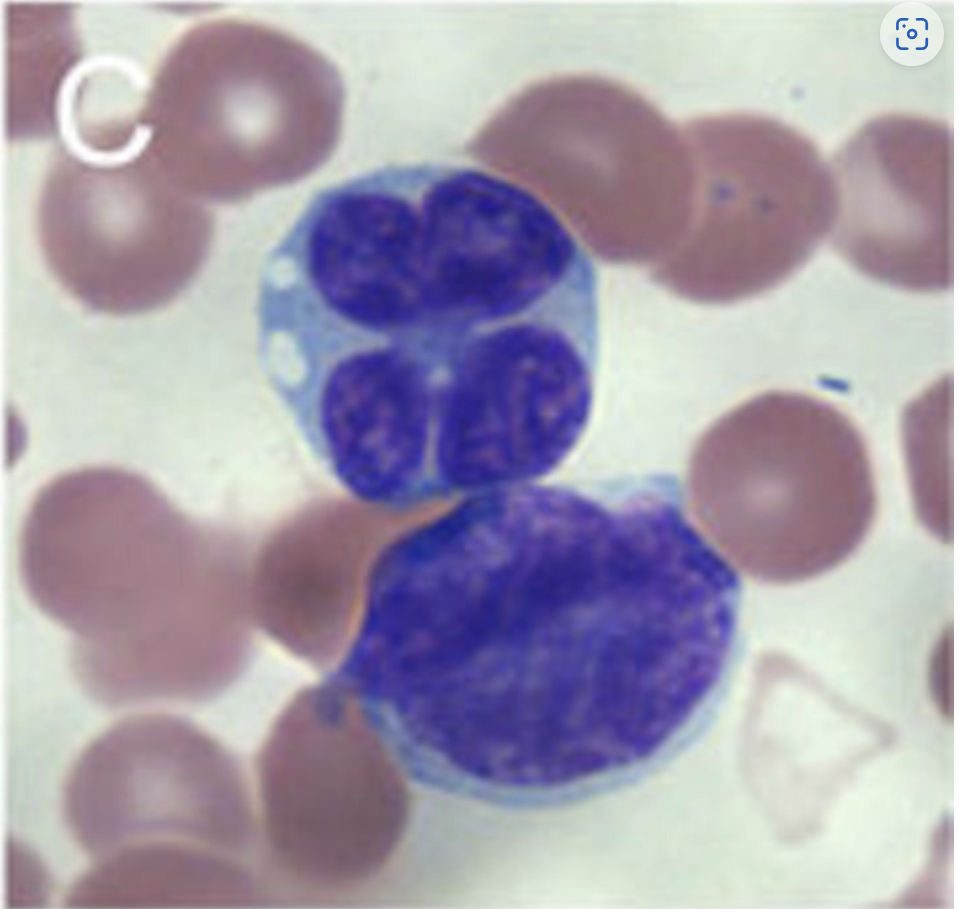
Answer: Adult T-Cell
Flashcard 9: Blood smear of essential _____ shows markedly increased number of platelets, which may be large or abnormally formed
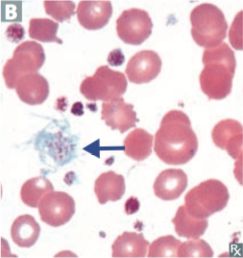
Answer: thrombocythemia
Flashcard 10: What unique antibodies in plasma do patients with the Rh- blood type have?
_____
Answer:
Flashcard 11: What unique antibodies in plasma do patients with the O blood type have?
_____
Answer:
Flashcard 12: Which class of cells have a round, densely stained nucleus with a small amount of cytoplasm?
_____
Answer: Lymphocytes (e.g. B cells, T cells, NK cells)
Flashcard 13: Patients with the A blood type cannot receive which blood types?
_____
Answer:
Flashcard 14: Beta-thalassemia electrophoresis findings: No answer _____
Answer: :)
Flashcard 15: What type of cell is represented in the image below?
_____
Answer: Monocyte
Flashcard 16: Giant inclusions in polymorphonuclear neutrophils, which along with oculocutaneous albinism, and neutropenia is seen in _____ syndrome
Answer: Chediak Higashi
Flashcard 17: What type of cell is represented in the image below?
_____
Answer: Basophil
Flashcard 18: Which of the following is a lymphoid / myeloid neoplasm with widespread involvement of bone marrow?
_____
Answer: Leukemia
Flashcard 19: Which subtype of Hodgkin lymphoma is seen in the image below?
_____
Answer: Nodular sclerosis
- Lymph node divided by bands of sclerosis
Flashcard 20: _____ test will help in diagnosis of factor XIII deficiency
Answer: Urea lysis
Flashcard 21: In -thalassemia major, 4 tetramers result in _____ erythropoiesis and extravascular hemolysis
Answer: ineffective
Flashcard 22: _____ gene mutation present on chromosome 14q is the most common genetic mutation seen in autosomal-dominant hereditary elliptocytosis
Answer: -spectrin
Flashcard 23: Microangiopathic hemolytic anemia is seen in _____, HUS, and HELLP syndrome
Answer: TTP
Flashcard 24: _____ is associated with free light chain excretion in the urine, known as Bence Jones proteinuria
Answer: Multiple myeloma
Flashcard 25: _____ gene mutation present on chromosome 8p is the most common genetic mutation seen in autosomal-dominant hereditary spherocytosis
Answer: Ankyrin
Flashcard 26: _____ gene mutation present on chromosome 1q is the most common genetic mutation seen in autosomal-recessive hereditary spherocytosis
Answer: -spectrin
Flashcard 27: Hemophilia (A, B, C) presents with _____ PT and increased PTT
Answer: normal
Flashcard 28: Hemoglobin >_____ g/dL or Hematocrit >49% in men + bone marrow showing trilineage (or panmyelosis) growth +JAK2 mutation are major criteria for Polycythemia Vera
Answer: 16.5
Flashcard 29: _____ is caused by an acquired defect in myeloid stem cells, resulting in absent GPI
Answer: Paraoxysmal nocturnal hemoglobinuria (PNH)
Flashcard 30: Hereditary stomatocytosis is caused by missense mutations in _____ or AEP
Answer: band 3
Flashcard 31: _____ is an antiphospholipid antibody that results in a falsely elevated PTT
Answer: Lupus anticoagulant
Flashcard 32: Immature neutrophils (e.g. left shift) are characterized by decreased _____ receptors (CD-16)
Answer: Fc
Flashcard 33: Diamond Blackfan syndrome increases the incidence of development of _____ and AML
Answer: MDS
Flashcard 34: Vitamin K deficiency is characterized by a _____ PT and increased PTT
Answer: increased
Flashcard 35: Type _____ vWD is characterized by qualitative defects in vWF
Answer: 2
Flashcard 36: _____-positive intranuclear inclusions containing Ig seen in some of the plasma cells in multiple myeloma are called Dutcher bodies
Answer: PAS
Flashcard 37: For cases with a lower blast count (three cytogenetic abnormalities:_____
Answer: t(15
Flashcard 38: Vitamin C deficiency is characterized by a _____ PT and increased PTT
Answer: normal
Flashcard 39: _____ is a bacteria associated with IgM cold agglutination of RBCs
Answer: Mycoplasma pneumoniae
Flashcard 40: Atypical (Downey type II) T cells are unusually large T cells with _____-philic, vacuolated cytoplasm and lobulated nucleus.
Answer: baso
Flashcard 41: _____ cells of Hodgkin's lymphoma are bi-nucleate with prominent nucleoi ("owl eyes"),
Answer: Reed-Sternberg
Flashcard 42: _____ is a malignant proliferation of mono-clonal plasma cells in the bone marrow
Answer: Multiple myeloma
Flashcard 43: Ataxia-telangiectasia is associated with increased risk of _____ and leukemia
Answer: lymphoma
Flashcard 44: Bernard-Soulier syndrome presents with _____ or decreased platelet count
Answer: normal
Flashcard 45: _____ leukemia is a neoplastic proliferation of naive B cells that co-express CD5 and CD20
Answer: Chronic lymphocytic
Flashcard 46: Days after an episode of _____-vascular hemolysis, hemosiderin may be seen in the urine
Answer: intra
Flashcard 47: _____ syndrome is congenital neutropenia that occurs due to mutations in granulocyte colony-stimulating factor (G-CSF) receptor and neutrophil elastase
Answer: Kostmann
Flashcard 48: _____ porphyria also is known as Gunther's disease
Answer: Congenital erythropoietic
Flashcard 49: _____ inclusions in red cells are described as "golf ball" inclusions in the supravital stain
Answer: Hb H
Flashcard 50: _____ are identified on blood smear as large RBCs (size) with a bluish (color) cytoplasm
Answer: Reticulocytes
Flashcard 51: _____ -blasts are characterized by positive nuclear staining for TdT, which is a DNA polymerase
Answer: Lympho
Flashcard 52: RBCs stored in _____ can be kept until 42 days
Answer: additive solutions
Flashcard 53: _____ cells are large B cells with multilobed nuclei and prominent nucleoli ("owl eye" appearance)
Answer: Reed-Sternberg
Flashcard 54: Failure of aggregation with ristocetin assay occurs in _____ disease and Bernard-Soulier syndrome
Answer: von Willebrand
Flashcard 55: One subtype of AML is _____, which is characterized by t(15;17)
Answer: acute promyelocytic leukemia (APL)
Flashcard 56: _____ consists of malignant "Reed-Sternberg" cells surrounded by inflammatory cells
Answer: Hodgkin's lymphoma
Flashcard 57: _____ is an autosomal dominant hematological disorder that involves spheroid erythrocytes due to a spectrin or ankyrin defect.
Answer: Hereditary Spherocytosis
Flashcard 58: Hemophilia _____ is a coagulation disorder due to a genetic factor VIII deficiency
Answer: A
Flashcard 59: _____ leukemia may transform into diffuse, large B-cell lymphoma (DLBCL) via the Richter transformation
Answer: Chronic lymphocytic
Flashcard 60: _____ bodies are seen in Multiple Myeloma
Answer: Russell
Flashcard 61: _____ anemia occurs when RBCs are "sheared" as they cross microthrombi
Answer: Microangiopathic hemolytic
Flashcard 62: _____ leukemia is defined by the t(9;22) translocation
Answer: Chronic myeloid
Flashcard 63: The _____ form of Burkitt lymphoma typically involves the pelvis or abdomen
Answer: sporadic
Flashcard 64: What is the associated tumor that results from 9;22 translocation of the ABL oncogene?_____
Answer: CML
Flashcard 65: _____ leukemia is commonly caused by translocation of BCR-ABL from chromosome 9 to chromosome 22
Answer: Chronic myeloid
Flashcard 66: _____ lymphoma is driven by a t(11;14) translocation
Answer: Mantle cell
Flashcard 67: What is the most likely mutation seen in multiple myeloma?_____
Answer: t(11
Flashcard 68: The antibodies in immune hemolytic anemia are either Ig_____ or IgM
Answer: G
Flashcard 69: Aplastic anemia can transform into either _____ leukemia and myelodysplastic syndrome
Answer: acute myeloid
Flashcard 70: -thalassemia due to a two gene deletion presents with mild _____ with a(n) increased RBC count
Answer: anemia
Flashcard 71: _____ lymphoma is driven by a t(14;18) translocation
Answer: Follicular
Flashcard 72: Inv 16 is associated with a _____ prognosis in patients with acute myeloid leukemia
Answer: good
Flashcard 73: Impaired division of granulocytic precursors in _____ anemia leads to hypersegmented neutrophils
Answer: megaloblastic
Flashcard 74: von Willebrand disease presents with _____ PT and normal or increased PTT
Answer: normal
Flashcard 75: The M spike seen in _____ is most commonly due to monoclonal IgG (55%) or IgA (25%)
Answer: multiple myeloma
Flashcard 76: Platelets can be stored between _____C to 24C with a shelf life of 5 days.
Answer: 20
Flashcard 77: Normocytic anemia with _____-vascular hemolysis is associated with decreased serum haptoglobin
Answer: intra
Flashcard 78: Reed-Sternberg cells of Hodgkin's lymphoma are CD_____+ and CD30+
Answer: 15
Flashcard 79: _____ is a neoplastic proliferation of mature myeloid cells, especially red blood cells
Answer: Polycythemia vera
Flashcard 80: Type I _____ deficiency leads to deposition of fibrin on mucous membranes
Answer: plasminogen
Flashcard 81: B-ALL is usually characterized by lymphoblasts (TdT+) that express CD_____, CD19, and CD20
Answer: 10
Flashcard 82: Anemia of chronic disease is associated with a(n) _____ free erythrocyte protoporphyrin (FEP)
Answer: increased
Flashcard 83: _____ leukemia causes marrow fibrosis, which results in a "dry tap" on bone marrow aspiration
Answer: Hairy cell
Flashcard 84: _____ leukemia commonly involves lymph nodes, leading to generalized lymphadenopathy; thus called small lymphocytic lymphoma
Answer: Chronic lymphocytic
Flashcard 85: A normal reticulocyte count is between _____ to 1.5%
Answer: 0.5
Flashcard 86: Megaloblastic anemia occurs due to delayed maturation of the _____ relative to the cytoplasm of precursor RBCs
Answer: nucleus
Flashcard 87: _____ syndrome is characterized by atypical CD4+ cells with cerebriform nuclei seen on blood smear
Answer: Sezary
Flashcard 88: B-ALL with t(_____;21) has a good prognosis and is more commonly seen in children
Answer: 12
Flashcard 89: Multiple myeloma is associated with increased risk of _____ due to lack of antigenic diversity of monoclonal antibodies
Answer: infection
Flashcard 90: _____ leukemia is associated with smudge cells and increased lymphocytes on blood smear
Answer: Chronic lymphocytic
Flashcard 91: -thalassemia mutations in -globin genes result in _____ or diminished (+) production of the -globin chain
Answer: absent (0)
Flashcard 92: _____ is due to inhibition or deficiency of the ADAMTS13 (vWF metalloprotease) enzyme
Answer: Thrombotic thrombocytopenic purpura (TTP)
Flashcard 93: EBV-positive diffuse large-cell lymphoma is _____ for CD20, CD79a, IRF4/MUM1, LMP1 and CD15 negative
Answer: positive
Flashcard 94: The bone lesions seen with multiple myeloma are most common in the _____ and skull
Answer: vertebrae
Flashcard 95: -thalassemia due to a _____ gene deletion is characterized by formation of 4 tetramers, known as HbH
Answer: three
Flashcard 96: Reed-Sternberg cells are classically positive for CD-_____ and CD-30
Answer: 15
Flashcard 97: DIC typically presents with increased _____ split products, particularly D-dimer
Answer: fibrin
Flashcard 98: In lymph nodes, _____ follicles have pale, central germinal centers and are active
Answer: secondary
Flashcard 99: A translocation of _____ from chromosome 18 to 14 results in overexpression and ultimately follicular lymphoma
Answer: Bcl2
Flashcard 100: _____ is prolonged in all platelet disorders (both quantitative and qualitative)
Answer: Bleeding time
Flashcard 101: Diagnostic criteria for CMML includes persistent peripheral blood _____cytosis e1 109/L, with monocytes accounting for e10% of the WBC count
Answer: mono
Flashcard 102: Disorders of primary hemostasis are divided into _____ and quantitative disorders
Answer: qualitative
Flashcard 103: _____ is a phenomenon wherein hematopoietic cells in the living and intact state are seen in the cytoplasm of the host cell without any damage
Answer: Emperipolesis
Flashcard 104: The typical normal values for a WBC differential (per USMLE) are:Neutrophils (~ _____%)Lymphocytes (~ 30%)Monocytes (~ 6%)Eosinophils (~ 3%)Basophils (~ 1%)
Answer: 60
Flashcard 105: Normocytic anemia with _____-vascular hemolysis is associated with enlargement of the spleen (splenomegaly)
Answer: extra
Flashcard 106: _____ lymphoma is a neoplastic proliferation of small B cells (CD20+ & CD5+) that expands into the mantle zone
Answer: Mantle cell
Flashcard 107: _____ lymphoma is a neoplastic proliferation of Reed-Sternberg cells
Answer: Hodgkin
Flashcard 108: Lymphomas are malignancies of _____ leukocytes, whereas Leukemias are malignancies of immature leukocytes
Answer: mature
Flashcard 109: _____ is important and the strongest predictor of prognosis for Hodgkin lymphoma (Hodgkin or non-Hodgkin)
Answer: Staging
Flashcard 110: _____ syndrome is characterized by enlarged platelets on blood smear
Answer: Bernard-Soulier
Flashcard 111: Aplastic anemia occurs due to damage to _____ stem cells, resulting in pancytopenia (anemia, thrombocytopenia, and leukopenia)
Answer: hematopoietic
Flashcard 112: DIC is associated with decreased factors _____ and VIII, which helps distinguish it from vitamin K deficiency
Answer: V
Flashcard 113: Other signs of a leukemoid reaction include _____ peripherally located "dohle bodies" in neutrophils, toxic granulation, and cytoplasmic vacuoles
Answer: basophilic
Flashcard 114: _____ syndromes may be associated with a Pseudo-Pelger-Huet anomaly, which are neutrophils with bilobed nuclei
Answer: Myelodysplastic
Flashcard 115: _____ are pathologic RBCs that have a(n) increased mean corpuscular hemoglobin concentration (MCHC)
Answer: Spherocytes
Flashcard 116: _____ is associated with defect at the level of the multipotent hematopoetic stem cell.
Answer: Reticular dysgenesis
Flashcard 117: Aplastic anemia is characterized by _____ reticulocyte count and increased erythropoietin
Answer: decreased
Flashcard 118: _____ syndrome is a qualitative platelet disorder due to a genetic GPIb deficiency
Answer: Bernard-Soulier
Flashcard 119: _____ leukemia/lymphoma is caused by the HTLV-1 virus
Answer: Adult T-cell
Flashcard 120: B-ALL with t(_____;22) has a poor prognosis and is more commonly seen in adults (age group)
Answer: 9
Flashcard 121: Patients with hairy cell leukemia typically present with massive _____ due to expansion of the red pulp
Answer: splenomegaly
Flashcard 122: Large granular lymphocytic leukemia can have a _____-cell or an NK-cell variant
Answer: T
Flashcard 123: Myeloblasts may have crystal aggregates of _____, which are seen on blood smear as Auer rods
Answer: MPO
Flashcard 124: Acute leukemia is subdivided into _____ or AML based on the phenotype of the blasts
Answer: ALL
Flashcard 125: _____ leukemia is a neoplastic proliferation of mature B cells characterized by hairy cytoplasmic processes
Answer: Hairy cell
Flashcard 126: The _____ Coombs test adds anti-human globulin (Coombs reagent) to a sample of a patient's RBCs
Answer: direct
Flashcard 127: Disseminated intravascular coagulation (DIC) as a paraneoplastic syndrome is most commonly associated with _____ and prostatic adenocarcinoma.
Answer: acute promyelocytic leukemia (APL)
Flashcard 128: _____ is an anemia due to decreased synthesis of globin chains
Answer: Thalassemia
Flashcard 129: Blood smear of a patient with hemoglobin C disease may show _____ cells and/or HbC crystals within RBCs
Answer: target
Flashcard 130: Apart form AML, Auer rods are also seen in _____ syndromes (RAEB-2), and chronic myelomonocytic leukemia.
Answer: myelodysplastic
Flashcard 131: The _____ subtype of Hodgkin lymphoma is characterized histologically by presence of Reed-Sternberg cells in lake-like spaces (lacunar cells)
Answer: nodular sclerosis
Flashcard 132: CML is distinguished from a leukemoid reaction (benign neutrophilia) by a _____ leukocyte alkaline phosphatase (LAP) stain
Answer: negative
Flashcard 133: Left shifts are usually seen with neutrophilia in the acute response to _____ or tissue necrosis
Answer: bacterial infection
Flashcard 134: _____ lymphoma is characterized by a high mitotic index and 'starry-sky' appearance on microscopy
Answer: Burkitt
Flashcard 135: Acute lymphoblastic leukemia is subclassified into _____-ALL and T-ALL based on surface markers
Answer: B
Flashcard 136: The most common translocation in gastric MALToma is _____
Answer: t(11
Flashcard 137: Ig_____-mediated immune hemolytic anemia usually causes extravascular hemolysis
Answer: G
Flashcard 138: Endotoxin/Lipopolysaccharide of Gram Negative Bacteria can activate _____, resulting in coagulation and possible DIC (disseminated intravascular coagulation)
Answer: tissue factor
Flashcard 139: Lymphoma is divided into _____ (60%) and Hodgkin lymphoma (40%) *bonus: age groups
Answer: non-Hodgkin
Flashcard 140: _____ gene rearrangement is a bad prognostic marker for ALL
Answer: MLL
Flashcard 141: _____ is characterized by Birbeck (tennis racket) granules on electron microscopy
Answer: Langerhans cell histiocytosis
Flashcard 142: T-ALL is characterized by lymphoblasts (TdT+) that express markers ranging from CD-_____ to CD-8
Answer: 2
Flashcard 143: _____ is due to autoimmune production of IgG against GPIIb/IIIa
Answer: Immune thrombocytopenic purpura (ITP)
Flashcard 144: Anemia is classified as _____ if the MCV < 80 m3
Answer: microcytic
Flashcard 145: Hereditary spherocytosis most commonly involves defects in _____, -spectrin, band 3.1, or protein 4.2
Answer: ankyrin
Flashcard 146: _____ anemia is associated with ringed sideroblasts, in which iron-laden mitochondria form a ring around the nucleus of erythroid precursors
Answer: Sideroblastic
Flashcard 147: _____ T-cells (ballerina skirt cells) are atypical CD8+ cytotoxic T-cells seen on a blood smear of Epstein-Barr Virus
Answer: Downey type II
Flashcard 148: The _____ subtype of Hodgkin lymphoma typically presents as an enlarging cervical or mediastinal lymph node in a female
Answer: nodular sclerosis
Flashcard 149: Disorders of fibrinolysis typically present with _____ PT and increased PTT
Answer: increased
Flashcard 150: Burkitt lymphoma classically presents as an extranodal mass in a _____ or young adult (age group)
Answer: child
Flashcard 151: Normocytic anemia with _____-vascular hemolysis may cause leakage of hemoglobin into the blood and urine
Answer: intra
Flashcard 152: In _____ deficiency, oxidative stress precipitates denaturated hemoglobin as Heinz bodies
Answer: G6PD
Flashcard 153: _____ is diagnosed via blood smear with a characteristic 'Maltese cross' structure within cells
Answer: Babesiosis
Flashcard 154: Hereditary _____ is diagnosed by the osmotic fragility test
Answer: spherocytosis
Flashcard 155: Lymphomas are _____ negative and Reticulin positive (stain)
Answer: PAS
Flashcard 156: RBCs stored in _____ can be kept until 21 days
Answer: ACD
Flashcard 157: _____ -blasts are usually characterized by positive cytoplasmic staining for myeloperoxidase (MPO)
Answer: Myelo
Flashcard 158: Hodgkin's lymphoma caused by EBV presents as a _____ mass or nontender lymphadenopathy
Answer: mediastinal
Flashcard 159: When exposed to conditions that favor the _____ form of Hemoglobin, HbS polymerizes and forms needle-like structures ("sickle cells")
Answer: taut
Flashcard 160: The _____ Coombs test adds donor blood and anti-Ig antibody (Coombs reagent) to the patient's serum
Answer: indirect
Flashcard 161: Diffuse Large B-Cell Lymphoma is most commonly caused by alterations in _____ or Bcl-6
Answer: Bcl-2
Flashcard 162: _____ is a neoplastic proliferation of mature myeloid cells, especially megakaryocytes
Answer: Myelofibrosis
Flashcard 163: _____ may be confirmed via flow cytometry, which detects a lack of CD-55 and CD-59
Answer: Paroxysmal nocturnal hemoglobinuria
Flashcard 164: _____ macrocytic anemia occurs when DNA synthesis is unimpaired (impaired or unimpaired)
Answer: Non-megaloblastic
Flashcard 165: In paroxysmal cold hemoglobinuria, Ig_____ antibodies (Donath Landsteiner abx) are directed against the P blood group antigen.
Answer: G
Flashcard 166: Vitamin K deficiency presents with _____ PT and increased (in severe cases) PTT
Answer: increased
Flashcard 167: _____ -cytosis refers to cells of varying shapes
Answer: Poikilo
Flashcard 168: _____ leukemia/lymphoma may present with lytic (punched-out) bone lesions and hypercalcemia
Answer: Adult T-cell
Flashcard 169: In TTP, large, uncleaved vWF multimers lead to increased platelet _____ with consequent microthrombi formation
Answer: adhesion
Flashcard 170: _____ is a qualitative platelet disorder due to a genetic GPIIb/IIIa deficiency
Answer: Glanzmann thrombasthenia
Flashcard 171: RBCs stored in _____ can be kept until 35 days
Answer: CPDA
Flashcard 172: In multiple myeloma, neoplastic plasma cells produce _____ and MIP1, which stimulates osteoclast maturation that will lead to bone resorption
Answer: IL-1
Flashcard 173: _____ lymphoma is characterized by painless "waxing and waning" lymphadenopathy
Answer: Follicular
Flashcard 174: _____ measures the intrinsic and common pathways of the coagulation cascade
Answer: Partial thromboplastin time (PTT)
Flashcard 175: G6PD deficiency presents with _____-uria and back pain hours after exposure to oxidative stress
Answer: hemoglobin
Flashcard 176: Diagnosis of _____ is confirmed by an isolated increase in HbA2 (> 3.5%) on electrophoresis
Answer: -thalassemia minor
Flashcard 177: In acute _____ leukemia, blasts characteristically infiltrate the gums
Answer: monocytic
Flashcard 178: -thalassemia with a _____ deletion (cis or trans) is more prevalent in African populations
Answer: trans
Flashcard 179: Immune thrombocytopenic purpura presents with _____ PT and normal PTT
Answer: normal
Flashcard 180: Epstein-Barr Virus is associated with the _____ form of Burkitts lymphoma
Answer: endemic (African)
Flashcard 181: _____ -philia is uncommon, but can be a sign of myeloproliferative disease, particularly CML
Answer: Baso
Flashcard 182: _____ or t(9 is a 22) or t(8 prognostic marker for ALL
Answer: Pseudodiploidy
Flashcard 183: The _____ form of Burkitt lymphoma typically involves the jaw
Answer: African
Flashcard 184: Normocytic anemia due to peripheral destruction is further divided into _____ and intravascular hemolysis
Answer: extravascular
Flashcard 185: Ig_____-mediated immune hemolytic anemia usually causes intravascular hemolysis
Answer: M
Flashcard 186: Normal platelet counts are between _____ and 400K/L
Answer: 150K
Flashcard 187: _____ lymphoma is driven by a t(8;14) translocation
Answer: Burkitt
Flashcard 188: Epstein-Barr Virus is strongly associated with the _____ and lymphocyte depleted subtypes of Hodgkins lymphoma
Answer: mixed cellularity
Flashcard 189: The blasts seen in acute leukemia are _____ (size), immature cells, often with 'punched out' nucleoli
Answer: large
Flashcard 190: During sleep, mild respiratory _____ develops due to shallow breathing causing activation of complement, which may then trigger PNH
Answer: acidosis
Flashcard 191: The cells in _____ leukemia stain positive for tartrate-resistant acid phosphatase (TRAP)
Answer: hairy cell
Flashcard 192: _____ cells in Multiple Myeloma with fiery red cytoplasm are called flame cells.
Answer: Plasma
Flashcard 193: Primary effusion lymphoma is also known as _____ lymphoma and is a B-cell lymphoma
Answer: body cavity based
Flashcard 194: _____ mutations are present in blasts from patients with Down syndrome who have the transient myeloproliferative disease
Answer: GATA1
Flashcard 195: Glanzmann thrombasthenia shows decreased levels on CD_____ and CD61 on flow cytometry
Answer: 41
Flashcard 196: _____ - ALL usually presents in teenagers (age group) as a mediastinal mass, thus it is often referred to as acute lymphoblastic lymphoma
Answer: T
Flashcard 197: Risk factors for acute myeloid leukemia include prior exposure to _____ chemotherapy and radiation
Answer: alkylating
Flashcard 198: Hodgkin lymphoma has a bimodal distribution: common in _____ and adults > 55 years
Answer: young adulthood
Flashcard 199: _____ is an anemia due to defective protoporphyrin synthesis
Answer: Sideroblastic anemia
Flashcard 200: _____ will show decreased mean fluorescence of RBCs in eosin 5-maleimide (EMA) binding test
Answer: Hereditary spherocytosis
Flashcard 201: _____ body is a drumstick shaped mass of chromatin hanging down from neutrophil nuclei
Answer: Davidson
Flashcard 202: The cell of origin for CLL/SLL is either a _____ B cell (interfollicular area) and naive B cell
Answer: post-germinal center memory/mature
Flashcard 203: Marginal-zone lymphoma can harbour t_____, t18), or t(14 mutations over time, that render their growth and survival antigen-independent
Answer: (11
Flashcard 204: _____ is a systemic overactivation of macrophages and cytotoxic T cells that leads to fever, pancytopenia and hepatosplenomegaly.
Answer: Hemophagocytic lymphohistiocytosis
Flashcard 205: Shift of the osmotic fragility curve to the _____ indicates thalassemia
Answer: right
Flashcard 206: Bleeding time is normally between _____ and 7 minutes
Answer: 2
Flashcard 207: DIC typically presents with _____ PT and increased PTT
Answer: increased
Flashcard 208: _____ ring seen in erythrocytes on peripheral blood smear, is considered as a remnant of microtubules during cell division.
Answer: Cabot
Flashcard 209: _____ leukemia is a neoplastic proliferation of mature myeloid cells, especially granulocytes and their precursors
Answer: Chronic myeloid
Flashcard 210: Nodular lymphocyte predominant subtype of Hodgkin's is CD15 _____ve, CD30 -ve, CD20 +ve, BCL6 +ve and EMA +ve
Answer: -
Flashcard 211: _____ -thalassemia is usually due to gene deletions
Answer: Alpha
Flashcard 212: Shift of the osmotic fragility curve to the _____ indicates hereditary spherocytosis
Answer: left
Flashcard 213: The _____ screen causes cells with any amount of HbS to sickle
Answer: metabisulfite
Flashcard 214: Which white blood cells can be elevated in patients of polycythemia vera?_____
Answer: Basophils and eosinophils
Flashcard 215: In atypical chronic myeloid leukemia, minimal absolute monocytosis is
Answer: In atypical chronic myeloid leukemia, minimal absolute monocytosis is
Flashcard 216: DCIP test is a test-tube turbidity test used for the screening of hemoglobin _____
Answer: E
Flashcard 217: What is the most common subtype of MGUS?_____
Answer: Non-IgM MGUS
Flashcard 218: Most efficient method for performing leukoreduction is the use of specific _____ filters
Answer: leukodepletion
Flashcard 219: Most myelomas are associated with more than _____ gm/dL of serum Ig
Answer: 3
Flashcard 220: Which AML subtype is also known as Schilling type?_____
Answer: AML M5 (monocytic or monoblastic)
Flashcard 221: Biallelic mutation in CEBPA suggests a _____ prognosis for AML
Answer: good
Flashcard 222: Coomb's _____ hemolytic anemia maybe seen in Wilson's disease due to large amounts of copper released from damaged hepatocytes
Answer: negative
Flashcard 223: Hermansky Pudlak syndrome is a disorder involving platelet _____ granules
Answer:
Flashcard 224: What is the confirmatory test for Factor XIII deficiency?_____
Answer: Urea lysis test
Flashcard 225: Cryoprecipitate is stored at a temperature of _____C
Answer: 30
Flashcard 226: _____ is a unique subtype of MGUS in which there is no immunoglobulin heavy-chain component
Answer: LC-MGUS
Flashcard 227: If Mentzer index is _____, the patient likely has a iron-deficiency anemia
Answer: >14
Flashcard 228: The transfusion of packed RBCs (PRBC) should be completed within a maximum period of _____ hours after the removal from the blood fridge.
Answer: 4
Flashcard 229: Inherited form of thrombotic thrombocytopenic purpura is also referred to as _____ syndrome
Answer: Upshaw-Schulman
Flashcard 230: What is the most common tumor arising due to ionizing radiation (medical imaging)?_____
Answer: Myeloid leukemia
Flashcard 231: HAM S test (acidified serum lysis) is used for the diagnosis of _____
Answer: Paroxysmal nocturnal hemoglobinuria
Flashcard 232: Quebec platelet syndrome is a disorder involving platelet _____ granules
Answer:
Flashcard 233: Hemophagocytic lymphohistiocytosis is characterized by low or absent _____ cell activity
Answer: NK
Flashcard 234: Large granular lymphocytic leukemia will have mutations in the _____ gene
Answer: STAT3
Flashcard 235: Deficiency of factor _____ is also referred to as Stuart-prower disease
Answer: X
Flashcard 236: _____ is a marker for Waldenstorm macroglobulinemia
Answer: MYD88
Flashcard 237: Which subtype of MGUS can progress to Waldenstrm macroglobulinemia?_____
Answer: IgM MGUS
Flashcard 238: _____ protein deficiency is responsible for the mushroom cell shape of the RBCs
Answer: Band 3
Flashcard 239: Anaplastic large cell lymphoma is a _____-cell lymphoma with large lymphoid cells
Answer: T
Flashcard 240: In small lymphocytic lymphoma the absolute neutrophil count is _____ per mm3
Answer: 5000
Flashcard 241: What is the inheritence pattern of Bernard-Soulier syndrome?_____
Answer: Autosomal Recessive
Flashcard 242: What is the most common bilateral testicular tumors?_____
Answer: Lymphoma
Flashcard 243: The test for prothrombin time is done within _____ hours.
Answer: 2
Flashcard 244: _____ is an aggressive lymphoid neoplasm that classically occurs in the oral cavity in immunosuppressed patients
Answer: Plasmablastic lymphoma
Flashcard 245: Delayed umbilical stump bleeding is characteristic of factor _____ deficiency.
Answer: XIII
Flashcard 246: Which form (primary or secondary) myelodysplastic syndrome show high risk of transforming to AML?_____
Answer: Secondary/therapy related
Flashcard 247: Lymph node biopsy of CLL will show loose aggregates of small lymphocytes and larger activated lymphocytes, commonly referred to as _____ centres
Answer: proliferation
Flashcard 248: What is the anticoagulant used in black coloured ESR vaccutainer?_____
Answer: Citrate
Flashcard 249: Activation of the transcription factor _____ is a common event in classical Hodgkin's lymphoma (HL).
Answer: NF-B
Flashcard 250: Do patients with juvenile CML have philadelphia chromosome?_____
Answer: No
Flashcard 251: What AML subtype is associated with organ infiltration?_____
Answer: AML M5
Flashcard 252: The most common site for extramedullary plasmacytoma is _____
Answer: upper respiratory tract
Flashcard 253: Infantile leukemia is usually _____ for CD10 (CALLA)
Answer: negative
Flashcard 254: Hemophagocytic lymphohistiocytosis is characterized by _____ levels of CXCL9
Answer: elevated
Flashcard 255: If the TT is _____ corrected after adding reptilase then the patient likely has afibrinogenemia
Answer: not
Flashcard 256: Blasts usually make up _____% of the circulating cells in blast phase of chronic myeloid leukemia
Answer: >20
Flashcard 257: Grey platelet syndrome is a disorder involving platelet _____ granules
Answer:
Flashcard 258: Single axial group of lymph nodes are frequently involved in a _____Hodgkin's lymphoma
Answer:
Flashcard 259: Inv 3 is associated with a _____ prognosis in patients with acute myeloid leukemia (AML).
Answer: poor
Flashcard 260: Which HLA antigen is associated with Burkitt's lymphoma (non-EBV)?_____
Answer: HLA-DR
Flashcard 261: Which AML subtype is also known as Naegli type?_____
Answer: AML M4
Flashcard 262: Reed Sternberg cells in nodular sclerosis variant of Hodgkin lymphoma (HL) are negative for CD_____ (leukocyte common antigen)
Answer: 45
Flashcard 263: Arbiskov cells are seen in _____.
Answer: chloroma
Flashcard 264: Chronic lymphocytic leukemia (CLL) contains a large number of monotonous, uniform-looking, mature lymphocytes, which is often described as a _____ appearance.
Answer: "convent-girl"
Flashcard 265: _____ lymphoma is a very aggressive tumor, having a very high mitotic index and a ki67 of about 100%.
Answer: Burkitt's
Flashcard 266: _____ is a lipophilic dye that binds irreversibly to an undefined granule component of myeloid cells (granulocytes and precursors, eosinophils and monocytes)
Answer: Sudan Black B (SBB)
Flashcard 267: What AML subtype is associated with inv 16 and t(16;16)?_____
Answer: AML M4 (myelomonocytic))
Flashcard 268: What is the most common subtype of acute lymphoblastic leukemia (ALL)?_____
Answer: Pre-B ALL
Flashcard 269: Characteristic leukocyte appearance in Pelger-Huet syndrome is with _____-shaped bilobed nuclei
Answer: dumbbell
Flashcard 270: _____ lymphomas may invade epithelial structures to form lymphoepithelial lesions
Answer: Marginal zone
Flashcard 271: _____ is the most common non-Hodgkin's lymphoma in children under the age of 15 years.
Answer: Burkitt lymphoma
Flashcard 272: Myeloperoxidase and acid hydrolases are a part of _____ granules of neutrophils.
Answer: primary (azurophilic)
Flashcard 273: What AML subtype is associated with Erythemic myelosis and Di Guglielmo disease?_____
Answer: AML M6 (erythroid)
Flashcard 274: A nonparatrabecular pattern of infiltration on bone marrow biopsy points to the diagnosis of _____
Answer: Waldenstrm macroglobulinemia
Flashcard 275: Histopathological finding of follicular hyperplasia (germinal centers) with a vascular core point towards the diagnosis of _____
Answer: Castleman's disease
Flashcard 276: _____ cells have horseshoe-shaped nuclei and voluminous cytoplasm, seen in anaplastic large cell lymphoma
Answer: Hallmark
Flashcard 277: Pawn ball megakaryocytes or cells with multiple separate nuclei are seen in _____
Answer: myelodysplastic syndrome
Flashcard 278: Best immunohistochemical marker for multiple myeloma is _____
Answer: cyclin D1
Flashcard 279: MALTomas are _____ for CD43, which is a T-cell marker
Answer: positive
Flashcard 280: What is the etiological agent for lymphoplasmacytic lymphoma/Waldenstrom's macroglobulinemia?_____
Answer: Hepatitis C virus
Flashcard 281: Which thrombin agonist and is used to differentiate heparin-induced thrombocytopenia (HIT) and afibrinogenemia?_____
Answer: Reptilase
Flashcard 282: MALTomas are _____ for CD10 (CALLA)
Answer: negative
Flashcard 283: - heavy chain disease (HCD) is known as _____ disease
Answer: Selligmann's
Flashcard 284: _____ positive giant inclusions seen in leukocytes is the first line diagnostic test for Chediak-Higashi syndrome.
Answer: Peroxidase
Flashcard 285: Cells in acute myeloid leukemia are _____ for CD33
Answer: positive
Flashcard 286: What is the most common primary malignancy of bone of hematological origin?_____
Answer: Multiple myeloma
Flashcard 287: Age >10 years or indicates _____ prognosis in acute lymphocytic leukemia (ALL).
Answer: poor
Flashcard 288: A _____ LAP score is seen in multiple myeloma
Answer: high
Flashcard 289: What is the most common cytogenetic change in children suffering from myelodysplastic syndrome?_____
Answer: Monosomy 7
Flashcard 290: _____ incompatibility is the most common cause of hemolytic disease of newborn and affects the first-born.
Answer: ABO
Flashcard 291: In atypical chronic myeloid leukemia, minimal absolute basophilia is
Answer: In atypical chronic myeloid leukemia, minimal absolute basophilia is
Flashcard 292: T-cell immunophenotype indicates _____ prognosis in acute lymphocytic leukemia (ALL).
Answer: poor
Flashcard 293: Scattered macrophages with abundant wrinkled, green-blue cytoplasm or pseudo-Gaucher cells are seen in _____
Answer: chronic myeloid leukemia
Flashcard 294: Hyperdiploidy indicates _____ prognosis in acute lymphocytic leukemia (ALL).
Answer: good
Flashcard 295: NESTROF is a very useful screening tool for diagnosis of -thalassemia _____
Answer: trait
Flashcard 296: Plasma cell tumors such as multiple myeloma are positive for CD_____
Answer: 138
Flashcard 297: Hb _____ levels are increased in juvenile chronic myeloid leukemia (JMML)
Answer: F
Flashcard 298: Atypical mononuclear cells (sezary cells) comprising _____ than 20% of total lymphocyte count is used to diagnose Sezary syndrome
Answer: more
Flashcard 299: For testing PT, the sample is activated by using _____ (derived from rabbit brain or lung).
Answer: thromboplastin
Flashcard 300: What AML subtype is therapy related?_____
Answer: AML M6 (erythroid)
Flashcard 301: Mantle Cell Lymphoma may show large cells resembling _____
Answer: centroblasts
Flashcard 302: What is the life span of affected red cells in hereditary spherocytosis?_____
Answer: 10 to 20 days
Flashcard 303: Lactoferrin, tPA and histaminase are a part of _____ granules of neutrophils.
Answer: secondary (specific)
Flashcard 304: Myeloid progenitors of JMML are hypersensitive to _____ (growth factor)
Answer: GM-CSF
Flashcard 305: Reactive lymphoid hyperplasia will show _____ variation in shape and size of the follicles
Answer: marked
Flashcard 306: In CLL/SLL, B cells originate from the naive B cells in _____ zones
Answer: interfollicular
Flashcard 307: _____ subtype of Hodgkin's is not associated with EBV
Answer: Lymphocyte predominant
Flashcard 308: _____ disease is sinus histiocytosis with massive lymphadenopathy
Answer: Rosai Dorfman
Flashcard 309: von Willebrand disease associated with thrombocytopenia is Type 2_____.
Answer: B
Flashcard 310: Bone marrow in AL amyloidosis shows _____
Answer: bone marrow plasmacytosis
Flashcard 311: Are Bence Jones proteins seen in urine in monoclonal gammopathy of undetermined significance (MGUS)?_____
Answer: Yes
Flashcard 312: A patient of PNH will show _____ MCV due to increased reticulocytosis
Answer: high
Flashcard 313: What AML subtype is associated with chloromas?_____
Answer: AML M2, M5a, M5b, M4
Flashcard 314: What is the inheritence pattern of Glanzmann thrombasthenia?_____
Answer: Autosomal Recessive
Flashcard 315: The most common cytogenetic abnormality associated with lymphoplasmacytic lymphoma is deletion of _____
Answer: 6q
Flashcard 316: Blasts usually make up less than _____% of the circulating cells in chronic phase of chronic myeloid leukemia
Answer: 5
Flashcard 317: The most common chromosomal defect seen in Chronic lymphocytic leukemia is the deletion of _____
Answer: 13q
Flashcard 318: Normal karyotyping with mutated NPM1 suggests a _____ prognosis for AML
Answer: good
Flashcard 319: Is Ph chromosome seen in JMML?_____
Answer: No
Flashcard 320: Is hemophagocytosis on bone marrow examination sufficient to make the diagnosis of hemophagocytic lymphohistiocytosis?_____
Answer: No
Flashcard 321: Which variant of Reed-Sternberg cells is seen with mixed cellularity subtype of Hodgkin's lymphoma?_____
Answer: Mononuclear subtype
Flashcard 322: Which AML subtype is negative for myeloperoxidase?_____
Answer: AML M0, M5, M6 and M7
Flashcard 323: Which immunohistochemical marker is associated with cyclin D1 negative mantle cell lymphoma?_____
Answer: SOX11
Flashcard 324: Increased MCHC in hereditary spherocytosis is due to _____ caused by the loss of K+ and H2O.
Answer: dehydration
Flashcard 325: _____ is the most specific and sensitive marker for Hairy-cell leukemia
Answer: Annexin A1
Flashcard 326: The lower blasts cutoff percentage for diagnosing acute lymphoblastic leukemia (ALL) on bone marrow biopsy is _____%.
Answer: 25
Flashcard 327: What subtype of hodgkin's lymphoma is associated with lymphohistiocytic variant of RS cells?_____
Answer: Lymphocyte-predominant
Flashcard 328: Which classes of AML show weak positivity for non-specifc esterases?_____
Answer: M3, M7
Flashcard 329: Which AML subtype shows increased serum muramidase levels?_____*also seen with?
Answer: M4
Flashcard 330: Hemoglobin solubility test is a test-tube turbidity test used for the screening of hemoglobin _____
Answer: S
Flashcard 331: Rees and Ecker's solution is used as a diluting fluid for performing _____ counts.
Answer: platelet
Flashcard 332: _____ bodies are irregular, dark, blue-purple granules, seen at the periphery of siderocytes, which stain iron positive
Answer: Pappenheimer
Flashcard 333: Smudge cells in CLL are artefacts due to disrupted tumor cells which lack _____
Answer: vimentin
Flashcard 334: Tumor cells with multilobulated nuclei ( cloverleaf or flower cells) which is characteristic of _____ Leukemia/Lymphoma.
Answer: Adult T-Cell
Flashcard 335: What subtype of Hodgkin's lymphoma has biphasic incidence?_____
Answer: Mixed cellularity
Flashcard 336: Bactericidal factors (lysozyme, defensins) and neutral proteases (Elastase, cathepsin G, nonspecific collagenases, proteinase 3) are a part of _____ granules of neutrophils.
Answer: primary (azurophilic)
Flashcard 337: Which variant of Reed-Sternberg cells is seen with lymphocyte rich subtype of Hodgkin's lymphoma?_____
Answer: Mononuclear subtype
Flashcard 338: The given instrument is a _____ needle used for bone marrow biopsy.
Answer: Klima
Flashcard 339: What AML subtype is associated with t(15;17)?_____
Answer: AML M3 (promyelocytic)
Flashcard 340: PNH results from mutations in the _____ gene
Answer: PIGA
Flashcard 341: What are the cellular markers expressed by nasal T-cell lymphoma?_____
Answer: CD56
Flashcard 342: The expression of _____ is associated with poor prognosis in chronic lymphocytic leukemia (CLL)
Answer: ZAP-70
Flashcard 343: Convent-girl appearance in peripheral blood smear is described for _____ leukemia
Answer: chronic lymphocytic
Flashcard 344: Which germinal center associated antigens are expressed with Burkitt's lymphoma (non-EBV)?_____
Answer: CD10 and BCL-6 (2)
Flashcard 345: Which classes of AML show diffuse positivity for PAS?_____
Answer: M6 erythroblasts
Flashcard 346: What AML subtype is associated with t(8;21)?_____
Answer: AML M2
Flashcard 347: In -thalassemia minor, the Hb A2 levels usually show an increase upto _____%
Answer: 4 8
Flashcard 348: Beta 2 microglobulin is an indicator of poor prognosis in _____.
Answer: multiple myeloma
Flashcard 349: Which blood component has protein C/S and antithrombin?_____
Answer: FFP
Flashcard 350: Which RBC membrane skeleton protein is never involved in hereditary spherocytosis?_____
Answer: Glycophorin
Flashcard 351: The implicated donors in Transfusion-related acute lung injury are frequently _____.
Answer: multiparous women
Flashcard 352: Monosomy 7 is associated with a _____ prognosis in patients with acute myeloid leukemia (AML).
Answer: poor
Flashcard 353: What is the most specific test for diagnosing hereditary spherocytosis?_____
Answer: eosin-5-maleimide test
Flashcard 354: Against which RBC antigen are the IgG antibodies of warm agglutination reaction directed?_____
Answer: Rh antigen
Flashcard 355: CD_____ is also known as the leukocyte common antigen.
Answer: 45
Flashcard 356: LAP score is usually _____ in the cells of chronic myeloid leukemia
Answer: low
Flashcard 357: RBCs stored in _____ are currently the most common preparations for transfusion
Answer: additive solutions
Flashcard 358: The optimum time for performing leukoreduction is before _____
Answer: storage
Flashcard 359: What AML subtype is associated with eosinophilia?_____
Answer: AML M4 (myelomonocytic))
Flashcard 360: _____ is an epigenomic regulatory gene mutated in 90% of follicular lymphomas
Answer: MLL2
Flashcard 361: - heavy chain disease is known as _____ disease
Answer: Franklin's
Flashcard 362: t(14;16), del 17p, and t(4;14) in multiple myeloma is associated with a _____ prognosis
Answer: poor
Flashcard 363: The most common cytogenetic change in multiple myeloma is the deletion of _____
Answer: 14q
Flashcard 364: What is the earliest hematological response to iron therapy in iron-deficiency anemia?_____
Answer: Bone marrow erythroid hyperplasia
Flashcard 365: _____ lymphadenitis is also known as histiocytic necrotizing lymphadenitis.
Answer: Kikuchi's
Flashcard 366: Hematopoetic presentation of acute radiation syndrome is marked by _____
Answer: aplastic anemia
Flashcard 367: In touch preparations of Extranodal NK/T-Cell Lymphoma, large _____philic granules are seen in the cytoplasm of the tumor cells
Answer: azuro
Flashcard 368: _____ are dilated endoplasmic reticulum cisternae is seen in myeloma
Answer: Thesaurocytes
Flashcard 369: Which variant of Reed-Sternberg cells is seen with lymphocyte depleted subtype of Hodgkin's lymphoma?_____
Answer: reticular variant
Flashcard 370: Blasts usually make up _____% of the circulating cells in accelerated phase of chronic myeloid leukemia
Answer: 10-19
Flashcard 371: _____ is the most specific marker of Reed Sternberg cell
Answer: PAX5
Flashcard 372: Hereditary _____ is a type of hemolytic anemia causing extreme variation in RBC size and shape.
Answer: pyropoikilocytosis
Flashcard 373: _____ bodies are siderotic nodules in spleen seen in cases of congestive splenomegaly and sickle cell disease
Answer: Gamma-Gandy
Flashcard 374: Ig_____ type of multiple myeloma has no or absent M spike on serum electrophoresis
Answer: D
Flashcard 375: Multifocal mucosal involvement of small bowel and colon, also known as _____ is seen in Mantle Cell Lymphoma
Answer: lymphomatoid polyposis
Flashcard 376: Which B-cell associated antigens are expressed with Burkitt's lymphoma (non-EBV)?_____
Answer: CD19, CD20, CD22, CD79a (4)
Flashcard 377: The size of -BCR ABL (micro BCR) protein in t(9;22) associated with myeloproliferative neoplasm (MPN) is _____ kDa.
Answer: 230
Flashcard 378: Which cell organelles fuse and form Auer rods of AML lymphocytes?_____
Answer: Lysosomes
Flashcard 379: Which classes of AML show strong positivity for non-specific esterases?_____
Answer: M4, M5
Flashcard 380: EBV-positive diffuse large-cell lymphoma is seen in elderly (>50 years) with_____ immunodeficiency or prior lymphoma
Answer: out
Flashcard 381: Involvement of spleen is under stage _____ of Ann-Arbor staging of Hodgkin's lymphoma
Answer: III
Flashcard 382: Rearrangements in the _____ gene is seen in anaplastic large cell lymphoma
Answer: ALK
Flashcard 383: What is the most common cytogenetic change in adults suffering from myelodysplastic syndrome?_____
Answer: del(5q)
Flashcard 384: A _____ LAP score is seen in hodgkin's lymphoma
Answer: high
Flashcard 385: _____ is the most severe protein deficiency associated with hereditary spherocytosis (HS).
Answer: Spectrin
Flashcard 386: Which non-hodgkin lymphomas are most common primary extranodal lymphomas?_____
Answer: Marginal zone lymphomas
Flashcard 387: For cases with a lower blast count (two chromosomal aberrations:_____
Answer: NPM1 or CEBPA mutation
Flashcard 388: The most commonly affected gene in T-cell acute lymphoblastic leukemia (T- ALL) is _____
Answer: NOTCH1
Flashcard 389: Marrow biopsy of patients with _____ leukemia, may show macrophages engulfing the apoptotic tumor cells giving it a starry sky appearance
Answer: acute lymphoblastic
Flashcard 390: Lymph node biopsy showing diffuse effacement with small lymphocytes and proliferation centers, is suggestive of _____
Answer: chronic lymphocytic leukemia/small lymphocytic lymphoma
Flashcard 391: Which variant of large-cell non-Hodgkin lymphomas is associated with Reed-Sternberg cells?_____
Answer: immunoblastic NHL
Flashcard 392: What AML subtype is associated with CD41/61?_____
Answer: AML M7 (megakaryocytic)
Flashcard 393: Which non-hodgkin's lymphoma presents most commonly as a destructive nasopharyngeal mass?_____
Answer: Extranodal NK/T-Cell Lymphoma
Flashcard 394: The most common site of extra-nodal lymphoma is the _____
Answer: stomach
Flashcard 395: Which cellular markers are absent from early pre-B acute leukemias?_____
Answer: CD10, CD20 and Cy Ig
Flashcard 396: Monocytoid B cells in sinuses are seen in _____ stages of HIV infection
Answer: early
Flashcard 397: Lysozymes and alkaline phosphatase are a part of _____ granules of neutrophils.
Answer: secondary (specific)
Flashcard 398: What is the least common type of AML?_____
Answer: AML M7
Flashcard 399: Haemoglobin is poor prognostic factors for Hodgkin's lymphoma
Answer: Haemoglobin is poor prognostic factors for Hodgkin's lymphoma
Flashcard 400: The estimation of prothrombin time (PT) and activated Partial Thromboplastin Time (aPTT) requires platelet-_____ plasma
Answer: poor
Flashcard 401: Lowest number of Reed-Sternberg cells are seen in _____ variant of Hodgkin's lymphoma
Answer: lymphocyte rich
Flashcard 402: Against which RBC antigen are the IgM antibodies of cold agglutination reaction directed?_____
Answer: I/i antigen
Flashcard 403: For testing PTT, the sample is activated by using _____
Answer: kaolin/silica/ellagic acid
Flashcard 404: Hemophagocytic lymphohistiocytosis is characterized by elevated levels of CD_____
Answer: 25
Flashcard 405: The ratio between fat cells to hematopoietic elements in a normal adult is about _____
Answer: 1:1
Flashcard 406: Sago spleen is due to deposition of amyloid in follicles of _____ pulp.
Answer: white
Flashcard 407: College-girl or Garden party appearance in peripheral blood smear is described for _____ leukemia
Answer: chronic myeloid
Flashcard 408: On bone marrow biopsy, hairy cell leukemia will show a _____ appearance of leukemic cells
Answer: fried egg
Flashcard 409: Marginal zone lymphomas are considered to be of _____ B cell origin
Answer: post-germinal center memory
Flashcard 410: Mesenteric group of lymph nodes and Waldeyer ring are frequently involved in a _____Hodgkin's lymphoma
Answer: Non-
Flashcard 411: Which blood products have a high chance of bacterial contamination?_____
Answer: Platelets
Flashcard 412: What variant of Hodgkin's lymphoma is associated with maximum necrosis of the lymph nodes?_____
Answer: Lymphocyte depleted
Flashcard 413: Pelger Huet syndrome, which is a defect of terminal neutrophil differentiation, occurring as a result of mutations in the _____-receptor gene
Answer: lamin B
Flashcard 414: _____ is the most sensitive marker of Reed Sternberg cell
Answer: CD30
Flashcard 415: The best investigation to diagnose marrow aplasia is bone marrow _____
Answer: biopsy
Flashcard 416: What is the investigation of choice for diagnosing myelofibrosis?_____
Answer: Bone marrow biopsy
Flashcard 417: _____ is a very useful screening tool for thalassemia.
Answer: NESTROFT
Flashcard 418: Tumor cells with multilobulated nuclei ( cloverleaf or flower cells) is characteristic of _____
Answer: Adult T-Cell Leukemia/Lymphoma
Flashcard 419: _____ syndrome is the transformation of _____ to aggressive lymphoma
Answer: Richter's; chronic lymphocytic leukemia (CLL)
Flashcard 420: _____ anemia is a form of marrow failure in which space-occupying lesions replace normal bone marrow elements
Answer: Myelophthisic
Flashcard 421: The marker of the _____ cells is CD94
Answer: natural killer
Flashcard 422: G6PD deficiency has _____ red cells.
Answer: spherical::Shape
Flashcard 423: Sickle cells have _____ mechanical fragility and _____ osmotic fragility.
Answer: high; low
Flashcard 424: Classical immunophenotypic feature of CLL on Flow cytometry is CD 19+, CD20+, CD _____, CD _____
Answer: 23+; 5+
Flashcard 425: The _____ assay is a very sensitive and specific test for Heparin-induced thrombocytopenia.
Answer: serotonin release
Flashcard 426: Glucose 6 phosphate dehydrogenase (G6PD) deficiency leads to _____ hemolysis
Answer: both extravascular and intravascular
Flashcard 427: _____ test detects lysis of RBCs in a mildly acidic pH due to complement fixation.
Answer: Ham
Flashcard 428: _____ syndrome is the transformation of _____ to aggressive lymphoma
Answer: Richter's; chronic lymphocytic leukemia (CLL)
Keywords: Hematopathology flashcards, medical flashcards, NEET PG preparation, USMLE Step 1 flashcards, Anki alternative, spaced repetition medical, OnCourse flashcards