NEET PG High-Yield Topics 2026: Subject-Wise Weightage & Strategy Guide That Toppers Actually Use
Complete NEET PG subject weightage breakdown for 2026. Discover which 4 subjects carry 60% marks, high-yield topics in each, and time allocation strategy that toppers use.
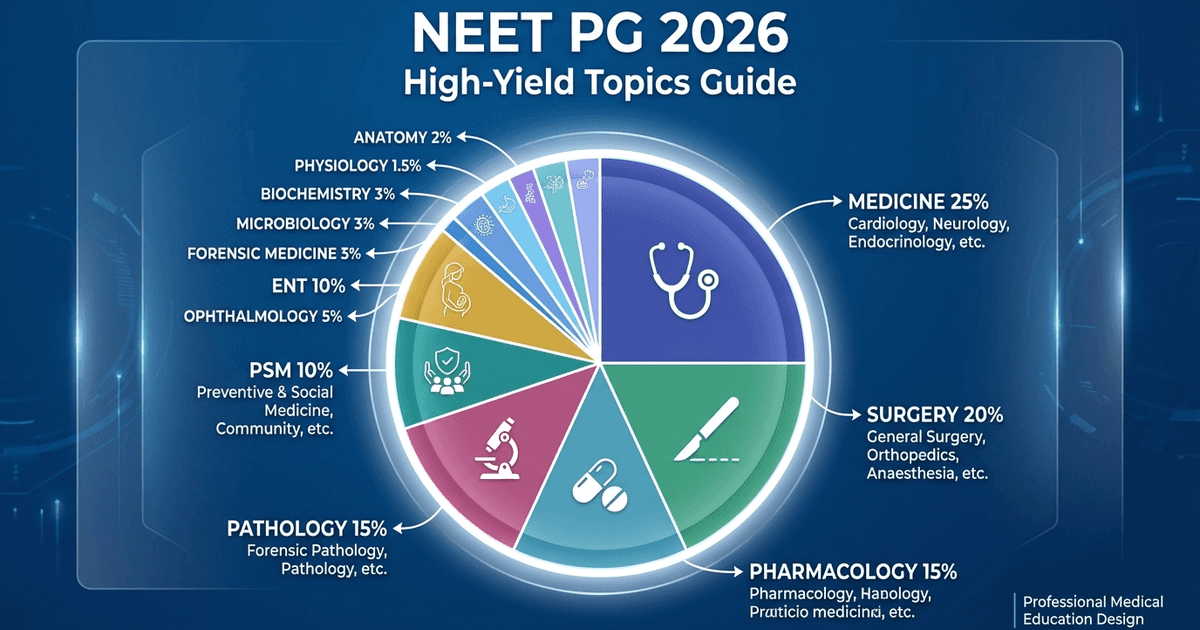
NEET PG High-Yield Topics 2026: Subject-Wise Weightage & Strategy Guide That Toppers Actually Use
You are probably staring at 19 NEET PG subjects right now, wondering how to split your remaining months without wasting time on low-yield content. Here is what toppers figured out: NEET PG isnt an equal-weightage exam. Four subjects carry 60% of your marks, while 8 subjects barely touch 25% combined.
This guide breaks down the exact weightage distribution across all 19 NEET PG subjects for 2026, the highest-yield topics within each, and how to allocate study time intelligently. No fluff — just the data-driven prioritisation strategy that gets you the maximum marks per study hour.
NEET PG 2026 Subject Weightage: The Big Four vs The Rest
NEET PG has 200 questions worth 800 marks total. But the distribution isnt even close to equal across subjects.
Here is the brutal reality:
High-Weightage Subjects (60% of exam) | Questions | Marks |
|---|---|---|
Internal Medicine | 40-45 | 160-180 |
Surgery (including subspecialties) | 35-40 | 140-160 |
Pharmacology | 20-25 | 80-100 |
Pathology | 18-22 | 72-88 |
Medium-Weightage Subjects (25% of exam) | Questions | Marks |
|---|---|---|
Anatomy | 12-15 | 48-60 |
Physiology | 10-12 | 40-48 |
Forensic Medicine | 8-12 | 32-48 |
Microbiology | 8-10 | 32-40 |
Community Medicine | 8-10 | 32-40 |
Lower-Weightage Subjects (15% of exam) | Questions | Marks |
|---|---|---|
Biochemistry | 6-8 | 24-32 |
Dermatology | 5-7 | 20-28 |
Radiology | 4-6 | 16-24 |
Ophthalmology | 4-6 | 16-24 |
ENT | 4-6 | 16-24 |
Orthopedics | 4-6 | 16-24 |
Anesthesia | 3-5 | 12-20 |
Pediatrics | 8-10 | 32-40 |
Obstetrics & Gynecology | 8-10 | 32-40 |
Psychiatry | 3-5 | 12-20 |
The math is simple: Master the Big Four (Medicine, Surgery, Pharmacology, Pathology) and you have secured 480+ marks. That alone puts you in the top percentile range for most branches.
Strategic Time Allocation: The 70-20-10 Rule
Based on this weightage, here is how toppers actually split their study time:
70% time on Big Four subjects:
Internal Medicine: 25%
Surgery: 20%
Pharmacology: 15%
Pathology: 10%
20% time on Medium-Weightage subjects:
Focus on Anatomy, Physiology, and Forensic Medicine first
Community Medicine and Microbiology second
10% time on Lower-Weightage subjects:
Quick revision only
Focus on high-yield topics within each
When using Oncourse AI's daily plan, this weightage distribution automatically surfaces your highest-completion subject as your 'Momentum' subject while rotating the remaining subjects by day number — so Medicine, Surgery, Pharmacology, and Pathology appear more frequently as you progress through them.
High-Yield Topics by Subject: What Actually Gets Asked
Internal Medicine (40-45 questions)
Cardiology (8-12 questions):
ECG interpretation (ST changes, arrhythmias)
Acute coronary syndrome management
Heart failure classification and drugs
Hypertension guidelines and target BP
Endocrinology (6-10 questions):
Diabetes management and complications
Thyroid disorders (hypo/hyperthyroidism)
PCOS and metabolic syndrome
Adrenal disorders
Gastroenterology (6-8 questions):
Chronic liver disease and cirrhosis
IBD (Crohns vs UC features)
GI bleeding approach
Peptic ulcer disease
Nephrology (4-6 questions):
Acute kidney injury classification
Chronic kidney disease stages
Electrolyte disorders
Dialysis indications
Respiratory Medicine (4-6 questions):
COPD vs Asthma differentiation
Pneumonia classification and treatment
Pleural effusion analysis
Lung function tests
Rheumatology (3-5 questions):
RA vs OA features
SLE diagnostic criteria
Gout management
The mnemonic "DM-HTN-CAD" (Diabetes-Hypertension-Coronary Artery Disease) covers 40% of Internal Medicine questions — these three topics alone carry 16-18 questions every year.
Surgery (35-40 questions)
General Surgery (15-18 questions):
Acute abdomen approach
GI surgeries (appendicectomy, cholecystectomy)
Hernia types and repair
Trauma management protocols
Wound healing and infections
Orthopedics (8-10 questions):
Fracture classification and management
Joint diseases (arthritis, replacement)
Spine disorders
Sports injuries
Urology (4-6 questions):
Kidney stones management
Prostate diseases
UTI and pyelonephritis
Renal tumors
Neurosurgery (3-5 questions):
Head injury management
Brain tumors
Spinal cord injuries
Other Surgical Specialties (5-8 questions):
Cardiothoracic surgery basics
Plastic surgery principles
Pediatric surgery conditions
The "ABCDE" trauma approach appears in 8-10 Surgery questions annually across different subspecialties — master this algorithm and youve secured 20% of Surgery marks.
Pharmacology (20-25 questions)
CVS Pharmacology (5-7 questions):
Antihypertensives (ACE inhibitors, ARBs, diuretics)
Antianginal drugs
Antiarrhythmic classification
Heart failure drugs
Using Oncourse's mnemonic engine, students drill one high-yield drug classification daily — topics like "ACE inhibitor side effects" or "Vaughan Williams classification" that appear in 3-4 questions every year. CNS Pharmacology (4-6 questions):
Antidepressants and antipsychotics
Antiepileptic drugs
Sedatives and anxiolytics
Parkinson's disease drugs
Antimicrobials (4-6 questions):
Antibiotic classification and resistance
Antifungal agents
Antiviral drugs
Drug interactions
GIT Pharmacology (2-4 questions):
Proton pump inhibitors
Antiemetics
Laxatives and antidiarrheals
Endocrine Pharmacology (2-4 questions):
Insulin types and regimens
Oral hypoglycemic agents
Thyroid drugs
Other Systems (2-4 questions):
Respiratory drugs
Renal drugs
Chemotherapy basics
The key insight: 70% of Pharmacology questions test drug side effects and contraindications, not mechanisms. Focus on "what not to give when" rather than memorizing pathways.
Pathology (18-22 questions)
General Pathology (6-8 questions):
Inflammation and wound healing
Neoplasia classification
Cell injury and death
Immunopathology basics
Systemic Pathology (12-14 questions):
CVS pathology (atherosclerosis, MI)
Respiratory pathology (pneumonia, tuberculosis)
GI pathology (peptic ulcers, liver disease)
Renal pathology (glomerulonephritis)
Hematology basics
Special Stains and Techniques:
Histopathology identification
Tumor markers
Cytology basics
When reviewing pathology slides, Oncourse's flashcard system prioritises the specific microscopic features students keep missing in mock tests — like "caseous necrosis patterns" or "malignancy criteria" — rather than reviewing topics in textbook order.
Time-Allocation Strategy for Different Prep Phases
12+ Months Remaining
Months 1-4: Build foundation in Medicine and Surgery
Months 5-8: Add Pharmacology and Pathology
Months 9-10: Integrate medium-weightage subjects
Months 11-12: Rapid revision of low-weightage subjects
6-12 Months Remaining
60% time: Medicine + Surgery (detailed study)
30% time: Pharmacology + Pathology (focused approach)
10% time: Quick coverage of remaining subjects
3-6 Months Remaining
Focus strategy: Master the Big Four completely
Skip detailed study of low-weightage subjects
Use question banks to identify weak areas in high-yield topics
Less than 3 Months
70% time: Pure revision of Medicine and Surgery
20% time: Pharmacology high-yield drugs
10% time: Pathology image recognition
Subject-Specific Study Approaches
High-Yield Anatomy Topics (12-15 questions)
Neuroanatomy (4-5 questions):
Cranial nerves and their nuclei
Blood supply of brain
Spinal cord tracts
Brainstem anatomy
CVS Anatomy (2-3 questions):
Coronary circulation
Cardiac conduction system
Heart chambers and valves
GI Anatomy (2-3 questions):
Liver segments and blood supply
Pancreatic anatomy
GI blood supply
MSK Anatomy (2-3 questions):
Joint classifications
Muscle origins and insertions
Ligament anatomy
Other Systems (2-3 questions):
Kidney anatomy
Respiratory tree
Reproductive anatomy
For anatomy's high visual content and numerous landmarks, creating topic-specific flashcard decks for the highest-weightage subtopics (like renal anatomy or CVS circulation) and letting the spaced repetition engine manage exactly when each card resurfaces saves hours of manual revision scheduling.
Physiology Essentials (10-12 questions)
CVS Physiology (3-4 questions):
Cardiac cycle and ECG correlation
Blood pressure regulation
Heart rate control
Respiratory Physiology (2-3 questions):
Oxygen-hemoglobin dissociation curve
Ventilation-perfusion matching
Respiratory centers
Renal Physiology (2-3 questions):
GFR regulation
Acid-base balance
Electrolyte handling
CNS Physiology (2-3 questions):
Synaptic transmission
Reflex arcs
Sensory pathways
Community Medicine Focus Areas (8-10 questions)
Epidemiology (3-4 questions):
Disease surveillance
Screening principles
Outbreak investigation
Biostatistics (2-3 questions):
Sensitivity and specificity
Study designs
Statistical tests
Health Programs (2-3 questions):
National health programs
Immunization schedules
Health indicators
Environmental Health (1-2 questions):
Water and air quality
Occupational health
For comprehensive guidance on individual subjects, check our detailed study guides for Surgery, Pharmacology, and Forensic Medicine.
Common Strategic Mistakes to Avoid
Mistake 1: Equal Time to All Subjects
Giving equal attention to all 19 subjects is the fastest way to score average marks. The student who spends 2 weeks each on Anesthesia and Internal Medicine will always lose to the one who spends 6 weeks on Medicine and 2 days on Anesthesia.
Mistake 2: Starting with Low-Yield Subjects
Many students start with "easier" subjects like Biochemistry or Dermatology. This builds false confidence but doesnt move the score needle. Start with Medicine — its hard, but carries 180 marks.
Mistake 3: Ignoring Integration
NEET PG loves cross-subject questions. A Pharmacology question about antihypertensives will include pathophysiology (Medicine), contraindications (Medicine), and mechanisms (Physiology). Study subjects in clusters, not isolation.
Mistake 4: Over-Preparing Low-Yield Topics
Scoring 100% in Psychiatry (20 marks maximum) while scoring 60% in Medicine (180 marks) is mathematically inefficient. Aim for 80% accuracy in high-yield subjects before touching low-yield ones.
Mock Test Analysis Strategy
Track your performance using this framework:
Big Four Analysis:
Medicine accuracy: Target 75%+
Surgery accuracy: Target 70%+
Pharmacology accuracy: Target 80%+
Pathology accuracy: Target 75%+
Red Flags:
Sub-60% accuracy in any Big Four subject
Spending more than 90 seconds per Medicine question
Getting pharmacology questions wrong due to side effects (not mechanisms)
Missing surgery questions on basic approaches (not rare conditions)
When you identify weak areas, practice with targeted MCQs in those specific topics rather than general subject-wise tests.
Creating Your Personalized Study Plan
Step 1: Assess Your Current Level
Take a baseline mock test to identify strengths in the Big Four subjects. Your strongest subject becomes your confidence-builder, while your weakest gets maximum time allocation.
Step 2: Plan Weekly Targets
Week 1-2: Medicine (2 systems)
Week 3-4: Surgery (2 subspecialties)
Week 5: Pharmacology (2 systems)
Week 6: Pathology + revision
Week 7: Medium-weightage subjects
Week 8: Mock tests and weak area focus
Step 3: Daily Structure
Morning (3 hours): Current subject new content
Afternoon (2 hours): Previous subject revision
Evening (2 hours): MCQs from covered topics
Night (1 hour): Pharmacology drugs or anatomy images
Step 4: Weekly Review
Every Sunday, analyze:
Mock test scores by subject
Time taken per question in Big Four subjects
Weak topics needing re-reading
Upcoming week's priority adjustments
Frequently Asked Questions
Which subject should I start NEET PG preparation with?
Start with Internal Medicine. It carries the highest weightage (40-45 questions) and integrates with most other subjects. Master cardiology, endocrinology, and gastroenterology first — these three systems alone contribute 20+ questions.
How many months do I need to cover all NEET PG subjects?
For the Big Four subjects, allow 6-8 months for thorough preparation. Medium-weightage subjects need 2-3 months, and low-weightage subjects can be covered in 1-2 months through targeted revision and question practice.
Should I skip low-weightage subjects completely?
No, but prioritize them differently. Subjects like Dermatology, Ophthalmology, and ENT contribute 15-20 questions total. Spend 2-3 weeks covering high-yield topics only, focusing on visual recognition and basic management protocols.
How do I remember so many Pharmacology drugs and their side effects?
Focus on drug classifications rather than individual drugs. The "Big 6" drug classes (antihypertensives, antibiotics, CNS drugs, GI drugs, endocrine drugs, and chemotherapy) cover 80% of Pharmacology questions. Use mnemonics for side effect patterns — like "ACE inhibitor side effects" affecting multiple systems.
What is the minimum score needed in each subject for NEET PG ranking?
There is no minimum per-subject score requirement. Focus on maximizing total marks. A student scoring 80% in Medicine (144/180 marks) and 40% in Dermatology (8/20 marks) will rank higher than someone scoring 60% uniformly across all subjects.
How should I balance clinical subjects vs basic science subjects?
Spend 80% time on clinical subjects (Medicine, Surgery, and clinical applications of Pharmacology/Pathology) and 20% on basic sciences. Clinical subjects carry higher weightage and integrate better with each other for cross-subject questions.
Master the Big Four, strategically cover the medium-weightage subjects, and efficiently review the rest. This data-driven approach consistently outperforms equal-time strategies by 40-60 marks — the difference between your target branch and a compromise.
Prepare smarter with Oncourse AI — adaptive MCQs, spaced repetition, and AI explanations built for NEET PG. Download free on Android and iOS.