Active Recall for Medical Students: The Science-Backed Study Method That Actually Works (2026)
Discover how active recall transforms medical exam preparation. Learn the neuroscience behind this proven technique and practical implementation for NEET PG, USMLE, and UKMLA success.
Active Recall for Medical Students: The Science-Backed Study Method That Actually Works (2026)
You probably read your pharmacology notes 3 times last night and still blanked on β-blockers this morning. Sound familiar? You're not alone — and you're definitely not stupid. The problem isnt your brain; its how you're using it.
Most medical students study like they're trying to pour water into a bucket with holes. They highlight textbooks, reread notes, and watch lectures on repeat, wondering why nothing sticks come exam day. Meanwhile, the students who consistently score in the 90th percentile have figured out something different: they dont just read about medicine — they actively retrieve it from memory.
This is active recall, and its not just another study hack. Its a neurologically-proven method that transforms how your brain encodes medical knowledge. When done right, 30 minutes of active recall beats 3 hours of passive review. Every single time.
Heres why your current study methods are failing you, what active recall actually does to your brain, and how to implement it correctly for NEET PG, USMLE, and UKMLA preparation.
What Is Active Recall and Why Most Students Get It Wrong
Active recall is the practice of forcing your brain to retrieve information from memory without looking at the source material first. Instead of reading "ACE inhibitors end in -pril" and nodding along, you close the book and ask yourself: "What are the common endings for ACE inhibitors?"
The difference seems small, but neurologically, its massive.
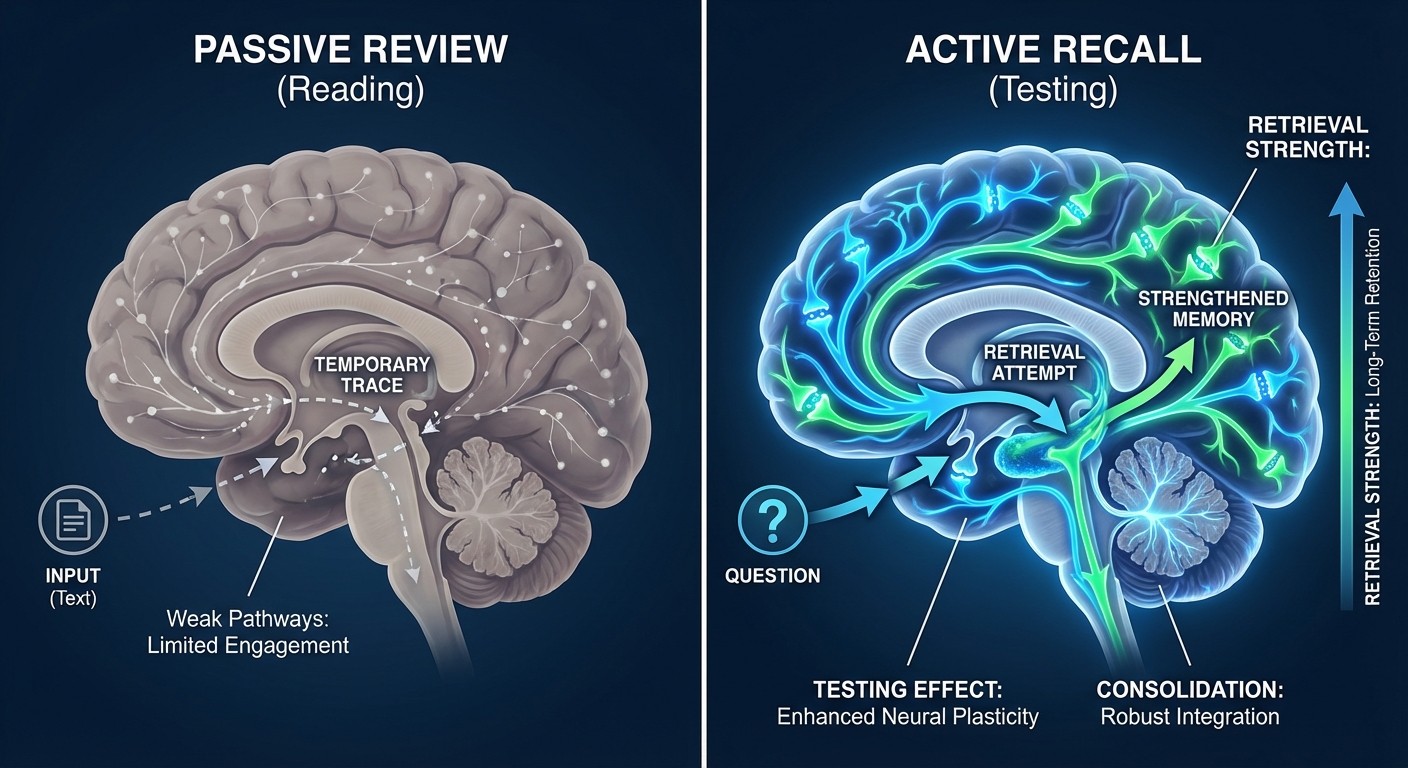
When you passively read information, your brain creates weak neural pathways — just enough to recognize the information when you see it again. Recognition feels like learning, but its not. Thats why you can read an entire chapter on cardiac physiology and feel confident, only to freeze when faced with a question about stroke volume.
Active recall works differently. When you force your brain to retrieve information from memory, you strengthen the actual neural pathways that long-term retention depends on. Each retrieval attempt makes the memory more accessible and more permanent.
But heres where most students mess up: they think active recall means testing themselves after they've "learned" the material. Wrong. Active recall works best when you use it as your primary learning method, not as a final check.
The Neuroscience Behind Why Active Recall Dominates Passive Review
Three key mechanisms make active recall so effective for medical students: the testing effect, memory consolidation, and retrieval-induced strengthening.
The Testing Effect
When you attempt to retrieve information from memory — even if you get it wrong initially — your brain creates stronger pathways to that information than it would through repeated exposure. This is called the testing effect, and its been replicated in medical education studies consistently.
In a 2019 study with medical students learning cardiology, students who used retrieval practice (active recall) retained 40% more information after 6 months compared to students who used traditional review methods. The kicker? The active recall group spent less total study time.
For medical students, this means every time you quiz yourself on drug mechanisms without looking at your notes first, you're literally rewiring your brain to access that information more easily under pressure.
Memory Consolidation During Sleep
Active recall doesn't just help during study sessions — it changes what happens when you sleep. When you actively retrieve information during the day, your brain prioritizes consolidating those memories during sleep. The effort of retrieval signals to your brain: "This information is important. Store it permanently."
Passive review doesnt create this signal. Your brain treats highlighted notes the same way it treats any other visual input — interesting but not crucial.
Retrieval-Induced Strengthening
Each time you successfully retrieve information from memory, you dont just maintain that neural pathway — you strengthen it. This is why medical students who use active recall techniques often report that information feels "automatic" after a few weeks of practice.
For complex medical concepts like the renin-angiotensin system, this automaticity is crucial. During high-pressure exams, you need information to flow effortlessly, not require conscious effort to reconstruct.
How to Apply Active Recall to Medical Subjects
Active recall isnt one technique — its a principle you can adapt to every aspect of medical school. Heres how to implement it across core subjects:
Anatomy: From Passive Labeling to Active Reconstruction
Most students study anatomy by staring at labeled diagrams. Better approach: look at unlabeled diagrams and force yourself to name every structure from memory. When you get stuck, resist the urge to immediately check the answer. Struggle for 10-15 seconds first.
For complex regions like the brachial plexus, draw it from memory before looking at any reference. Your first attempt will be terrible — thats the point. Each reconstruction attempt builds stronger spatial memory networks than 100 passive viewings.
Oncourse's anatomy lessons are designed around this principle — every diagram comes with active recall exercises that force you to reconstruct rather than just recognize.
Pharmacology: Beyond Memorizing Drug Lists
Pharmacology seems like pure memorization, but active recall transforms it into pattern recognition. Instead of reading "Propranolol is a non-selective β-blocker," create scenarios: "A patient with hypertension and migraine needs a β-blocker. Which one provides both benefits and why?"
For drug mechanisms, draw them from memory. Start with a blank page and reconstruct how ACE inhibitors affect the renin-angiotensin system. Include every step: renin release, angiotensin conversion, aldosterone effects, and clinical outcomes.
When you're reviewing pharmacology flashcards, dont just flip to see the answer. Force yourself to explain the complete mechanism before checking. Oncourse's Synapses feature is built around this — each card makes you retrieve the answer from memory before revealing it, training exactly the neural pathways that long-term retention depends on.
Physiology: Systems Thinking Through Active Integration
Physiology is about interconnected systems, not isolated facts. Active recall here means connecting dots before youre given the complete picture.
When studying cardiac output, dont just read the formula. Start with a clinical scenario: "A marathon runner's heart rate increases from 60 to 180 BPM during a race. Walk through every physiological change that maintains cardiac output." Force yourself to work through stroke volume changes, Frank-Starling mechanism, venous return, and autonomic responses.
For complex pathways like glucose homeostasis, create flow charts from memory. Start with "blood glucose rises after a meal" and map every hormonal response without looking at your notes. This builds the systems-level thinking that clinical medicine requires.
Pathophysiology: Disease Logic Over Pattern Matching
Medical students often try to memorize disease presentations like shopping lists. Active recall transforms this into logical reasoning. Instead of memorizing "CHF presents with dyspnea, edema, fatigue," understand why: "Heart cant pump effectively → blood backs up → pressure rises in lungs and periphery → dyspnea and edema."
Practice with case-based scenarios. Given symptoms and basic history, work backwards to identify the underlying pathophysiology before jumping to diagnosis. This builds clinical reasoning skills that serve you in both exams and actual patient care.
Active Recall vs Spaced Repetition: Why You Need Both
Students often ask whether they should use active recall or spaced repetition. The answer: both, because they serve different purposes.
Active recall is about how you study — forcing retrieval instead of passive review. Spaced repetition is about when you study — reviewing information at increasing intervals to optimize memory consolidation.
The most effective approach combines them: use active recall techniques (self-testing, blank page reconstruction) within a spaced repetition schedule. Review new material actively after 1 day, then 3 days, then 1 week, then 3 weeks.
For medical students with massive content loads, this combination is essential. You cant afford to relearn material multiple times. Spaced repetition systems combined with active recall ensure that everything you study once sticks permanently.
Implementing Active Recall for NEET PG, USMLE, and UKMLA
NEET PG: High-Yield Pattern Recognition
NEET PG tests broad knowledge across all medical subjects with emphasis on pattern recognition. Active recall here means creating your own question banks before using commercial ones.
For each topic you study, write 3-5 questions that test different aspects: factual recall, application, and differential diagnosis. Before moving to the next topic, quiz yourself on the previous ones. This builds the rapid pattern recognition that NEET PG's time constraints demand.
Oncourse's adaptive question banks surface questions in your weakest areas automatically, ensuring your active recall practice is always targeted at knowledge gaps rather than topics you've already mastered.
USMLE Step 1: Mechanisms Over Memorization
USMLE Step 1 emphasizes understanding mechanisms over isolated facts. Your active recall practice should reflect this. Instead of memorizing that "cystic fibrosis causes pancreatic insufficiency," work through why: CFTR dysfunction → thick secretions → ductal obstruction → enzyme deficiency.
Create concept maps from memory that connect basic science to clinical manifestations. For biochemistry and pathology topics, this means explaining disease mechanisms at the molecular level without looking at references first.
USMLA: Clinical Application Focus
UKMLA tests clinical decision-making alongside medical knowledge. Your active recall should emphasize practical application. Instead of just memorizing antibiotic choices, work through clinical scenarios: "30-year-old with cellulitis and penicillin allergy — what do you prescribe and why?"
Practice management pathways from memory. Given a presentation like "chest pain in a 55-year-old smoker," map out your complete evaluation strategy before checking guidelines.
Daily Active Recall Routines That Actually Work
The 20-Minute Power Session
Start each study block with 20 minutes of pure active recall before opening any books. Quiz yourself on yesterday's material using these techniques:
Blank page brain dumps: Write everything you remember about a topic without any prompts
Explain-to-a-friend: Verbally explain concepts as if teaching someone else
Case creation: Invent clinical scenarios that test the material
Connection mapping: Link new information to previously learned concepts
Oncourse's Daily Challenges are built around this principle — micro-sessions of targeted active recall delivered daily, creating distributed practice that's more effective than massed review sessions.
The Evening Review Protocol
Before bed, spend 10 minutes actively recalling the day's most challenging concepts. Don't reread notes — just try to reconstruct the information from memory. This primes your brain for overnight consolidation.
Studies show that information actively recalled before sleep gets prioritized during memory consolidation. Those 10 minutes are more valuable than an hour of passive review.
The Weekly Integration Test
Every Sunday, conduct a comprehensive active recall session covering the entire week's material. Create connections between topics studied on different days. This builds the integrated knowledge base that medical practice requires.
Common Active Recall Mistakes Medical Students Make
Mistake 1: Checking Answers Too Quickly
The moment of struggle — when you're trying to retrieve information but can't quite access it — is where learning happens. Most students panic and check the answer within 5 seconds. Wait at least 10-15 seconds. The discomfort is the point.
Mistake 2: Only Testing "Easy" Material
Students gravitate toward active recall on topics they already understand because it feels good to get answers right. This is backwards. Active recall works best on your weakest areas. Seek out the discomfort of not knowing.
Mistake 3: Confusing Recognition with Recall
Reading a question and recognizing the correct answer is not active recall. You must generate the answer from memory first, then check if you're correct. Multiple choice questions can train recognition, but they won't build the recall pathways you need for comprehensive exams.
Mistake 4: Abandoning the Method When It Feels Hard
Active recall feels more difficult than passive review because it is more difficult. Your brain is doing real work instead of coasting. The increased effort directly correlates with increased learning. Embrace the difficulty.
Measuring Your Active Recall Progress
Track these metrics to ensure your active recall practice is working:
Retrieval Speed: How quickly can you access information without conscious effort? Time yourself explaining complex pathways like the coagulation cascade. Connection Density: Can you link new information to existing knowledge automatically? When learning about a new drug, do connections to similar mechanisms arise spontaneously? Error Recovery: When you make mistakes during retrieval attempts, how quickly can you self-correct and identify the source of confusion? Applied Recall: Can you use retrieved information in novel scenarios immediately, or does it only work in the exact context you studied?
These metrics matter more than how much time you spend studying. An hour of high-quality active recall beats 4 hours of passive review every time.
Frequently Asked Questions
How long should each active recall session be?
Start with 15-20 minute focused sessions. Your brain can only sustain high-effort retrieval for limited periods. Its better to do 3 focused 20-minute sessions than one unfocused 60-minute session.
Should I use active recall for every subject?
Yes, but adapt the technique to the subject. Anatomy benefits from spatial reconstruction, pharmacology from mechanism mapping, and clinical medicine from case-based scenarios. The core principle — forcing retrieval from memory — applies universally.
What if I keep getting answers wrong during active recall?
Getting answers wrong initially is normal and valuable. Each mistake followed by correction strengthens the correct pathway more than getting it right the first time. Focus on understanding why you made the error, not just memorizing the right answer.
Can active recall replace all other study methods?
Active recall should be your primary method, but combine it with other techniques. Use concept mapping to build frameworks, then use active recall to strengthen those frameworks. Use passive reading for initial exposure, then immediately switch to active retrieval.
How do I know if my active recall is working?
You should notice information feeling more "automatic" after 1-2 weeks of consistent practice. In exams, answers should come to mind quickly without conscious searching. If you're still struggling to access information after active recall practice, adjust your technique or increase retrieval frequency.
Should I use active recall while reading or after reading?
Both. Use frequent self-testing while reading (pause after each paragraph and summarize from memory), then conduct comprehensive active recall sessions after completing sections. The key is making retrieval practice frequent and effortful.
Prepare smarter with Oncourse AI — adaptive MCQs, spaced repetition, and AI explanations built for NEET PG, USMLE, and UKMLA. Download free on Android and iOS.