Best USMLE Step 2 CK Prep Course in 2026: How to Choose One That Actually Works
Complete guide to selecting an effective USMLE Step 2 CK prep course in 2026. Learn what features matter most: adaptive learning, spaced repetition, and clinical reasoning focus.

Best USMLE Step 2 CK Prep Course in 2026: How to Choose One That Actually Works
You're staring at another Step 2 CK prep course promising "guaranteed score improvement" and wondering if this one is different. Spoiler alert: most arent.
The Step 2 CK exam throws 280 clinical vignettes at you over 8 hours. Each question tests your ability to diagnose, manage, and navigate real patient scenarios. Yet most prep courses still operate like Step 1 — passive video lectures and static question banks that treat every student the same way.
Here's what actually separates effective Step 2 CK prep from expensive disappointment: adaptive learning that mirrors the exam format, spaced repetition built for clinical pattern recognition, and analytics that show exactly where you're hemorrhaging points. Not flashy marketing or celebrity instructors.
This guide breaks down what makes a Step 2 CK prep course actually work in 2026, backed by how the exam has evolved and what high-scoring students consistently use.
What Makes Step 2 CK Different (And Why Most Courses Miss This)
Step 2 CK isnt just "more questions." Its a fundamentally different cognitive challenge from Step 1. You're not memorizing biochemical pathways — you're pattern-matching clinical presentations to diagnoses and management decisions under time pressure.
The Clinical Reasoning Gap
Traditional courses fail because they approach Step 2 CK like Step 1 with clinical window dressing. They'll show you a pneumonia lecture, then give you pneumonia questions. But the real exam doesnt work that way.
Step 2 CK questions integrate multiple systems. A "cardiology" question might involve diabetes management, renal function, and medication interactions. The key is recognizing these multi-system patterns, not memorizing isolated facts.
Effective courses simulate this integration. They present cases that cross specialty boundaries and require you to think like a clinician, not a student cramming for subject-specific exams.
Adaptive Learning That Matches the Exam Format
Step 2 CK uses computer adaptive testing. Get questions right, and the difficulty increases. Struggle in cardiology, and you'll see more cardiology until you demonstrate competency.
Most prep courses ignore this completely. They give you random questions or let you choose topics, which creates a false sense of progress. Oncourse's adaptive question bank adjusts difficulty and topic frequency based on your performance patterns, identifying weak clinical domains and re-routing your prep there automatically.
This mirrors the actual exam experience and builds the pattern recognition you need for diagnosis and management scenarios.
Essential Features Every Step 2 CK Prep Course Must Have
1. High-Quality Clinical Vignettes (Not Just Question Count)
The magic number isnt 4,000+ questions — its question quality that matters. Effective Step 2 CK questions should:
Present realistic clinical scenarios with appropriate detail
Include lab values, imaging descriptions, and patient demographics that matter
Test clinical reasoning, not recall of random facts
Cover both common presentations and high-yield rare conditions
Integrate multiple medical specialties in single questions
Weak courses pad their question count with low-yield minutiae or Step 1-style fact recall dressed up as clinical vignettes. Quality courses focus on the clinical decision-making patterns you'll actually encounter.
2. Integrated Spaced Repetition for Pattern Recognition
Clinical pattern recognition requires long-term retention of thousands of presentation-diagnosis-management chains. Traditional courses expect you to manage this with external flashcard apps.
Effective courses integrate spaced repetition directly into the workflow. After answering questions about acute coronary syndromes, high-yield cards covering ECG patterns, troponin kinetics, and treatment algorithms get automatically scheduled for review at optimal intervals.
This builds the instant recognition patterns essential for Step 2 CK success — seeing "crushing chest pain + diaphoresis + ST elevations" and immediately thinking "STEMI + cathlab + dual antiplatelet therapy."
3. Performance Analytics That Drive Study Decisions
Most courses give you generic percentage scores by subject. Effective courses break down performance by:
Clinical reasoning type (diagnosis vs management vs prognosis)
Disease presentation patterns (acute vs chronic, common vs rare)
Patient demographics (pediatric vs geriatric, pregnant patients)
Question difficulty levels matched to your target score
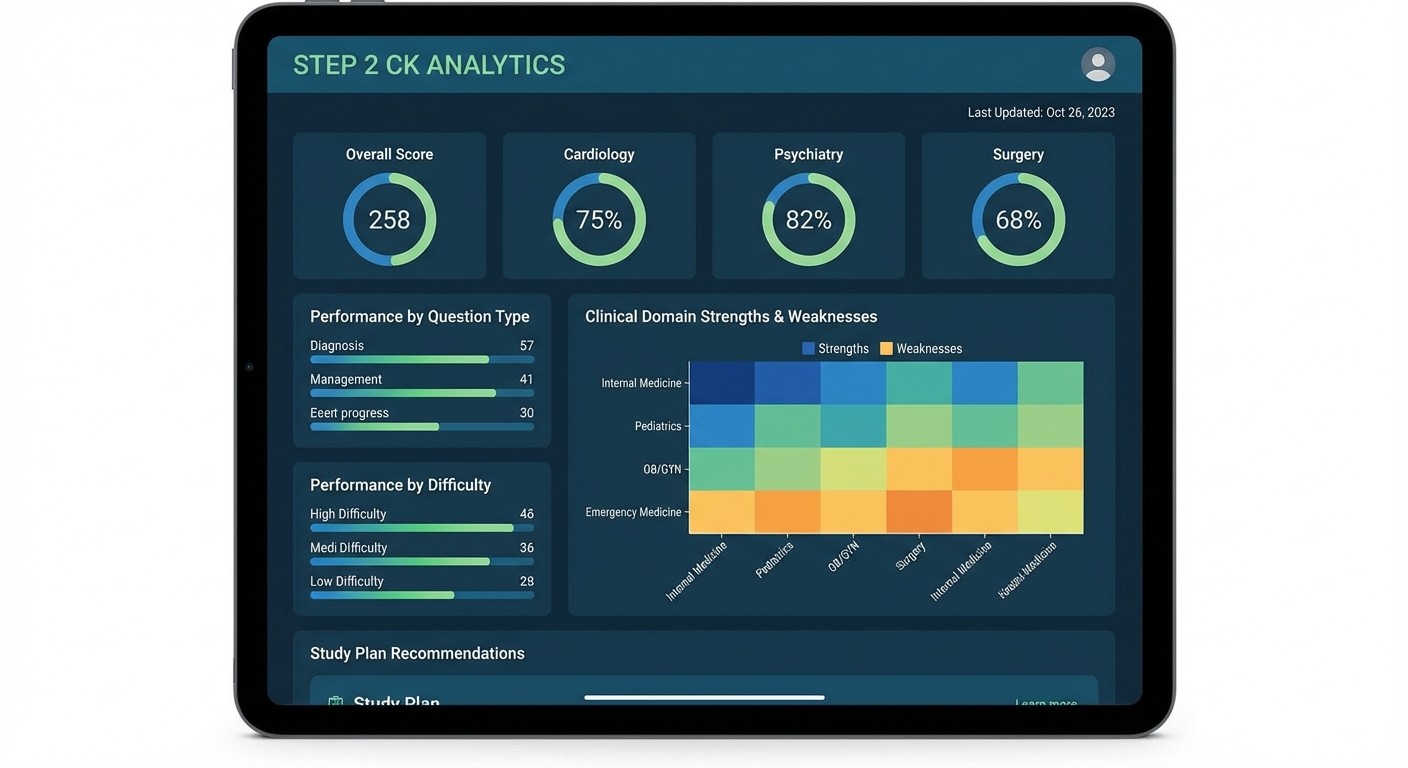
Oncourse's performance analytics dashboard provides exactly this level of detail. Students can see they're losing marks on cardiology management questions specifically, not just "cardiology" generally. This enables targeted study instead of wasteful broad review.
4. AI-Powered Explanations for Clinical Reasoning
Step 2 CK explanations need to walk through clinical reasoning, not just state the right answer. Effective explanations should:
Explain why other answer choices represent common clinical reasoning errors
Connect the question to broader diagnostic and management frameworks
Highlight key clinical clues that point toward the correct diagnosis
Reference relevant guidelines and evidence-based management
Generic explanations tell you pneumonia is treated with antibiotics. Quality explanations walk through community-acquired vs hospital-acquired considerations, antibiotic selection based on patient factors, and when to consider atypical coverage.
Red Flags: What to Avoid in Step 2 CK Prep Courses
Passive Video-Heavy Approaches
If a course's main selling point is "hundreds of hours of video lectures," run. Step 2 CK requires active clinical reasoning practice, not passive consumption of clinical content.
High-scoring students spend 80% of their time doing questions and analyzing their reasoning patterns. Video content should supplement active practice, not replace it.
Generic Question Banks Without Adaptive Features
Question banks that let you freely choose topics or difficulty levels often hurt more than they help. Students gravitate toward comfortable topics and avoid their weaknesses.
Effective prep forces you to confront weak areas through adaptive algorithms that identify knowledge gaps and automatically adjust your study path.
Score Guarantees and Marketing Gimmicks
No course can guarantee a specific Step 2 CK score. Your baseline knowledge, study time, and clinical reasoning development vary too much for blanket guarantees.
Legitimate courses focus on proven learning methodologies — adaptive testing, spaced repetition, detailed analytics — rather than marketing promises.
How to Evaluate Step 2 CK Prep Courses: A Practical Framework
Questions to Ask Before Enrolling
About Question Quality:
How many questions are Step 2 CK-specific (not repurposed Step 1 content)?
Do questions integrate multiple medical specialties?
Are clinical vignettes based on real patient presentations?
About Learning Science:
Does the platform use adaptive algorithms to adjust difficulty?
Is spaced repetition integrated into the workflow?
How detailed are the performance analytics?
About Clinical Focus:
Do explanations walk through clinical reasoning processes?
Are answer choices designed around common diagnostic errors?
Does content emphasize evidence-based management approaches?
Test Drive Options
Most effective courses offer free trials or limited access. Use this to evaluate:
Question quality and clinical realism
Explanation depth and clinical reasoning focus
User interface and study workflow efficiency
Analytics quality and actionability
Dont just count questions or features. Actually work through sample content and assess whether it builds the clinical reasoning skills Step 2 CK demands.
Building Your Step 2 CK Study Plan With the Right Course
Integration With Other Resources
Even the best prep course shouldnt be your only Step 2 CK resource. Effective study plans typically combine:
Primary question bank (your main prep course) for 70% of study time
Reference materials (UpToDate, clinical guidelines) for clarifying management details
Practice exams from NBME for score prediction and test-taking practice
Targeted review for consistently weak areas identified through analytics
Timeline Considerations
Step 2 CK prep typically requires 3-4 months of dedicated study for IMGs, 2-3 months for US medical students with clinical rotations experience. Your prep course should support this timeline with:
Structured study schedules that cover all high-yield content
Progress tracking that shows readiness for scheduling your exam
Adaptive algorithms that accelerate or decelerate based on performance
The spaced repetition system should automatically schedule reviews throughout your prep period, ensuring long-term retention of clinical patterns by exam day.
Why Oncourse Works for Step 2 CK Prep
Oncourse addresses every major Step 2 CK prep challenge through evidence-based learning methodologies:
Adaptive Question Selection: The platform dynamically adjusts question difficulty and topic frequency based on your performance across clinical domains. Instead of random practice, you get targeted exposure to your weakest areas until you demonstrate competency. Integrated Spaced Repetition: After answering questions about acute management scenarios, relevant flashcards covering drug mechanisms, dosing protocols, and contraindications are automatically scheduled for review. This builds the instant recall essential for time-pressured clinical decisions. Granular Performance Analytics: See exactly where points are being lost — not just "internal medicine" but "diabetes management in acute care settings" or "cardiovascular risk stratification." This precision enables laser-focused review instead of broad subject cramming.
The platform includes comprehensive USMLE Step 2 CK lessons covering clinical reasoning frameworks and specialized flashcards for high-yield management protocols.
Common Step 2 CK Prep Mistakes (And How to Avoid Them)
Mistake 1: Treating It Like Step 1 With Clinical Cases
Step 1 rewards detailed mechanism knowledge. Step 2 CK rewards clinical pattern recognition and evidence-based management decisions. Courses that focus on pathophysiology details miss the clinical reasoning emphasis entirely.
Fix: Choose courses that emphasize diagnostic and management decision-making over mechanistic explanations.
Mistake 2: Neglecting Weak Clinical Areas
Students often avoid uncomfortable clinical domains (psychiatry, pediatrics, obstetrics) and over-study comfortable areas (internal medicine, surgery). This creates dangerous knowledge gaps.
Fix: Use adaptive courses that force exposure to weak areas and track improvement across all clinical specialties.
Mistake 3: Passive Review Without Active Recall
Re-reading clinical facts or watching management videos creates false familiarity without building retrieval strength. Step 2 CK requires instant access to clinical knowledge under pressure.
Fix: Prioritize active recall through question practice and spaced repetition flashcard review.
Frequently Asked Questions
How long should I study for USMLE Step 2 CK?
Most students need 3-4 months of dedicated study (300-400 hours total). US medical students with recent clinical rotations may need 2-3 months, while IMGs often require the full 4 months to build clinical reasoning skills and familiarize themselves with US management approaches.
Should I use multiple question banks for Step 2 CK prep?
One high-quality adaptive question bank is more effective than multiple static banks. Multiple banks often overlap significantly and prevent you from developing consistent clinical reasoning patterns. Focus on completing one excellent bank thoroughly rather than sampling multiple mediocre ones.
How important are practice exams compared to daily question practice?
Daily adaptive question practice builds clinical reasoning skills and identifies knowledge gaps. Practice exams (NBME, free 120) are essential for score prediction and test-taking strategy but shouldnt replace daily practice. Aim for 80% daily questions, 20% practice exams in your final month.
What score should I target on practice questions?
Target 70-75% correct on your primary question bank for a Step 2 CK score in the 250+ range. However, adaptive question banks adjust difficulty, so focus more on improvement trends and performance analytics than raw percentage scores.
How do I know when Im ready to schedule Step 2 CK?
You're ready when you consistently score 70%+ on adaptive questions across all clinical domains, your performance analytics show no major weak areas, and NBME practice exams predict your target score. This typically occurs after completing your primary question bank once and reviewing flagged questions.
Can I pass Step 2 CK with just a prep course?
A high-quality prep course can be your primary study resource, but most successful students supplement with reference materials for management details and NBME practice exams for score prediction. Oncourse provides comprehensive coverage, but having UpToDate or similar references for complex management scenarios is helpful.
Prepare smarter with Oncourse AI — adaptive MCQs, spaced repetition, and AI explanations built for USMLE Step 2 CK. Download free on Android and iOS.