How to Study Pharmacology for NEET PG 2026: Complete Checklist, High-Yield Systems and Exam Strategy
Master NEET PG pharmacology with our complete 2026 study guide. Covers high-yield systems, memory techniques, MCQ strategies and a week-by-week preparation checklist.
How to Study Pharmacology for NEET PG 2026: Complete Checklist, High-Yield Systems and Exam Strategy
You probably just opened your pharmacology textbook and felt overwhelmed by the sheer volume of drug names, mechanisms, and side effects staring back at you. NEET PG allocates roughly 30-35 questions to pharmacology – thats 15-17% of your total score riding on this single subject. With 63 seconds per question, you cant afford to waste time memorizing every minor drug interaction.
The students who crack pharmacology dont memorize everything. They target the right systems, use proven memory techniques, and practice the exact question patterns that repeat every year. If you have been struggling to make pharmacology stick or wondering which topics actually matter for NEET PG 2026, this guide breaks down the complete strategy.
Most students approach pharmacology wrong – they try to learn every drug in isolation instead of building systematic frameworks. The toppers know that 80% of pharmacology questions come from just 6 core systems, and they focus their energy there first.
Understanding Pharmacology's Weight in NEET PG 2026
Pharmacology carries approximately 30-35 questions out of 200 total questions in NEET PG. This translates to 15-17% of your overall score. More importantly, pharmacology questions are often interconnected with other subjects:
Medicine: Clinical pharmacology overlaps heavily
Surgery: Anesthetics and perioperative drugs appear frequently
Obstetrics: Drugs in pregnancy and labor management
Pediatrics: Age-specific dosing and contraindications
The National Board of Examinations consistently tests mechanism-based questions rather than pure memorization. This means understanding drug pathways matters more than cramming drug lists.
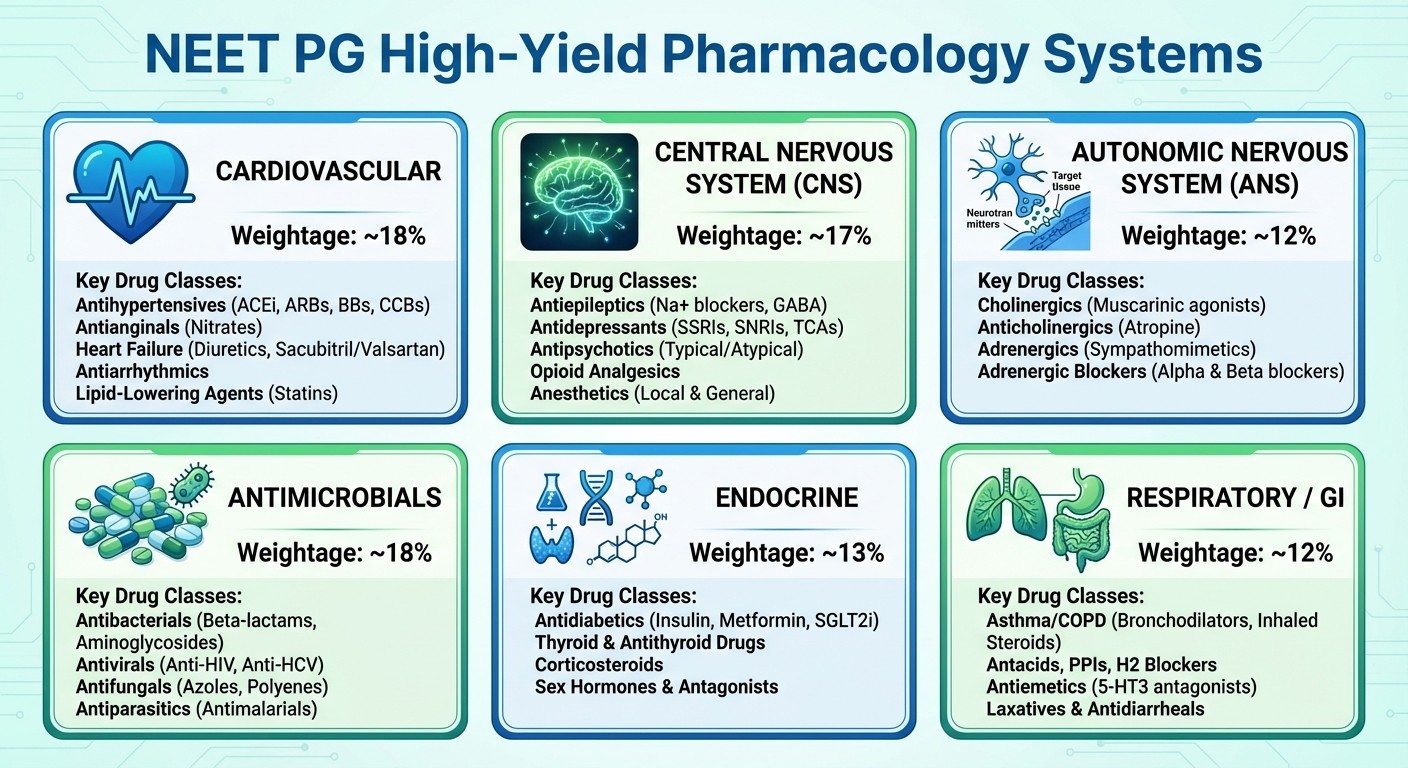
High-Yield Systems That Dominate NEET PG
1. Cardiovascular Pharmacology (Highest Yield)
Why it matters: 8-10 questions typically come from this system alone. CVS drugs appear in medicine, surgery, and even obstetrics contexts. Core topics to master:
Antihypertensives (ACE inhibitors, ARBs, calcium channel blockers)
Anti-arrhythmics (Class I-IV classification)
Heart failure drugs (digoxin, diuretics, ACE inhibitors)
Anticoagulants and antiplatelets
Lipid-lowering agents
Study tip: Learn the drug classifications first, then mechanisms, then clinical applications. For ACE inhibitors, master the mnemonic "CAPTOPRIL" - Cough, Angioedema, Pregnancy contraindication, Teratogenic, Orthostatic hypotension, Potassium elevation, Renal dysfunction, Inflammation, Loss of taste. Practice with cardiovascular pharmacology questions to solidify your understanding.
2. Central Nervous System Drugs
Question frequency: 5-7 questions per exam High-yield areas:
Antiepileptics (mechanism and drug interactions)
Antidepressants (SSRIs, tricyclics, MAOIs)
Antipsychotics (typical vs atypical)
General anesthetics and local anesthetics
Drugs for Parkinson's and Alzheimer's
The key here is understanding receptor pharmacology. Most CNS questions test which receptor each drug targets and what happens when you block or activate it.
3. Autonomic Nervous System
Why it's crucial: Foundation for understanding most other drug mechanisms Must-know concepts:
Cholinergic vs adrenergic systems
Alpha and beta receptor subtypes
Sympathomimetics and sympatholytics
Cholinesterase inhibitors
Muscarinic and nicotinic effects
Master the autonomic system first – it makes cardiovascular, respiratory, and GI pharmacology much easier to understand. Use autonomic nervous system drug lessons for systematic learning.
4. Antimicrobials and Chemotherapy
Question distribution: 4-6 questions consistently Critical areas:
Antibiotic mechanisms and resistance
Antifungals (azoles, polyenes)
Antivirals (especially HIV and hepatitis drugs)
Cancer chemotherapy basics
Antimalarial drugs
Study approach: Group by mechanism rather than alphabetically. All drugs that inhibit cell wall synthesis, then protein synthesis inhibitors, then DNA/RNA targeting drugs.
5. Endocrine Pharmacology
Focus areas:
Diabetes drugs (insulin types, oral hypoglycemics)
Thyroid medications
Corticosteroids and their effects
Reproductive hormones
Calcium metabolism drugs
The trend in recent NEET PG papers shows increased questions on diabetes management and corticosteroid complications.
6. Respiratory and GI Pharmacology
Key drug classes:
Bronchodilators (beta-agonists, anticholinergics)
Anti-asthma drugs (steroids, leukotriene modifiers)
Acid suppression (PPIs, H2 blockers)
Antiemetics and prokinetic agents
Complete Study Checklist for NEET PG Pharmacology
Phase 1: Foundation Building (Weeks 1-3)
Week 1: Core Concepts
[ ] General pharmacology principles (ADME)
[ ] Receptor theory and drug interactions
[ ] Autonomic nervous system overview
[ ] Basic pharmacokinetics and pharmacodynamics
Week 2: High-Yield System 1
[ ] Complete cardiovascular pharmacology
[ ] Practice 50+ CVS drug MCQs
[ ] Create drug classification charts
[ ] Master mechanism-based mnemonics
Week 3: High-Yield System 2
[ ] CNS pharmacology fundamentals
[ ] Antiepileptics and antidepressants
[ ] Practice 40+ CNS drug questions
Phase 2: System Mastery (Weeks 4-7)
Week 4: Antimicrobials
[ ] Antibiotic mechanisms and spectra
[ ] Antifungal and antiviral drugs
[ ] Resistance patterns and combinations
[ ] 60+ antimicrobial MCQs
Week 5: Endocrine Drugs
[ ] Diabetes medication algorithms
[ ] Thyroid and adrenal drugs
[ ] Reproductive hormones
[ ] 40+ endocrine pharmacology questions
Week 6: Respiratory + GI
[ ] Asthma and COPD medications
[ ] Acid-peptic disease drugs
[ ] Antiemetics and motility agents
[ ] 30+ questions from each system
Week 7: Specialized Topics
[ ] Anesthetics (general and local)
[ ] Drugs in pregnancy and pediatrics
[ ] Toxicology basics
[ ] Immunosuppressants
Phase 3: Integration and Practice (Weeks 8-10)
Week 8: Cross-Subject Integration
[ ] Medicine-pharmacology overlap questions
[ ] Surgery-anesthesia drug correlations
[ ] Obstetrics drug safety profiles
[ ] 100+ integrated MCQs
Week 9: Weakness Identification
[ ] Take 3 full-length pharmacology tests
[ ] Identify lowest-scoring systems
[ ] Focused revision of weak areas
[ ] Additional 150+ targeted questions
Week 10: Final Consolidation
[ ] Review all drug classification charts
[ ] Practice high-yield mnemonics daily
[ ] Solve previous year NEET PG questions
[ ] 200+ mixed pharmacology MCQs
Memory Techniques That Work for Drug Names
The System-Based Mnemonic Approach
Instead of random memory tricks, organize drugs by their mechanisms. For antihypertensives: "ABCD" - ACE inhibitors, Beta blockers, Calcium channel blockers, Diuretics. Each category then gets its own detailed mnemonic.
For ACE inhibitors: "CAPE" - Captopril, Enalapril, Perindopril, Enalapril variations. The beauty of Oncourse's Synapses feature is that it builds these memory connections automatically - you practice a cardiovascular drug question, and it immediately shows you related drugs with similar mechanisms or side effects.
Drug Ending Pattern Recognition
Most students underestimate how many drug names follow predictable patterns:
-pril: ACE inhibitors (lisinopril, captopril)
-sartan: ARBs (losartan, valsartan)
-olol: Beta blockers (propranolol, metoprolol)
-dipine: Calcium channel blockers (amlodipine, nifedipine)
-azole: Antifungals (fluconazole, itraconazole)
Learning these patterns cuts your memorization load by 60%.
The Side Effect Story Method
Create mini-stories connecting drugs to their major side effects. For digoxin: "The NAVY guy (N-nausea, A-arrhythmias, V-visual disturbances, Y-yellow vision) was too POSITIVE about his heart medicine." Silly stories stick better than dry lists.
Strategic MCQ Practice Schedule
Daily Question Targets by Study Phase
Foundation Phase (Weeks 1-3): 20-30 questions/day
Focus on understanding explanations over speed
Review every incorrect answer immediately
Track weak drug categories
Mastery Phase (Weeks 4-7): 40-50 questions/day
Time yourself: 90 seconds max per question
Practice questions from NEET PG pharmacology question bank
Create error logs for repeated mistakes
Integration Phase (Weeks 8-10): 60-80 questions/day
Mix pharmacology with other subjects
Simulate exam conditions
Focus on speed and accuracy together
Question Pattern Analysis
NEET PG pharmacology questions follow predictable patterns:
1. Direct mechanism questions (40%)
- "Which of the following is the mechanism of action of..."
- Focus on receptor binding and cellular pathways
2. Clinical correlation questions (35%)
- "A patient on ACE inhibitors develops..."
- Requires knowing both mechanism and side effects
3. Contraindication/drug interaction questions (25%)
- "Drug X is contraindicated in which condition..."
- Tests practical clinical knowledge
Practice each pattern type separately before mixing them.
Exam Day Strategy for Pharmacology Questions
The 30-Second Rule
Spend maximum 30 seconds reading a pharmacology question. If the drug name or mechanism isnt immediately familiar, make an educated guess based on:
Drug name endings (as discussed above)
Clinical context clues in the question
Process of elimination
Dont spend 2 minutes trying to recall a minor drug detail – that time is better used on other questions.
Question Approach Framework
1. Identify the drug class first (15 seconds)
2. Recall the primary mechanism (10 seconds)
3. Match with answer choices (5 seconds)
For example: "Ramipril causes..." → ACE inhibitor → blocks angiotensin conversion → leads to cough, hyperkalemia → check which option matches.
Common Trap Patterns to Avoid
Drug name confusion: Watch for similar-sounding drugs (metoprolol vs metroprolol)
Mechanism mixing: Dont confuse drug categories with similar effects
Dose-dependent effects: Some drugs have different mechanisms at different doses
Integration with Other NEET PG Subjects
Medicine Overlap Strategy
When studying cardiology in medicine, simultaneously review cardiovascular pharmacology. The drug mechanisms you learn will directly help with:
Heart failure management protocols
Hypertension treatment guidelines
Acute coronary syndrome medications
Ask yourself: "Which drug class would I use for this condition?" rather than studying drugs in isolation. Oncourse's clinical pharmacology lessons are specifically designed with this integrated approach.
Surgery Connections
Anesthetic pharmacology appears in both surgery and pharmacology sections. Master these crossover topics:
Local anesthetic mechanisms and toxicity
General anesthetic stages and complications
Perioperative drug interactions
Muscle relaxants and reversal agents
Obstetrics Safety Profiles
Pregnancy categories and drug safety appear frequently. Create a master list of:
Category X drugs (absolute contraindications)
Safe alternatives for common conditions
Drugs that cross placental barrier
Lactation safety considerations
Common Mistakes That Tank Pharmacology Scores
Mistake 1: Memorizing Without Understanding
Students often cram drug names without grasping mechanisms. This backfires when questions test drug interactions or ask about related compounds you havent memorized.
Solution: Always learn the "why" before the "what." Understand how beta blockers work before memorizing propranolol vs metoprolol differences.
Mistake 2: Ignoring Low-Yield Topics Completely
While focusing on high-yield areas is smart, completely skipping topics like immunosuppressants or specialized anesthetics can cost easy marks.
Solution: Do a quick 2-hour review of lower-yield topics in your final week. You might pick up 2-3 bonus questions.
Mistake 3: Practicing Only Pharmacology in Isolation
Pharmacology questions in NEET PG often require clinical correlation. Studying drugs without knowing the diseases they treat leaves you unprepared for scenario-based questions.
Solution: Always connect drugs to clinical conditions. When learning antiepileptics, know which seizure types each drug treats best.
Mistake 4: Skipping Side Effect Profiles
Many students focus only on therapeutic effects and skip adverse reactions. However, side effect questions are some of the easiest to score if you know them.
Solution: For every major drug, memorize the top 3 side effects. These often become direct questions.
Technology Tools for Pharmacology Mastery
Spaced Repetition for Drug Facts
The human brain forgets 70% of new information within 24 hours unless reinforced. For pharmacology's massive factual load, spaced repetition is non-negotiable.
Use pharmacology flashcards that automatically schedule review sessions based on your performance. Cards you get wrong appear more frequently, while mastered concepts fade into longer intervals.
AI-Powered Doubt Resolution
When youre stuck on a complex drug interaction or mechanism, dont waste hours searching through textbooks. Rezzy AI tutor can instantly clarify pharmacology concepts and even create personalized mnemonics based on your learning style.
For example, if you ask about "ACE inhibitor side effects," Rezzy doesnt just list them – it explains why each side effect occurs mechanistically and gives you memory aids to remember them.
Practice Question Analytics
Track your pharmacology performance across different systems. If youre scoring 90% on cardiovascular drugs but only 60% on antimicrobials, adjust your study time accordingly. Most students dont realize they have specific weak spots until they analyze their practice data.
Final Month Revision Strategy
Week 1: System-Wise Review
Day 1-2: Cardiovascular + practice 50 MCQs
Day 3-4: CNS + practice 40 MCQs
Day 5-6: Antimicrobials + practice 45 MCQs
Day 7: Review mistakes + weak areas
Week 2: Clinical Integration
Study pharmacology alongside related clinical subjects
Focus on drug choice reasoning for different conditions
Practice 70+ mixed questions daily
Review clinical guidelines that mention specific drugs
Week 3: Speed and Accuracy
Time-bound practice sessions
Aim for 45-50 seconds per pharmacology question
Take 2 full-length tests
Identify last-minute knowledge gaps
Week 4: Confidence Building
Review only high-confidence topics
Practice familiar question patterns
Light revision of drug classification charts
Focus on staying calm and systematic
Frequently Asked Questions
How many months should I dedicate to pharmacology for NEET PG?
Start pharmacology preparation at least 3-4 months before your exam. The subject requires consistent daily practice rather than intensive cramming. Dedicate 2-3 hours daily for the first 2 months, then increase to 3-4 hours in your final 2 months.
Is it necessary to memorize every drug name and dose?
No. NEET PG rarely asks specific drug doses. Focus on drug mechanisms, major side effects, and clinical correlations. Learn prototype drugs from each class thoroughly rather than memorizing entire drug lists.
Which pharmacology reference book is best for NEET PG?
KDT (Katzung, Masters & Trevor) remains the gold standard, but its too detailed for NEET PG. Most successful candidates use Lippincott Pharmacology or Shanbhag Pharmacology, supplemented with question banks. The key is active practice, not passive reading.
How can I remember drug mechanisms without getting confused?
Build a systematic framework. Learn receptor types first, then which drugs target each receptor, then what happens when you activate or block those receptors. Use visual aids and flowcharts rather than text-heavy notes.
Should I study pharmacology with other subjects simultaneously?
Yes, especially with internal medicine and surgery. When you study hypertension in medicine, immediately review antihypertensive drugs. This integrated approach helps both subjects and saves time.
What percentage of pharmacology questions are repeat or similar to previous years?
Approximately 40-50% of pharmacology questions follow similar patterns to previous NEET PG exams. However, the specific drugs or clinical scenarios change. Focus on understanding concepts rather than memorizing exact questions.
---
Pharmacology doesnt have to be your weakness in NEET PG 2026. With systematic preparation, the right memory techniques, and consistent practice, you can turn this challenging subject into a score booster. Remember – the students who excel in pharmacology dont try to memorize everything. They master the high-yield systems, understand mechanisms, and practice strategically.
Prepare smarter with Oncourse AI – adaptive MCQs, spaced repetition, and AI explanations built for NEET PG. Download free on Android and iOS.