How to Prepare Cardiology for NEET PG 2026: Complete High-Yield Strategy
Master cardiology for NEET PG 2026 with this comprehensive guide. Learn high-yield topics, ECG interpretation, systematic study approach, and scoring strategies from a 650+ scorer.
How to Prepare Cardiology for NEET PG 2026: Complete High-Yield Strategy
You know that sinking feeling when you see an ECG-based MCQ and cant tell if its Mobitz I or Mobitz II? Or when a heart failure question asks about Framingham criteria and you draw a blank? Cardiology consistently delivers 10-15 questions in NEET PG — thats 40-60 marks just from one subject. Yet most students study it completely wrong.
Heres the thing: cardiology isnt just another subject you can cram two weeks before the exam. Its pattern-heavy, clinically dense, and requires systematic thinking. But when you approach it right, its one of the most scoring subjects in NEET PG.
After scoring 651 in NEET PG 2025, I realized cardiology was my strongest scoring section — not because I memorized everything, but because I studied the right topics in the right sequence. This guide gives you exactly that roadmap.
Why Cardiology Matters in NEET PG 2026
Cardiology consistently appears in 12-16 questions across NEET PG papers. Thats roughly 6-8% of your total score from one subject. But heres what makes it even more valuable:
Predictable patterns: 60% of cardiology questions repeat the same clinical scenarios every year
Cross-subject overlap: Cardiology concepts appear in medicine, pediatrics, anesthesia, and surgery
High accuracy potential: Unlike subjects with controversial questions, cardiology has clear-cut answers
Clinical correlation: Strong cardiology knowledge directly helps in clinical rounds and viva
The 2025 NEET PG had 14 cardiology questions. Pattern analysis shows these topics appearing most frequently:
1. ECG interpretation (2-3 questions annually)
2. Heart failure management (2 questions annually)
3. Ischemic heart disease (2-3 questions annually)
4. Arrhythmias and conduction defects (2 questions annually)
5. Valvular heart disease (1-2 questions annually)
Complete High-Yield Topic Breakdown
Ischemic Heart Disease (IHD) — 25% Weightage
This is your highest-scoring cardiology chapter. Focus on:
Unstable Angina vs NSTEMI vs STEMI
Troponin levels and timeline (6-12 hours for detection, peak at 24 hours)
ECG changes: ST depression (NSTEMI), ST elevation (STEMI), T wave inversion (unstable angina)
Management algorithms: dual antiplatelet therapy, primary PCI timing
Acute MI Management
Door-to-needle time: 30 minutes for thrombolysis
Door-to-balloon time: 90 minutes for primary PCI
Contraindications to thrombolysis (recent surgery, active bleeding, previous hemorrhagic stroke)
Post-MI complications timeline: papillary muscle rupture (day 3-5), Dresslers syndrome (2-6 weeks)
Start with Oncourse's IHD lessons which break down each MI type with real ECG tracings and clinical scenarios.
Heart Failure — 20% Weightage
Framingham Criteria (Major and Minor)
This appears in 90% of heart failure MCQs. Memorize these:
Major criteria: Paroxysmal nocturnal dyspnea, neck vein distension, rales, cardiomegaly, acute pulmonary edema, S3 gallop, increased venous pressure, positive hepatojugular reflux Minor criteria: Ankle edema, night cough, dyspnea on exertion, hepatomegaly, pleural effusion, tachycardia (>120/min)
Diagnosis requires 2 major OR 1 major + 2 minor criteria.
HFrEF vs HFpEF Management
HFrEF (EF <40%): ACE inhibitors, beta-blockers, spironolactone, ivabradine
HFpEF (EF >50%): symptom management, treat comorbidities, no proven mortality benefit drugs
Practice heart failure scenarios with Oncourse's cardiology question bank — the adaptive algorithm identifies whether you struggle with acute vs chronic heart failure concepts.
ECG Interpretation — 20% Weightage
ECG questions are either 100% correct or completely wrong. No partial marks. Heres your systematic approach:
Conduction Defects (High-Yield) First-degree AV block: PR interval >200ms, every P wave followed by QRS Mobitz I (Wenckebach): Progressive PR prolongation until dropped QRS Mobitz II: Fixed PR interval with sudden dropped QRS complexes Third-degree: Complete AV dissociation, P waves and QRS independent Bundle Branch Blocks
RBBB: RSR' pattern in V1, wide S wave in V6
LBBB: Broad R wave in V6, QS pattern in V1
The Clinical Rounds feature presents ECGs in clinical context — exactly how NEET PG asks them. You see the patients presentation first, then interpret the ECG, just like real exam questions.
Arrhythmias — 15% Weightage
Supraventricular Tachycardias
AVNRT: Narrow QRS, no visible P waves (hidden in QRS)
AVRT: Narrow QRS, inverted P waves in inferior leads
Atrial flutter: Sawtooth pattern, 2:1 or 3:1 conduction usually
Atrial fibrillation: Irregularly irregular rhythm, no distinct P waves
Antiarrhythmic Drug Classes
Use the mnemonic "Some Block Potassium Channels":
Class I (Sodium blockers): Quinidine, procainamide, lidocaine
Class II (Beta blockers): Propranolol, metoprolol
Class III (Potassium blockers): Amiodarone, sotalol
Class IV (Calcium blockers): Verapamil, diltiazem
For drug memorization, use Oncourse's flashcards with spaced repetition — they show up exactly when you're about to forget them.
Valvular Heart Disease — 12% Weightage
Infective Endocarditis Master the Duke criteria: Major criteria:
Positive blood cultures (typical organisms in 2 separate cultures)
Echo evidence (vegetation, abscess, new dehiscence of prosthetic valve)
Minor criteria:
Predisposing heart condition or IV drug use
Fever >38°C
Vascular phenomena (arterial emboli, septic pulmonary infarcts)
Immunologic phenomena (Osler nodes, Roth spots, rheumatoid factor)
Diagnosis: 2 major OR 1 major + 3 minor OR 5 minor criteria.
Study valve pathophysiology systematically with Oncourse's valvular disease lessons — they correlate physical findings with hemodynamics and imaging.
How to Approach ECG-Based MCQs
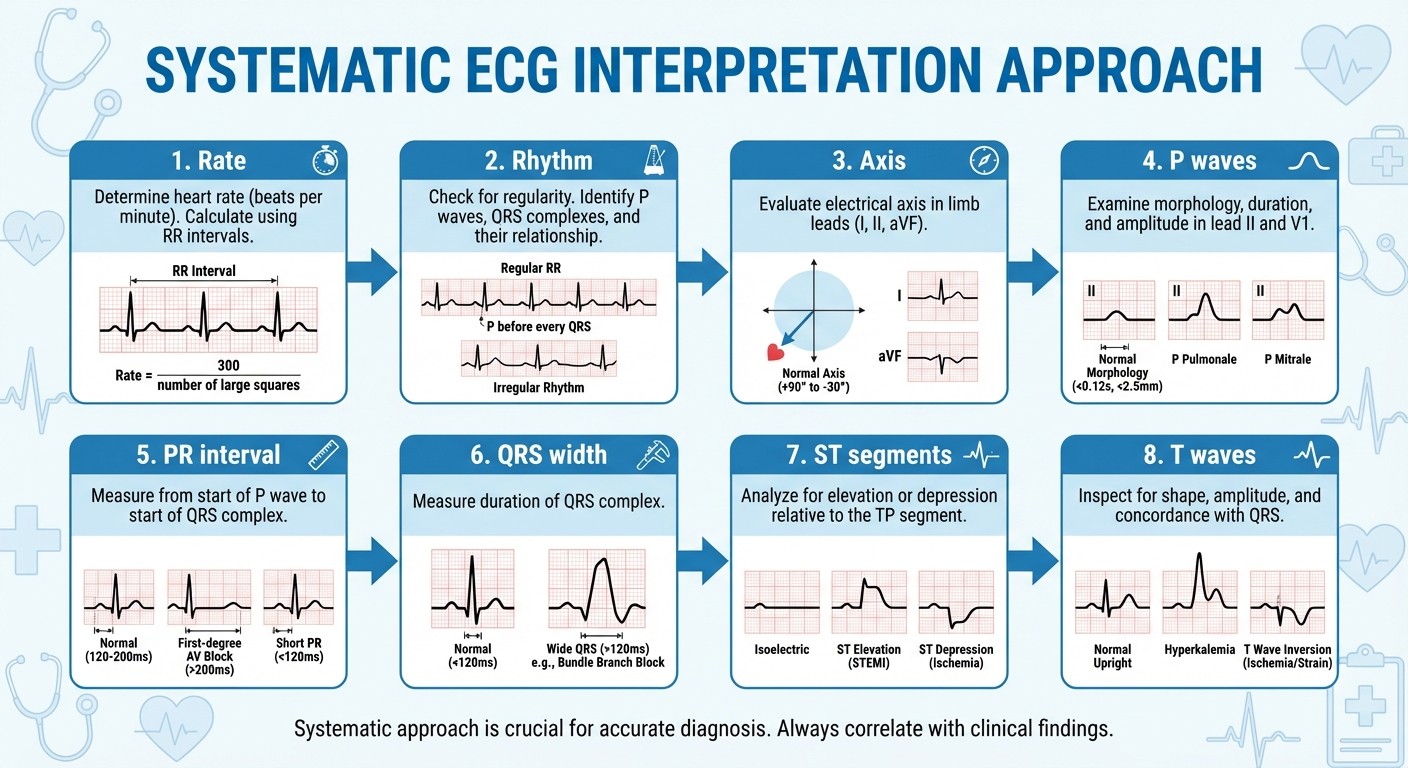
ECG questions seem intimidating but follow predictable patterns. Heres your step-by-step approach:
Step 1: Read the clinical scenario first
Before looking at the ECG, understand the patient: age, symptoms, presentation. This gives you diagnostic clues.
Step 2: Apply the systematic approach
Use the same sequence every time:
1. Rate: Normal (60-100), bradycardia (<60), tachycardia (>100) 2. Rhythm: Regular vs irregular 3. P waves: Present, absent, morphology, ratio to QRS 4. PR interval: Normal (120-200ms), prolonged, short 5. QRS width: Narrow (<120ms) vs wide (>120ms) 6. ST segments: Elevated, depressed, normal Step 3: Correlate with clinical presentation
A 65-year-old with chest pain and ST elevation → STEMI
A 25-year-old athlete with bradycardia → Physiological
A patient with palpitations and narrow QRS tachycardia → SVT
Use the Probe Game to practice this elimination technique — it shows you exactly why each wrong ECG interpretation doesnt fit the clinical scenario.
High-Yield Cardiology Mnemonics
Antiarrhythmic Drug Memory "Queen Proclaimed Legal Marijuana":
Quidine, Procainamide, Lidocaine → Class I
Metoprolol, propranolol → Class II
Amiodarone, sotalol → Class III
Verapamil, diltiazem → Class IV
MI Complications Timeline "Every Day After Wednesday Feels Difficult":
Electrical (arrhythmias) → Day 1-3
Dresslers syndrome → After 2-6 weeks
Wall rupture → Wednesday (day 3-5)
Practice these mnemonics with Oncourse's spaced repetition system — it tracks which mnemonics you forget and reviews them at optimal intervals.
Recommended Study Timeline
Phase 1: Foundation (Weeks 1-2)
Week 1: IHD and ECG basics
Study normal ECG components and measurements
Learn STEMI vs NSTEMI differentiation
Complete Oncourse's heart failure lessons
Week 2: Heart failure and arrhythmias
Master Framingham criteria
Study HFrEF vs HFpEF management
Practice 20 ECG interpretations daily
Phase 2: Clinical Application (Weeks 3-4)
Week 3: Valvular disease
Correlate murmurs with pathophysiology
Study echo findings for each valve lesion
Use Oncourse's Clinical Rounds for case-based learning
Week 4: Advanced topics
Study antiarrhythmic drug classifications
Practice complex ECG interpretations
Review infective endocarditis criteria
The Rezzy AI tutor helps optimize this timeline based on your current knowledge gaps — ask it "Create my personalized cardiology study plan" and it analyzes your practice performance to suggest focus areas.
How Oncourse AI Enhances Your Preparation
Adaptive Question Selection
Traditional question banks show random cardiology MCQs. Oncourse AI identifies your weak areas and prioritizes those topics. If you miss ECG interpretation questions, it serves more ECG-based MCQs until you master the pattern.
AI-Powered Explanations
When you select the wrong ECG diagnosis, Oncourse AI explains WHY your choice is incorrect: "You identified this as atrial flutter, but notice the irregularly irregular rhythm — thats characteristic of atrial fibrillation instead."
Clinical Context Integration
The platform presents cardiology concepts in clinical scenarios, not isolated facts. You learn heart failure management through actual patient presentations, making exam questions feel familiar.
Integrate your preparation with your overall NEET PG study plan and check out our high-yield cardiology topics guide.
Frequently Asked Questions
How many questions come from cardiology in NEET PG?
Cardiology consistently appears in 12-16 questions in NEET PG, representing about 6-8% of the total paper. The 2025 NEET PG had exactly 14 cardiology questions distributed across medicine, pediatrics, surgery, and anesthesia.
Should I memorize all ECG patterns or focus on high-yield ones?
Focus on high-yield patterns first: STEMI, NSTEMI, atrial fibrillation, atrial flutter, ventricular tachycardia, and AV blocks. These appear in 80% of ECG-based questions. Master the basics before attempting rare conditions.
How long does it take to master cardiology for NEET PG?
With focused study, 6-8 weeks is sufficient to master high-yield cardiology topics. Spend 2 weeks each on IHD/ECG basics, heart failure/arrhythmias, valvular disease, and practice/revision. Daily practice with adaptive questioning accelerates this timeline.
Which cardiology drug classifications are most important?
Antiarrhythmic drugs (Classes I-IV), heart failure medications (ACE inhibitors, beta-blockers, diuretics), and anticoagulants are highest yield. Know mechanisms, not just names. Understand why amiodarone works in VT rather than just memorizing "amiodarone treats VT."
---
Cardiology seems overwhelming initially, but its one of the most systematic subjects in NEET PG. Master the approach, practice consistently, and correlate everything clinically. The 40-60 marks from cardiology questions can significantly boost your rank.
Prepare smarter with Oncourse AI — adaptive MCQs, spaced repetition, and AI explanations built for NEET PG success. Download free on Android and iOS and start your cardiology preparation today.