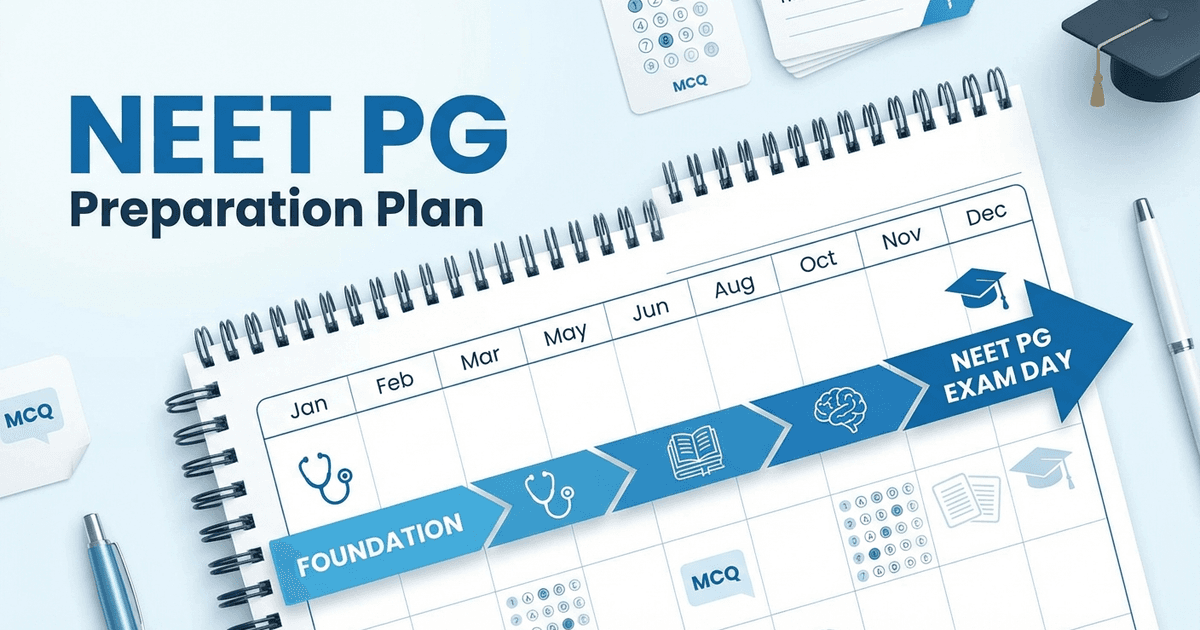
NEET PG Preparation Plan 2026: Month-by-Month Study Schedule
Complete month-by-month NEET PG preparation plan for 2026. Get a structured 15-month study schedule covering high-yield subjects, revision strategy, and mock test integration for success.
NEET PG Preparation Plan 2026: Month-by-Month Study Schedule
You are probably staring at that NEET PG syllabus wondering where to even start. 2,700+ topics. 200 questions in 200 minutes. One shot to secure your dream specialty.
Here's what nobody tells you: the students who crack NEET PG dont study harder — they study smarter with a plan. They know exactly what to study on Day 1, Month 6, and the final week. They treat preparation like surgery: precise, systematic, and executed flawlessly.
This month-by-month breakdown gives you that roadmap. No guesswork. No panic. Just a proven system that transforms 18 months of chaos into structured success.
Understanding the NEET PG Timeline
NEET PG 2026 will likely be held in March 2026, giving you 15-18 months to prepare depending on when you start. The exam pattern remains consistent: 200 MCQs covering all clinical subjects with no negative marking.
Here's the reality: you need minimum 12 months for solid preparation if starting fresh, or 8-10 months if you have a strong MBBS foundation. Anything less puts you in damage control mode.
High-Yield vs Low-Yield Subject Distribution
High-Yield Subjects (60% weightage) | Questions Expected |
|---|---|
Internal Medicine | 35-40 |
Surgery | 30-35 |
Obstetrics & Gynecology | 25-30 |
Pediatrics | 25-30 |
Pathology | 15-20 |
Pharmacology | 15-20 |
Low-yield subjects (40% remaining): Anatomy, Physiology, Biochemistry, Microbiology, Forensic Medicine, PSM, Radiology, Anesthesia, Dermatology, Psychiatry, ENT, Ophthalmology.
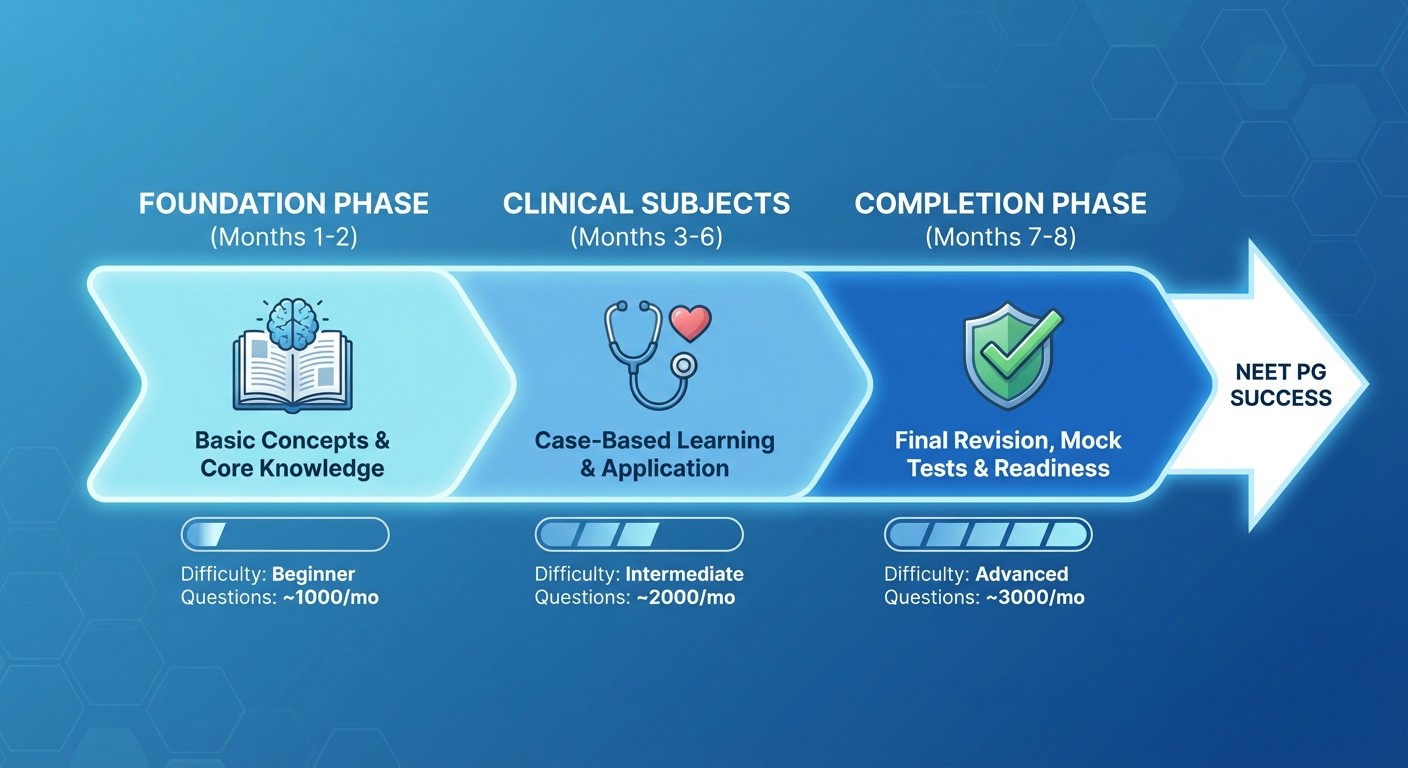
Month 1-2: Foundation Phase (Strong Base Building)
Month 1: Pathology Deep Dive
Start with pathology — it's the foundation for everything clinical. Cover systemic pathology completely before touching clinical subjects.
Week 1-2: General pathology (cell injury, inflammation, healing, neoplasia) Week 3-4: Systemic pathology (cardiovascular, respiratory, GIT)
Your daily routine should include reading theory for 6-7 hours, but dont just read passively. As you study each topic, Oncourse's spaced repetition flashcards automatically schedule high-yield facts for review, ensuring nothing slips through the cracks by exam day.
Key targets for Month 1:
Complete pathology theory once
Start with pathology MCQs — 25-30 daily
Build your first set of notes
Month 2: Pharmacology + Pathology Revision
Pharmacology is pure memory work. The sooner you start, the better your retention.
Week 1-2: Systemic pharmacology (CNS, CVS, antibiotics) Week 3-4: Special pharmacology + pathology revision
Use this month to establish your question-solving rhythm. Mix fresh pharmacology questions with pathology revision MCQs. The mnemonic "ABCDE" for beta-blocker side effects isn't just clever — it saves 30 seconds per question when you recall it instantly during the exam.
Month 3-4: Core Clinical Subjects
Month 3: Internal Medicine Foundation
Medicine forms the backbone of NEET PG. Start with high-yield systems.
Week 1: Cardiology (MI, heart failure, arrhythmias) Week 2: Pulmonology (COPD, asthma, TB, pneumonia) Week 3: Gastroenterology (peptic ulcer, IBD, liver diseases) Week 4: Endocrinology (diabetes, thyroid disorders)
At this stage, Oncourse's AI daily study plan becomes invaluable — it auto-generates your personalized schedule based on your exam date and weak subjects, removing the daily guesswork of what to study next.
Month 4: Surgery Fundamentals
Surgery questions are high-yield and follow predictable patterns.
Week 1-2: General surgery (GIT surgeries, hernias, trauma) Week 3: Orthopedics (fractures, joint diseases) Week 4: Other surgical specialties (neurosurgery basics, urology) Daily schedule for Months 3-4:
7-8 hours theory (new topics)
2 hours MCQ practice (50-75 questions)
1 hour revision (previous month topics)
Month 5-6: High-Yield Clinical Subjects
Month 5: Obstetrics & Gynecology
OBG is scoring if you know the guidelines and protocols.
Week 1-2: Obstetrics (pregnancy complications, labor, infections) Week 3-4: Gynecology (menstrual disorders, infertility, cancers)
Month 6: Pediatrics
Pediatrics follows developmental patterns — learn systematically.
Week 1: Neonatology and nutrition Week 2: Growth and development, immunization Week 3: Pediatric infections and emergencies Week 4: Pediatric specialties
By Month 6, you should be solving 100+ questions daily. Use NEET PG practice questions to drill topic-wise before attempting mixed practice.
Month 7-8: Completing the Syllabus
Month 7: Remaining Clinical Subjects
Cover the remaining clinical subjects systematically.
Week 1: Dermatology + Psychiatry Week 2: ENT + Ophthalmology Week 3: Anesthesia + Radiology Week 4: Forensic Medicine + PSM
Month 8: Pre-Clinical Subjects Revision
Revise Anatomy, Physiology, Biochemistry, and Microbiology. These subjects need active recall, not passive reading.
Focus on high-yield topics: embryology in anatomy, cardiovascular physiology, enzyme kinetics in biochemistry, and antibiotic mechanisms in microbiology.
Month 9-10: First Revision Cycle
This is where smart preparation separates from cramming. You have covered the entire syllabus once — now make it stick.
Month 9: High-Yield Subject Revision
Focus 80% time on Medicine, Surgery, OBG, Pediatrics, Pathology, and Pharmacology.
Week 1-2: Medicine + Surgery revision Week 3-4: OBG + Pediatrics revision
Month 10: Complete Syllabus Revision + Mock Tests
Start your first mock test series this month.
Week 1-2: Pathology + Pharmacology + pre-clinical subjects Week 3-4: Full-length mock tests (2 per week) Mock test strategy:
Take tests in exam conditions
Analyze every wrong answer
Identify weak topics for targeted revision
Maintain error log
When reviewing mock tests, Oncourse's PYQ practice mode with AI explanations transforms your mistake analysis — instead of just seeing the right answer, you understand the underlying concept behind each question.
Month 11-12: Intensive Practice Phase
Month 11: Subject-Wise Test Series
Take subject-wise tests to identify specific weak areas.
Daily routine:
2-3 hours targeted revision
4-5 hours MCQ practice (150+ questions)
2 hours mock test analysis
Month 12: Grand Tests + Weak Area Focus
Start taking grand tests (full 200-question papers) weekly.
Focus remaining study time on your consistently weak subjects. If cardiology keeps tripping you up, spend extra time on internal medicine practice questions until the patterns become second nature.
Month 13-15: Peak Performance Phase
Month 13-14: High-Frequency Revision
By now, you should know your strong and weak areas clearly.
High-frequency revision strategy:
Revise entire high-yield syllabus in 10 days
Solve 200+ questions daily
Take 3-4 grand tests per week
Focus 70% time on weak subjects
Month 15: Final Polish
Last month before exam — no new topics.
Week 1-2: Quick revision of entire syllabus Week 3: Previous year questions + important topics Week 4: Light revision + exam strategy
Final 2 Weeks: Exam Mode
Week 1: Last Revision
Complete high-yield topics one final time
Solve previous year papers
Review your error log
Take 2-3 final mock tests
Week 2: Confidence Building
Light revision only
Review mnemonics and formulas
Solve easier questions to build confidence
Plan exam day logistics
What to revise in final week:
Drug dosages and contraindications
Normal values and cutoffs
Clinical guidelines and protocols
High-yield mnemonics
As you approach the final weeks, those facts you reviewed through spaced repetition flashcards earlier will resurface effortlessly — this is the power of distributed practice over cramming.
Study Hours Distribution by Phase
Phase | Theory Hours | MCQ Practice | Revision | Mock Tests |
|---|---|---|---|---|
Foundation (Month 1-2) | 7-8 hours | 1 hour | 30 min | None |
Clinical (Month 3-6) | 6-7 hours | 2 hours | 1 hour | None |
Completion (Month 7-8) | 5-6 hours | 3 hours | 1 hour | Weekly |
Revision (Month 9-12) | 3-4 hours | 4-5 hours | 2 hours | 2-3 weekly |
Peak (Month 13-15) | 2-3 hours | 6-7 hours | 2 hours | 3-4 weekly |
Managing High-Yield vs Low-Yield Subjects
High-Yield Subject Strategy (Medicine, Surgery, OBG, Pediatrics)
Study theory thoroughly with multiple revisions
Solve 500+ questions per subject
Make detailed notes of patterns
Focus on recent guidelines and updates
Low-Yield Subject Strategy (Anatomy, Physiology, etc.)
Focus on high-yield topics only
Solve sufficient MCQs for pattern recognition
Avoid going too deep into theory
Quick revision multiple times
Pathology and Pharmacology (Bridge Subjects)
These subjects support clinical understanding:
Pathology: essential for all clinical subjects
Pharmacology: high weightage and pure memory
Treat these as foundation subjects
Revise frequently to maintain retention
When to Shift to Revision Mode
The transition to revision mode should be gradual, not sudden:
Month 7: 70% new topics, 30% revision Month 9: 50% new topics, 50% revision Month 11: 20% new topics, 80% revision Month 13+: 100% revision mode Signs you are ready for pure revision mode:
Completed entire syllabus at least once
Solving 100+ MCQs daily comfortably
Identifying question patterns consistently
Scoring 60%+ in subject-wise tests
Mock Test Integration Strategy
Phase 1 (Month 9-10): Introduction
1 mock test per week
Focus on exam endurance
Analyze mistakes thoroughly
Phase 2 (Month 11-12): Building Momentum
2-3 mock tests per week
Subject-wise tests on weak areas
Track performance trends
Phase 3 (Month 13-15): Peak Practice
3-4 grand tests per week
Focus on time management
Fine-tune exam strategy
Mock Test Analysis Framework
For every mock test:
1. Immediate review: Check answers within 2 hours 2. Subject-wise analysis: Identify weak subjects 3. Topic-wise drilling: Solve 20+ questions on weak topics 4. Concept clarification: Review theory for recurring mistakes 5. Pattern identification: Note frequently asked question types
Creating Your Personal NEET PG Preparation Plan
Every student's preparation needs are different. Consider these factors when customizing your plan:
Starting Point Assessment
Strong MBBS foundation: Reduce foundation phase to 1 month
Average foundation: Follow the standard timeline
Weak foundation: Extend foundation phase to 3 months
Available Time Per Day
8+ hours daily: Follow accelerated timeline
6-8 hours daily: Standard timeline with focused approach
Less than 6 hours: Extend preparation by 2-3 months
Weak Subject Management
Identify your consistently weak subjects early and allocate extra time:
Pathology weak: Extend foundation phase
Clinical subjects weak: Add extra month for clinical coverage
Pharmacology weak: Start earlier and revise frequently
Frequently Asked Questions
How many hours should I study daily for NEET PG?
Study 8-10 hours daily during peak preparation. Break this into 6-7 hours of active studying and 2-3 hours of MCQ practice. Quality matters more than quantity — focused 8 hours beats distracted 12 hours.
Is 6 months enough for NEET PG preparation?
Six months is possible if you have a strong clinical foundation from MBBS and can dedicate 12+ hours daily. However, 8-12 months gives you better retention and less stress. Rushing through preparation often leads to superficial understanding.
Which books should I follow for NEET PG 2026?
Focus on 1-2 standard books per subject rather than multiple sources. For theory: Harrison's (Medicine), Bailey & Love (Surgery), Williams (OBG), Nelson (Pediatrics). For MCQs: solve diverse question banks and previous year papers rather than sticking to one source.
When should I start taking mock tests?
Start mock tests after completing 70% of the syllabus, typically around Month 9-10. Early mock tests can be demoralizing and dont provide accurate performance indicators. Focus on subject-wise tests before attempting full-length papers.
How important are previous year questions?
Previous year questions are extremely important — they reveal exam patterns, frequently tested topics, and question styles. Dedicate the last 2 months to intensive PYQ practice. Solve at least 5 years of previous papers multiple times.
Should I join a coaching institute or self-study?
Self-study works if you have discipline and access to quality resources. Coaching provides structure and peer motivation but isnt mandatory. Choose based on your learning style, budget, and available time. Many successful candidates combine both approaches.
Prepare smarter with Oncourse AI — adaptive MCQs, spaced repetition, and AI explanations built for NEET PG. Download free on Android and iOS.