Back
NEET PG 1 Study Plan: 60-Day Strategy to Crack the Exam in 2026
Master NEET PG 2026 with this intensive 60-day study plan. Week-by-week breakdown, subject rotation strategy, mock test schedule, and day-before-exam protocol for maximum success.

NEET PG 1 Study Plan: 60-Day Strategy to Crack the Exam in 2026
You probably opened this article because you have exactly 60 days left and you are feeling the pressure. NEET PG 2026 has 200 questions. You get 63 seconds per question. Your entire PG dream comes down to these next 2 months.
Heres the reality: 60 days is enough time to crack NEET PG if you study smart. But most students waste these crucial weeks reviewing everything equally, attempting random mock tests, and burning out right before the exam.
This isnt a generic study plan. Its a precision strategy designed for the final sprint — exactly which subjects to hit when, how many PYQs to solve daily, and how to stay mentally sharp when the pressure peaks. If you are serious about converting these 60 days into your PG seat, this roadmap will get you there.
The 60-Day NEET PG Blueprint: Week-by-Week Breakdown
The key to 60-day success is structured intensity. You dont have time for scattered preparation — every week has a specific purpose in your exam strategy.
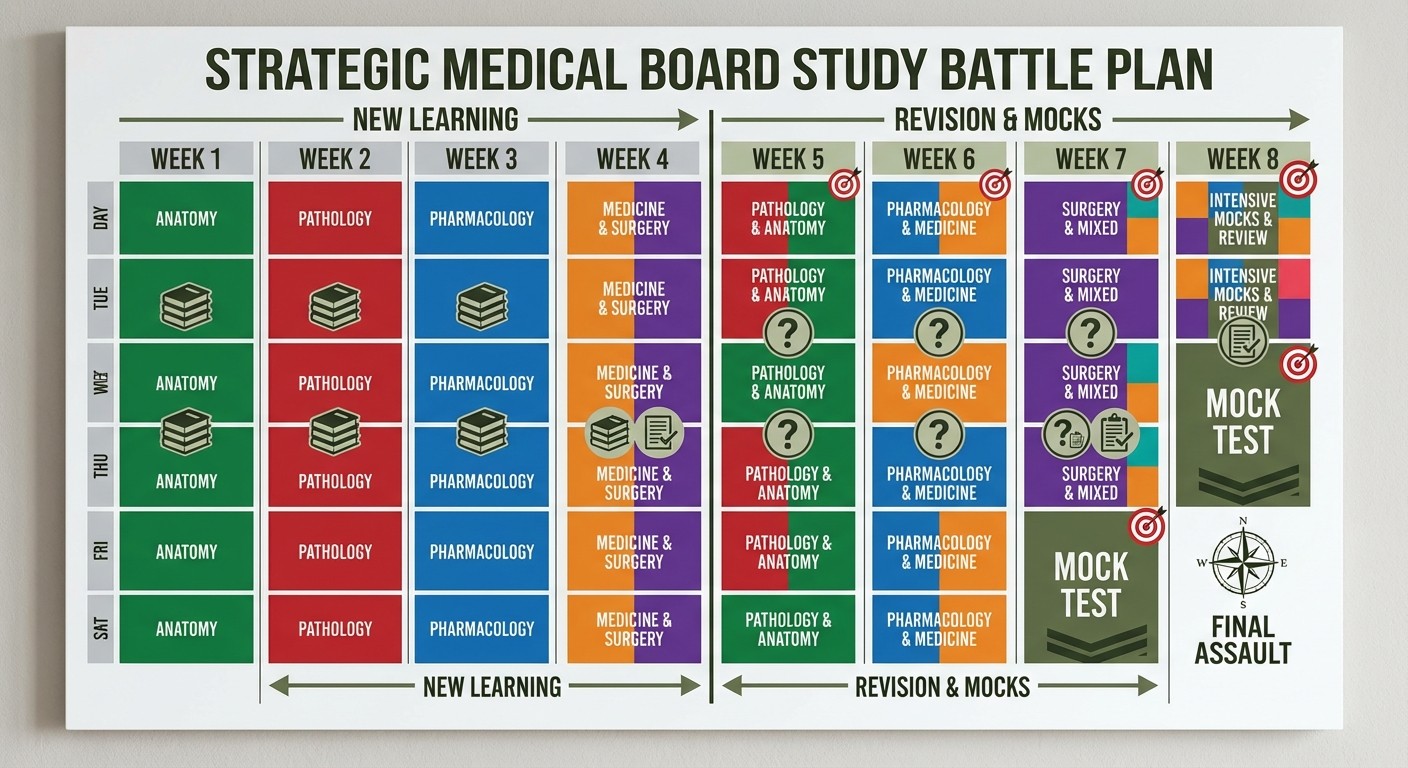
Weeks 1-2: High-Yield Foundation (Days 1-14)
Primary objective: Lock in the subjects that give maximum marks per hour invested. Daily structure:
6 hours active study
100-120 MCQs practice
Subject focus: Pharmacology, Pathology, Anatomy
Zero new topics — only revision and strengthening
Subject rotation strategy:
Morning (2.5 hours): Pharmacology mechanisms and high-yield drugs
Afternoon (2 hours): Pathology — focus on gross pathology images and key disease patterns
Evening (1.5 hours): Anatomy — high-yield areas like neuroanatomy, embryology
The app's Daily Study Plan adjusts your schedule automatically when you input your exam date — it knows exactly which topics to prioritize in the 60-day countdown mode. Week 1 targets: Complete cardiovascular pharmacology, respiratory pathology, CNS anatomy Week 2 targets: GI pharmacology, GI pathology, thorax anatomy
Weeks 3-4: Clinical Subjects Blitz (Days 15-28)
Primary objective: Cover all clinical subjects with exam-focused depth. Daily structure:
7 hours active study
120-150 MCQs practice
Subject focus: Medicine, Surgery, OBG, Pediatrics
Clinical correlation with basic sciences
Grand rounds strategy: Rotate through clinical subjects every 2 days to maintain freshness and prevent burnout.
Days 15-16: Internal Medicine (focus on common presentations)
Days 17-18: General Surgery (emergency surgery emphasis)
Days 19-20: OBG (high-yield obstetric emergencies)
Days 21-22: Pediatrics (developmental milestones, vaccines)
Days 23-24: Medicine subspecialties
Days 25-26: Surgery subspecialties
Days 27-28: Integration day — mixed practice
During this phase, Oncourse's AI flashcards become crucial — you can generate topic-specific flashcard decks instantly instead of rereading entire textbooks.
Weeks 5-6: Mock Test Mastery (Days 29-42)
Primary objective: Perfect your exam technique and identify weak areas. Daily structure:
5 hours active study
1 full mock test every alternate day
Detailed performance analysis
Targeted revision of weak topics
Mock test strategy:
Days 29, 31, 33, 35, 37, 39, 41: Full 200-question mocks
Days 30, 32, 34, 36, 38, 40, 42: Analyze previous mock + targeted revision
After each mock test, the platform's Mock Test Analytics shows exactly which subjects are bleeding marks, letting you redirect your revision to the highest-ROI areas rather than studying everything equally. Key performance metrics to track:
Target score: 110+ by Week 5 end
Subject-wise accuracy: 55%+ in all major subjects
Time management: Complete all 200 questions with 15 minutes to spare
Weeks 7-8: Peak Performance Mode (Days 43-56)
Primary objective: Fine-tune your exam readiness and maintain peak performance. Daily structure:
4 hours focused study
80-100 MCQs practice
90% revision, 10% new material maximum
Mental conditioning and stress management
Revision vs new learning ratio:
Week 7: 80% revision, 20% new material
Week 8: 95% revision, 5% new material only for critical gaps
Subject prioritization for final weeks: 1. Pharmacology: Drug interactions, adverse effects, contraindications 2. Pathology: Histopathology slides, lab values 3. Medicine: Treatment protocols, emergency management 4. Surgery: Indications for surgery, complications
Final 4 Days: Exam Ready Protocol (Days 57-60)
Days 57-58: Last comprehensive revision
Review all high-yield formulae and drug dosages
Practice image-based questions intensively
Complete subject-wise rapid fire tests
Day 59: Light revision + mental preparation
Review only previously marked important points
No new topics whatsoever
Early sleep, proper nutrition
Day 60 (Exam day): Peak performance execution
Light breakfast 2 hours before exam
Arrive at center 90 minutes early
10-minute breathing exercise before starting
Daily Question Practice Strategy: The PYQ Formula
Your daily MCQ practice isnt random — it follows a specific pattern optimized for 60-day preparation.
Days 1-14: Foundation Building
100-120 questions daily
70% topic-specific practice
30% mixed subject questions
Focus: Accuracy over speed
Days 15-28: Clinical Integration
120-150 questions daily
50% clinical subjects
30% basic sciences
20% mixed practice
Focus: Pattern recognition
Days 29-42: Mock Test Phase
200 questions (mock) + 50-80 additional practice
Alternate between full mocks and targeted practice
Focus: Time management + weak area strengthening
Days 43-56: Precision Practice
80-100 questions daily
Only previously incorrect questions
High-yield topics revision
Focus: Converting weaknesses to strengths
Days 57-60: Maintenance Mode
50-60 questions daily
Only confidence-building easy questions
No analysis of new mistakes
Focus: Mental readiness
Subject Rotation Strategy: The Grand Rounds Method
Instead of studying one subject for entire days, use the grand rounds approach — rotate through subjects like a medical resident making rounds.
Morning Block (9 AM - 12 PM): Heavy Cognitive Load
Best for: Pharmacology, Pathology, complex Medicine topics
Why: Your brain processes complex mechanisms best in the morning
Afternoon Block (2 PM - 5 PM): Application Focus
Best for: Surgery, OBG, Pediatrics, practical scenarios
Why: Post-lunch period suits clinical problem-solving
Evening Block (7 PM - 9 PM): Memory Consolidation
Best for: Anatomy, quick revisions, flashcard practice
Why: Spaced repetition before sleep improves retention
Benefits of rotation:
Prevents subject fatigue
Maintains engagement across all topics
Mimics the mixed question pattern of actual NEET PG
Reduces risk of complete weak areas
The Final 2 Weeks: Revision vs New Learning Balance
The last 14 days determine your performance. Heres the exact balance that works:
Week 7 (Days 43-49): Strategic Revision
80% time: Revision of known topics
20% time: Filling critical knowledge gaps only
No new subjects: Only complete pending topics from weeks 1-6
Week 8 (Days 50-56): Maintenance Mode
95% time: Pure revision and practice
5% time: Only if you discover a major knowledge gap
Zero stress: Avoid any new challenging topics
Last 3 days (Days 57-59): Mental Preparation
100% revision: Only previously studied material
Confidence building: Focus on your strong subjects
Stress management: Meditation, light exercise, proper sleep
Mental Consistency: The 60-Day Mindset
The biggest challenge isnt content — its staying mentally consistent for 60 intense days. Heres your psychological strategy:
Week-by-Week Mental Goals:
Weeks 1-2: Build momentum, establish routine
Weeks 3-4: Push through the initial resistance
Weeks 5-6: Handle mock test pressure and maintain confidence
Weeks 7-8: Channel nervous energy into focused preparation
Daily Mental Conditioning:
1. Morning affirmation: "Today I get closer to my PG seat" 2. Progress tracking: Mark each completed topic as a victory 3. Evening reflection: What did I learn that will help me tomorrow?
Handling Mock Test Scores:
Below 100: Normal for initial weeks — focus on improvement pattern
100-120: Good progress — identify 2-3 weak subjects to target
120+: Excellent — maintain consistency and fine-tune weak areas
Stress Management Tactics:
Physical: 30 minutes daily walk, proper sleep schedule
Mental: 10 minutes meditation before studying
Social: Limited but positive interactions with fellow aspirants
Academic: Focus on daily progress, not final outcome
Day-Before-Exam Protocol: Your 24-Hour Strategy
The last 24 hours can make or break your performance. Heres the exact protocol that maximizes your exam day performance:
24 Hours Before (Day -1, Evening):
6 PM: Light dinner, no heavy or spicy food
7 PM: Quick review of high-yield formulae and drug doses
8 PM: Pack exam day essentials (admit card, ID, stationery)
9 PM: Relaxation time — light music, positive visualization
10 PM: Sleep (8 hours minimum)
Exam Day Morning:
6 AM: Wake up naturally (no jarring alarm)
6:30 AM: Light exercise or stretching
7 AM: Nutritious breakfast (avoid new foods)
8 AM: Quick review of confidence-boosting topics only
9 AM: Leave for exam center
10 AM: Arrive at center, complete formalities
10:30 AM: 10-minute breathing exercise and positive affirmations
Pre-Exam Mental Prep (Last 30 Minutes):
1. Controlled breathing: 4-7-8 technique (inhale 4, hold 7, exhale 8) 2. Positive visualization: See yourself confidently answering questions 3. Physical relaxation: Shoulder rolls, neck stretches 4. Mental affirmations: "I am prepared. I am confident. I will succeed."
Frequently Asked Questions
Is 60 days enough time to crack NEET PG?
Absolutely, but only with strategic preparation. Students have successfully cleared NEET PG with 60-day intensive preparation by focusing on high-yield topics, consistent mock practice, and efficient time management. The key is maximizing your study efficiency rather than study hours.
How many mock tests should I take in 60 days?
Take 15-20 full-length mocks spread across weeks 5-8. Start with 2 mocks per week during weeks 5-6, then increase to 3 per week during weeks 7-8. Always analyze each mock thoroughly before taking the next one.
Which subjects should I prioritize in the last 60 days?
Focus on Pharmacology, Pathology, and Anatomy first (contribute 25% of total marks), followed by Internal Medicine and General Surgery. These 5 subjects give you 50+ marks and should consume 70% of your study time.
Should I study new topics or just revise in the last 60 days?
Follow the 80-20 rule: 80% revision of known topics, 20% filling critical knowledge gaps. After day 50, switch to 95% revision only. Never start completely new subjects in the last 60 days.
How do I maintain consistency for 60 intense days?
Break the 60 days into 4 phases of 15 days each with specific goals. Track daily progress, take one complete rest day per week, and focus on small wins rather than the final outcome. Join study groups for accountability but avoid negative discussions about the exam.
What if my mock test scores are not improving?
Analyze your performance pattern: are you making silly mistakes, running out of time, or lacking knowledge? Adjust your strategy accordingly. Focus on accuracy before speed, and remember that consistent 110+ scores are sufficient for most PG seats.
---
Prepare smarter with Oncourse AI — adaptive MCQs, spaced repetition, and AI explanations built for NEET PG. Download free on Android and iOS.