Back
USMLE Step 1 Study Schedule: 3-Month Plan for Medical Students in 2026
Complete 12-week USMLE Step 1 study schedule for US medical students. Week-by-week plan with daily hours, system coverage, practice test timing, and strategies for weak subjects.
USMLE Step 1 Study Schedule: 3-Month Plan for Medical Students in 2026
You are probably staring at a blank calendar, wondering how the hell to fit everything into 12 weeks. Step 1 has 280 questions covering every system you have ever studied — and some you havent. You have 90 days to go from "I think I know this" to "I can nail this under pressure."
Here is what 250+ scorers actually do: they dont wing it. They follow a system that balances comprehensive review with targeted practice. No cramming. No panic studying. Just 12 weeks of disciplined execution.
This isnt theoretical advice from someone who took Step 1 in 2018. This is a week-by-week breakdown that works in 2026, when the exam pattern demands both depth and speed.
Why 3 Months Is the Sweet Spot
Most US medical students take Step 1 after their second year, when the basic science foundation is solid but not sharp enough for boards. Three months gives you enough time to:
Complete First Aid twice (minimum)
Do 2,500+ practice questions
Address weak areas without rushing
Build the pattern recognition Step 1 demands
Less than 10 weeks? You are cramming, not learning. More than 16 weeks? You start forgetting early topics by test day.
Research shows that spaced repetition over 12-16 weeks produces better retention than marathon study sessions. Your brain needs time to consolidate information between review cycles.
The 3-Phase Structure That Actually Works
Phase 1: Foundation (Weeks 1-4)
Goal: Complete systems review + establish question rhythm
This phase builds your knowledge base. You are not trying to memorize everything — you are creating mental frameworks that questions can hang on later. Focus on understanding pathophysiology over memorization.
Daily schedule:
4-5 hours content review
2 hours practice questions (40-50 questions)
1 hour flashcard review
Phase 2: Integration (Weeks 5-8)
Goal: Connect systems + increase question volume
Now you start seeing how systems interact. A cardiology question might test renal physiology. A pharmacology question might require knowing both mechanism and side effects. This is where Oncourse's AI Daily Study Plan becomes crucial — it automatically adjusts your system coverage based on what you have mastered, so you stop wasting time on strong areas.
Daily schedule:
3-4 hours targeted review
3 hours practice questions (60-80 questions)
1 hour weak area focus
Phase 3: Mastery (Weeks 9-12)
Goal: Peak performance + test readiness
The final month is about speed, accuracy, and confidence. You should be scoring consistently in your target range. If not, you extend this phase and push back your test date.
Daily schedule:
2 hours high-yield review
4 hours practice questions (80-100 questions)
1 hour rapid flashcard review
Week-by-Week Breakdown
Weeks 1-2: Cardiovascular + Respiratory
Start with these systems because they appear in 25-30% of questions. Master normal physiology before diving into pathology.
Week 1 Focus: Heart anatomy, cardiac cycle, ECG basics, common arrhythmias Week 2 Focus: Heart failure, valvular disease, lung anatomy, ventilation/perfusion
Daily questions: 40-50 (mixed topics to maintain other systems)
Flashcards: 50-75 new cards daily, review all due cards
Oncourse tip: Use AI-powered flashcards to generate cards for specific weak spots instead of downloading massive pre-made decks that include concepts you already know.
Weeks 3-4: Renal + Endocrine
These systems test both memorization (hormone pathways) and understanding (acid-base balance).
Week 3 Focus: Kidney anatomy, GFR, electrolyte handling, acid-base disorders Week 4 Focus: Diabetes, thyroid, adrenal, reproductive hormones
Daily questions: 50-60
Begin mixing systems — dont just do renal questions during renal week
Weeks 5-6: Neurology + Psychiatry
Neurology questions often test anatomical knowledge. Psychiatry questions test pattern recognition and DSM criteria.
Week 5 Focus: Brain anatomy, cranial nerves, stroke, seizures Week 6 Focus: Movement disorders, psychiatric diagnoses, psychopharmacology
Daily questions: 60-70
Start taking 40-question blocks under timed conditions
Weeks 7-8: GI + Hepatology
High-yield systems with lots of pathophysiology connections.
Week 7 Focus: GI anatomy, digestion, inflammatory bowel disease Week 8 Focus: Liver function, hepatitis, cirrhosis, pancreatic disorders
Daily questions: 70-80
First practice test at end of week 8
Weeks 9-10: Hematology/Oncology + Immunology
Complex topics that require understanding mechanisms, not just memorizing facts.
Week 9 Focus: Blood cells, coagulation, common anemias, lymphomas Week 10 Focus: Immune system, hypersensitivity reactions, immunodeficiency
Daily questions: 80-90
Second practice test at end of week 10
Weeks 11-12: Microbiology/Infectious Disease + Review
Final systems plus comprehensive review of weak areas identified through practice tests.
Week 11 Focus: Bacterial, viral, fungal infections, antibiotic mechanisms Week 12 Focus: Weak area review, rapid First Aid review, confidence building
Daily questions: 90-100
Final practice test 3-4 days before exam
Daily Hour Targets That Actually Work
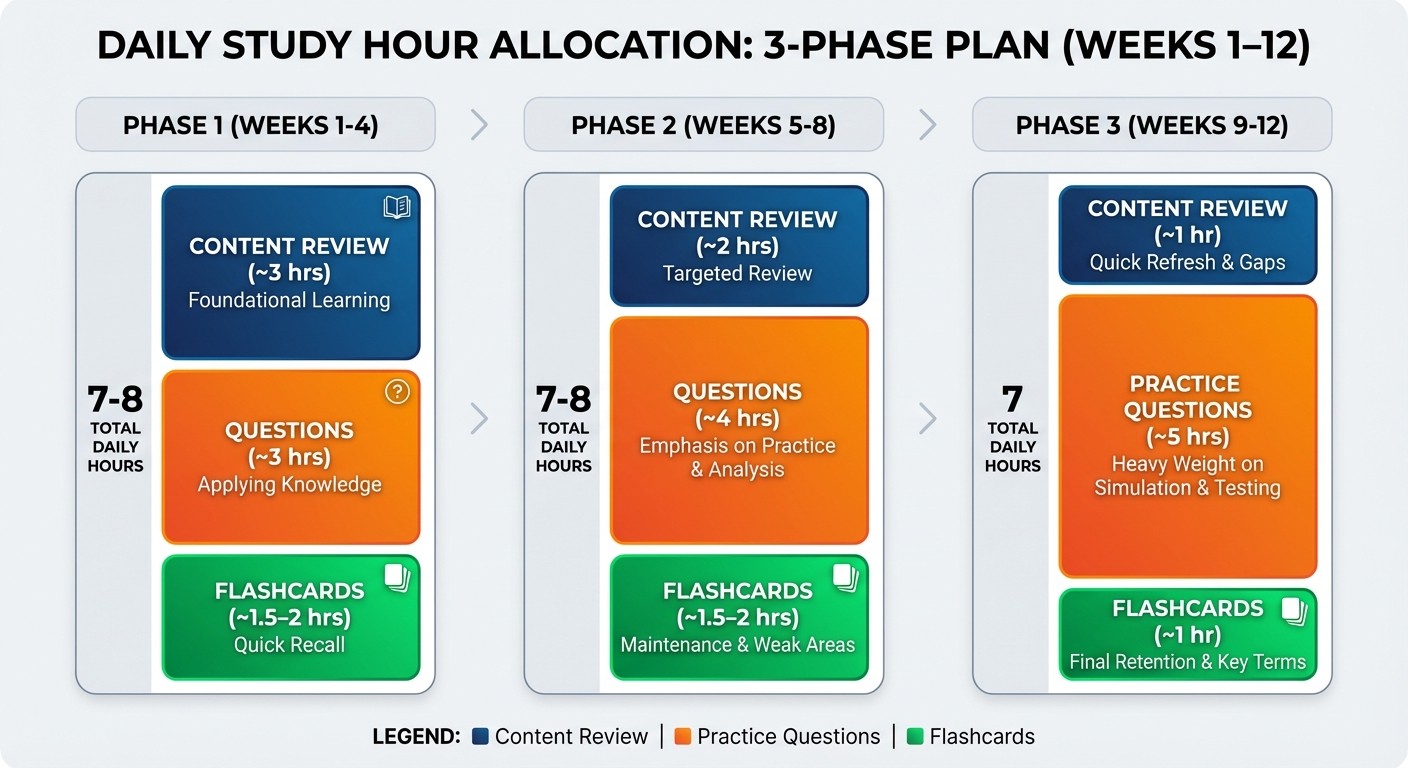
Most students either under-study (5-6 hours) or burn out (10+ hours). The sweet spot is 7-8 focused hours with strategic breaks.
Study Phase | Content Review | Practice Questions | Flashcards | Total Hours |
|---|---|---|---|---|
Weeks 1-4 | 4-5 hours | 2 hours | 1 hour | 7-8 hours |
Weeks 5-8 | 3-4 hours | 3 hours | 1 hour | 7-8 hours |
Weeks 9-12 | 2 hours | 4 hours | 1 hour | 7 hours |
Morning block (3-4 hours): Content review when your brain is fresh Afternoon block (2-3 hours): Practice questions when you need active engagement Evening block (1-2 hours): Flashcard review and weak area targeting
Take 15-minute breaks every 90 minutes. Take 1 full day off per week — usually Sunday.
When to Start Practice Tests
Week 8: First full-length practice test to identify weak systems Week 10: Second practice test to track improvement Week 12: Final practice test 3-4 days before exam (confidence builder, not learning tool)
Dont take practice tests earlier than week 8. You waste them when you havent covered enough material. Dont take them daily in the final week — you are reviewing, not cramming new information.
Your practice test scores should show steady improvement:
Week 8: Baseline (often 15-25 points below target)
Week 10: Significant jump (within 10-15 points of target)
Week 12: Consistent target range performance
How to Handle Weak Subjects
Every student has 2-3 systems that just dont click. Maybe its pharmacology. Maybe its embryology. Maybe its biostatistics.
Week 4 assessment: After your first month, identify your bottom 3 systems based on question performance. Weeks 5-8 strategy: Allocate 30 extra minutes daily to weak areas. Use Oncourse's practice question AI explanations — they break down wrong answers with full pathophysiology context, not just the correct choice. This bridges the gap between seeing an answer and understanding it. Weeks 9-12 strategy: Double down on weak areas. If you are missing 60% of pharmacology questions, spend 1 hour daily on pharma until you hit 75%+ accuracy.
Dont ignore strong subjects completely, but dont over-study them either. If you consistently score 85%+ on cardiology, move on.
The Spaced Repetition Advantage
Cramming doesnt work for Step 1. You need spaced repetition — reviewing information at increasing intervals to build long-term retention.
Week 1: Learn new concepts Week 3: First review of week 1 material Week 6: Second review of week 1 material Week 10: Final review of week 1 material
Most students try to cram First Aid in the final two weeks. By then, you have forgotten half of what you studied in month 1. Instead, cycle through material every 2-3 weeks.
Traditional flashcard apps give you pre-made decks with thousands of cards you dont need. Oncourse generates AI-powered flashcards on demand for your specific weak spots, reviewed at optimal intervals. If you miss a cardiology question, you get targeted cards for that exact concept.
What to Do When You Fall Behind
You will fall behind. Everyone does. The key is adjusting intelligently, not panicking.
If you are 3-4 days behind: Skip low-yield topics (embryology details, rare genetic syndromes) and focus on high-yield systems. If you are 1-2 weeks behind: Condense your content review. Read First Aid more superficially and rely on practice questions for learning. If you are 3+ weeks behind: Consider pushing back your test date. Better to be fully prepared than to rush and underperform. Red flags that mean push back:
Practice test scores not improving after week 10
Consistently scoring below your target range
Feeling overwhelmed rather than challenged
Pushing back 2-4 weeks is common and smart. Rushing to an unprepared test date rarely works.
Adjusting for Your Learning Style
Visual learners: Use more diagrams and flowcharts. Spend extra time on image-based questions. Auditory learners: Record yourself reading high-yield facts. Use question explanations that include spoken reasoning. Kinesthetic learners: Write out pathways and mechanisms. Use active recall instead of passive reading.
Most students are visual-kinesthetic combinations. Pure auditory learners are rare in medical school.
The Final Week Strategy
7 days before: Light review only. No new material. Focus on confidence and test logistics. 3 days before: Take your final practice test. Score should be in your target range. 1 day before: Review high-yield facts. Get good sleep. Prepare test day logistics. Test day: Arrive early. Eat a good breakfast. Trust your preparation.
The final week is about maintaining what you have built, not adding new knowledge.
Common Schedule Mistakes to Avoid
Starting too easy: Week 1 should feel challenging. If it feels comfortable, you are not pushing hard enough. Question overload too early: Doing 100 questions daily in week 2 burns you out and wastes questions when you havent learned enough content. Ignoring weak areas: Hoping your weak subjects will improve through osmosis. They wont. Target them deliberately. Over-studying strong areas: If you know cardiology cold, dont spend 2 hours daily on more cardiology questions. Skipping breaks: Studying 12 hours daily for 12 weeks leads to burnout, not better scores. All-or-nothing mentality: One bad practice test score doesnt mean you are failing. Consistency matters more than perfection.
Resource Integration Strategy
First Aid: Your foundation text. Read actively, not passively. Annotate based on question mistakes. Question banks: Use 2-3 maximum. Quality over quantity. Focus on explanations, not just getting answers right. Video resources: Supplement only. Use for difficult concepts, not comprehensive review. Flashcards: For rapid recall of facts. Not for understanding complex pathophysiology.
The key is using each resource for its strength, not trying to make one resource do everything.
Frequently Asked Questions
Is 3 months enough for Step 1 preparation?
Three months is the optimal timeframe for most US medical students who have completed their basic science years. This allows for comprehensive review without information decay from early topics.
How many practice questions should I do daily?
Start with 40-50 questions daily in weeks 1-4, increase to 60-80 in weeks 5-8, and aim for 80-100 in the final month. Quality of review matters more than raw quantity.
What if I score poorly on my first practice test?
First practice tests often show scores 15-25 points below your eventual score. Focus on identifying weak systems rather than the overall score. Significant improvement typically happens between weeks 8-10.
Should I memorize all of First Aid?
No. Use First Aid as a reference and framework. Focus on understanding concepts through practice questions, then use First Aid to fill knowledge gaps.
How do I know if I am ready for the exam?
Consistently scoring in your target range on practice tests, completing your planned review schedule, and feeling confident (not perfect) with question timing and content.
What happens if I need to postpone my exam date?
Postponing 2-4 weeks is common and often leads to better scores than rushing unprepared. Contact your testing center early and adjust your schedule accordingly.
Prepare smarter with Oncourse AI — adaptive MCQs, spaced repetition, and AI explanations built for USMLE Step 1. Download free on Android and iOS.