Every Hematogenous Spreading Cancer Reigns Foolishly: Complete Hematogenous Metastasis Mnemonic Guide for NEET PG 2026
Master the hematogenous metastasis mnemonic for NEET PG 2026. Complete guide to cancers spreading via blood: renal cell carcinoma, sarcomas, follicular thyroid. High-yield pathology revision.
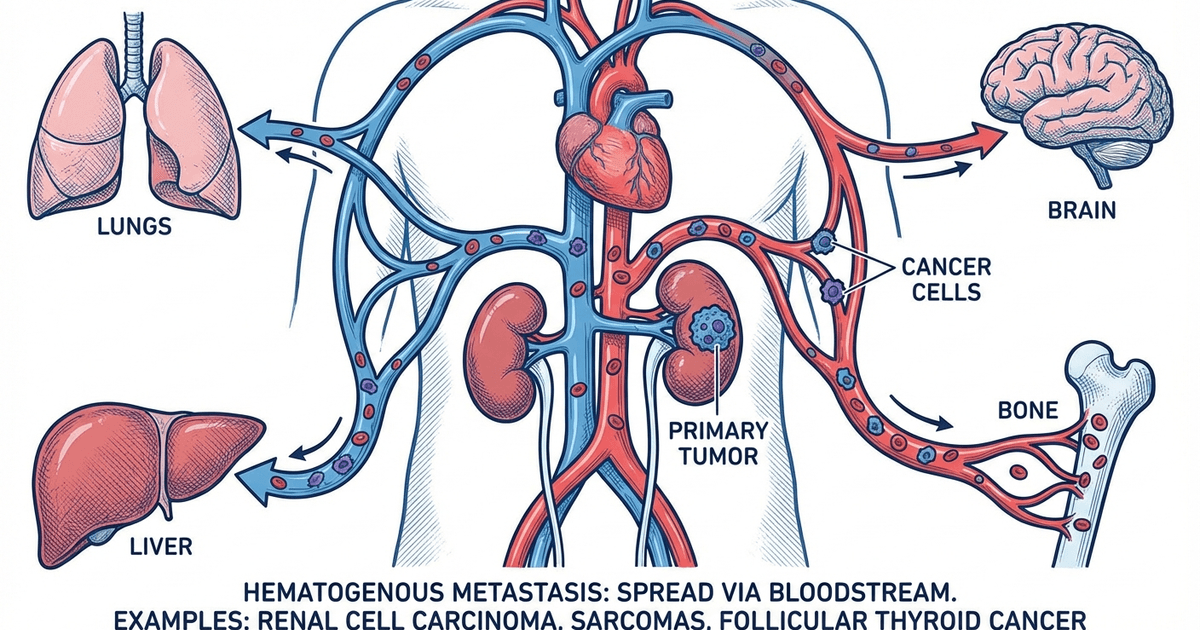
Every Hematogenous Spreading Cancer Reigns Foolishly: Complete Hematogenous Metastasis Mnemonic Guide for NEET PG 2026
You are staring at another metastasis question in your NEET PG mock. "Which cancer characteristically spreads hematogenously?" Four options. You know the answer is there, but the pressure makes everything blur together.
Here's what separates the 90+ scorers from everyone else in pathology — they don't memorise cancer lists. They use the every hematogenous spreading cancer reigns foolishly mnemonic and nail metastasis patterns in 15 seconds flat.
NEET PG pathology has roughly 35-40 questions. About 6-8 of them directly test metastasis routes. Miss these, and you're fighting uphill for the rest of the paper. But crack the hematogenous vs lymphatic spread pattern, and you've just locked in 15-20% of your pathology score before the examiner even tries to trick you.
This guide breaks down the mnemonic letter-by-letter, explains why these specific cancers choose blood over lymph, and gives you a foolproof system to handle NEET PG's favourite metastasis traps.
The Core Mnemonic: Every Hematogenous Spreading Cancer Reigns Foolishly
Letter | Stands For | Cancer Type | Why Hematogenous |
|---|---|---|---|
E | Every | Endometrial (some variants) | Anchor word |
H | Hematogenous | - | Route of spread |
S | Spreading | - | Mechanism |
C | Cancer | - | Malignancy type |
R | Reigns | Renal cell carcinoma | Invades renal vein → IVC |
F | Foolishly | Follicular thyroid + Fibrosarcoma | Thyroid rich vascularity + Sarcoma rule |
High-yield additions for NEET PG 2026:
Hepatocellular carcinoma (HCC) — portal vein invasion
Choriocarcinoma — highly vascular, direct blood invasion
All sarcomas — lack lymphatics in mesenchymal tissue
The golden rule that wins you marks: Carcinomas spread lymphatically first. Sarcomas spread hematogenously first. NEET PG loves testing this exact distinction.
Why These Cancers Choose Blood Over Lymph
Renal Cell Carcinoma (RCC): The IVC Invader
RCC doesn't mess around with lymph nodes. It goes straight for the renal vein and inferior vena cava (IVC). When you see "renal cell carcinoma with IVC thrombus" in a question stem, the examiner is testing whether you know this is classic hematogenous spread.
NEET PG favorite targets: Lungs (85% of RCC metastases), bone, liver, brain. The sequence matters — lungs first because venous blood from kidneys hits pulmonary circulation directly. Study tip: When reviewing renal cell carcinoma pathology, focus on the venous invasion pattern. Oncourse AI's Rezzy can explain exactly why RCC invades the IVC while most other cancers dont — it's the proximity to major venous drainage and the tumor's aggressive angioinvasive nature.
Sarcomas: The Lymphatic-Free Zone
Here's the mechanism that unlocks every sarcoma question: mesenchymal tissues have poor lymphatic drainage. Sarcomas arise from connective tissue, muscle, bone, fat — all tissues with sparse lymphatics.
NEET PG high-yield sarcomas that spread hematogenously:
Osteosarcoma → lungs (classic "cannon ball" lesions)
Leiomyosarcoma → lungs, liver
Fibrosarcoma → lungs
Angiosarcoma → lungs, liver, brain
The pattern is always lungs first because sarcomas dump directly into venous circulation, bypassing lymph nodes entirely.
Follicular Thyroid Cancer: The Vascular Exception
Most thyroid cancers (papillary) spread lymphatically. Follicular thyroid cancer breaks the rule because of two factors:
1. Rich vascular supply of thyroid tissue
2. Follicular architecture that promotes angioinvasion over lymphatic invasion
NEET PG trap: They'll give you "thyroid cancer with bone and lung metastases" — that's follicular, not papillary. Papillary thyroid goes to cervical lymph nodes first.
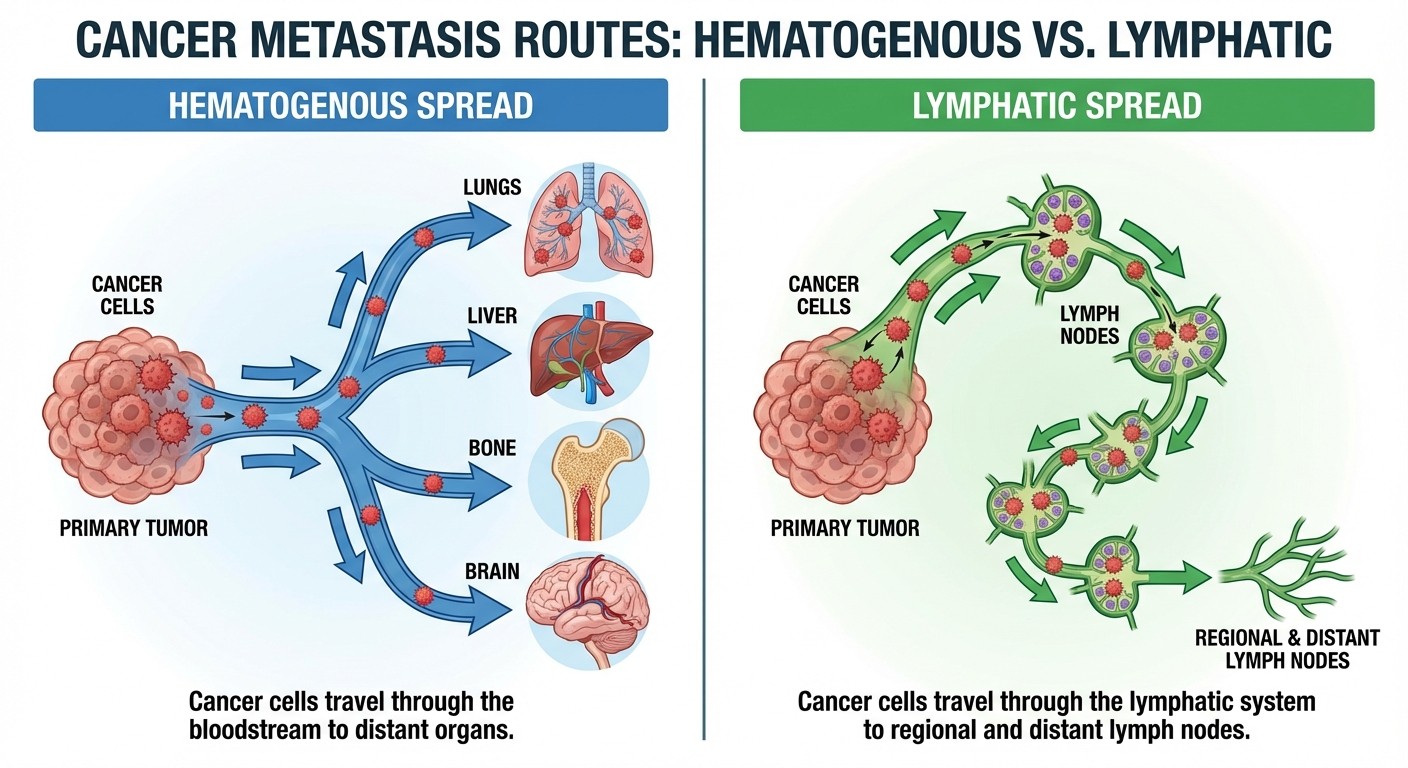
The Big Picture: Hematogenous vs Lymphatic Metastasis
Understanding the why behind each route helps you tackle NEET PG variants without memorising every cancer separately.
Hematogenous Spread Characteristics
Route: Primary tumor → blood vessels → distant organs
Target organs: Lungs, liver, bone, brain (rich blood supply)
Cancer types: Sarcomas, RCC, follicular thyroid, HCC, choriocarcinoma
Mechanism: Direct vascular invasion or poor lymphatic drainage
Lymphatic Spread Characteristics
Route: Primary tumor → regional lymph nodes → distant lymph nodes
Target organs: Lymph nodes, then secondary hematogenous spread
Cancer types: Most carcinomas (breast, gastric, colorectal, papillary thyroid)
Mechanism: Lymphatic vessel invasion, follows anatomical drainage patterns
NEET PG exam strategy: When you see a metastasis question, first classify the primary cancer as carcinoma vs sarcoma. That alone gets you to the right answer 80% of the time.
High-Yield Hematogenous Spreaders for NEET PG 2026
Hepatocellular Carcinoma (HCC)
Spread pattern: Portal vein → hepatic veins → IVC → lungs NEET PG favorites: Portal vein invasion (90% of cases), lung metastases Exam tip: "HCC with portal vein thrombus" = hematogenous spread pattern
Practice identifying HCC metastasis patterns with oncology questions that test portal circulation anatomy.
Choriocarcinoma
Spread pattern: Highly vascular → direct blood invasion → widespread metastases NEET PG favorites: Lungs (most common), brain, liver Exam tip: Any gestational trophoblastic disease question mentioning "lung nodules" = hematogenous spread
Wilms Tumor (Nephroblastoma)
Spread pattern: Renal vein invasion → IVC → lungs NEET PG favorites: Pediatric kidney tumor with lung metastases Exam tip: Think "kidney + child + lungs = Wilms hematogenous spread"
Memory Palace Technique for Mnemonic Retention
Here's how to lock in every hematogenous spreading cancer reigns foolishly permanently:
1. Every — Picture yourself entering an exam hall (every student's experience)
2. Hematogenous — Blood flowing through IV lines (hema = blood)
3. Spreading — Cancer cells floating in that blood like fish
4. Cancer — Tumor cells with evil faces (your mental cancer image)
5. Reigns — A kidney wearing a crown (Renal cell carcinoma rules the blood)
6. Foolishly — A thyroid gland and muscle tissue acting silly (Follicular thyroid + Fibrosarcoma/sarcomas)
Oncourse AI's daily Mnemonic Challenge surfaces puzzles like this one — students crack "EVERY HSC Reigns Foolishly" by piecing together the clue and testing recall in 3 attempts. It's like Wordle for medical mnemonics, and students who play daily retain pathology mnemonics 3x longer than passive readers.
Clinical Vignette Patterns: How NEET PG Tests This
Pattern 1: Imaging + Primary Cancer
"45-year-old man with renal mass. CT shows multiple 'cannon ball' lesions in both lungs. Most likely diagnosis?" Answer approach: Kidney cancer + lung lesions = RCC with hematogenous spread. The "cannon ball" description is classic for any hematogenous metastases to lungs.
Pattern 2: Metastasis Route Question
"Which of the following cancers characteristically spreads hematogenously rather than lymphatically?"
A) Gastric adenocarcinoma
B) Papillary thyroid cancer
C) Osteosarcoma
D) Breast carcinoma
Answer: C (Osteosarcoma = sarcoma = hematogenous rule)
Pattern 3: Exception Testing
"A 35-year-old woman has thyroid cancer with bone metastases but no lymph node involvement. Most likely histologic type?" Answer approach: Thyroid + bone mets + skipped lymph nodes = follicular thyroid cancer (hematogenous spreader)
Use pathology flashcards to drill these exact patterns. Oncourse AI's Synapses surfaces each hematogenous cancer as a separate spaced repetition card, so you only review the ones you're shaky on — not the entire list every time.
Advanced NEET PG Concepts: Beyond the Basic Mnemonic
Angioinvasion vs Lymphovascular Invasion
Angioinvasion: Direct blood vessel invasion (RCC, sarcomas) Lymphovascular invasion: Both lymphatics and blood vessels (aggressive carcinomas)
NEET PG tests this distinction in histopathology images and prognosis questions.
Metastatic Patterns by Organ
Bone metastases: Breast, lung, kidney, prostate, thyroid ("BLT with Pickles and Tomato") Brain metastases: Lung, breast, kidney, melanoma, colon Liver metastases: GI primaries (portal drainage), then hematogenous spreaders
Molecular Mechanisms
Sarcomas lack E-cadherin → poor cell adhesion → easier hematogenous dissemination Carcinomas have lymphatic vessel density → lymphatic spread predominates initially
When diving deeper into cancer biology mechanisms, Rezzy can explain why mesenchymal tissue architecture predisposes to hematogenous over lymphatic spread — understanding this "why" lets you extend the logic to any sarcoma without memorising each one separately.
Quick Revision Table: All Hematogenous Spreaders
Cancer | Primary Site | First Metastasis | Mechanism |
|---|---|---|---|
Renal cell carcinoma | Kidney | Lungs | IVC invasion |
Osteosarcoma | Bone | Lungs | Poor lymphatic drainage |
Leiomyosarcoma | Smooth muscle | Lungs | Sarcoma rule |
Follicular thyroid | Thyroid | Bone/lungs | Vascular invasion |
Hepatocellular carcinoma | Liver | Lungs | Portal vein invasion |
Choriocarcinoma | Trophoblast | Lungs | High vascularity |
Wilms tumor | Kidney (pediatric) | Lungs | Renal vein invasion |
Common NEET PG Traps and How to Avoid Them
Trap 1: Papillary vs Follicular Thyroid
Wrong thinking: "All thyroid cancers spread the same way" Right approach: Papillary = lymphatic, Follicular = hematogenous Memory trick: "Papillary goes to Palpable lymph nodes, Follicular Flies through blood"
Trap 2: Carcinoma vs Sarcoma Confusion
Wrong thinking: "Size or grade determines spread pattern" Right approach: Histologic origin trumps everything else Memory trick: "Carcinomas Crawl through lymphatics, Sarcomas Swim through blood"
Trap 3: Renal Cell Carcinoma Variants
Wrong thinking: "All kidney cancers spread hematogenously" Right approach: Only clear cell and papillary RCC follow this pattern consistently Memory trick: RCC = "Really Cruel Cancer" that goes straight for blood vessels
Frequently Asked Questions
How do you remember which cancers spread hematogenously vs lymphatically?
Use the tissue origin rule first: sarcomas (mesenchymal) = hematogenous, carcinomas (epithelial) = lymphatic. Then memorise the carcinoma exceptions using "every hematogenous spreading cancer reigns foolishly" — renal cell carcinoma, follicular thyroid, hepatocellular, and choriocarcinoma break the carcinoma rule.
Why does renal cell carcinoma prefer hematogenous spread?
RCC has a unique tendency to invade large veins, particularly the renal vein and inferior vena cava. This direct venous access gives cancer cells a highway to systemic circulation, bypassing regional lymph nodes entirely. The kidney's rich vascular supply and RCC's angioinvasive nature make this route more efficient than lymphatic drainage.
What's the most common site of hematogenous metastasis?
Lungs, because all venous blood passes through pulmonary circulation before reaching systemic arteries. Any cancer spreading hematogenously hits the lungs first — that's why lung metastases from RCC, sarcomas, and other hematogenous spreaders are so common in NEET PG questions.
How can I differentiate follicular thyroid cancer from papillary on NEET PG?
Look for the metastasis pattern: papillary thyroid spreads to cervical lymph nodes first, while follicular skips lymph nodes and goes directly to bone and lungs via blood. If the question mentions "thyroid cancer with bone metastases but no lymphadenopathy," that's follicular thyroid cancer.
Do all sarcomas spread hematogenously?
Yes, as a general rule. Mesenchymal tissues (where sarcomas arise) have poor lymphatic drainage compared to epithelial tissues. However, some aggressive sarcomas can eventually spread lymphatically after establishing distant hematogenous metastases, but the initial and predominant route is always hematogenous.
What about mixed patterns — can cancers use both routes?
Absolutely. Advanced cancers often use both hematogenous and lymphatic routes, but NEET PG tests the predominant or characteristic initial pattern. For example, breast cancer primarily spreads lymphatically to axillary nodes first, but later stages can have hematogenous spread to bone and liver.
Prepare smarter with Oncourse AI — adaptive MCQs, spaced repetition, and AI explanations built for NEET PG 2026. Download free on Android and iOS.