Back
USMLE Step 2 CK Prep Course: How to Choose the Right One and Structure Your Study Plan (2026)
Complete guide to choosing the best USMLE Step 2 CK prep course and building a structured study plan that targets weak areas. Includes timeline templates, adaptive strategies, and common mistakes to avoid.
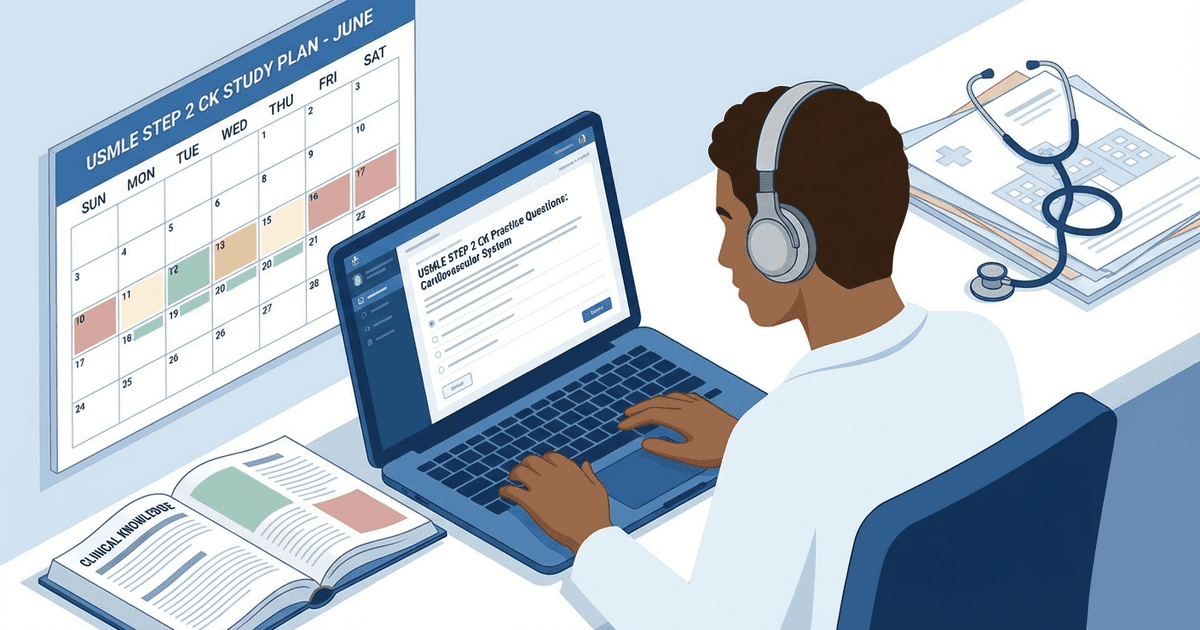
USMLE Step 2 CK Prep Course: How to Choose the Right One and Structure Your Study Plan (2026)
You are scrolling through hundreds of Step 2 CK prep courses, each promising "guaranteed score improvement" and "comprehensive coverage." Meanwhile, your test date is getting closer, and you still dont have a solid study plan. Sound familiar?
Step 2 CK has 318 questions across 8 hours. That gives you 90 seconds per question to diagnose, analyze clinical vignettes, and pick the best next step. Unlike Step 1's memorization-heavy approach, Step 2 demands clinical reasoning skills you cant just drill through practice tests.
The problem isnt finding study materials — its choosing the right combination and structuring them into a plan that actually builds clinical thinking. Most students either over-prepare with too many resources or under-prepare with passive reading.
This guide breaks down how to evaluate prep courses, build a personalized study timeline, and use adaptive tools to target your weak areas systematically. No fluff — just the framework that works.
What Makes Step 2 CK Different from Other USMLE Exams
Step 2 CK tests clinical decision-making, not just medical knowledge. You need to:
Interpret clinical vignettes in 60-90 seconds each
Apply knowledge across systems — a cardiology question might involve renal considerations
Prioritize next best steps rather than just identifying diagnoses
Handle multi-step scenarios where the right answer depends on patient stability
This means your prep strategy should focus on pattern recognition and clinical reasoning, not just content review. Traditional question banks that only provide explanations after you answer dont build the thinking process you need during the actual exam.
When you get a vignette about chest pain, you should automatically think: "Stable vs unstable? ECG changes? Troponins? Next imaging?" This systematic approach comes from deliberate practice, not passive reading.
How to Assess Your Current Readiness Level
Before choosing any prep course, figure out where you stand. Take a diagnostic practice test within your first week of serious Step 2 prep. Dont wait until youve "studied enough" — you need baseline data.
Score ranges and what they mean:
180-200: Need 4-6 months of structured prep with strong foundation building
200-220: 3-4 months with focus on weak systems and question practice
220-240: 2-3 months with targeted review and extensive practice questions
240+: 6-8 weeks of fine-tuning and maintaining your knowledge base
Track your performance by system, not just overall score. Step 2 covers Internal Medicine (25%), Surgery (15%), Pediatrics (15%), OB-GYN (15%), Psychiatry (10%), and Emergency Medicine (10%). If youre scoring 60% in Internal Medicine but 85% in Psychiatry, your study plan should reflect that gap.
Most students make the mistake of studying what they already know well. The goal is to identify your 2-3 weakest systems and bring them up to your average performance level.
Core Study Materials You Actually Need
Primary question bank: Essential. Aim for 2,000-3,000 questions minimum. Quality explanations matter more than quantity. Clinical reference: One comprehensive text or well-structured course content. Pick one and stick with it rather than jumping between resources. Practice tests: 4-6 full-length practice exams spaced throughout your prep. These build endurance and test-taking strategy. System-specific review: Target your 2-3 weakest areas identified in your diagnostic test. Active recall tool: Flashcards or spaced repetition system for high-yield facts and rapid recall items.
Avoid the "more is better" trap. Three well-used resources beat ten half-finished ones. The key is depth of engagement, not breadth of materials.
Top Prep Course Categories and How to Choose
1. Comprehensive Prep Courses
These cover all Step 2 systems with structured curricula, practice questions, and study schedules.
Best for: Students who want everything organized in one place and prefer guided learning paths. What to look for:
Adaptive scheduling that adjusts based on your performance
Clinical vignette-style questions that mirror the actual exam
Explanation chat features for immediate clarification on wrong answers
Performance tracking by system and topic
2. Question Bank-Focused Platforms
Heavy emphasis on practice questions with detailed explanations and performance analytics.
Best for: Students who learn best through practice and prefer self-directed study. Key features to prioritize:
Questions written by practicing physicians
Detailed explanations that walk through clinical reasoning
Ability to create custom quizzes by system or difficulty
Spaced repetition scheduling for reviewing missed questions
3. Video-Based Lecture Courses
Traditional lecture format with comprehensive coverage of Step 2 topics.
Best for: Students coming from clinical rotations who need systematic review of all systems. Limitations: Passive learning format. Must supplement with extensive question practice.
4. Hybrid AI-Powered Platforms
Combine traditional study materials with AI tutoring and adaptive features.
Best for: Students who want personalized learning experiences and immediate feedback. Advanced features to look for:
AI tutors that answer follow-up questions during lessons
Adaptive algorithms that adjust your daily study plan based on completion data
Instant explanations for wrong answers with memory integration
Building Your Step 2 CK Study Schedule
Phase 1: Foundation Building (Weeks 1-4)
Goal: Systematic review of all major systems Structure:
3-4 hours daily study time
Morning: Content review (1.5-2 hours)
Afternoon: Practice questions (1-1.5 hours)
Evening: Review mistakes (30 minutes)
Instead of manually deciding which system to study each day, use an adaptive scheduler that balances your strongest subject (maintains momentum) while rotating through your weaker areas systematically. This replicates exactly how Step 2 jumps between Internal Medicine, Surgery, Pediatrics, and OB-GYN within the same question block.
Daily targets:
30-50 practice questions
1 major system review per week
Track performance by subspecialty
Phase 2: Intensive Practice (Weeks 5-8)
Goal: Build clinical reasoning speed and accuracy Structure:
4-5 hours daily study time
Morning: Timed question blocks (2 hours)
Afternoon: Targeted weak area review (1.5 hours)
Evening: Full question review with explanations (1 hour)
Weekly targets:
200-300 practice questions
1 full-length practice test
Deep dive into your 2 lowest-scoring systems
This is where explanation chat becomes crucial. After every wrong answer, trigger an immediate AI-powered debrief that explains not just why you were wrong, but why the correct answer is the best next step in that clinical scenario. This builds pattern recognition faster than just reading static explanations.
Phase 3: Test-Taking Mastery (Weeks 9-12)
Goal: Simulate exam conditions and fine-tune performance Structure:
5-6 hours daily study time
Morning: Full 4-hour practice blocks
Afternoon: Review and remediation
Evening: High-yield fact review
Weekly targets:
2 full-length practice tests
300+ practice questions
Complete review of all missed questions from previous phases
Use this phase to test your stamina. Step 2 CK is 8 hours including breaks. Practice maintaining focus and accuracy throughout long question blocks.
Using Adaptive Tools for Weak Area Targeting
Traditional study plans treat all subjects equally. Adaptive tools identify your knowledge gaps and adjust automatically.
Key adaptive features that work:
1. Performance-based scheduling: Algorithms that increase exposure to your weakest topics while maintaining your strongest areas
2. Intelligent question selection: Systems that serve you questions just above your current performance level — challenging but not frustrating
3. Memory integration: Tools that remember your specific mistake patterns and provide targeted follow-up questions
When reviewing complex pathophysiology topics like heart failure management or sepsis workup, use AI tutoring that lets you ask clarifying questions mid-lesson. Instead of re-reading the same paragraph three times, ask "explain this mechanism differently" or "give me a clinical example" without breaking your study flow.
The goal is turning passive reading into active dialogue with the material.
Common Prep Course Mistakes to Avoid
Mistake 1: Resource hopping
Switching between multiple prep courses when you hit difficult material. Pick one primary resource and supplement strategically.
Mistake 2: Question bank addiction
Doing 200+ questions daily without reviewing explanations thoroughly. Better to do 50 questions with complete understanding than 200 questions superficially.
Mistake 3: Ignoring weak areas
Avoiding your lowest-scoring systems because theyre "hard." These represent your biggest score improvement opportunity.
Mistake 4: Passive video watching
Treating video lectures like entertainment. Take active notes and test yourself immediately after each section.
Mistake 5: Inadequate practice test frequency
Waiting until the final month to take practice tests. Start within your first two weeks to establish baseline performance.
Creating Your Personal Study Timeline
For 3-month prep:
Month 1: Foundation building + diagnostic testing
Month 2: Intensive practice + weak area targeting
Month 3: Test simulation + final review
For 6-month prep:
Months 1-2: Systematic content review
Months 3-4: Question practice + first pass weak areas
Months 5-6: Intensive practice + mastery of weak areas
For 8-week dedicated prep:
Weeks 1-2: Rapid review + baseline testing
Weeks 3-5: Intensive question practice
Weeks 6-8: Test simulation + final weak area drilling
Regardless of timeline length, spend 60% of your time on practice questions and explanations, 30% on content review, and 10% on practice tests.
Measuring Progress and Adjusting Your Plan
Track these metrics weekly:
Performance metrics:
Overall practice test scores (target: 15-20 point improvement per month)
System-specific accuracy (target: bring weakest areas to within 10% of your average)
Question speed (target: 90 seconds per question average)
Study metrics:
Daily study hours completed vs planned
Question completion rate
Time spent reviewing explanations vs answering questions
Red flags requiring plan adjustment:
Scores plateauing for 3+ weeks
Consistent poor performance in same systems
Inability to maintain planned study hours
Increasing anxiety about weaker subjects
If you hit a plateau, focus on your mistake review process. Many students answer questions but dont engage deeply with explanations. Each wrong answer should trigger a structured debrief: Why was I wrong? What pattern did I miss? What should I look for next time?
Advanced Study Strategies for High Scorers
Pattern recognition training:
Group questions by clinical presentation rather than medical system. Practice identifying "unstable patient" vs "stable patient" across all specialties.
Differential diagnosis frameworks:
For common chief complaints (chest pain, shortness of breath, abdominal pain), memorize systematic approaches that work every time.
Next best step decision trees:
Practice the meta-skill of determining whether a patient needs immediate stabilization, further workup, or definitive treatment.
Cross-system integration:
Study how different medical systems interact. A nephrology question might require cardiology knowledge for proper fluid management.
High scorers distinguish themselves by thinking systematically rather than relying on recognition alone.
Frequently Asked Questions
How long should I prepare for Step 2 CK?
Most students need 3-4 months of dedicated preparation. If you scored above 220 on your diagnostic test, 6-8 weeks may suffice. Students scoring below 200 typically need 4-6 months with systematic foundation building.
Should I use multiple question banks?
Stick to one primary question bank with 2,000+ questions, then add a second bank only after completing your first one. Quality of explanations and systematic review matters more than raw question quantity.
How many practice questions should I do daily?
Target 50-100 questions daily during dedicated prep, with 60% of your time spent reviewing explanations. Better to thoroughly understand 50 questions than superficially complete 200.
When should I take my first practice test?
Take a diagnostic practice test within your first week of serious prep. This establishes your baseline and identifies weak areas that need immediate attention.
Is it worth paying for expensive prep courses?
Expensive doesnt always mean better. Look for courses with adaptive features, quality explanations, and systematic weak area targeting rather than just high price tags.
How do I know if Im ready to take Step 2 CK?
You are ready when you consistently score within 20 points of your target on practice tests, maintain 75%+ accuracy across all major systems, and can complete 8-hour practice blocks without significant performance decline.
---
Step 2 CK success comes from structured preparation and adaptive learning, not just grinding through questions. Choose prep resources that build clinical reasoning systematically, target your specific weak areas, and provide immediate feedback when you make mistakes.
The difference between passing and excelling is how you engage with wrong answers. Each mistake should become a learning opportunity that strengthens your clinical decision-making for similar future scenarios.
Prepare smarter with Oncourse AI — adaptive MCQs, spaced repetition, and AI explanations built for USMLE Step 2 CK. Download free on Android and iOS.