Back
How to Study Forensic Medicine for NEET PG 2026: Complete High-Yield Guide, Must-Do Topics and Exam Checklist
Master forensic medicine for NEET PG 2026 with this complete study guide. Learn high-yield topics, memory techniques, and proven strategies to score maximum marks in 8-12 questions.
How to Study Forensic Medicine for NEET PG 2026: Complete High-Yield Guide, Must-Do Topics and Exam Checklist
You are probably staring at your forensic medicine textbook wondering where to even begin. The subject feels like a maze of legal jargon mixed with medical facts, and you dont have time to memorize every case law and section number.
Here's the truth: forensic medicine is one of the highest-scoring subjects in NEET PG when studied right. It has clear patterns, predictable question types, and a manageable syllabus. The catch? Most students either overstudy the low-yield topics or understudy the core concepts that appear every year.
NEET PG forensic medicine typically has 8-12 questions worth 48 points. That's nearly 3% of your total score from just one subject. Miss these, and you are giving away ranks to students who cracked the pattern.
This guide breaks down exactly what works: the 20% of topics that give you 80% of the marks, the memorization tricks that stick, and the common traps to avoid. No fluff, no generic advice — just the forensic medicine roadmap that gets results.
Understanding Forensic Medicine in NEET PG 2026
Forensic medicine covers the application of medical knowledge to legal matters. The NEET PG pattern favors certain topics heavily while barely touching others.
Question distribution typically breaks down as:
Medical jurisprudence and ethics: 35-40%
Forensic pathology and autopsy: 25-30%
Toxicology: 20-25%
Identification and anthropology: 10-15%
Most questions are fact-based with some clinical correlation. You'll see fewer case-based questions compared to clinical subjects, making this more about pattern recognition and memory work than deep analysis.
The key insight: forensic medicine questions often have one obviously correct answer once you know the facts. There's less ambiguity than clinical subjects, which makes it perfect for scoring full marks with focused preparation.
High-Yield Topics That Appear Every Year
Medical Jurisprudence (Must-Study)
This section carries the heaviest weightage and has the most predictable questions.
Consumer Protection Act provisions:
Medical negligence definitions and burden of proof
Compensation mechanisms and state vs district commissions
Time limits for filing complaints (2 years for services, 3 years for products)
Indian Medical Council Act essentials:
Registration procedures and temporary registration
Professional misconduct definitions (infamous conduct vs serious professional misconduct)
Disciplinary actions and appeal procedures
When reviewing medical jurisprudence cases, focus on the principles rather than memorizing case names. Oncourse's forensic medicine lessons break down these concepts with real NEET PG question patterns, making the legal language digestible. Essential Acts with frequent questions:
Medical Termination of Pregnancy Act: gestational limits, consent requirements, emergency provisions
PCPNDT Act: prohibited determinations, penalties, registration requirements
Transplantation of Human Organs Act: brain death criteria, living donor restrictions
Drugs and Cosmetics Act: schedule classifications, licensing requirements
Forensic Pathology and Autopsy
Time of death determination:
Master the temperature-based calculations. Body temperature drops 1-1.5°F per hour in average conditions. Questions often give you temperature readings and ask for time since death.
Rigor mortis patterns:
Onset: 2-6 hours post-mortem
Complete establishment: 8-12 hours
Duration: 18-36 hours total
Factors affecting: temperature, physical activity before death, muscle mass
Post-mortem changes sequence:
Cadaveric spasm (immediate) → Algor mortis → Rigor mortis → Livor mortis → Putrefaction. Know the timeline for each and the factors that accelerate or delay them.
Wound analysis:
Entry vs exit wounds in firearm injuries
Sharp vs blunt force trauma characteristics
Defense wounds patterns and locations
Vital vs post-mortem injuries (hemorrhage, tissue reaction, healing signs)
Practice identifying wound patterns through the forensic pathology questions on Oncourse. The image-based questions here mirror the visual identification patterns you'll see in NEET PG.
Toxicology Essentials
Poison classification:
Focus on the medico-legal classification rather than chemical groupings. Know your irritants, corrosives, systemic poisons, and asphyxiants with their classic presentations.
Specific poison presentations:
Organophosphorus: miosis, muscle fasciculations, cholinergic crisis
Carbon monoxide: cherry red coloration, carboxyhemoglobin levels
Methanol: metabolic acidosis, blindness, formic acid formation
Ethylene glycol: calcium oxalate crystals, acute kidney injury
Postmortem toxicology:
Sample collection priorities and preservation methods. Blood from femoral vein preferred over cardiac blood. Urine and gastric contents for recent ingestion. Vitreous humor for alcohol estimation.
Know the common drug screening tests and their detection windows. This connects to practical forensic work and often appears as case-based questions.
Identification and Anthropology
Age estimation methods:
Dental age: eruption patterns, wear patterns, cementum annulation
Skeletal age: ossification centers, epiphyseal fusion timing
Radiological age: wrist X-ray standards, dental radiographs
Sex determination:
Skull features (supraorbital ridges, mastoid processes, nuchal lines) and pelvic characteristics (subpubic angle, greater sciatic notch). Learn the pelvis measurements that are most reliable.
Stature estimation:
Race-specific regression formulas for different bones. Focus on femur and tibia calculations as these appear most frequently.
Memory Techniques for Forensic Medicine
Legal Section Numbers
Instead of rote memorization, group related sections by theme:
Consent-related sections: IPC 87-92 (consent and age of consent) Hurt and grievous hurt: IPC 319-326 Sexual offenses: IPC 375-376D Medical termination: MTP Act Sections 3-5
Toxicology Mnemonics
For organophosphorus poisoning management:
"SLUDGE BAM" - Salivation, Lacrimation, Urination, Diarrhea, GI upset, Emesis + Bradycardia, Ataxia, Miosis
For cholinesterase levels:
Normal: >75%
Mild poisoning: 50-75%
Moderate: 25-50%
Severe: <25%
Remember as "Quarters going down" - each level drops by 25%.
Time-Based Memory Hooks
Rigor mortis timing: "2-6-8-12" (onset 2-6 hours, complete 8-12 hours) Livor mortis: "30 minutes to show, 6-8 hours to fix" Body temperature: "1.5 degrees per hour" (simplified rule)
The spaced repetition system in Oncourse's forensic medicine flashcards helps consolidate these timing patterns through regular testing intervals.
Creating Your Study Schedule
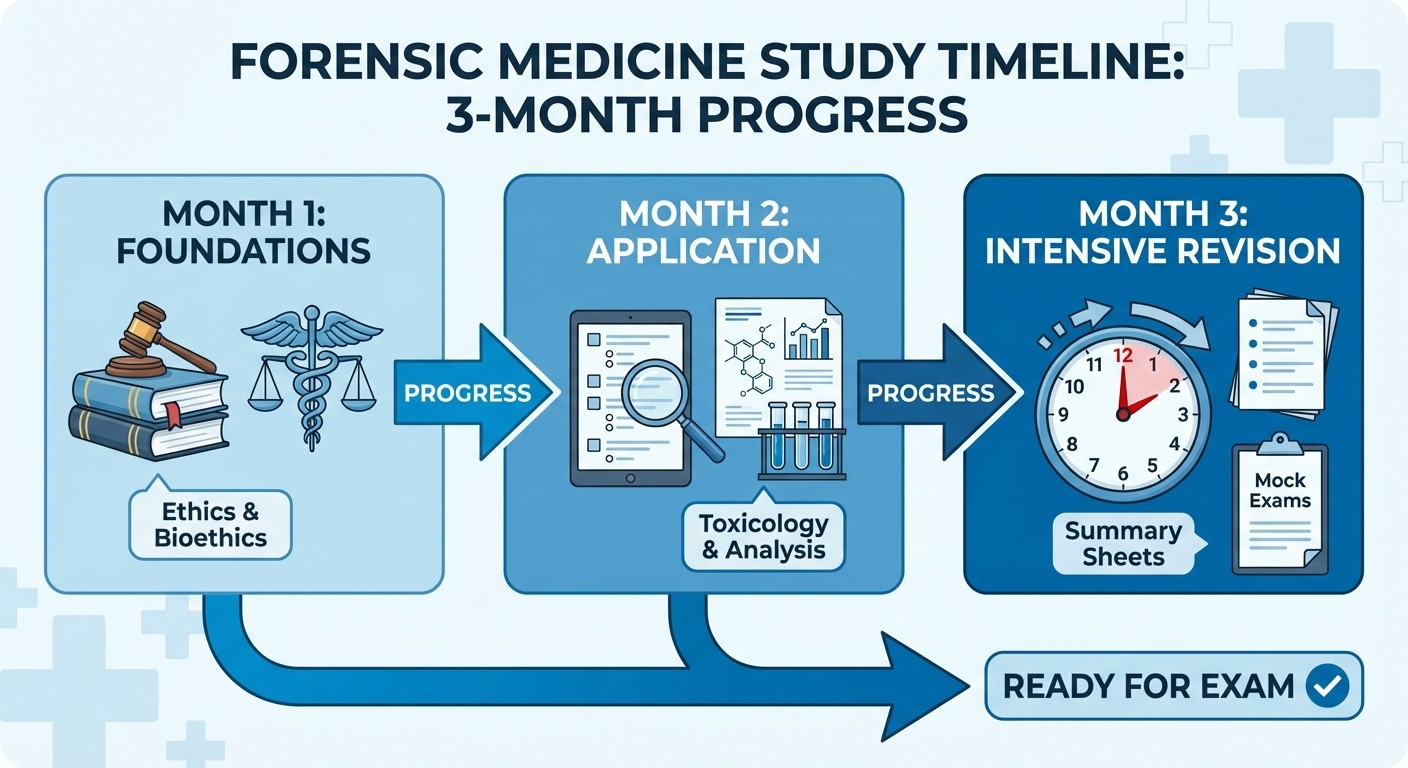
Month 1: Foundation Building
Week 1-2: Medical jurisprudence and ethics
Read through major acts systematically
Focus on Consumer Protection Act and IMC Act details
Practice section-based questions daily
Week 3-4: Forensic pathology basics
Master post-mortem changes and timing
Learn wound classification and characteristics
Study identification methods
Month 2: Application and Practice
Week 1: Toxicology deep dive
Common poisons and antidotes
Sample collection and preservation
Medicolegal aspects of poisoning
Week 2: Special topics
Forensic psychiatry basics
Sexual offenses and medical examination
Mass disaster management
Week 3-4: Integration and revision
Mixed practice questions
Case-based problem solving
Weak area reinforcement
Final Month: Intensive Revision
Focus on high-yield topics with daily practice. Use active recall rather than passive reading. Test yourself on section numbers, timing calculations, and poison characteristics without looking at notes.
Create a one-page summary sheet with the most commonly asked facts. This becomes your final revision material for the weeks leading up to NEET PG.
Common Mistakes to Avoid
Over-Studying Low-Yield Areas
Many students spend weeks on forensic odontology details or anthropometry calculations that rarely appear in NEET PG. Stick to the high-frequency topics and only touch advanced areas if you have extra time after mastering the basics.
Ignoring Recent Updates
Medical laws change frequently. The latest amendments to MTP Act, updates to PCPNDT guidelines, and new medico-legal procedures often appear as current affairs-style questions. Stay updated with recent changes through medical news sources.
Memorizing Without Understanding
Learning section numbers without understanding their application leads to confusion during exams. Focus on the practical implications of each law rather than just the numerical references.
Skipping Practice Questions
Forensic medicine seems straightforward while studying but can trip you up during exams if you haven't practiced enough questions. The forensic medicine practice questions on Oncourse include detailed explanations that clarify common conceptual errors.
Weak Integration with Clinical Subjects
Forensic principles appear in clinical scenarios too. Age of consent affects pediatric cases, medical negligence concepts connect to all clinical practices, and toxicology overlaps with emergency medicine. Study with these connections in mind.
Recommended Resources and Books
Primary Textbooks
For comprehensive coverage: Reddy KSN's "The Essentials of Forensic Medicine and Toxicology"
Clear explanations of medico-legal concepts
Updated with recent law changes
Good case examples and illustrations
For quick revision: Anil Aggrawal's "APC Textbook of Forensic Medicine and Toxicology"
Concise presentation
Exam-focused content
Good for final month revision
Online Resources
Legal updates: Keep track of recent judgments and law amendments through legal medical websites and journals. Image banks: Forensic pathology often involves visual identification. Practice with high-quality images of wounds, post-mortem changes, and toxicology presentations. Question banks: Regular practice with NEET PG-specific question patterns helps identify knowledge gaps early.
For integrated practice that combines reading with immediate testing, the lessons and questions on Oncourse provide a seamless study flow where each concept gets reinforced through practice questions right away.
Pre-Exam Checklist
15 Days Before NEET PG
Complete topics checklist:
[ ] Medical jurisprudence major acts covered
[ ] Consumer Protection Act provisions memorized
[ ] Post-mortem changes timeline mastered
[ ] Common poison presentations learned
[ ] Identification methods practiced
[ ] Recent legal updates reviewed
7 Days Before NEET PG
Final revision priorities:
[ ] One-page summary sheet created
[ ] Section numbers quick recall tested
[ ] Timing calculations practiced
[ ] Weak areas identified and reviewed
[ ] Mock test performance analyzed
1 Day Before NEET PG
Last-minute checklist:
[ ] Summary sheet final review
[ ] Common mnemonics recalled
[ ] Recent updates glanced through
[ ] Avoid new topics
[ ] Rest well for peak performance
The key is confidence in your preparation rather than last-minute cramming. Trust the systematic approach and focus on staying calm for optimal recall during the exam.
Frequently Asked Questions
How much time should I allocate to forensic medicine daily?
Dedicate 45-60 minutes daily for the first two months, then increase to 75-90 minutes during final month revision. This subject rewards consistent daily study over long weekend sessions.
Which topics can I safely skip if I'm short on time?
Skip detailed forensic anthropometry calculations, advanced toxicology mechanisms, and rare medico-legal procedures. Focus on medical jurisprudence, basic post-mortem changes, and common poison presentations.
How do I memorize all the section numbers effectively?
Group sections by theme rather than numerical order. Practice daily recall sessions and use spaced repetition. Focus on the most frequently asked sections first: Consumer Protection Act, IPC 319-326, and MTP Act provisions.
Should I solve previous year questions or focus on new practice questions?
Both are important. Previous year questions show exact NEET PG patterns, while new practice questions test your understanding of concepts. Aim for 70% previous years and 30% new questions in your practice mix.
How do I handle case-based forensic medicine questions?
Read the case carefully to identify the core legal or forensic principle being tested. Most case-based questions in forensic medicine test application of basic concepts rather than complex analysis. Focus on key facts rather than getting lost in case details.
Is it worth studying forensic psychiatry for NEET PG?
Basic forensic psychiatry concepts appear occasionally. Study competency to stand trial, criminal responsibility, and civil commitment basics. Don't go deep unless you have completed all high-yield topics first.
Forensic medicine success comes from systematic preparation focused on high-yield areas. Master the legal foundations, practice consistently, and trust your preparation. With the right approach, this subject can significantly boost your NEET PG score.
Prepare smarter with Oncourse AI — adaptive MCQs, spaced repetition, and AI explanations built for NEET PG. Download free on Android and iOS.