Back
How to Study Pathology for NEET PG 2026: High-Yield Topics, Checklist & Exam Strategy
Master pathology for NEET PG 2026 with this complete study guide. Get high-yield topics checklist, weightage analysis, and proven strategies to score 80+ marks efficiently.
How to Study Pathology for NEET PG 2026: High-Yield Topics, Checklist & Exam Strategy
You are probably staring at a 2,000-page pathology textbook wondering where to even start. NEET PG pathology has 25-30 questions worth 100-120 marks, but the syllabus feels infinite. The good news? 70% of pathology questions come from just 8 high-yield topics that you can master in 6-8 weeks with the right strategy.
This isnt another generic study guide. This is the exact system that helped NEET PG toppers score 80+ marks in pathology — without memorizing every rare syndrome or obscure tumor classification. Whether you have 6 months or 6 weeks left, this checklist will show you exactly what to prioritize and what to skip.
Why Pathology is Your Secret Weapon for NEET PG 2026
Pathology offers unique advantages that smart NEET PG candidates leverage:
Predictable question patterns: 68% of pathology questions repeat the same core concepts — inflammation mechanisms, neoplasia basics, and cardiovascular pathology. Master these once, score consistently. Cross-subject overlap: Pathology directly connects to Internal Medicine (MI pathophysiology), Surgery (tumor staging), and Pharmacology (anti-inflammatory drugs). Each pathology concept you master gives you bonus marks across 3-4 subjects. Image-based advantages: 35% of pathology questions include histology slides, gross specimens, or clinical photos. These are easier to crack than purely theoretical questions because visual patterns are more memorable than text. Factual recall focus: Unlike Surgery's procedural complexity, pathology relies on factual recall and pattern recognition. Perfect for spaced repetition and flashcard-based study methods.
NEET PG Pathology Weightage Analysis 2026
Based on analysis of NEET PG papers from 2019-2025, heres the exact distribution:
Topic | Weightage | Expected Questions | Priority Level |
|---|---|---|---|
General Pathology | 30% | 8-9 | Ultra High |
Neoplasia | 20% | 5-6 | Ultra High |
Cardiovascular Pathology | 15% | 4-5 | High |
Respiratory Pathology | 10% | 3 | High |
Hematopathology | 8% | 2-3 | Medium |
GI Pathology | 7% | 2 | Medium |
Renal Pathology | 5% | 1-2 | Low |
CNS Pathology | 5% | 1-2 | Low |
Strategic insight: The top 4 topics (General Pathology through Respiratory Pathology) account for 75% of all pathology questions. Master these first for maximum impact.
Complete High-Yield Topics Checklist
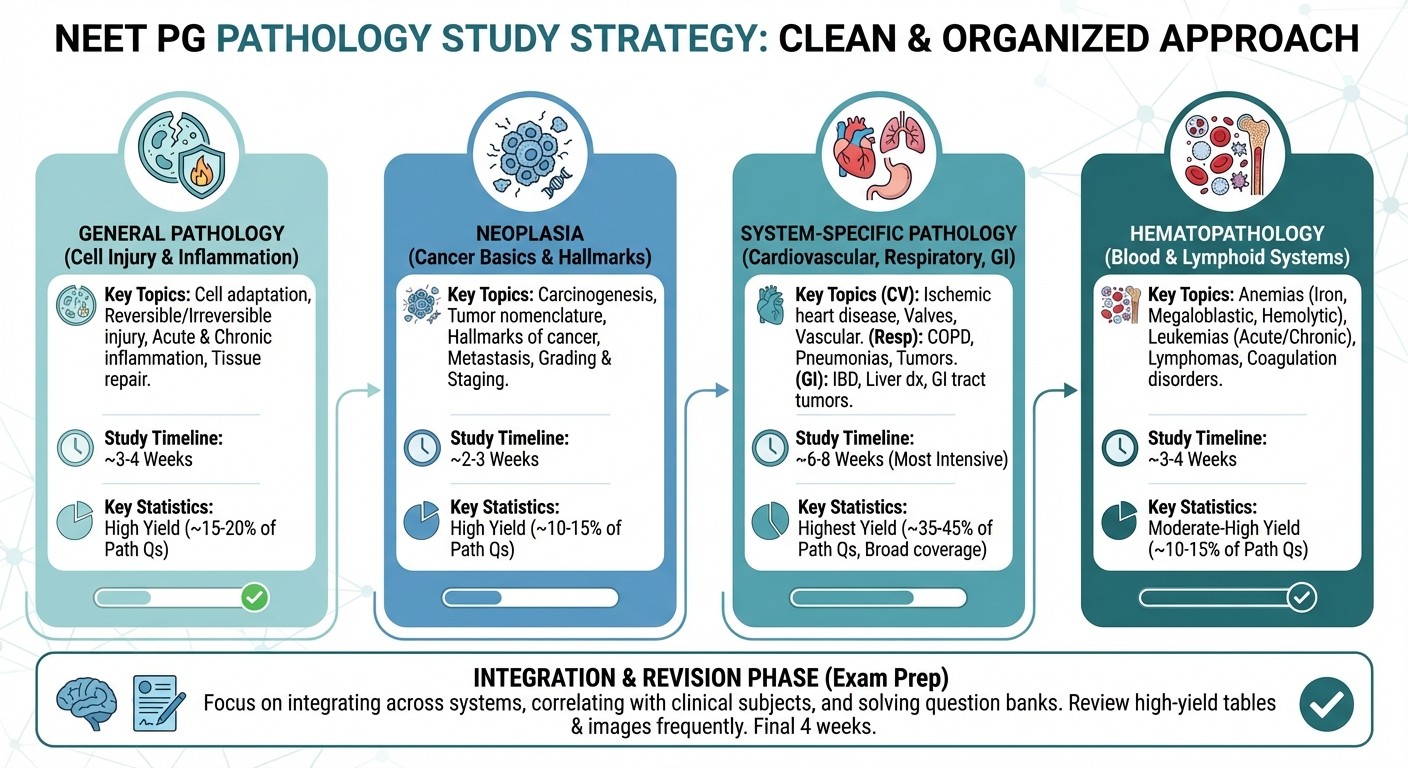
General Pathology (Ultra High Priority) - 8-9 Questions
Must-Know Topics (Study First):
[ ] Cell injury and death (necrosis vs apoptosis)
[ ] Inflammation mechanisms (acute and chronic)
[ ] Healing and repair processes
[ ] Hemodynamic disorders (thrombosis, embolism, shock)
[ ] Immunopathology basics (hypersensitivity reactions)
[ ] Infections and host response
Important Topics (Study Second):
[ ] Cellular adaptations (hypertrophy, hyperplasia, atrophy)
[ ] Environmental diseases and toxicology
[ ] Genetic disorders and chromosomal abnormalities
Master these concepts with general pathology lessons and practice with general pathology MCQs.
Neoplasia (Ultra High Priority) - 5-6 Questions
Must-Know Topics:
[ ] Benign vs malignant tumor characteristics
[ ] Carcinogenesis and molecular basis of cancer
[ ] Tumor markers and staging systems
[ ] Common cancers (breast, lung, colorectal)
[ ] Metastasis mechanisms and patterns
[ ] Paraneoplastic syndromes
Important Topics:
[ ] Cancer epidemiology and risk factors
[ ] Tumor suppressor genes (p53, Rb)
[ ] Oncogenes and growth factors
Study neoplasia concepts and reinforce with neoplasia flashcards for quick revision.
Cardiovascular Pathology (High Priority) - 4-5 Questions
Must-Know Topics:
[ ] Myocardial infarction (acute and chronic changes)
[ ] Atherosclerosis pathogenesis and complications
[ ] Hypertensive heart disease
[ ] Valvular heart diseases (rheumatic, degenerative)
[ ] Cardiomyopathies (dilated, hypertrophic, restrictive)
[ ] Congenital heart diseases (common defects)
Practice with cardiovascular pathology questions to master these high-yield topics.
Respiratory Pathology (High Priority) - 3 Questions
Must-Know Topics:
[ ] Pneumonia types and complications
[ ] Chronic obstructive pulmonary disease (COPD)
[ ] Lung cancers (classification and characteristics)
[ ] Pulmonary edema and ARDS
[ ] Pneumoconioses (silicosis, asbestosis)
[ ] Pulmonary embolism and infarction
Use respiratory pathology lessons for detailed understanding.
Hematopathology (Medium Priority) - 2-3 Questions
Key Topics:
[ ] Anemia classification and morphology
[ ] Leukemias (acute vs chronic)
[ ] Lymphomas (Hodgkins vs non-Hodgkins)
[ ] Bleeding disorders and coagulation
[ ] Blood transfusion reactions
Review hematopathology concepts for targeted practice.
8-Week Pathology Study Schedule
Weeks 1-2: Foundation Building
Week 1: General pathology basics (cell injury, inflammation)
Week 2: Complete general pathology + start neoplasia
Weeks 3-4: Core Concepts
Week 3: Finish neoplasia + start cardiovascular pathology
Week 4: Complete cardiovascular + start respiratory pathology
Weeks 5-6: System-Specific Pathology
Week 5: Complete respiratory + cover hematopathology
Week 6: GI and renal pathology (selected high-yield topics only)
Weeks 7-8: Revision and Practice
Week 7: Complete revision of all topics using flashcards
Week 8: Full-length mock tests and image-based practice
Active Learning Techniques for Pathology
1. Visual Pattern Recognition
Create comparison charts for:
Benign vs malignant tumor features
Types of necrosis with examples
Inflammatory vs non-inflammatory conditions
2. Conceptual Mind Maps
Link related concepts:
Atherosclerosis → MI → heart failure → complications
Inflammation → healing → scarring → complications
3. Clinical Correlation
Connect pathology to clinical presentations:
MI pathology → chest pain, ECG changes, cardiac enzymes
Pneumonia pathology → fever, cough, consolidation
4. Spaced Repetition Schedule
Day 1: Learn new concept
Day 3: Quick review
Day 7: Active recall test
Day 21: Final reinforcement
Use pathology flashcards for systematic spaced repetition.
How to Master Pathology Images for NEET PG
35% of pathology questions include visual components. Heres how to crack them:
Histology Slides
Focus on these patterns:
Normal vs abnormal tissue architecture
Cell types and their characteristics
Inflammatory infiltrates and their distribution
Neoplastic changes and growth patterns
Gross Specimens
Key features to identify:
Size, shape, and surface characteristics
Color changes (hemorrhage, necrosis, fibrosis)
Consistency (hard, soft, fluctuant)
Relationship to surrounding structures
Practice Strategy
1. Daily image review: Spend 15 minutes daily reviewing pathology images 2. Pattern recognition: Group similar images together 3. Active description: Describe what you see before reading the answer 4. Clinical correlation: Connect image findings to symptoms and diagnosis
Common Pathology Mistakes to Avoid
1. Memorizing Without Understanding
Mistake: Learning tumor classifications without understanding the underlying biology. Solution: Focus on mechanisms first, then memorize specific details.
2. Ignoring Clinical Correlation
Mistake: Studying pathology in isolation from clinical subjects. Solution: Always connect pathology concepts to symptoms, diagnosis, and treatment.
3. Insufficient Image Practice
Mistake: Focusing only on textbook descriptions without visual practice. Solution: Use image-based question banks and atlases regularly.
4. Poor Revision Strategy
Mistake: Single-pass reading without active recall. Solution: Use spaced repetition and self-testing techniques.
Quick Revision Checklist (Final 2 Weeks)
High-Yield Facts to Remember
General Pathology:
[ ] 4 types of necrosis and their locations
[ ] 5 cardinal signs of inflammation
[ ] Apoptosis vs necrosis differences
[ ] Thrombosis formation mechanism
Neoplasia:
[ ] Benign vs malignant characteristics (10 key differences)
[ ] TNM staging principles
[ ] Common tumor markers
[ ] Metastasis routes
Cardiovascular:
[ ] MI timeline and morphology changes
[ ] Atherosclerosis risk factors and complications
[ ] Heart failure pathophysiology
Respiratory:
[ ] Pneumonia classification and pathogens
[ ] COPD pathology and complications
[ ] Lung cancer types and characteristics
Integration with Other NEET PG Subjects
Pathology + Internal Medicine
MI pathology → management protocols
Heart failure pathology → treatment options
Pneumonia pathology → antibiotic selection
Pathology + Surgery
Tumor pathology → staging and surgical planning
Inflammation pathology → wound healing
Vascular pathology → surgical interventions
Pathology + Pharmacology
Inflammation pathology → NSAIDs mechanism
Cancer pathology → chemotherapy targets
Cardiovascular pathology → drug mechanisms
Using Technology for Pathology Preparation
AI-Powered Learning
Use Rezzy AI to:
Get instant explanations for complex pathology mechanisms
Create custom study plans based on your weak areas
Generate practice questions for specific topics
Mobile Learning
Download pathology atlases for image practice
Use flashcard apps during commute time
Watch histology videos during breaks
Online Resources
Virtual microscopy platforms for slide practice
Pathology case discussions and forums
Image databases for pattern recognition
Frequently Asked Questions
How many months do I need to master pathology for NEET PG?
With focused study, 6-8 weeks is sufficient for pathology if you prioritize high-yield topics. Spend 2-3 hours daily on pathology during this period.
Should I read entire pathology textbooks for NEET PG?
No. Focus on high-yield topics that account for 70% of questions. Use targeted resources rather than comprehensive textbooks for NEET PG preparation.
How important are rare pathology conditions for NEET PG?
Rare conditions account for less than 10% of questions. Master common conditions first, then add rare ones only if time permits.
Can I score well in pathology without memorizing extensive classifications?
Yes. Focus on understanding mechanisms and clinical correlations. Most questions test concepts rather than detailed classifications.
How do I improve my performance on image-based pathology questions?
Practice daily with histology atlases and image banks. Focus on pattern recognition rather than memorizing every detail.
Is pathology more important than other pre-clinical subjects for NEET PG?
Pathology has higher weightage (25-30 questions) compared to other pre-clinical subjects and offers better score predictability with focused preparation.
Your Next Steps
Start with general pathology concepts using Oncourse pathology lessons and practice with targeted MCQs. Focus on understanding mechanisms before memorizing facts.
Use this checklist systematically — master one topic completely before moving to the next. Remember, consistent daily practice with active recall beats sporadic intensive study sessions.
Prepare smarter with Oncourse AI — adaptive MCQs, spaced repetition, and AI explanations built for NEET PG. Download free on Android and iOS.