Step 1 Prep: The 7 Mistakes That Tank IMG Scores (And How to Fix Each One)
Avoid these 7 critical USMLE Step 1 preparation mistakes that cause IMG failures. Learn the exact fixes that help international medical graduates pass on their first attempt.
Step 1 Prep: The 7 Mistakes That Tank IMG Scores (And How to Fix Each One)
You have spent 6 months buried in First Aid. You can recite pathways from memory. Your UWorld percentage looks decent. Then Step 1 results arrive — and you dont pass.
This scenario plays out for thousands of IMGs every year. The difference between passing and failing Step 1 usually isnt about intelligence or study hours. Its about strategic mistakes that compound over months of preparation.
After analyzing the patterns from students who struggled versus those who passed comfortably, seven critical errors emerge again and again. Each one seems minor in isolation. Together, they create a perfect storm of underperformance.
Here are the 7 mistakes that tank IMG scores — and the specific fixes that work.
1. Starting with First Aid Instead of Building Foundations
The Mistake: You grab First Aid on Day 1 and try to memorize every line. The book feels overwhelming, concepts dont stick, and you burn through months without real progress. Why It Fails: First Aid assumes you already know the material. Its a review book, not a learning tool. For IMGs whose medical education may have different emphases, jumping straight to First Aid is like trying to read poetry in a language you barely speak. The Fix: Start with concept-building resources first:
Pathoma for pathology: Watch videos before touching First Aid pathology sections
Physeo or BRS Physiology: Build the physiological foundation that First Aid assumes
High-yield anatomy atlases: Establish anatomical relationships before memorizing facts
Spend your first 4-6 weeks building conceptual understanding. Then use First Aid to consolidate and review. Students who follow this sequence consistently report better retention and higher confidence levels.
Practice this approach with USMLE Step 1 anatomy lessons that build concepts progressively rather than jumping into memorization.
2. Doing UWorld Too Early (And Too Passively)
The Mistake: Starting UWorld questions in month 1 of preparation, getting 40% correct, feeling defeated, and continuing to grind through without strategy. Why It Fails: UWorld questions assume foundational knowledge. Starting too early turns practice into guessing games. Even worse — reading explanations passively without active learning wastes the best question bank available. The Fix: Wait until you have covered 60-70% of content before starting UWorld. When you do start:
Do it in tutor mode initially: See explanations immediately
Create active notes: Write down why wrong answers are wrong, not just why the right answer is right
Focus on patterns: UWorld questions test concepts through different scenarios — identify the underlying principles
Reset and repeat: Do UWorld twice. First pass for learning, second pass for retention testing
Target 70%+ on your first pass through UWorld. This indicates solid content knowledge. Supplement with USMLE practice questions that provide detailed explanations for every answer choice.
3. Memorizing Without Understanding Mechanisms
The Mistake: Creating massive Anki decks with isolated facts. "Furosemide causes hypokalemia" gets memorized without understanding why diuretics affect electrolytes. Why It Fails: Step 1 tests application, not pure recall. Questions present clinical scenarios that require you to connect mechanisms to outcomes. Pure memorization collapses when faced with unfamiliar presentations. The Fix: For every fact, understand the "why":
Pharmacology: Know mechanism of action before memorizing side effects
Pathology: Understand disease progression before memorizing presentations
Physiology: Learn normal function before studying dysfunction
Use active recall techniques that test understanding:
"Explain furosemide's mechanism and predict 3 side effects"
"If a patient has metabolic alkalosis, what diuretics could have caused it?"
"Compare loop versus thiazide diuretic mechanisms"
This approach takes longer initially but pays massive dividends on exam day. Reinforce mechanistic learning with spaced repetition flashcards designed around concepts, not isolated facts.
4. Ignoring Your Weak Subjects Until Too Late
The Mistake: Focusing 80% of study time on subjects you already understand while avoiding your weakest areas until the final month. Why It Fails: Step 1 is comprehensive. You cant compensate for zero points in pharmacology with perfect scores in anatomy. Weak subjects require the most time to improve, but students tackle them when stress is highest and time is shortest. The Fix: Identify weak areas early through diagnostic testing:
Take an NBME practice exam after 6-8 weeks of preparation
Analyze results by subject, not just overall score
Allocate study time inversely to current performance
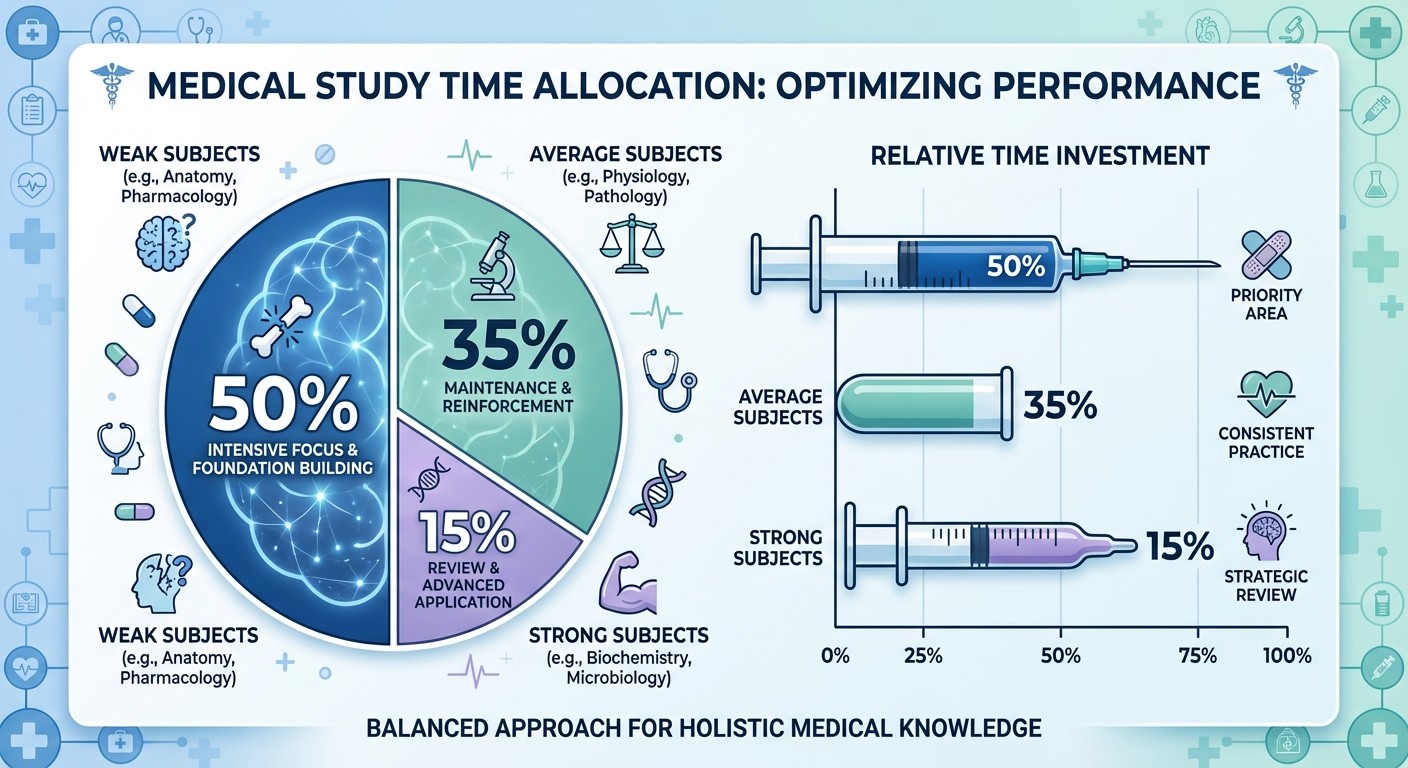
Time allocation strategy:
Strongest subjects: 15% of study time (maintenance review)
Average subjects: 35% of study time (solid improvement)
Weakest subjects: 50% of study time (intensive focus)
This feels counterintuitive because studying weak subjects is uncomfortable. But the score gains from improving weak areas dwarf the gains from perfecting strong areas.
5. Cramming Everything Into 3-Month Sprints
The Mistake: Attempting to cover all Step 1 content in 12-16 weeks with 8+ hour study days. Burnout hits by month 2, retention plummets, and anxiety skyrockets. Why It Fails: Step 1 covers 4+ years of medical school content. Cramming creates superficial knowledge that evaporates under exam pressure. Burnout destroys consistency, which matters more than intensity for retention. The Fix: Plan for 6-9 months with sustainable daily schedules: Months 1-3: Foundation building (4-5 hours daily)
Content review with concept-building resources
Light question practice (20-30 questions daily)
Focus on understanding over coverage
Months 4-6: Active practice (5-6 hours daily)
UWorld first pass
Subject-specific question banks
Weekly practice exams
Months 7-9: Intensive review (6-7 hours daily)
UWorld second pass
Targeted weak area review
Frequent practice exams
This timeline allows for proper retention and reduces pre-exam anxiety. Students consistently report feeling more prepared and confident with longer preparation periods.
6. Using NBMEs Wrong (Or Avoiding Them Completely)
The Mistake: Either never taking practice exams or taking them without proper analysis. Some students avoid NBMEs because they fear poor scores. Others take them, check the score, and move on without learning. Why It Fails: NBMEs are the closest approximation to the real exam. They reveal knowledge gaps and test-taking weaknesses that question banks miss. Avoiding them or using them poorly wastes crucial feedback. The Fix: Take NBMEs strategically and analyze thoroughly: Timeline:
First NBME: After 6-8 weeks (baseline assessment)
Middle NBMEs: Every 3-4 weeks during preparation
Final NBMEs: Weekly in the last month
Analysis process: 1. Review every incorrect answer: Understand why you got it wrong 2. Identify patterns: Are errors due to knowledge gaps, misreading, or reasoning mistakes? 3. Note correct answers you guessed: These represent knowledge gaps too 4. Create targeted study plans: Focus next 2-3 weeks on identified weaknesses
Track your NBME performance trends. Consistent improvement matters more than absolute scores. A steady upward trend indicates effective preparation.
7. Neglecting Test-Taking Strategy and Mental Preparation
The Mistake: Focusing 100% on content while ignoring test-taking skills, timing practice, and stress management. Walking into the exam without a strategy for difficult questions or time management. Why It Fails: Step 1 is as much about test-taking skill as content knowledge. Poor time management, second-guessing, and anxiety can tank scores even with solid preparation. The Fix: Develop systematic test-taking strategies: Timing strategy:
90 seconds per question average
Mark difficult questions and return later
Always guess before moving on (no blank answers)
Question approach:
1. Read the last sentence first (what are they asking?)
2. Scan for key clinical details
3. Eliminate obviously wrong answers
4. Choose based on most likely diagnosis/mechanism
Stress management:
Practice meditation or breathing exercises daily
Simulate exam conditions during practice
Develop pre-exam routines that calm anxiety
Mental preparation:
Visualize successful performance
Prepare for challenging questions without panic
Focus on process over outcome during the exam
Practice these strategies during every question session. They become automatic with repetition.
How to Avoid All 7 Mistakes: Your Action Plan
Instead of falling into these traps, follow this systematic approach:
1. Week 1-2: Take a diagnostic exam, identify weak areas, create a 6-9 month timeline
2. Months 1-3: Build foundations with concept-based resources before touching First Aid
3. Months 4-6: Begin UWorld after solid content coverage, focus on understanding mechanisms
4. Months 7-9: Intensive practice with regular NBMEs and test-taking strategy development
5. Throughout: Allocate time based on weakness, maintain consistency over intensity
The students who pass Step 1 comfortably arent necessarily the smartest. Theyre the ones who avoid these systematic mistakes and prepare strategically rather than frantically.
Your Step 1 score depends more on your preparation strategy than your raw intelligence. Avoid these 7 mistakes, and youll join the ranks of IMGs who pass confidently on their first attempt.
Frequently Asked Questions
How long should IMGs study for Step 1?
Most successful IMGs prepare for 6-9 months with 4-7 hours of daily study. Shorter timelines (3-4 months) lead to superficial learning and higher failure rates. Longer timelines (12+ months) often result in burnout and knowledge decay.
When should I start doing practice questions?
Begin light practice (20-30 questions daily) after covering 30-40% of content for concept reinforcement. Start serious question banks like UWorld only after covering 60-70% of material to avoid discouragement and ineffective learning.
How many NBMEs should I take before the real exam?
Take 6-8 NBMEs total: one early diagnostic, 3-4 during preparation, and 2-3 in the final month. More frequent testing in the final weeks helps with timing and confidence building.
What should I do if my NBME scores arent improving?
Analyze your mistakes systematically. Are they knowledge gaps or test-taking errors? Adjust your study plan to focus on identified weaknesses. Consider extending your timeline if scores plateau below passing levels.
Is it normal to feel overwhelmed during Step 1 prep?
Yes, but overwhelming feelings often indicate cramming too much content too quickly. Slow down, focus on understanding over coverage, and maintain consistent daily schedules rather than marathon study sessions.
How do I know when Im ready to take Step 1?
You are ready when your NBME average is 5-10 points above the passing threshold for 2-3 consecutive exams, you have completed UWorld twice with 70%+ accuracy, and you feel confident with test-taking strategies.
Prepare smarter with Oncourse AI — adaptive MCQs, spaced repetition, and AI explanations built for USMLE Step 1. Download free on Android and iOS.