USMLE Step 2 CK for IMGs: Score Strategy, Timing, and What US Residency Matching Requires in 2026
Complete USMLE Step 2 CK strategy for IMGs: target scores by specialty, optimal timing, study approach for clinical reasoning, and ECFMG certification timeline for 2026 Match.
USMLE Step 2 CK for IMGs: Score Strategy, Timing, and What US Residency Matching Requires in 2026
You probably know Step 1 went pass/fail in January 2022. What you might not realize yet is how dramatically this shifted the weight onto Step 2 CK for IMGs. Your Step 2 CK score isnt just one factor anymore — its often the primary numerical differentiator between you and thousands of other IMG applicants competing for the same residency spots.
The 2026 Match cycle data shows IMG match rates remain challenging: approximately 60% for non-US IMG applicants across all specialties. But heres what the numbers dont tell you — the successful 60% had significantly higher Step 2 CK scores than ever before. Internal Medicine, the most IMG-friendly specialty, now sees successful IMG applicants averaging 250+ on Step 2 CK.
This isnt about perfection. Its about strategy.
When Step 1 carried a 3-digit score, programs could evaluate IMGs on multiple numerical metrics. Now Step 2 CK carries that entire burden. Your score needs to not just pass — it needs to convince a program director that youre worth interviewing over hundreds of other qualified candidates.
Why Step 2 CK Became Make-or-Break for IMGs in 2026
Step 1 going pass/fail fundamentally changed how residency programs evaluate IMG applications. Before 2022, programs could compare Step 1 scores across all applicants. Now they rely heavily on Step 2 CK as the primary standardized metric for academic competence.
This shift hit IMGs harder than US medical students. US students have additional metrics that programs trust: clinical grades from known institutions, letters of recommendation from faculty the programs recognize, and often research connections. IMGs dont have these built-in advantages.
The result? Step 2 CK scores for successful IMG applicants jumped significantly. What was a competitive score in 2021 became barely adequate by 2025.
The new reality for IMGs:
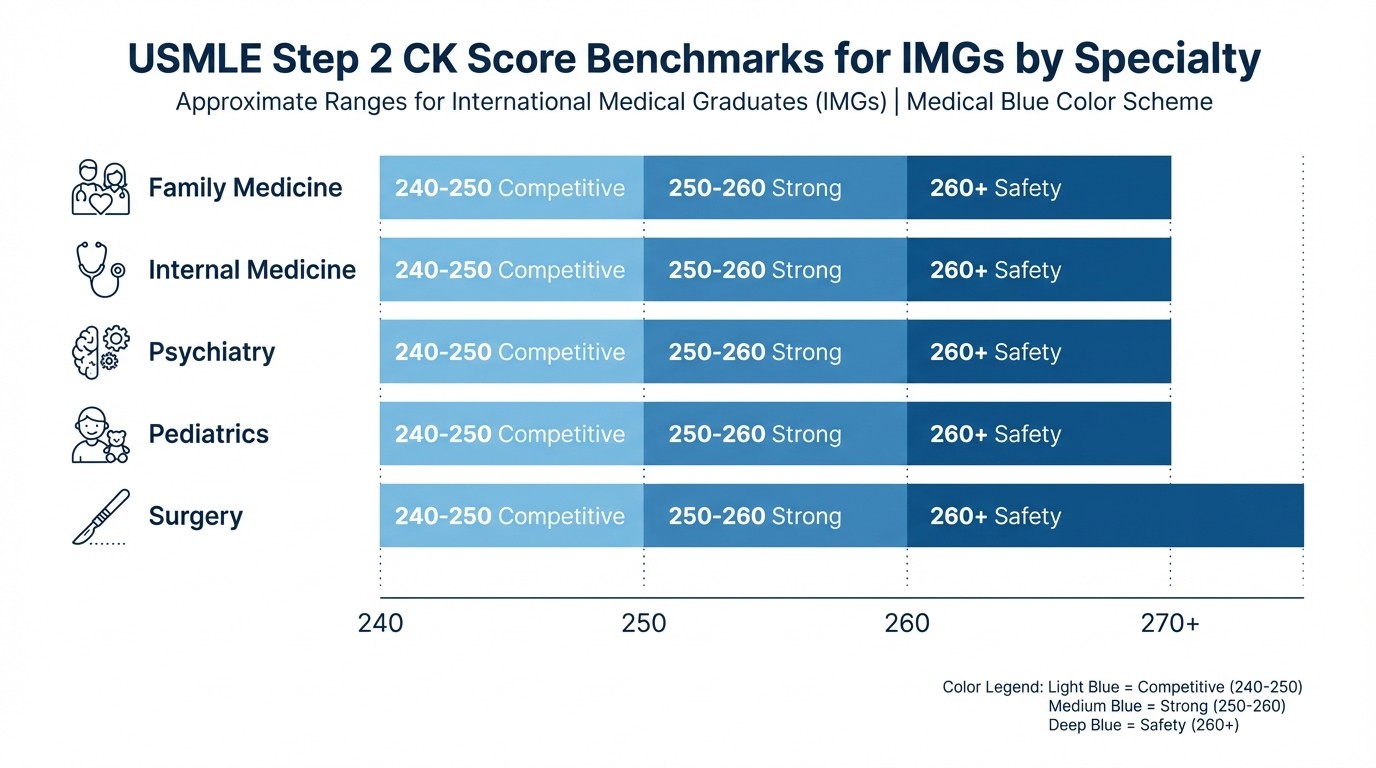
Family Medicine: 240+ competitive, 250+ strong
Internal Medicine: 245+ competitive, 255+ strong
Psychiatry: 250+ competitive, 260+ strong
Pediatrics: 250+ competitive, 260+ strong
Surgery specialties: 260+ minimum for consideration
These arent official cutoffs — programs dont publish them. But analyzing match data from successful IMG applicants reveals these patterns consistently.
Target Score Benchmarks by Specialty for IMGs
Understanding realistic score targets helps you plan your preparation timeline and manage expectations. These ranges reflect what successful IMG applicants actually scored, not what programs officially require.
Primary Care Specialties
Family Medicine remains the most IMG-accessible specialty, but even here, competition intensified. Successful IMG applicants typically score:
Competitive range: 240-250
Strong candidate range: 250-260
Safety range: 260+
Family Medicine programs value clinical reasoning and patient communication skills, which Step 2 CK tests directly. A 245 with strong clinical experience can be more compelling than a 260 with no hands-on patient care.
Internal Medicine has become increasingly competitive for IMGs. The specialty that once welcomed international graduates now sees successful applicants with:
Competitive range: 245-255
Strong candidate range: 255-265
Safety range: 265+
Internal Medicine programs receive thousands of IMG applications. Your Step 2 CK score determines whether you make the initial screening cut for interview invitations.
Psychiatry: The Hidden Gem for IMGs
Psychiatry offers excellent long-term career prospects and IMG match rates around 65%, but score expectations jumped significantly:
Competitive range: 250-260
Strong candidate range: 260-270
Safety range: 270+
Psychiatry programs value clinical reasoning about complex cases, exactly what Step 2 CK tests. The specialty also offers good work-life balance and growing demand, making higher scores worthwhile.
Pediatrics and Other Specialties
Pediatrics match rates for IMGs hover around 50%, with successful applicants scoring:
Competitive range: 250-260
Strong candidate range: 260-270
Safety range: 270+
Surgical specialties remain extremely challenging for IMGs. Even preliminary surgery positions often require 260+ scores, with categorical positions demanding 270+. Radiology, Anesthesia, and Emergency Medicine each have unique IMG challenges beyond Step 2 CK scores, but 260+ remains the baseline for serious consideration.
Strategic Timing: When to Take Step 2 CK as an IMG
Timing Step 2 CK requires balancing two competing pressures: taking it early enough to have scores for your application, but only after youre truly ready to score in your target range. Unlike Step 1, you cant easily retake Step 2 CK without raising red flags.
The Application Timeline Reality
ERAS applications open in September for the following years Match. Your Step 2 CK score needs to be available by then to be competitive. This means taking the exam by late July at the absolute latest, though June is safer given potential score delays.
Optimal timing for most IMGs:
January-March: Intensive preparation phase
April-May: Practice tests and weak area focus
June: Target exam date
July: Score available for ERAS
Starting preparation in January gives you 5-6 months of focused study time. This timeline assumes youve completed medical school and arent juggling current coursework.
The "Ready When Ready" Principle
Heres the crucial insight many IMGs miss: taking Step 2 CK before youre ready costs you more than delaying your application by one year. A retake creates a permanent red flag on your transcript that programs notice.
Youre ready when:
Practice test scores consistently hit your target range
Youve completed at least 3,000 practice questions
Clinical reasoning feels automatic, not forced
You can work through cases systematically without panic
Youre not ready when:
Practice scores fluctuate wildly
You rely on memorization over understanding
Time management remains a major issue
You havent touched clinical material in over a year
Gap Year Strategy for IMGs
If you graduated medical school more than 18 months ago, consider whether youre clinically sharp enough for Step 2 CK. The exam tests active clinical reasoning, not passive recall.
Many successful IMGs take a gap year to work in healthcare (medical scribe, research assistant, clinical observer) before attempting Step 2 CK. This clinical exposure makes the difference between a 240 and a 260.
Efficient Study Strategy When You've Been Away from Clinical Medicine
The biggest challenge for IMGs taking Step 2 CK is clinical rustiness. If youve been away from patient care, your clinical reasoning muscles have atrophied. You remember facts but struggle with the systematic approach that Step 2 CK demands.
Rebuilding Clinical Reasoning Skills
Start with pattern recognition before diving into question banks. Review common presentations systematically:
Chest pain workups and differential diagnosis
Shortness of breath evaluation algorithms
Abdominal pain systematic approach
Altered mental status protocols
Fever workups by patient population
Focus on the thinking process, not just the facts. Step 2 CK tests whether you can work through cases like a practicing physician.
Use clinical reasoning practice questions to rebuild this systematic approach. The questions simulate real clinical decision-making under time pressure.
The 3-Phase Study Approach
Phase 1: Foundation Building (6-8 weeks)
Review high-yield topics through active learning. Read about a condition, then immediately practice related questions. Dont try to memorize everything before touching questions.
Focus areas:
Internal medicine core conditions
Emergency medicine presentations
Outpatient management protocols
Preventive care guidelines
Phase 2: Integration and Pattern Recognition (8-10 weeks)
Work through comprehensive question banks while identifying your weak patterns. Most IMGs struggle with:
US-specific practice guidelines
Cost-effectiveness considerations
Outpatient vs inpatient management decisions
Preventive care timing and recommendations
Phase 3: Performance Optimization (4-6 weeks)
Focus on speed and accuracy under test conditions. Take full-length practice tests weekly. Analyze not just wrong answers but also questions you got right through lucky guessing.
Using Technology to Accelerate Clinical Reasoning
Traditional question banks present cases in isolation. Real clinical reasoning connects patterns across cases and specialties. Oncourse AI's adaptive clinical case questions help rebuild this connective thinking.
The AI identifies your reasoning gaps and presents cases that challenge those specific weaknesses. If you struggle with cardiac risk stratification, it generates similar cases with different presentations until the pattern becomes automatic.
This targeted approach cuts study time significantly compared to working through random question sets hoping to hit your weak areas.
ECFMG Certification Timeline and Documentation
ECFMG certification requires passing Step 1, Step 2 CK, Step 2 CS (or Step 2 CS waiver), and completing medical education credential verification. The timeline is longer than most IMGs expect.
Documentation Requirements
Medical school transcript verification takes 2-4 months after submission. Start this process immediately after Step 1, dont wait until Step 2 CK. Primary source verification involves ECFMG contacting your medical school directly. Schools in certain countries respond slowly, adding months to the process. Step 2 CS waiver requirements (for graduates during COVID-19 period) include specific clinical experience documentation. Gather these documents while studying for Step 2 CK.
The Critical Path Timeline
12 months before desired Match:
Submit medical school transcripts for verification
Ensure passport and identification documents are current
Begin Step 2 CK preparation
8-10 months before Match:
Take Step 2 CK (June for following years Match)
Complete any remaining Step 2 CS requirements
Submit final ECFMG certification paperwork
6 months before Match:
Receive ECFMG certification
Finalize ERAS application materials
Apply for ERAS and begin residency applications
Missing any of these deadlines pushes your Match back by a full year. The process has no shortcuts.
How Oncourse AI Transforms IMG Preparation
Traditional USMLE prep focuses on content review and isolated question practice. This approach works for US medical students who recently completed clinical rotations. IMGs need something different — a way to rebuild clinical reasoning skills quickly and efficiently.
Adaptive Learning for Clinical Reasoning
Oncourse's clinical reasoning modules identify exactly where your clinical thinking breaks down. Instead of reviewing random cases, you practice cases that target your specific reasoning gaps.
The system recognizes patterns like:
Jumping to conclusions without systematic evaluation
Missing cost-effectiveness considerations
Overlooking outpatient management options
Struggling with risk stratification decisions
AI Explanations That Build Understanding
Every question includes detailed AI explanations that break down the clinical reasoning process step-by-step. These explanations focus on the thinking approach, not just the correct answer.
For example, instead of just stating "The answer is C - Order echocardiogram," the explanation walks through:
Why this patients presentation suggests heart failure
How to systematically evaluate dyspnea
When echocardiogram is preferred over other cardiac tests
Cost considerations in the outpatient setting
This approach rebuilds the systematic thinking that Step 2 CK demands.
Spaced Repetition for Clinical Patterns
Oncourse's flashcard system uses spaced repetition to reinforce clinical patterns and decision trees. Instead of memorizing isolated facts, you practice recognizing clinical patterns that appear across different cases.
The system schedules review based on your performance, ensuring you see challenging concepts more frequently until theyre automatic.
Performance Analytics for IMGs
The platform tracks your performance across clinical domains and identifies US-specific knowledge gaps that trip up IMGs:
Preventive care guidelines and timing
Outpatient management preferences
Insurance and cost considerations
US-specific drug choices and dosing
This data-driven approach ensures your study time targets actual weaknesses rather than perceived ones.
Common IMG Mistakes to Avoid
Mistake 1: Overemphasizing Content Review
Many IMGs spend months reviewing textbooks before touching practice questions. Step 2 CK tests application of knowledge, not passive recall. Start practice questions early and often.
Mistake 2: Ignoring US Practice Patterns
Clinical care differs significantly between countries. US medicine emphasizes cost-effectiveness, outpatient management, and preventive care more than many international systems. Study these differences explicitly.
Mistake 3: Taking the Exam Too Early
The pressure to have scores for your application can lead to premature test-taking. A retake looks worse than a delayed application. Only take Step 2 CK when consistently scoring in your target range.
Mistake 4: Neglecting Communication Skills
Step 2 CK includes patient communication scenarios that challenge non-native English speakers. Practice these systematically — they can differentiate your score significantly.
Mistake 5: Underestimating ECFMG Timeline
ECFMG certification takes longer than expected, especially for graduates from certain countries. Start the process early and follow up proactively.
Building Your Step 2 CK Study Schedule
Month 1-2: Foundation Phase
Complete systematic review of high-yield internal medicine
Begin practice questions (30-50 per day)
Focus on understanding reasoning patterns
Review US practice guidelines
Month 3-4: Integration Phase
Increase question volume (75-100 per day)
Take first practice test to establish baseline
Identify weak areas for focused review
Practice communication scenarios
Month 5-6: Performance Phase
Full-length practice tests weekly
Focus on speed and accuracy optimization
Review and reinforce weak patterns
Simulate test day conditions
Final 2 Weeks: Maintenance
Light review of high-yield facts
Maintain question-solving rhythm
Focus on test-taking strategies
Manage stress and maintain health
Frequently Asked Questions
What Step 2 CK score do IMGs need for Internal Medicine?
Most successful IMG applicants to Internal Medicine programs score 245 or higher on Step 2 CK. Scores above 255 put you in competitive territory for better programs. Below 240 makes matching significantly more challenging.
Should IMGs take Step 2 CK before or after Step 1?
Take Step 1 first. Most IMGs benefit from the foundational knowledge review before tackling clinical reasoning. Step 1 also fulfills ECFMG requirements earlier, allowing more time for Step 2 CK preparation.
How long should IMGs study for Step 2 CK?
Plan 4-6 months of dedicated study time if you have recent clinical experience, or 6-8 months if youve been away from clinical medicine for over a year. Quality of study matters more than total hours.
Can IMGs retake Step 2 CK if they dont pass?
Yes, but retakes appear on your transcript and raise questions for residency programs. Take the exam only when youre consistently scoring in your target range on practice tests.
Do IMGs need US clinical experience before Step 2 CK?
US clinical experience helps but isnt required. However, if youve been away from patient care for over 18 months, consider gaining clinical exposure through observerships, research, or healthcare work before taking Step 2 CK.
How important is Step 2 CK timing for IMG applications?
Critical. Your score must be available by early September to be included in your initial ERAS application. Late scores significantly disadvantage your application, as many programs make interview decisions before October.
---
Step 2 CK represents your biggest opportunity to stand out as an IMG applicant. With Step 1 now pass/fail, your performance on this exam carries unprecedented weight in residency selection.
The key is approaching preparation strategically: understanding exactly what scores you need for your target specialty, timing the exam appropriately, and using the right tools to rebuild clinical reasoning skills efficiently.
Most importantly, dont rush. Taking Step 2 CK when youre truly ready — even if it means delaying application by a year — is always better than retaking.
Prepare smarter with Oncourse AI — adaptive MCQs, spaced repetition, and AI explanations built for USMLE success. Download free on Android and iOS.