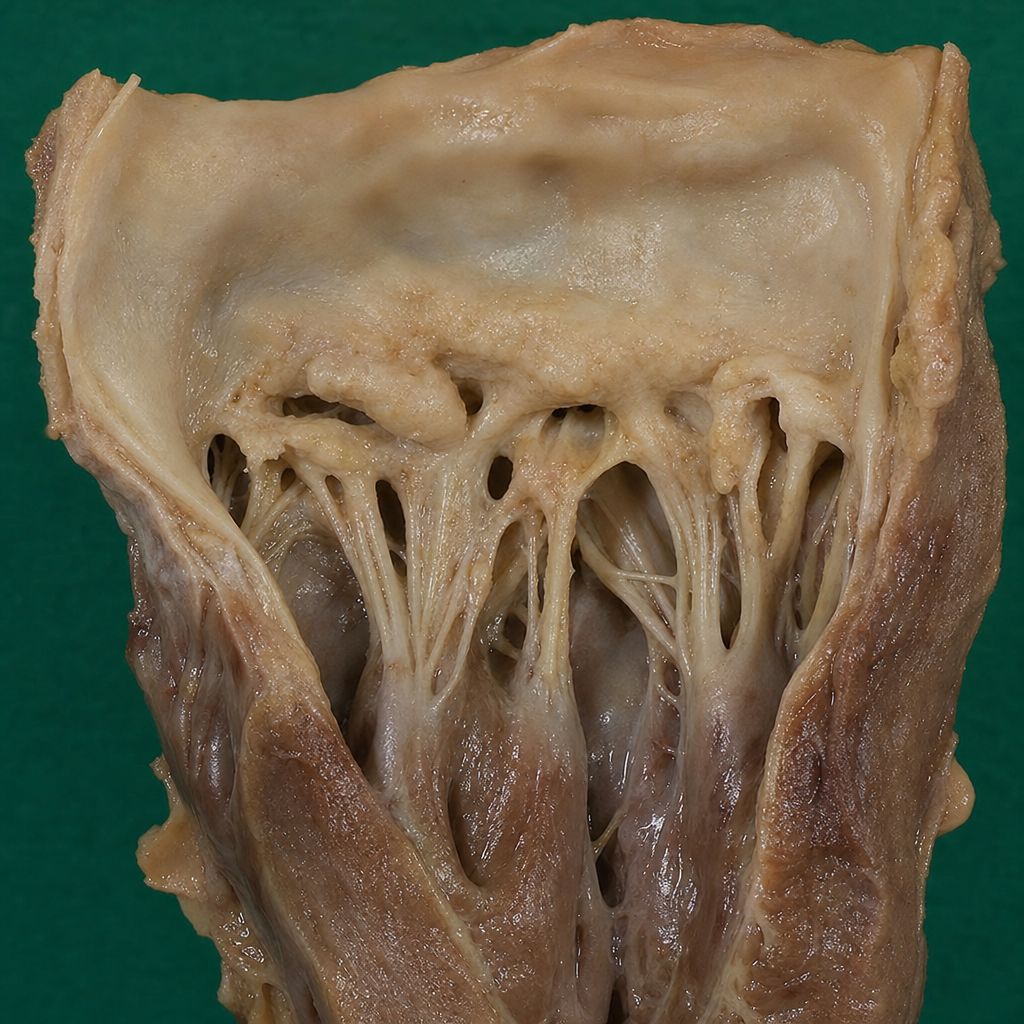
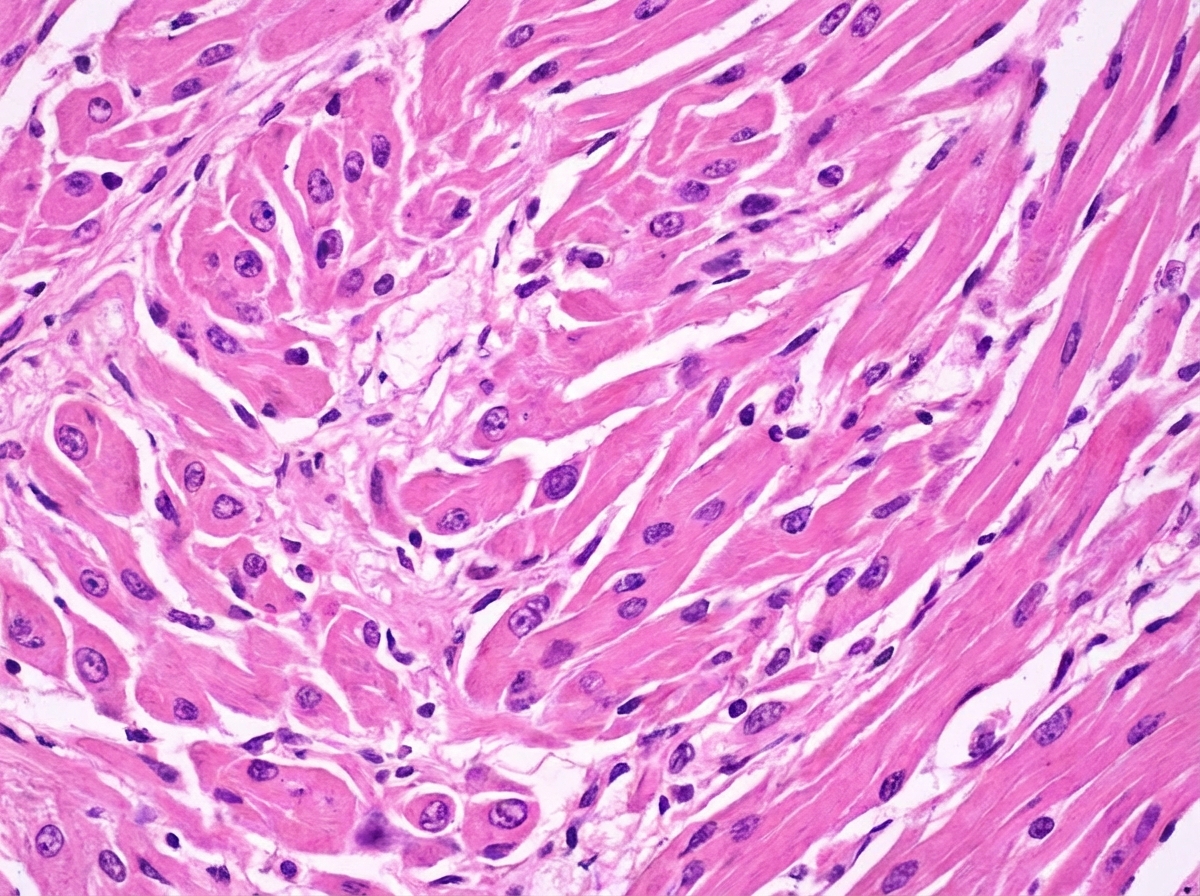
All of the following statements regarding endocarditis are true, except:
What is the typical site of lesion in endocarditis of rheumatic heart disease?
What is the most sensitive and specific marker for myocardial infarction?
Aschoff bodies in the myocardium are the hallmark of carditis associated with which condition?
Which of the following is true about Libman-Sacks endocarditis?
Firm warty vegetations along the line of apposition of heart valves are present in which condition?
McCallum's patch is diagnostic of which condition?
All are true about hyperopic obstructive cardiomyopathy except?
A stenotic valve is removed from a 70-year-old man. The valve demonstrates hard nodular masses heaped up within the sinuses of Valsalva. On microscopic section, the acellular masses stain darkly blue with hematoxylin and eosin. Which of the following is the MOST significant constituent of the masses?
A patient developed an anterior wall myocardial infarction and died within 2 hours of symptom onset. An autopsy is being performed, and the involved myocardium is being observed under light microscopy. What pathological finding would be expected?
Explanation: ### Explanation The correct answer is **C**, as it is a false statement. In **Infective Endocarditis (IE)**, vegetations typically occur on the **atrial surface of atrioventricular valves** (Mitral/Tricuspid) and the **ventricular surface of semilunar valves** (Aortic/Pulmonary). They are generally found on the line of closure on the surface exposed to the forward flow of blood. #### Why Option C is the Correct Choice (The False Statement): Vegetations occurring on **both surfaces** of the valve cusps (and even on the endocardium) is a hallmark of **Libman-Sacks Endocarditis** (associated with Systemic Lupus Erythematosus), not Infective Endocarditis [1]. #### Analysis of Other Options: * **Option A (True):** IE vegetations are characterized as **large, irregular, and friable** (easily crumbled) [1]. Their friability makes them highly prone to embolization, leading to systemic septic infarcts [2]. * **Option B (True):** **Non-Bacterial Thrombotic Endocarditis (NBTE)**, also known as marantic endocarditis, occurs in **References:** [1] Kumar V, Abbas AK, et al.. Robbins and Cotran Pathologic Basis of Disease. 9th ed. The Heart, pp. 568-570. [2] Cross SS. Underwood's Pathology: A Clinical Approach. 6th ed. Common Clinical Problems From Cardiovascular Disease, pp. 294-296.
Explanation: In Acute Rheumatic Fever (ARF), the endocardial involvement manifests as **Rheumatic Endocarditis**, characterized by the formation of small, sterile, friable vegetations called **verrucae**. [1] ### Why "Along the lines of closure" is correct: The vegetations in rheumatic heart disease are unique because they develop specifically at the **lines of closure** of the valve leaflets (on the atrial surface of AV valves and ventricular surface of semilunar valves). [1] This occurs because the inflammatory process makes the endocardium edematous and fragile; the repetitive mechanical trauma of the valves closing leads to focal endothelial loss, triggering the deposition of fibrin and platelets at these precise contact points. ### Explanation of Incorrect Options: * **B. Free margin of valves:** While the lines of closure are near the margins, they are not the "free edge" itself. Vegetations on the free margins are more characteristic of Infective Endocarditis (IE). [1] * **C. Both sides of valves:** This is the hallmark of **Libman-Sacks Endocarditis** (associated with SLE), where vegetations appear on both the upper and lower surfaces of the cusps. [1] * **D. Valve cusps:** This is too non-specific. While the lesion is on the cusp, the NEET-PG examiner looks for the specific anatomical location (lines of closure). ### High-Yield Clinical Pearls for NEET-PG: * **Morphology:** Rheumatic verrucae are 1–2 mm, small, firm, sterile, and non-destructive (unlike the large, friable, destructive vegetations of Infective Endocarditis). [1] * **Valve Frequency:** Mitral > Aortic > Tricuspid > Pulmonary (MATP). * **MacCallum’s Patch:** An area of endocardial thickening usually found in the **posterior wall of the left atrium**, caused by regurgitant jets. * **Pathognomonic Feature:** The presence of **Aschoff bodies** (containing Anitschkow "caterpillar" cells) in the myocardium. **References:** [1] Kumar V, Abbas AK, et al.. Robbins and Cotran Pathologic Basis of Disease. 9th ed. The Heart, p. 568.
Explanation: **Explanation:** **Troponin (Correct Answer):** Cardiac Troponins (specifically **Troponin I and T**) are the gold standard markers for diagnosing Myocardial Infarction (MI). They are highly **specific** because these isoforms are unique to cardiac myocytes and are not found in other tissues. They are highly **sensitive** because they can detect even microscopic areas of myocardial necrosis. Troponins begin to rise 3–12 hours after injury, peak at 24 hours, and remain elevated for 7–10 days (Troponin I) or up to 14 days (Troponin T). **Incorrect Options:** * **Cytokeratin:** This is an intermediate filament found in epithelial cells. It is used as an immunohistochemical marker for carcinomas, not for cardiac injury. * **Myoglobin:** While it is the **earliest** marker to rise (within 1–2 hours), it lacks specificity because it is present in all skeletal muscles. Any muscle trauma or strenuous exercise can cause a false positive. * **CPK-MM:** This is an isoenzyme of Creatine Phosphokinase found predominantly in **skeletal muscle** [1]. The cardiac-specific isoenzyme is **CK-MB** [1]. While CK-MB is useful for detecting **re-infarction** (due to its short half-life of 48–72 hours), it is less sensitive and specific than Troponin. **High-Yield Clinical Pearls for NEET-PG:** * **Earliest Marker:** Myoglobin. * **Most Specific/Sensitive:** Cardiac Troponin. * **Marker for Re-infarction:** CK-MB (returns to baseline within 2-3 days) [1]. * **LDH Flip:** In MI, LDH-1 becomes higher than LDH-2 (normally LDH-2 > LDH-1) [1]. This is an older marker rarely used now. * **Troponin I vs. T:** Troponin I is slightly more cardiac-specific as Troponin T can sometimes be elevated in chronic renal failure or skeletal muscle diseases. **References:** [1] Cross SS. Underwood's Pathology: A Clinical Approach. 6th ed. (Basic Pathology) introduces the student to key general principles of pathology, both as a medical science and as a clinical activity with a vital role in patient care. Part 2 (Disease Mechanisms) provides fundamental knowledge about the cellular and molecular processes involved in diseases, providing the rationale for their treatment. Part 3 (Systematic Pathology) deals in detail with specific diseases, with emphasis on the clinically important aspects., pp. 255-256.
Explanation: **Explanation:** **Aschoff bodies** are the pathognomonic histological hallmark of **Acute Rheumatic Fever (ARF)** [2]. They represent areas of focal interstitial inflammation found in all three layers of the heart (pancarditis), though they are most characteristic in the myocardium. 1. **Why Rheumatic Fever is correct:** ARF is an immunologically mediated multisystem disease following a Group A Streptococcal infection [2]. Aschoff bodies consist of a central focus of fibrinoid necrosis surrounded by chronic inflammatory cells (lymphocytes, plasma cells) and characteristic **Anitschkow cells** (caterpillar cells)—modified macrophages with wavy, ribbon-like chromatin [1], [2]. Over time, these bodies fibrose to form small scars. 2. **Why other options are incorrect:** * **Infective Endocarditis:** Characterized by "vegetations" (friable masses of fibrin, platelets, and microorganisms) on heart valves, not granulomatous Aschoff bodies [3]. * **Rheumatoid Arthritis:** Can cause fibrinous pericarditis or rheumatoid nodules, but these are histologically distinct from Aschoff bodies. * **Systemic Lupus Erythematosus (SLE):** Associated with **Libman-Sacks endocarditis**, characterized by small, sterile vegetations on both sides of the valves, and "hematoxylin bodies" in tissues, but not Aschoff bodies [4]. **High-Yield Pearls for NEET-PG:** * **Anitschkow Cells:** If the nucleus is seen in cross-section, it is called an **"Owl-eye cell."** * **MacCallum Patch:** A subendocardial thickening, usually in the left atrium, caused by regurgitant jets in ARF. * **Jones Criteria:** Used for clinical diagnosis of ARF (Major: Joint, Carditis, Nodules, Erythema marginatum, Sydenham chorea). * **Chronic Rheumatic Heart Disease:** Characterized by "fish-mouth" or "button-hole" stenosis of the mitral valve [1]. **References:** [1] Kumar V, Abbas AK, et al.. Robbins and Cotran Pathologic Basis of Disease. 9th ed. The Heart, pp. 566-567. [2] Kumar V, Abbas AK, et al.. Robbins and Cotran Pathologic Basis of Disease. 9th ed. The Heart, p. 566. [3] Kumar V, Abbas AK, et al.. Robbins and Cotran Pathologic Basis of Disease. 9th ed. The Heart, p. 568. [4] Kumar V, Abbas AK, et al.. Robbins and Cotran Pathologic Basis of Disease. 9th ed. Diseases of the Immune System, pp. 232-233.
Explanation: **Explanation:** **Libman-Sacks Endocarditis (LSE)** is a form of non-bacterial thrombotic endocarditis (NBTE) classically associated with **Systemic Lupus Erythematosus (SLE)** [1], [3]. **Why Option B is correct:** The hallmark of Libman-Sacks endocarditis is the presence of small, sterile, pinkish vegetations that can occur **anywhere on the valve surface**, including the undersurfaces, the chordae tendineae, and the endocardial surfaces [1]. This "random" distribution on **both sides of the valve leaflets** is a pathognomonic feature that distinguishes it from other types of endocarditis [2]. **Analysis of Incorrect Options:** * **Option A:** Vegetations along the **line of closure** are characteristic of Rheumatic Heart Disease (RHD) and standard NBTE (marantic endocarditis) [2]. LSE is not restricted to this line. * **Option C:** Vegetations in LSE are typically **friable** (easily crumbled), similar to Infective Endocarditis (IE). Non-friable, firm vegetations are more characteristic of healed RHD. * **Option D:** While LSE is "sterile" (no bacteria), the question asks what is *true*. Option B is the definitive morphological description [3]. Furthermore, modern pathology notes that while organisms are absent, **hematoxylin bodies** (LE bodies) can sometimes be seen within the vegetations. **High-Yield NEET-PG Pearls:** * **Association:** Most commonly seen in SLE; also associated with Antiphospholipid Syndrome (APS). * **Valve involved:** Mitral valve is most frequently affected [1]. * **Composition:** Vegetations consist of fibrin, inflammatory cells, and focal necrosis. * **Clinical Impact:** Usually asymptomatic, but can lead to mitral regurgitation or embolic events. * **Key Distinction:** Unlike Infective Endocarditis, LSE vegetations are **sterile** (no microorganisms) [1]. **References:** [1] Kumar v, Abbas AK, et al.. Robbins and Cotran Pathologic Basis of Disease. 9th ed. The Heart, p. 570. [2] Kumar v, Abbas AK, et al.. Robbins and Cotran Pathologic Basis of Disease. 9th ed. The Heart, p. 568. [3] Kumar v, Abbas AK, et al.. Robbins and Cotran Pathologic Basis of Disease. 9th ed. Diseases of the Immune System, pp. 232-233.
Explanation: ### Explanation The correct answer is **Rheumatic Heart Disease (RHD)**. #### 1. Why Rheumatic Heart Disease is Correct In Acute Rheumatic Fever, pancarditis occurs. The endocardial involvement leads to the formation of **verrucae** (vegetations). These are characteristically **small (1–2 mm), firm, sterile, and friable**. Crucially, they are arranged in a continuous row **along the line of closure (apposition)** of the valve leaflets [1]. This location is due to the mechanical trauma at the point where leaflets meet, which overlying the inflamed endocardium leads to fibrin deposition. #### 2. Why Other Options are Incorrect * **NBTE (Non-Bacterial Thrombotic Endocarditis):** These vegetations are also sterile and occur along the line of closure, but they are typically **larger** than RHD verrucae and occur in hypercoagulable states (e.g., Trousseau syndrome) [1]. They are loosely attached and prone to embolization. * **Bacterial Endocarditis:** These vegetations are **large, bulky, irregular, and highly friable** [1]. They often cause significant valvular destruction (perforation) and are not restricted to the line of closure. * **Libman-Sacks Endocarditis (SLE):** These are small, sterile vegetations that are unique because they occur on **both sides of the valve leaflets** (undersurface/chordae), not just the line of closure [1], [2]. #### 3. NEET-PG High-Yield Pearls * **Most common valve involved in RHD:** Mitral valve (followed by Aortic). * **Microscopic Hallmark:** **Aschoff bodies** (containing Anitschkow "caterpillar" cells) [1]. * **Macroscopic Hallmark:** **MacCallum patches** (subendocardial thickenings, usually in the left atrium). * **Chronic RHD:** Characterized by "fish-mouth" or "buttonhole" stenosis due to commissural fusion [1]. **References:** [1] Kumar V, Abbas AK, et al.. Robbins and Cotran Pathologic Basis of Disease. 9th ed. The Heart, p. 568. [2] Kumar V, Abbas AK, et al.. Robbins and Cotran Pathologic Basis of Disease. 9th ed. The Heart, p. 570.
Explanation: **Explanation:** **MacCallum’s patch** is a characteristic lesion pathonomonic for **Acute Rheumatic Carditis**. It presents as a map-like, thickened, and wrinkled area of the endocardium, typically located in the **posterior wall of the left atrium**, just above the posterior leaflet of the mitral valve [1]. The underlying mechanism involves subendocardial inflammation (endocarditis) caused by the regurgitant jet of blood hitting the atrial wall (due to mitral valve involvement) and the inflammatory process itself. Histologically, these patches contain **Aschoff bodies**, which are the hallmark granulomatous lesions of Rheumatic Heart Disease [1]. **Analysis of Incorrect Options:** * **Infective Endocarditis:** Characterized by "vegetations" (friable, bulky thrombi) on valve leaflets, not endocardial patches [2]. * **Myocardial Infarction:** Presents with coagulative necrosis and subsequent scarring (fibrosis) of the myocardium, typically involving the ventricles rather than the atrial endocardium. * **Tetralogy of Fallot (ToF):** A congenital cyanotic heart disease characterized by four structural defects (VSD, Overriding aorta, Pulmonary stenosis, RVH); it does not feature MacCallum’s patches. **High-Yield Clinical Pearls for NEET-PG:** * **Location:** Most common in the **Left Atrium** (Posterior wall). * **Aschoff Bodies:** The pathognomonic microscopic feature of Rheumatic Fever, consisting of Anitschkow cells ("caterpillar cells") [1]. * **Pancarditis:** Rheumatic fever affects all three layers (Endocardium, Myocardium, Pericardium) [1]. * **Bread and Butter Pericarditis:** Refers to the fibrinous pericarditis seen in Rheumatic Heart Disease. **References:** [1] Kumar V, Abbas AK, et al.. Robbins and Cotran Pathologic Basis of Disease. 9th ed. The Heart, pp. 566-567. [2] Kumar V, Abbas AK, et al.. Robbins and Cotran Pathologic Basis of Disease. 9th ed. The Heart, p. 568.
Explanation: Explanation: Hypertrophic Obstructive Cardiomyopathy (HOCM) is a genetic cardiac disorder characterized by massive myocardial hypertrophy without a secondary cause (like hypertension) [1]. Why Option C is the correct answer: HOCM is fundamentally a disease of impaired diastolic filling due to a non-compliant, thickened ventricular wall [1]. The hallmark of HOCM is a reduced or slit-like ventricular cavity, not dilatation [1]. Ventricular dilatation is a feature of Dilated Cardiomyopathy (DCM), which represents systolic failure. In HOCM, the ejection fraction is typically preserved or even increased (hyperdynamic state). Analysis of other options: Option A (Asymmetric septal hypertrophy): This is the classic morphological pattern [2]. The interventricular septum is significantly thicker than the left ventricular free wall (ratio > 1.3:1), leading to the characteristic "banana-shaped" ventricular cavity [1]. Option B (Dilatation of atria): Due to the stiff, non-compliant left ventricle, there is resistance to filling, leading to increased left atrial pressures [1]. This chronically results in left atrial enlargement/dilatation and often predisposes patients to atrial fibrillation [2]. Option C (Outflow obstruction): In the obstructive variant, the thickened septum and the Systolic Anterior Motion (SAM) of the mitral valve create a functional sub-aortic obstruction, worsening during exercise [1]. High-Yield NEET-PG Pearls: Genetics: Most commonly due to mutations in genes encoding sarcomeric proteins, specifically Beta-myosin heavy chain (most common) and Myosin-binding protein C. Histology: Characterized by myocyte disarray, interstitial fibrosis, and hypertrophied myocytes [1]. Clinical: It is the leading cause of Sudden Cardiac Death (SCD) in young athletes [2]. Murmur: Harsh systolic ejection murmur that increases with Valsalva or standing (decreased preload) and decreases with squatting (increased preload). **References:** [1] Kumar V, Abbas AK, et al.. Robbins and Cotran Pathologic Basis of Disease. 9th ed. The Heart, pp. 576-578. [2] Cross SS. Underwood's Pathology: A Clinical Approach. 6th ed. Common Clinical Problems From Cardiovascular Disease, pp. 303-304.
Explanation: ### Explanation The clinical presentation describes **Calcific Aortic Stenosis**, the most common cause of aortic stenosis in the elderly [1]. The "nodular masses heaped up within the sinuses of Valsalva" are characteristic of **Dystrophic Calcification** [1]. **1. Why Calcium Phosphate is Correct:** Dystrophic calcification occurs in damaged, necrotic, or aging tissues despite **normal** serum calcium levels [2]. In the heart valves, chronic mechanical stress leads to valvular injury and lipid accumulation, triggering a process similar to bone formation. The mineral deposits primarily consist of **crystalline calcium phosphate**, specifically in the form of **hydroxyapatite** ($Ca_{10}(PO_4)_6(OH)_2$) [2]. On H&E stain, these deposits appear intensely basophilic (dark blue) and acellular. **2. Why the Other Options are Incorrect:** * **A. Calcium oxalates:** These are typically associated with renal stones or ethylene glycol poisoning. They are not the primary constituent of vascular or valvular calcification. * **C. Complexed iron:** While iron can deposit in tissues (hemosiderosis/hemochromatosis), it appears as golden-brown granules on H&E and requires a Prussian Blue stain for confirmation. It does not form hard, nodular masses in valves. * **D. Magnesium phosphates:** While trace amounts of magnesium may be present in minerals, the predominant inorganic constituent of human pathologic calcification is calcium phosphate. **3. High-Yield NEET-PG Pearls:** * **Dystrophic Calcification:** Normal serum calcium; occurs in necrotic tissue (e.g., caseous necrosis in TB, Atherosclerosis, Psammoma bodies). * **Metastatic Calcification:** Elevated serum calcium (Hypercalcemia); occurs in normal tissues (primarily lungs, kidneys, and gastric mucosa due to alkaline pH) [2]. * **Morphology:** Both types appear as "gritty" white granules macroscopically and basophilic (blue) deposits microscopically [2]. * **Aortic Stenosis Triad:** Dyspnea, Angina, and Syncope (SAD). **References:** [1] Kumar V, Abbas AK, et al.. Robbins and Cotran Pathologic Basis of Disease. 9th ed. The Heart, pp. 562-564. [2] Kumar V, Abbas AK, et al.. Robbins and Cotran Pathologic Basis of Disease. 9th ed. Cellular Responses to Stress and Toxic Insults: Adaptation, Injury, and Death, pp. 76-77.
Explanation: **Explanation:** The correct answer is **Waviness of myocyte fibers at the border**. This finding represents the earliest histological change in myocardial infarction (MI), typically occurring within **0.5 to 4 hours** of ischemia [1]. **1. Why Option C is correct:** When a portion of the myocardium becomes ischemic and loses its ability to contract, the surrounding viable muscle continues to pull on the non-contractile, dead fibers. This mechanical stretching causes the necrotic myocytes to become thin, elongated, and "wavy." This is a high-yield microscopic hallmark of the very early phase of MI (0–4 hours) [1]. **2. Why the other options are incorrect:** * **Option A (Beginning of coagulation necrosis):** While the process starts early, classic features of coagulation necrosis (pyknosis, karyorrhexis, and increased eosinophilia) are usually not clearly visible under light microscopy until **4 to 12 hours** post-infarction [1]. * **Option B (Neutrophilic infiltration):** Neutrophils begin to appear at the margins of the infarct between **12 to 24 hours**, peaking at 1–3 days [1]. * **Option D (Phagocytosis):** Macrophages arrive to clear dead cells and debris much later, typically between **3 to 7 days** post-MI [1]. **Clinical Pearls for NEET-PG:** * **0–30 mins:** No changes on light microscopy; reversible injury [3]. * **0.5–4 hours:** Waviness of fibers (earliest change) [1]. * **4–12 hours:** Early coagulation necrosis, edema, and hemorrhage [1]. * **12–24 hours:** Contraction band necrosis (due to reperfusion) and beginning of neutrophilic infiltrate [1]. * **Gross finding at 2 hours:** Usually none. **Triphenyltetrazolium chloride (TTC) stain** can be used to identify the infarct (it remains unstained/pale, while viable tissue turns brick red) [2]. **References:** [1] Kumar V, Abbas AK, et al.. Robbins and Cotran Pathologic Basis of Disease. 9th ed. The Heart, p. 552. [2] Kumar V, Abbas AK, et al.. Robbins and Cotran Pathologic Basis of Disease. 9th ed. The Heart, pp. 552-554. [3] Kumar V, Abbas AK, et al.. Robbins and Cotran Pathologic Basis of Disease. 9th ed. The Heart, pp. 548-550.
Explanation: **Explanation:** **Aschoff bodies (or nodules)** are the pathognomonic histological hallmark of **Acute Rheumatic Fever (ARF)** [1]. They represent areas of focal interstitial inflammation found in all three layers of the heart (pancarditis). **Why Rheumatic Carditis is correct:** Aschoff bodies evolve through three stages: 1. **Exudative stage:** Early fibrinoid degeneration of collagen. 2. **Proliferative (Granulomatous) stage:** Characterized by the presence of **Anitschkow cells** (caterpillar cells)—modified macrophages with wavy, ribbon-like chromatin [1]. When these cells become multinucleated, they are called **Aschoff giant cells**. 3. **Healed stage:** Replacement by fibrous scars. **Why other options are incorrect:** * **Subacute Bacterial Endocarditis (SBE):** Characterized by large, irregular masses (vegetations) on the valve cusps that can extend onto the chordae [2]. Histology shows fibrin, inflammatory cells, and bacterial colonies, not Aschoff nodules. * **Libman-Sacks Endocarditis:** Associated with **SLE**. It features small or medium-sized vegetations on either or both sides of the valve leaflets [2]. * **Non-Bacterial Thrombotic Endocarditis (NBTE):** Seen in wasting diseases (Marantic endocarditis). It involves small, bland thrombi along the lines of closure [2], typically due to hypercoagulable states. **High-Yield Pearls for NEET-PG:** * **Anitschkow cells** are the most characteristic component of the Aschoff body [1]. * **MacCallum patch:** A map-like area of subendocardial thickening, usually in the left atrium, caused by regurgitant jets in Rheumatic Heart Disease. * **Jones Criteria:** Used for clinical diagnosis of ARF (Major: Joint, Carditis, Nodules, Erythema marginatum, Sydenham chorea). * **Molecular Mimicry:** The underlying mechanism where antibodies against Group A Streptococcal M-protein cross-react with cardiac myosin [1]. **References:** [1] Kumar V, Abbas AK, et al.. Robbins and Cotran Pathologic Basis of Disease. 9th ed. The Heart, pp. 566-567. [2] Kumar V, Abbas AK, et al.. Robbins and Cotran Pathologic Basis of Disease. 9th ed. The Heart, p. 568.
Explanation: ### Explanation **Correct Answer: D. Myocardial infarct** The clinical presentation describes a classic case of **silent myocardial infarction (MI)** leading to post-infarct complications. In patients with long-standing **diabetes mellitus**, autonomic neuropathy often blunts the perception of pain, leading to "silent" ischemia (presenting here as vague chest heaviness and dyspnea rather than crushing chest pain) [1]. The autopsy finding of **sterile fibrinous pericarditis** is a hallmark complication of a transmural MI [2]. It typically occurs in two phases: 1. **Early (2–4 days):** Localized fibrinous pericarditis due to underlying myocardial inflammation. 2. **Late (2–10 weeks):** Dressler syndrome (autoimmune-mediated). Given the 2-week history of symptoms and the presence of pericardial effusion, the patient likely suffered a transmural MI that progressed to fibrinous pericarditis and subsequent cardiac arrest. --- ### Why Incorrect Options are Wrong: * **A. Endocardial fibroelastosis:** This is a rare cause of restrictive cardiomyopathy seen primarily in infants and children, characterized by diffuse thickening of the endocardium. * **B. Marantic endocarditis (NBTE):** These are sterile, friable vegetations on valves typically seen in "wasting" diseases (cancer or sepsis). While sterile, it does not typically cause fibrinous pericarditis. * **C. Mitral valve prolapse:** While common, it presents with a mid-systolic click and is not a direct cause of acute fibrinous pericarditis or sudden collapse in the context of diabetic symptoms. --- ### NEET-PG High-Yield Pearls: * **Silent MI:** Most common in diabetics, the elderly, and heart transplant recipients [1]. * **Fibrinous Pericarditis:** Grossly described as a **"Bread and Butter"** appearance [2]. * **Post-MI Timeline:** * *3–7 days:* Risk of free wall rupture (leading to tamponade), papillary muscle rupture, or septal rupture [2]. * *Weeks to Months:* Ventricular aneurysm [2]. * **Dressler Syndrome:** Characterized by fever, pleuritis, and pericarditis weeks after an MI; treated with NSAIDs or steroids. **References:** [1] Kumar V, Abbas AK, et al.. Robbins and Cotran Pathologic Basis of Disease. 9th ed. The Heart, pp. 547-548. [2] Kumar V, Abbas AK, et al.. Robbins and Cotran Pathologic Basis of Disease. 9th ed. The Heart, pp. 556-557.
Explanation: **Explanation:** The core concept distinguishing types of endocarditis is the presence or absence of microorganisms within the vegetations. **Correct Answer: B. Infective Endocarditis** Infective endocarditis (IE) is characterized by **non-sterile** vegetations [1]. These are bulky, friable, and destructive lesions composed of fibrin, inflammatory cells, and, most importantly, **colonies of bacteria or fungi** [2]. Because these vegetations contain live pathogens, they are the only ones among the options that are inherently non-sterile [3]. **Analysis of Incorrect Options:** * **A. Rheumatic Fever:** Vegetations (verrucae) are small, sterile, and occur along the lines of closure of the valves [1]. They result from an inflammatory reaction (Type II hypersensitivity), not direct infection. * **C. Non-bacterial Thrombotic Endocarditis (NBTE):** As the name implies, these are sterile thrombi consisting of fibrin and platelets [1]. They typically occur in "wasting" states (Marantic endocarditis) or advanced malignancies. * **D. Libman-Sacks Endocarditis:** These are sterile, small-to-medium-sized vegetations associated with Systemic Lupus Erythematosus (SLE) [1]. They are unique because they can occur on both sides of the valve leaflets. **NEET-PG High-Yield Pearls:** 1. **Location:** Libman-Sacks is the only endocarditis that classically involves **both sides** of the valve (undersurface and chordae) [1]. 2. **Friability:** IE vegetations are the most friable and carry the highest risk of **septic embolization** [2]. 3. **Valve Involvement:** Mitral valve is most commonly affected in all types, except in IV drug users where the **Tricuspid valve** (S. aureus) is frequently involved [3]. 4. **Size:** NBTE and IE have larger vegetations, while Rheumatic Fever has the smallest (1-2 mm) [1]. **References:** [1] Kumar V, Abbas AK, et al.. Robbins and Cotran Pathologic Basis of Disease. 9th ed. The Heart, p. 568. [2] Kumar V, Abbas AK, et al.. Robbins and Cotran Pathologic Basis of Disease. 9th ed. The Heart, pp. 568-570. [3] Kumar V, Abbas AK, et al.. Robbins and Cotran Pathologic Basis of Disease. 9th ed. The Heart, pp. 567-568.
Explanation: **Explanation:** The location and characteristics of vegetations on heart valves are high-yield diagnostic markers in pathology. **1. Why Libman-Sacks Endocarditis (LSE) is correct:** Libman-Sacks endocarditis, associated with **Systemic Lupus Erythematosus (SLE)**, is unique because the vegetations are **randomly distributed**. They can occur on the valve leaflets, the chordae tendineae, the endocardial surfaces, and specifically on the **undersurface (ventricular surface) of the AV valves** [1]. These vegetations are small, sterile, granular, and pinkish [3]. This "atypical" distribution is a classic pathological hallmark of SLE. **2. Why the other options are incorrect:** * **Acute Rheumatic Carditis:** Vegetations (verrucae) are small, friable, and sterile, but they occur strictly along the **lines of closure** on the atrial surface of AV valves [2]. * **Non-Bacterial Thrombotic Endocarditis (NBTE):** Also known as marantic endocarditis, these vegetations are sterile and bland. Like rheumatic fever, they are typically found along the **lines of closure**, usually in patients with hypercoagulable states or advanced malignancy [2]. * **Chronic Rheumatic Carditis:** This stage is characterized by permanent structural changes such as **thickening, shortening, and fusion** of chordae tendineae and "fish-mouth" stenosis, rather than active, fresh vegetations on the undersurfaces. **High-Yield Clinical Pearls for NEET-PG:** * **Location Mnemonic:** * **RHD:** Lines of closure (Atrial surface). * **Infective Endocarditis:** Bulky/friable, can destroy the valve. * **Libman-Sacks:** Both sides of the valve (Undersurface/Pocket) [2]. * **LSE Histology:** Characterized by intense valvulitis and **hematoxylin bodies** (Antinuclear antibody-coated nuclei). * **NBTE Association:** Often associated with **Trousseau sign** (migratory thrombophlebitis) and mucinous adenocarcinomas. **References:** [1] Kumar V, Abbas AK, et al.. Robbins and Cotran Pathologic Basis of Disease. 9th ed. The Heart, p. 570. [2] Kumar V, Abbas AK, et al.. Robbins and Cotran Pathologic Basis of Disease. 9th ed. The Heart, p. 568. [3] Kumar V, Abbas AK, et al.. Robbins and Cotran Pathologic Basis of Disease. 9th ed. Diseases of the Immune System, pp. 232-233.
Explanation: **Explanation:** The correct answer is **C. McCallum patch**. The key to this question lies in the distinction between **Acute** and **Chronic** Rheumatic Heart Disease (RHD). 1. **Why McCallum patch is the correct answer:** A McCallum patch is a map-like area of subendocardial thickening, typically found in the posterior wall of the left atrium. While it is a feature of Rheumatic Heart Disease, it is a **sequela of chronic valvular damage** and regurgitant jets (endocardial friction) over time. In a child dying of *acute* rheumatic fever, there hasn't been sufficient time for this chronic fibrous thickening to develop. 2. **Why the other options are incorrect (Features of Acute RHD):** * **Aschoff’s nodules:** These are the pathognomonic histological hallmark of acute rheumatic carditis [1]. They are granulomatous foci consisting of fibrinoid necrosis surrounded by inflammatory cells. * **Anitschkow cells:** Found within Aschoff bodies, these are activated macrophages with "caterpillar-like" chromatin [1]. They are characteristic of the acute phase. * **Fibrinous pericarditis:** Acute rheumatic fever causes **pancarditis**. The pericardial involvement typically manifests as a "bread and butter" fibrinous pericarditis during the acute stage [2]. **NEET-PG High-Yield Pearls:** * **Aschoff Bodies:** Pathognomonic for RHD; they progress through three stages: Exudative (Early) → Proliferative (Intermediate/Granulomatous) → Healing (Fibrotic) [1]. * **Pancarditis:** In the acute phase, all three layers are involved. Myocarditis is the most common cause of death in acute RF. * **Verrucae:** Small, friable, sterile vegetations along the lines of closure of valves are also seen in the acute phase [3]. * **McCallum Patch Location:** Most commonly the **posterior wall of the left atrium**, superior to the mitral valve. **References:** [1] Kumar V, Abbas AK, et al.. Robbins and Cotran Pathologic Basis of Disease. 9th ed. The Heart, pp. 566-567. [2] Kumar V, Abbas AK, et al.. Robbins and Cotran Pathologic Basis of Disease. 9th ed. The Heart, pp. 581-582. [3] Kumar V, Abbas AK, et al.. Robbins and Cotran Pathologic Basis of Disease. 9th ed. The Heart, p. 568.
Explanation: The **Aschoff body** is the pathognomonic histological hallmark of **Acute Rheumatic Carditis** [2]. It represents a focus of granulomatous inflammation specifically associated with Rheumatic Heart Disease (RHD). **Why Epithelioid cells are the correct answer:** Epithelioid cells (modified activated macrophages) are characteristic of **Type IV hypersensitivity granulomas**, such as those seen in Tuberculosis or Sarcoidosis [3]. While Aschoff bodies are often described as "granuloma-like," they **do not contain true epithelioid cells**. Instead, they contain specialized activated macrophages known as Anitschkow cells. **Analysis of Incorrect Options:** * **Anitschkow cells (Option A):** These are the most characteristic cells within an Aschoff body. They are plump macrophages with abundant cytoplasm and a central nucleus containing a wavy ribbon of chromatin (often called **"Caterpillar cells"** in longitudinal section or **"Owl-eye cells"** in cross-section) [1]. * **Giant cells (Option C):** As the Aschoff body matures, Anitschkow cells can coalesce to form multinucleated giant cells, often referred to as **Aschoff giant cells**. * **Fibrinoid necrosis (Option D):** The early (exudative) stage of an Aschoff body is characterized by a central zone of eosinophilic, smudgy material representing collagen damage and fibrin deposition, known as fibrinoid necrosis. **NEET-PG High-Yield Pearls:** 1. **Stages of Aschoff Body:** Exudative (Early) → Proliferative (Intermediate/Diagnostic) → Healing (Fibrotic). 2. **Location:** Most commonly found in the **myocardium** (interstitial tissue), but RHD is a **pancarditis** [2]. 3. **MacCallum Patch:** An area of subendocardial thickening, usually in the **left atrium**, caused by regurgitant jets. 4. **Verrucae:** Small, friable, sterile vegetations found along the **lines of closure** of the valves (Mitral > Aortic). **References:** [1] Kumar V, Abbas AK, et al.. Robbins and Cotran Pathologic Basis of Disease. 9th ed. The Heart, pp. 566-567. [2] Kumar V, Abbas AK, et al.. Robbins and Cotran Pathologic Basis of Disease. 9th ed. The Heart, p. 566. [3] Kumar V, Abbas AK, et al.. Robbins and Cotran Pathologic Basis of Disease. 9th ed. Inflammation and Repair, p. 109.
Explanation: **Explanation:** The correct answer is **Libman-Sacks Endocarditis (LSE)**. This condition is a form of non-infective endocarditis associated with **Systemic Lupus Erythematosus (SLE)**. [1] **1. Why Libman-Sacks Endocarditis is correct:** The hallmark of LSE is the presence of small, sterile, pinkish vegetations (verrucae) that can occur **anywhere** on the valve surface [3]. Uniquely, these vegetations are found on the **undersurface** of the valves, the chordae tendineae, and the endocardial surfaces (mural endocardium) [1]. This "random" distribution, particularly on the undersurface of Atrioventricular (A.V.) valves, is a classic pathognomonic feature. **2. Why other options are incorrect:** * **Acute Rheumatic Fever:** Vegetations (verrucae) are small, sterile, and friable, but they occur strictly along the **lines of closure** on the atrial surface of A.V. valves [2]. * **Non-Bacterial Thrombotic Endocarditis (NBTE):** Also known as marantic endocarditis, these sterile vegetations are found along the **lines of closure** [2]. They are associated with hypercoagulable states or advanced malignancies (e.g., Trousseau sign). * **Chronic Rheumatic Carditis:** This stage is characterized by valve thickening, commissural fusion ("fish-mouth" deformity), and calcification rather than active vegetations [4]. **High-Yield Clinical Pearls for NEET-PG:** * **Location Summary:** * *Rheumatic:* Lines of closure (Atrial surface of A.V. valves) [2]. * *Infective Endocarditis:* Large, friable vegetations on the flow surface; can cause perforation [2]. * *Libman-Sacks:* Both surfaces (including undersurface) and chordae [1]. * **LSE Pathology:** Histologically shows intense valvulitis with **fibrinoid necrosis** and often contains hematoxylin bodies (LE cells). * **Most common valve involved in LSE:** Mitral valve [3]. **References:** [1] Kumar V, Abbas AK, et al.. Robbins and Cotran Pathologic Basis of Disease. 9th ed. The Heart, p. 570. [2] Kumar V, Abbas AK, et al.. Robbins and Cotran Pathologic Basis of Disease. 9th ed. The Heart, p. 568. [3] Kumar V, Abbas AK, et al.. Robbins and Cotran Pathologic Basis of Disease. 9th ed. Diseases of the Immune System, pp. 232-233. [4] Kumar V, Abbas AK, et al.. Robbins and Cotran Pathologic Basis of Disease. 9th ed. The Heart, pp. 566-567.
Explanation: **Explanation:** **Libman-Sacks Endocarditis (LSE)** is the characteristic cardiac manifestation of Systemic Lupus Erythematosus (SLE) [1]. It is a form of **non-bacterial verrucous endocarditis**. The underlying mechanism involves immune complex deposition and subsequent inflammation, leading to the formation of small, sterile, pinkish vegetations [1]. A high-yield feature of LSE is that these vegetations can occur on **both sides of the valve leaflets** (surface and undersurface), as well as on the chordae tendineae and endocardial surfaces [1]. While the mitral and aortic valves are most commonly involved, the tricuspid valve can also be affected [1]. **Analysis of Incorrect Options:** * **Salmon patch:** This refers to a "flame nevus" or capillary hemangioma commonly seen on the eyelids or nape of the neck in newborns. In pathology, it can also refer to the characteristic mucosal lesions seen in the ileum during **Typhoid fever**. * **Janeway lesions:** These are small, **painless**, erythematous macules on the palms or soles, representing septic microemboli. They are a peripheral sign of **Infective Endocarditis**. * **Osler’s nodes:** These are **painful**, tender, pea-sized nodules found on the pads of fingers and toes, caused by immune complex deposition. Like Janeway lesions, they are associated with **Infective Endocarditis**. **NEET-PG High-Yield Pearls:** * **Vegetation Location:** LSE is the only endocarditis where vegetations are found on both sides of the valve [1]. * **Sterility:** Unlike Infective Endocarditis, LSE vegetations are **sterile** (no organisms) [1]. * **Association:** Strongly associated with **Antiphospholipid Antibody Syndrome (APS)**. * **Histology:** Shows fibrinoid necrosis, mucoid degeneration, and "Hematoxylin bodies" (Gross bodies). **References:** [1] Kumar V, Abbas AK, et al.. Robbins and Cotran Pathologic Basis of Disease. 9th ed. The Heart, p. 570.
Explanation: **Explanation:** **Aschoff bodies** are the pathognomonic histological hallmark of **Acute Rheumatic Fever (ARF)** [1]. They represent areas of focal interstitial inflammation found in all three layers of the heart (pancarditis). 1. **Why Rheumatic Fever is Correct:** Aschoff bodies are granulomatous lesions consisting of a central zone of fibrinoid necrosis surrounded by chronic inflammatory cells (lymphocytes, plasma cells) and characteristic **Anitschkow cells** (caterpillar cells) [1]. These are plump activated macrophages with wavy, ribbon-like chromatin. Over time, these bodies fibrose and form scars. 2. **Why Other Options are Incorrect:** * **Rheumatoid arthritis:** Characterized by **Rheumatoid nodules** (necrobiotic granulomas), which have a large central area of fibrinoid necrosis surrounded by palisading macrophages, typically found in skin or joints, not Aschoff bodies. * **Bacterial endocarditis:** Characterized by **vegetations** (friable masses of fibrin, inflammatory cells, and microorganisms) on heart valves. * **Marantic endocarditis (NBTE):** Characterized by small, sterile, bland thrombi (vegetations) on valve leaflets, usually associated with hypercoagulable states or malignancy. **High-Yield Clinical Pearls for NEET-PG:** * **Anitschkow Cells:** Pathognomonic macrophages within Aschoff bodies [1]. When viewed in cross-section, they are called **Owl-eye cells**. * **Location:** Most commonly found in the **myocardium** and subendocardium [1]. * **MacCallum Patch:** A map-like area of subendocardial thickening, usually in the **left atrium**, caused by regurgitant jets in ARF. * **Jones Criteria:** Used for clinical diagnosis of ARF (Major: Joint, Carditis, Nodules, Erythema marginatum, Sydenham chorea). **References:** [1] Kumar V, Abbas AK, et al.. Robbins and Cotran Pathologic Basis of Disease. 9th ed. The Heart, pp. 566-567.
Explanation: **Explanation:** The correct answer is **B. Mycobacterium tuberculosis**. While *Mycobacterium tuberculosis* (TB) frequently involves the heart, it characteristically affects the **pericardium** (causing chronic constrictive pericarditis), not the myocardium [2]. Myocarditis is defined as inflammation of the heart muscle, and TB is an extremely rare cause of primary myocardial inflammation. **Analysis of Options:** * **A. Trichinosis:** *Trichinella spiralis* is the most common helminthic cause of myocarditis worldwide. It typically presents with eosinophilic infiltration of the myocardium. * **C. Corynebacterium diphtheriae:** This is a classic bacterial cause of myocarditis. The damage is mediated by the **diphtheria exotoxin**, which inhibits protein synthesis (via ADP-ribosylation of EF-2), leading to fatty change and necrosis of myocytes in up to 25% of patients. * **D. Systemic Lupus Erythematosus (SLE):** SLE is a well-known non-infectious cause of myocarditis [2]. It can cause inflammation across all layers of the heart (pancarditis), though **Libman-Sacks endocarditis** (sterile vegetations) is its most characteristic cardiac manifestation. **NEET-PG High-Yield Pearls:** * **Most common cause of myocarditis:** Viral infections, specifically **Coxsackievirus B** [1]. * **Chagas Disease:** Caused by *Trypanosoma cruzi*; it is a major cause of myocarditis in South America [1]. * **Giant Cell Myocarditis:** A rare, rapidly fatal form characterized by multinucleated giant cells and extensive necrosis [1]. * **Hypersensitivity Myocarditis:** Often drug-induced (e.g., sulfonamides, diuretics) and histologically marked by **eosinophils** [1]. **References:** [1] Kumar V, Abbas AK, et al.. Robbins and Cotran Pathologic Basis of Disease. 9th ed. The Heart, pp. 578-579. [2] Kumar V, Abbas AK, et al.. Robbins and Cotran Pathologic Basis of Disease. 9th ed. The Heart, pp. 581-582.
Explanation: **Explanation:** **Anitschkow cells** (also known as "caterpillar cells") are pathognomonic for **Acute Rheumatic Heart Disease (RHD)**. They are specialized activated macrophages found within **Aschoff bodies**, which are the characteristic granulomatous lesions of RHD [1]. 1. **Why Rheumatic Heart Disease is correct:** In the acute phase of RHD, the body mount an immune response against Group A Streptococcal antigens that cross-reacts with cardiac tissue (molecular mimicry). This leads to the formation of Aschoff bodies. Anitschkow cells within these bodies have abundant cytoplasm and a central nucleus with chromatin condensed into a slender, wavy ribbon, resembling a **caterpillar** under light microscopy [1]. When viewed in cross-section, they may look like "owl eyes." 2. **Why other options are incorrect:** * **Rheumatoid arthritis:** While it can cause pericarditis or rheumatoid nodules, it does not feature Anitschkow cells or Aschoff bodies. * **Bacterial endocarditis:** Characterized by large, friable, destructive vegetations containing bacteria and fibrin, not granulomatous Aschoff bodies. * **Marantic endocarditis (NBTE):** Involves sterile, small thrombi on valves typically seen in wasting diseases (cancer); it lacks the specific inflammatory cellular infiltrate of RHD. **High-Yield Clinical Pearls for NEET-PG:** * **Aschoff Bodies:** Pathognomonic for RHD; they represent foci of fibrinoid necrosis surrounded by lymphocytes, plasma cells, and Anitschkow cells [1]. * **Aschoff Giant Cells:** When Anitschkow cells become multinucleated, they are termed Aschoff giant cells. * **Pancarditis:** RHD is a pancarditis (affects endo-, myo-, and pericardium). * **McCallum Patch:** A map-like area of subendocardial thickening, usually in the left atrium, caused by regurgitant jets in RHD. **References:** [1] Kumar V, Abbas AK, et al.. Robbins and Cotran Pathologic Basis of Disease. 9th ed. The Heart, pp. 566-567.
Explanation: **Explanation:** **1. Why Fibrinous Pericarditis is Correct:** Acute Rheumatic Fever (ARF) is characterized by **pancarditis**, involving the endocardium, myocardium, and pericardium. The pericardial involvement typically manifests as **fibrinous or serofibrinous pericarditis** [1]. In this condition, the pericardium loses its glistening appearance and becomes opaque and granular due to the deposition of fibrin [2]. This creates a rough, shaggy surface traditionally described as the **"Bread and Butter" appearance** (where the visceral and parietal layers resemble two slices of buttered bread pulled apart) [2]. **2. Analysis of Incorrect Options:** * **A. Serous:** This involves a thin, watery exudate (e.g., in early viral infections or uremia). While ARF can have a serous component, the predominant and characteristic feature is the fibrin deposit [1]. * **C. Serofibrinous:** While many sources use "fibrinous" and "serofibrinous" interchangeably, **Fibrinous** is the classic textbook description for the specific inflammatory reaction in ARF [2]. If both are present, "Fibrinous" is the preferred primary descriptor for the pathology. * **D. Purulent:** Also known as suppurative pericarditis, this is caused by bacterial or fungal infections (e.g., Staphylococci or Pneumococci) and involves pus formation, which is not a feature of the sterile inflammatory response in ARF [1]. **3. High-Yield Clinical Pearls for NEET-PG:** * **Pathognomonic Lesion:** The **Aschoff body** (granuloma) is the hallmark of ARF, found most commonly in the myocardium. * **Anitschkow Cells:** Found within Aschoff bodies, these are modified macrophages with "caterpillar-like" chromatin. * **MacCallum Patch:** A subendocardial thickening, usually in the left atrium, caused by regurgitant jets. * **Clinical Sign:** A **pericardial friction rub** is the classic physical exam finding for fibrinous pericarditis. * **Valve Involvement:** The **Mitral valve** is most commonly affected in ARF, followed by the Aortic valve. **References:** [1] Kumar V, Abbas AK, et al.. Robbins and Cotran Pathologic Basis of Disease. 9th ed. The Heart, pp. 581-582. [2] Kumar V, Abbas AK, et al.. Robbins and Cotran Pathologic Basis of Disease. 9th ed. Inflammation and Repair, pp. 101-103.
Explanation: **Explanation:** The clinical presentation of ventricular hypertrophy with asymmetric septal thickening is the classic hallmark of **Hypertrophic Cardiomyopathy (HCM)**. [1] **1. Why the correct answer is right:** The microscopic hallmark of HCM is **myocyte disarray** (disorganization of myofibrils) [1]. In a normal heart, myocytes are arranged in parallel bundles. In HCM, the myocytes are hypertrophied, haphazardly arranged, and branch at sharp angles, losing their parallel alignment [1]. This architectural distortion, often accompanied by interstitial fibrosis, is the pathological basis for the diastolic dysfunction and arrhythmias seen in these patients [1]. **2. Why the other options are incorrect:** * **A. Aschoff bodies:** These are pathognomonic for **Acute Rheumatic Carditis**. They consist of foci of fibrinoid necrosis surrounded by Anitschkow cells (caterpillar cells) and multinucleated giant cells. * **C. Infiltration by inflammatory cells:** This is characteristic of **Myocarditis** (e.g., viral, Chagas disease, or hypersensitivity). While some fibrosis exists in HCM, active inflammatory infiltrates are not a primary feature. * **D. Localized fibrous scarring:** This is typically seen in **Old Myocardial Infarction** (Ischemic Heart Disease), where necrotic myocardium is replaced by a collagenous scar. [3] **High-Yield Clinical Pearls for NEET-PG:** * **Genetics:** HCM is most commonly caused by mutations in genes encoding **sarcomeric proteins**, most frequently the **Beta-myosin heavy chain** and **Myosin-binding protein C**. [2] * **Inheritance:** Autosomal Dominant. * **Clinical Significance:** HCM is the leading cause of **sudden cardiac death (SCD)** in young athletes. [2] * **Gross Pathology:** "Banana-shaped" left ventricular cavity due to disproportionate septal thickening. [1] **References:** [1] Kumar V, Abbas AK, et al.. Robbins and Cotran Pathologic Basis of Disease. 9th ed. The Heart, pp. 577-578. [2] Cross SS. Underwood's Pathology: A Clinical Approach. 6th ed. Common Clinical Problems From Cardiovascular Disease, pp. 303-304. [3] Kumar V, Abbas AK, et al.. Robbins and Cotran Pathologic Basis of Disease. 9th ed. The Heart, p. 576.
Explanation: Non-Bacterial Thrombotic Endocarditis (NBTE), also known as **Marantic Endocarditis**, is characterized by the deposition of small, sterile thrombi on the leaflets of cardiac valves [1]. **Why Option C is the correct (False) statement:** The hallmark of NBTE is that the vegetations are **non-inflammatory**. Unlike infective endocarditis, there is no significant infiltration of neutrophils or organization by granulation tissue. The thrombi consist of bland fibrin and platelets loosely attached to the valve surface. Because there is no underlying inflammation or destruction of the valve tissue, the vegetations do not cause structural damage to the leaflets [1]. **Analysis of other options:** * **Option A (Marantic endocarditis):** This is a synonymous term derived from "marasmus" (wasting), as it is frequently seen in patients with debilitating diseases like advanced cancer or chronic sepsis. * **Option B (Thrombi on leaflets):** NBTE involves the formation of small (1–5 mm) friable vegetations, typically along the line of closure of the valves (most commonly the mitral valve) [1]. * **Option D (Non-invasive):** The vegetations are superficial and do not invade or erode the underlying endocardium or valve substance. **NEET-PG High-Yield Pearls:** 1. **Association:** Strongly associated with **hypercoagulable states** and **mucinous adenocarcinomas** (Trousseau syndrome/migratory thrombophlebitis) [2]. 2. **Clinical Significance:** While the vegetations are non-destructive to the valve, they are highly friable and prone to **systemic embolization**, often leading to strokes or infarcts in the spleen and kidneys. 3. **Comparison:** Unlike Libman-Sacks endocarditis (SLE), which can occur on both sides of the valve, NBTE vegetations typically occur only on the atrial surface of AV valves or ventricular surface of semilunar valves [1]. **References:** [1] Kumar V, Abbas AK, et al.. Robbins and Cotran Pathologic Basis of Disease. 9th ed. The Heart, p. 568. [2] Kumar V, Abbas AK, et al.. Robbins and Cotran Pathologic Basis of Disease. 9th ed. The Heart, p. 570.
Explanation: **Explanation:** **Anitschkow cells** (also known as "caterpillar cells") are the pathognomonic cellular component of the **Aschoff body**, which is the hallmark granulomatous lesion of **Acute Rheumatic Fever (ARF)** [1]. **Why Macrophages are the correct answer:** Anitschkow cells are specialized, activated **cardiac histiocytes (macrophages)** [2]. Under the microscope, they are characterized by an abundant cytoplasm and a central nucleus containing a wavy, ribbon-like chromatin pattern that resembles a caterpillar [1]. When viewed in cross-section, they may appear as "owl-eye" cells. These cells are derived from the mononuclear phagocyte system (macrophages) that migrate to the site of myocardial inflammation [2]. **Why other options are incorrect:** * **Lymphocytes:** While T-lymphocytes and plasma cells are present within the Aschoff body, they do not transform into Anitschkow cells [2]. * **Histiocytes:** While "histiocyte" is often used interchangeably with macrophage, modern pathology and NEET-PG conventions specifically identify the **macrophage** as the definitive precursor. (Note: If "Macrophages" were not an option, Histiocytes would be the next best choice). * **Neutrophils:** These are markers of acute bacterial inflammation. ARF is an immune-mediated delayed hypersensitivity reaction (Type II) where granulomatous inflammation (macrophages/giant cells) predominates rather than a neutrophilic infiltrate [2]. **High-Yield Clinical Pearls for NEET-PG:** * **Aschoff Bodies:** Found in all three layers of the heart (pancarditis), but most common in the **myocardium** (interstitium) [1]. * **Aschoff Giant Cells:** Formed by the fusion of multiple Anitschkow cells (multinucleated). * **Evolution:** Aschoff bodies eventually undergo fibrosis, leaving behind a small collagenous scar. * **MacCallum Patch:** A subendocardial thickening, usually in the **left atrium**, caused by regurgitant jets in ARF. **References:** [1] Kumar V, Abbas AK, et al.. Robbins and Cotran Pathologic Basis of Disease. 9th ed. The Heart, pp. 566-567. [2] Kumar V, Abbas AK, et al.. Robbins and Cotran Pathologic Basis of Disease. 9th ed. The Heart, p. 566.
Explanation: The healing process of Myocardial Infarction (MI) follows a predictable chronological sequence of inflammation, repair, and remodeling [1]. **Explanation of the Correct Answer:** **Option A (6 weeks)** is correct because the replacement of necrotic myocardium with a **dense, fibrous collagenous scar** is typically well-established by the end of the 6th to 8th week [1]. By this stage, the highly vascularized granulation tissue has been replaced by relatively acellular, white collagenous tissue, marking the completion of the healing phase [1]. **Analysis of Incorrect Options:** * **Option C (6 days):** At this stage, the heart is characterized by **early granulation tissue** at the edges, extensive macrophage infiltration, and the beginning of collagen deposition [1]. The tissue is soft and structurally weak, making this the peak period for myocardial rupture [1]. * **Option D (30 days):** By one month, the scar is forming and maturing, but the process of collagen cross-linking and contraction is still ongoing [1]. It is not considered "well-established" until the 6-week mark. * **Option B (6 months):** While the scar may undergo further thinning or remodeling over months, the definitive fibrous scar is already fully formed much earlier (by 6–8 weeks) [1]. **High-Yield Clinical Pearls for NEET-PG:** * **0–24 hours:** Coagulative necrosis and wavy fibers [1]. * **1–3 days:** Peak neutrophilic infiltration (Yellow-tan center) [1]. * **3–7 days:** Peak macrophage activity; highest risk of **free wall rupture**, VSD, or papillary muscle rupture [1]. * **1–2 weeks:** Maximum granulation tissue formation [1]. * **Modification:** Factors like large infarct size, advanced age, or steroid use can delay this healing timeline. **References:** [1] Kumar V, Abbas AK, et al.. Robbins and Cotran Pathologic Basis of Disease. 9th ed. The Heart, pp. 552-554.
Explanation: **Explanation:** The clinical presentation of a young athlete experiencing sudden cardiac death (SCD) during strenuous physical activity, combined with the autopsy finding of septal hypertrophy, is a classic description of **Hypertrophic Obstructive Cardiomyopathy (HOCM)** [1]. **Why HOCM is correct:** HOCM is the most common cause of sudden cardiac death in young athletes [2]. It is an autosomal dominant genetic disorder (most commonly involving mutations in the **Beta-myosin heavy chain** or **Myosin-binding protein C**) [1]. Pathologically, it is characterized by **asymmetric septal hypertrophy**, which leads to left ventricular outflow tract (LVOT) obstruction [1]. Histologically, one would see **myocyte disarray** [1]. During exercise, increased heart rate and contractility worsen the obstruction, leading to fatal arrhythmias or low cardiac output. **Why other options are incorrect:** * **Right ventricular conduction abnormality:** While conditions like Brugada syndrome or Arrhythmogenic Right Ventricular Dysplasia (ARVD) can cause SCD, they are not typically associated with isolated septal hypertrophy. * **Epilepsy:** While a seizure can cause collapse, it does not explain the gross anatomical finding of a hypertrophied septum at autopsy. * **Snake bite:** This would present with specific systemic signs (neurotoxicity or vasculotoxicity) and a history of a bite, rather than isolated cardiac hypertrophy. **High-Yield Clinical Pearls for NEET-PG:** * **Inheritance:** Autosomal Dominant. * **Murmur:** Harsh systolic ejection murmur that **increases** with Valsalva or standing (decreased preload) and **decreases** with squatting (increased preload/afterload). * **Histology:** Myocyte disarray and interstitial fibrosis [1]. * **Treatment of choice:** Beta-blockers (to increase diastolic filling time). Avoid Digoxin and Diuretics. **References:** [1] Kumar V, Abbas AK, et al.. Robbins and Cotran Pathologic Basis of Disease. 9th ed. The Heart, pp. 576-578. [2] Cross SS. Underwood's Pathology: A Clinical Approach. 6th ed. Common Clinical Problems From Cardiovascular Disease, pp. 303-304.
Explanation: **Explanation:** The **Left Anterior Descending (LAD) artery**, often referred to as the "widow-maker," is the most common site of coronary artery occlusion (40–50%). It primarily supplies the **anterior wall of the left ventricle**, the **anterior 2/3rd of the interventricular septum**, and the cardiac apex [1]. Therefore, an occlusion in this branch directly results in an anteroseptal or anterior wall myocardial infarction [2]. **Analysis of Incorrect Options:** * **Option A (Posterior wall of the interventricular septum):** This area, along with the posterior wall of the left ventricle, is typically supplied by the **Posterior Descending Artery (PDA)**. In 85% of individuals (right dominance), the PDA arises from the Right Coronary Artery (RCA) [1]. * **Option C (Lateral wall of the heart):** The lateral wall of the left ventricle is supplied by the **Left Circumflex Artery (LCX)**. Occlusion here leads to a lateral wall MI. * **Option D (Inferior surface of the right ventricle):** The right ventricular wall and the inferior (diaphragmatic) surface of the heart are supplied by the **Right Coronary Artery (RCA)** [1]. **High-Yield Clinical Pearls for NEET-PG:** * **Frequency of Occlusion:** LAD (40-50%) > RCA (30-40%) > LCX (15-20%). * **ECG Correlations:** * LAD occlusion: ST elevation in leads **V1–V4**. * LCX occlusion: ST elevation in leads **I, aVL, V5, V6**. * RCA occlusion: ST elevation in leads **II, III, aVF**. * **Papillary Muscle Rupture:** The posteromedial papillary muscle has a single blood supply (RCA), making it more prone to rupture than the anterolateral muscle (dual supply from LAD/LCX). **References:** [1] Kumar V, Abbas AK, et al.. Robbins and Cotran Pathologic Basis of Disease. 9th ed. The Heart, pp. 550-552. [2] Cross SS. Underwood's Pathology: A Clinical Approach. 6th ed. Common Clinical Problems From Cardiovascular Disease, pp. 286-288.
Explanation: **Explanation:** The core concept here is the **anatomical pathway of systemic circulation**. **Why Lung is the correct answer:** The mitral valve is located on the **left side** of the heart (between the left atrium and left ventricle). Vegetations (infected thrombi) that dislodge from the mitral valve enter the left ventricle and are ejected into the **Aorta**. From the aorta, these emboli travel through the systemic arterial circulation to various organs [1], [2]. For an embolus to reach the **Lungs**, it must originate from the **right side** of the heart (Tricuspid or Pulmonary valves) or from the deep veins of the legs (DVT), traveling via the Vena Cava into the Pulmonary Artery [3]. Therefore, systemic emboli from the mitral valve do not reach the lungs unless there is a right-to-left shunt (paradoxical embolism) [3]. **Why other options are incorrect:** * **Brain:** The carotid arteries are major branches of the aortic arch. The brain is the most common site for clinically significant systemic embolism, often leading to ischemic strokes [1], [2]. * **Spleen and Liver:** Both receive significant arterial blood supply directly from branches of the Abdominal Aorta (Celiac trunk). The spleen is a frequent site of embolic infarction due to its terminal arterial supply [1]. **High-Yield NEET-PG Pearls:** 1. **Most common site of systemic embolism:** Lower extremities (approx. 75%), followed by the Brain (10%). 2. **Right-sided Endocarditis:** Most common in IV drug users, typically involving the **Tricuspid Valve**; these *do* embolize to the lungs, causing septic pulmonary infarcts. 3. **Paradoxical Embolism:** Occurs when a venous embolus bypasses the lungs via an Atrial Septal Defect (ASD) or Patent Foramen Ovale (PFO) to enter the systemic circulation [3]. **References:** [1] Kumar V, Abbas AK, et al.. Robbins and Cotran Pathologic Basis of Disease. 9th ed. Hemodynamic Disorders, Thromboembolic Disease, and Shock, pp. 136-137. [2] Cross SS. Underwood's Pathology: A Clinical Approach. 6th ed. (Basic Pathology) introduces the student to key general principles of pathology, both as a medical science and as a clinical activity with a vital role in patient care. Part 2 (Disease Mechanisms) provides fundamental knowledge about the cellular and molecular processes involved in diseases, providing the rationale for their treatment. Part 3 (Systematic Pathology) deals in detail with specific diseases, with emphasis on the clinically important aspects., pp. 145-146. [3] Cross SS. Underwood's Pathology: A Clinical Approach. 6th ed. (Basic Pathology) introduces the student to key general principles of pathology, both as a medical science and as a clinical activity with a vital role in patient care. Part 2 (Disease Mechanisms) provides fundamental knowledge about the cellular and molecular processes involved in diseases, providing the rationale for their treatment. Part 3 (Systematic Pathology) deals in detail with specific diseases, with emphasis on the clinically important aspects., pp. 144-145.
Explanation: The correct answer is **Rheumatic Heart Disease (RHD)**. In **Acute Rheumatic Fever**, the vegetations (verrucae) are characteristically small (1–2 mm), firm, and sterile. They are typically found along the **lines of closure** of the valve leaflets [1]. However, a unique pathological feature of RHD is the involvement of the endocardial surface beyond the leaflets, leading to **flat vegetations in the pockets of the valves** (the angles where the leaflets meet the wall) and the formation of **MacCallum patches** (subendocardial thickenings, usually in the left atrium) [2]. **Analysis of Options:** * **Rheumatic Heart Disease (Correct):** Features small, friable, row-like verrucae along lines of closure and within valve pockets [1]. * **Non-Bacterial Thrombotic Endocarditis (NBTE):** Characterized by small, sterile, bland vegetations (marantic endocarditis) occurring in wasted states (cancer/cachexia). These occur strictly along the lines of closure and do not typically involve the valve pockets or cause significant inflammation [1]. * **Infective Endocarditis (IE):** Features **large, bulky, friable, and destructive** vegetations that often contain bacteria [5]. They can lead to valve perforation or chordae rupture, unlike the "flat" nature of RHD verrucae [1]. * **Libman-Sacks Endocarditis (SLE):** These vegetations are unique because they occur on **both sides** of the valve leaflets (undersurfaces) and on the endocardial surfaces, but they are typically described as "mulberry-like" rather than flat pocket vegetations [4]. **High-Yield Pearls for NEET-PG:** * **MacCallum Patch:** Most common in the **Posterior wall of the Left Atrium**. * **Aschoff Bodies:** Pathognomonic focal inflammatory lesions found in all three layers of the heart (pancarditis) in RHD [2]. * **Anitschkow Cells:** "Caterpillar cells" (activated macrophages) found within Aschoff bodies [2]. * **Most common valve involved:** Mitral > Aortic > Tricuspid > Pulmonary [3]. **References:** [1] Kumar V, Abbas AK, et al.. Robbins and Cotran Pathologic Basis of Disease. 9th ed. The Heart, p. 568. [2] Kumar V, Abbas AK, et al.. Robbins and Cotran Pathologic Basis of Disease. 9th ed. The Heart, p. 566. [3] Kumar V, Abbas AK, et al.. Robbins and Cotran Pathologic Basis of Disease. 9th ed. The Heart, pp. 566-567. [4] Kumar V, Abbas AK, et al.. Robbins and Cotran Pathologic Basis of Disease. 9th ed. The Heart, p. 570. [5] Kumar V, Abbas AK, et al.. Robbins and Cotran Pathologic Basis of Disease. 9th ed. The Heart, pp. 568-570.
Explanation: **Explanation:** The correct answer is **B. Mycobacterium tuberculosis**. In pathology, **myocarditis** is defined as an inflammation of the heart muscle (myocardium) that causes injury without an underlying ischemic cause [1]. While *Mycobacterium tuberculosis* (TB) frequently involves the cardiovascular system, it characteristically causes **pericarditis** (specifically chronic constrictive pericarditis) rather than primary myocarditis. While rare myocardial tuberculomas can occur, TB is not classified as a standard cause of infectious myocarditis in medical literature or standard textbooks like Robbins Pathology. **Analysis of Incorrect Options:** * **A. Trichinosis:** *Trichinella spiralis* is the most common helminthic cause of myocarditis worldwide. * **C. Borrelia:** *Borrelia burgdorferi* (Lyme disease) is a well-known cause of "Lyme Carditis," which often manifests as conduction blocks (AV blocks) due to myocardial inflammation. * **D. CMV:** Cytomegalovirus is a significant viral cause of myocarditis, particularly in immunocompromised patients and post-transplant recipients [1]. **High-Yield Clinical Pearls for NEET-PG:** * **Most common cause overall:** Viral infections, specifically **Coxsackievirus B** [1]. * **Chagas Disease:** Caused by *Trypanosoma cruzi*; it is the most common cause of myocarditis in endemic areas (South America) [1]. * **Diphtheritic Myocarditis:** Caused by the *Corynebacterium diphtheriae* exotoxin; it is a major cause of death in diphtheria patients. * **Hypersensitivity Myocarditis:** Characterized by an **eosinophilic infiltrate**, usually due to drug reactions (e.g., sulfonamides) [1]. * **Giant Cell Myocarditis:** A rare, aggressive form with a poor prognosis, characterized by multinucleated giant cells and extensive necrosis [1]. **References:** [1] Kumar V, Abbas AK, et al.. Robbins and Cotran Pathologic Basis of Disease. 9th ed. The Heart, pp. 578-581.
Explanation: The clinical presentation of ventricular hypertrophy with **asymmetric septal thickening** is the classic hallmark of **Hypertrophic Cardiomyopathy (HCM)** [1]. ### **Explanation of the Correct Answer** **B. Disorganisation of myofibrils:** The microscopic hallmark of HCM is **myocyte disarray** [1]. This involves a chaotic arrangement of hypertrophied myocytes that are haphazardly oriented, rather than being parallel [1]. This disorganization leads to the interruption of normal electrical conduction (increasing arrhythmia risk) and mechanical inefficiency [1]. Other features include extreme myocyte hypertrophy and interstitial fibrosis [1]. ### **Why Other Options are Incorrect** * **A. Aschoff bodies:** These are pathognomonic for **Acute Rheumatic Carditis**. They consist of foci of fibrinoid necrosis surrounded by Anitschkow cells (caterpillar cells) and multinucleated giant cells. * **C. Infiltration by inflammatory cells:** This is characteristic of **Myocarditis** (e.g., viral, Chagas disease, or hypersensitivity). HCM is a genetic structural disorder, not an inflammatory one. * **D. Localised fibrous scarring:** While fibrosis occurs in HCM, localized scarring is more typical of a **healed Myocardial Infarction (MI)** following ischemic necrosis. ### **High-Yield Clinical Pearls for NEET-PG** * **Genetics:** HCM is most commonly caused by mutations in genes encoding **sarcomeric proteins**, most frequently the **Beta-myosin heavy chain** or **Myosin-binding protein C**. * **Inheritance:** Autosomal Dominant. * **Clinical Significance:** HCM is the leading cause of **sudden cardiac death (SCD)** in young athletes [2]. * **Gross Pathology:** "Banana-shaped" left ventricular cavity due to the bulging septum [1]. * **Hemodynamics:** Characterized by diastolic dysfunction and dynamic left ventricular outflow tract (LVOT) obstruction [1]. **References:** [1] Kumar V, Abbas AK, et al.. Robbins and Cotran Pathologic Basis of Disease. 9th ed. The Heart, pp. 572-578. [2] Cross SS. Underwood's Pathology: A Clinical Approach. 6th ed. Common Clinical Problems From Cardiovascular Disease, pp. 303-304.
Explanation: **Explanation:** **Calcific Aortic Stenosis** is the most common cause of aortic stenosis in the elderly [1]. The underlying mechanism is **dystrophic calcification**, where calcium salts deposit in injured or aging tissues despite normal serum calcium levels [2]. Chronic "wear and tear" leads to valvular injury, lipid accumulation, and inflammation, eventually resulting in the formation of large, stony-hard calcified nodules within the Sinuses of Valsalva [1]. These nodules prevent the cusps from opening fully, leading to left ventricular outflow obstruction. **Analysis of Options:** * **Aortic Stenosis (Correct):** Calcification is the hallmark of "Senile Calcific Aortic Stenosis" (occurring in the 7th–9th decades) and "Congenital Bicuspid Aortic Valve" (occurring earlier, in the 5th–6th decades) [1]. * **Aortic Regurgitation:** While severe stenosis can have a regurgitant component, pure aortic regurgitation is typically caused by aortic root dilation (e.g., syphilis, hypertension) or cusp destruction (e.g., endocarditis), rather than primary calcification. * **Marfan’s Syndrome:** This is characterized by **cystic medial necrosis** of the aorta, leading to aortic root dilation and mitral valve prolapse (myxomatous degeneration), not valvular calcification. * **Hurler’s Syndrome:** This mucopolysaccharidosis leads to the accumulation of dermatan and heparan sulfate, causing **valvular thickening** due to metabolite deposits, but not primary calcification. **NEET-PG High-Yield Pearls:** * **Dystrophic Calcification:** Occurs in dead/dying tissues; Serum Calcium is **Normal** [2]. * **Bicuspid Aortic Valve:** The most common congenital heart defect; it predisposes patients to calcific stenosis much earlier than tricuspid valves [1]. * **Clinical Triad of AS:** Dyspnea, Angina, and Syncope (SAD). * **Morphology:** In calcific AS, the free edges of the cusps are usually not involved (unlike Rheumatic Heart Disease, where commissural fusion occurs) [1]. **References:** [1] Kumar V, Abbas AK, et al.. Robbins and Cotran Pathologic Basis of Disease. 9th ed. The Heart, pp. 562-563. [2] Kumar V, Abbas AK, et al.. Robbins and Cotran Pathologic Basis of Disease. 9th ed. The Heart, p. 572.
Explanation: **Explanation:** The patient’s clinical presentation of sudden cardiac arrest, history of diabetes mellitus (a major risk factor for atherosclerosis), and symptoms of chest heaviness/shortness of breath for two weeks strongly suggest an **Acute Myocardial Infarction (MI)** [3], [4]. The key diagnostic clue at autopsy is **sterile fibrinous pericarditis** [1]. In the context of an MI, this typically occurs during two distinct timeframes [2]: 1. **Early (2–4 days post-MI):** Localized fibrinous pericarditis occurs due to transmural inflammation extending to the epicardium [1]. 2. **Late (2–10 weeks post-MI):** Known as **Dressler Syndrome**, an autoimmune-mediated pericarditis. Given the 2-week history of symptoms, the pericarditis is a direct complication of a recent transmural myocardial infarct. **Analysis of Incorrect Options:** * **A. Endocardial fibroelastosis:** Characterized by diffuse thickening of the endocardium (porcelain-like), typically seen in infants and associated with restrictive cardiomyopathy, not acute cardiac events in adults. * **B. Marantic endocarditis (NBTE):** Non-bacterial thrombotic endocarditis involves sterile vegetations on valves, usually associated with advanced malignancy or wasting diseases, not pericarditis. * **C. Mitral valve prolapse:** While it can cause sudden death, it does not typically present with fibrinous pericarditis or a 2-week prodrome of "heaviness" in a diabetic patient. **High-Yield Pearls for NEET-PG:** * **Silent MI:** Diabetic patients often experience "painless" or silent MIs due to autonomic neuropathy [3]. * **Bread and Butter Appearance:** The gross appearance of fibrinous pericarditis is often described as "bread and butter" due to the shaggy exudate [2]. * **Post-MI Timeline:** * *1–3 days:* Neutrophilic infiltrate, fibrinous pericarditis [1]. * *3–7 days:* Macrophage infiltration, risk of free wall rupture [1]. * *7–14 days:* Granulation tissue formation [1]. **References:** [1] Kumar V, Abbas AK, et al.. Robbins and Cotran Pathologic Basis of Disease. 9th ed. The Heart, pp. 556-557. [2] Cross SS. Underwood's Pathology: A Clinical Approach. 6th ed. Common Clinical Problems From Cardiovascular Disease, pp. 297-298. [3] Kumar V, Abbas AK, et al.. Robbins and Cotran Pathologic Basis of Disease. 9th ed. The Heart, p. 556. [4] Cross SS. Underwood's Pathology: A Clinical Approach. 6th ed. Common Clinical Problems From Cardiovascular Disease, pp. 286-288.
Explanation: **Explanation:** The term **"cardiac polyp"** is a classical pathological description for an **organized fibrinous clot (thrombus)** that is firmly attached to the endocardium or heart valves. These are typically mural thrombi that have undergone varying degrees of organization, where fibrin and platelets are replaced by fibrous connective tissue, making them appear like polypoid outgrowths from the cardiac wall [1]. **Analysis of Options:** * **Option D (Correct):** A cardiac polyp is not a true neoplasm but a **thrombus** that has become adherent and organized. They are commonly found in the atrial appendages or over areas of endocardial injury [4]. * **Option A:** Acute Myocardial Infarction (AMI) refers to myocardial necrosis due to ischemia. While AMI can lead to the formation of mural thrombi (which could become cardiac polyps), the term itself does not describe the infarct. * **Option B:** A cardiac aneurysm is a localized dilation of the heart wall (usually the left ventricle) following a transmural MI. * **Option C:** Benign cardiac tumors, such as **Atrial Myxoma**, are true primary neoplasms. While a myxoma may appear "polypoid" or pedunculated, the specific historical pathological term "cardiac polyp" refers to a thrombus [2] [3]. **NEET-PG High-Yield Pearls:** * **Atrial Myxoma:** The most common primary cardiac tumor in adults; usually located in the **left atrium** (fossa ovalis) [2]. It is a true tumor, unlike a cardiac polyp. * **Rhabdomyoma:** The most common primary cardiac tumor in children; strongly associated with **Tuberous Sclerosis** [3]. * **Lines of Zahn:** Microscopic laminations (alternating layers of platelets/fibrin and RBCs) found in thrombi formed in flowing blood, helping distinguish a cardiac polyp from a post-mortem clot. **References:** [1] Kumar V, Abbas AK, et al.. Robbins and Cotran Pathologic Basis of Disease. 9th ed. The Heart, p. 576. [2] Kumar V, Abbas AK, et al.. Robbins and Cotran Pathologic Basis of Disease. 9th ed. The Heart, pp. 583-584. [3] Cross SS. Underwood's Pathology: A Clinical Approach. 6th ed. Common Clinical Problems From Cardiovascular Disease, pp. 304-306. [4] Kumar V, Abbas AK, et al.. Robbins and Cotran Pathologic Basis of Disease. 9th ed. The Heart, p. 570.
Explanation: **Explanation:** The correct answer is **Infective Endocarditis (IE)**. The nature of vegetations in IE is determined by the underlying pathophysiology: massive colonization by microorganisms (usually bacteria) leads to extensive tissue destruction and the formation of bulky, crumbly, and **friable** masses of fibrin, inflammatory cells, and microbes [1]. Because these vegetations are loosely attached and structurally weak, they are **easily detachable**, leading to a high risk of systemic embolization and septic infarcts [2]. **Analysis of Incorrect Options:** * **Rheumatic Fever (RHD):** Vegetations (verrucae) are small (1-2 mm), firm, and **wart-like**. They are arranged in a row along the lines of closure and are firmly adherent, rarely embolizing [1]. * **Rheumatoid Heart Disease:** Similar to RHD, these involve small, firm granulomatous nodules that do not typically detach. * **Systemic Lupus Erythematosus (Libman-Sacks Endocarditis):** These vegetations are small, sterile, and can occur on **both sides** of the valve leaflets [1]. While they can be slightly friable, they are generally more adherent than those in IE. **High-Yield NEET-PG Pearls:** 1. **Location:** IE vegetations usually occur on the **atrial surface** of AV valves and the **ventricular surface** of semilunar valves (at the site of jet lesions). 2. **Size:** IE produces the largest vegetations among all types of endocarditis [1]. 3. **Non-Bacterial Thrombotic Endocarditis (NBTE):** Also produces friable vegetations, but they are **sterile** and typically associated with advanced malignancy (Marantic endocarditis) [1]. 4. **Comparison Table:** * **RHD:** Small, firm, along lines of closure. * **IE:** Large, friable, destructive. * **Libman-Sacks:** Small, both sides of the valve. * **NBTE:** Small/medium, bland, along lines of closure [1]. **References:** [1] Kumar V, Abbas AK, et al.. Robbins and Cotran Pathologic Basis of Disease. 9th ed. The Heart, p. 568. [2] Kumar V, Abbas AK, et al.. Robbins and Cotran Pathologic Basis of Disease. 9th ed. The Heart, pp. 568-570.
Explanation: **Explanation:** The correct answer is **Myxoma**. **Why Myxoma is correct:** Primary tumors of the heart are rare; however, among them, **Myxoma** is the most common primary cardiac tumor in adults [1]. It is a benign mesenchymal tumor, most frequently located in the **left atrium** (approx. 75%), specifically attached to the interatrial septum near the fossa ovalis [1],[2]. Histologically, it is characterized by "lepidic" cells (stellate or globular cells) embedded in a glycosaminoglycan-rich myxoid stroma [2]. **Analysis of Incorrect Options:** * **B. Rhabdomyosarcoma:** This is the most common primary **malignant** cardiac tumor in adults, but it is far less common than the benign myxoma. (Note: In children, *Rhabdomyoma* is the most common primary tumor [1]). * **C. Fibroma:** This is a benign connective tissue tumor. While it is the second most common primary cardiac tumor in infants and children, it is rare in adults. * **D. Leiomyosarcoma:** This is a rare malignant tumor of smooth muscle origin that can occur in the heart but is significantly less frequent than myxomas or rhabdomyosarcomas. **High-Yield Clinical Pearls for NEET-PG:** 1. **Metastatic Tumors:** While Myxoma is the most common *primary* tumor, **metastatic secondary tumors** (from lung, breast, or melanoma) are actually 20-40 times more common than primary cardiac tumors. 2. **"Wrecking Ball" Effect:** Myxomas are often pedunculated and mobile; they can physically obstruct the mitral valve, mimicking mitral stenosis symptoms that change with body position [2]. 3. **Carney Complex:** An autosomal dominant syndrome (PRKAR1A mutation) characterized by cardiac myxomas, skin pigmentation (lentigines), and endocrine overactivity. 4. **Auscultation:** A characteristic "tumor plop" may be heard during diastole as the tumor drops into the valve orifice. **References:** [1] Cross SS. Underwood's Pathology: A Clinical Approach. 6th ed. Common Clinical Problems From Cardiovascular Disease, pp. 304-306. [2] Kumar V, Abbas AK, et al.. Robbins and Cotran Pathologic Basis of Disease. 9th ed. The Heart, pp. 583-584.
Explanation: **Explanation:** The correct answer is **Nitric Oxide (NO)**. In the setting of an acute myocardial infarction (MI), the body initiates an inflammatory response. Nitric oxide is a potent endogenous gas produced by endothelial cells (eNOs) and macrophages (iNOs). It acts on vascular smooth muscle cells by activating **guanylate cyclase**, increasing **cGMP** levels, which leads to dephosphorylation of myosin light chains and subsequent **vasodilation**. In this clinical scenario, the absence of a visible thrombus on angiography despite evidence of MI suggests **coronary artery spasm** (Prinzmetal angina) [2] or spontaneous thrombolysis; however, the question specifically asks for the mediator responsible for arteriolar relaxation and vasodilation at the site of injury. **Analysis of Incorrect Options:** * **Bradykinin:** While it causes vasodilation and increases vascular permeability, its primary role in inflammation is the mediation of **pain** via the kinin system [1], [2]. * **Histamine:** Released by mast cells, it causes vasodilation [1] and increased venular permeability (leading to edema), but it is primarily involved in the **immediate phase** of acute inflammation and type I hypersensitivity, rather than the sustained vascular regulation post-MI. * **Leukotrienes:** Specifically $LTC_4, LTD_4,$ and $LTE_4$ are potent **vasoconstrictors** and bronchoconstrictors [1]. $LTB_4$ is primarily a chemotactic agent for neutrophils. **NEET-PG High-Yield Pearls:** * **Nitric Oxide Mechanism:** L-Arginine $\xrightarrow{NOS}$ Nitric Oxide + Citrulline. * **Vasodilation Site:** NO acts primarily on **arterioles**, whereas histamine acts primarily on **post-capillary venules** to increase permeability. * **Clinical Correlation:** The lack of thrombus on angiography 2 hours post-MI can occur due to **spontaneous fibrinolysis** or **coronary vasospasm**. * **Nitroglycerin:** Works by being converted into Nitric Oxide, mimicking this endogenous relaxation pathway to relieve angina. **References:** [1] Kumar V, Abbas AK, et al.. Robbins and Cotran Pathologic Basis of Disease. 9th ed. Inflammation and Repair, p. 101. [2] Kumar V, Abbas AK, et al.. Robbins and Cotran Pathologic Basis of Disease. 9th ed. The Heart, pp. 547-548.
Explanation: **Explanation:** **Carcinoid Heart Disease** is a manifestation of systemic carcinoid syndrome, occurring in approximately 50% of patients with metastatic neuroendocrine tumors (usually from the ileum) [2]. **1. Why Option A is Correct:** The pathology is driven by high circulating levels of **serotonin (5-HT)** and other vasoactive substances. These mediators cause fibrous, plaque-like thickenings of the **endocardium**, primarily affecting the **valves of the right heart** (tricuspid and pulmonary valves) and the endocardial surfaces of the **right atrium and ventricle** [1]. The right side is targeted because serotonin is inactivated in the lungs by monoamine oxidase (MAO) before it can reach the left heart. **2. Why Incorrect Options are Wrong:** * **Option B:** The **left heart** is typically spared because the lungs act as a metabolic filter, degrading serotonin into the inactive metabolite 5-HIAA. Left-sided involvement only occurs in rare cases of right-to-left shunts (e.g., Patent Foramen Ovale) or primary bronchial carcinoids. * **Option C & D:** While the mural endocardium can be involved, the hallmark and most clinically significant lesions of carcinoid heart disease are **valvular** [1]. The myocardium is not the primary site of deposition or injury in this syndrome [1]. **3. High-Yield Clinical Pearls for NEET-PG:** * **Pathognomonic Lesion:** Glistening, white, pearly fibrous plaques composed of smooth muscle cells and collagen in a glycosaminoglycan-rich matrix [1]. * **Valve Lesions:** Typically causes **Tricuspid Regurgitation** and **Pulmonary Stenosis** [1]. * **Diagnostic Marker:** Elevated urinary **5-HIAA** (5-hydroxyindoleacetic acid). * **Treatment:** Somatostatin analogues (Octreotide) to reduce mediator release. **References:** [1] Kumar V, Abbas AK, et al.. Robbins and Cotran Pathologic Basis of Disease. 9th ed. The Heart, pp. 570-572. [2] Kumar V, Abbas AK, et al.. Robbins and Cotran Pathologic Basis of Disease. 9th ed. The Gastrointestinal Tract, pp. 781-782.
Explanation: **Explanation:** **Dilated Cardiomyopathy (DCM)** is characterized by ventricular dilation and systolic dysfunction [1]. It is the most common form of cardiomyopathy, and approximately 30–50% of cases are genetic. 1. **Why Option C is Correct:** **Titin (TTN gene)** is the largest protein in the human body and acts as a molecular spring, maintaining the structural integrity and passive stiffness of the sarcomere [1]. Mutations in the *TTN* gene (specifically truncating mutations) are the **most common genetic cause of DCM**, accounting for approximately 20–25% of familial cases [1]. 2. **Why Other Options are Incorrect:** * **Option A (Defective desmosomes):** This is the hallmark of **Arrhythmogenic Right Ventricular Cardiomyopathy (ARVC)**. Mutations in proteins like desmoplakin or plakoglobin lead to fibrofatty replacement of the right ventricular myocardium [3]. * **Option B (Mutated ̢-myosin heavy chain):** This is the most common genetic cause of **Hypertrophic Cardiomyopathy (HCM)** [3]. HCM is characterized by a "nondilated" thick ventricle and myofiber disarray. * **Option D (Mutated osteoglycin):** While osteoglycin is involved in collagen fibrillogenesis and left ventricular mass regulation, it is not a primary recognized cause of DCM in clinical pathology exams. **High-Yield Clinical Pearls for NEET-PG:** * **DCM Morphology:** Characterized by "ballooning" of the heart (globular shape) and all four chambers being dilated [4]. * **Most common non-genetic cause:** Chronic Alcoholism [1]. * **Other causes:** Viral myocarditis (Coxsackie B), Pregnancy (Peripartum cardiomyopathy) [2], and Drugs (Doxorubicin/Adriamycin) [2]. * **Key Complication:** Mural thrombi due to stasis of blood in dilated chambers, leading to systemic embolism [4]. **References:** [1] Kumar V, Abbas AK, et al.. Robbins and Cotran Pathologic Basis of Disease. 9th ed. The Heart, p. 574. [2] Cross SS. Underwood's Pathology: A Clinical Approach. 6th ed. Common Clinical Problems From Cardiovascular Disease, pp. 302-303. [3] Kumar V, Abbas AK, et al.. Robbins and Cotran Pathologic Basis of Disease. 9th ed. The Heart, pp. 576-577. [4] Kumar V, Abbas AK, et al.. Robbins and Cotran Pathologic Basis of Disease. 9th ed. The Heart, p. 576.
Explanation: ### Explanation **1. Why the Ventricular Slicing Method is Correct:** The **Ventricular Slicing Method** (also known as the Bread-loafing technique) is the gold standard for evaluating Ischemic Heart Disease (IHD). In this method, the heart is sliced transversely (short-axis) at 1 cm intervals starting from the apex toward the base, stopping just below the mitral valve. This approach allows for a direct, circumferential comparison of the left and right ventricles, making it the most effective way to visualize the **extent and distribution of myocardial infarction** (e.g., transmural vs. subendocardial) and to correlate the damage with specific coronary artery territories [1]. **2. Analysis of Incorrect Options:** * **Inflow-Outflow Method (Virchow’s Method):** This is the standard autopsy technique where the heart is opened in the direction of blood flow. While excellent for visualizing valves and chambers, it disrupts the myocardium, making it difficult to assess the full circumferential extent of an infarct. * **Sandwich Method:** This is a variation used primarily for studying the conduction system or specific septal defects, rather than routine infarct mapping. * **Perfusion Method:** This involves injecting radio-opaque dyes or resins into coronary arteries. It is used to study coronary anatomy and blockages (angiographic correlation) rather than the parenchymal distribution of the dead muscle (infarct) itself. **3. High-Yield Clinical Pearls for NEET-PG:** * **TTC Stain (Triphenyl Tetrazolium Chloride):** Used on fresh heart slices. Viable myocardium turns **brick red** (due to lactate dehydrogenase activity), while infarcted areas remain **pale/white** [1]. * **Earliest Gross Change:** An MI is usually not visible grossly until **12–24 hours** (appears as dark mottling) [1]. * **Most Common Site of MI:** Left Anterior Descending (LAD) artery, affecting the anterior wall of the LV and the anterior 2/3rd of the septum. **References:** [1] Kumar V, Abbas AK, et al.. Robbins and Cotran Pathologic Basis of Disease. 9th ed. The Heart, pp. 552-554.
Explanation: **Explanation:** The clinical presentation of a large obstructing mass in the left atrium, combined with mitral valve calcification and symptoms of pulmonary congestion, is highly suggestive of a **Left Atrial Myxoma**. [1] **1. Why Arterial Embolism is correct:** Atrial myxomas are the most common primary cardiac tumors in adults. They are often pedunculated and friable (crumbly) in nature [1]. The pathogenesis of stroke in this patient involves **systemic arterial embolism**, where either a fragment of the tumor itself or an overlying thrombus (formed due to blood stasis in the enlarged left atrium) detaches [2]. This embolus enters the systemic circulation, travels through the aorta, and lodges in a cerebral artery, causing an ischemic stroke [3]. **2. Why the other options are incorrect:** * **Atherosclerosis:** While a common cause of stroke, it is a chronic degenerative process of the arterial wall. The acute presentation of a cardiac mass makes embolism the more direct and likely cause. * **Cardiogenic shock:** This would cause global cerebral hypoperfusion (watershed infarcts) rather than a focal stroke, and typically presents with profound hypotension. * **Hypertensive hemorrhage:** This results from the rupture of small penetrating arteries (e.g., Charcot-Bouchard aneurysms). There is no evidence of chronic hypertension or intracranial bleeding provided in the history. **High-Yield Clinical Pearls for NEET-PG:** * **Atrial Myxoma:** Most common primary heart tumor; 75-80% occur in the **left atrium** near the fossa ovalis [1]. * **"Wrecking Ball" Effect:** The tumor can physically damage or obstruct the mitral valve, mimicking mitral stenosis (diastolic murmur) [1]. * **Constitutional Symptoms:** Patients may present with fever and weight loss due to the release of **Interleukin-6 (IL-6)**. * **Diagnosis:** Echocardiography is the gold standard for initial identification. **References:** [1] Kumar V, Abbas AK, et al.. Robbins and Cotran Pathologic Basis of Disease. 9th ed. The Heart, pp. 583-584. [2] Cross SS. Underwood's Pathology: A Clinical Approach. 6th ed. (Basic Pathology) introduces the student to key general principles of pathology, both as a medical science and as a clinical activity with a vital role in patient care. Part 2 (Disease Mechanisms) provides fundamental knowledge about the cellular and molecular processes involved in diseases, providing the rationale for their treatment. Part 3 (Systematic Pathology) deals in detail with specific diseases, with emphasis on the clinically important aspects., pp. 145-146. [3] Kumar V, Abbas AK, et al.. Robbins and Cotran Pathologic Basis of Disease. 9th ed. The Central Nervous System, pp. 1266-1268.
Explanation: ### Explanation **Correct Answer: C. Endocardial fibroelastosis (EFE)** **1. Why it is correct:** Endocardial fibroelastosis is a rare cause of restrictive cardiomyopathy in infants, typically occurring within the first two years of life. The hallmark pathological finding is **diffuse, pearly-white thickening** of the endocardium, most commonly involving the left ventricle. Histologically, this thickening is due to the proliferation of **collagen and elastic fibers** (forming "regular bands" as mentioned in the question). This rigid endocardial layer impairs ventricular filling (diastolic dysfunction) and contraction, leading to rapid-onset heart failure and death in infancy. **2. Why incorrect options are wrong:** * **A. Coxsackievirus myocarditis:** While a common cause of pediatric heart failure, it presents histologically with **lymphocytic infiltration** and myocyte necrosis, not organized fibroelastic thickening of the endocardium. * **B. Cardiac amyloidosis:** This is a restrictive cardiomyopathy typically seen in **elderly patients** (AL or ATTR amyloid). Histology shows extracellular eosinophilic deposits that stain with **Congo Red** [1] (apple-green birefringence), not elastic tissue bands. * **C. Idiopathic subaortic stenosis:** Now more commonly known as **Hypertrophic Obstructive Cardiomyopathy (HOCM)**, it is characterized by asymmetrical septal hypertrophy and "myocyte disarray" [2] on histology, rather than endocardial thickening. **3. NEET-PG High-Yield Pearls:** * **Primary EFE:** Often associated with **mumps virus** infection during pregnancy or genetic factors. * **Secondary EFE:** Often associated with congenital heart defects, most notably **Aortic Stenosis** or **Hypoplastic Left Heart Syndrome**. * **Key Histological Stain:** **Verhoeff-Van Gieson (VVG) stain** is used to highlight the black-staining elastic fibers in EFE. * **Clinical Presentation:** Sudden onset of dyspnea, wheezing, and cyanosis in a previously healthy infant (often misdiagnosed as pneumonia). **References:** [1] Kumar V, Abbas AK, et al.. Robbins and Cotran Pathologic Basis of Disease. 9th ed. The Heart, pp. 580-581. [2] Kumar V, Abbas AK, et al.. Robbins and Cotran Pathologic Basis of Disease. 9th ed. The Heart, pp. 577-578.
Explanation: **Explanation:** The correct answer is **C. Metastatic tumour**. In clinical practice, **secondary (metastatic) tumors** are significantly more common than primary cardiac tumors, occurring approximately **20 to 40 times** more frequently [1]. The most common primary sites that metastasize to the heart include the lungs, breast, melanoma, and hematologic malignancies (lymphoma/leukemia) [1]. These typically reach the heart via lymphatic spread, hematogenous seeding, or direct extension [1]. **Analysis of Incorrect Options:** * **A. Ventricular rhabdomyoma:** This is the most common **primary** cardiac tumor in **infants and children**, often associated with Tuberous Sclerosis [2]. It is not common in adults. * **B. Atrial myxoma:** This is the most common **primary** cardiac tumor in **adults** [2]. While frequently tested, it is still rarer than metastatic disease. About 90% occur in the left atrium, often in the region of the fossa ovalis [1]. * **D. Angiosarcoma:** This is the most common **primary malignant** tumor of the heart in adults, typically arising in the right atrium [1]. However, overall metastatic involvement remains more prevalent. **High-Yield Clinical Pearls for NEET-PG:** * **Most common tumor of the heart (overall):** Metastatic tumor. * **Most common primary tumor (adults):** Myxoma (usually "Fossa Ovalis" in the Left Atrium) [1]. * **Most common primary tumor (children):** Rhabdomyoma [2]. * **Most common primary malignant tumor (adults):** Angiosarcoma. * **Carcinoid Heart Disease:** Typically affects the **right side** (tricuspid/pulmonary valves) because the lungs contain monoamine oxidase (MAO) which inactivates serotonin before it reaches the left heart. **References:** [1] Kumar V, Abbas AK, et al.. Robbins and Cotran Pathologic Basis of Disease. 9th ed. The Heart, pp. 582-586. [2] Cross SS. Underwood's Pathology: A Clinical Approach. 6th ed. Common Clinical Problems From Cardiovascular Disease, pp. 304-306.
Explanation: **Explanation:** The **"Tigered effect"** (also known as *tigroid heart* or *tabby cat heart*) is a classic gross pathological finding associated with **Fatty Change (Steatosis)** of the myocardium. **1. Why "Fat deposition" is correct:** In the heart, fatty change occurs primarily due to **prolonged moderate hypoxia**, often caused by severe anemia (e.g., profound iron deficiency or pernicious anemia). The hypoxia prevents the proper oxidation of fatty acids, leading to the accumulation of lipid vacuoles within myocytes. * **Gross Appearance:** The myocardium shows alternating bands of yellow (representing intracellular fat deposits) and reddish-brown (representing normal, non-fatty myocardium). This creates a striped pattern resembling a tiger’s skin or a tabby cat. **2. Why the other options are incorrect:** * **Malignant change:** Primary malignancies of the heart (like Rhabdomyosarcoma) are rare and present as localized masses or infiltrative growth, not as a diffuse "tigered" pattern. * **Rheumatic fever:** This is characterized by **Aschoff bodies** (granulomas) and Verrucae on valves. It does not produce the alternating yellow-red bands of lipid accumulation. * **Myocarditis:** This involves inflammatory cell infiltration and myocyte necrosis. While it can cause global dysfunction, it does not typically present with the specific "tigered" lipid distribution. **NEET-PG High-Yield Pearls:** * **Mechanism:** Moderate hypoxia $\rightarrow$ Tigered effect (Fatty change). * **Profound Hypoxia/Diphtheria:** Leads to **diffuse** fatty change (not striped). * **Fatty Infiltration vs. Fatty Change:** Fatty *infiltration* is the presence of mature adipose tissue between myocardial fibers (often in the right ventricle), whereas fatty *change* (Tigered effect) is intracellular lipid accumulation within the myocytes themselves. * **Stains for Fat:** Oil Red O or Sudan Black (requires fresh/frozen tissue as routine processing dissolves fat).
Explanation: **Explanation:** **Carcinoid Heart Disease** occurs in approximately 50% of patients with systemic carcinoid syndrome (usually secondary to metastatic neuroendocrine tumors in the liver). **1. Why Option A is Correct:** The hallmark of carcinoid heart disease is the formation of **glistening, white, plaque-like fibrous thickenings** on the endocardium [1]. These plaques are composed of smooth muscle cells and sparse collagen embedded in an acid mucopolysaccharide-rich matrix [1]. Crucially, these lesions primarily affect the **right side of the heart** (right ventricle, tricuspid, and pulmonary valves) because the vasoactive substances (serotonin, bradykinin) are inactivated by the lungs (monoamine oxidase) before reaching the left heart [1]. **2. Analysis of Incorrect Options:** * **Option B:** While the tricuspid valve is involved, the functional consequence is typically **tricuspid regurgitation** rather than isolated severe stenosis [1]. The plaques cause the leaflets to become thickened and retracted (fixed in an open position). * **Option C:** Carcinoid plaques are characteristically **devoid of elastic fibers**, which helps pathologically distinguish them from other types of endocardial fibroelastosis [1]. * **Option D:** Unlike rheumatic heart disease or calcific aortic stenosis, the valvular dysfunction in carcinoid heart disease is due to fibrous plaque deposition, **not calcification** [1]. **3. NEET-PG High-Yield Pearls:** * **Biomarker:** Elevated urinary **5-HIAA** (5-hydroxyindoleacetic acid) is the diagnostic gold standard. * **Left-sided involvement:** Occurs only in the presence of a **Right-to-Left shunt** (e.g., Patent Foramen Ovale) or if the primary tumor is in the **lung** (bronchial carcinoid). * **Morphology:** "Plaque-like" is the keyword. These plaques do not extend into the underlying myocardium [1]. **References:** [1] Kumar V, Abbas AK, et al.. Robbins and Cotran Pathologic Basis of Disease. 9th ed. The Heart, pp. 570-572.
Explanation: **Explanation:** The correct answer is **Chronic cor pulmonale**. **1. Why Chronic Cor Pulmonale is the correct answer:** Left ventricular hypertrophy (LVH) is a compensatory response to increased pressure or volume load on the left side of the heart. **Cor pulmonale** is defined as hypertrophy and dilation of the **right ventricle** resulting from pulmonary hypertension caused by primary disorders of the lung parenchyma or pulmonary vasculature (e.g., COPD, interstitial lung disease) [1]. Since the pathology is isolated to the pulmonary circuit, it leads to Right Ventricular Hypertrophy (RVH), not LVH [1]. **2. Why the other options are incorrect:** * **Aortic Stenosis:** This creates a significant pressure gradient across the aortic valve. To maintain cardiac output against this high resistance (increased afterload), the left ventricle undergoes **concentric hypertrophy** [2,5]. * **Chronic Kidney Disease (CKD):** CKD is a classic cause of LVH through multiple mechanisms: chronic fluid overload (volume stress), activation of the Renin-Angiotensin-Aldosterone System (RAAS), and secondary hypertension [3]. * **Essential Hypertension:** This is the most common cause of LVH [4]. Persistent high systemic vascular resistance forces the left ventricle to contract more forcefully, leading to the thickening of the ventricular wall [3,4]. **Clinical Pearls for NEET-PG:** * **Concentric Hypertrophy:** Caused by **pressure overload** (e.g., Hypertension, Aortic Stenosis). New sarcomeres are added in **parallel** [2]. * **Eccentric Hypertrophy:** Caused by **volume overload** (e.g., Aortic Regurgitation, Dilated Cardiomyopathy). New sarcomeres are added in **series**, leading to chamber dilation [2]. * **Steell’s Law:** In pure cor pulmonale, the left ventricle remains normal in size and function unless there is a secondary systemic cause [1]. **References:** [1] Cross SS. Underwood's Pathology: A Clinical Approach. 6th ed. Common Clinical Problems From Cardiovascular Disease, pp. 284-285. [2] Kumar V, Abbas AK, et al.. Robbins and Cotran Pathologic Basis of Disease. 9th ed. The Heart, p. 536. [3] Cross SS. Underwood's Pathology: A Clinical Approach. 6th ed. Common Clinical Problems From Cardiovascular Disease, pp. 276-277. [4] Kumar V, Abbas AK, et al.. Robbins and Cotran Pathologic Basis of Disease. 9th ed. The Heart, pp. 560-562. [5] Kumar V, Abbas AK, et al.. Robbins and Cotran Pathologic Basis of Disease. 9th ed. The Heart, pp. 541-542.
Explanation: **Explanation:** **1. Why Hypertension is Correct:** Concentric hypertrophy is the compensatory response of the myocardium to **pressure overload** [1][2]. In systemic hypertension, the left ventricle (LV) must generate higher pressure to overcome increased peripheral resistance. To handle this wall stress, new sarcomeres are added **in parallel**, leading to an increase in the thickness of the ventricular wall without an increase in the chamber size (the lumen may even appear smaller) [2]. Histologically, this is characterized by an increase in the diameter of individual muscle fibers [2]. **2. Why Other Options are Incorrect:** * **Mitral Stenosis:** This condition primarily affects the **Left Atrium**, leading to atrial dilation and hypertrophy. Since the mitral valve is narrowed, the LV actually receives less blood (decreased preload) and typically remains normal in size or may even undergo disuse atrophy. * **Aortic Regurgitation:** This causes **volume overload** (increased preload) because the LV receives blood from both the left atrium and the leaking aorta. This leads to **eccentric hypertrophy**, where sarcomeres are added **in series**, resulting in chamber dilation with a proportional increase in wall thickness [2]. **3. High-Yield NEET-PG Pearls:** * **Pressure Overload → Concentric Hypertrophy:** Seen in Hypertension and Aortic Stenosis [2]. * **Volume Overload → Eccentric Hypertrophy:** Seen in Aortic/Mitral Regurgitation and Dilated Cardiomyopathy [2]. * **Cor Bovinum:** A massive heart (often >500g) typically seen in severe eccentric hypertrophy due to Aortic Regurgitation. * **Molecular Marker:** Hypertrophy is often associated with the induction of the "fetal gene program" (e.g., expression of ANP and beta-myosin heavy chain) [3]. **References:** [1] Kumar V, Abbas AK, et al.. Robbins and Cotran Pathologic Basis of Disease. 9th ed. The Heart, pp. 560-562. [2] Kumar V, Abbas AK, et al.. Robbins and Cotran Pathologic Basis of Disease. 9th ed. The Heart, p. 536. [3] Kumar V, Abbas AK, et al.. Robbins and Cotran Pathologic Basis of Disease. 9th ed. Cellular Responses to Stress and Toxic Insults: Adaptation, Injury, and Death, pp. 45-46.
Explanation: **Explanation:** **Aschoff bodies** are the pathognomonic (most characteristic) histological hallmark of acute rheumatic fever [3]. These are focal areas of interstitial inflammation consisting of a central zone of fibrinoid necrosis surrounded by a collection of T lymphocytes, plasma cells, and characteristic **Anitschkow cells** (activated macrophages with "caterpillar-like" nuclei) [1]. When these cells become multinucleated, they are known as **Aschoff giant cells**. While rheumatic fever is a pancarditis, Aschoff bodies are most distinctively found within the myocardium [3]. **Analysis of Incorrect Options:** * **A. Fibrinous pericarditis:** Often described as a "bread and butter" appearance, this is a common feature of acute rheumatic carditis but is non-specific; it can occur in uremia, post-MI (Dressler syndrome), or viral infections [4]. * **B. Vegetations on mitral valve leaflets:** Small, sterile friable vegetations (verrucae) along the lines of closure are characteristic of rheumatic heart disease, but they are not as specific as the microscopic Aschoff body [2]. * **D. Increased vascularity of the valves:** Chronic or recurrent inflammation leads to neovascularization of the normally avascular valve leaflets, but this is a secondary change rather than the primary diagnostic histological finding [1]. **NEET-PG High-Yield Pearls:** * **Anitschkow Cells:** The most characteristic cell within the Aschoff body; look for "caterpillar nuclei" (longitudinal) or "owl-eye" appearance (cross-section) [1]. * **MacCallum Patch:** Subendocardial thickening, usually in the left atrium, caused by regurgitant jets. * **Valve Involvement:** Mitral valve is most commonly affected (Mitral > Aortic > Tricuspid > Parker) [1]. * **Molecular Mimicry:** The pathogenesis involves Type II hypersensitivity where antibodies against Group A Streptococcal M-protein cross-react with cardiac myosin [3]. **References:** [1] Kumar V, Abbas AK, et al.. Robbins and Cotran Pathologic Basis of Disease. 9th ed. The Heart, pp. 566-567. [2] Kumar V, Abbas AK, et al.. Robbins and Cotran Pathologic Basis of Disease. 9th ed. The Heart, p. 568. [3] Kumar V, Abbas AK, et al.. Robbins and Cotran Pathologic Basis of Disease. 9th ed. The Heart, p. 566. [4] Cross SS. Underwood's Pathology: A Clinical Approach. 6th ed. Common Clinical Problems From Cardiovascular Disease, pp. 297-298.
Explanation: **Explanation:** **1. Why Option B is Correct:** Cardiac muscle cells are **permanent cells**, meaning they have lost their capacity for cell division (mitosis) in postnatal life [1]. When the heart is subjected to increased hemodynamic overload (e.g., hypertension or valvular stenosis), it cannot adapt by increasing the number of cells. Instead, it adapts through **hypertrophy**—an increase in the size of individual myocytes [1], [2]. This is driven by increased protein synthesis and the assembly of additional sarcomeres, leading to an increase in the overall muscle mass and wall thickness [3]. **2. Why Other Options are Incorrect:** * **Option A (Hyperplasia):** This refers to an increase in the number of cells. As mentioned, adult cardiomyocytes are non-dividing cells; therefore, hyperplasia is not a feature of adult cardiac adaptation [1]. * **Option C & D (Mitochondrial changes):** While there is an increase in metabolic demand, the hallmark of cellular hypertrophy is the synthesis of structural proteins (actin, myosin) and new myofibrils. While mitochondrial mass may increase to meet energy demands, it is a secondary organelle adaptation and not the "essential" defining pathological change of cardiac hypertrophy. **3. NEET-PG High-Yield Pearls:** * **Gene Expression:** Cardiac hypertrophy involves a "fetal gene program" switch, where adult isoforms of proteins (e.g., α-MHC) are replaced by fetal isoforms (e.g., β-MHC) which are more energy-efficient [2]. * **ANP/BNP:** Hypertrophic myocytes secrete **Atrial Natriuretic Peptide (ANP)** and **Brain Natriuretic Peptide (BNP)** to reduce blood volume and pressure. * **Concentric vs. Eccentric:** Pressure overload (Hypertension) leads to **concentric hypertrophy** (sarcomeres added in parallel), while volume overload (Regurgitation) leads to **eccentric hypertrophy** (sarcomeres added in series) [3]. **References:** [1] Kumar V, Abbas AK, et al.. Robbins and Cotran Pathologic Basis of Disease. 9th ed. Cellular Responses to Stress and Toxic Insults: Adaptation, Injury, and Death, pp. 45-46. [2] Kumar V, Abbas AK, et al.. Robbins and Cotran Pathologic Basis of Disease. 9th ed. Diseases of Infancy and Childhood, pp. 535-536. [3] Kumar V, Abbas AK, et al.. Robbins and Cotran Pathologic Basis of Disease. 9th ed. The Heart, p. 536.
Explanation: **Explanation:** **Why the Left Ventricle is the Correct Answer:** Myocardial Infarction (MI) predominantly affects the **Left Ventricle (LV)** because it is the most metabolically active and hemodynamically burdened chamber of the heart [3]. The LV has the thickest muscular wall, requiring a significantly higher oxygen supply to pump blood against systemic vascular resistance. Consequently, it is most susceptible to ischemia when coronary blood flow is compromised. Within the LV, the **Anterior Wall** (supplied by the Left Anterior Descending artery) is the most common specific site of infarction [1]. **Why Other Options are Incorrect:** * **Right Ventricle (RV):** Isolated RV infarction is rare (less than 3-5%) because the RV has a lower muscle mass, lower oxygen demand, and receives better collateral flow. It is usually involved only as an extension of a posterior or inferior LV wall MI. * **Atria (Left and Right):** Atrial infarctions are clinically uncommon and rarely occur in isolation. The atrial walls are thin and can often meet their limited oxygen requirements through diffusion directly from the blood within the chambers [2], making them relatively resistant to ischemic necrosis compared to the ventricles. **High-Yield Clinical Pearls for NEET-PG:** * **Order of Frequency (Arteries):** LAD (40-50%) > RCA (30-40%) > Left Circumflex (15-20%). * **LAD Occlusion:** Leads to infarction of the anterior wall of the LV and the anterior 2/3rd of the interventricular septum [1]. * **Subendocardial Zone:** This is the most vulnerable area to ischemia (the "watershed" area) because it is the last to receive blood from the epicardial vessels [2] and is subject to the highest intramural pressure. * **RV Infarction Triad:** Hypotension, clear lung fields, and elevated JVP (Right Heart Failure). **References:** [1] Cross SS. Underwood's Pathology: A Clinical Approach. 6th ed. Common Clinical Problems From Cardiovascular Disease, pp. 286-288. [2] Kumar V, Abbas AK, et al.. Robbins and Cotran Pathologic Basis of Disease. 9th ed. The Heart, p. 550. [3] Kumar V, Abbas AK, et al.. Robbins and Cotran Pathologic Basis of Disease. 9th ed. The Heart, pp. 550-552.
Explanation: **Explanation:** **Carcinoid Heart Disease** is a manifestation of systemic carcinoid syndrome, occurring in approximately 50% of patients with the syndrome. **Why Valvular Endocardium is correct:** The primary pathology involves the deposition of **fibrous, plaque-like thickenings** on the endocardial surfaces of the heart [1]. These plaques are composed of smooth muscle cells and collagen embedded in an acid mucopolysaccharide-rich matrix [1]. The lesions characteristically involve the **valvular endocardium**, leading to thickening, shortening, and rigidity of the valve leaflets [1]. This typically results in **Tricuspid Regurgitation** and **Pulmonary Stenosis** [1]. **Why other options are incorrect:** * **Pericardium & Epicardium:** These are the outer layers of the heart. Carcinoid heart disease is a luminal (internal) pathology mediated by circulating humoral factors; it does not involve the external lining or the pericardial space. [1] * **Myocardium:** While chronic valvular dysfunction can lead to secondary right ventricular hypertrophy or failure, the primary site of the carcinoid-induced lesion is the endocardium, not the cardiac muscle fibers [1]. **High-Yield Clinical Pearls for NEET-PG:** * **Right-sided Predominance:** It primarily affects the **Right Heart** (Tricuspid and Pulmonary valves) [1]. * **Left Heart Sparing:** The Left Heart is usually spared because the lungs contain **Monoamine Oxidase (MAO)**, which inactivates the circulating serotonin (5-HT) and bradykinin before they reach the left atrium. * **Exception:** Left-sided involvement occurs only in the presence of a **Right-to-Left shunt** (e.g., Patent Foramen Ovale) or **Primary Bronchial Carcinoid**. * **Biomarker:** Elevated urinary **5-HIAA** (5-hydroxyindoleacetic acid) is the diagnostic hallmark. **References:** [1] Kumar V, Abbas AK, et al.. Robbins and Cotran Pathologic Basis of Disease. 9th ed. The Heart, pp. 570-572.
Explanation: **Explanation:** **Aschoff bodies** are the pathognomonic histological hallmark of **Acute Rheumatic Heart Disease (RHD)** [1]. They represent areas of focal interstitial inflammation consisting of a central zone of fibrinoid necrosis surrounded by mononuclear inflammatory cells (lymphocytes and plasma cells) and characteristic **Anitschkow cells** [1]. Anitschkow cells are specialized macrophages with "caterpillar-like" nuclei due to condensed chromatin [1]. When these cells become multinucleated, they are termed **Aschoff giant cells**. **Analysis of Options:** * **Rheumatic Heart Disease (Correct):** Aschoff bodies can be found in all three layers of the heart (pancarditis)—pericardium, myocardium, and endocardium [1]. * **Libman-Sacks Endocarditis:** Associated with **Systemic Lupus Erythematosus (SLE)** [2]. It is characterized by small, sterile, "verrucous" vegetations on both sides of the valve leaflets [2]. It does not feature Aschoff bodies. * **Bacterial Endocarditis:** Characterized by large, friable, destructive vegetations containing bacteria and inflammatory cells (neutrophils), leading to valvular perforation or abscesses [2]. * **Marantic Endocarditis (NBTE):** Occurs in wasted (cachectic) patients or those with hypercoagulable states (e.g., Trousseau syndrome). It features small, sterile thrombi along the lines of closure without significant inflammation or Aschoff bodies [2]. **High-Yield Pearls for NEET-PG:** * **Anitschkow Cells:** "Caterpillar cells" (longitudinal section) or "Owl-eye appearance" (cross-section) [1]. * **MacCallum Patch:** Subendocardial thickening, usually in the left atrium, caused by regurgitant jets in RHD. * **Jones Criteria:** Used for the clinical diagnosis of Acute Rheumatic Fever. * **Molecular Mimicry:** The pathogenesis involves Type II hypersensitivity where antibodies against Group A Streptococcal M-protein cross-react with cardiac self-antigens [1]. **References:** [1] Kumar V, Abbas AK, et al.. Robbins and Cotran Pathologic Basis of Disease. 9th ed. The Heart, pp. 566-567. [2] Kumar V, Abbas AK, et al.. Robbins and Cotran Pathologic Basis of Disease. 9th ed. The Heart, p. 568.
Explanation: **Explanation:** **Heart failure cells** are **hemosiderin-laden macrophages** found in the **alveoli of the lungs** [2]. 1. **Mechanism (Why Lungs is correct):** In Left-Sided Heart Failure, the left ventricle cannot pump blood efficiently, leading to increased pressure in the pulmonary veins and capillaries (pulmonary congestion) [1]. This high pressure causes red blood cells (RBCs) to leak out of the capillaries into the alveolar spaces. Alveolar macrophages then phagocytose these RBCs and break down their hemoglobin into **hemosiderin**, a golden-brown pigment [2]. The presence of these pigmented macrophages in the lung tissue or sputum is a hallmark of chronic pulmonary congestion [2]. 2. **Why other options are incorrect:** * **Myocardium:** While the heart is the *cause* of the failure, the macrophages accumulate where the congestion occurs (the lungs). * **Liver:** Chronic passive congestion of the liver (Right-Sided Heart Failure) leads to a **"Nutmeg Liver"** appearance due to centrilobular necrosis, not heart failure cells [2]. * **Spleen:** Congestion here leads to **"Gamna-Gandy bodies"** (siderofibrotic nodules), which are distinct from the alveolar macrophages of the lungs. **High-Yield NEET-PG Pearls:** * **Stain:** Heart failure cells are best visualized using **Prussian Blue (Perl’s stain)**, which stains the iron in hemosiderin blue. * **Clinical Correlation:** Their presence indicates chronic left-sided heart failure or mitral stenosis [1]. * **Brown Induration:** Long-standing congestion leads to "Brown Induration" of the lungs due to the combination of fibrosis and heavy hemosiderin deposition. **References:** [1] Cross SS. Underwood's Pathology: A Clinical Approach. 6th ed. Common Clinical Problems From Cardiovascular Disease, pp. 284-285. [2] Kumar V, Abbas AK, et al.. Robbins and Cotran Pathologic Basis of Disease. 9th ed. Hemodynamic Disorders, Thromboembolic Disease, and Shock, p. 126.
Explanation: **Explanation:** The correct answer is **Lipochrome** (also known as **Lipofuscin**). **1. Why Lipochrome is Correct:** Lipofuscin is an insoluble, brownish-yellow granular intracellular pigment [1]. It is known as the **"wear-and-tear"** or **aging pigment**. It is composed of polymers of lipids and phospholipids complexed with protein, derived through the **peroxidation of polyunsaturated lipids** of subcellular membranes [3]. In the heart of an elderly individual (as in this 83-year-old), it typically accumulates in the **perinuclear** region of cardiac myocytes [1]. When associated with tissue shrinkage/atrophy, the condition is termed **"Brown Atrophy."** **2. Why Other Options are Incorrect:** * **Hemosiderin:** This is a golden-yellow to brown pigment derived from hemoglobin (iron) [4]. While it looks similar to lipofuscin, it is usually associated with iron overload (hemosiderosis) and is identified using the **Prussian Blue stain**, which would be negative for lipofuscin. * **Cholesterol metabolite:** Cholesterol typically appears as clear, needle-like "clefts" in tissue sections (e.g., in atherosclerosis) rather than granular brown pigment [2]. * **Anthracotic pigment:** This is exogenous carbon/dust pigment commonly found in the lungs and hilar lymph nodes of smokers or city dwellers. It appears **jet black**, not light brown [2]. **3. High-Yield Clinical Pearls for NEET-PG:** * **Nature:** Lipofuscin is a hallmark of **free radical injury** and lipid peroxidation [3]. * **Staining:** It is **PAS positive** and can be visualized with Sudan Black B (though it is not a true fat). * **Key Association:** It is not toxic to the cell itself but serves as a marker of past oxidative stress and aging. * **Differential:** Always distinguish from Melanin (brown-black) and Hemosiderin (golden-brown) based on clinical context and special stains. **References:** [1] Kumar V, Abbas AK, et al.. Robbins and Cotran Pathologic Basis of Disease. 9th ed. Cellular Responses to Stress and Toxic Insults: Adaptation, Injury, and Death, p. 75. [2] Kumar V, Abbas AK, et al.. Robbins and Cotran Pathologic Basis of Disease. 9th ed. Cellular Responses to Stress and Toxic Insults: Adaptation, Injury, and Death, p. 77. [3] Cross SS. Underwood's Pathology: A Clinical Approach. 6th ed. (Basic Pathology) introduces the student to key general principles of pathology, both as a medical science and as a clinical activity with a vital role in patient care. Part 2 (Disease Mechanisms) provides fundamental knowledge about the cellular and molecular processes involved in diseases, providing the rationale for their treatment. Part 3 (Systematic Pathology) deals in detail with specific diseases, with emphasis on the clinically important aspects., pp. 241-242. [4] Kumar V, Abbas AK, et al.. Robbins and Cotran Pathologic Basis of Disease. 9th ed. Cellular Responses to Stress and Toxic Insults: Adaptation, Injury, and Death, pp. 75-76.
Explanation: **Explanation:** Hemorrhagic pericarditis is characterized by an inflammatory exudate composed of blood mixed with a fibrinous or suppurative effusion. It is fundamentally caused by processes that lead to significant vascular damage or the erosion of epicardial and pericardial surfaces. **Analysis of Options:** * **Tuberculosis (A):** While TB classically causes "bread and butter" (fibrinous) or caseous pericarditis, it is a frequent cause of hemorrhagic effusions, especially in chronic stages where granulomatous inflammation erodes small vessels [1]. * **After Cardiac Surgery (B):** Post-operative pericarditis (including Post-pericardiotomy syndrome) often involves surgical trauma to the pericardial vessels and the use of anticoagulants, leading to blood-stained effusions [1]. * **Metastatic Disease (C):** Malignancy is the **most common cause** of persistent hemorrhagic pericarditis [1]. Tumor infiltration (most commonly from Lung or Breast cancer, or Lymphoma) causes direct invasion and rupture of blood vessels within the pericardial space. **Why "All the Above" is correct:** All three conditions share the common pathophysiological mechanism of disrupting the integrity of the pericardial microvasculature, leading to the leakage of red blood cells into the pericardial sac [1]. **High-Yield NEET-PG Pearls:** * **Most common cause of Hemorrhagic Pericarditis:** Metastatic Malignancy. * **Other causes:** Uremia, Acute Myocardial Infarction (Dressler Syndrome), and bleeding diathesis [1]. * **Clinical Significance:** If the accumulation of hemorrhagic fluid is rapid, it can lead to **Cardiac Tamponade**, a medical emergency characterized by Beck’s Triad (Hypotension, JVD, and muffled heart sounds). * **Distinction:** It must be differentiated from **Hemopericardium** (pure blood in the sac), which is usually caused by a ruptured MI, aortic dissection, or penetrating trauma. **References:** [1] Kumar V, Abbas AK, et al.. Robbins and Cotran Pathologic Basis of Disease. 9th ed. The Heart, pp. 582-583.
Explanation: **Explanation:** **McCallum’s patch** is a classic morphological feature of **Rheumatic Endocarditis** (Acute Rheumatic Fever). [2] It appears as a map-like, irregular area of subendocardial thickening, typically located in the **posterior wall of the left atrium**, just above the posterior leaflet of the mitral valve. The lesion is caused by the inflammatory process of rheumatic fever affecting the endocardium. [2] It results from the impact of regurgitant blood jets (due to mitral valve dysfunction) hitting the inflamed atrial wall, leading to subendocardial inflammation and subsequent fibrosis. **Analysis of Options:** * **Infective Endocarditis:** Characterized by large, friable, and bulky **vegetations** (verrucae) on the valve leaflets, which can lead to valve destruction or embolic phenomena, but not McCallum’s patch. [1] * **Myocardial Infarction:** Involves coagulative necrosis of the myocardium due to ischemia. Complications include ventricular rupture or aneurysm, but not specific atrial endocardial patches. * **Tetralogy of Fallot (ToF):** A congenital cyanotic heart disease characterized by four structural defects (VSD, pulmonary stenosis, overriding aorta, and RVH). It does not involve inflammatory endocardial patches. **High-Yield Clinical Pearls for NEET-PG:** * **Aschoff Bodies:** The pathognomonic microscopic feature of Rheumatic Heart Disease (granulomatous inflammation with Anitschkow cells). [2] * **Anitschkow Cells:** Modified macrophages found in Aschoff bodies, described as having **"caterpillar nuclei."** [2] * **Pancarditis:** Rheumatic fever affects all three layers of the heart (Pericarditis, Myocarditis, and Endocarditis). [2] * **Bread and Butter Pericarditis:** Refers to the fibrinous pericarditis seen in acute rheumatic fever. [2] **References:** [1] Kumar V, Abbas AK, et al.. Robbins and Cotran Pathologic Basis of Disease. 9th ed. The Heart, p. 568. [2] Kumar V, Abbas AK, et al.. Robbins and Cotran Pathologic Basis of Disease. 9th ed. The Heart, pp. 566-567.
Explanation: **Libman-Sacks Endocarditis (LSE)**, also known as verrucous endocarditis, is a manifestation of **Systemic Lupus Erythematosus (SLE)** [1]. It is unique because the vegetations are **sterile, small, and can occur on any part of the valve surface.** [3] Specifically, it is the only condition where vegetations are characteristically found on the **undersurface (ventricular surface) of the AV valves**, the chordae tendineae, and the endocardial surfaces [1]. **Analysis of Options:** * **Acute Rheumatic Carditis:** Vegetations (verrucae) are small, sterile, and friable, but they are strictly located along the **lines of closure** on the atrial surface of AV valves [2]. * **Chronic Rheumatic Carditis:** This is characterized by permanent valvular deformity (thickening, fusion of commissures, and "fish-mouth" stenosis) rather than active, shifting vegetations. * **Non-Bacterial Thrombotic Endocarditis (NBTE):** Also known as marantic endocarditis, these sterile vegetations occur in wasted states (cancer/cachexia) [1]. Like rheumatic fever, they occur primarily along the **lines of closure** but are larger and more friable [2]. **High-Yield Clinical Pearls for NEET-PG:** * **Location Trick:** If the question mentions "both sides of the valve" or "undersurface/below the valve," always think **Libman-Sacks (SLE)** [2]. * **Pathology:** Histologically, LSE shows intense valvulitis with **fibrinoid necrosis** and may contain **Hematoxylin bodies** (LE bodies). * **Embolization:** Unlike Rheumatic vegetations, Libman-Sacks vegetations can occasionally embolize, though they are usually asymptomatic. * **Association:** LSE is strongly associated with **Antiphospholipid Antibody Syndrome (APS)**. **References:** [1] Kumar V, Abbas AK, et al.. Robbins and Cotran Pathologic Basis of Disease. 9th ed. The Heart, p. 570. [2] Kumar V, Abbas AK, et al.. Robbins and Cotran Pathologic Basis of Disease. 9th ed. The Heart, p. 568. [3] Kumar V, Abbas AK, et al.. Robbins and Cotran Pathologic Basis of Disease. 9th ed. Diseases of the Immune System, pp. 232-233.
Explanation: **Libman-Sacks Endocarditis (LSE)**, also known as verrucous endocarditis, is the characteristic cardiac manifestation of **Systemic Lupus Erythematosus (SLE)**. The pathognomonic feature of LSE is the presence of small, sterile, flat, or granular vegetations that can occur **anywhere on the valvular surface**, including the leaflets, chordae tendineae, and specifically within the **valve pockets (under-surfaces of the valves)** [1]. This "random" distribution is a key differentiator in pathology [2]. **Analysis of Options:** * **Rheumatic Heart Disease (RHD):** Vegetations (verrucae) are small, firm, and sterile, but they occur strictly along the **lines of closure** of the valve leaflets [3]. * **Non-bacterial Thrombotic Endocarditis (NBTE):** These are small, bland, sterile thrombi usually found in patients with hypercoagulable states (e.g., Trousseau syndrome). Like RHD, they are typically confined to the **lines of closure** and do not involve the valve pockets [2]. * **Infective Endocarditis (IE):** These vegetations are typically **large, friable, and destructive** [2]. They often cause perforation of the valve leaflets and are composed of bacteria and inflammatory cells, unlike the sterile vegetations of LSE. **High-Yield Clinical Pearls for NEET-PG:** * **LSE Association:** Strongly associated with **Antiphospholipid Antibody Syndrome (APS)**. * **Location:** LSE is the only endocarditis where vegetations are commonly found on the **undersurface/pockets** of the valves [1]. * **Histology:** Shows intense valvulitis with fibrinoid necrosis and "Hematoxylin bodies" (Gross bodies). * **Mnemonic for Vegetations:** * *RHD:* Small, along lines of closure [2]. * *IE:* Large, friable, destructive [2]. * *NBTE:* Small, bland, along lines of closure (marantic) [2]. * *LSE:* Both sides of the valve, valve pockets, and endocardial surfaces [1]. **References:** [1] Kumar V, Abbas AK, et al.. Robbins and Cotran Pathologic Basis of Disease. 9th ed. The Heart, p. 570. [2] Kumar V, Abbas AK, et al.. Robbins and Cotran Pathologic Basis of Disease. 9th ed. The Heart, p. 568. [3] Kumar V, Abbas AK, et al.. Robbins and Cotran Pathologic Basis of Disease. 9th ed. Diseases of the Immune System, pp. 232-233.
Explanation: **Explanation:** **Why Option B is Correct:** The heart is highly sensitive to hypoxia. In cases of **long-standing, moderately severe anemia**, there is a chronic reduction in the oxygen-carrying capacity of the blood [1]. This leads to intracellular hypoxia, which impairs the mitochondrial β-oxidation of fatty acids within myocytes. As a result, neutral fats (triglycerides) accumulate as droplets within the cytoplasm—a process known as **Fatty Change (Steatosis)** [1]. Macroscopically, this manifests as the **"Tigroid Heart" or "Tabby Cat Heart"** appearance, characterized by alternating yellow bands of fatty change and reddish-brown bands of normal myocardium, typically seen in the papillary muscles and columns carneae. **Why Other Options are Incorrect:** * **A. Endocarditis:** This is an inflammatory/infectious process of the endocardium, usually triggered by bacteremia or autoimmune conditions (e.g., Rheumatic fever), not by chronic anemia. * **C. Fibrinous Pericarditis:** This occurs due to irritation of the pericardium, commonly seen in uremia, acute myocardial infarction (Dressler syndrome), or viral infections. Anemia does not cause pericardial inflammation. * **D. Fibrosis of valve leaflets:** This is a chronic sequela of inflammation (like Chronic Rheumatic Heart Disease) or age-related degeneration. Anemia affects the myocardium, not the structural integrity of the valves. **NEET-PG High-Yield Pearls:** 1. **Tigroid Heart:** Classic morphological descriptor for cardiac steatosis due to chronic hypoxia/anemia. 2. **Profound Hypoxia vs. Moderate Hypoxia:** While moderate anemia causes the "banded" appearance, profound hypoxia (e.g., severe CO poisoning) causes **diffuse** fatty change. 3. **Reversibility:** Fatty change is a form of **reversible cell injury** [1]; however, if the underlying hypoxia persists, it can progress to cell death. 4. **Stain:** To demonstrate fatty change histologically on frozen sections, use **Sudan IV or Oil Red O**. **References:** [1] Kumar V, Abbas AK, et al.. Robbins and Cotran Pathologic Basis of Disease. 9th ed. Red Blood Cell and Bleeding Disorders, pp. 638-639.
Explanation: **Explanation:** **1. Why Myxoma is the correct answer:** Myxoma is the most common primary cardiac tumor in **adults**, accounting for approximately 50% of all primary heart neoplasms [1]. These are benign mesenchymal tumors, most frequently located in the **left atrium** (75–80%), specifically attached to the interatrial septum near the fossa ovalis [1], [2]. Histologically, they are characterized by "lepidic" cells (stellate or globular cells) embedded in a rich acid mucopolysaccharide (myxoid) stroma [2]. **2. Why the other options are incorrect:** * **Rhabdomyoma:** This is the most common primary cardiac tumor in **infants and children** [1]. It is highly associated with **Tuberous Sclerosis** and often presents as multiple gray-white myocardial masses that may spontaneously regress. * **Hemangioma & Lipoma:** While these are benign primary tumors of the heart, they are significantly rarer than myxomas. Lipomas are most commonly found in the left ventricle, right atrium, or interatrial septum (lipomatous hypertrophy) [1]. **3. Clinical Pearls for NEET-PG:** * **Clinical Presentation:** Myxomas often present with the "Triad": Constitutional symptoms (fever, weight loss due to IL-6 release), Embolic phenomena, and Obstructive symptoms (mimicking mitral stenosis) [1]. * **Physical Exam:** A characteristic **"Tumor Plop"** may be heard during diastole as the pedunculated mass drops into the mitral valve orifice [2]. * **Carney Complex:** An autosomal dominant syndrome (PRKAR1A mutation) featuring atrial myxomas, spotty skin pigmentation (lentigines), and endocrine overactivity. * **Metastatic Disease:** Remember that secondary (metastatic) tumors of the heart are actually **more common** than primary tumors (most common source: Lung, Breast, Melanoma, or Lymphoma). **References:** [1] Cross SS. Underwood's Pathology: A Clinical Approach. 6th ed. Common Clinical Problems From Cardiovascular Disease, pp. 304-306. [2] Kumar V, Abbas AK, et al.. Robbins and Cotran Pathologic Basis of Disease. 9th ed. The Heart, pp. 583-584.
Explanation: **Explanation:** **Libman-Sacks Endocarditis (LSE)** is the correct answer because it is characterized by small, sterile, pinkish-tan vegetations that can occur on **both sides of the valve leaflets** (the surface and the undersurface), as well as on the chordae tendineae and endocardial surfaces [1]. This condition is classically associated with **Systemic Lupus Erythematosus (SLE)** and is a manifestation of immune complex deposition and subsequent inflammation [1]. **Analysis of Incorrect Options:** * **Infective Endocarditis (IE):** Typically presents with large, friable, and destructive vegetations located primarily on the **atrial surface** of AV valves or the **ventricular surface** of semilunar valves (the "flow side") [1]. They do not typically involve both sides of the valve. * **Rheumatic Carditis:** Characterized by small, firm, "wart-like" vegetations called **verrucae** that occur strictly along the **lines of closure** of the valve leaflets [1]. * **Non-Bacterial Thrombotic Endocarditis (NBTE/Marantic):** Presents with small, sterile vegetations along the lines of closure, similar to rheumatic fever, but without the significant underlying inflammation or valve destruction [1]. **NEET-PG High-Yield Pearls:** * **LSE Association:** Strongly linked to SLE and **Antiphospholipid Antibody Syndrome (APS)**. * **Vegetation Nature:** Sterile (non-infective) and composed of fibrin, inflammatory cells, and hematoxylin bodies (the tissue equivalent of LE cells). * **Most Common Valve:** Mitral valve is most frequently involved [1]. * **Key Differentiator:** LSE is the *only* endocarditis where vegetations are commonly found on the undersurface of the valves [1]. **References:** [1] Kumar V, Abbas AK, et al.. Robbins and Cotran Pathologic Basis of Disease. 9th ed. The Heart, pp. 568, 570.
Explanation: ### Explanation The "tigereye" or **"tabby cat" heart** appearance is a classic gross pathological finding associated with **fatty change (steatosis)** of the myocardium. **1. Why Fatty Change is Correct:** Fatty change in the heart occurs due to prolonged, moderate **hypoxia** (often seen in severe anemia). The mechanism involves the deposition of intracellular triglycerides within myocytes [2]. This deposition is not uniform; it occurs in bands. The alternating yellow bands (representing fatty change/steatosis) and reddish-brown bands (representing normal, well-oxygenated myocardium) create a striated appearance resembling the fur of a tiger or a tabby cat. This is most prominently seen in the subendocardial layer and papillary muscles. **2. Why the Other Options are Incorrect:** * **Hyaline change:** This refers to a descriptive histological term for a glassy, pink appearance (e.g., Zenker’s degeneration in skeletal muscle). It does not produce a macroscopically striped pattern in the heart. * **Amyloidosis:** This results in a firm, "waxy" or "lardaceous" appearance [1], . The heart typically becomes enlarged (restrictive cardiomyopathy) and thickened, but not striped. * **Atrophy:** Specifically, "Brown Atrophy" of the heart occurs due to the accumulation of **lipofuscin** (wear-and-tear pigment). This results in a uniformly shrunken, dark brown heart, not a striped appearance. **3. NEET-PG High-Yield Pearls:** * **Tigereye Heart:** Caused by **Chronic Hypoxia** (e.g., profound anemia). * **Diffuse Fatty Change:** Caused by **Severe Toxemia** (e.g., Diphtheria) or profound hypoxia; the heart appears uniformly pale and flabby rather than striped. * **Fatty Infiltration:** Distinct from fatty change; it involves the ingrowth of mature adipose tissue between myocardial fibers (common in the right ventricle). * **Nutmeg Liver:** A similar "mottled" gross appearance, but caused by chronic passive venous congestion (CPVC). **References:** [1] Kumar V, Abbas AK, et al.. Robbins and Cotran Pathologic Basis of Disease. 9th ed. The Heart, pp. 579-580. [2] Kumar V, Abbas AK, et al.. Robbins and Cotran Pathologic Basis of Disease. 9th ed. Cellular Responses to Stress and Toxic Insults: Adaptation, Injury, and Death, p. 73.
Explanation: **Explanation:** **Aschoff bodies** are pathognomonic (diagnostic) histological hallmarks of **Acute Rheumatic Fever (ARF)** [1]. They represent areas of focal interstitial inflammation and are most characteristically found within the **myocardium** [1]. 1. **Why Rheumatic Myocarditis is correct:** Aschoff bodies are granulomatous lesions consisting of a central zone of fibrinoid necrosis surrounded by chronic inflammatory cells (lymphocytes, plasma cells) and characteristic **Anitschkow cells** (caterpillar cells) [1]. While ARF is a pancarditis, these bodies are the classic microscopic finding of rheumatic myocarditis. 2. **Why other options are incorrect:** * **Rheumatic arthritis:** While ARF causes migratory polyarthritis, Aschoff bodies are specific to the heart and are not found in the joints. * **Bacterial endocarditis:** This is characterized by large, friable, destructive **vegetations** containing bacteria and fibrin, not Aschoff bodies. * **Marantic endocarditis (NBTE):** This involves small, sterile, bland thrombi (vegetations) on valve leaflets, typically seen in hypercoagulable states or malignancy. **High-Yield Clinical Pearls for NEET-PG:** * **Anitschkow Cells:** These are activated macrophages found within Aschoff bodies [1]. They feature a "caterpillar-like" chromatin pattern in longitudinal sections and an "owl-eye" appearance in cross-sections [1]. * **McCallum Patch:** A subendocardial thickening, usually in the left atrium, caused by the healing of rheumatic endocarditis. * **Evolution:** Aschoff bodies evolve through three stages: Exudative (early), Proliferative (intermediate/diagnostic), and Healing (fibrotic/polar scar). * **Jones Criteria:** Remember that Carditis is a "Major" criterion for the diagnosis of ARF. **References:** [1] Kumar V, Abbas AK, et al.. Robbins and Cotran Pathologic Basis of Disease. 9th ed. The Heart, pp. 566-567.
Explanation: **Explanation:** **Senile Cardiac Amyloidosis (SCA)**, also known as Wild-Type Transthyretin Amyloidosis (ATTRwt), is a restrictive cardiomyopathy typically seen in elderly patients (usually >70 years). 1. **Why Transthyretin (TTR) is correct:** Transthyretin is a serum protein synthesized by the liver that transports thyroxine and retinol [1]. In SCA, **normal (wild-type) transthyretin** becomes unstable with age, misfolds, and deposits as amyloid fibrils specifically in the ventricles of the heart [1], [2]. This leads to a thickened, stiff myocardium and restrictive heart failure. 2. **Why the other options are incorrect:** * **ANP (Atrial Natriuretic Peptide):** This is the precursor protein for **Isolated Atrial Amyloidosis (IAA)**. Unlike SCA, which affects the ventricles and can be clinically significant, IAA is usually restricted to the atria and is often an incidental finding in the elderly. * **Beta-2 Microglobulin:** This protein is associated with **Dialysis-related amyloidosis** [1]. It deposits in osteoarticular structures (ligaments and joints), commonly causing Carpal Tunnel Syndrome. * **Gelsolin:** This is associated with a rare form of **Familial (Hereditary) Amyloidosis**, primarily manifesting as lattice corneal dystrophy and cranial neuropathy. **High-Yield Clinical Pearls for NEET-PG:** * **Staining:** Like all amyloid, it shows **Apple-green birefringence** under polarized light with Congo Red stain [2]. * **SCA vs. AL Amyloidosis:** SCA has a much better prognosis than AL (Light chain) amyloidosis. * **Hereditary ATTR:** If the TTR is **mutant** (not wild-type), it causes Familial Amyloid Polyneuropathy/Cardiomyopathy [1]. * **Diagnosis:** Technetium-99m pyrophosphate (PYP) scintigraphy is a highly specific non-invasive test for ATTR cardiac amyloid. **References:** [1] Kumar V, Abbas AK, et al.. Robbins and Cotran Pathologic Basis of Disease. 9th ed. Diseases of the Immune System, p. 266. [2] Kumar V, Abbas AK, et al.. Robbins and Cotran Pathologic Basis of Disease. 9th ed. The Heart, pp. 580-581.
Explanation: **Explanation:** **Myocardial rupture** is a catastrophic complication of myocardial infarction (MI) that typically occurs **3 to 7 days** after the initial event, placing it firmly within the **first week** [1]. **Why the First Week is Correct:** The timing of rupture correlates with the peak of the inflammatory response and tissue remodeling. By days 3–7, **neutrophils and macrophages** have infiltrated the necrotic area to clear dead myocytes. This process involves the release of powerful **proteolytic enzymes and metalloproteinases**, which degrade the extracellular matrix. At this stage, the infarcted wall is composed of soft, friable "yellow-tan" necrotic tissue that has not yet been replaced by strong collagen (granulation tissue). The mechanical stress of ventricular pressure against this weakened wall leads to rupture [1]. **Why Other Options are Incorrect:** * **Second Week:** By the second week, **granulation tissue** (characterized by neovascularization and fibroblast proliferation) is well-established. This tissue is structurally more stable than necrotic debris, significantly reducing the risk of rupture. * **Third & Fourth Weeks:** During this period, **collagen scarring (fibrosis)** occurs. The myocardium is replaced by a firm, contracted scar, making rupture virtually impossible. Complications at this stage are more likely to be chronic heart failure or ventricular aneurysms. **High-Yield Clinical Pearls for NEET-PG:** * **Risk Factors:** Most common in first-time MIs (no pre-existing fibrosis/collateral circulation), elderly patients, females, and those with hypertension [1]. * **Types of Rupture:** 1. **Free Wall Rupture:** Leads to hemopericardium and **cardiac tamponade** (most common cause of death in this context). 2. **Interventricular Septal Rupture:** Leads to a Left-to-Right shunt and acute VSD [1]. 3. **Papillary Muscle Rupture:** Leads to acute, severe **mitral regurgitation** [1]. * **Morphology:** Look for "Coagulative necrosis" in the first 24 hours and "Macrophage infiltration" during the rupture window (Days 3-7). **References:** [1] Kumar V, Abbas AK, et al.. Robbins and Cotran Pathologic Basis of Disease. 9th ed. The Heart, pp. 556-557.
Explanation: **Explanation:** **Atrial Myxoma** is the most common primary tumor of the heart in adults [2]. It is a benign mesenchymal tumor that typically presents as a pedunculated, gelatinous mass [1]. **Why Left Atrium is Correct:** Approximately **75-80% of cardiac myxomas** arise in the **left atrium** [2]. Specifically, they most commonly originate from the **interatrial septum** at the border of the **fossa ovalis** [1]. This site-specific predilection is a classic hallmark used in clinical diagnosis and imaging (echocardiography). **Why Other Options are Incorrect:** * **Right Atrium (Option D):** While the right atrium is the second most common site (accounting for about 15-20% of cases), it is significantly less frequent than the left atrium [1]. * **Ventricles (Options A & C):** Myxomas arising from the ventricles are rare (less than 5%). Ventricular masses in adults are more likely to be secondary (metastatic) or other rare primary tumors like rhabdomyomas (more common in children) [2]. **High-Yield Clinical Pearls for NEET-PG:** * **Clinical Presentation:** Often mimics mitral stenosis (diastolic murmur) due to the "ball-valve" effect, where the tumor obstructs the mitral orifice [2]. A characteristic **"tumor plop"** may be heard on auscultation. * **Constitutional Symptoms:** Patients often present with fever, weight loss, and elevated ESR due to the secretion of **Interleukin-6 (IL-6)**. * **Complications:** Systemic embolization (e.g., stroke) is a major risk due to the friable nature of the tumor [2]. * **Histology:** Characterized by "myxoma cells" (stellate or spindle-shaped) embedded in a profuse acid mucopolysaccharide (myxoid) ground substance [1]. * **Carney Complex:** An autosomal dominant syndrome (PRKAR1A mutation) featuring multiple myxomas (cardiac and cutaneous), spotty skin pigmentation (lentigines), and endocrine overactivity. **References:** [1] Kumar V, Abbas AK, et al.. Robbins and Cotran Pathologic Basis of Disease. 9th ed. The Heart, pp. 583-584. [2] Cross SS. Underwood's Pathology: A Clinical Approach. 6th ed. Common Clinical Problems From Cardiovascular Disease, pp. 304-306.
Explanation: **Explanation:** **Why Mitral Regurgitation (MR) is the correct answer:** Myocardial Infarction (MI) commonly leads to Mitral Regurgitation through two primary mechanisms: 1. **Papillary Muscle Dysfunction/Rupture:** The papillary muscles (especially the posteromedial muscle, which has a single blood supply from the RCA) are highly susceptible to ischemia. If they become dysfunctional or rupture (typically 3–5 days post-MI), the mitral valve leaflets fail to coapt, leading to acute, severe MR [1]. 2. **Ventricular Remodeling:** Chronic MI leads to left ventricular dilatation. This "stretches" the mitral valve annulus and displaces the papillary muscles, causing functional MR. **Analysis of Incorrect Options:** * **A. Aortic Stenosis:** This is typically a chronic degenerative or congenital process (e.g., senile calcification or bicuspid valve) and is not caused by acute ischemic events [1]. * **C. Aortic Regurgitation:** This usually results from aortic root dilation (e.g., syphilis, Marfan syndrome) or valve damage (e.g., endocarditis), not myocardial ischemia. * **D. Septal Defect:** While a **Ventricular Septal Rupture (VSR)** is a known complication of MI, it is a structural defect of the wall, not a "valvular lesion" [1]. **High-Yield NEET-PG Pearls:** * **Posteromedial Papillary Muscle:** Most common to rupture because it is supplied solely by the **Right Coronary Artery (RCA)**. * **Timeline:** Papillary muscle rupture typically occurs **3 to 5 days** after an MI [1]. * **Clinical Sign:** A new-onset **holosystolic murmur** at the apex radiating to the axilla post-MI should immediately raise suspicion of MR. * **Dressler Syndrome:** An autoimmune pericarditis occurring weeks after MI (Late complication). **References:** [1] Kumar V, Abbas AK, et al.. Robbins and Cotran Pathologic Basis of Disease. 9th ed. The Heart, pp. 556-557.
Explanation: **Explanation:** Rheumatic Heart Disease (RHD) is a sequela of Rheumatic Fever caused by molecular mimicry between Streptococcal M-proteins and human cardiac antigens [1]. The frequency of valvular involvement in RHD is directly related to the **hemodynamic stress** (pressure) placed on the valves. **1. Why Mitral and Aortic are correct:** The **Mitral valve** is the most commonly affected valve in RHD (involved in nearly all cases), followed by the **Aortic valve** [5]. This is because the left side of the heart operates under significantly higher pressures than the right side. High mechanical stress leads to greater endothelial trauma, facilitating the deposition of fibrin and the formation of characteristic small, friable vegetations (verrucae) along the lines of closure [2]. **2. Analysis of Incorrect Options:** * **Tricuspid and Pulmonary valves (Options A, B, & C):** Right-sided valves are rarely involved in RHD. When they are affected, it is almost always in association with severe multivallular involvement of the mitral and aortic valves [4]. Isolated right-sided rheumatic disease is clinically rare. * **Mitral and Tricuspid (Option C):** While the mitral valve is #1, the tricuspid valve is only the 3rd most common [4]. Therefore, the "Mitral and Aortic" combination is statistically more frequent. **High-Yield Clinical Pearls for NEET-PG:** * **Order of frequency:** Mitral > Aortic > Tricuspid > Pulmonary (M > A > T > P) [4]. * **Pathognomonic lesion:** **Aschoff bodies** (interstitial myocardial inflammation containing Anitschkow "caterpillar" cells) [1][4]. * **Macroscopic hallmark:** "Fish-mouth" or "Button-hole" stenosis due to commissural fusion and thickening of chordae tendineae [3][4]. * **McCallum Patch:** An area of endocardial thickening, usually in the posterior wall of the left atrium, caused by regurgitant jets. **References:** [1] Kumar V, Abbas AK, et al.. Robbins and Cotran Pathologic Basis of Disease. 9th ed. The Heart, p. 566. [2] Kumar V, Abbas AK, et al.. Robbins and Cotran Pathologic Basis of Disease. 9th ed. The Heart, p. 568. [3] Cross SS. Underwood's Pathology: A Clinical Approach. 6th ed. Common Clinical Problems From Cardiovascular Disease, pp. 293-294. [4] Kumar V, Abbas AK, et al.. Robbins and Cotran Pathologic Basis of Disease. 9th ed. The Heart, pp. 566-567. [5] Kumar V, Abbas AK, et al.. Robbins and Cotran Pathologic Basis of Disease. 9th ed. The Heart, p. 572.
Explanation: **Explanation:** The most common site of myocardial infarction (MI) is the **Anterior wall of the left ventricle**. This occurs due to the occlusion of the **Left Anterior Descending (LAD) artery**, which is the most frequently involved vessel in coronary atherosclerosis (often referred to as the "widow-maker" artery) [1]. **Why the Correct Answer is Right:** The LAD artery supplies the apex of the heart, the anterior wall of the left ventricle, and the anterior two-thirds of the interventricular septum. Because the left ventricle performs the highest amount of work and has the highest oxygen demand, it is most susceptible to ischemic injury. Statistically, LAD occlusion accounts for approximately 40–50% of all MIs. **Analysis of Incorrect Options:** * **B. Posterior wall of the right ventricle:** Isolated right ventricular MIs are rare (only 2-3%) because the RV has a lower muscle mass, lower oxygen demand, and better collateral circulation compared to the LV. * **C. Posterior wall of the left ventricle:** This area is typically supplied by the Right Coronary Artery (RCA) or the Left Circumflex Artery (LCX). It is less commonly involved than the anterior wall. * **D. Inferior wall of the left ventricle:** This is the second most common site of MI (30–40%), usually resulting from occlusion of the **Right Coronary Artery (RCA)**. **High-Yield Clinical Pearls for NEET-PG:** * **Frequency of Arterial Occlusion:** LAD (40-50%) > RCA (30-40%) > Left Circumflex (15-20%). * **ECG Findings:** LAD occlusion typically shows ST-elevation in leads V1–V4 [1]. * **Complication:** Rupture of the interventricular septum is a specific complication of LAD-related anterior wall MIs. **References:** [1] Cross SS. Underwood's Pathology: A Clinical Approach. 6th ed. Common Clinical Problems From Cardiovascular Disease, pp. 286-288.
Explanation: **Explanation:** **Aschoff bodies (or nodules)** are the pathognomonic histological hallmark of **Acute Rheumatic Fever (ARF)** [1]. They represent areas of focal interstitial inflammation found in all three layers of the heart (pancarditis) [1]. 1. **Why Rheumatic Carditis is correct:** Aschoff bodies undergo a specific evolution: * **Early phase:** Fibrinoid degeneration of collagen. * **Intermediate phase (Granulomatous):** Characterized by the presence of **Anitschkow cells** (caterpillar cells)—modified macrophages with wavy, ribbon-like chromatin [1]. When these cells become multinucleated, they are called **Aschoff giant cells**. * **Late phase:** Healing by fibrosis (scarring). 2. **Why other options are incorrect:** * **Libman-Sacks Endocarditis:** Associated with **Systemic Lupus Erythematosus (SLE)**. It features small, sterile, "mulberry-like" vegetations on *both* sides of the valves [2]. Histology shows fibrinoid necrosis but no Aschoff bodies. * **Subacute Bacterial Endocarditis (SBE):** Caused typically by *Viridans streptococci*. It presents with large, friable vegetations containing bacteria and inflammatory cells, not granulomatous nodules [2]. * **Non-bacterial Thrombotic Endocarditis (NBTE):** Associated with hypercoagulable states (e.g., Trousseau sign in malignancy). It features sterile, bland thrombi without significant inflammation [2]. **High-Yield NEET-PG Pearls:** * **Anitschkow Cells:** Pathognomonic "caterpillar cells" found within Aschoff bodies [1]. * **MacCallum Patch:** A map-like subendocardial thickening, usually in the left atrium, caused by regurgitant jets in Rheumatic Heart Disease. * **Jones Criteria:** Used for clinical diagnosis of ARF (Major: Joint, Heart, Nodules, Erythema marginatum, Sydenham chorea). **References:** [1] Kumar V, Abbas AK, et al.. Robbins and Cotran Pathologic Basis of Disease. 9th ed. The Heart, pp. 566-567. [2] Kumar V, Abbas AK, et al.. Robbins and Cotran Pathologic Basis of Disease. 9th ed. The Heart, p. 568.
Explanation: ### **Explanation** Cardiac myxomas are the most common primary cardiac neoplasms in adults. This question tests the specific anatomical and genetic characteristics of these tumors. **Why Option D is the correct answer (The Exception):** While myxomas are predominantly found in the atrial chambers, they are **not strictly limited** to them. Although rare, myxomas can arise from the ventricular endocardium or directly from the **heart valves**. Therefore, the statement that they "never" occur on valves is factually incorrect. (Note: Papillary fibroelastomas are the most common tumors specifically involving valves, but myxomas can occur there too). **Analysis of Other Options:** * **Option A:** True. Myxomas are the **most common primary heart tumor** in adults [1]. (Rhabdomyomas are the most common in children [1]). * **Option B:** True. Cytogenetic studies have identified recurrent **clonal abnormalities of chromosomes 12 and 17** in both sporadic and familial cases. * **Option C:** True. Approximately **90% of myxomas occur in the atria** [2], with a strong predilection for the **left atrium (75-80%)** [1], typically attached to the fossa ovalis in the interatrial septum [2]. **High-Yield Clinical Pearls for NEET-PG:** * **Morphology:** They can be "sessile" or "pedunculated" [2]. Pedunculated myxomas can cause a **"wrecking ball" effect** [2], damaging valve leaflets or causing intermittent AV valve obstruction (mimicking mitral stenosis) [1]. * **Microscopy:** Characterized by **"Lepidic" cells** (myxoma cells) embedded in an abundant acid mucopolysaccharide ground substance [2]. * **Carney Complex:** An autosomal dominant syndrome (PRKAR1A gene mutation) featuring multiple cardiac/extracardiac myxomas, spotty skin pigmentation (lentigines), and endocrine overactivity. * **Clinical Sign:** A characteristic **"Tumor Plop"** may be heard on auscultation during diastole. **References:** [1] Cross SS. Underwood's Pathology: A Clinical Approach. 6th ed. Common Clinical Problems From Cardiovascular Disease, pp. 304-306. [2] Kumar V, Abbas AK, et al.. Robbins and Cotran Pathologic Basis of Disease. 9th ed. The Heart, pp. 583-584.
Explanation: The clinical presentation of ventricular hypertrophy with asymmetric septal thickening is the classic hallmark of **Hypertrophic Cardiomyopathy (HCM)** [1]. ### **Explanation of the Correct Answer** The characteristic microscopic finding in HCM is **myocyte disarray** (disorganization of myofibrils) [1]. In a normal heart, myocytes are arranged in parallel bundles. In HCM, the myocytes are hypertrophied, haphazardly arranged, and branch at sharp angles, losing their parallel orientation [1]. This architectural chaos is often accompanied by interstitial fibrosis and is the primary substrate for life-threatening arrhythmias [2]. ### **Why Other Options are Incorrect** * **A. Aschoff bodies:** These are pathognomonic for **Acute Rheumatic Carditis**. They consist of foci of fibrinoid necrosis surrounded by lymphocytes, plasma cells, and Anitschkow cells (caterpillar cells). * **C. Infiltration by inflammatory cells:** This is characteristic of **Myocarditis** (e.g., viral, Chagas disease, or giant cell myocarditis), not a primary hypertrophic cardiomyopathy. * **D. Localized fibrous scarring:** While fibrosis occurs in HCM, localized scarring is more typical of a **healed Myocardial Infarction** or chronic ischemic heart disease. ### **NEET-PG High-Yield Pearls** * **Genetics:** HCM is most commonly caused by mutations in genes encoding sarcomeric proteins, most frequently the **Beta-myosin heavy chain** (MYH7) and **Myosin-binding protein C** (MYBPC3). * **Inheritance:** Autosomal Dominant. * **Clinical:** It is the leading cause of **Sudden Cardiac Death (SCD)** in young athletes [2]. * **Gross Pathology:** "Banana-shaped" left ventricular cavity due to the bulging interventricular septum. **References:** [1] Kumar V, Abbas AK, et al.. Robbins and Cotran Pathologic Basis of Disease. 9th ed. The Heart, pp. 577-578. [2] Cross SS. Underwood's Pathology: A Clinical Approach. 6th ed. Common Clinical Problems From Cardiovascular Disease, pp. 303-304.
Explanation: The correct answer is **Rheumatic Heart Disease (RHD)**. In acute rheumatic fever, the inflammatory process leads to the formation of small (1–2 mm), **firm, friable, and verrucous vegetations** (verrucae) [1]. These are characteristically arranged in a continuous row **along the line of closure** of the valve leaflets (most commonly the mitral valve) [1]. These vegetations are composed of fibrin and are firmly attached, meaning they rarely embolize. [3] **Analysis of Incorrect Options:** * **Libman-Sacks Endocarditis (SLE):** These vegetations are small and sterile but are unique because they occur on **both sides** (upper and lower surfaces) of the valve leaflets, the chordae tendineae, and the endocardial surfaces [1][2]. * **Non-bacterial Thrombotic Endocarditis (NBTE):** Also known as marantic endocarditis, these vegetations occur along the line of closure but are **bland, loosely attached, and highly friable**, making them prone to systemic embolization [1]. They are typically associated with hypercoagulable states or malignancy. * **Infective Endocarditis (IE):** These vegetations are **large, bulky, irregular, and extremely friable** [1][4]. They often cause significant valvular destruction (perforation/ulceration) and frequently lead to septic emboli. **High-Yield NEET-PG Pearls:** * **McCallum’s Patch:** A subendocardial thickening usually found in the **posterior wall of the left atrium**, associated with RHD. * **Aschoff Bodies:** The pathognomonic histological feature of RHD, containing **Anitschkow cells** (caterpillar cells) [3]. * **Valve Involvement Frequency:** Mitral > Aortic > Tricuspid > Pulmonary (MATP). * **Fish-mouth/Button-hole deformity:** Characteristic of chronic RHD due to fibrous thickening and fusion of commissures. **References:** [1] Kumar V, Abbas AK, et al.. Robbins and Cotran Pathologic Basis of Disease. 9th ed. The Heart, p. 568. [2] Kumar V, Abbas AK, et al.. Robbins and Cotran Pathologic Basis of Disease. 9th ed. The Heart, p. 570. [3] Kumar V, Abbas AK, et al.. Robbins and Cotran Pathologic Basis of Disease. 9th ed. The Heart, p. 566. [4] Kumar V, Abbas AK, et al.. Robbins and Cotran Pathologic Basis of Disease. 9th ed. The Heart, pp. 568-570.
Explanation: **Explanation:** **Aschoff bodies** are the pathognomonic histological hallmark of **Acute Rheumatic Fever (ARF)** [1]. They represent areas of focal interstitial inflammation found in all three layers of the heart (pancarditis). 1. **Why Rheumatic Fever is correct:** Aschoff bodies are granulomatous lesions consisting of a central zone of fibrinoid necrosis surrounded by chronic inflammatory cells (lymphocytes, plasma cells) and characteristic **Anitschkow cells** (caterpillar cells)—enlarged macrophages with condensed chromatin [1]. Over time, these bodies fibrose and form scars. Their presence indicates the active phase of rheumatic carditis. 2. **Why other options are incorrect:** * **Rheumatoid arthritis:** While it can cause rheumatoid nodules (fibrinoid necrosis surrounded by palisading macrophages), it does not present with Aschoff bodies [2]. * **Bacterial endocarditis:** Characterized by "vegetations" consisting of thrombotic debris and organisms [3]. It may lead to abscess formation but not Aschoff bodies. * **Marantic endocarditis (NBTE):** Involves sterile, small thrombi on valves, typically seen in wasting diseases or hypercoagulable states; it lacks the granulomatous inflammation of ARF [3]. **High-Yield Clinical Pearls for NEET-PG:** * **Anitschkow Cells:** Known as "caterpillar cells" in longitudinal section and "owl-eye cells" in cross-section [1]. * **Location:** Most commonly found in the **myocardium** and subendocardium [1]. * **MacCallum Patch:** An area of endocardial thickening (usually in the left atrium) caused by subendocardial Aschoff bodies. * **Jones Criteria:** Remember that Carditis is a major criterion for the diagnosis of ARF. **References:** [1] Kumar V, Abbas AK, et al.. Robbins and Cotran Pathologic Basis of Disease. 9th ed. The Heart, pp. 566-567. [2] Cross SS. Underwood's Pathology: A Clinical Approach. 6th ed. Common Clinical Problems From Osteoarticular And Connective Tissue Disease, pp. 677-678. [3] Kumar V, Abbas AK, et al.. Robbins and Cotran Pathologic Basis of Disease. 9th ed. The Heart, p. 568.
Explanation: Explanation: Hemopericardium refers to the accumulation of whole blood in the pericardial sac. It is a critical condition because rapid accumulation of even a small amount of blood (150–200 mL) can lead to Cardiac Tamponade, where the intrapericardial pressure exceeds the diastolic filling pressure of the heart, leading to fatal circulatory collapse. [1] Why "All of the Above" is Correct: * Chest Injury (Option A): Penetrating trauma (e.g., stab or gunshot wounds) or blunt chest trauma can lacerate the myocardium or coronary vessels, leading to rapid bleeding into the pericardial space. * Myocardial Infarction (Option B): A classic complication of MI is ventricular wall rupture, typically occurring 3–7 days post-infarct when the necrotic myocardium is softest (myomalacia cordis). This results in massive hemopericardium. * Ruptured Aortic Aneurysm (Option C): A proximal Aortic Dissection (Stanford Type A) can rupture retrograde into the pericardial sac, as the initial segment of the ascending aorta is intrapericardial. [1] Clinical Pearls for NEET-PG: 1. Beck’s Triad: The classic clinical presentation of cardiac tamponade includes Hypotension, Distended neck veins (JVP), and Muffled heart sounds. 2. Pulsus Paradoxus: An exaggerated drop in systolic BP (>10 mmHg) during inspiration, commonly seen in hemopericardium leading to tamponade. 3. Electrical Alternans: A characteristic ECG finding where the QRS amplitude alternates due to the heart "swinging" in the fluid-filled sac. 4. Differential Diagnosis: Do not confuse hemopericardium (pure blood) with hemorrhagic pericarditis (inflammatory exudate mixed with blood), which is commonly caused by Malignancy or Tuberculosis. [2] **References:** [1] Kumar V, Abbas AK, et al.. Robbins and Cotran Pathologic Basis of Disease. 9th ed. Diseases of Infancy and Childhood, pp. 512-513. [2] Kumar V, Abbas AK, et al.. Robbins and Cotran Pathologic Basis of Disease. 9th ed. The Heart, pp. 582-583.
Explanation: **Explanation:** The **tigroid appearance** (also known as "tabby cat heart") is a classic gross pathological finding associated with **fatty change (steatosis)** of the myocardium. **1. Why Fat Deposition is Correct:** This appearance occurs due to **prolonged moderate hypoxia**, most commonly seen in severe anemia (e.g., profound iron deficiency or pernicious anemia). In these states, the myocardium receives insufficient oxygen for normal fat metabolism. This results in alternating bands of: * **Yellowish bands:** Representing myocytes with intracellular lipid accumulation (fatty change). * **Reddish-brown bands:** Representing normal, well-oxygenated myocardium. The visual result is a striped pattern resembling the fur of a tiger or a tabby cat, typically most prominent in the papillary muscles and columns of the left ventricle. **2. Why Other Options are Incorrect:** * **Malignant change:** Primary cardiac malignancies (like rhabdomyosarcoma) are rare and present as solid masses or infiltrative growths, not a diffuse striped pattern. * **Rheumatic fever:** Characterized by **Aschoff bodies** (microscopic) and Bread-and-butter pericarditis (gross), not tigroid banding. * **Myocarditis:** Usually presents with a pale, flabby, or mottled myocardium with inflammatory infiltrates, but lacks the specific alternating bands of lipid deposition. **3. High-Yield Clinical Pearls for NEET-PG:** * **Tigroid Heart vs. Greasy Heart:** Moderate hypoxia causes *Tigroid appearance* (focal bands), whereas severe hypoxia or toxins (like Diphtheria) cause *diffuse fatty change*, making the heart appear uniformly pale and greasy. * **Mechanism:** It is an example of **reversible cell injury**. * **Stains:** To confirm fat deposition on frozen sections, use **Sudan IV** or **Oil Red O**.
Explanation: **Explanation:** **Mitral Valve Prolapse (MVP)**, also known as Barlow Syndrome, is one of the most common causes of mitral regurgitation [1]. The hallmark histopathological finding is **Myxomatous Degeneration** [1]. 1. **Why Myxomatous Degeneration is Correct:** The core pathology involves the accumulation of excessive **glycosaminoglycans (GAGs)** and proteoglycans within the *stratum spongiosa* (the middle layer) of the valve leaflet. This leads to the thinning and fragmentation of the *fibrosa* layer (the structural collagen framework) [1]. Consequently, the leaflets become thickened, redundant, and "floppy," causing them to balloon or prolapse into the left atrium during systole. 2. **Why Other Options are Incorrect:** * **Hyaline Degeneration:** This refers to a non-specific, glassy, pink appearance on H&E stain, often seen in vascular walls (hyaline arteriolosclerosis) or old scar tissue, but it is not the primary process in MVP. * **Fibrinoid Necrosis:** This is a form of cell death characterized by the deposition of immune complexes and fibrin in vessel walls. It is typically seen in conditions like Malignant Hypertension, Polyarteritis Nodosa (PAN), or Rheumatic Heart Disease (Aschoff bodies), rather than degenerative valve disease. **High-Yield Clinical Pearls for NEET-PG:** * **Auscultation:** Characterized by a **Mid-systolic click** followed by a late systolic murmur. * **Associations:** Frequently associated with connective tissue disorders like **Marfan Syndrome** (mutation in Fibrillin-1) and Ehlers-Danlos Syndrome. * **Complications:** Infective endocarditis, mitral regurgitation, arrhythmias, and rarely, chordae tendineae rupture [2]. * **Gross Appearance:** "Hooding" of the valve leaflets with elongated, thinned chordae tendineae. **References:** [1] Kumar V, Abbas AK, et al.. Robbins and Cotran Pathologic Basis of Disease. 9th ed. The Heart, p. 572. [2] Kumar V, Abbas AK, et al.. Robbins and Cotran Pathologic Basis of Disease. 9th ed. The Heart, pp. 564-566.
Explanation: ### Explanation **Correct Answer: B. Lymphocytes** **1. Why Lymphocytes are Correct:** The clinical presentation describes **Viral Myocarditis**. The patient has a history of fever, chest pain, and heart failure (reduced ejection fraction) despite normal coronary arteries (ruling out myocardial infarction) [2]. The positive PCR for **Coxsackievirus B** (the most common viral cause) confirms the diagnosis . In viral myocarditis, the characteristic histopathological finding is a **diffuse lymphocytic infiltrate** (predominantly T-cells) associated with focal or patchy myocyte necrosis and edema [1], [2]. This inflammatory response is the body's reaction to the viral infection of the cardiomyocytes. **2. Why Other Options are Incorrect:** * **A. Eosinophils:** These are the hallmark of **Hypersensitivity Myocarditis** (often drug-induced) or parasitic infections [1]. While chemotherapy can cause cardiotoxicity, the positive viral PCR points specifically to an infectious etiology. * **C. Macrophages:** While macrophages are present during the later healing phase of myocarditis to clear debris, they are not the predominant diagnostic cell type in the acute phase of viral myocarditis. * **D. Mast cells:** These are involved in Type I hypersensitivity and anaphylaxis; they do not play a primary role in the pathology of viral myocarditis. **3. Clinical Pearls for NEET-PG:** * **Most Common Cause:** Coxsackievirus B is the leading cause of viral myocarditis . * **Gold Standard Diagnosis:** Endomyocardial biopsy (though clinical diagnosis is often made via Cardiac MRI) [2]. * **Dallas Criteria:** The traditional histological criteria for diagnosing myocarditis require an inflammatory infiltrate (lymphocytes) with associated myocyte necrosis [2]. * **Giant Cell Myocarditis:** A rare, aggressive form characterized by multinucleated giant cells and a poor prognosis; it requires urgent treatment [1]. * **Chagas Disease:** Caused by *Trypanosoma cruzi*, it is a common cause of myocarditis in endemic areas, characterized by pseudocysts of amastigotes in myocytes [1]. **References:** [1] Kumar V, Abbas AK, et al.. Robbins and Cotran Pathologic Basis of Disease. 9th ed. The Heart, pp. 578-580. [2] Cross SS. Underwood's Pathology: A Clinical Approach. 6th ed. Common Clinical Problems From Cardiovascular Disease, pp. 298-299.
Explanation: **Explanation:** **1. Why Systemic Hypertension is Correct:** Concentric hypertrophy is the adaptive response of the myocardium to **pressure overload** [2]. In systemic hypertension, the left ventricle must generate higher pressure to overcome increased systemic vascular resistance (afterload). To handle this stress, new sarcomeres are added **in parallel**, leading to an increase in the thickness of the ventricular wall without a corresponding increase in chamber size [2]. This results in a decreased ventricular lumen and reduced compliance [1]. **2. Analysis of Incorrect Options:** * **Mitral Regurgitation (B):** This condition causes **volume overload**. The heart responds by adding sarcomeres **in series**, leading to **eccentric hypertrophy**, where the ventricular wall may thicken slightly, but the chamber undergoes significant dilation [2]. * **Hypertrophic Cardiomyopathy (C):** While this involves massive hypertrophy, it is typically **asymmetric** (disproportionate septal hypertrophy) and is a primary genetic disorder of sarcomeric proteins rather than a secondary response to hemodynamic load. * **Mitral Stenosis (D):** This leads to pressure overload of the **left atrium**, resulting in atrial dilation and hypertrophy. The left ventricle is usually normal or even small (atrophic) because it is "protected" from volume/pressure by the stenotic valve. **3. High-Yield Clinical Pearls for NEET-PG:** * **Pressure Overload** $\rightarrow$ Parallel sarcomeres $\rightarrow$ **Concentric** Hypertrophy (e.g., Hypertension, Aortic Stenosis) [2]. * **Volume Overload** $\rightarrow$ Series sarcomeres $\rightarrow$ **Eccentric** Hypertrophy/Dilation (e.g., Regurgitant valves, Shunts) [1]. * **Microscopic Hallmark:** Enlarged "Box-car" shaped nuclei in cardiomyocytes [2]. * **Gene Expression:** Hypertrophy often involves a shift back to the **fetal gene program** (e.g., expression of $\beta$-myosin heavy chain instead of $\alpha$-isoform). **References:** [1] Kumar V, Abbas AK, et al.. Robbins and Cotran Pathologic Basis of Disease. 9th ed. The Heart, pp. 560-562. [2] Kumar V, Abbas AK, et al.. Robbins and Cotran Pathologic Basis of Disease. 9th ed. The Heart, p. 536.
Explanation: In **Acute Rheumatic Fever (ARF)**, the characteristic valvular lesions are known as **verrucae**. These are small, sterile vegetations that form along the lines of closure of the heart valves (most commonly the mitral valve) [1]. ### Why "Soft and Firm" is Correct: The vegetations in ARF are unique because they are composed of small, organized thrombi (fibrin and platelets) that have undergone a degree of organization. * **Soft:** They are small (1–2 mm) and lack the bulky, necrotic debris seen in infections. * **Firm:** Unlike the vegetations in infective endocarditis, rheumatic verrucae are **firmly adherent** to the underlying endocardium [1]. This adherence is due to the underlying inflammatory process (pancarditis) and subsequent organization, making them difficult to dislodge. ### Why Other Options are Incorrect: * **A & D (Friable):** "Friable" means easily crumbled or detached. This is a hallmark of **Infective Endocarditis (IE)**, where large, irregular masses easily break off to cause systemic emboli [1]. Rheumatic vegetations rarely embolize because they are firm and adherent. * **B & D (Large):** Rheumatic vegetations are tiny (pinhead-sized). Large vegetations are characteristic of **Infective Endocarditis** or **Libman-Sacks Endocarditis** (SLE) [1]. ### NEET-PG High-Yield Pearls: * **Location:** Verrucae occur specifically along the **lines of closure** [1]. * **Sterility:** These vegetations are **sterile** (no bacteria), unlike IE [3]. * **Aschoff Bodies:** These are the pathognomonic microscopic lesions of ARF, containing **Anitschkow cells** ("caterpillar cells") [2]. * **MacCallum Patch:** A map-like area of subendocardial thickening, usually in the posterior wall of the left atrium, caused by regurgitant jets. **References:** [1] Kumar V, Abbas AK, et al.. Robbins and Cotran Pathologic Basis of Disease. 9th ed. The Heart, p. 568. [2] Kumar V, Abbas AK, et al.. Robbins and Cotran Pathologic Basis of Disease. 9th ed. The Heart, p. 566. [3] Kumar V, Abbas AK, et al.. Robbins and Cotran Pathologic Basis of Disease. 9th ed. The Heart, p. 570.
Explanation: **Carcinoid Heart Disease** is a complication of carcinoid syndrome, occurring in approximately 50% of patients with systemic symptoms. It is caused by the high circulating levels of bioactive amines (primarily **Serotonin**) secreted by neuroendocrine tumors that have metastasized to the liver. **Why Tricuspid Regurgitation is correct:** The high levels of serotonin cause **fibrous intimal thickening** (plaques) of the endocardium [1]. These plaques are composed of smooth muscle cells and collagen embedded in an acid mucopolysaccharide matrix [1]. * **Right-sided involvement:** The lesions characteristically affect the right side of the heart because the lungs contain **Monoamine Oxidase (MAO)**, which degrades serotonin before it can reach the left heart. * **Valvular dysfunction:** The fibrous plaques cause the tricuspid valve leaflets to become thickened, shortened, and retracted [1]. This prevents proper closure, leading primarily to **Tricuspid Regurgitation** (and occasionally pulmonary stenosis) [1]. **Why other options are incorrect:** * **Aortic Stenosis & Aortic Regurgitation (A & D):** These involve the left side of the heart. Carcinoid heart disease rarely affects the left side unless there is a right-to-left shunt (e.g., Patent Foramen Ovale) or a primary bronchial carcinoid. * **Mitral Stenosis (C):** This is typically a sequela of Rheumatic Heart Disease. In carcinoid syndrome, the mitral valve is protected by pulmonary metabolic inactivation of serotonin. **High-Yield NEET-PG Pearls:** * **Biochemical Marker:** 24-hour urinary **5-HIAA** (5-hydroxyindoleacetic acid) is used for diagnosis. * **Pathognomonic Lesion:** "Glistening white, pearly plaques" on the endocardial surface [1]. * **Drug Association:** Similar valvular lesions were historically seen with the use of Fenfluramine (appetite suppressant) and Ergotamine. **References:** [1] Kumar V, Abbas AK, et al.. Robbins and Cotran Pathologic Basis of Disease. 9th ed. The Heart, pp. 570-572.
Explanation: **Explanation:** **McCallum’s patch** is a classic morphological feature of **Rheumatic Heart Disease (RHD)**, specifically occurring during the acute phase of rheumatic endocarditis. It is a localized area of endocardial thickening, appearing as a corrugated, wrinkled, or "map-like" patch. 1. **Why it occurs in Rheumatic Endocarditis:** It is caused by the subendocardial inflammation and subsequent fibrosis resulting from regurgitant jets of blood (usually from the mitral valve) hitting the atrial wall. It is most commonly found in the **posterior wall of the left atrium**, just above the posterior leaflet of the mitral valve. 2. **Why other options are incorrect:** * **Infective Endocarditis:** Characterized by "vegetations" (friable masses of fibrin, platelets, and bacteria) on valve leaflets, not endocardial patches [1]. * **Myocardial Infarction:** Presents with coagulative necrosis of the myocardium and eventual scarring, but does not produce these specific endocardial wrinkled patches. * **Tetralogy of Fallot:** A congenital cyanotic heart disease characterized by structural defects (VSD, pulmonary stenosis, overriding aorta, RVH) rather than inflammatory endocardial lesions. **High-Yield Clinical Pearls for NEET-PG:** * **Aschoff Bodies:** The pathognomonic histological hallmark of acute rheumatic carditis (granulomatous lesions with Anitschkow cells). * **Anitschkow Cells:** Modified macrophages found within Aschoff bodies, described as having "caterpillar nuclei." * **Valve Involvement:** The **Mitral valve** is the most commonly affected valve in RHD, followed by the Aortic valve [1]. * **Fish-mouth/Button-hole deformity:** Refers to the chronic stage of RHD where valvular stenosis and scarring occur. **References:** [1] Kumar V, Abbas AK, et al.. Robbins and Cotran Pathologic Basis of Disease. 9th ed. The Heart, p. 568.
Explanation: **Explanation:** **Libman-Sacks Endocarditis (LSE)** is a form of non-bacterial endocarditis classically associated with **Systemic Lupus Erythematosus (SLE)**. It is characterized by the formation of sterile, inflammatory vegetations on heart valves [1]. 1. **Why Option D is Correct:** * **Medium Sized (A):** Unlike the tiny, pinpoint vegetations of Non-Bacterial Thrombotic Endocarditis (NBTE) or the large, bulky, friable vegetations of Infective Endocarditis (IE), LSE vegetations are typically **medium-sized** (1-4 mm) [1][2]. * **Irregular Contour (B):** The vegetations are described as verrucous (wart-like), granular, and **irregular** in shape [1][2]. * **Surface of Cusps (C):** A pathognomonic feature of LSE is that vegetations can occur **anywhere on the valve surface**, including the undersurface of the cusps, the chordae tendineae, or the endocardial surfaces (mural endocardium) [1]. 2. **Analysis of Options:** Since all three descriptors (medium size, irregular contour, and presence on cusp surfaces) accurately define the morphology of LSE, "All the above" is the correct choice. **High-Yield Clinical Pearls for NEET-PG:** * **Location:** LSE is unique because it affects **both sides of the valve** (undersurface/ventricular surface and flow surface) [2]. Most other endocarditides affect only the line of closure. * **Valve Involvement:** The **Mitral valve** is most commonly affected [1]. * **Histology:** Characterized by intense valvulitis, fibrinoid necrosis, and the presence of **Hematoxylin bodies (LE bodies)** within the vegetations [1]. * **Association:** While primarily seen in SLE, it can also occur in **Antiphospholipid Antibody Syndrome (APS)**. * **Nature:** These are **sterile** (non-infective) vegetations; however, they can become a nidus for secondary bacterial seeding. **References:** [1] Kumar V, Abbas AK, et al.. Robbins and Cotran Pathologic Basis of Disease. 9th ed. The Heart, p. 570. [2] Kumar V, Abbas AK, et al.. Robbins and Cotran Pathologic Basis of Disease. 9th ed. The Heart, p. 568.
Explanation: **Explanation:** **Libman-Sacks Endocarditis (LSE)**, also known as verrucous endocarditis, is the characteristic cardiac manifestation of Systemic Lupus Erythematosus (SLE). The hallmark of LSE is the presence of small, sterile, pinkish vegetations that can occur **anywhere on the valve surface** [2]. Uniquely, these vegetations are frequently found on the **under-surface of the leaflets** (ventricular surface of semilunar valves or atrial surface of AV valves), the chordae tendineae, and the endocardial surfaces [1]. **Analysis of Options:** * **Acute Rheumatic Carditis:** Vegetations (verrucae) are small, sterile, and friable, but they occur strictly along the **lines of closure** on the atrial surface of AV valves [2]. * **Non-Bacterial Thrombotic Endocarditis (NBTE):** These are sterile, bland thrombi usually found in hypercoagulable states (e.g., Trousseau syndrome). Like rheumatic fever, they are typically restricted to the **lines of valve closure** [2]. * **Chronic Rheumatic Carditis:** This stage is characterized by valve thickening, commissural fusion ("fish-mouth" deformity), and calcification rather than active vegetations. **High-Yield NEET-PG Pearls:** * **Location Trick:** If the question mentions "both sides of the valve" or "under-surface," think **Libman-Sacks (SLE)**. * **Pathology:** LSE vegetations consist of immune complexes, fibrin, and "hematoxylin bodies" (the tissue equivalent of LE cells). * **Clinical:** While usually asymptomatic, LSE can lead to valvular regurgitation or embolic events. * **Most Common Valve:** Mitral valve is most frequently involved in all forms of non-infective endocarditis [1]. **References:** [1] Kumar V, Abbas AK, et al.. Robbins and Cotran Pathologic Basis of Disease. 9th ed. The Heart, p. 570. [2] Kumar V, Abbas AK, et al.. Robbins and Cotran Pathologic Basis of Disease. 9th ed. The Heart, p. 568.
Explanation: ### Explanation **Correct Answer: C. Rheumatic myocarditis** **Anitschkow cells** (also known as "caterpillar cells") are pathognomonic for **Acute Rheumatic Fever (ARF)**. They are specialized, activated macrophages found within **Aschoff bodies**, which are the characteristic granulomatous lesions of rheumatic carditis [1]. * **Morphology:** These cells have an abundant cytoplasm and a central nucleus where the chromatin is condensed into a slender, wavy, longitudinal ribbon, resembling a **caterpillar** when viewed in cross-section [1]. If viewed in cross-section, they may appear as "owl-eye" cells. * **Significance:** Aschoff bodies can be found in all three layers of the heart (pancarditis), but they are most distinct in the myocardium. --- ### Why the other options are incorrect: * **A. Infective Endocarditis:** This condition is characterized by **vegetations** (friable masses of fibrin, inflammatory cells, and bacteria) on heart valves [2]. It does not feature Aschoff bodies or Anitschkow cells. * **B. Myocardial Infarction:** The hallmark of MI is **coagulative necrosis** followed by an inflammatory infiltrate (neutrophils, then macrophages) and eventually a collagenous scar. It lacks the specific granulomatous inflammation seen in ARF. --- ### High-Yield Pearls for NEET-PG: 1. **Aschoff Body Components:** Consists of a central zone of fibrinoid necrosis surrounded by T-lymphocytes, plasma cells, and **Anitschkow cells** [1]. When these macrophages become multinucleated, they are called **Aschoff giant cells**. 2. **Pancarditis:** ARF affects the endocardium (MacCallum patches), myocardium (Aschoff bodies), and pericardium ("Bread and butter" pericarditis). 3. **Chronic Rheumatic Heart Disease:** Characterized by "fish-mouth" or "buttonhole" stenosis of the mitral valve due to commissural fusion [1]. 4. **Jones Criteria:** Used for clinical diagnosis; remember "J♥NES" (Joints, Carditis, Nodules, Erythema marginatum, Sydenham chorea). **References:** [1] Kumar V, Abbas AK, et al.. Robbins and Cotran Pathologic Basis of Disease. 9th ed. The Heart, pp. 566-567. [2] Kumar V, Abbas AK, et al.. Robbins and Cotran Pathologic Basis of Disease. 9th ed. The Heart, p. 568.
Explanation: **Explanation:** **Aschoff bodies (or nodules)** are the pathognomonic histological hallmark of **Acute Rheumatic Fever (ARF)** [2]. They represent areas of focal interstitial inflammation found in all three layers of the heart (pancarditis). An Aschoff body typically consists of: 1. **Central Fibrinoid Necrosis:** A focus of collagen degeneration [1]. 2. **Anitschkow Cells:** Pathognomonic "caterpillar cells" (enlarged macrophages with ribbon-like chromatin) [1]. 3. **Aschoff Giant Cells:** Multinucleated cells formed by fused macrophages [2]. 4. **Infiltrate:** Lymphocytes and occasional plasma cells [2]. **Analysis of Incorrect Options:** * **Subacute Bacterial Endocarditis (SBE):** Characterized by large, friable, and destructive **vegetations** containing bacteria, fibrin, and inflammatory cells [3]. It does not feature granulomatous Aschoff nodules. * **Libman-Sacks Endocarditis:** Associated with **Systemic Lupus Erythematosus (SLE)** [4]. It presents as small, sterile, "mulberry-like" vegetations on both sides of the valve leaflets [3]. Histology shows intense valvulitis with fibrinoid necrosis but no Aschoff bodies. * **Non-bacterial Thrombotic Endocarditis (NBTE):** Also known as marantic endocarditis, it involves small, sterile thrombi on valves in patients with hypercoagulable states (e.g., advanced malignancy) [3]. It lacks a significant inflammatory response. **High-Yield Clinical Pearls for NEET-PG:** * **Anitschkow cells** are the most characteristic component of the Aschoff body [2]. * **MacCallum’s patch:** A map-like subendocardial thickening, usually in the left atrium, caused by regurgitant jets in Rheumatic Heart Disease. * **Jones Criteria:** Used for the clinical diagnosis of ARF (Major: Joint, Carditis, Nodules, Erythema marginatum, Sydenham chorea). * **Molecular Mimicry:** The underlying pathogenesis involves Type II hypersensitivity where antibodies against Group A Streptococcal M-protein cross-react with cardiac myosin [2]. **References:** [1] Kumar V, Abbas AK, et al.. Robbins and Cotran Pathologic Basis of Disease. 9th ed. The Heart, pp. 566-567. [2] Kumar V, Abbas AK, et al.. Robbins and Cotran Pathologic Basis of Disease. 9th ed. The Heart, p. 566. [3] Kumar V, Abbas AK, et al.. Robbins and Cotran Pathologic Basis of Disease. 9th ed. The Heart, p. 568. [4] Kumar V, Abbas AK, et al.. Robbins and Cotran Pathologic Basis of Disease. 9th ed. Diseases of the Immune System, pp. 232-233.
Explanation: **Explanation:** The correct answer is **Lungs (Option D)**. This question tests your understanding of the circulatory pathway and the destination of systemic versus pulmonary emboli. **1. Why Lungs is the correct answer:** The mitral valve is located on the **left side** of the heart (between the left atrium and left ventricle). When vegetations (seen in Infective Endocarditis or NBTE) break off from the mitral valve, they enter the left ventricle and are ejected into the **Aorta**. From the aorta, these emboli travel through the **systemic arterial circulation** [1]. Since the lungs are supplied by the pulmonary arteries (originating from the right heart), systemic emboli cannot reach the lungs unless there is a right-to-left shunt (paradoxical embolism) [1], [2]. **2. Why the other options are incorrect:** * **Brain (Option A):** Emboli traveling up the carotid arteries frequently lodge in the middle cerebral artery, leading to embolic strokes or mycotic aneurysms [4], [5]. * **Spleen (Option C) & Liver (Option B):** These are major abdominal organs supplied by branches of the abdominal aorta (Celiac trunk). Splenic infarction is a classic complication of left-sided endocarditis due to its terminal arterial supply [3]. **High-Yield Clinical Pearls for NEET-PG:** * **Left-sided valves (Mitral > Aortic)** are most commonly involved in Infective Endocarditis, leading to **systemic emboli** (Brain, Spleen, Kidneys) [3], [4]. * **Right-sided valves (Tricuspid)** are commonly involved in **IV drug users** (*S. aureus*), leading to **pulmonary emboli** (septic pulmonary infarcts). * **Libman-Sacks Endocarditis (SLE):** Characterized by small, sterile vegetations on **both sides** of the valve leaflets. * **Marantic Endocarditis (NBTE):** Associated with advanced malignancy (Trousseau sign) and carries a high risk of systemic embolization. **References:** [1] Kumar V, Abbas AK, et al.. Robbins and Cotran Pathologic Basis of Disease. 9th ed. Hemodynamic Disorders, Thromboembolic Disease, and Shock, pp. 137-138. [2] Cross SS. Underwood's Pathology: A Clinical Approach. 6th ed. (Basic Pathology) introduces the student to key general principles of pathology, both as a medical science and as a clinical activity with a vital role in patient care. Part 2 (Disease Mechanisms) provides fundamental knowledge about the cellular and molecular processes involved in diseases, providing the rationale for their treatment. Part 3 (Systematic Pathology) deals in detail with specific diseases, with emphasis on the clinically important aspects., pp. 144-145. [3] Kumar V, Abbas AK, et al.. Robbins and Cotran Pathologic Basis of Disease. 9th ed. Hemodynamic Disorders, Thromboembolic Disease, and Shock, pp. 136-137. [4] Cross SS. Underwood's Pathology: A Clinical Approach. 6th ed. (Basic Pathology) introduces the student to key general principles of pathology, both as a medical science and as a clinical activity with a vital role in patient care. Part 2 (Disease Mechanisms) provides fundamental knowledge about the cellular and molecular processes involved in diseases, providing the rationale for their treatment. Part 3 (Systematic Pathology) deals in detail with specific diseases, with emphasis on the clinically important aspects., pp. 145-146. [5] Cross SS. Underwood's Pathology: A Clinical Approach. 6th ed. (Basic Pathology) introduces the student to key general principles of pathology, both as a medical science and as a clinical activity with a vital role in patient care. Part 2 (Disease Mechanisms) provides fundamental knowledge about the cellular and molecular processes involved in diseases, providing the rationale for their treatment. Part 3 (Systematic Pathology) deals in detail with specific diseases, with emphasis on the clinically important aspects., pp. 146-147.
Explanation: **Explanation:** **Carcinoid Heart Disease** is a manifestation of systemic carcinoid syndrome, typically occurring when neuroendocrine tumors (usually from the GI tract) metastasize to the liver. These tumors release bioactive substances like **serotonin (5-HT)**, bradykinin, and histamine into the systemic circulation. **1. Why Option A is Correct:** The hallmark of carcinoid heart disease is the formation of **glistening, white, plaque-like fibrous thickenings** on the endocardial surfaces [1]. These plaques are composed of smooth muscle cells and collagen embedded in an acid mucopolysaccharide-rich matrix [1]. Crucially, these lesions primarily affect the **right side of the heart** (tricuspid valve and right ventricle) because the lungs contain **monoamine oxidase (MAO)**, which degrades serotonin before it can reach the left heart. **2. Why the Other Options are Incorrect:** * **Option B:** While collagen is present, the pathognomonic feature is **endocardial thickening** (plaques) rather than simple deposition within the muscular wall of the ventricle [1]. * **Option C:** The lesions are endocardial, not "interstitial." While the pulmonic valve is often involved, the description of interstitial thickening is more characteristic of restrictive cardiomyopathies. * **Option D:** Carcinoid heart disease is a non-inflammatory, metabolite-mediated fibrotic process. A mononuclear infiltrate would suggest myocarditis. **High-Yield Clinical Pearls for NEET-PG:** * **Localization:** Right heart > Left heart. Left-sided lesions only occur in the presence of a **Right-to-Left shunt** (e.g., ASD) or primary bronchial carcinoids. * **Valve Lesions:** Typically causes **Tricuspid Regurgitation** and **Pulmonary Stenosis** [1]. * **Biomarker:** Elevated urinary **5-HIAA** (5-hydroxyindoleacetic acid) is the diagnostic gold standard. * **Morphology:** On microscopy, the underlying endocardium and myocardium remain normal; the plaque is simply "superimposed" [1]. **References:** [1] Kumar V, Abbas AK, et al.. Robbins and Cotran Pathologic Basis of Disease. 9th ed. The Heart, pp. 570-572.
Explanation: **Explanation:** **1. Why Coagulative Necrosis is Correct:** Myocardial infarction (MI) is a form of ischemic cell death resulting from the sudden occlusion of a coronary artery [1]. In most solid organs (except the brain), ischemia leads to **coagulative necrosis**. This process is characterized by the denaturation of structural proteins and enzymes. The loss of enzymes prevents proteolysis, which "freezes" the cell's architecture in place for several days. Histologically, this is seen as "ghost-like" cells that retain their basic shape but lack nuclei (karyolysis) [1]. **2. Analysis of Incorrect Options:** * **Liquefactive Necrosis:** This is characteristic of ischemic injury in the **Central Nervous System (brain)** or in focal bacterial/fungal infections (abscesses) [3]. It involves complete digestion of dead cells, turning the tissue into a liquid viscous mass. * **Fibrinoid Necrosis:** This occurs in immune-mediated vascular damage (e.g., Polyarteritis Nodosa) or malignant hypertension. It is characterized by the deposition of immune complexes and fibrin in arterial walls. * **Contraction Band Necrosis:** While seen in MI, it is specifically a feature of **reperfusion injury**. It occurs when calcium enters damaged myocytes upon restoration of blood flow, causing hypercontraction of myofibrils [1]. It is not the "major" histological feature of the infarct itself. **3. NEET-PG High-Yield Pearls:** * **Earliest Histological Change (0–30 mins):** No change visible by light microscopy [1]. * **First 4–12 hours:** Wavy fibers (due to tugging by adjacent viable myocardium) [1]. * **12–24 hours:** Definitive coagulative necrosis begins, accompanied by neutrophilic infiltration [1]. * **Stain for Early Detection:** Triphenyltetrazolium chloride (TTC) stain—infarcted areas remain pale/white, while viable tissue turns brick red [2]. **References:** [1] Kumar V, Abbas AK, et al.. Robbins and Cotran Pathologic Basis of Disease. 9th ed. The Heart, p. 552. [2] Kumar V, Abbas AK, et al.. Robbins and Cotran Pathologic Basis of Disease. 9th ed. The Heart, pp. 552-554. [3] Cross SS. Underwood's Pathology: A Clinical Approach. 6th ed. (Basic Pathology) introduces the student to key general principles of pathology, both as a medical science and as a clinical activity with a vital role in patient care. Part 2 (Disease Mechanisms) provides fundamental knowledge about the cellular and molecular processes involved in diseases, providing the rationale for their treatment. Part 3 (Systematic Pathology) deals in detail with specific diseases, with emphasis on the clinically important aspects., pp. 148-149.
Explanation: **Explanation:** **Senile Systemic Amyloidosis (SSA)**, also known as Age-related Amyloidosis, occurs due to the deposition of **wild-type Transthyretin (TTR)** [1]. Transthyretin is a serum protein synthesized in the liver that normally functions to transport thyroxine and retinol [1]. In elderly individuals (typically >70 years), this protein can become unstable and misfold, depositing as amyloid fibrils predominantly in the ventricles of the heart [1]. This leads to restrictive cardiomyopathy, though it carries a better prognosis than AL amyloidosis [2]. **Analysis of Options:** * **Option A (Beta-2 microglobulin):** This protein forms **Aβ2M** amyloid. It is characteristically seen in patients on long-term **hemodialysis** because the protein is not effectively filtered by dialysis membranes, leading to deposits in joints and tendon sheaths (Carpal Tunnel Syndrome) [1]. * **Option C (Atrial Natriuretic Peptide):** Deposition of ANP leads to **Isolated Atrial Amyloidosis (IAA)** [2]. Unlike senile systemic amyloidosis which affects the ventricles, IAA is confined to the atria and is often an incidental finding in the elderly [2]. * **Option D (Pyrin):** Mutations in the *MEFV* gene (which encodes pyrin) cause **Familial Mediterranean Fever (FMF)** [5]. This leads to the deposition of **AA amyloid** (derived from Serum Amyloid-Associated protein), not TTR [5]. **High-Yield Pearls for NEET-PG:** 1. **TTR Mutations:** While wild-type TTR causes senile amyloidosis, **mutated TTR** causes Familial Amyloid Polyneuropathies/Cardiomyopathies [1]. 2. **Staining:** All amyloid shows **Apple-green birefringence** under polarized light after **Congo Red** staining [4]. 3. **Diagnosis:** Cardiac MRI (Late Gadolinium Enhancement) and Technetium-pyrophosphate (PYP) scans are modern diagnostic mainstays. 4. **Most common systemic amyloidosis:** AL Amyloidosis (Light chain), associated with Plasma Cell Dyscrasias [3]. **References:** [1] Kumar V, Abbas AK, et al.. Robbins and Cotran Pathologic Basis of Disease. 9th ed. Diseases of the Immune System, p. 266. [2] Kumar V, Abbas AK, et al.. Robbins and Cotran Pathologic Basis of Disease. 9th ed. The Heart, pp. 580-581. [3] Kumar V, Abbas AK, et al.. Robbins and Cotran Pathologic Basis of Disease. 9th ed. Diseases of the Immune System, pp. 266-267. [4] Kumar V, Abbas AK, et al.. Robbins and Cotran Pathologic Basis of Disease. 9th ed. Diseases of the Immune System, pp. 268-269. [5] Kumar V, Abbas AK, et al.. Robbins and Cotran Pathologic Basis of Disease. 9th ed. Diseases of the Immune System, pp. 267-268.
Explanation: **Explanation:** In essential hypertension, the heart must pump against chronically elevated systemic vascular resistance (increased afterload). To compensate for this increased workload, the myocardium undergoes **Cardiac Cell Hypertrophy** [1]. **Why Option B is Correct:** Cardiac myocytes are **permanent cells**; they have lost the capacity for cell division (mitosis) in postnatal life. Therefore, they cannot increase in number [2]. Instead, they adapt to increased stress by increasing the synthesis of structural proteins and organelles, leading to an increase in individual cell size [2]. This results in concentric left ventricular hypertrophy, characterized by a thickened ventricular wall and a reduction in lumen size [1]. **Why Other Options are Incorrect:** * **A. Cardiac cell hyperplasia:** This is incorrect because myocytes are non-dividing cells. Hyperplasia (increase in cell number) occurs in tissues with regenerative capacity (e.g., uterine smooth muscle during pregnancy), but not in the heart [2]. * **C & D. Mitochondrial changes:** While there is an increase in metabolic demand, the hallmark of pathological hypertrophy is a **decrease** in mitochondrial density relative to the increased myofibrillar volume. This "mismatch" between energy production and energy consumption is a key factor leading to eventual heart failure. **High-Yield Clinical Pearls for NEET-PG:** * **Molecular Mechanism:** Hypertrophy involves the induction of the **"fetal gene program,"** where genes like ANP (Atrial Natriuretic Peptide) and β-myosin heavy chain are re-expressed. * **Morphology:** Look for **"Box-car nuclei"** (enlarged, rectangular, hyperchromatic nuclei) on histopathology [1]. * **Transition to Failure:** Pathological hypertrophy eventually leads to ventricular dilation and wall thinning, marking the shift from compensated hypertrophy to heart failure [1]. **References:** [1] Kumar V, Abbas AK, et al.. Robbins and Cotran Pathologic Basis of Disease. 9th ed. The Heart, pp. 560-562. [2] Kumar V, Abbas AK, et al.. Robbins and Cotran Pathologic Basis of Disease. 9th ed. Cellular Responses to Stress and Toxic Insults: Adaptation, Injury, and Death, pp. 45-46.
Explanation: **Explanation:** The correct answer is **A. Myxoma**. In cardiac pathology, it is crucial to distinguish between primary and secondary tumors. While metastatic (secondary) tumors are the most common tumors found in the heart overall, **Myxoma** is the most common **primary** tumor of the heart in adults [1]. * **Myxoma:** These are benign mesenchymal tumors [1]. Approximately 75-90% occur in the **left atrium**, typically attached to the interatrial septum at the fossa ovalis via a stalk (pedunculated) [1], [2]. Clinically, they can cause a "wrecking ball" effect, damaging mitral valves or causing "ball-valve" obstruction, leading to sudden syncopal episodes [2]. * **Lipoma:** While these can occur in the heart (often in the left ventricle or right atrium), they are significantly less common than myxomas [1]. * **Rhabdomyoma:** This is the most common primary cardiac tumor in **infants and children** [1]. It is highly associated with **Tuberous Sclerosis** (TSC1/TSC2 mutations) and often presents as multiple gray-white myocardial masses that frequently regress spontaneously. **High-Yield Clinical Pearls for NEET-PG:** 1. **Most common heart tumor overall:** Metastatic tumors (most commonly from lung, breast, or melanoma). 2. **Most common primary heart tumor (Adults):** Myxoma [1]. 3. **Most common primary heart tumor (Children):** Rhabdomyoma [1]. 4. **Carney Complex:** A familial syndrome (PRKAR1A mutation) characterized by multiple cardiac myxomas, spotty skin pigmentation, and endocrine overactivity. 5. **Histology of Myxoma:** Features "Lepidic" cells (stellate or globular cells) embedded in an abundant acid mucopolysaccharide (myxoid) stroma [2]. **References:** [1] Cross SS. Underwood's Pathology: A Clinical Approach. 6th ed. Common Clinical Problems From Cardiovascular Disease, pp. 304-306. [2] Kumar V, Abbas AK, et al.. Robbins and Cotran Pathologic Basis of Disease. 9th ed. The Heart, pp. 583-584.
Explanation: **Explanation:** Libman-Sacks Endocarditis (LSE) is a form of **non-bacterial verrucous endocarditis** classically associated with **Systemic Lupus Erythematosus (SLE)** [1]. **Why Option B is correct:** The hallmark of Libman-Sacks endocarditis is the presence of small, sterile, pinkish vegetations that occur **randomly on any part of the valve surface**. Unlike other forms of endocarditis, these vegetations characteristically appear on the **undersurface (ventricular surface)** of the valves, on the chordae tendineae, or even on the endocardial surfaces of the chambers [1]. This "on either side of the valve" distribution is a high-yield diagnostic feature [2]. **Analysis of Incorrect Options:** * **Option A (Along the line of closure):** This is characteristic of **Rheumatic Heart Disease (RHD)**. In RHD, small, firm vegetations (verrucae) are strictly confined to the lines of closure [2]. * **Option C (Friable):** "Friable" (easily crumbled) and large vegetations are the hallmark of **Infective Endocarditis (IE)** [2]. LSE vegetations are typically small, firm, and gritty. * **Option D (Organisms are seen):** LSE is a **non-infective** (sterile) endocarditis [1]. The presence of organisms on microscopy would indicate Infective Endocarditis. **NEET-PG High-Yield Pearls:** * **Association:** Most commonly seen in SLE; also associated with Antiphospholipid Syndrome (APS). * **Pathology:** Vegetations consist of immune complexes, fibrin, and "hematoxylin bodies" (remnants of cell nuclei). * **Valve Involvement:** Mitral and aortic valves are most frequently affected [3]. * **Clinical Significance:** While often asymptomatic, it can lead to valve regurgitation or serve as a nidus for secondary bacterial endocarditis. **References:** [1] Kumar V, Abbas AK, et al.. Robbins and Cotran Pathologic Basis of Disease. 9th ed. The Heart, p. 570. [2] Kumar V, Abbas AK, et al.. Robbins and Cotran Pathologic Basis of Disease. 9th ed. The Heart, p. 568. [3] Kumar V, Abbas AK, et al.. Robbins and Cotran Pathologic Basis of Disease. 9th ed. Diseases of the Immune System, pp. 232-233.
Explanation: **Explanation:** **Carcinoid Heart Disease** is a manifestation of systemic carcinoid syndrome, occurring in approximately 50% of patients with metastatic neuroendocrine tumors (usually from the ileum). **Why Option A is Correct:** The hallmark of carcinoid heart disease is the formation of **pearly-white, plaque-like fibrous thickenings** on the endocardium [1]. These lesions are composed of smooth muscle cells and collagen fibers embedded in an acid mucopolysaccharide-rich matrix [1]. Crucially, these plaques affect the **right side of the heart** (right ventricle, tricuspid, and pulmonary valves) because the vasoactive substances (Serotonin, Bradykinin) are inactivated by the lungs (via monoamine oxidase) before they can reach the left heart. **Why the other options are incorrect:** * **Option B:** While collagen is present, the primary pathology is **endocardial thickening** (surface plaques) rather than infiltration into the muscular "wall" of the ventricle [1]. * **Option C:** The thickening is **endocardial**, not "interstitial." Interstitial fibrosis is more characteristic of conditions like chronic ischemia or myocarditis [1]. * **Option D:** Carcinoid heart disease is a non-inflammatory, chemical-induced fibrotic process. A mononuclear infiltrate would suggest an inflammatory condition like viral myocarditis. **High-Yield NEET-PG Pearls:** * **Location:** Right heart is involved. Left heart involvement is rare and suggests either a **patent foramen ovale (R-to-L shunt)** or a **primary bronchial carcinoid**. * **Valvular Lesions:** Typically causes **Tricuspid Insufficiency (Regurgitation)** and **Pulmonary Stenosis** [1]. * **Mediator:** **Serotonin (5-HT)** is the primary culprit. Urinary **5-HIAA** is the diagnostic marker. * **Morphology:** "Plaque-like" endocardial thickening is the classic buzzword [1]. **References:** [1] Kumar V, Abbas AK, et al.. Robbins and Cotran Pathologic Basis of Disease. 9th ed. The Heart, pp. 570-572.
Explanation: **Explanation:** **1. Why Breast Cancer is Correct:** While primary tumors of the heart are rare (with Myxoma being the most common in adults), **metastatic secondary tumors** are 20 to 40 times more frequent. Metastasis to the heart occurs via three routes: hematogenous spread, lymphatic spread, or direct extension [1]. **Lung cancer and Breast cancer** are the most common primary sources due to their high incidence and anatomical proximity to the heart, allowing for direct invasion or lymphatic spread through the mediastinal nodes [1]. Between the options provided, Breast cancer is the leading primary site. **2. Why Other Options are Incorrect:** * **Prostate Cancer:** While prostate cancer frequently metastasizes to the bone (osteoblastic lesions), it rarely involves the heart. * **Ovarian Cancer:** Ovarian malignancies typically spread via seeding through the peritoneal cavity (omental caking) rather than hematogenous spread to the myocardium. * **All of the above:** This is incorrect because there is a clear statistical hierarchy; breast and lung cancers far outweigh prostate and ovarian cancers in frequency of cardiac involvement [1]. **3. NEET-PG High-Yield Pearls:** * **Most common primary heart tumor (Adults):** Left Atrial Myxoma. * **Most common primary heart tumor (Children):** Rhabdomyoma (associated with Tuberous Sclerosis). * **Most common tumor of the heart overall:** Metastatic (Secondary) tumors [1]. * **Highest relative risk:** While lung/breast are most common in absolute numbers, **Malignant Melanoma** has the highest *propensity* (percentage of cases) to involve the heart [1]. * **Clinical Presentation:** Most cardiac metastases are clinically silent but can present as pericardial effusion or arrhythmias [1]. **References:** [1] Kumar V, Abbas AK, et al.. Robbins and Cotran Pathologic Basis of Disease. 9th ed. The Heart, pp. 584-586.
Explanation: ### Explanation **Correct Answer: A. Arrhythmogenic Right Ventricular Dysplasia (ARVD)** **Why it is correct:** Arrhythmogenic Right Ventricular Dysplasia (also known as ARVC) is an autosomal dominant inherited heart muscle disease. The hallmark pathological feature is the **replacement of the right ventricular myocardium with fibrofatty tissue** [1]. This leads to thinning of the RV wall, electrical instability, and life-threatening ventricular arrhythmias. It is a classic cause of **sudden cardiac death (SCD)** in young athletes and adolescents, often triggered by physical exertion. **Why other options are incorrect:** * **B. Dilated Cardiomyopathy (DCM):** Characterized by four-chamber enlargement and impaired systolic function. Histology shows non-specific findings like myocyte hypertrophy and interstitial fibrosis, but not the specific fibrofatty replacement of the RV. * **C. Hypertrophic Cardiomyopathy (HCM):** The most common cause of SCD in young athletes [1]. However, the pathology involves massive ventricular hypertrophy (usually the septum) and **myocyte disarray**, not fibrofatty replacement [2]. * **D. Obstructive Cardiomyopathy:** This is typically a functional variant of HCM (HOCM) where the thickened septum obstructs the left ventricular outflow tract [2]. The pathological hallmark remains myocyte disarray. **NEET-PG High-Yield Pearls:** * **Genetic Mutation:** Most commonly involves mutations in **desmosomal proteins** (e.g., Plakoglobin, Desmoplakin, Plakophilin-2) [1]. * **Naxos Disease:** A specific triad of ARVD, palmoplantar keratoderma, and woolly hair (mutation in the *Plakoglobin* gene) [1]. * **Carvajal Syndrome:** Similar to Naxos but involves the Left Ventricle (mutation in the *Desmoplakin* gene). * **ECG Finding:** Look for the **Epsilon wave** (a small notch at the end of the QRS complex) in leads V1-V3. **References:** [1] Kumar V, Abbas AK, et al.. Robbins and Cotran Pathologic Basis of Disease. 9th ed. The Heart, pp. 576-577. [2] Kumar V, Abbas AK, et al.. Robbins and Cotran Pathologic Basis of Disease. 9th ed. The Heart, pp. 577-578.
Explanation: ### Explanation **1. Why Dilated Cardiomyopathy (DCM) is Correct:** Dilated cardiomyopathy is primarily a **systolic dysfunction** disorder [1]. The hallmark of DCM is progressive cardiac dilation and contractile (pump) failure. The heart becomes "flabby" and enlarged, leading to a significantly decreased **Ejection Fraction (EF <40%)** [1]. Because the ventricular walls are stretched and thin, the myocytes cannot generate sufficient force to eject blood, resulting in impaired contractility. **2. Why the Other Options are Incorrect:** * **Hypertrophic Cardiomyopathy (HCM):** This is characterized by massive myocardial hypertrophy and **diastolic dysfunction** [1]. The primary issue is a "stiff" left ventricle that cannot fill properly during diastole, but the contractile function (systolic function) is usually preserved or even hyperdynamic (high EF) [1]. * **Restrictive Cardiomyopathy (RCM):** Similar to HCM, RCM is a disorder of **diastolic filling** [1]. The ventricles are of normal size but are stiff and non-compliant, restricting filling. Contractile function remains relatively normal until late stages. * **Infiltrative Cardiomyopathy:** This is a sub-type of Restrictive Cardiomyopathy (e.g., Amyloidosis, Sarcoidosis). It causes stiffening of the myocardium, leading to **diastolic dysfunction**, not primary contractile failure [1]. **3. NEET-PG High-Yield Pearls:** * **Most Common Type:** DCM is the most common form of cardiomyopathy (90% of cases). * **Genetic Link:** Mutations in the **TTN gene (Titin)** are the most common genetic cause of DCM [1]. * **Morphology:** Look for "globular" heart enlargement and mural thrombi in the apex [1]. * **Microscopy:** Non-specific; features include myocyte hypertrophy and interstitial fibrosis [1]. * **Key Causes:** Alcohol, Beriberi (B1 deficiency), Coxsackie B virus, Doxorubicin, and Pregnancy (Peripartum) [1]. **References:** [1] Kumar V, Abbas AK, et al.. Robbins and Cotran Pathologic Basis of Disease. 9th ed. The Heart, pp. 572-574.
Explanation: **Explanation:** **Troponin (specifically Troponin I and T)** is the gold standard and the most sensitive and specific marker for myocardial infarction (MI). These proteins are components of the cardiac muscle contractile apparatus. Unlike other markers, cardiac-specific isoforms (cTnI and cTnT) are virtually absent in the blood of healthy individuals, making even minor elevations highly indicative of myocardial injury. They begin to rise within **3–12 hours**, peak at **24 hours**, and remain elevated for **7–10 days (cTnI)** or up to **14 days (cTnT)**. **Analysis of Incorrect Options:** * **CK-MB (Creatine Kinase-MB):** Previously the gold standard, it is less specific than Troponin because it can be elevated in skeletal muscle injury [1]. However, it is still useful for detecting **re-infarction** because it returns to baseline quickly (within 48–72 hours) [1]. * **Myoglobin:** This is the **earliest marker** to rise (within 1–2 hours). While highly sensitive for early detection, it is very non-specific as it is found in all muscle types; thus, a negative result is useful only to "rule out" MI early on. * **LDH (Lactate Dehydrogenase):** This is a late marker that peaks at 3–4 days [1]. It is no longer used in routine practice due to its lack of specificity (found in RBCs, liver, and muscle) [1], [2]. **High-Yield NEET-PG Pearls:** * **Earliest marker:** Myoglobin. * **Most specific marker:** Troponin I. * **Marker for Re-infarction:** CK-MB [1]. * **Marker that stays elevated longest:** Troponin T (up to 2 weeks). * **AST (Aspartate Aminotransferase):** Historically used but now obsolete for MI diagnosis [1]. **References:** [1] Cross SS. Underwood's Pathology: A Clinical Approach. 6th ed. (Basic Pathology) introduces the student to key general principles of pathology, both as a medical science and as a clinical activity with a vital role in patient care. Part 2 (Disease Mechanisms) provides fundamental knowledge about the cellular and molecular processes involved in diseases, providing the rationale for their treatment. Part 3 (Systematic Pathology) deals in detail with specific diseases, with emphasis on the clinically important aspects., pp. 255-256. [2] Kumar V, Abbas AK, et al.. Robbins and Cotran Pathologic Basis of Disease. 9th ed. The Heart, pp. 552-554.
Explanation: **Explanation:** The clinical presentation of sudden cardiac death (SCD) in a young athlete during strenuous physical activity, combined with autopsy findings of a **hypertrophied septum**, is a classic description of **Hypertrophic Obstructive Cardiomyopathy (HOCM)** [1], [2]. **1. Why HOCM is correct:** HOCM is the most common cause of SCD in young athletes. It is an autosomal dominant disorder, most frequently caused by mutations in genes encoding sarcomeric proteins (e.g., **Beta-myosin heavy chain** or **Myosin-binding protein C**) [1]. Pathologically, it is characterized by **asymmetric septal hypertrophy** (disproportionate thickening of the interventricular septum compared to the left ventricular free wall) and **myocyte disarray** on histology [1]. Death usually occurs due to ventricular arrhythmias triggered by physical exertion [2]. **2. Why other options are incorrect:** * **Right ventricular conduction abnormality:** While conditions like Brugada Syndrome or ARVD can cause SCD, they do not typically present with isolated septal hypertrophy on autopsy. * **Epilepsy:** While seizures can cause collapse, they are rarely a cause of sudden death in an athlete and would not explain the cardiac anatomical findings. * **Snake bite:** This would present with local puncture marks, systemic envenomation signs (neurotoxicity/hemotoxicity), and a relevant history, rather than isolated septal hypertrophy. **High-Yield Clinical Pearls for NEET-PG:** * **Genetics:** Most common mutation involves the **Beta-myosin heavy chain**. * **Histology:** Look for **"Myocyte Disarray"** (disorganized bundles of myocytes) [1]. * **Clinical Sign:** A harsh systolic murmur that **increases** with Valsalva or standing (due to decreased preload) and **decreases** with squatting. * **Gross Pathology:** "Banana-shaped" left ventricular cavity due to septal bulging [1]. **References:** [1] Kumar V, Abbas AK, et al.. Robbins and Cotran Pathologic Basis of Disease. 9th ed. The Heart, pp. 576-578. [2] Cross SS. Underwood's Pathology: A Clinical Approach. 6th ed. Common Clinical Problems From Cardiovascular Disease, pp. 303-304.
Explanation: **Explanation:** **Carcinoid Heart Disease** occurs in approximately 50% of patients with systemic carcinoid syndrome. The primary mechanism involves the release of bioactive substances, most notably **serotonin (5-HT)**, by neuroendocrine tumor cells. 1. **Why Option B is Correct:** Serotonin stimulates fibroblasts, leading to the deposition of **glistening, white, plaque-like intimal thickening** [1]. This fibrosis primarily affects the endocardium of the **right ventricle**, the **tricuspid valve**, and the **pulmonary valve** [1]. This typically results in tricuspid regurgitation and pulmonary stenosis. 2. **Why Other Options are Incorrect:** * **Option A:** The pathology is characterized by **fibrous tissue deposition**, not dystrophic or metastatic calcification. * **Options C & D:** The **left side of the heart is typically spared**. This is because the lungs contain high concentrations of **Monoamine Oxidase (MAO)**, which metabolizes serotonin into an inactive metabolite (5-HIAA) before it can reach the left atrium. Left-sided involvement only occurs in cases of a patent foramen ovale (right-to-left shunt) or primary bronchial carcinoids. **High-Yield NEET-PG Pearls:** * **Biochemical Marker:** Elevated 24-hour urinary **5-HIAA** (5-hydroxyindoleacetic acid) is the diagnostic hallmark. * **Location Rule:** Carcinoid syndrome usually occurs only after the tumor (typically midgut) has **metastasized to the liver**, bypassing the portal metabolism. * **Morphology:** On microscopy, these plaques consist of smooth muscle cells and collagen fibers embedded in an acid mucopolysaccharide-rich matrix [1]. The underlying endocardium remains intact [1]. **References:** [1] Kumar V, Abbas AK, et al.. Robbins and Cotran Pathologic Basis of Disease. 9th ed. The Heart, pp. 570-572.
Explanation: ### Explanation **1. Why Option D is the Correct Answer (The False Statement):** In cardiac pathology, the relationship between an aneurysm and an infarction is one of **consequence, not cause**. A ventricular aneurysm is a late complication of a **transmural myocardial infarction (MI)**, where the weakened, necrotic wall thins and bulges during systole [4]. An aneurysm does not cause a subendocardial infarction; rather, it is the result of a full-thickness (transmural) injury. **2. Analysis of Other Options:** * **Option A (Multifocal):** Subendocardial infarctions are often **circumferential and multifocal** because they typically result from a global reduction in blood flow rather than the occlusion of a single epicardial vessel [1]. * **Option B (Hypotension/Shock):** The subendocardium is the "watershed" area of the heart—the most distal region supplied by coronary arteries and subject to high intramural pressure [2]. Therefore, systemic hypotension or shock leads to global hypoperfusion, primarily damaging this vulnerable zone. * **Option C (No Epicarditis):** Fibrinous pericarditis (epicarditis) occurs when inflammation reaches the serosal surface [4]. Since subendocardial MIs are limited to the inner 1/3 to 1/2 of the ventricular wall, the inflammation does not reach the epicardium [3]. **3. Clinical Pearls for NEET-PG:** * **ECG Finding:** Subendocardial MI typically presents as **ST-segment depression** (NSTEMI), whereas Transmural MI presents as ST-segment elevation (STEMI) and subsequent Q-waves [3]. * **Vulnerability:** The subendocardium is the most vulnerable to ischemia because it receives blood only during diastole and is compressed by high end-diastolic pressures [1]. * **Morphology:** Subendocardial MI involves the inner 1/3 to 1/2 of the left ventricular wall [3]. If the entire circumference is involved, it is termed a "circumferential subendocardial infarction." **References:** [1] Kumar V, Abbas AK, et al.. Robbins and Cotran Pathologic Basis of Disease. 9th ed. The Heart, p. 550. [2] Cross SS. Underwood's Pathology: A Clinical Approach. 6th ed. (Basic Pathology) introduces the student to key general principles of pathology, both as a medical science and as a clinical activity with a vital role in patient care. Part 2 (Disease Mechanisms) provides fundamental knowledge about the cellular and molecular processes involved in diseases, providing the rationale for their treatment. Part 3 (Systematic Pathology) deals in detail with specific diseases, with emphasis on the clinically important aspects., pp. 150-151. [3] Cross SS. Underwood's Pathology: A Clinical Approach. 6th ed. Common Clinical Problems From Cardiovascular Disease, pp. 288-289. [4] Kumar V, Abbas AK, et al.. Robbins and Cotran Pathologic Basis of Disease. 9th ed. The Heart, pp. 556-557.
Explanation: Nonbacterial thrombotic endocarditis (NBTE), formerly known as marantic endocarditis, is characterized by the formation of sterile, non-infective vegetations on heart valves [1]. **Why Option C is the Correct (False) Statement:** Unlike infective endocarditis, which often requires a pre-existing valvular abnormality, **NBTE typically occurs on previously normal valves.** The primary driver is not structural damage, but rather a systemic hypercoagulable state or circulating cytokines that trigger fibrin and platelet deposition. **Analysis of Other Options:** * **Option A:** NBTE vegetations are **sterile** (composed of fibrin and platelets) and do not contain microorganisms, distinguishing them from infective endocarditis [1]. * **Option B:** The vegetations are characteristically **small (1–5 mm)**, single or multiple, and are loosely attached along the line of closure of the leaflets [1]. * **Option D:** **Hypercoagulable states** are the hallmark precursors. It is frequently associated with advanced malignancies (especially mucinous adenocarcinomas—known as **Trousseau syndrome**) and chronic wasting diseases. **High-Yield Clinical Pearls for NEET-PG:** * **Morphology:** Vegetations are friable and can easily embolize, leading to systemic infarcts (e.g., stroke). * **Valve Involvement:** Most commonly affects the **Mitral valve**, followed by the Aortic valve. * **Key Association:** Often seen in patients with **DIC** (Disseminated Intravascular Coagulation) or underlying malignancy. * **Comparison:** Unlike Libman-Sacks endocarditis (SLE), NBTE vegetations occur only on the valve surfaces and do not cause significant valvular inflammation or scarring [1]. **References:** [1] Kumar V, Abbas AK, et al.. Robbins and Cotran Pathologic Basis of Disease. 9th ed. The Heart, p. 568.
Explanation: **Explanation:** Metastatic involvement of the heart is significantly more common than primary cardiac tumors (ratio of approximately 30:1). While any malignant tumor can spread to the heart, certain cancers show a higher predilection due to anatomical proximity or lymphatic/hematogenous pathways [1]. **Why Option A is Correct:** **Carcinoma of the breast** is one of the most common tumors to metastasize to the heart, alongside lung cancer, melanoma, and lymphomas [1]. The heart is involved in approximately 10% of fatal cases of breast cancer. The spread typically occurs via **direct extension** or **retrograde lymphatic spread** through the mediastinal lymph nodes, often involving the pericardium first, leading to pericardial effusion [1]. **Why Other Options are Incorrect:** * **B & C (Stomach and Urinary Bladder):** While these carcinomas can metastasize hematogenously, they rarely involve the heart. Their primary sites of metastasis are typically the liver, lungs, or regional lymph nodes. * **D (Osteogenic Sarcoma):** Although sarcomas can spread hematogenously to the lungs, cardiac involvement is rare compared to the high frequency seen in breast and lung malignancies. **High-Yield NEET-PG Pearls:** * **Most common primary cardiac tumor (Adults):** Myxoma (usually in the left atrium). * **Most common primary cardiac tumor (Children):** Rhabdomyoma (associated with Tuberous Sclerosis). * **Most common tumor to metastasize to the heart:** Lung cancer (due to proximity) [1]. * **Tumor with the highest *rate* of cardiac metastasis:** Malignant Melanoma (up to 50% of cases involve the heart) [1]. * **Clinical Presentation:** Most cardiac metastases are clinically silent, but the most common manifestation is **pericardial effusion** [1]. **References:** [1] Kumar V, Abbas AK, et al.. Robbins and Cotran Pathologic Basis of Disease. 9th ed. The Heart, pp. 584-586.
Explanation: **Explanation:** **Anitschkow cells** (also known as "caterpillar cells") are pathognomonic for **Acute Rheumatic Fever (ARF)** [1]. These are specialized activated macrophages found within **Aschoff bodies**, which are the characteristic granulomatous lesions of rheumatic carditis [1]. 1. **Why Option A is correct:** In ARF, these macrophages exhibit abundant cytoplasm and a central nucleus with chromatin condensed into a slender, wavy ribbon, resembling a caterpillar when viewed longitudinally [1]. If viewed in cross-section, they may appear as "owl-eye" cells. Their presence within Aschoff bodies across the three layers of the heart (pancarditis) confirms the diagnosis of rheumatic heart disease. 2. **Why the other options are incorrect:** * **Yellow Fever:** Characterized by **Councilman bodies** (acidophilic/apoptotic hepatocytes). * **Malarial Spleen:** Associated with **Durck’s granulomas** (in the brain) and massive splenomegaly with slate-grey discoloration due to hemozoin pigment. * **ITP:** Characterized by increased megakaryocytes in the bone marrow and peripheral destruction of platelets; it does not involve Anitschkow cells. **High-Yield Pearls for NEET-PG:** * **Aschoff Bodies:** These represent the pathognomonic histological hallmark of ARF. They consist of T-cells, plasma cells, and Anitschkow cells [1]. * **MacCallum Patch:** A subendocardial thickening, usually in the left atrium, caused by regurgitant jets in ARF. * **Molecular Mimicry:** The underlying pathogenesis of ARF involves Type II hypersensitivity where antibodies against Group A Streptococcal M-protein cross-react with cardiac myosin [1]. * **Bread and Butter Pericarditis:** The classic gross appearance of the pericardium in ARF. **References:** [1] Kumar V, Abbas AK, et al.. Robbins and Cotran Pathologic Basis of Disease. 9th ed. The Heart, pp. 566-567.
Explanation: **Explanation:** **Aschoff bodies** are the pathognomonic histological hallmark of the acute phase of **Rheumatic Heart Disease (RHD)**. They represent a form of granulomatous inflammation specifically localized within the myocardium, endocardium, or pericardium [1]. **Why Epithelioid cells are the correct answer:** While Aschoff bodies are often described as "granuloma-like," they **do not contain true epithelioid cells** (which are characteristic of Sarcoidosis or Tuberculosis [2]). Instead, the modified macrophages in RHD are specifically called **Anitschkow cells** [1]. Therefore, Option B is the "except" feature. **Analysis of Incorrect Options:** * **Anitschkow cells (Option A):** These are specialized macrophages found within Aschoff bodies. They feature abundant cytoplasm and a central nucleus with chromatin condensed into a slender, wavy ribbon (resembling a caterpillar), hence the name **"Caterpillar cells"** [1]. * **Giant cells (Option B):** As the lesion matures, Anitschkow cells can coalesce to form multinucleated cells known as **Aschoff giant cells** [1]. * **Fibrinoid necrosis (Option D):** The early (exudative) stage of an Aschoff body is characterized by a central zone of eosinophilic, proteinaceous material known as fibrinoid necrosis, surrounded by inflammatory cells [3]. **NEET-PG High-Yield Pearls:** 1. **Stages of Aschoff Body:** Exudative (Early) → Proliferative (Intermediate/Granulomatous) → Healing (Fibrotic). 2. **MacCallum Patch:** An area of subendocardial thickening, usually in the left atrium, caused by regurgitant jets in RHD. 3. **Bread and Butter Pericarditis:** The classic description of the fibrinous pericarditis seen in acute RHD [3]. 4. **Pancarditis:** RHD is unique because it involves all three layers of the heart. **References:** [1] Kumar V, Abbas AK, et al.. Robbins and Cotran Pathologic Basis of Disease. 9th ed. The Heart, pp. 566-567. [2] Kumar V, Abbas AK, et al.. Robbins and Cotran Pathologic Basis of Disease. 9th ed. Inflammation and Repair, p. 109. [3] Kumar V, Abbas AK, et al.. Robbins and Cotran Pathologic Basis of Disease. 9th ed. Inflammation and Repair, pp. 101-103.
Explanation: **Explanation:** Triphenyl Tetrazolium Chloride (TTC) staining is a macroscopic method used to identify myocardial infarction (MI) in its early stages (typically 2–12 hours post-infarct), before gross morphological changes become visible to the naked eye [1]. **1. Why the correct answer is right:** The TTC stain relies on the activity of **Lactate Dehydrogenase (LDH)**, an intracellular enzyme. * **In viable (non-infarcted) tissue:** LDH is present and active. It reacts with the colorless TTC salt, reducing it to a stable, insoluble **brick-red precipitate** (formazan) [1]. * **In infarcted tissue:** The cell membranes are damaged, causing LDH to leak out of the necrotic myocytes into the interstitium and bloodstream [1]. Because the enzyme is absent in the dead tissue, the TTC remains unreacted, and the infarcted area appears **pale or white** [1]. **2. Why the incorrect options are wrong:** * **Options A & C:** The infarcted area does not turn red; it remains pale because it lacks the necessary enzymes to react with the stain. * **Option D:** While Creatine Kinase (CK-MB) also leaks out of necrotic cells, the specific biochemical reaction used in TTC staining specifically utilizes the LDH enzyme system, not CK-MB. **3. NEET-PG High-Yield Pearls:** * **Timing:** TTC staining is most useful between **2 to 12 hours** after the onset of ischemia [1]. Before 2 hours, the LDH loss may not be sufficient for visual detection. * **Gross Appearance (Post-12 hours):** After 12–24 hours, the infarct becomes visible without staining as a dark, mottled area [1]. * **Microscopic Hallmark:** The earliest microscopic change (4–12 hours) is **wavy fibers**, followed by coagulation necrosis and contraction band necrosis. * **Biochemical Correlation:** The "leakage" of LDH that causes the pale staining on TTC is the same process that leads to elevated serum LDH levels in clinical diagnosis [1]. **References:** [1] Kumar V, Abbas AK, et al.. Robbins and Cotran Pathologic Basis of Disease. 9th ed. The Heart, pp. 552-554.
Explanation: **Explanation:** **Libman-Sachs Endocarditis (LSE)**, also known as **verrucous endocarditis**, is a classic cardiac manifestation of **Systemic Lupus Erythematosus (SLE)** [1]. It occurs in approximately 10% of SLE patients and is characterized by small, sterile, fibrofibrinous vegetations [2]. 1. **Why Option B is correct:** In SLE, immune complex deposition and subsequent inflammation lead to the formation of vegetations. Unlike other forms of endocarditis, LSE vegetations are unique because they can occur on **both sides of the valve leaflets** (surface and undersurface), the chordae tendineae, and the endocardial surfaces [1]. They are sterile (non-bacterial) and consist of eosinophilic material (fibrin) and hematoxylin bodies (Antinuclear antibody-coated nuclei) [2]. 2. **Why other options are incorrect:** * **Option A (Rheumatic Heart Disease):** Characterized by small, sterile vegetations (verrucae) that occur strictly along the **lines of closure** of the valve leaflets, not on both sides [2]. * **Option C (Carcinoma):** Advanced malignancies (especially mucinous adenocarcinomas) are associated with **Marantic Endocarditis** (Non-Bacterial Thrombotic Endocarditis - NBTE). These are also sterile but typically occur on previously normal valves in hypercoagulable states [2]. **High-Yield Clinical Pearls for NEET-PG:** * **Location:** Most common on the Mitral and Aortic valves [3]. * **Morphology:** Small (1-4mm), sterile, "mulberry-like" appearance [1]. * **Key Histology:** Presence of **Hematoxylin bodies** (the only pathognomonic feature of SLE). * **Complication:** While often asymptomatic, LSE can lead to valvular regurgitation or serve as a source for systemic emboli. * **Association:** Also strongly linked with **Antiphospholipid Antibody Syndrome (APS)**. **References:** [1] Kumar V, Abbas AK, et al.. Robbins and Cotran Pathologic Basis of Disease. 9th ed. The Heart, p. 570. [2] Kumar V, Abbas AK, et al.. Robbins and Cotran Pathologic Basis of Disease. 9th ed. The Heart, p. 568. [3] Kumar V, Abbas AK, et al.. Robbins and Cotran Pathologic Basis of Disease. 9th ed. Diseases of the Immune System, pp. 232-233.
Explanation: **Explanation:** **Mitral Valve Prolapse (MVP)**, also known as Barlow syndrome, is the most common cause of mitral regurgitation requiring surgery. **Why Option A is correct:** The hallmark histological feature of MVP is **Myxomatous degeneration**. This process involves the pathological accumulation of **glycosaminoglycans (dermatan sulfate)** within the middle layer of the valve (the *stratum spongiosa*). This causes the spongiosa to thicken and encroach upon the *fibrosa* layer, weakening the structural integrity of the valve [1]. Consequently, the leaflets become enlarged, redundant, and "floppy," causing them to balloon (prolapse) into the left atrium during systole [1]. **Why the other options are incorrect:** * **B. Fibrinoid degeneration:** This is characteristic of **Rheumatic Heart Disease (Aschoff bodies)** or collagen vascular diseases like SLE (Libman-Sacks endocarditis), not MVP [1]. * **C. Granulomatous inflammation:** This suggests a chronic inflammatory process like Sarcoidosis or Tuberculosis. MVP is a non-inflammatory, degenerative structural change. * **D. Fibrous thickening:** While secondary fibrosis can occur due to mechanical stress, the *primary* underlying pathology in MVP is the loss of collagenous integrity due to myxomatous change. **High-Yield Clinical Pearls for NEET-PG:** * **Auscultation:** Characterized by a **Mid-systolic click** followed by a late systolic murmur. * **Associations:** Frequently associated with connective tissue disorders like **Marfan Syndrome** and Ehlers-Danlos Syndrome. * **Gross Appearance:** "Hooding" or "Ballooning" of the leaflets with elongated, thinned chordae tendineae. * **Complications:** Infective endocarditis, sudden cardiac death (rare), and chordae rupture. **References:** [1] Kumar V, Abbas AK, et al.. Robbins and Cotran Pathologic Basis of Disease. 9th ed. The Heart, p. 572.
Explanation: **Explanation:** Carcinoid heart disease occurs in approximately 50% of patients with systemic carcinoid syndrome [1]. The condition is characterized by the deposition of **fibrous, plaque-like thickenings** (composed of smooth muscle cells and collagen) on the endocardial surfaces of the heart [1]. **Why the Tricuspid Valve is the correct answer:** The primary mediators of the damage are vasoactive substances, specifically **Serotonin (5-HT)**, released by carcinoid tumors (usually from the GI tract that have metastasized to the liver). These substances enter the hepatic veins and reach the **right side of the heart** first. The **Tricuspid valve** is the most frequently and severely affected, typically resulting in tricuspid insufficiency and pulmonary stenosis [1]. The pulmonary valve is also commonly involved. **Why the other options are incorrect:** * **A. Pulmonary Valve:** While the pulmonary valve is frequently affected, the **Tricuspid valve** is statistically the most common site of involvement in carcinoid heart disease. * **C & D. Mitral and Aortic Valves:** The left side of the heart is generally **spared**. This is because the lungs contain the enzyme **Monoamine Oxidase (MAO)**, which inactivates serotonin before it can reach the left atrium and ventricle. Left-sided lesions only occur in rare cases of right-to-left shunts (e.g., Patent Foramen Ovale) or primary bronchial carcinoids. **High-Yield NEET-PG Pearls:** * **Pathognomonic finding:** "Hedinger syndrome" refers to these specific endocardial plaques. * **Biochemical Marker:** Elevated urinary **5-HIAA** (5-hydroxyindoleacetic acid) is used for diagnosis. * **Morphology:** The plaques are typically found on the "downstream" side of the valves [1]. * **Clinical Rule:** Right-sided heart failure is a major cause of morbidity in these patients. **References:** [1] Kumar V, Abbas AK, et al.. Robbins and Cotran Pathologic Basis of Disease. 9th ed. The Heart, pp. 570-572.
Explanation: The correct answer is **Lung (Option A)**. This question tests your understanding of systemic versus pulmonary circulation in the context of infective endocarditis. **Why Lung is the correct answer:** The mitral valve is located on the **left side** of the heart (between the left atrium and left ventricle). When vegetations (friable masses of fibrin, platelets, and microbes) detach from the mitral valve, they enter the **systemic circulation** via the aorta [2, 5]. These emboli travel through the arterial tree to various organs. For an embolus to reach the lungs, it must originate from the **right side** of the heart (Tricuspid or Pulmonary valves) or from the venous system (DVT), where it travels through the vena cava into the pulmonary arteries [4]. **Why the other options are incorrect:** * **Brain (Option D):** This is a common site for systemic embolization [1]. Emboli can travel up the carotid arteries, leading to embolic strokes or mycotic aneurysms [2]. * **Spleen (Option C):** The spleen is highly vascular and a frequent recipient of systemic emboli, often resulting in wedge-shaped splenic infarcts [1]. * **Liver (Option B):** While less common than the spleen or brain due to its dual blood supply, the liver is part of the systemic arterial circuit and can receive emboli via the hepatic artery. **High-Yield Clinical Pearls for NEET-PG:** * **Right-sided Endocarditis:** Most commonly involves the **Tricuspid valve**; typically seen in IV drug users (*S. aureus*). These vegetations lead to **septic pulmonary emboli**. * **Left-sided Endocarditis:** Most commonly involves the **Mitral valve** (followed by Aortic); leads to **systemic emboli** (Brain, Spleen, Kidneys, Extremities) [5]. * **Paradoxical Embolism:** A rare scenario where a venous embolus reaches the systemic circulation (e.g., brain) by bypassing the lungs through a Right-to-Left shunt (like a Patent Foramen Ovale) [3]. **References:** [1] Kumar V, Abbas AK, et al.. Robbins and Cotran Pathologic Basis of Disease. 9th ed. Hemodynamic Disorders, Thromboembolic Disease, and Shock, pp. 136-137. [2] Cross SS. Underwood's Pathology: A Clinical Approach. 6th ed. (Basic Pathology) introduces the student to key general principles of pathology, both as a medical science and as a clinical activity with a vital role in patient care. Part 2 (Disease Mechanisms) provides fundamental knowledge about the cellular and molecular processes involved in diseases, providing the rationale for their treatment. Part 3 (Systematic Pathology) deals in detail with specific diseases, with emphasis on the clinically important aspects., pp. 145-146. [3] Cross SS. Underwood's Pathology: A Clinical Approach. 6th ed. (Basic Pathology) introduces the student to key general principles of pathology, both as a medical science and as a clinical activity with a vital role in patient care. Part 2 (Disease Mechanisms) provides fundamental knowledge about the cellular and molecular processes involved in diseases, providing the rationale for their treatment. Part 3 (Systematic Pathology) deals in detail with specific diseases, with emphasis on the clinically important aspects., pp. 144-145. [4] Cross SS. Underwood's Pathology: A Clinical Approach. 6th ed. Common Clinical Problems From Respiratory Tract Disease, pp. 323-324. [5] Kumar V, Abbas AK, et al.. Robbins and Cotran Pathologic Basis of Disease. 9th ed. Hemodynamic Disorders, Thromboembolic Disease, and Shock, pp. 137-138.
Explanation: ### Explanation The correct answer is **A. Decreased mass**. In the aging heart, the most characteristic change is actually an **increase in myocardial mass**, primarily due to compensatory hypertrophy of myocytes [1]. As myocytes are lost over time (apoptosis/necrosis), the remaining cells undergo hypertrophy to maintain cardiac output, often leading to a "sigmoid-shaped" ventricular septum. **Analysis of Options:** * **A. Decreased mass (Correct):** Aging typically leads to **increased** ventricular wall thickness and mass [1]. A decrease in mass is generally pathological (e.g., end-stage dilated cardiomyopathy) rather than a physiological aging process. * **B. Increased subepicardial fat:** With age, there is a progressive accumulation of adipose tissue in the subepicardium, particularly over the right ventricle. This is a classic morphological hallmark of the aging heart. * **C. Brown atrophy:** This term describes the gross appearance of the heart in elderly or cachectic individuals. It occurs when the heart shrinks slightly in volume (though mass often remains stable or increases due to hypertrophy) and takes on a brownish hue. * **D. Lipofuscin deposition:** Known as the "wear-and-tear" pigment, lipofuscin is a product of lipid peroxidation. It accumulates in the perinuclear region of myocytes as a result of aging and is the microscopic basis for brown atrophy. **High-Yield NEET-PG Pearls:** * **Basophilic degeneration:** A common aging change where gray-blue byproduct of glycogen metabolism accumulates in myocytes. * **Amyloidosis:** Senile systemic amyloidosis (transthyretin-derived) is frequently found in the hearts of patients >80 years. * **Valvular changes:** Calcification of the aortic valve and mitral annulus are the most common valvular findings in the elderly. **References:** [1] Kumar V, Abbas AK, et al.. Robbins and Cotran Pathologic Basis of Disease. 9th ed. The Heart, p. 536.
Explanation: **Explanation:** **MacCallum’s patch** is a classic pathological feature of **Acute Rheumatic Fever (ARF)** [1]. It represents an area of subendocardial thickening caused by inflammatory changes and subsequent fibrosis. 1. **Why the Left Atrium is correct:** During rheumatic carditis, the mitral valve is the most commonly affected valve. Regurgitant jets of blood (mitral regurgitation) strike the endocardial surface of the **posterior wall of the left atrium**, usually just above the posterior leaflet of the mitral valve [1]. This chronic mechanical irritation, combined with the underlying inflammatory process (Aschoff bodies), leads to the formation of a map-like, roughened, and thickened plaque known as MacCallum’s patch. 2. **Why other options are incorrect:** * **Right Atrium/Right Ventricle:** These chambers are rarely involved in the primary hemodynamic stress of rheumatic valvular disease. While the tricuspid valve can be affected, it is far less common than left-sided involvement [2]. * **Left Ventricle:** While the left ventricle undergoes hypertrophy or dilation in chronic rheumatic heart disease, the specific endocardial "patch" described by MacCallum is anatomically localized to the atrium due to the direction of the regurgitant jet. **High-Yield Clinical Pearls for NEET-PG:** * **Aschoff Bodies:** The pathognomonic histological feature of rheumatic carditis (contains Anitschkow cells/caterpillar cells) [1]. * **Pancarditis:** Rheumatic fever affects all three layers (Endocardium, Myocardium, Pericardium). * **Valve Involvement Frequency:** Mitral > Aortic > Tricuspid > Pulmonary ("MAT-P") [1]. * **Bread and Butter Pericarditis:** The characteristic appearance of the pericardium in ARF. **References:** [1] Kumar V, Abbas AK, et al.. Robbins and Cotran Pathologic Basis of Disease. 9th ed. The Heart, pp. 566-568. [2] Cross SS. Underwood's Pathology: A Clinical Approach. 6th ed. Common Clinical Problems From Cardiovascular Disease, pp. 293-294.
Explanation: ### Explanation **Correct Option: C (20 minutes)** The transition from reversible to irreversible cell injury in myocardial ischemia is a time-dependent process. When coronary blood flow is interrupted, aerobic metabolism ceases within seconds, leading to a drop in ATP [3]. However, the myocardium can tolerate this state for a short window. **Irreversible injury (necrosis)** of the cardiomyocytes begins when ischemia persists for approximately **20 to 40 minutes** [1], [3]. At this point, the sarcolemmal membrane is breached, and intracellular enzymes (like Troponins and CK-MB) begin to leak into the interstitium [2]. **Analysis of Incorrect Options:** * **A. Few seconds:** Within 0–2 minutes, there is a loss of contractility (functional failure), but the injury remains completely **reversible** if perfusion is restored [1]. * **B. 10 minutes:** At this stage, the cells undergo "stunning" and significant ATP depletion, but the damage is still reversible [1]. * **D. 40 minutes:** While irreversible injury continues to progress at 40 minutes, the question asks for the **earliest** time duration, which is established as 20 minutes in standard pathology texts (Robbins) [3]. **High-Yield Clinical Pearls for NEET-PG:** * **First change in MI:** Loss of contractility (occurs within 60 seconds) [3]. * **Earliest Gross Change:** Pallor (seen at 12–24 hours). Note: Triphenyltetrazolium chloride (TTC) stain can detect MI gross changes earlier (2–3 hours) by staining non-infarcted tissue red. * **Earliest Microscopic Change:** Wavy fibers (due to tugging of dead fibers by adjacent viable ones) [2]. * **Coagulative Necrosis:** The characteristic pattern of cell death in MI (except in the brain) [2]. * **The "Golden Hour":** Reperfusion within the first 20 minutes can prevent necrosis entirely; beyond this, the "wavefront of necrosis" moves from subendocardium to subepicardium [4]. **References:** [1] Kumar V, Abbas AK, et al.. Robbins and Cotran Pathologic Basis of Disease. 9th ed. The Heart, pp. 554-556. [2] Kumar V, Abbas AK, et al.. Robbins and Cotran Pathologic Basis of Disease. 9th ed. The Heart, p. 552. [3] Kumar V, Abbas AK, et al.. Robbins and Cotran Pathologic Basis of Disease. 9th ed. The Heart, pp. 548-550. [4] Kumar V, Abbas AK, et al.. Robbins and Cotran Pathologic Basis of Disease. 9th ed. The Heart, p. 550.
Explanation: Explanation: Aschoff bodies are the pathognomonic hallmark of **Acute Rheumatic Carditis**. They represent a specialized form of granulomatous inflammation found within the myocardium, endocardium, or pericardium [1][3]. **Why Epithelioid cells are the correct answer:** Unlike typical granulomas (like those in Tuberculosis or Sarcoidosis) which are characterized by a predominant collection of **epithelioid cells** (activated macrophages) [2], Aschoff bodies are composed of a central zone of fibrinoid necrosis surrounded by a specific inflammatory infiltrate. While macrophages are present, they differentiate into specialized **Anitschkow cells**, not the classic epithelioid cells seen in caseating or non-caseating granulomas [1][3]. **Analysis of other options:** * **Anitschkow cells:** These are specialized macrophages (caterpillar cells) with wavy, ribbon-like chromatin [1][3]. They are the most characteristic component of the Aschoff body. * **Giant cells:** When Anitschkow cells become multinucleated, they are referred to as **Aschoff giant cells** [3]. * **Fibrinoid necrosis:** This is the central feature of an "early" or "exudative" Aschoff body, representing a focus of collagen degeneration [1]. **NEET-PG High-Yield Pearls:** 1. **Evolution of Aschoff Body:** It progresses through three stages: Exudative (Early) → Proliferative (Intermediate/Diagnostic) → Healing (Fibrotic). 2. **Anitschkow Cells:** In longitudinal section, they look like "Caterpillar cells"; in cross-section, they look like "Owl-eye cells" [1][3]. 3. **Location:** Most commonly found in the **interstitial connective tissue** of the myocardium (often subendocardial) [3]. 4. **MacCallum Patch:** A map-like area of subendocardial thickening, usually in the **left atrium**, caused by regurgitant jets. **References:** [1] Kumar V, Abbas AK, et al.. Robbins and Cotran Pathologic Basis of Disease. 9th ed. The Heart, pp. 566-567. [2] Kumar V, Abbas AK, et al.. Robbins and Cotran Pathologic Basis of Disease. 9th ed. Inflammation and Repair, p. 109.
Explanation: **Explanation:** **Carcinoid heart disease** occurs in approximately 50% of patients with systemic carcinoid syndrome. The characteristic lesion is the deposition of **glistening, white, plaque-like fibrous thickenings** on the endocardial surfaces [1]. **Why Option A is Correct:** The pathology is driven by high circulating levels of **serotonin (5-HT)** and other mediators (like High-yield bradykinin) produced by metastatic carcinoid tumors (usually from the ileum). These mediators stimulate fibroblast proliferation and collagen synthesis. The lesions primarily affect the **right heart** (endocardium of the right ventricle, tricuspid, and pulmonary valves) because the lungs contain monoamine oxidase (MAO), which degrades serotonin before it can reach the left heart [1]. **Analysis of Incorrect Options:** * **Option B:** While the tricuspid valve is involved, the most common functional outcome is **tricuspid regurgitation**, not severe stenosis [1]. * **Option C:** The plaques are specifically **devoid of elastic fibers** (composed of smooth muscle cells and collagen in a glycosaminoglycan-rich matrix) [1]. This "elastic-free" nature is a classic histopathological distinction. * **Option D:** Carcinoid lesions are fibrous and non-calcific. Calcification is more characteristic of rheumatic heart disease or senile aortic stenosis. **NEET-PG High-Yield Pearls:** * **Left-sided involvement** is rare; it only occurs in the presence of a **Right-to-Left shunt** (e.g., ASD/PFO) or **bronchial carcinoids**, where mediators bypass pulmonary metabolism. * **Diagnostic Marker:** Elevated 24-hour urinary **5-HIAA** (serotonin metabolite). * **Morphology:** "Plaque-like" thickenings are the buzzword for gross pathology [1]. **References:** [1] Kumar V, Abbas AK, et al.. Robbins and Cotran Pathologic Basis of Disease. 9th ed. The Heart, pp. 570-572.
Explanation: **Explanation:** **1. Why Hypertension is Correct:** Concentric hypertrophy is the compensatory response of the myocardium to **pressure overload** [1]. In systemic hypertension, the left ventricle (LV) must generate higher pressure to overcome increased peripheral resistance [2]. To handle this wall stress, new sarcomeres are added in **parallel**, leading to an increase in the thickness of the ventricular wall without an increase in the chamber size (the lumen may even appear smaller) [1]. **2. Why the Other Options are Incorrect:** * **Mitral Stenosis:** This condition primarily affects the **left atrium**, leading to atrial dilation and hypertrophy. Since the mitral valve is narrowed, the left ventricle actually receives *less* blood, often resulting in a normal or even small-sized LV (unless there is associated valvular disease). * **Aortic Regurgitation:** This causes **volume overload** because the LV receives blood from both the left atrium and the leaking aorta. This leads to **eccentric hypertrophy**, where sarcomeres are added in **series**, resulting in chamber dilation and proportional wall thickening [1]. **3. Clinical Pearls for NEET-PG:** * **Pressure Overload (Concentric):** Seen in Hypertension and Aortic Stenosis [1]. * **Volume Overload (Eccentric):** Seen in Aortic/Mitral Regurgitation and Dilated Cardiomyopathy [1]. * **Microscopic Hallmark:** Look for "Box-car nuclei" (enlarged, rectangular, hyperchromatic nuclei) in hypertrophied myocytes [1]. * **Cor Pulmonale:** Right ventricular hypertrophy (concentric) due to pulmonary hypertension. * **Key Distinction:** Concentric = Increased wall thickness, decreased/normal lumen. Eccentric = Increased wall thickness, increased lumen (dilation) [1]. **References:** [1] Kumar V, Abbas AK, et al.. Robbins and Cotran Pathologic Basis of Disease. 9th ed. The Heart, p. 536. [2] Kumar V, Abbas AK, et al.. Robbins and Cotran Pathologic Basis of Disease. 9th ed. The Heart, pp. 560-562.
Explanation: **Explanation:** Hypertrophic Obstructive Cardiomyopathy (HOCM) is a genetic cardiac disorder characterized by primary myocardial hypertrophy, typically due to mutations in genes encoding sarcomeric proteins (most commonly **Beta-myosin heavy chain**). **Why Option C is the correct answer (The "Except"):** HOCM is characterized by a **non-dilated, non-compliant left ventricle** [1]. The hallmark of the disease is massive myocardial hypertrophy that leads to a **reduction in ventricular volume** (slit-like lumen) [3]. Dilatation of the ventricles is a feature of Dilated Cardiomyopathy (DCM), not HOCM [3]. **Analysis of Incorrect Options:** * **Option A (Asymmetric septal hypertrophy):** This is the classic morphological pattern [1]. The interventricular septum is significantly thicker than the left ventricular free wall (ratio >1.3:1), leading to the characteristic "banana-shaped" ventricular cavity [2]. * **Option B (Dilatation of atria):** Due to the thick, stiff ventricular walls, there is impaired diastolic filling (diastolic dysfunction) [1]. This leads to high filling pressures which are transmitted back to the atria, causing secondary atrial dilatation [1]. * **Option D (Outflow obstruction):** In HOCM, the thickened septum and the **Systolic Anterior Motion (SAM)** of the mitral valve create a dynamic subaortic pressure gradient, obstructing the Left Ventricular Outflow Tract (LVOT) [1]. **NEET-PG High-Yield Pearls:** * **Histology:** Characterized by **myocyte disarray**, interstitial fibrosis, and hypertrophied myocytes [1]. * **Genetics:** Autosomal Dominant; most common cause of **Sudden Cardiac Death (SCD)** in young athletes [2]. * **Murmur:** Harsh systolic ejection murmur that **increases** with Valsalva or standing (decreased preload) and **decreases** with squatting (increased preload/afterload). **References:** [1] Kumar V, Abbas AK, et al.. Robbins and Cotran Pathologic Basis of Disease. 9th ed. The Heart, pp. 577-578. [2] Cross SS. Underwood's Pathology: A Clinical Approach. 6th ed. Common Clinical Problems From Cardiovascular Disease, pp. 303-304. [3] Kumar V, Abbas AK, et al.. Robbins and Cotran Pathologic Basis of Disease. 9th ed. The Heart, pp. 572-574.
Explanation: Myocardial infarctions (MI) are classified into two types based on the depth of involvement: **Transmural** and **Subendocardial** [1][2]. **Why Option D is the correct answer (The Exception):** Ventricular aneurysms are a late complication of **Transmural MI**, not subendocardial MI [1]. An aneurysm requires the entire thickness of the ventricular wall to be weakened and replaced by thin, fibrous scar tissue, which then bulges outward during systole. In subendocardial MI, the outer layers of the myocardium remain viable and structurally sound, providing enough mechanical integrity to prevent aneurysmal dilatation. **Analysis of Incorrect Options:** * **Option A:** Subendocardial MIs are typically **multifocal** or circumferential because they result from a global reduction in blood flow rather than the occlusion of a single epicardial vessel [2]. * **Option B:** The subendocardium is the "watershed area" of the heart (most distal from epicardial vessels and subject to high intramural pressure). Therefore, systemic **hypotension, shock, or severe anemia** frequently trigger subendocardial ischemia [2]. * **Option C:** **Epicarditis** (Fibrinous pericarditis) occurs only when the inflammation reaches the visceral pericardium [1]. Since subendocardial MIs are limited to the inner 1/3 to 1/2 of the wall, they do not involve the epicardial surface. **High-Yield Clinical Pearls for NEET-PG:** * **ECG Finding:** Subendocardial MI typically presents as **ST-segment depression** (NSTEMI), whereas Transmural MI presents as **ST-segment elevation** (STEMI). * **Pathology:** Subendocardial MI is often associated with non-occlusive thrombi or generalized atherosclerosis [2]. * **Complications:** Cardiac rupture and aneurysms are almost exclusively seen in Transmural MIs [1]. **References:** [1] Kumar V, Abbas AK, et al.. Robbins and Cotran Pathologic Basis of Disease. 9th ed. The Heart, pp. 556-557. [2] Kumar V, Abbas AK, et al.. Robbins and Cotran Pathologic Basis of Disease. 9th ed. The Heart, pp. 550-552.
Explanation: **Explanation:** **Core Concept:** Carcinoid heart disease occurs in patients with systemic carcinoid syndrome (usually from metastatic neuroendocrine tumors of the midgut). The pathology is driven by the release of vasoactive substances, primarily **Serotonin (5-HT)**, into the systemic circulation. These substances stimulate fibroblast proliferation, leading to characteristic **pearly-white, plaque-like fibrous thickenings** on the endocardial surfaces [1]. **Why the Tricuspid Valve?** The **Tricuspid valve** (and Pulmonary valve) is primarily affected because these substances reach the right side of the heart first via the vena cava. Serotonin causes the valve leaflets to become thickened, rigid, and shortened, typically resulting in **Tricuspid Regurgitation** [1]. **Why other options are incorrect:** * **Mitral and Aortic Valves (Left-sided):** These are generally spared because the **lungs contain monoamine oxidase (MAO)**, which inactivates serotonin and other mediators before they can reach the left atrium. Left-sided involvement only occurs in cases of a Right-to-Left shunt (e.g., PFO) or primary bronchial carcinoids. * **Venous Valves:** While the mediators travel through the veins, they do not cause significant valvular pathology in the peripheral venous system; the endocardial surface of the heart is the primary target for plaque deposition. **High-Yield NEET-PG Pearls:** * **Pathognomonic Lesion:** "Pearly-white fibrous plaques" composed of smooth muscle cells and collagen in an acid mucopolysaccharide matrix [1]. * **Biomarker:** Elevated urinary **5-HIAA** (metabolite of serotonin) is used for diagnosis. * **Mnemonic:** **TIPS** (Tricuspid Insufficiency, Pulmonary Stenosis) – the classic right-sided findings in Carcinoid [1]. **References:** [1] Kumar V, Abbas AK, et al.. Robbins and Cotran Pathologic Basis of Disease. 9th ed. The Heart, pp. 570-572.
Explanation: **Explanation:** **Libman-Sacks Endocarditis (LSE)**, also known as verrucous endocarditis, is a classic manifestation of **Systemic Lupus Erythematosus (SLE)** [1]. It is characterized by small, sterile, fibrofibrinous vegetations. 1. **Why SLE is correct:** In SLE, immune complex deposition and subsequent inflammation lead to the formation of vegetations. Unlike infective endocarditis, these are **sterile** (non-bacterial). A unique pathological hallmark of LSE is that vegetations can occur on **both sides of the valve leaflets** (undersurfaces), chordae tendineae, or endocardial surfaces, though the mitral valve is most commonly affected [1]. 2. **Why other options are incorrect:** * **Fungal Endocarditis:** Characterized by **large, friable vegetations** that frequently cause embolization [1]. It is an infective process, unlike the sterile nature of LSE. * **Rheumatic Heart Disease:** Features small, sterile vegetations (verrucae) but these occur strictly **along the lines of closure** of the valve leaflets, not on both sides [1]. * **Cardiac Amyloidosis:** This is a restrictive cardiomyopathy caused by protein deposition in the myocardium, not a valvular endocarditis. **High-Yield NEET-PG Pearls:** * **Sterile Vegetations:** Remember the mnemonic **"L-S-N"** for sterile vegetations: **L**ibman-Sacks (SLE), **S**terile/Marantic (NBTE), and **N**on-bacterial. * **Location:** LSE is the only endocarditis where vegetations are found on **both surfaces** of the valve [1]. * **Hematoxylin Bodies:** These may be found within the vegetations, representing the tissue equivalent of LE cells. * **Association:** LSE is also strongly associated with **Antiphospholipid Antibody Syndrome (APS)**. **References:** [1] Kumar V, Abbas AK, et al.. Robbins and Cotran Pathologic Basis of Disease. 9th ed. The Heart, pp. 568-570.
Explanation: **Explanation:** The site of a myocardial infarction (MI) is determined by the specific coronary artery that undergoes occlusion. In clinical practice, the **Left Anterior Descending (LAD) artery** is the most frequently occluded vessel (40–50% of cases). Because the LAD supplies the **anterior wall of the left ventricle**, the anterior septum, and the apex, this region is the most common site of infarction [1], [2]. **Analysis of Options:** * **A. Anterior wall of the left ventricle (Correct):** As mentioned, this is supplied by the LAD, which is known as the "widow-maker" artery due to its high frequency of occlusion and the large territory of myocardium it serves [2]. * **B. Posterior wall of the right ventricle:** Isolated right ventricular MIs are rare. The right ventricle has a lower muscle mass and lower oxygen demand compared to the left, making it less susceptible to primary ischemic events. * **C. Posterior wall of the left ventricle:** This area is typically supplied by the Right Coronary Artery (RCA) or the Left Circumflex Artery (LCX). While common, it occurs less frequently than LAD-related anterior wall MIs [2]. * **D. Inferior wall of the left ventricle:** This is usually caused by occlusion of the RCA (in right-dominant hearts). It is the second most common site of MI (30–40% of cases) but still follows the anterior wall in frequency [2]. **High-Yield Clinical Pearls for NEET-PG:** 1. **Frequency of Occlusion:** LAD (40-50%) > RCA (30-40%) > LCX (15-20%) [2]. 2. **LAD Occlusion:** Leads to ST-elevation in leads V1–V4. 3. **RCA Occlusion:** Leads to inferior wall MI (leads II, III, aVF) and often involves the SA/AV nodes, causing bradyarrhythmias. 4. **LCX Occlusion:** Leads to lateral wall MI (leads I, aVL, V5, V6). **References:** [1] Cross SS. Underwood's Pathology: A Clinical Approach. 6th ed. Common Clinical Problems From Cardiovascular Disease, pp. 286-288. [2] Kumar V, Abbas AK, et al.. Robbins and Cotran Pathologic Basis of Disease. 9th ed. The Heart, pp. 550-552.
Explanation: **Explanation:** The correct answer is **B. Caterpillar cell**. In the context of Rheumatic Heart Disease (RHD), **Anitschkow cells** are specialized activated macrophages found within Aschoff bodies. When the chromatin of these cells condenses into a central, wavy, longitudinal ribbon-like structure, they are referred to as **Caterpillar cells** [1]. These are considered the pathognomonic (diagnostic) microscopic feature of RHD [1]. **Analysis of Options:** * **A. Aschoff nodule:** While these are the characteristic granulomatous lesions of RHD, the *pathognomonic cell* within them is the Anitschkow/Caterpillar cell [1]. In many exams, if both are listed, the specific cell is preferred over the lesion. * **C. McCallum plaques:** These are irregular subendocardial thickenings, usually in the left atrium, caused by the impact of regurgitant jets. They are characteristic of RHD but not pathognomonic. * **D. Fibrinous pericarditis:** Often described as a "bread and butter" appearance, this is a common manifestation of acute rheumatic carditis but is non-specific and can occur in uremia, MI, or viral infections. **NEET-PG High-Yield Pearls:** * **Anitschkow cells:** If viewed in cross-section, the chromatin looks like a bird's eye (**Owl-eye appearance**). * **Aschoff Bodies:** These represent a form of granulomatous inflammation and progress through three stages: Exudative, Proliferative (where Caterpillar cells appear), and Healing (fibrosis) [1]. * **Pancarditis:** RHD is a pancarditis, affecting the endocardium (valves), myocardium (Aschoff bodies), and pericardium (fibrinous). * **Molecular Mimicry:** The pathogenesis involves Type II hypersensitivity where antibodies against Streptococcal M-protein cross-react with cardiac myosin. **References:** [1] Kumar V, Abbas AK, et al.. Robbins and Cotran Pathologic Basis of Disease. 9th ed. The Heart, pp. 566-567.
Explanation: **Explanation:** The correct answer is **Infective Endocarditis (IE)**. The hallmark of IE is the presence of **large, friable, and irregular vegetations** (composed of thrombotic debris and organisms) on the heart valves [3]. These vegetations are often destructive and can lead to valve perforation or chordae tendineae rupture [2]. Their "friable" nature makes them highly prone to systemic embolization. **Analysis of Options:** * **Rheumatic Heart Disease (RHD):** Characterized by small (1–2 mm), firm, sterile, wart-like vegetations called **verrucae** along the lines of closure [1]. They are not large or friable. * **Libman-Sacks Endocarditis (LSE):** Associated with SLE. These are small-to-medium, sterile vegetations that can occur on **both sides** (undersurface) of the valve leaflets and the endocardium [1]. * **Non-bacterial Thrombotic Endocarditis (NBTE):** Also known as marantic endocarditis, these are small, sterile, bland thrombi found in wasted/cachectic patients (e.g., advanced cancer) [1]. While they are friable, they are typically **non-destructive** and smaller than IE vegetations. **High-Yield Clinical Pearls for NEET-PG:** * **Most common valve involved:** Mitral valve (overall); Tricuspid valve (in IV drug users). * **Most common organism:** *Staphylococcus aureus* (Acute IE/IVDU); *Viridans streptococci* (Subacute IE/damaged valves) [4]. * **Duke’s Criteria:** Used for clinical diagnosis (Major: Positive blood cultures, Echo evidence; Minor: Fever, Predisposition, Vascular/Immunologic phenomena) [3]. * **Microscopic feature:** IE vegetations contain bacteria, whereas RHD, LSE, and NBTE are sterile. **References:** [1] Kumar V, Abbas AK, et al.. Robbins and Cotran Pathologic Basis of Disease. 9th ed. The Heart, p. 568. [2] Cross SS. Underwood's Pathology: A Clinical Approach. 6th ed. Common Clinical Problems From Cardiovascular Disease, pp. 295-296. [3] Kumar V, Abbas AK, et al.. Robbins and Cotran Pathologic Basis of Disease. 9th ed. The Heart, pp. 568-570. [4] Kumar V, Abbas AK, et al.. Robbins and Cotran Pathologic Basis of Disease. 9th ed. The Heart, pp. 567-568.
Explanation: **Explanation:** **Primary Amyloidosis (AL type)** is characterized by the deposition of monoclonal immunoglobulin light chains in various tissues [1]. While the kidney is the most frequently involved organ, **Cardiac Failure** is the most common cause of death, accounting for approximately 40% of fatalities. 1. **Why Cardiac Failure is correct:** Amyloid fibrils infiltrate the myocardial interstitium, leading to **Restrictive Cardiomyopathy** [2]. This causes stiffening of the ventricles, impaired diastolic filling, and eventually, systolic dysfunction and conduction disturbances (arrhythmias). The prognosis in AL amyloidosis is primarily determined by the extent of cardiac involvement. 2. **Why other options are incorrect:** * **Renal Failure:** Although the kidney is the most common site of deposition (leading to nephrotic syndrome), modern dialysis and management have reduced it as a primary cause of death compared to cardiac complications. * **Respiratory Failure:** While amyloid can deposit in the alveolar septa or tracheobronchial tree, it rarely leads to fatal respiratory failure. * **Septicemia:** While patients are immunocompromised due to plasma cell dyscrasia or chemotherapy, it is a secondary complication rather than the leading cause of mortality. **High-Yield Clinical Pearls for NEET-PG:** * **Most common organ involved:** Kidney (presents as Nephrotic Syndrome). * **Most common cause of death:** Cardiac involvement (Restrictive Cardiomyopathy). * **Echocardiography:** Shows a characteristic **"Speckled" or "Granular"** appearance of the myocardium. * **ECG finding:** Pathognomonic **Low voltage complexes** despite a thickened heart wall. * **Staining:** Congo Red stain shows **Apple-green birefringence** under polarized light [1]. **References:** [1] Kumar V, Abbas AK, et al.. Robbins and Cotran Pathologic Basis of Disease. 9th ed. Diseases of the Immune System, pp. 264-269. [2] Kumar V, Abbas AK, et al.. Robbins and Cotran Pathologic Basis of Disease. 9th ed. The Heart, pp. 580-581.
Explanation: **Explanation** Primary tumors of the heart are rare, as most cardiac neoplasms are metastatic [1]. Among primary tumors, **Myxoma** is the most common overall, particularly in adults [1]. **1. Why Myxoma is Correct:** Myxomas are benign mesenchymal tumors, most commonly located in the **left atrium (75%)** near the fossa ovalis [1],[2]. They are typically pedunculated and gelatinous [2]. Clinically, they present with the "tumor plop" sound on auscultation and can mimic mitral stenosis. They may also cause systemic embolization or constitutional symptoms (fever, weight loss) due to the release of Interleukin-6 (IL-6). **2. Analysis of Incorrect Options:** * **A. Rhabdomyoma:** This is the most common primary cardiac tumor in **infants and children** [1]. It is strongly associated with **Tuberous Sclerosis** and often involves the ventricles. * **B. Fibroma:** The second most common primary cardiac tumor in children. It is a firm, connective tissue tumor often associated with Gorlin syndrome. * **C. Lipoma:** While these occur in the heart (often in the left ventricle or interatrial septum), they are significantly less common than myxomas [1]. **3. NEET-PG High-Yield Pearls:** * **Most common cardiac tumor overall:** Metastatic (Secondary) tumors (e.g., from lung, breast, or melanoma). * **Carney Complex:** An autosomal dominant syndrome characterized by cardiac myxomas, skin pigmentation (lentigines), and endocrine overactivity. * **Histology of Myxoma:** Characterized by "Stellate" or globular myxoma cells embedded in a glycosaminoglycan-rich edematous mucopolysaccharide stroma [2]. * **Most common site:** Left Atrium > Right Atrium > Ventricles [2]. **References:** [1] Cross SS. Underwood's Pathology: A Clinical Approach. 6th ed. Common Clinical Problems From Cardiovascular Disease, pp. 304-306. [2] Kumar V, Abbas AK, et al.. Robbins and Cotran Pathologic Basis of Disease. 9th ed. The Heart, pp. 583-584.
Explanation: ### Explanation The correct answer is **C. 1 week**. #### 1. Why 1 week is correct The evolution of a Myocardial Infarction (MI) follows a predictable microscopic timeline [1]. **Granulation tissue**—characterized by the proliferation of new capillaries (angiogenesis), fibroblasts, and a loose extracellular matrix—typically begins to appear at the margins of the infarct by **day 7 (1 week)** [1], [3]. This stage marks the transition from the inflammatory phase (removal of necrotic debris by macrophages) to the repair phase (formation of a collagenous scar). #### 2. Why the other options are incorrect * **A. 1 hour:** At this stage, there are no gross or light microscopic changes. The only detectable changes are biochemical (leakage of troponins) or seen via electron microscopy (mitochondrial swelling) [1]. * **B. 24 hours:** This period is characterized by **coagulative necrosis**, wavy fibers, and the beginning of neutrophilic infiltration [1], [2]. Granulation tissue has not yet formed. * **D. 1 month:** By this time, the granulation tissue has matured. The hypervascularity decreases, and dense collagen deposition occurs, resulting in a **contracted gray-white scar** [3]. #### 3. High-Yield Clinical Pearls for NEET-PG * **0–24 hours:** Risk of arrhythmias (most common cause of death in the pre-hospital phase). * **1–3 days:** Peak of neutrophilic infiltrate; clinically presents as **post-infarct fibrinous pericarditis** [1]. * **3–7 days:** Peak of macrophage activity. This is the **most dangerous period** for mechanical complications (e.g., ventricular wall rupture, interventricular septum rupture, or papillary muscle rupture) because the tissue is softest ("yellow softening") [1]. * **10 days to 2 weeks:** Granulation tissue is at its maximum prominence [3]. * **6–8 weeks:** Scar formation is complete. **References:** [1] Kumar V, Abbas AK, et al.. Robbins and Cotran Pathologic Basis of Disease. 9th ed. The Heart, p. 552. [2] Cross SS. Underwood's Pathology: A Clinical Approach. 6th ed. (Basic Pathology) introduces the student to key general principles of pathology, both as a medical science and as a clinical activity with a vital role in patient care. Part 2 (Disease Mechanisms) provides fundamental knowledge about the cellular and molecular processes involved in diseases, providing the rationale for their treatment. Part 3 (Systematic Pathology) deals in detail with specific diseases, with emphasis on the clinically important aspects., pp. 147-148. [3] Kumar V, Abbas AK, et al.. Robbins and Cotran Pathologic Basis of Disease. 9th ed. The Heart, pp. 552-554.
Explanation: **Explanation:** Cardiac myxomas are the most common primary tumors of the heart in adults [1, 2]. They are benign mesenchymal tumors that typically present as a pedunculated, gelatinous mass [1]. **1. Why Left Atrium is Correct:** Approximately **75-80% of cardiac myxomas arise in the left atrium** [1, 2], specifically originating from the **fossa ovalis** on the interatrial septum [1]. The high prevalence in the left atrium is a classic "high-yield" anatomical fact. Their location often leads to a "ball-valve" effect, where the tumor intermittently obstructs the mitral valve, mimicking mitral stenosis [1]. **2. Why other options are incorrect:** * **Right Atrium (Option D):** While the right atrium is the second most common site (approx. 15-20%) [1], it is significantly less frequent than the left. Right-sided myxomas may present with symptoms of right heart failure or pulmonary embolism. * **Ventricles (Options A & C):** Myxomas are rarely found in the ventricles (less than 5% combined). Ventricular masses are more likely to be other types of tumors, such as rhabdomyomas (common in children) or fibromas [2]. **3. NEET-PG High-Yield Clinical Pearls:** * **Histology:** Characterized by "Stellate" or "Myxoma cells" embedded in a rich acid mucopolysaccharide ground substance [1]. * **Clinical Triad:** 1. Constitutional symptoms (fever, weight loss due to IL-6 production); 2. Embolic phenomena; 3. Obstructive symptoms (positional dyspnea). * **Auscultation:** A characteristic **"Tumor Plop"** may be heard during diastole as the mass drops into the mitral orifice. * **Genetics:** While most are sporadic, they can be part of **Carney Complex** (autosomal dominant, PRKAR1A mutation), associated with spotty skin pigmentation, endocrine overactivity, and extra-cardiac myxomas. **References:** [1] Kumar V, Abbas AK, et al.. Robbins and Cotran Pathologic Basis of Disease. 9th ed. The Heart, pp. 583-584. [2] Cross SS. Underwood's Pathology: A Clinical Approach. 6th ed. Common Clinical Problems From Cardiovascular Disease, pp. 304-306.
Explanation: Explanation: In **Acute Rheumatic Heart Disease (RHD)**, the characteristic lesions are small (1–2 mm), firm, friable, and sterile vegetations called **verrucae**. These are specifically located **along the line of closure (apposition)** of the valve leaflets [1]. They result from fibrin deposition at sites of endocardial inflammation and do not typically cause significant valve destruction in the acute phase. **Analysis of Options:** * **NBTE (Non-bacterial thrombotic endocarditis):** These vegetations are also sterile and occur along the line of closure, but they are typically **bland, loosely attached (easily embolize)**, and occur in wasted patients (marantic endocarditis) or those with underlying malignancy [1]. * **Bacterial Endocarditis:** These vegetations are **large, irregular, and highly friable** [1]. They often cause significant **destruction/perforation** of the valve leaflets and are not restricted to the line of closure. * **Libman-Sacks Endocarditis (SLE):** These are small, sterile vegetations that are unique because they occur on **both sides of the valve leaflets** (undersurfaces), the chordae tendineae, and the endocardial surfaces [1]. **High-Yield Clinical Pearls for NEET-PG:** * **Most common valve involved in RHD:** Mitral valve (followed by Aortic). * **Aschoff Bodies:** The pathognomonic histological feature of RHD (containing Anitschkow "caterpillar" cells). * **MacCallum Patch:** Subendocardial thickening, usually in the left atrium, due to regurgitant jets in RHD. * **Memory Aid for Vegetations:** * *RHD:* Small, firm, line of closure [1]. * *NBTE:* Small, bland, line of closure, friable [1]. * *Libman-Sacks:* Both sides of the valve [1]. * *Infective Endocarditis:* Large, destructive, bulky [1]. **References:** [1] Kumar V, Abbas AK, et al.. Robbins and Cotran Pathologic Basis of Disease. 9th ed. The Heart, p. 568.
Explanation: **Explanation:** The clinical presentation describes **Libman-Sacks Endocarditis (LSE)**, also known as verrucous endocarditis, which is a classic manifestation of **Systemic Lupus Erythematosus (SLE)** [1][3]. **1. Why Option C is Correct:** Libman-Sacks endocarditis is characterized by small-to-medium-sized, sterile, bland vegetations that can occur on **both sides** of the valve leaflets (surface and undersurface) [2]. The pathogenesis is linked to immune complex deposition and, significantly, the presence of **Antiphospholipid antibodies (like anticardiolipin antibody)** [4]. These antibodies promote a prothrombotic state and endothelial damage, leading to the formation of sterile thrombi on the valves. **2. Why the other options are incorrect:** * **Option A:** Turbulent flow through an incompetent valve is the mechanism for **Infective Endocarditis**, where bacteria seed damaged endothelium [2]. LSE vegetations are sterile. * **Option B:** Excess secretion of vasoactive amines (Serotonin) occurs in **Carcinoid Syndrome**, which typically causes endocardial fibrosis of the right heart (tricuspid/pulmonary) rather than discrete vegetations on both sides. * **Option D:** Cachexia-induced hypercoagulability refers to **Marantic Endocarditis** (Non-Bacterial Thrombotic Endocarditis). While also sterile, these are usually associated with advanced cancers (e.g., pancreatic) and typically affect only the lines of valve closure [2]. **High-Yield Clinical Pearls for NEET-PG:** * **LSE Location:** Unique because vegetations can occur on the **undersurface** of valves, chordae tendineae, or endocardial surfaces [1][3]. * **Valve Involvement:** Mitral valve is most common, but LSE is known for involving both sides of the valve [1]. * **Histology:** Shows "hematoxylin bodies" (remnants of nuclei) and fibrinoid necrosis. * **Association:** Strongly associated with **Antiphospholipid Syndrome (APS)** [4]. **References:** [1] Kumar V, Abbas AK, et al.. Robbins and Cotran Pathologic Basis of Disease. 9th ed. The Heart, p. 570. [2] Kumar V, Abbas AK, et al.. Robbins and Cotran Pathologic Basis of Disease. 9th ed. The Heart, p. 568. [3] Kumar V, Abbas AK, et al.. Robbins and Cotran Pathologic Basis of Disease. 9th ed. Diseases of the Immune System, pp. 232-233. [4] Kumar V, Abbas AK, et al.. Robbins and Cotran Pathologic Basis of Disease. 9th ed. Hemodynamic Disorders, Thromboembolic Disease, and Shock, pp. 134-135.
Explanation: **Explanation:** The hallmark of **Libman-Sacks Endocarditis (LSE)**, which occurs in patients with Systemic Lupus Erythematosus (SLE), is the presence of small, sterile, pinkish vegetations (verrucae) [1]. Unlike other forms of endocarditis, these vegetations are unique because they can occur **anywhere on the valve surface**, including the **undersurface (ventricular surface)** of the valves, the chordae tendineae, and even the endocardial mural surfaces [1], [2]. **Analysis of Options:** * **Acute Rheumatic Fever:** Vegetations (verrucae) are small and sterile but are strictly located along the **lines of closure** on the atrial surface of AV valves and the ventricular surface of semilunar valves [2]. They do not typically involve the undersurface. * **Non-Bacterial Thrombotic Endocarditis (NBTE):** These are sterile, bland thrombi found in wasting diseases (Marantic endocarditis). Like rheumatic fever, they occur primarily along the **lines of closure** and are easily detached (friable) [2]. * **Chronic Rheumatic Carditis:** This stage is characterized by valve thickening, commissural fusion ("fish-mouth" deformity), and calcification rather than active vegetation formation. **High-Yield Pearls for NEET-PG:** * **Location Trick:** If the question mentions "both sides of the valve" or "undersurface," think **Libman-Sacks (SLE)** [3]. * **Pathology:** LSE vegetations exhibit **fibrinoid necrosis** and are associated with high titers of anti-phospholipid antibodies. * **Infective Endocarditis (IE):** Unlike the others, IE produces **large, friable, and destructive** vegetations that often lead to valve perforation [2]. * **Mnemonic for LSE:** **L**ibman-**S**acks = **L**upus **S**urface (both surfaces). **References:** [1] Kumar V, Abbas AK, et al.. Robbins and Cotran Pathologic Basis of Disease. 9th ed. The Heart, p. 570. [2] Kumar V, Abbas AK, et al.. Robbins and Cotran Pathologic Basis of Disease. 9th ed. The Heart, p. 568. [3] Kumar V, Abbas AK, et al.. Robbins and Cotran Pathologic Basis of Disease. 9th ed. Diseases of the Immune System, pp. 232-233.
Explanation: **Explanation:** Cardiac hypertrophy is a compensatory response to increased mechanical load (pressure or volume overload). This process involves a complex signaling cascade that leads to increased protein synthesis and the re-expression of the **"fetal gene program."** [1] **Why C is correct:** **c-myc** is an "immediate early gene" and a transcription factor. In response to mechanical stress or trophic signals (like Angiotensin II), c-myc is rapidly induced within minutes. It plays a pivotal role in stimulating the synthesis of proteins and ribosomal RNA required for increasing the size of cardiomyocytes. Along with other early genes like *c-fos* and *c-jun*, c-myc triggers the transition from a quiescent state to a hypertrophic growth phase. **Why other options are incorrect:** * **A. Atrial Natriuretic Factor (ANF):** While ANF expression increases during hypertrophy (as part of the fetal gene program), its primary physiological role is to promote salt and water excretion to *reduce* blood pressure and cardiac load. It is a marker of hypertrophy rather than the primary driver. * **B. TNF-alpha:** This is a pro-inflammatory cytokine primarily associated with cardiac cachexia and the progression of heart failure (apoptosis), rather than the initial compensatory hypertrophic growth. [2] * **D. TGF-beta:** While TGF-beta is involved in tissue repair, its primary role in the heart is stimulating **fibrosis** (collagen deposition) rather than the hypertrophy of the myocytes themselves. **High-Yield Clinical Pearls for NEET-PG:** * **Hypertrophy vs. Hyperplasia:** Permanent cells like cardiomyocytes undergo **hypertrophy only** (increase in cell size), not hyperplasia (increase in cell number). [1] * **Fetal Gene Program:** Hypertrophy involves a switch from $\alpha$-Myosin Heavy Chain to **$\beta$-Myosin Heavy Chain** (which is more energy-efficient but has slower contraction). * **Morphology:** Pressure overload (e.g., Hypertension) causes **concentric** hypertrophy; Volume overload (e.g., Valvular regurgitation) causes **eccentric** hypertrophy. **References:** [1] Kumar V, Abbas AK, et al.. Robbins and Cotran Pathologic Basis of Disease. 9th ed. Cellular Responses to Stress and Toxic Insults: Adaptation, Injury, and Death, pp. 45-46. [2] Kumar V, Abbas AK, et al.. Robbins and Cotran Pathologic Basis of Disease. 9th ed. Diseases of Infancy and Childhood, pp. 535-536.
Explanation: **Explanation:** The correct answer is **Fibrosis**. Myocardial infarction (MI) follows a predictable chronological sequence of morphological changes [1]. Fibrosis represents the final stage of the healing process, where dead myocytes are replaced by a collagenous scar. This process typically begins around **2 weeks** post-infarction and can take up to **2 months** to complete [2]. Therefore, it is never seen in the "early phase" (the first few days) of an MI. **Analysis of Incorrect Options:** * **Coagulation Necrosis:** This is the hallmark of irreversible ischemic injury in the heart [1]. It typically becomes visible under light microscopy within **4–12 hours**. Features include "wavy fibers" and loss of nuclei (karyolysis) [1]. * **Edema:** This occurs very early (within **4–12 hours**) as a result of vascular leakage and cell membrane failure following ischemic injury [1]. * **Hemorrhage:** Microvascular injury during the acute phase leads to the extravasation of red blood cells into the interstitium, often seen alongside the early neutrophilic infiltrate (**12–24 hours**) [1]. **NEET-PG High-Yield Pearls:** * **0–30 mins:** Reversible injury; no light microscopy (LM) changes [1]. * **4–12 hours:** First visible LM changes (Coagulation necrosis, edema, hemorrhage) [1]. * **1-3 days:** Peak of **Neutrophilic infiltration** (highest risk of fibrinous pericarditis) [1]. * **3–7 days:** Macrophage infiltration and beginning of **Granulation tissue** (highest risk of free wall rupture/ventricular septal defect) [1]. * **10 days–2 weeks:** Well-established granulation tissue [2]. * **>2 months:** Dense collagenous **Fibrosis/Scarring** [2]. **References:** [1] Kumar V, Abbas AK, et al.. Robbins and Cotran Pathologic Basis of Disease. 9th ed. The Heart, p. 552. [2] Kumar V, Abbas AK, et al.. Robbins and Cotran Pathologic Basis of Disease. 9th ed. The Heart, pp. 552-554.
Explanation: **Explanation:** **Carcinoid Heart Disease** occurs in approximately 50% of patients with systemic carcinoid syndrome. The pathology is driven by the release of bioactive substances, primarily **serotonin (5-HT)**, from neuroendocrine tumor metastases (usually in the liver). 1. **Why Option B is Correct:** Serotonin stimulates fibroblasts, leading to the deposition of **plaque-like intimal thickening** composed of smooth muscle cells and collagen within a mucopolysaccharide matrix [1]. This fibrosis typically involves the endocardium of the **right ventricle**, the **tricuspid valve**, and the **pulmonary valve**, often leading to tricuspid regurgitation and pulmonary stenosis [1]. 2. **Why Other Options are Incorrect:** * **Option A:** The lesions are characterized by fibrous tissue deposition, not calcification. * **Option C:** Carcinoid heart disease specifically targets the endocardium and valves; it does not typically involve the major blood vessels (aorta or large arteries). * **Option D:** The **left side of the heart is usually spared** because the lungs contain monoamine oxidase (MAO), which degrades serotonin before it reaches the left atrium. Left-sided involvement only occurs in cases of right-to-left shunts (e.g., Patent Foramen Ovale) or primary bronchial carcinoids. **High-Yield NEET-PG Pearls:** * **Biomarker:** Elevated 24-hour urinary **5-HIAA** (5-hydroxyindoleacetic acid) is the diagnostic hallmark. * **Morphology:** "Glistening white" plaques on the endocardial surface [1]. * **Clinical Sign:** Right-sided heart failure is a major cause of morbidity in these patients. * **Rule of Thumb:** Carcinoid = **Right-sided** lesions (Tricuspid/Pulmonary) unless there is a lung bypass. **References:** [1] Kumar V, Abbas AK, et al.. Robbins and Cotran Pathologic Basis of Disease. 9th ed. The Heart, pp. 570-572.
Explanation: ### Explanation **Correct Answer: B. Coagulative Necrosis** **Why it is correct:** Myocardial infarction (MI) is a classic example of **ischemic cell death** [3]. In most solid organs (except the brain), ischemia leads to **coagulative necrosis** [3]. This process is characterized by the denaturation of structural proteins and enzymes, which blocks proteolysis. Consequently, the basic outline of the dead cell is preserved for several days, even though the nuclei are lost (a phenomenon often described as "tombstone" or "ghost" cells). Microscopically, features of coagulative necrosis (such as wavy fibers and early neutrophilic infiltration) typically become evident between **4 to 12 hours** post-MI [1]. **Why the other options are incorrect:** * **A. Caseous Necrosis:** This is a "cheese-like" necrosis characteristic of granulomatous inflammation, most commonly seen in **Tuberculosis** [2]. * **C. Fat Necrosis:** This occurs due to the release of activated lipases (as seen in **Acute Pancreatitis**) or physical trauma to fatty tissue (e.g., breast tissue) [2]. * **D. Liquefactive Necrosis:** This is characterized by the digestion of dead cells into a liquid viscous mass. It is seen in **bacterial/fungal infections** (abscesses) and **ischemic death of the Brain** [3]. **High-Yield Clinical Pearls for NEET-PG:** * **0–30 mins:** Reversible injury; no gross or light microscopic changes [1]. * **1–3 hours:** Wavy fibers (earliest light microscopic change) [1]. * **4–12 hours:** Early coagulative necrosis, edema, and hemorrhage [1]. * **12–24 hours:** Contraction band necrosis (due to reperfusion injury) [1]. * **1–3 days:** Peak neutrophilic infiltrate and loss of nuclei [1]. * **3–7 days:** Macrophage infiltration and phagocytosis (highest risk of **myocardial rupture**). * **2 months+:** Complete collagenous scar formation. **References:** [1] Kumar V, Abbas AK, et al.. Robbins and Cotran Pathologic Basis of Disease. 9th ed. The Heart, p. 552. [2] Kumar V, Abbas AK, et al.. Robbins and Cotran Pathologic Basis of Disease. 9th ed. Cellular Responses to Stress and Toxic Insults: Adaptation, Injury, and Death, p. 55. [3] Kumar V, Abbas AK, et al.. Robbins and Cotran Pathologic Basis of Disease. 9th ed. Cellular Responses to Stress and Toxic Insults: Adaptation, Injury, and Death, pp. 51-53.
Explanation: **Explanation:** The correct answer is **B. Caterpillar cell**. In the context of Rheumatic Heart Disease (RHD), **Anitschkow cells** are specialized activated macrophages found within Aschoff bodies [1]. When viewed in a longitudinal section, their chromatin is condensed into a central, wavy ribbon resembling a caterpillar, hence the name "Caterpillar cell" [1]. While the Aschoff body is the pathognomonic *lesion*, the Anitschkow (Caterpillar) cell is considered the pathognomonic *cell* or feature of RHD. **Analysis of Options:** * **A. Aschoff nodule:** These are the characteristic granulomatous foci found in RHD [1]. While they are diagnostic, the question specifically points toward the "Caterpillar cell" as the unique microscopic feature within these nodules. * **C. McCallum plaques:** These are subendocardial thickenings, usually in the left atrium, caused by regurgitant jets. While characteristic of RHD, they are not pathognomonic. * **D. Fibrinous pericarditis:** Often described as a "bread and butter" appearance, this is seen in the acute phase of RHD. However, it is non-specific and can occur in uremia, post-MI (Dressler syndrome), or viral infections. **High-Yield Clinical Pearls for NEET-PG:** * **Aschoff Bodies:** These represent the **pathognomonic histological lesion** of RHD [1]. They evolve through three stages: Exudative (Early), Proliferative (Intermediate), and Healing (Late/Fibrotic). * **Anitschkow Cells:** If viewed in cross-section, they are called **"Owl-eye cells"** (not to be confused with CMV or Reed-Sternberg cells). * **Jones Criteria:** Remember that RHD follows Group A Beta-hemolytic Streptococcal (GABHS) pharyngitis via molecular mimicry (Type II hypersensitivity). * **Valve Involvement:** Mitral valve is most common (M > A > T > P). Mitral stenosis is the most common chronic valvular manifestation [1]. **References:** [1] Kumar V, Abbas AK, et al.. Robbins and Cotran Pathologic Basis of Disease. 9th ed. The Heart, pp. 566-567.
Explanation: **Explanation:** **1. Why Anterior Transmural MI is Correct:** Ventricular aneurysms are a late complication of myocardial infarction (MI), typically occurring weeks to months after the event. They result from the thinning and stretching of necrotic myocardium that has been replaced by fibrous scar tissue [1]. **Anterior transmural MIs** (usually involving the LAD artery) are the most common precursors because the anterior wall and apex are thinner and subjected to higher systolic wall stress compared to other regions [2]. The transmural nature ensures that the entire thickness of the wall is weakened, allowing the intraventricular pressure to cause outward bulging (paradoxical movement) during systole [1]. **2. Why the Other Options are Incorrect:** * **Posterior and Inferior Wall MI:** While these can lead to complications like papillary muscle rupture (leading to mitral regurgitation), they are statistically much less likely to result in true aneurms compared to anterior wall infarcts [1]. * **Subendocardial MI:** By definition, these involve only the inner 1/3 to 1/2 of the ventricular wall [2]. The remaining viable epicardial myocardium provides enough structural integrity to prevent the wall from bulging outward into an aneurysm [4]. **3. Clinical Pearls for NEET-PG:** * **Most Common Site:** The apex of the left ventricle is the most frequent site for post-MI aneurysms [1]. * **Complications:** Ventricular aneurysms do **not** typically rupture (due to dense fibrous scarring), but they predispose patients to **mural thrombus** (and subsequent embolism), refractory heart failure, and ventricular arrhythmias [1], [3]. * **ECG Finding:** Persistent ST-segment elevation in the same leads as the original MI is a classic sign of a ventricular aneurysm. * **True vs. False Aneurysm:** A true aneurysm involves all layers of the thinned heart wall; a pseudoaneurysm (false aneurysm) is a contained rupture by the pericardium and carries a high risk of sudden rupture. **References:** [1] Kumar V, Abbas AK, et al.. Robbins and Cotran Pathologic Basis of Disease. 9th ed. The Heart, pp. 556-557. [2] Cross SS. Underwood's Pathology: A Clinical Approach. 6th ed. Common Clinical Problems From Cardiovascular Disease, pp. 288-289. [3] Cross SS. Underwood's Pathology: A Clinical Approach. 6th ed. Common Clinical Problems From Cardiovascular Disease, pp. 289-290. [4] Kumar V, Abbas AK, et al.. Robbins and Cotran Pathologic Basis of Disease. 9th ed. The Heart, p. 550.
Explanation: **Explanation:** **1. Why Verrucous Endocarditis is correct:** Systemic Lupus Erythematosus (SLE) is classically associated with **Libman-Sacks Endocarditis**, also known as **Verrucous Endocarditis** [1]. The characteristic lesions are small, sterile, pinkish, "wart-like" vegetations (verrucae) that can occur on any heart valve [3]. * **Pathognomonic Feature:** Unlike infective endocarditis, these vegetations can be found on **both sides** of the valve leaflets (surface and undersurface), as well as on the chordae tendineae and endocardial surfaces [2]. * **Histology:** They consist of eosinophilic fibrinoid material with an inflammatory infiltrate, but notably **lack microorganisms** (sterile) [1]. **2. Why other options are incorrect:** * **A. Pericarditis:** While pericarditis is actually the **most common** clinical cardiac manifestation of SLE, it is not considered the "characteristic" or pathognomonic lesion often tested in pathology [3]. * **C. Myocardial fibrosis:** This is a non-specific finding that may occur due to small vessel vasculitis or secondary to hypertension in SLE patients with renal involvement, but it is not a hallmark of the disease. * **D. Valvular incompetence:** While chronic Libman-Sacks endocarditis can lead to scarring and subsequent valvular regurgitation (incompetence), the primary characteristic lesion is the formation of the verrucae themselves [3]. **High-Yield Clinical Pearls for NEET-PG:** * **Location:** Most common on the Mitral and Aortic valves [3]. * **Sterility:** Always remember these are **non-bacterial** (sterile) vegetations [1]. * **Association:** Strongly associated with **Antiphospholipid Antibody Syndrome (APS)** [4]. * **Hematoxylin Bodies:** These may be found within the vegetations, representing the cardiac equivalent of the LE cell. **References:** [1] Kumar V, Abbas AK, et al.. Robbins and Cotran Pathologic Basis of Disease. 9th ed. The Heart, p. 570. [2] Kumar V, Abbas AK, et al.. Robbins and Cotran Pathologic Basis of Disease. 9th ed. The Heart, p. 568. [3] Kumar V, Abbas AK, et al.. Robbins and Cotran Pathologic Basis of Disease. 9th ed. Diseases of the Immune System, pp. 232-233. [4] Kumar V, Abbas AK, et al.. Robbins and Cotran Pathologic Basis of Disease. 9th ed. Hemodynamic Disorders, Thromboembolic Disease, and Shock, pp. 134-135.
Explanation: **Explanation:** The pathognomonic lesion of Acute Rheumatic Heart Disease (RHD) is the **Aschoff body**, which is a form of granulomatous inflammation [1]. However, unlike the "caseating granulomas" seen in Tuberculosis, Aschoff bodies are **non-epithelioid granulomas**. 1. **Why Option B is correct:** **Epithelioid cells** (activated macrophages that resemble epithelial cells) are the hallmark of "true" granulomas seen in TB, Sarcoidosis, or Leprosy [2]. In Aschoff bodies, the macrophages transform into specialized **Anitschkow cells**, not classical epithelioid cells [1]. 2. **Why Options A, C, and D are incorrect:** * **Anitschkow cells (A):** These are specialized macrophages with abundant cytoplasm and "caterpillar-like" nuclei (due to condensed chromatin) [1]. They are the most characteristic feature of Aschoff bodies. * **Giant cells (C):** Aschoff bodies often contain multinucleated giant cells (Aschoff giant cells) formed by the fusion of Anitschkow cells. * **Fibrinoid necrosis (D):** The early (exudative) phase of an Aschoff body is characterized by a central focus of eosinophilic, proteinaceous material known as fibrinoid necrosis. **High-Yield Clinical Pearls for NEET-PG:** * **Phases of Aschoff Body:** 1. Exudative (Fibridoid necrosis) → 2. Proliferative (Anitschkow/Giant cells) → 3. Healing (Fibrosis/Scarring). * **Anitschkow Cells:** Also called "Caterpillar cells" in longitudinal section and "Owl-eye cells" in cross-section [1]. * **Location:** Aschoff bodies can be found in all three layers of the heart (**Pancarditis**), but are most commonly found in the **interstitial connective tissue of the myocardium** [1]. * **MacCallum Patch:** A subendocardial thickening, usually in the left atrium, caused by inflammatory regurgitant jets. **References:** [1] Kumar V, Abbas AK, et al.. Robbins and Cotran Pathologic Basis of Disease. 9th ed. The Heart, pp. 566-567. [2] Kumar V, Abbas AK, et al.. Robbins and Cotran Pathologic Basis of Disease. 9th ed. Inflammation and Repair, p. 109.
Explanation: **Explanation:** **Troponin T (cTnT)** is a component of the troponin complex (along with Troponin I and C) that regulates the calcium-dependent interaction between actin and myosin in cardiac muscle. [2] **Why Myocardial Infarction is correct:** When myocardial cells are damaged due to ischemia (Myocardial Infarction), the cell membrane integrity is lost, causing cardiac-specific proteins to leak into the bloodstream. [1] Cardiac Troponin T (cTnT) and Troponin I (cTnI) are the **gold standard biomarkers** for diagnosing MI because they are highly sensitive and specific to cardiac injury. [2] They typically rise within 3–12 hours of injury, peak at 24 hours, and cTnT can remain elevated for up to 10–14 days. [1] **Why other options are incorrect:** * **Renal disease:** While cTnT can be chronically elevated in end-stage renal disease (due to decreased clearance or silent micro-infarcts), it is not a diagnostic marker for renal disease itself. * **Muscular dystrophy:** This condition primarily involves skeletal muscle. While skeletal troponins exist, the clinical "Troponin T" test specifically targets the **cardiac isoform**, making it a poor marker for primary muscular dystrophies (where Creatine Kinase/CK is more relevant). * **Cirrhosis of the liver:** Liver damage is monitored via ALT, AST, and Bilirubin. Troponin has no physiological role in hepatic pathology. **High-Yield Clinical Pearls for NEET-PG:** * **Most Specific Marker:** Troponin I is considered slightly more cardio-specific than Troponin T. * **Earliest Marker:** Myoglobin (rises in 1–2 hours), but it lacks specificity. * **Marker for Re-infarction:** CK-MB is preferred because it returns to baseline within 48–72 hours, whereas Troponins stay elevated for over a week. * **Troponin C** is not used clinically for MI diagnosis because it is identical in both skeletal and cardiac muscle. **References:** [1] Kumar V, Abbas AK, et al.. Robbins and Cotran Pathologic Basis of Disease. 9th ed. The Heart, pp. 552-554. [2] Cross SS. Underwood's Pathology: A Clinical Approach. 6th ed. Common Clinical Problems From Cardiovascular Disease, pp. 288-289.
Explanation: **Explanation:** The correct answer is **Constrictive Pericarditis**. **Why it is correct:** Tuberculosis (TB) is the most common cause of constrictive pericarditis in developing countries. Pathologically, TB causes a chronic inflammatory response characterized by granulomatous inflammation. Over time, the healing process involves extensive **fibrosis and calcification** of the pericardium [1]. This results in a rigid, "shell-like" casing (concretio cordis) that prevents the heart from expanding during diastole, leading to the clinical features of constriction. **Why the other options are incorrect:** * **Hemorrhagic:** While TB can occasionally cause bloody effusions, hemorrhagic pericarditis is most classically associated with **malignancy** (metastatic spread) or post-cardiac surgery [1]. * **Fibrinous:** This is characterized by a "bread and butter" appearance and is most commonly seen in **Acute Myocardial Infarction** (Dressler syndrome) or Uremia. * **Serofibrinous:** This is the most common type of *acute* pericarditis overall, often seen in viral infections or Rheumatic Fever. While TB may start as a serofibrinous exudate, its hallmark and most definitive presentation in pathology exams is the progression to **constriction** [1]. **High-Yield Clinical Pearls for NEET-PG:** * **Imaging:** Chest X-ray may show a "calcified ring" around the heart. * **Clinical Sign:** **Kussmaul’s sign** (paradoxical rise in JVP during inspiration) and a **Pericardial Knock** (early diastolic sound) are classic findings. * **Treatment:** Surgical pericardiectomy is the definitive treatment for symptomatic constrictive pericarditis. * **Gold Standard:** Cardiac catheterization showing the "Square root sign" (dip-and-plateau pattern) in ventricular pressure tracings. **References:** [1] Kumar V, Abbas AK, et al.. Robbins and Cotran Pathologic Basis of Disease. 9th ed. The Heart, pp. 582-583.
Explanation: **Explanation:** **Concentric hypertrophy** is characterized by an increase in ventricular wall thickness with a decrease or no change in the internal chamber diameter. This occurs in response to **pressure overload** or genetic mutations affecting sarcomeric proteins [1]. 1. **Why Hypertrophic Cardiomyopathy (HCM) is correct:** HCM is a genetic disorder (most commonly mutations in the Beta-myosin heavy chain) that leads to significant **concentric hypertrophy**, often involving the interventricular septum disproportionately (Asymmetric Septal Hypertrophy) [2, 5]. Histologically, it is marked by **myocyte disarray**. 2. **Why other options are incorrect:** * **Systemic Hypertension:** While chronic hypertension *does* cause concentric hypertrophy, in the context of NEET-PG questions, if both HCM and Hypertension are listed, HCM is the classic pathological prototype for primary concentric changes [3]. However, note that many textbooks consider both A and C as causes; HCM is the intrinsic genetic cause, while Hypertension is the extrinsic hemodynamic cause. * **Congestive Heart Failure (CHF):** This is a clinical syndrome, not a specific morphological pattern. Most end-stage CHF cases involve **eccentric hypertrophy** (dilated chambers) due to systolic dysfunction. * **Mitral Regurgitation:** This causes **volume overload**, which leads to **eccentric hypertrophy** (chamber dilation with compensatory wall thinning) [1]. **High-Yield Clinical Pearls for NEET-PG:** * **Pressure Overload (Concentric):** Seen in Systemic Hypertension and Aortic Stenosis [1, 4]. New sarcomeres are added in **parallel**. * **Volume Overload (Eccentric):** Seen in Valvular Regurgitation (AR/MR) [1]. New sarcomeres are added in **series**. * **HCM Triad:** Sudden cardiac death in young athletes, systolic anterior motion (SAM) of the mitral valve, and myocyte disarray [2]. **References:** [1] Kumar V, Abbas AK, et al.. Robbins and Cotran Pathologic Basis of Disease. 9th ed. The Heart, p. 536. [2] Cross SS. Underwood's Pathology: A Clinical Approach. 6th ed. Common Clinical Problems From Cardiovascular Disease, pp. 303-304. [3] Kumar V, Abbas AK, et al.. Robbins and Cotran Pathologic Basis of Disease. 9th ed. The Heart, pp. 560-562. [4] Kumar V, Abbas AK, et al.. Robbins and Cotran Pathologic Basis of Disease. 9th ed. The Heart, pp. 576-577.
Explanation: ### Explanation The question describes a patient who suffered a myocardial infarction (MI) and died within **24 hours** of admission. The key to answering this question lies in understanding the chronological sequence of histological changes following myocardial ischemia. **1. Why Option B is Correct:** In the timeline of MI, **12 to 24 hours** post-infarct is characterized by the transition from early biochemical changes to visible light microscopic changes [1]. The hallmark of this period is **coagulative necrosis** (pyknosis of nuclei, hypereosinophilia) and the **early infiltration of neutrophils** at the margins of the infarct [1]. Neutrophils are the first inflammatory cells to arrive, peaking between days 1 and 3. **2. Why the Other Options are Incorrect:** * **Option A (Edema):** This occurs very early, typically between **0 to 4 hours**. While present, it is not the most definitive finding compared to the onset of necrosis and inflammatory infiltration seen at 24 hours [1]. * **Option C (Granulation Tissue):** This is a feature of the healing phase, typically appearing **1 to 2 weeks** after the MI [2]. It consists of new capillaries and fibroblasts. * **Option D (Histiocytes/Macrophages):** Macrophages replace neutrophils to clear necrotic debris. This process usually begins around **day 3 to 7** and is prominent by the end of the first week [1]. **Clinical Pearls for NEET-PG:** * **0–4 hours:** No gross changes; light microscopy may show "wavy fibers" (earliest change) [1]. * **12–24 hours:** Coagulative necrosis + Neutrophil infiltration begins [1]. * **3–7 days:** Maximum risk of **myocardial rupture** (ventricular wall, septum, or papillary muscle) due to tissue softening by macrophages [2]. * **2 months:** Completion of scarring (dense collagenous scar). * **Staining:** Triphenyltetrazolium chloride (TTC) stain is used macroscopically to identify infarcted areas (infarct remains pale/unstained; viable tissue turns red) [2]. **References:** [1] Kumar V, Abbas AK, et al.. Robbins and Cotran Pathologic Basis of Disease. 9th ed. The Heart, p. 552. [2] Kumar V, Abbas AK, et al.. Robbins and Cotran Pathologic Basis of Disease. 9th ed. The Heart, pp. 552-554.
Explanation: **Explanation:** **Heart failure cells** are hemosiderin-laden alveolar macrophages found in the lungs of patients with **Chronic Passive Congestion (CPC)**, typically due to Left-Sided Heart Failure [1]. **Why Option A is Correct:** In left-sided heart failure, the heart cannot pump blood efficiently, leading to increased pressure in the pulmonary veins and capillaries [1]. This high pressure causes red blood cells (RBCs) to leak into the alveolar spaces (diapedesis). Alveolar macrophages phagocytose these RBCs and break down the hemoglobin. The iron released from the heme is stored as **hemosiderin** granules within the cytoplasm of the macrophage, giving them a characteristic golden-brown appearance. These cells can be visualized using a **Prussian Blue (Perl’s) stain**, which stains the iron blue. **Why Incorrect Options are Wrong:** * **B. Lipofuschin:** Known as the "wear and tear" pigment, it represents indigestible lipid peroxidation products [2]. It is found in aging cells or during brown atrophy of the heart [2], not specifically in alveolar macrophages during congestion. * **C. Myoglobin:** This is an oxygen-binding protein found in muscle tissue. While it is released during myocardial infarction (muscle damage), it is not the component found within heart failure cells. * **D. Albumin:** This is the primary plasma protein responsible for oncotic pressure. While it may leak into alveoli during pulmonary edema, it is not stored as a pigment within macrophages. **High-Yield Clinical Pearls for NEET-PG:** * **Gross Appearance:** Long-standing congestion leads to "Brown Induration" of the lungs due to fibrosis and hemosiderin deposition. * **Nutmeg Liver:** This is the counterpart in the liver, caused by Right-Sided Heart Failure (congestion of the central veins) [1]. * **Stain of Choice:** Prussian Blue (Perl's) reaction is used to confirm the presence of iron in heart failure cells. **References:** [1] Kumar V, Abbas AK, et al.. Robbins and Cotran Pathologic Basis of Disease. 9th ed. Hemodynamic Disorders, Thromboembolic Disease, and Shock, p. 126. [2] Kumar V, Abbas AK, et al.. Robbins and Cotran Pathologic Basis of Disease. 9th ed. Cellular Responses to Stress and Toxic Insults: Adaptation, Injury, and Death, p. 75.
Explanation: **Explanation:** **Mitral Valve Prolapse (MVP)**, also known as Barlow syndrome, is characterized by the ballooning (flopping) of the mitral valve leaflets into the left atrium during systole. **Why Option C is Correct:** The hallmark histological feature of MVP is **myxomatous degeneration**. This involves the marked thickening of the **stratum spongiosa** layer of the valve due to the deposition of mucoid (glycosaminoglycan) material. Simultaneously, there is attenuation and fragmentation of the collagenous **stratum fibrosa**, which weakens the structural integrity of the valve, leading to its characteristic "billowing" appearance [1]. **Why Other Options are Incorrect:** * **Option A (Hyalinization):** This refers to a non-specific glassy, pink appearance on H&E stain, often seen in chronic scarring or vascular changes (e.g., hypertension), but it is not the primary pathology in MVP. * **Option B (Fibrinoid Necrosis):** This is a type of connective tissue destruction seen in immunopathological conditions like Rheumatic Heart Disease (Aschoff bodies) or Polyarteritis Nodosa. It is not a feature of the degenerative process seen in MVP. **High-Yield Clinical Pearls for NEET-PG:** * **Auscultation:** Characterized by a **Mid-systolic click** (due to sudden tension of chordae) followed by a **Late systolic murmur**. * **Associations:** Frequently associated with connective tissue disorders like **Marfan Syndrome** and Ehlers-Danlos Syndrome. * **Gross Appearance:** "Hooding" of the leaflets; they appear enlarged, redundant, and translucent [1]. * **Complications:** Most patients are asymptomatic, but potential risks include infective endocarditis, mitral regurgitation, and arrhythmias [1]. **References:** [1] Kumar V, Abbas AK, et al.. Robbins and Cotran Pathologic Basis of Disease. 9th ed. Diseases of Infancy and Childhood, pp. 533-534.
Explanation: **Explanation:** The healing process of a Myocardial Infarction (MI) follows a predictable chronological sequence of inflammation, tissue repair, and remodeling. **1. Why 6 weeks is correct:** Healing of the myocardium occurs by **replacement fibrosis** (scarring), as cardiac myocytes are permanent cells and cannot regenerate [1]. * **0–2 weeks:** Characterized by acute inflammation (neutrophils) followed by macrophage infiltration to clear necrotic debris [1], [2]. * **2–4 weeks:** Granulation tissue is at its peak, characterized by neovascularization and collagen deposition [1]. * **4–8 weeks:** The granulation tissue is gradually replaced by a dense, white fibrous scar [1]. By the end of **6 weeks**, the necrotic area is usually completely replaced by a mature collagenous scar, marking the completion of the healing phase. **2. Why other options are incorrect:** * **A (3 weeks):** At this stage, the tissue is still in the "granulation tissue" phase. It is highly vascular and lacks the tensile strength of a mature scar [1]. * **C & D (12–15 weeks):** While the scar may continue to undergo subtle "remodeling" (contraction) for several months, the primary healing process and the formation of the fibrous bridge are completed much earlier, typically by the 6-to-8-week mark. **High-Yield NEET-PG Pearls:** * **Earliest Gross Change:** 4–12 hours (Occasional dark mottling) [2]. * **Earliest Microscopic Change:** 0.5–4 hours (Wavy fibers) [2]. * **Maximum Risk of Rupture:** 3–7 days (when the wall is softest due to macrophage-mediated lysis of necrotic tissue, known as *myomalacia cordis*) [1]. * **Staining:** Triphenyltetrazolium chloride (TTC) stains viable myocardium **red** (due to LDH enzyme); infarcted areas remain **pale/white** [1]. **References:** [1] Kumar V, Abbas AK, et al.. Robbins and Cotran Pathologic Basis of Disease. 9th ed. The Heart, pp. 552-554. [2] Kumar V, Abbas AK, et al.. Robbins and Cotran Pathologic Basis of Disease. 9th ed. The Heart, p. 552.
Explanation: **Explanation:** **Aschoff bodies (or nodules)** are the pathognomonic histological hallmark of **Acute Rheumatic Fever (ARF)** [2]. They represent areas of focal interstitial inflammation found in all three layers of the heart (pancarditis) [2]. ### 1. Why Rheumatic Carditis is Correct: Aschoff nodules evolve through three stages: * **Early (Exudative) stage:** Fibrinoid degeneration of collagen. * **Intermediate (Proliferative) stage:** Characterized by the presence of **Anitschkow cells** (caterpillar cells)—specialized macrophages with "owl-eye" nuclei in cross-section [1]. These cells coalesce to form multinucleated **Aschoff giant cells**. * **Late (Healed) stage:** The nodule is replaced by a fibrous scar. ### 2. Why Other Options are Incorrect: * **Subacute Bacterial Endocarditis (SBE):** Characterized by large, friable vegetations on valves and the presence of **Roth spots** (retina) or **Janeway lesions**, but not Aschoff nodules [4]. * **Libman-Sacks Endocarditis:** Associated with **Systemic Lupus Erythematosus (SLE)** [3]. It features small, sterile vegetations on *both* sides of the valve leaflets [4]. Histology shows hematoxylin bodies, not Aschoff nodules. * **Non-bacterial Thrombotic Endocarditis (NBTE):** Seen in wasting diseases (marantic endocarditis). It involves sterile thrombi of fibrin and platelets without significant inflammation or nodule formation [4]. ### 3. NEET-PG High-Yield Pearls: * **Anitschkow Cells:** Often described as having "caterpillar-like" chromatin [1]. * **Location:** Aschoff bodies are most commonly found in the **interstitial subendocardial tissue** and the myocardium. * **MacCallum’s Patch:** A map-like area of subendocardial thickening, usually in the **left atrium**, caused by regurgitant jets in Rheumatic Heart Disease. * **Jones Criteria:** Used for the clinical diagnosis of ARF (Joints, Carditis, Nodules, Erythema marginatum, Sydenham chorea). **References:** [1] Kumar V, Abbas AK, et al.. Robbins and Cotran Pathologic Basis of Disease. 9th ed. The Heart, pp. 566-567. [2] Kumar V, Abbas AK, et al.. Robbins and Cotran Pathologic Basis of Disease. 9th ed. The Heart, p. 566. [3] Kumar V, Abbas AK, et al.. Robbins and Cotran Pathologic Basis of Disease. 9th ed. Diseases of the Immune System, pp. 232-233. [4] Kumar V, Abbas AK, et al.. Robbins and Cotran Pathologic Basis of Disease. 9th ed. The Heart, p. 568.
Explanation: **Explanation:** **Heart failure cells** are alveolar macrophages that contain **hemosiderin**. The underlying mechanism is rooted in **chronic passive congestion** of the lungs, typically due to left-sided heart failure. 1. **Mechanism:** In left heart failure, blood backs up into the pulmonary vasculature, increasing pulmonary capillary hydrostatic pressure. This causes red blood cells (RBCs) to leak into the alveolar spaces (diapedesis). Alveolar macrophages phagocytose these RBCs and break down the hemoglobin. The iron released from hemoglobin is stored as **hemosiderin** granules [1], giving the macrophages a characteristic golden-brown, granular appearance. **Analysis of Incorrect Options:** * **B. Lipofuscin:** Known as the "wear-and-tear" pigment, it represents indigestible lipid peroxidation products. It is commonly seen in the heart (brown atrophy) and liver of aging or malnourished patients, but it is not related to heart failure cells. * **C. Myoglobin:** This is an iron- and oxygen-binding protein found in muscle tissue. While it is a marker for myocardial injury, it is not the pigment found within alveolar macrophages. * **D. Albumin:** This is the primary plasma protein responsible for oncotic pressure. While it may leak into alveoli during pulmonary edema, it does not form the characteristic pigment seen in heart failure cells. **High-Yield Clinical Pearls for NEET-PG:** * **Stain:** Hemosiderin in heart failure cells is best visualized using the **Prussian Blue (Perl’s) stain**, which stains the iron blue. * **Clinical Significance:** Their presence in sputum or lung biopsy is a classic histological marker of **chronic left-sided heart failure**. * **Gross Appearance:** Lungs in chronic congestion appear heavy, firm, and brown (termed **Brown Induration** of the lung) due to the combination of hemosiderin deposition and secondary fibrosis. **References:** [1] Kumar V, Abbas AK, et al.. Robbins and Cotran Pathologic Basis of Disease. 9th ed. Cellular Responses to Stress and Toxic Insults: Adaptation, Injury, and Death, pp. 75-76.
Explanation: **Explanation:** **1. Why Option B is Correct:** "Heart failure cells" are **hemosiderin-laden alveolar macrophages**. In the setting of mitral stenosis, there is an obstruction to left atrial outflow, leading to increased pressure in the left atrium and pulmonary veins. This results in **chronic passive congestion of the lungs** [1]. The increased hydrostatic pressure causes capillary rupture and intra-alveolar hemorrhage. Alveolar macrophages phagocytose the extravasated red blood cells and break down the hemoglobin into hemosiderin, a golden-brown pigment. The presence of these cells is a classic histological hallmark of chronic left-sided heart failure [1]. **2. Why Incorrect Options are Wrong:** * **Option A:** While the coagulation cascade is involved in thrombus formation (common in the left atrium in mitral stenosis), it does not directly produce pigmented macrophages in the alveoli. * **Option C:** Hypoxic myocardial injury refers to ischemia [1]. While heart failure can lead to hypoxia, the specific formation of "heart failure cells" is a pulmonary manifestation of back-pressure, not a direct result of myocardial cell death. * **Option D:** Hyperemia is an active process involving increased arterial inflow. Passive congestion (the cause here) is a passive process resulting from impaired venous outflow. **3. NEET-PG High-Yield Pearls:** * **Brown Induration of Lung:** This is the gross appearance of the lungs in chronic passive congestion, caused by the combination of hemosiderin deposition and compensatory alveolar septal fibrosis. * **Nutmeg Liver:** This refers to chronic passive congestion of the **liver**, typically seen in **right-sided** heart failure (centrilobular necrosis and congestion) [1]. * **Prussian Blue Stain:** This stain is used to confirm the presence of iron (hemosiderin) within heart failure cells, appearing as bright blue granules. **References:** [1] Kumar V, Abbas AK, et al.. Robbins and Cotran Pathologic Basis of Disease. 9th ed. The Heart, pp. 536-537.
Explanation: The clinical presentation describes **Libman-Sacks Endocarditis (LSE)**, also known as verrucous endocarditis, which is a classic cardiac manifestation of **Systemic Lupus Erythematosus (SLE)** [1]. ### **Explanation of the Correct Answer** Libman-Sacks endocarditis is characterized by small-to-medium-sized, sterile, pinkish vegetations [1]. Unlike most other forms of endocarditis, these vegetations can occur on **both sides of the valve leaflets** (undersurface and flow surface) and on the chordae tendineae [1], [3]. * **Pathogenesis:** The formation of these vegetations is strongly associated with **Antiphospholipid Syndrome (APS)**, specifically the presence of **anticardiolipin antibodies** and lupus anticoagulant [2]. These antibodies promote a prothrombotic state and endothelial injury, leading to the deposition of fibrin-platelet thrombi on the valves. ### **Analysis of Incorrect Options** * **Option B:** Turbulent flow through an incompetent valve is the mechanism for **Non-Bacterial Thrombotic Endocarditis (NBTE)**, typically seen in wasting diseases (Marantic endocarditis) [3]. While LSE is also non-bacterial, the specific association with SLE and "both sides of the valve" points to LSE. * **Option C:** Abnormal secretion of vasoactive amines (like serotonin) causes **Carcinoid Heart Disease**, which typically affects the right-sided valves (tricuspid/pulmonary) and presents as fibrous plaque-like thickenings rather than vegetations on both sides. * **Option D:** Bacterial colonization is the hallmark of **Infective Endocarditis**. These vegetations are usually large, friable, and occur only on the flow surface of the valve [3]. ### **NEET-PG High-Yield Pearls** * **LSE Location:** Mitral valve is most common; uniquely occurs on **both surfaces** of the valve [3]. * **Histology:** Vegetations consist of fibrin, inflammatory cells, and "hematoxylin bodies" (LE cells). * **Sterility:** Vegetations are **sterile** (non-infective) [1]. * **Association:** Highly associated with **Antiphospholipid Antibody Syndrome (APS)** [2]. **References:** [1] Kumar V, Abbas AK, et al.. Robbins and Cotran Pathologic Basis of Disease. 9th ed. The Heart, p. 570. [2] Kumar V, Abbas AK, et al.. Robbins and Cotran Pathologic Basis of Disease. 9th ed. Hemodynamic Disorders, Thromboembolic Disease, and Shock, pp. 134-135. [3] Kumar V, Abbas AK, et al.. Robbins and Cotran Pathologic Basis of Disease. 9th ed. The Heart, p. 568.
Explanation: **Explanation:** **Coarctation of the Aorta (CoA)** is a congenital narrowing of the aortic lumen [1], most commonly occurring distal to the origin of the left subclavian artery (juxtaductal) [1]. **Why "Boot-shaped heart" is the correct answer:** The **"Boot-shaped heart" (Coeur en sabot)** is the classic radiological hallmark of **Tetralogy of Fallot (TOF)**, not Coarctation [2]. In TOF, the "toe" of the boot is formed by right ventricular hypertrophy (RVH) displacing the apex upward, combined with a narrow mediastinum due to pulmonary hypoplasia [2]. In contrast, CoA primarily affects the left side of the heart. **Analysis of Incorrect Options:** * **Diminution of femoral pulsations:** This is a classic clinical sign of CoA. The narrowing creates a pressure gradient, leading to hypertension in the upper extremities and hypotension/weak pulses in the lower extremities (radio-femoral delay). * **High incidence of Bicuspid Aortic Valve (BAV):** This is the most common associated cardiac anomaly, seen in approximately **50-70%** of patients with CoA [1]. * **Left Ventricular Hypertrophy (LVH):** Because the heart must pump against the high resistance of the narrowed aorta (increased afterload), the left ventricle undergoes compensatory concentric hypertrophy [3]. **High-Yield Clinical Pearls for NEET-PG:** 1. **Rib Notching:** Seen on X-ray due to pressure erosion of the lower borders of ribs by dilated intercostal collateral arteries. 2. **3-Sign:** Seen on X-ray/Barium swallow; the "3" is formed by pre-stenotic dilation, the coarctation, and post-stenotic dilation. 3. **Turner Syndrome:** Approximately 15-20% of patients with Turner Syndrome (45,XO) have Coarctation of the Aorta. 4. **Berry Aneurysms:** CoA is associated with an increased risk of intracranial berry aneurysms and subarachnoid hemorrhage. **References:** [1] Cross SS. Underwood's Pathology: A Clinical Approach. 6th ed. Common Clinical Problems From Cardiovascular Disease, pp. 300-301. [2] Kumar V, Abbas AK, et al.. Robbins and Cotran Pathologic Basis of Disease. 9th ed. The Heart, pp. 543-544. [3] Kumar V, Abbas AK, et al.. Robbins and Cotran Pathologic Basis of Disease. 9th ed. The Heart, pp. 541-542.
Explanation: **Explanation:** **Hypertrophic Obstructive Cardiomyopathy (HOCM)** is the correct answer. The "ground glass appearance" refers to the macroscopic (gross) look of the interventricular septum (IVS) due to massive, asymmetrical hypertrophy [1]. This appearance is caused by the dense, disorganized arrangement of hypertrophied myocytes and compensatory interstitial fibrosis [1]. On a cellular level, this corresponds to **myocyte disarray**, where muscle fibers lose their parallel alignment and are arranged in whorls or pinwheel patterns [1]. **Analysis of Incorrect Options:** * **Tetralogy of Fallot (TOF):** Characterized by a ventricular septal defect (VSD), overriding aorta, pulmonary stenosis, and right ventricular hypertrophy. The septum is not typically described as "ground glass"; rather, it is incomplete due to the VSD. * **Transposition of the Great Arteries (TGA):** This is a cyanotic congenital heart disease involving ventriculoarterial discordance. While the ventricles may hypertrophy due to pressure changes, the specific "ground glass" septal morphology is absent. * **Congestive Heart Failure (CHF):** This is a clinical syndrome resulting from various etiologies (like Dilated Cardiomyopathy). In DCM, the heart chambers are dilated and the walls are often thinned out, rather than showing the massive septal thickening seen in HOCM [3]. **High-Yield Clinical Pearls for NEET-PG:** * **Genetics:** HOCM is most commonly caused by mutations in genes encoding sarcomeric proteins, specifically the **Beta-myosin heavy chain** (most common) and **Myosin-binding protein C** [2]. * **Histology:** The hallmark is **myocyte disarray** and replacement fibrosis [1]. * **Clinical:** It is the leading cause of **Sudden Cardiac Death (SCD)** in young athletes [2]. * **Murmur:** An ejection systolic murmur that **increases** with Valsalva or standing (decreased preload) and **decreases** with squatting (increased preload). **References:** [1] Kumar V, Abbas AK, et al.. Robbins and Cotran Pathologic Basis of Disease. 9th ed. The Heart, pp. 576-578. [2] Cross SS. Underwood's Pathology: A Clinical Approach. 6th ed. Common Clinical Problems From Cardiovascular Disease, pp. 303-304. [3] Kumar V, Abbas AK, et al.. Robbins and Cotran Pathologic Basis of Disease. 9th ed. The Heart, pp. 572-574.
Explanation: **Explanation:** **Correct Answer: B. Myxoma** Myxoma is the most common primary tumor of the heart in **adults** [1]. These are benign mesenchymal tumors, most frequently (75–80%) located in the **left atrium** near the fossa ovalis [1],[2]. Grossly, they appear as gelatinous, pedunculated masses [1]. Histologically, they are characterized by "lepidic" cells (stellate or globular cells) embedded in a glycosaminoglycan-rich myxoid stroma [2]. **Analysis of Incorrect Options:** * **A. Adenoma:** This is a benign epithelial tumor. Since the heart is composed of mesenchymal tissues (muscle, connective tissue, endothelium), primary adenomas do not occur in the heart. * **C. Myoma:** This is a general term for muscle tumors. While specific types like leiomyomas or rhabdomyomas exist, "myoma" is not a standard classification for primary cardiac tumors. * **D. Rhabdomyoma:** This is the most common primary cardiac tumor in **infants and children** [1]. It is highly associated with **Tuberous Sclerosis** and often presents as multiple ventricular masses that may spontaneously regress. **High-Yield Clinical Pearls for NEET-PG:** * **Clinical Presentation:** Myxomas often produce a "wrecking ball" effect, damaging mitral valve leaflets or causing intermittent AV valve obstruction (mimicking mitral stenosis) [2]. A characteristic **"Tumor Plop"** sound may be heard on auscultation. * **Constitutional Symptoms:** Patients may present with fever and weight loss due to the release of **Interleukin-6 (IL-6)**. * **Carney Complex:** An autosomal dominant syndrome involving cardiac myxomas, spotty skin pigmentation (lentigines), and endocrine overactivity. * **Metastatic Disease:** While myxoma is the most common *primary* tumor, **metastatic tumors** (from lung, breast, or melanoma) are actually more common than all primary cardiac tumors combined. **References:** [1] Cross SS. Underwood's Pathology: A Clinical Approach. 6th ed. Common Clinical Problems From Cardiovascular Disease, pp. 304-306. [2] Kumar V, Abbas AK, et al.. Robbins and Cotran Pathologic Basis of Disease. 9th ed. The Heart, pp. 583-584.
Explanation: **Explanation:** **MacCallum’s patch** is a classic morphological feature of **Rheumatic Heart Disease (RHD)**. It represents an area of endocardial thickening caused by the mechanical trauma of regurgitant blood jets [1]. In RHD, mitral insufficiency leads to high-pressure regurgitant jets striking the posterior wall of the **left atrium**, just above the posterior leaflet of the mitral valve. This chronic irritation results in subendocardial inflammation and subsequent fibrosis, appearing as a map-like, wrinkled, or roughened patch. **Analysis of Options:** * **Infective Endocarditis (A):** Characterized by "vegetations" (friable, bulky masses of fibrin and bacteria) on valve leaflets [1]. It does not produce MacCallum’s patches. * **Myocardial Infarction (C):** Involves coagulative necrosis of the myocardium due to ischemia. Complications include ventricular rupture or aneurysms, not specific endocardial patches. * **Tetralogy of Fallot (D):** A cyanotic congenital heart disease characterized by four specific anatomical defects (VSD, Overriding aorta, Pulmonary stenosis, RVH). It is not associated with rheumatic endocardial scarring. **High-Yield NEET-PG Pearls:** * **Location:** MacCallum’s patch is most commonly found in the **Left Atrium**. * **Aschoff Bodies:** These are the pathognomonic microscopic lesions of acute rheumatic carditis, containing **Anitschkow cells** (caterpillar cells) [1]. * **Valve Involvement:** The **Mitral valve** is the most frequently affected valve in RHD, followed by the Aortic valve [1]. * **Bread and Butter Pericarditis:** Refers to the fibrinous pericarditis seen in the acute phase of RHD. **References:** [1] Kumar V, Abbas AK, et al.. Robbins and Cotran Pathologic Basis of Disease. 9th ed. The Heart, pp. 566-567.
Explanation: **Explanation:** **MacCallum plaques** are characteristic subendocardial lesions seen in **Acute Rheumatic Fever (ARF)**. They represent irregular, map-like areas of thickening and wrinkling of the endocardium. **Why the Left Atrium is correct:** These plaques are most commonly found in the **posterior wall of the left atrium**, typically just above the posterior leaflet of the mitral valve. They occur due to the constant "jet effect" of **mitral regurgitation** (the most common valvular dysfunction in ARF). The turbulent blood flow strikes the endocardium, leading to inflammation, subendocardial edema, and subsequent fibrosis. Histologically, these plaques contain Aschoff bodies, which are the pathognomonic hallmark of rheumatic carditis. **Why other options are incorrect:** * **Right Atrium & Right Ventricle:** Rheumatic heart disease predominantly affects the left side of the heart due to higher hemodynamic pressures. Involvement of the right heart is rare and usually secondary to severe left-sided valvular disease. * **Left Ventricle:** While ARF causes pancarditis (affecting the myocardium and pericardium of the left ventricle), the specific endocardial "plaques" described by MacCallum are localized to the high-pressure impact zone in the atrium. **High-Yield Facts for NEET-PG:** * **Aschoff Bodies:** Pathognomonic microscopic feature of ARF; they consist of Anitschkow cells ("caterpillar cells") and multinucleated Aschoff giant cells. * **Valvular Involvement:** Mitral valve is most common > Aortic > Tricuspid > Pulmonary (MATP). * **Bread and Butter Pericarditis:** Describes the fibrinous pericarditis seen in ARF. * **Jones Criteria:** Used for the clinical diagnosis of ARF (Major: Joint, Carditis, Nodules, Erythema marginatum, Sydenham chorea).
Explanation: **Explanation:** **Aschoff bodies** are the pathognomonic histological hallmark of **Acute Rheumatic Carditis**. They represent a form of granulomatous inflammation specifically found in the heart (most commonly the myocardium) [1]. **Why "Epithelioid cells" is the correct answer:** Epithelioid cells (activated macrophages resembling epithelial cells) are characteristic of **chronic granulomatous diseases** like Tuberculosis or Sarcoidosis [2]. While Aschoff bodies are technically "granulomas," they are composed of specialized cells unique to Rheumatic Heart Disease (RHD) rather than the classical epithelioid cells seen in TB. **Analysis of other options:** * **Antischkow cells (Option A):** These are specialized "caterpillar cells" (enlarged macrophages with wavy, ribbon-like chromatin) [1]. They are the most characteristic component of the Aschoff body. * **Giant cells (Option C):** As the Aschoff body matures, Antischkow cells can fuse to form multinucleated cells known as **Aschoff giant cells** [1]. * **Fibrinoid necrosis (Option D):** The early (exudative) phase of an Aschoff body is characterized by a central zone of eosinophilic, smudgy material known as fibrinoid necrosis, surrounded by inflammatory cells [1]. **High-Yield NEET-PG Pearls:** 1. **Stages of Aschoff Body:** 1. Exudative (Fibrinoid necrosis) → 2. Proliferative (Antischkow/Giant cells) → 3. Healing (Fibrosis/Scars). 2. **Anitschkow Cells:** If cut in cross-section, they appear as "Owl-eye cells." 3. **Location:** Most common in the interventricular septum and left ventricle; they are rarely found in the pericardium. 4. **MacCallum Patch:** A map-like area of subendocardial thickening in the left atrium caused by regurgitant jets in RHD. **References:** [1] Kumar V, Abbas AK, et al.. Robbins and Cotran Pathologic Basis of Disease. 9th ed. The Heart, pp. 566-567. [2] Kumar V, Abbas AK, et al.. Robbins and Cotran Pathologic Basis of Disease. 9th ed. Inflammation and Repair, p. 109.
Explanation: **Explanation:** **Osler’s nodes** are painful, erythematous, pea-sized nodules typically found on the pads of the fingers and toes. Pathologically, they represent **immune complex deposition** (Type III hypersensitivity) leading to focal vasculitis [1]. **Why Rheumatic Carditis is the Correct Answer:** While Osler’s nodes are classically associated with Infective Endocarditis (IE), in the context of this specific question and standard NEET-PG patterns, they are also recognized as a rare peripheral manifestation of **Acute Rheumatic Fever (ARF)**. In ARF, they occur due to the systemic inflammatory response and vasculitis associated with the disease. *Note: In most clinical scenarios, Osler’s nodes are the hallmark of Subacute Bacterial Endocarditis. However, if the examiner marks Rheumatic Carditis as correct, it refers to the shared immunologic mechanism of vasculitis seen in both conditions.* **Analysis of Incorrect Options:** * **Subacute Bacterial Endocarditis (SBE):** Classically, Osler’s nodes are a major peripheral sign of SBE [1]. If this were a "multiple correct" style or if SBE is not the intended answer, it is usually because the question focuses on the broader inflammatory spectrum of Rheumatic Heart Disease [2]. * **Libman-Sacks Endocarditis:** Associated with SLE. It features small, sterile vegetations on both sides of the valves [2]. Peripheral stigmata like Osler’s nodes are absent. * **Non-bacterial Thrombotic Endocarditis (NBTE):** Seen in wasting diseases (Marantic endocarditis). These are sterile, bland thrombi without the immunologic or embolic phenomena required to produce Osler’s nodes [2]. **High-Yield Clinical Pearls for NEET-PG:** * **Osler’s Nodes:** "O" for **O**uch (Painful) and **O**sler. * **Janeway Lesions:** Non-tender, erythematous macules on palms/soles (Microabscesses/Embolic). * **Roth Spots:** Retinal hemorrhages with pale centers. * **Aschoff Bodies:** Pathognomonic histological feature of Rheumatic Carditis (contains Anitschkow cells/caterpillar cells) [3]. **References:** [1] Cross SS. Underwood's Pathology: A Clinical Approach. 6th ed. Common Clinical Problems From Cardiovascular Disease, pp. 296-297. [2] Kumar V, Abbas AK, et al.. Robbins and Cotran Pathologic Basis of Disease. 9th ed. The Heart, p. 568. [3] Kumar V, Abbas AK, et al.. Robbins and Cotran Pathologic Basis of Disease. 9th ed. The Heart, p. 566.
Explanation: **Explanation:** **1. Why Coagulative Necrosis is Correct:** Myocardial infarction (MI) is a classic example of **ischemic cell death**. In most solid organs (except the brain), ischemia leads to **coagulative necrosis**. This process occurs because the injury denatures not only structural proteins but also enzymatic proteins, thereby blocking the proteolysis (self-digestion) of the dead cells. As a result, the basic outline of the cell (the "tombstone" appearance) is preserved for several days despite the loss of nuclei and striations. Microscopically, this begins to manifest clearly between 4–12 hours post-MI as wavy fibers and early coagulation [1]. **2. Why Other Options are Incorrect:** * **Caseous Necrosis (A):** This is a "cheese-like" necrosis characteristic of granulomatous inflammation, most commonly seen in **Tuberculosis**. * **Fat Necrosis (C):** This refers to focal areas of fat destruction, typically resulting from the release of activated pancreatic lipases (as in **Acute Pancreatitis**) or trauma to breast tissue. * **Liquefactive Necrosis (D):** This occurs when the tissue is transformed into a liquid viscous mass. It is characteristic of **bacterial/fungal infections** (abscesses) and **ischemic death of the Central Nervous System (Brain)**. **3. High-Yield Clinical Pearls for NEET-PG:** * **0–30 mins:** Reversible injury; no gross or light microscopic changes [1]. * **1–3 hours:** "Wavy fibers" (earliest microscopic change) [1]. * **4–12 hours:** Early coagulative necrosis and edema [1]. * **12–24 hours:** Contraction band necrosis (due to reperfusion) and neutrophilic infiltration [1], [3]. * **3–7 days:** Maximum risk of **myocardial rupture** (due to macrophage activity softening the tissue) [1], [2]. * **7 weeks+:** Completion of scarring (Type I Collagen). * **Staining Tip:** Triphenyltetrazolium chloride (TTC) stain identifies the infarcted area as a pale/white zone (lacking dehydrogenase enzymes) against brick-red viable tissue [2]. **References:** [1] Kumar V, Abbas AK, et al.. Robbins and Cotran Pathologic Basis of Disease. 9th ed. The Heart, p. 552. [2] Kumar V, Abbas AK, et al.. Robbins and Cotran Pathologic Basis of Disease. 9th ed. The Heart, pp. 552-554. [3] Kumar V, Abbas AK, et al.. Robbins and Cotran Pathologic Basis of Disease. 9th ed. The Heart, p. 554.
Explanation: **Explanation:** **Anitschkow cells** (also known as "caterpillar cells") are specialized activated macrophages characterized by an ovoid nucleus and a central ribbon-like chromatin pattern. While classically associated with **Rheumatic Heart Disease (RHD)**, they are not pathognomonic for it and can be seen in various inflammatory and regenerative states. 1. **Why Systemic Sclerosis is the correct answer:** In **Systemic Sclerosis (Scleroderma)**, the primary pathology involves excessive collagen deposition, fibroblast activation, and microvascular damage [1]. While it can cause myocardial fibrosis, Anitschkow cells are typically **absent** . The inflammatory infiltrate in scleroderma is usually lymphocytic rather than the specialized histiocytic response seen in RHD. 2. **Analysis of other options:** * **Rheumatic Fever:** This is the most common association. Anitschkow cells are the hallmark of **Aschoff bodies**, which represent the pathognomonic granulomatous lesion of acute rheumatic carditis. * **Iron Deficiency Anemia:** Interestingly, Anitschkow cells can be found in the hearts of patients with severe, chronic anemia (likely due to hypoxic stress/remodeling). * **Recurrent Aphthous Stomatitis:** These cells have been identified in the inflammatory infiltrate of oral ulcers, demonstrating that they are a general feature of certain types of tissue injury/inflammation beyond the heart. **High-Yield Clinical Pearls for NEET-PG:** * **Aschoff Body Components:** Anitschkow cells (activated macrophages) and **Aschoff cells** (multinucleated giant cells). * **Morphology:** On longitudinal section, they look like "caterpillars"; on cross-section, they look like "owl eyes." * **Location:** Aschoff bodies are most commonly found in the **subendocardium** and **myocardium** (specifically the interventricular septum). * **Macroscopic Sign:** Look for **McCallum’s patch** (roughened endocardium in the left atrium) in chronic RHD. **References:** [1] Kumar V, Abbas AK, et al.. Robbins and Cotran Pathologic Basis of Disease. 9th ed. Diseases of the Immune System, pp. 237-238.
Explanation: **Explanation:** **Aschoff nodules** are the pathognomonic histological hallmark of **Acute Rheumatic Fever (ARF)** [1]. They represent areas of focal interstitial inflammation consisting of fragmented collagen, fibrinoid necrosis, and a characteristic collection of immune cells (lymphocytes, plasma cells, and activated macrophages) [1]. 1. **Why Rheumatic Carditis is correct:** Aschoff bodies are found in all three layers of the heart (pancarditis) but are most common in the myocardium [1]. A key feature within these nodules is the **Anitschkow cell** (caterpillar cell)—an activated macrophage with a central ribbon-like chromatin pattern [1]. When these cells become multinucleated, they are called **Aschoff giant cells**. 2. **Why other options are incorrect:** * **Infective Endocarditis:** Characterized by large, friable, microbe-laden **vegetations** (verrucae) on valve leaflets, not interstitial granulomatous nodules [2]. * **Viral Myocarditis:** Typically shows diffuse interstitial edema and a mononuclear inflammatory infiltrate (predominantly lymphocytes) with associated myocyte necrosis, but lacks Aschoff bodies. * **Libman-Sacks Endocarditis:** Associated with **SLE**, it features small, sterile, "mulberry-like" vegetations on *both* sides of the valve leaflets [2], [3]. **High-Yield Clinical Pearls for NEET-PG:** * **Location:** Most common in the interventricular septum and left ventricle. * **Evolution:** Aschoff nodules progress through three stages: Exudative (Early) → Proliferative (Intermediate/Granulomatous) → Healing (Fibrotic). * **Anitschkow Cells:** These are pathognomonic; in cross-section, they look like "owl eyes" [1]. * **Jones Criteria:** Remember that Carditis is a Major criterion for diagnosing ARF. **References:** [1] Kumar V, Abbas AK, et al.. Robbins and Cotran Pathologic Basis of Disease. 9th ed. The Heart, pp. 566-567. [2] Kumar V, Abbas AK, et al.. Robbins and Cotran Pathologic Basis of Disease. 9th ed. The Heart, p. 568. [3] Kumar V, Abbas AK, et al.. Robbins and Cotran Pathologic Basis of Disease. 9th ed. Diseases of the Immune System, pp. 232-233.
Explanation: **Explanation:** **Correct Answer: B. Coagulative Necrosis** Myocardial infarction (MI) is a classic example of **ischemic cell death** in solid organs (except the brain). When blood supply is cut off, the lack of oxygen leads to the denaturation of structural proteins and enzymes. This process, known as **coagulative necrosis**, preserves the basic outline of the cell for several days, even though the cells are dead and lack nuclei. While the earliest microscopic changes (wavy fibers) appear within 1–3 hours, definitive coagulative necrosis becomes histologically evident between **4 to 12 hours** post-infarction [1]. **Incorrect Options:** * **A. Caseous Necrosis:** Characteristic of granulomatous inflammation, most notably seen in **Tuberculosis** [3]. It has a "cheese-like" appearance and lacks preserved cell outlines. * **C. Fat Necrosis:** Occurs in tissues with high adipose content, typically seen in **Acute Pancreatitis** (enzymatic) or breast trauma (non-enzymatic) [3]. * **D. Liquefactive Necrosis:** Characterized by the digestion of dead cells into a liquid viscous mass. This is typical of **Brain Infarctions** and bacterial/fungal abscesses. **High-Yield NEET-PG Pearls:** 1. **0–30 mins:** Reversible injury; no gross or light microscopic changes [1]. 2. **1–3 hours:** Wavy fibers (earliest microscopic change) [1]. 3. **4–12 hours:** Coagulative necrosis begins; **TTC stain** (Triphenyl Tetrazolium Chloride) shows the infarct as a pale/white area (normal tissue turns red) [1], [2]. 4. **1–3 days:** Peak neutrophilic infiltration [1]. 5. **7–10 days:** Maximum risk of **myocardial rupture** due to granulation tissue formation and softening (yellow-tan center) [1]. 6. **2 months:** Completion of dense collagenous **scar** formation. **References:** [1] Kumar V, Abbas AK, et al.. Robbins and Cotran Pathologic Basis of Disease. 9th ed. The Heart, p. 552. [2] Kumar V, Abbas AK, et al.. Robbins and Cotran Pathologic Basis of Disease. 9th ed. The Heart, pp. 552-554. [3] Kumar V, Abbas AK, et al.. Robbins and Cotran Pathologic Basis of Disease. 9th ed. Cellular Responses to Stress and Toxic Insults: Adaptation, Injury, and Death, p. 55.
Explanation: The location and characteristics of vegetations are high-yield diagnostic markers in cardiac pathology. **1. Why Libman-Sacks Endocarditis (LSE) is correct:** Libman-Sacks endocarditis, associated with **Systemic Lupus Erythematosus (SLE)**, is unique because the vegetations are **non-bacterial** and can occur **anywhere** on the valve surface [1]. Specifically, it is the only condition where vegetations are characteristically found on the **undersurface** (ventricular surface) of the leaflets, the chordae tendineae, or even the endocardial mural surfaces [2]. These vegetations are small, sterile, and granular. **2. Analysis of Incorrect Options:** * **Acute Rheumatic Carditis:** Vegetations (verrucae) are small, friable, and occur strictly along the **lines of closure** on the atrial surface of AV valves or ventricular surface of semilunar valves [1]. They do not typically involve the undersurface. * **Non-Bacterial Thrombotic Endocarditis (NBTE):** Also known as marantic endocarditis, these are small, sterile thrombi found along the **lines of closure** [1]. They are associated with hypercoagulable states (e.g., Trousseau syndrome) but do not involve the undersurfaces. * **Chronic Rheumatic Carditis:** This is characterized by valve thickening, commissural fusion ("fish-mouth" deformity), and calcification rather than active vegetations. **High-Yield Clinical Pearls for NEET-PG:** * **Location Summary:** * *RHD:* Lines of closure [1]. * *IE (Infective Endocarditis):* Bulky, friable, may extend to chordae [1]. * *LSE:* Both sides of the valve (undersurface/pockets) [3]. * **LSE Association:** Strongly linked to **Antiphospholipid Antibody Syndrome (APS)** [4]. * **NBTE Association:** Often seen in **Mucinous Adenocarcinomas** (Pancreas/Lung). **References:** [1] Kumar V, Abbas AK, et al.. Robbins and Cotran Pathologic Basis of Disease. 9th ed. The Heart, p. 568. [2] Kumar V, Abbas AK, et al.. Robbins and Cotran Pathologic Basis of Disease. 9th ed. The Heart, p. 570. [3] Kumar V, Abbas AK, et al.. Robbins and Cotran Pathologic Basis of Disease. 9th ed. Diseases of the Immune System, pp. 232-233. [4] Kumar V, Abbas AK, et al.. Robbins and Cotran Pathologic Basis of Disease. 9th ed. Hemodynamic Disorders, Thromboembolic Disease, and Shock, pp. 134-135.
Explanation: **Explanation:** The sequence of the inflammatory response following myocardial infarction (MI) is a high-yield topic for NEET-PG. The correct answer is **Polymorphs (Neutrophils)** because they are the hallmark of acute inflammation [1]. **1. Why Polymorphs are correct:** Following myocardial necrosis (which begins within 20–30 minutes of ischemia), the body initiates an acute inflammatory response to clear the dead tissue. * **0–24 hours:** Early changes include wavy fibers and contraction bands. * **24–72 hours:** This is the peak period for **neutrophilic infiltration** (polymorphs) [2]. They reach their maximum concentration around 48 hours, releasing enzymes to liquefy the necrotic myocardium. **2. Why other options are incorrect:** * **Macrophages (Option D):** These cells typically appear after the neutrophils, peaking between **3 to 7 days** [2]. Their role is to phagocytose the debris created by the neutrophils. * **Fibroblasts (Option B):** These are involved in the repair phase. They begin to appear at the margins of the infarct during the **1st to 2nd week** to lay down collagen for scar formation (granulation tissue). * **Lymphocytes (Option C):** These are characteristic of chronic inflammation or viral myocarditis, not the acute necrotic response seen in a typical MI. **Clinical Pearls for NEET-PG:** * **Earliest gross change:** Mottling/Pallor (12–24 hours). * **Risk of Cardiac Rupture:** Highest at **3–7 days** when the wall is softest due to macrophage activity (Yellow softening) [2]. * **Staining:** Triphenyl Tetrazolium Chloride (TTC) stains viable tissue red; infarcted tissue remains pale/unstained. * **Reperfusion injury:** Characterized by **contraction bands** due to calcium influx. **References:** [1] Kumar V, Abbas AK, et al.. Robbins and Cotran Pathologic Basis of Disease. 9th ed. Inflammation and Repair, p. 89. [2] Kumar V, Abbas AK, et al.. Robbins and Cotran Pathologic Basis of Disease. 9th ed. The Heart, p. 552.
Explanation: **Explanation:** Metastatic tumors of the heart are significantly more common (about 20–40 times) than primary cardiac tumors [1]. While any malignant tumor can spread to the heart, **Carcinoma of the Lung** is the most common source of cardiac metastases due to its high incidence and anatomical proximity [1]. **1. Why Lung Carcinoma is Correct:** The heart is anatomically adjacent to the lungs. Lung cancer spreads to the heart via **direct extension**, lymphatic spread, or hematogenous routes [1]. It most frequently involves the pericardium, often leading to pericardial effusion or tamponade [2], [3]. **2. Analysis of Incorrect Options:** * **Carcinoma of the Breast (Option A):** This is the second most common source of cardiac metastasis [1]. While frequent, it statistically trails behind lung cancer in overall incidence. * **Carcinoma of the Stomach (Option B) & Urinary Bladder (Option D):** These tumors rarely metastasize to the heart. When they do, it is usually via the hematogenous route in the setting of widespread disseminated disease. **3. NEET-PG High-Yield Pearls:** * **Most common primary cardiac tumor (Adults):** Myxoma (usually in the Left Atrium). * **Most common primary cardiac tumor (Children):** Rhabdomyoma (associated with Tuberous Sclerosis). * **Most common tumor of the heart overall:** Metastatic tumors (Lung > Breast > Melanoma > Lymphoma) [1]. * **Highest relative risk:** While lung cancer is the most common in absolute numbers, **Malignant Melanoma** has the highest *propensity* (percentage of cases) to metastasize to the heart [1]. * **Clinical Presentation:** Most cardiac metastases are clinically silent, but the most common sign is a hemorrhagic pericardial effusion [1]. **References:** [1] Kumar V, Abbas AK, et al.. Robbins and Cotran Pathologic Basis of Disease. 9th ed. The Heart, pp. 584-586. [2] Kumar V, Abbas AK, et al.. Robbins and Cotran Pathologic Basis of Disease. 9th ed. The Lung, p. 725. [3] Cross SS. Underwood's Pathology: A Clinical Approach. 6th ed. Common Clinical Problems From Respiratory Tract Disease, pp. 334-335.
Explanation: **Explanation:** **Why Fibrinous is Correct:** Acute Rheumatic Fever (ARF) is characterized by pancarditis (inflammation of all three layers of the heart). The inflammation of the pericardium leads to a **fibrinous or serofibrinous exudate** [1], famously described as a **"Bread and Butter" pericarditis**. This occurs because the intense inflammatory response increases vascular permeability, allowing large plasma proteins like fibrinogen to leak out and deposit as fibrin on the pericardial surfaces [2]. When the visceral and parietal pericardium are pulled apart, the shaggy, irregular appearance resembles buttered bread. **Why Incorrect Options are Wrong:** * **Serous:** This exudate is thin and watery, typical of mild irritations or viral infections (e.g., early viral pericarditis) [1]. While ARF can have a serous component, the defining characteristic is the fibrin deposition. * **Purulent (Suppurative):** This is characterized by pus and neutrophils, typically seen in bacterial infections (e.g., Staphylococcal or Pneumococcal pericarditis). ARF is an immune-mediated non-suppurative inflammatory process [1]. * **Myxomatous:** This refers to the accumulation of mucoid ground substance, characteristic of **Mitral Valve Prolapse (MVP)**, not the acute inflammatory phase of rheumatic fever. **High-Yield NEET-PG Pearls:** * **Aschoff Bodies:** The pathognomonic histological feature of ARF (granulomatous inflammation). * **Anitschkow Cells:** Found within Aschoff bodies; these are modified macrophages with a "caterpillar-like" chromatin nucleus. * **MacCallum Patch:** Subendocardial thickening, usually in the left atrium, due to regurgitant jets. * **Most Common Cause of Death in ARF:** Myocarditis (not the pericarditis). **References:** [1] Kumar V, Abbas AK, et al.. Robbins and Cotran Pathologic Basis of Disease. 9th ed. The Heart, pp. 581-582. [2] Kumar V, Abbas AK, et al.. Robbins and Cotran Pathologic Basis of Disease. 9th ed. Inflammation and Repair, pp. 101-103.
Explanation: **Explanation:** **Heart failure cells** are a classic histopathological hallmark of **chronic passive venous congestion of the lungs**, most commonly caused by **Left-Sided Heart Failure** [1]. 1. **Why the correct answer is right:** In left-sided heart failure, the left ventricle cannot pump blood efficiently, leading to increased pressure in the pulmonary capillaries [2]. This high pressure causes red blood cells (RBCs) to leak out into the alveolar spaces (micro-hemorrhages). Alveolar **macrophages** phagocytose these extravasated RBCs and break down the hemoglobin into **hemosiderin**, a golden-brown pigment [1]. These **hemosiderin-laden macrophages** are termed "heart failure cells." 2. **Why the incorrect options are wrong:** * **Foam cells / Lipid-laden macrophages:** These are macrophages that have ingested oxidized LDL cholesterol. They are characteristic of **Atherosclerosis**, not heart failure. * **Type 1 pneumocytes:** These are thin, squamous cells responsible for gas exchange in the alveoli. While they are part of the alveolar wall, they do not phagocytose RBCs or form heart failure cells. 3. **High-Yield Clinical Pearls for NEET-PG:** * **Staining:** Hemosiderin in heart failure cells can be specifically highlighted using the **Prussian Blue (Perl’s) stain**, which colors the iron blue. * **Gross Appearance:** Chronic congestion leads to a condition known as **Brown Induration of the lung**, characterized by fibrosis and heavy pigment deposition. * **Sputum:** Heart failure cells can often be detected in the sputum of patients with chronic pulmonary edema. * **Nutmeg Liver:** While heart failure cells are seen in the lungs (left heart failure), "Nutmeg liver" is the classic finding in the liver due to **Right-Sided Heart Failure** [1]. **References:** [1] Kumar V, Abbas AK, et al.. Robbins and Cotran Pathologic Basis of Disease. 9th ed. Hemodynamic Disorders, Thromboembolic Disease, and Shock, p. 126. [2] Kumar V, Abbas AK, et al.. Robbins and Cotran Pathologic Basis of Disease. 9th ed. The Heart, pp. 536-537.
Explanation: ### Explanation The correct answer is **Libman-Sacks Endocarditis (LSE)**. **1. Why Libman-Sacks Endocarditis is correct:** Libman-Sacks endocarditis is the classic cardiac manifestation of **Systemic Lupus Erythematosus (SLE)**, which typically affects young females [3]. The hallmark pathological finding is the presence of small, sterile, **verrucous (wart-like) vegetations** [2]. Crucially, these vegetations can occur on **both sides** of the valve leaflets (surface, undersurface, and chordae tendineae), though they are most common on the mitral valve surface [1][2]. **2. Why the other options are incorrect:** * **Rheumatic Fever:** Vegetations (verrucae) in Acute Rheumatic Fever are typically small and occur strictly along the **lines of closure** of the valve leaflets, not randomly across the surface [1]. * **Marantic Endocarditis (NBTE):** These are small, sterile vegetations usually seen in patients with wasting diseases or underlying malignancy (paraneoplastic). They occur along the lines of closure and are not specifically associated with "young females" unless SLE is specified [1]. * **Infective Endocarditis:** These vegetations are typically **large, friable, and destructive**, often leading to valve perforation [1]. They are composed of bacteria and inflammatory cells, unlike the sterile verrucae of LSE. **3. High-Yield NEET-PG Pearls:** * **Location Trick:** If the question mentions vegetations on **both surfaces** (undersurface/ventricular surface) of the valve, always think **Libman-Sacks** [3]. * **Composition:** LSE vegetations consist of eosinophilic material (fibrin) and hematoxylin bodies (LE bodies). * **Most Common Valve:** Mitral valve (followed by Aortic). * **Clinical Context:** Often asymptomatic but can lead to mitral regurgitation or embolic events. **References:** [1] Kumar V, Abbas AK, et al.. Robbins and Cotran Pathologic Basis of Disease. 9th ed. The Heart, p. 568. [2] Kumar V, Abbas AK, et al.. Robbins and Cotran Pathologic Basis of Disease. 9th ed. The Heart, p. 570. [3] Kumar V, Abbas AK, et al.. Robbins and Cotran Pathologic Basis of Disease. 9th ed. Diseases of the Immune System, pp. 232-233.
Explanation: **Explanation:** **Aschoff bodies** are the pathognomonic histological hallmark of **Acute Rheumatic Fever (ARF)** [1]. They represent areas of focal interstitial inflammation consisting of a central zone of fibrinoid necrosis surrounded by chronic inflammatory cells [1]. **Why Rheumatic Myocarditis is Correct:** Aschoff bodies can be found in any of the three layers of the heart (pericardium, myocardium, or endocardium), a condition known as pancarditis [1]. However, they are most characteristically identified within the **myocardium** (interstitial connective tissue) [1]. Their presence indicates an active phase of rheumatic carditis [1]. **Analysis of Incorrect Options:** * **Rheumatic Arthritis:** While arthritis is a major Jones criterion for ARF, it is characterized by non-specific inflammatory changes and synovial effusions. Aschoff bodies are **not** found in the joints; they are specific to cardiac tissue. * **Bacterial Endocarditis:** This is characterized by "vegetations" consisting of thrombotic debris and organisms [2]. The classic histological finding is acute inflammatory infiltrate (neutrophils) and tissue destruction, not granulomatous Aschoff bodies. * **Marantic Endocarditis (NBTE):** This involves sterile, non-destructive vegetations (fibrin and platelets) typically seen in wasting diseases or hypercoagulable states [2]. It does not involve the granulomatous inflammation seen in ARF [2]. **High-Yield Clinical Pearls for NEET-PG:** 1. **Anitschkow Cells:** Found within Aschoff bodies, these are modified macrophages with "caterpillar-like" nuclei (condensed chromatin) [1]. 2. **McCallum Patch:** A map-like area of subendocardial thickening, usually in the left atrium, caused by regurgitant jets in ARF. 3. **Evolution:** Aschoff bodies evolve through three stages: Exudative (Early) → Proliferative (Intermediate/Granulomatous) → Healed (Fibrotic). 4. **Pancarditis:** ARF is the most common cause of death during the acute phase due to myocarditis leading to heart failure. **References:** [1] Kumar V, Abbas AK, et al.. Robbins and Cotran Pathologic Basis of Disease. 9th ed. The Heart, pp. 566-567. [2] Kumar V, Abbas AK, et al.. Robbins and Cotran Pathologic Basis of Disease. 9th ed. The Heart, p. 568.
Explanation: **Explanation:** **Aschoff bodies** are the pathognomonic histological hallmark of **Acute Rheumatic Carditis** [1, 3]. These are focal areas of interstitial inflammation consisting of fibrinoid necrosis surrounded by a collection of specific inflammatory cells. **Why Monocytes are the correct answer:** Aschoff cells are essentially **activated macrophages** (which are derived from **monocytes**) [1]. They are characterized by abundant cytoplasm and one or more nuclei containing prominent, wavy, ribbon-like chromatin (often described as "caterpillar cells" when the chromatin is longitudinal) [1, 3]. While they are specialized macrophages, in the context of NEET-PG options, they are classified under the mononuclear phagocyte system (Monocytes). **Analysis of Incorrect Options:** * **A. Fibroblasts:** While fibroblasts are present in the later "healing" or "cicatricial" stage of the Aschoff body (leading to collagen deposition and scarring), they are not the defining "Aschoff cells." * **C. Neutrophils:** These are markers of acute bacterial inflammation. Rheumatic fever is an immune-mediated post-streptococcal sequela; thus, neutrophils are not the predominant cell type in these granulomatous lesions [2]. * **D. Lymphocytes:** Although T-lymphocytes and plasma cells are present within the Aschoff body, they do not transform into the characteristic large, multinucleated Aschoff cells [2]. **High-Yield Clinical Pearls for NEET-PG:** * **Anitschkow Cells:** These are the smaller, mononuclear versions of activated macrophages [2]. When they become large and multinucleated, they are called **Aschoff cells**. * **Caterpillar Cells:** Refers to the longitudinal nuclear chromatin pattern of Anitschkow/Aschoff cells [1]. * **Owl-eye appearance:** Refers to the cross-sectional view of the chromatin. * **Location:** Aschoff bodies can be found in all three layers of the heart (**Pancarditis**), but are most commonly found in the myocardium and subendocardium (McCallum’s patch) [2]. **References:** [1] Kumar V, Abbas AK, et al.. Robbins and Cotran Pathologic Basis of Disease. 9th ed. The Heart, pp. 566-567. [2] Kumar V, Abbas AK, et al.. Robbins and Cotran Pathologic Basis of Disease. 9th ed. The Heart, p. 566.
Explanation: ### Explanation **Correct Option: C. Rheumatic carditis** Aschoff bodies (or nodules) are the **pathognomonic** histological hallmark of **Acute Rheumatic Fever (ARF)** [2]. They represent areas of focal interstitial inflammation found in all three layers of the heart (pancarditis). **Microscopic Components of an Aschoff Body:** 1. **Central Zone:** Fibrinoid necrosis. 2. **Cellular Infiltrate:** T-cells, plasma cells, and characteristic **Anitschkow cells** (caterpillar cells)—which are activated macrophages with condensed chromatin [1]. 3. **Aschoff Giant Cells:** Multinucleated cells formed by the fusion of Anitschkow cells. --- ### Why the other options are incorrect: * **A. Subacute Bacterial Endocarditis (SBE):** Characterized by large, friable, systemic embolizing **vegetations** (usually on previously damaged valves) consisting of fibrin, inflammatory cells, and bacteria [3]. It does not feature granulomatous Aschoff nodules [4]. * **B. Libman-Sacks Endocarditis:** Associated with **Systemic Lupus Erythematosus (SLE)**. It presents as small, sterile, "verrucous" vegetations on *both* sides of the valve leaflets [3], [5]. * **D. Nonbacterial Thrombotic Endocarditis (NBTE):** Also known as marantic endocarditis, these are sterile, bland thrombi seen in wasting diseases or cancers (hypercoagulable states) [3]. --- ### High-Yield Clinical Pearls for NEET-PG: * **Anitschkow Cells:** Look for the "caterpillar" appearance of chromatin in longitudinal sections and an "owl-eye" appearance in cross-sections [1]. * **Location:** Aschoff bodies are most commonly found in the **myocardium** and subendocardium [1]. * **Macroscopic Finding:** **McCallum’s patch** is a map-like area of subendocardial thickening, usually in the left atrium, caused by regurgitant jets in ARF. * **Jones Criteria:** Remember that Carditis is a *Major* criterion for the diagnosis of Rheumatic Fever. **References:** [1] Kumar V, Abbas AK, et al.. Robbins and Cotran Pathologic Basis of Disease. 9th ed. The Heart, pp. 566-567. [2] Kumar V, Abbas AK, et al.. Robbins and Cotran Pathologic Basis of Disease. 9th ed. The Heart, p. 566. [3] Kumar V, Abbas AK, et al.. Robbins and Cotran Pathologic Basis of Disease. 9th ed. The Heart, p. 568. [4] Kumar V, Abbas AK, et al.. Robbins and Cotran Pathologic Basis of Disease. 9th ed. The Heart, pp. 568-570. [5] Kumar V, Abbas AK, et al.. Robbins and Cotran Pathologic Basis of Disease. 9th ed. The Heart, p. 570.
Explanation: ### Explanation **Correct Answer: A. Hypertrophic cardiomyopathy (HOCM)** **Why it is correct:** Hypertrophic Cardiomyopathy (HCM/HOCM) is the most common cause of **Sudden Cardiac Death (SCD)** in young athletes and individuals under age 35 [4]. The classic pathology involves massive ventricular hypertrophy (often asymmetric septal hypertrophy) without a secondary cause like hypertension [1]. On histology, the hallmark finding is **myocyte hypertrophy**, myofiber disarray, and interstitial fibrosis [1]. In the context of a young person dying suddenly during physical exertion ("died while playing"), HOCM is the most high-yield diagnosis. **Why the other options are incorrect:** * **B. Dilated cardiomyopathy (DCM):** Characterized by four-chamber dilation and systolic dysfunction [3]. While myocytes may show some hypertrophy, the predominant feature is thinning of the ventricular walls and "flabby" heart morphology [3]. * **C. Arrhythmogenic cardiomyopathy (ARVC):** Typically involves the replacement of the right ventricular myocardium with **fibrofatty tissue** [2]. While it also causes SCD in athletes, the question specifically points to myocyte hypertrophy as the primary autopsy finding. * **D. Restrictive cardiomyopathy:** Characterized by stiff, non-compliant ventricles (often due to amyloidosis or sarcoidosis) that impair diastolic filling. It does not typically present as isolated massive myocyte hypertrophy in a young athlete. **NEET-PG High-Yield Pearls:** * **Genetics:** Most commonly due to mutations in genes encoding sarcomeric proteins, specifically **Beta-myosin heavy chain** (most common) and **Myosin-binding protein C**. * **Histology Hallmark:** **Myofiber disarray** (disorganized myocytes) [1]. * **Clinical Sign:** Harsh systolic ejection murmur that **increases** with Valsalva maneuver or standing (decreased preload). * **Gross Pathology:** "Banana-shaped" left ventricular cavity due to asymmetric septal hypertrophy [1]. **References:** [1] Kumar V, Abbas AK, et al.. Robbins and Cotran Pathologic Basis of Disease. 9th ed. The Heart, pp. 577-578. [2] Kumar V, Abbas AK, et al.. Robbins and Cotran Pathologic Basis of Disease. 9th ed. The Heart, pp. 576-577. [3] Kumar V, Abbas AK, et al.. Robbins and Cotran Pathologic Basis of Disease. 9th ed. The Heart, p. 576. [4] Cross SS. Underwood's Pathology: A Clinical Approach. 6th ed. Common Clinical Problems From Cardiovascular Disease, pp. 303-304.
Explanation: ### Explanation The **'no-reflow' phenomenon** refers to the inability to reperfuse a previously ischemic area of the myocardium despite the restoration of blood flow in the epicardial coronary arteries (e.g., after angioplasty or thrombolysis) [1]. **Why Leukocyte Aggregation is Correct:** The primary mechanism behind the no-reflow phenomenon is **microvascular obstruction**. During ischemia and subsequent reperfusion, neutrophils become activated and less deformable. These **leukocytes aggregate** within the small capillaries, physically plugging the microvasculature [1]. This is further exacerbated by endothelial cell swelling (blebbing) and compression of the vessels by interstitial edema, preventing blood from reaching the myocytes even after the main blockage is cleared [1]. **Analysis of Incorrect Options:** * **A. Myocyte hypercontracture:** This occurs due to a sudden influx of calcium upon reperfusion, leading to "contraction band necrosis" [1]. While it is a feature of reperfusion injury, it is a result of cellular damage rather than the cause of microvascular no-reflow. * **C. Free radicals:** Reactive Oxygen Species (ROS) cause oxidative stress, lipid peroxidation, and membrane damage. They contribute to the *lethal* component of reperfusion injury but are not the physical cause of microvascular plugging. * **D. Complement activation:** This contributes to the inflammatory response and attracts leukocytes to the site, but it is a secondary mediator rather than the direct mechanical cause of the no-reflow state. **NEET-PG High-Yield Pearls:** * **Contraction Band Necrosis:** The hallmark histological finding of reperfusion injury (caused by calcium-induced hypercontracture) [1]. * **Stunned Myocardium:** Temporary systolic dysfunction following reperfusion that eventually recovers [1]. * **Reperfusion Arrhythmias:** Often manifest as Accelerated Idioventricular Rhythm (AIVR), which is actually a sign of successful reperfusion. **References:** [1] Kumar V, Abbas AK, et al.. Robbins and Cotran Pathologic Basis of Disease. 9th ed. The Heart, pp. 554-556.
Explanation: **Non-bacterial thrombotic endocarditis (NBTE)**, also known as marantic endocarditis, is characterized by the deposition of small, sterile thrombi (fibrin and platelets) on heart valves [3]. Unlike infective endocarditis, these vegetations occur in the absence of microorganisms and typically affect previously normal valves. **Why Intravenous Drug Abuse (IVDA) is the correct answer:** IVDA is a major risk factor for **Infective Endocarditis (IE)**, not NBTE [1]. In IVDA, the introduction of bacteria (most commonly *Staphylococcus aureus*) into the bloodstream leads to septic vegetations, frequently involving the right-sided heart valves (Tricuspid valve) [1]. NBTE, by definition, is non-infectious. **Analysis of Incorrect Options:** * **Systemic Lupus Erythematosus (SLE):** Associated with **Libman-Sacks endocarditis**, a specific form of NBTE where small vegetations form on both sides of the valve leaflets [2], [3]. * **Antiphospholipid Antibody Syndrome (APLAS):** This is a hypercoagulable state strongly associated with sterile thrombotic vegetations on the mitral and aortic valves [4]. * **Mucinous Adenocarcinoma:** Often associated with Trousseau syndrome (migratory thrombophlebitis) [2]. These tumors (e.g., pancreatic or lung) release procoagulants that trigger the formation of sterile vegetations in NBTE. **High-Yield NEET-PG Pearls:** * **Pathology:** Vegetations in NBTE are **friable**, sterile, and do not cause significant valvular destruction, but they pose a high risk for **systemic embolization** (e.g., stroke). * **Most Common Valve:** Mitral valve is most frequently involved. * **Association:** Often seen in "wasting" diseases (cancer cachexia), hence the name "marantic" (from *marasmus*). * **Key Histology:** Fibrin and platelets without inflammation or bacteria. **References:** [1] Kumar V, Abbas AK, et al.. Robbins and Cotran Pathologic Basis of Disease. 9th ed. The Heart, pp. 567-568. [2] Kumar V, Abbas AK, et al.. Robbins and Cotran Pathologic Basis of Disease. 9th ed. The Heart, p. 570. [3] Kumar V, Abbas AK, et al.. Robbins and Cotran Pathologic Basis of Disease. 9th ed. The Heart, p. 568. [4] Kumar V, Abbas AK, et al.. Robbins and Cotran Pathologic Basis of Disease. 9th ed. Hemodynamic Disorders, Thromboembolic Disease, and Shock, pp. 134-135.
Explanation: **Explanation:** Carcinoid syndrome is caused by systemic release of vasoactive substances (primarily **serotonin**) from carcinoid tumors. The cardiac manifestations, known as **Carcinoid Heart Disease**, typically involve plaque-like fibrous thickenings of the endocardium [1]. **Why the Correct Answer (B/C) is nuanced:** *Note: There appears to be a discrepancy in the provided key. Classically, Carcinoid syndrome affects the **Right Heart (Tricuspid and Pulmonary valves)**. However, if the question specifies a scenario where the **Mitral valve** is involved, it implies the presence of a **Right-to-Left shunt (e.g., Patent Foramen Ovale)** or a **Primary Bronchial Carcinoid**, which bypasses pulmonary metabolism.* 1. **Right Heart Involvement (Tricuspid/Pulmonary):** In most cases, serotonin is inactivated by **Monoamine Oxidase (MAO)** in the lungs. Therefore, the left heart is protected, and the **Tricuspid valve** is the most common site of pathology (leading to insufficiency) [1]. 2. **Left Heart Involvement (Mitral/Aortic):** This occurs only if: * The patient has a **Right-to-Left shunt**, allowing serotonin to reach the left heart. * The primary tumor is in the **Lung (Bronchial carcinoid)**, as the secretions enter the pulmonary veins directly. **Analysis of Options:** * **Tricuspid Valve:** The most common site in standard gastrointestinal carcinoid with liver metastasis [1]. * **Mitral Valve:** Affected only in bronchial carcinoids or shunts. * **Venous Valves:** Not a primary site for carcinoid-related fibrotic plaques. * **Aortic Valve:** Rarely involved; follows the same logic as the mitral valve. **High-Yield NEET-PG Pearls:** * **Pathognomonic Lesion:** Glistening white, "bread-crust" fibrous plaques on the endocardium [1]. * **Biomarker:** Elevated urinary **5-HIAA** (5-hydroxyindoleacetic acid). * **Clinical Triad:** Flushing, Diarrhea, and Wheezing. * **Rule of Thumb:** Right-sided lesions = GI Carcinoid; Left-sided lesions = Bronchial Carcinoid. **References:** [1] Kumar V, Abbas AK, et al.. Robbins and Cotran Pathologic Basis of Disease. 9th ed. The Heart, pp. 570-572.
Explanation: ### Explanation The key to answering this question lies in distinguishing between **destructive** and **non-destructive** valvular lesions. **1. Why Acute Infective Endocarditis (AIE) is correct:** Acute Infective Endocarditis is typically caused by highly virulent organisms like *Staphylococcus aureus* [2]. These pathogens possess high invasive potential, leading to the formation of large, friable, and bulky vegetations [1]. These vegetations are associated with **significant tissue necrosis**, which results in the **destruction of the underlying valve leaflets**, often leading to perforation, ulceration, or rupture of the chordae tendineae [1], [2]. **2. Why the other options are incorrect:** * **Libman-Sacks Endocarditis (LSE):** Associated with SLE, these are small, sterile, "verrucous" vegetations that can occur on both sides of the valve [2]. While they cause inflammation, they are typically **non-destructive** and do not cause valvular perforation. * **Rheumatic Heart Disease (RHD):** Acute RHD produces small, firm, sterile vegetations (verrucae) along the lines of closure [2]. While chronic RHD leads to fibrosis, thickening, and "fish-mouth" stenosis, the initial process is **not acutely destructive** to the valve tissue [2] in the way a bacterial infection is. **3. NEET-PG High-Yield Pearls:** * **Subacute Bacterial Endocarditis (SBE):** Caused by less virulent organisms (*Viridans streptococci*); it occurs on previously damaged valves and is significantly **less destructive** than AIE. * **Non-Bacterial Thrombotic Endocarditis (NBTE):** Associated with marasmic states/cancer; these are sterile, bland vegetations that are **non-destructive** [2]. * **Most common valve involved:** Mitral valve (except in IV drug users, where the **Tricuspid valve** is most common). * **Key Histology:** AIE vegetations contain fibrin, inflammatory cells, and **masses of bacteria**. **References:** [1] Cross SS. Underwood's Pathology: A Clinical Approach. 6th ed. Common Clinical Problems From Cardiovascular Disease, pp. 295-296. [2] Kumar V, Abbas AK, et al.. Robbins and Cotran Pathologic Basis of Disease. 9th ed. The Heart, pp. 568-570.
Explanation: This question tests your knowledge of the **evolution of Myocardial Infarction (MI)**, a high-yield topic for NEET-PG. ### **Explanation of the Correct Answer** The patient presented with acute chest pain and died within **24 hours**. In the timeline of MI, the microscopic changes follow a predictable sequence: * **0–4 hours:** No visible changes (or minimal "wavy fibers"). [1] * **4–12 hours:** Early coagulative necrosis, edema, and hemorrhage. [1] * **12–24 hours:** Progressive **coagulative necrosis** (pyknosis of nuclei, hypereosinophilic cytoplasm) and the **initial infiltration of neutrophils**. [1] Since the patient survived nearly 24 hours, the hallmark finding is the presence of necrotic myocytes accompanied by the start of an acute inflammatory response (neutrophils). ### **Analysis of Incorrect Options** * **A. Edema in between normal myofibers:** This is seen very early (1–4 hours). By 24 hours, the myofibers are no longer "normal"; they show definitive signs of necrosis. * **C. Granulation tissue:** This is a late finding, typically appearing **7–10 days** post-MI as the body begins the repair process. [1] * **D. Histiocytes and hemosiderin-laden macrophages:** Macrophages become the predominant cell type between **3–7 days**. [1] Hemosiderin-laden macrophages (heart failure cells) are more characteristic of chronic pulmonary congestion due to left heart failure, not acute MI histology. ### **High-Yield Clinical Pearls for NEET-PG** * **Earliest sign of MI (Light Microscopy):** Wavy fibers (due to stretching of non-contractile dead fibers). [1] * **Earliest sign of MI (Electron Microscopy):** Mitochondrial swelling and sarcolemmal membrane disruption. [1] * **Gross Appearance (24 hours):** Dark mottling (often described as "hemorrhagic" or "cyanotic"). [1] * **Triphenyl Tetrazolium Chloride (TTC) Stain:** Used to diagnose MI grossly at autopsy (4–12 hours). Infarcted areas remain **pale/unstained**, while viable tissue turns **brick red**. * **Maximum Risk of Rupture:** 3–7 days (when the wall is softest due to macrophage-mediated lysis of the necrotic tissue). [1] **References:** [1] Kumar V, Abbas AK, et al.. Robbins and Cotran Pathologic Basis of Disease. 9th ed. The Heart, p. 552.
Explanation: **Explanation:** In myocardial infarction (MI), the distinction between **Transmural** and **Subendocardial** patterns is a high-yield topic for NEET-PG. [1] **Why Option D is the correct (false) statement:** Ventricular aneurysms are a late complication of **Transmural MI**, not subendocardial MI. [3] An aneurysm requires the entire thickness of the ventricular wall to be replaced by weakened, non-contractile fibrous scar tissue, which then bulges outward under systolic pressure. [4] In subendocardial MI, the outer layers of the myocardium remain viable and structurally intact, providing enough mechanical strength to prevent aneurysmal dilation. **Analysis of other options:** * **Option A (Multifocal):** Subendocardial infarctions are often circumferential or multifocal because they result from a global decrease in perfusion rather than the occlusion of a single epicardial vessel. * **Option B (Hypotension/Shock):** The subendocardium is the "watershed" area of the heart (the most distal region from epicardial coronary flow) and has the highest intramural pressure. [2] Therefore, it is the first area to suffer during systemic hypotension, shock, or severe anemia. [5] * **Option C (Epicarditis):** Fibrinous pericarditis (or epicarditis) occurs only when the inflammation reaches the visceral pericardium. Since subendocardial MI is limited to the inner 1/3 to 1/2 of the wall, the epicardial surface remains uninvolved. [3] **NEET-PG High-Yield Pearls:** 1. **ECG Finding:** Subendocardial MI typically presents as **ST-segment depression**, whereas Transmural MI presents as **ST-segment elevation (STEMI)** and subsequent **Q-waves**. [5] 2. **Pathogenesis:** Transmural MI is usually due to acute plaque rupture with superimposed thrombus; Subendocardial MI is often due to "demand-supply" mismatch. 3. **Mural Thrombi:** While aneurysms are rare in subendocardial MI, mural thrombi can still occur due to endocardial surface damage. **References:** [1] Kumar V, Abbas AK, et al.. Robbins and Cotran Pathologic Basis of Disease. 9th ed. The Heart, p. 550. [2] Cross SS. Underwood's Pathology: A Clinical Approach. 6th ed. (Basic Pathology) introduces the student to key general principles of pathology, both as a medical science and as a clinical activity with a vital role in patient care. Part 2 (Disease Mechanisms) provides fundamental knowledge about the cellular and molecular processes involved in diseases, providing the rationale for their treatment. Part 3 (Systematic Pathology) deals in detail with specific diseases, with emphasis on the clinically important aspects., pp. 150-151. [3] Kumar V, Abbas AK, et al.. Robbins and Cotran Pathologic Basis of Disease. 9th ed. The Heart, pp. 556-557. [4] Cross SS. Underwood's Pathology: A Clinical Approach. 6th ed. Common Clinical Problems From Cardiovascular Disease, pp. 289-290. [5] Cross SS. Underwood's Pathology: A Clinical Approach. 6th ed. Common Clinical Problems From Cardiovascular Disease, pp. 288-289.
Explanation: **Explanation:** **1. Why Cardiac Cell Hypertrophy is Correct:** Essential hypertension increases the **afterload** (systemic vascular resistance) against which the left ventricle must pump [1]. Since adult cardiac myocytes are **permanent cells** (post-mitotic), they have lost the capacity for cell division. To compensate for the increased workload, the myocytes adapt by increasing the synthesis of contractile proteins and organelles, leading to an **increase in cell size**, known as **hypertrophy** [1]. This results in concentric thickening of the left ventricular wall to maintain cardiac output. **2. Why the Other Options are Incorrect:** * **Option A (Hyperplasia):** Hyperplasia refers to an increase in the *number* of cells. Because cardiac myocytes cannot undergo mitosis in response to stress, hyperplasia does not occur in the adult heart [1]. * **Options C & D (Mitochondrial changes):** While there is an increase in the total mass of organelles during hypertrophy, the hallmark pathological change is the overall increase in cell size and protein synthesis [1]. Isolated increases in mitochondrial number or size are not the primary or defining pathological features of hypertensive heart disease; in fact, in late-stage heart failure, mitochondrial density may actually decrease relative to the myofibrillar volume [3]. **Clinical Pearls for NEET-PG:** * **Molecular Mechanism:** Hypertrophy involves the induction of the **"fetal gene program"** (e.g., expression of ANP and ̢-myosin heavy chain) [3]. * **Microscopic Hallmark:** Enlarged, rectangular-shaped nuclei (often called **"boxcar nuclei"**) [1]. * **Gross Pathology:** Concentric left ventricular hypertrophy (LVH) with a reduction in lumen size initially [1]. * **Key Distinction:** Hypertrophy is a **pathological adaptation** to stress; if the stress (hypertension) is not relieved, it progresses to ventricular dilation and heart failure [2]. **References:** [1] Kumar V, Abbas AK, et al.. Robbins and Cotran Pathologic Basis of Disease. 9th ed. The Heart, pp. 536, 560-562. [2] Cross SS. Underwood's Pathology: A Clinical Approach. 6th ed. Common Clinical Problems From Cardiovascular Disease, pp. 276-277. [3] Kumar V, Abbas AK, et al.. Robbins and Cotran Pathologic Basis of Disease. 9th ed. Diseases of Infancy and Childhood, pp. 535-536.
Explanation: **Explanation:** **Heart failure cells** are hemosiderin-laden alveolar macrophages. They are a classic histopathological hallmark of **Chronic Passive Congestion (CPC) of the Lungs**, typically caused by Left-Sided Heart Failure [1]. **Why Alveoli is the Correct Answer:** In left-sided heart failure, the heart cannot pump blood efficiently, leading to increased pressure in the pulmonary veins and capillaries. This high pressure causes red blood cells (RBCs) into the **alveolar spaces**. Alveolar macrophages then phagocytose these RBCs and break down their hemoglobin into **hemosiderin**, a golden-brown pigment. These pigment-filled macrophages are termed "heart failure cells." **Why Other Options are Incorrect:** * **Myocytes:** While myocytes (cardiac muscle cells) undergo hypertrophy or necrosis in heart failure, they do not phagocytose RBCs to form heart failure cells. * **Hepatocytes:** Congestion in the liver (Right-Sided Heart Failure) leads to "Nutmeg Liver." * **Astrocytes:** These are glial cells of the CNS. They do not play a role in pulmonary congestion. **High-Yield NEET-PG Pearls:** * **Stain:** Heart failure cells are best visualized using **Prussian Blue (Perl’s stain)**, which stains the iron in hemosiderin a deep blue. * **Gross Appearance:** Chronic congestion leads to **Brown Induration** of the lungs due to fibrosis and hemosiderin deposition. * **Clinical Correlation:** Their presence in sputum or bronchoalveolar lavage (BAL) fluid is a diagnostic indicator of past or chronic pulmonary edema. **References:** [1] Kumar V, Abbas AK, et al.. Robbins and Cotran Pathologic Basis of Disease. 9th ed. The Heart, pp. 536-537.
Explanation: **Explanation:** In Cardiac Pathology, myocardial infarctions (MI) are classified into two main types based on the depth of involvement: **Transmural** and **Subendocardial** [1]. **Why Option D is the correct (false) statement:** Ventricular aneurysms are a late complication of **Transmural MI**, not subendocardial MI [2]. An aneurysm occurs when the entire thickness of the ventricular wall is replaced by weakened, non-contractile fibrous scar tissue, which then bulges outward during systole. In subendocardial MI, the outer layers of the myocardium remain viable and structurally intact, providing enough mechanical strength to prevent the formation of an aneurysm. **Analysis of other options:** * **Option A (Multifocal):** Subendocardial infarctions are often circumferential or multifocal because they typically result from a global decrease in blood flow rather than a single vessel occlusion [1]. * **Option B (Hypotension/Shock):** The subendocardium is the "watershed area" of the heart (the most distal region from the epicardial coronaries) [3]. Therefore, systemic hypotension, shock, or severe anemia leads to ischemia first in this vulnerable zone. * **Option C (Epicarditis):** Fibrinous pericarditis (or epicarditis) occurs only when the inflammation reaches the epicardial surface [2]. Since subendocardial MI is limited to the inner 1/3 to 1/2 of the wall, it does **not** cause pericarditis. **NEET-PG High-Yield Pearls:** 1. **ECG Finding:** Subendocardial MI typically presents as **ST-segment depression**, whereas Transmural MI presents as **ST-segment elevation (STEMI)** and subsequent Q-waves. 2. **Pathogenesis:** Transmural MI is usually due to complete occlusion of a major coronary artery (plaque rupture + thrombosis); Subendocardial MI is often due to severe stable atherosclerosis combined with increased demand or systemic hypotension. 3. **Mural Thrombi:** Can occur in both, but are more common in transmural MI due to greater stasis and endocardial injury. **References:** [1] Kumar V, Abbas AK, et al.. Robbins and Cotran Pathologic Basis of Disease. 9th ed. The Heart, pp. 550-552. [2] Kumar V, Abbas AK, et al.. Robbins and Cotran Pathologic Basis of Disease. 9th ed. The Heart, pp. 556-557. [3] Cross SS. Underwood's Pathology: A Clinical Approach. 6th ed. (Basic Pathology) introduces the student to key general principles of pathology, both as a medical science and as a clinical activity with a vital role in patient care. Part 2 (Disease Mechanisms) provides fundamental knowledge about the cellular and molecular processes involved in diseases, providing the rationale for their treatment. Part 3 (Systematic Pathology) deals in detail with specific diseases, with emphasis on the clinically important aspects., pp. 150-151.
Explanation: **Explanation:** Metastatic involvement of the heart is significantly more common (about 15–30 times) than primary cardiac tumors [1]. The correct answer is **Breast** because of its high incidence and anatomical proximity to the mediastinum. 1. **Why Breast is Correct:** Metastasis to the heart occurs via three main routes: lymphatic spread, hematogenous spread, or direct extension [1]. Breast cancer, along with **Lung cancer**, represents the most frequent source of cardiac metastasis [1]. This is due to the rich lymphatic drainage from the thoracic wall and the proximity of the breast to the pericardium. In many clinical series, Lung cancer is the most common primary site, but among the options provided, Breast cancer is the leading cause [1]. 2. **Why Incorrect Options are Wrong:** * **Prostate:** While prostate cancer frequently metastasizes to the bone (osteoblastic lesions), it rarely involves the heart. * **Ovary:** Ovarian cancer typically spreads via local seeding (peritoneal carcinomatosis) and rarely involves the myocardium or pericardium. * **All of the above:** This is incorrect as there is a clear hierarchy in the frequency of primary sites. **High-Yield NEET-PG Pearls:** * **Most common primary cardiac tumor:** Myxoma (Adults), Rhabdomyoma (Children). * **Most common site for Myxoma:** Left Atrium (Fossa ovalis). * **Most common malignancy of the heart:** Metastatic disease (Secondary) [1]. * **Highest relative risk:** While Lung/Breast are most common in absolute numbers, **Malignant Melanoma** has the highest *propensity* (percentage of cases) to spread to the heart [1]. * **Clinical Presentation:** Most cardiac metastases are clinically silent, but the most common manifestation is **pericardial effusion** (often hemorrhagic) [1]. **References:** [1] Kumar V, Abbas AK, et al.. Robbins and Cotran Pathologic Basis of Disease. 9th ed. The Heart, pp. 584-586.
Explanation: **Explanation:** The correct answer is **Lungs (Option D)**. This question tests your understanding of the circulatory pathway and the destination of systemic versus pulmonary emboli. **1. Why Lungs is the correct answer:** The mitral valve is located on the **left side** of the heart (between the left atrium and left ventricle). When vegetations (seen in Infective Endocarditis or Non-Bacterial Thrombotic Endocarditis) dislodge from the mitral or aortic valves, they enter the **systemic circulation** via the aorta [1]. These emboli travel to peripheral organs supplied by systemic arteries [4]. For an embolus to reach the lungs, it must originate from the **right side** of the heart (tricuspid or pulmonary valves) or the venous system (e.g., DVT), as it must travel through the pulmonary artery [5]. **2. Why the other options are incorrect:** * **Brain (Option A):** The carotid arteries are major branches of the aorta; thus, the brain is a common site for systemic embolization, often leading to embolic strokes or mycotic aneurysms [1], [3]. * **Spleen (Option C) & Liver (Option B):** Both receive blood from the systemic arterial system (splenic artery and hepatic artery, respectively). The spleen is a particularly high-yield site for infarction in cases of left-sided endocarditis [2]. **High-Yield NEET-PG Pearls:** * **Right-sided Endocarditis:** Typically involves the **Tricuspid Valve**; common in IV drug users (*S. aureus*). These vegetations embolize to the **Lungs**, causing septic pulmonary infarcts. * **Left-sided Endocarditis:** Involves Mitral/Aortic valves; embolizes to the **Brain, Spleen, Kidneys, and Lower Limbs** [2]. * **Paradoxical Embolism:** A rare scenario where a venous embolus reaches the systemic circulation (e.g., Brain) by bypassing the lungs through a **Patent Foramen Ovale (PFO)** or ASD [4], [5]. **References:** [1] Cross SS. Underwood's Pathology: A Clinical Approach. 6th ed. (Basic Pathology) introduces the student to key general principles of pathology, both as a medical science and as a clinical activity with a vital role in patient care. Part 2 (Disease Mechanisms) provides fundamental knowledge about the cellular and molecular processes involved in diseases, providing the rationale for their treatment. Part 3 (Systematic Pathology) deals in detail with specific diseases, with emphasis on the clinically important aspects., pp. 145-146. [2] Kumar V, Abbas AK, et al.. Robbins and Cotran Pathologic Basis of Disease. 9th ed. Hemodynamic Disorders, Thromboembolic Disease, and Shock, pp. 136-137. [3] Cross SS. Underwood's Pathology: A Clinical Approach. 6th ed. (Basic Pathology) introduces the student to key general principles of pathology, both as a medical science and as a clinical activity with a vital role in patient care. Part 2 (Disease Mechanisms) provides fundamental knowledge about the cellular and molecular processes involved in diseases, providing the rationale for their treatment. Part 3 (Systematic Pathology) deals in detail with specific diseases, with emphasis on the clinically important aspects., pp. 146-147. [4] Kumar V, Abbas AK, et al.. Robbins and Cotran Pathologic Basis of Disease. 9th ed. Hemodynamic Disorders, Thromboembolic Disease, and Shock, pp. 137-138. [5] Cross SS. Underwood's Pathology: A Clinical Approach. 6th ed. (Basic Pathology) introduces the student to key general principles of pathology, both as a medical science and as a clinical activity with a vital role in patient care. Part 2 (Disease Mechanisms) provides fundamental knowledge about the cellular and molecular processes involved in diseases, providing the rationale for their treatment. Part 3 (Systematic Pathology) deals in detail with specific diseases, with emphasis on the clinically important aspects., pp. 144-145.
Explanation: **Explanation:** **Why Myxoma is the correct answer:** Atrial myxoma is the **most common primary cardiac tumor in adults** [2]. Approximately 75–90% of these tumors occur in the **left atrium**, typically arising from the interatrial septum near the fossa ovalis [1], [2]. Clinically, they often present with a "wrecking ball" effect, potentially obstructing the mitral valve (mimicking mitral stenosis) or causing embolic events and constitutional symptoms (fever, weight loss) due to IL-6 production [1], [2]. **Analysis of Incorrect Options:** * **A. Rhabdomyoma:** This is the most common primary cardiac tumor in **children/infants** and is strongly associated with Tuberous Sclerosis [2]. It most frequently involves the ventricles rather than the left atrium. * **C. Metastasis:** While metastatic tumors (from lung, breast, or melanoma) are the most common tumors found in the heart overall, the question asks for a specific growth in the left atrium in a young male. In the context of primary cardiac masses, Myxoma is the classic "textbook" presentation for this location. * **D. Papillary fibroelastoma:** These are small, sea-anemone-like growths typically found on **cardiac valves** (most commonly the aortic valve) rather than the atrial wall. **High-Yield NEET-PG Pearls:** * **Histology:** Myxoma cells (lepidic cells) are embedded in a "sea" of acid mucopolysaccharide ground substance (myxoid stroma) [1]. * **Carney Complex:** An autosomal dominant syndrome characterized by cardiac myxomas, skin pigmentation (lentigines), and endocrine overactivity. * **Auscultation:** A characteristic "tumor plop" may be heard during diastole as the mass drops into the mitral orifice. **References:** [1] Kumar V, Abbas AK, et al.. Robbins and Cotran Pathologic Basis of Disease. 9th ed. The Heart, pp. 583-584. [2] Cross SS. Underwood's Pathology: A Clinical Approach. 6th ed. Common Clinical Problems From Cardiovascular Disease, pp. 304-306.
Explanation: **Explanation:** **Carcinoid Heart Disease** occurs in patients with systemic carcinoid syndrome (usually from metastatic neuroendocrine tumors of the ileum). The characteristic finding is the formation of **glistening, white, plaque-like fibrous thickenings** on the endocardial surfaces [1]. 1. **Why Option A is correct:** The lesions consist of smooth muscle cells and dense collagen fibers embedded in an acid mucopolysaccharide-rich matrix [1]. These plaques primarily affect the **right side of the heart** (endocardium of the right ventricle, tricuspid, and pulmonary valves) because the vasoactive substances (Serotonin, Bradykinin) are inactivated by the lungs (MAO in pulmonary endothelium) before reaching the left heart. This leads to tricuspid regurgitation and pulmonary stenosis. 2. **Why Option B & C are incorrect:** Carcinoid heart disease is an **endocardial** process, not a myocardial one. It does not involve the "wall" (myocardium) or the interstitium of the ventricle; the deposition is superficial to the internal elastic lamina [1]. 3. **Why Option D is incorrect:** The plaques are characteristically **acellular** (except for smooth muscle cells) and do not feature a significant mononuclear inflammatory infiltrate, which would be more suggestive of myocarditis [1]. **High-Yield NEET-PG Pearls:** * **Mediator:** Serotonin (5-HT) is the primary culprit. * **Localization:** Right-sided lesions are the rule. **Left-sided lesions** occur only if there is a Right-to-Left shunt (e.g., PFO) or a primary bronchial carcinoid. * **Diagnosis:** Elevated urinary **5-HIAA** (metabolite of serotonin). * **Morphology:** "Plaque-like" thickening is the buzzword for exams [1]. **References:** [1] Kumar V, Abbas AK, et al.. Robbins and Cotran Pathologic Basis of Disease. 9th ed. The Heart, pp. 570-572.
Explanation: **Explanation:** The correct answer is **Syphilis (Option C)**. In tertiary syphilis, the spirochete *Treponema pallidum* causes **obliterative endarteritis** of the vasa vasorum of the aorta [1]. This leads to ischemic injury of the aortic media (mesoaortitis), resulting in the loss of elastic tissue and subsequent dilation of the aortic root and ring. This dilation prevents the aortic valve leaflets from coapting properly, leading to **Aortic Regurgitation** [1]. The chronic turbulence and mechanical stress associated with this valvular dysfunction frequently lead to secondary **calcification** of the aortic valve and the ascending aorta (often seen as a "linear calcification" on X-ray). **Analysis of Incorrect Options:** * **Hurler Syndrome (Option A):** This is a mucopolysaccharidosis characterized by the accumulation of dermatan and heparan sulfate. While it causes valvular thickening and "floppy" valves due to metabolite deposition, it is not typically associated with primary aortic valve calcification. * **Marfan Syndrome (Option B):** This is a connective tissue disorder caused by *FBN1* mutations leading to cystic medial necrosis. It typically results in aortic root dilation and mitral valve prolapse (myxomatous degeneration), but not primary calcification of the aortic valve. **High-Yield Clinical Pearls for NEET-PG:** * **Syphilitic Aortitis:** Classically involves the **ascending aorta** (unlike atherosclerosis, which favors the abdominal aorta) [1]. * **Tree-barking appearance:** The gross appearance of the aortic intima in syphilis due to scarring. * **Cor Bovinum:** The massive cardiomegaly (cow’s heart) seen due to severe volume overload from syphilitic aortic regurgitation. * **Most common cause of Aortic Stenosis:** In patients >70 years, it is **Senile Calcific Aortic Stenosis** [2]; in younger patients, it is often a **Congenital Bicuspid Aortic Valve** [2]. **References:** [1] Kumar V, Abbas AK, et al.. Robbins and Cotran Pathologic Basis of Disease. 9th ed. Infectious Diseases, pp. 388-389. [2] Kumar V, Abbas AK, et al.. Robbins and Cotran Pathologic Basis of Disease. 9th ed. The Heart, pp. 562-564.
Explanation: **Explanation:** **Hemorrhagic pericarditis** is characterized by an inflammatory exudate composed of blood mixed with a fibrinous or suppurative effusion [1]. It is most commonly associated with conditions that cause direct vascular rupture or malignant erosion into the pericardial space [2]. **Why Constrictive Pericarditis is the Correct Answer:** Constrictive pericarditis is a chronic condition characterized by the replacement of the pericardial space by **dense, fibrous scar tissue**, often with calcification (forming a "bread-and-butter" or "plaster-mold" appearance) [3]. It is the end-stage result of previous inflammatory processes (like TB or viral pericarditis) rather than an acute hemorrhagic event [1]. It results in restricted diastolic filling but does not typically present with an acute bloody effusion. **Analysis of Incorrect Options:** * **Transmural Myocardial Infarction:** Can lead to hemorrhagic pericarditis either through localized fibrinous inflammation (Dressler syndrome) [4] or, more acutely, via **myocardial rupture** (usually 3–7 days post-MI), leading to hemopericardium. * **Dissecting Aneurysm of Aorta:** A proximal (Stanford Type A) dissection can rupture through the adventitia into the pericardial sac, causing rapid accumulation of blood and fatal cardiac tamponade [2]. * **Metastatic Disease:** Malignant infiltration (commonly from lung or breast cancer) erodes pericardial blood vessels, making it one of the most frequent causes of bloody pericardial effusions [1]. **High-Yield Clinical Pearls for NEET-PG:** * **Most common cause of Hemorrhagic Pericarditis:** Malignancy and Tuberculosis (TB) [1]. * **Most common cause of Constrictive Pericarditis:** In developing countries like India, it is **Tuberculosis** [1]; in developed countries, it is often idiopathic or post-viral. * **Key Sign:** Look for **Kussmaul’s sign** (paradoxical rise in JVP on inspiration) and a **pericardial knock** in cases of constrictive pericarditis. **References:** [1] Kumar V, Abbas AK, et al.. Robbins and Cotran Pathologic Basis of Disease. 9th ed. The Heart, pp. 581-583. [2] Kumar V, Abbas AK, et al.. Robbins and Cotran Pathologic Basis of Disease. 9th ed. Diseases of Infancy and Childhood, pp. 512-513. [3] Kumar V, Abbas AK, et al.. Robbins and Cotran Pathologic Basis of Disease. 9th ed. Inflammation and Repair, pp. 101-103. [4] Cross SS. Underwood's Pathology: A Clinical Approach. 6th ed. Common Clinical Problems From Cardiovascular Disease, pp. 297-298.
Explanation: **Explanation:** The location of a myocardial infarction (MI) is determined by the specific coronary artery that is occluded. The **Left Anterior Descending (LAD) artery** is the most frequently involved vessel in coronary atherosclerosis, often referred to as the "widow-maker." 1. **Why Option A is Correct:** The LAD artery supplies the **anterior wall of the left ventricle**, the anterior 2/3rd of the interventricular septum, and the cardiac apex [1]. Because the LAD is the most common site of thrombotic occlusion (40–50% of cases), the **Anterior wall of the left ventricle** is the most common site of infarction [1]. 2. **Why Other Options are Incorrect:** * **Option B & D:** The posterior and inferior walls of the left ventricle are typically supplied by the **Right Coronary Artery (RCA)** [1]. RCA occlusion occurs in approximately 30–40% of cases, making it the second most common site. * **Option C:** Isolated Right Ventricular (RV) infarcts are rare because the RV has a lower oxygen demand and better collateral flow. RV involvement usually occurs as an extension of an inferior wall LV infarct. **NEET-PG High-Yield Pearls:** * **Frequency of Occlusion:** LAD (40-50%) > RCA (30-40%) > Left Circumflex (LCX) (15-20%) [1]. * **LCX Infarction:** Leads to lateral wall ischemia/infarction. * **ECG Correlation:** Anterior wall MI shows ST-elevation in leads **V1–V4**. * **Complication:** Anterior wall infarcts are more likely to lead to free wall rupture, ventricular aneurysms, and cardiogenic shock compared to other sites [2]. **References:** [1] Kumar V, Abbas AK, et al.. Robbins and Cotran Pathologic Basis of Disease. 9th ed. The Heart, pp. 550-552. [2] Cross SS. Underwood's Pathology: A Clinical Approach. 6th ed. Common Clinical Problems From Cardiovascular Disease, pp. 288-289.
Explanation: **Explanation:** The correct answer is **B. Rupture of chordae tendineae**. [1] In **Acute Rheumatic Fever (ARF)**, the cardiac involvement is a **pancarditis** (endocarditis, myocarditis, and pericarditis). While the chordae tendineae become thickened, edematous, and fused during the chronic stage of Rheumatic Heart Disease (RHD), they **do not rupture** in the acute phase. [1] Rupture of chordae tendineae is a classic complication of **Infective Endocarditis** or **Acute Myocardial Infarction**, not ARF. [2] **Analysis of Incorrect Options:** * **Aschoff Nodules (A):** These are the pathognomonic histological hallmark of ARF. [3] They are granulomatous foci containing Anitschkow cells ("caterpillar cells"), T-cells, and plasma cells found in any of the three layers of the heart. [1] * **McCallum Patch (C):** This is a characteristic subendocardial thickening, usually found in the **posterior wall of the left atrium** above the posterior mitral leaflet. it results from regurgitant jets of blood causing endocardial damage. * **Fibrinous Pericarditis (D):** ARF often presents with "Bread and Butter" pericarditis (fibrinous or serofibrinous exudate), which clinically manifests as a pericardial friction rub. **High-Yield Clinical Pearls for NEET-PG:** * **Jones Criteria:** Used for diagnosis (Major: Joint, Carditis, Nodules, Erythema marginatum, Sydenham chorea). * **Most Common Valve Involved:** Mitral valve (followed by Aortic). [1] * **Anitschkow Cells:** Activated macrophages with wavy, chromatin-condensed nuclei resembling caterpillars. [1] * **Chronic RHD:** Characterized by "Fish-mouth" or "Button-hole" stenosis due to commissural fusion. [1] **References:** [1] Kumar V, Abbas AK, et al.. Robbins and Cotran Pathologic Basis of Disease. 9th ed. The Heart, pp. 566-567. [2] Kumar V, Abbas AK, et al.. Robbins and Cotran Pathologic Basis of Disease. 9th ed. The Heart, p. 568. [3] Kumar V, Abbas AK, et al.. Robbins and Cotran Pathologic Basis of Disease. 9th ed. The Heart, p. 566.
Explanation: ### Explanation The correct answer is **B. Rupture of chordae tendinae**. **1. Why Rupture of Chordae Tendinae is the Correct Answer:** Acute Rheumatic Fever (ARF) is characterized by **pancarditis** (inflammation of all three layers of the heart). While the chordae tendinae do become thickened, edematous, and fused during the chronic phase of Rheumatic Heart Disease (RHD), they **do not typically rupture** during the acute phase [1]. Rupture of chordae tendinae is a classic complication of **Infective Endocarditis (IE)** [1] or **Acute Myocardial Infarction**, not ARF. **2. Analysis of Incorrect Options:** * **A. Aschoff Nodules:** These are the pathognomonic histological hallmark of ARF [1]. They are granulomatous foci consisting of T-cells, plasma cells, and characteristic **Anitschkow cells** (caterpillar cells) [1]. * **C. MacCallum Patch:** This refers to subendocardial thickening, usually in the **posterior wall of the left atrium**, caused by the inflammatory effect of regurgitant jets (mitral regurgitation) during the acute phase. * **D. Fibrinous Pericarditis:** The pericardial involvement in ARF typically manifests as a "Bread and Butter" appearance due to fibrinous exudate [2]. **3. High-Yield NEET-PG Pearls:** * **Pathognomonic cell:** Anitschkow cell (enlarged macrophages with "caterpillar" chromatin) [1]. * **Most common valve involved:** Mitral valve (followed by Aortic). * **Chronic RHD:** Characterized by "Fish-mouth" or "Button-hole" stenosis due to commissural fusion [1]. * **Jones Criteria:** Used for clinical diagnosis (Major: Joint, Carditis, Nodules, Erythema marginatum, Sydenham chorea). * **Key Distinction:** ARF causes **verrucae** (small, sterile vegetations) along the lines of closure [1]; IE causes large, friable vegetations that lead to structural destruction like chordal rupture [1]. **References:** [1] Kumar V, Abbas AK, et al.. Robbins and Cotran Pathologic Basis of Disease. 9th ed. The Heart, pp. 566-568. [2] Kumar V, Abbas AK, et al.. Robbins and Cotran Pathologic Basis of Disease. 9th ed. The Heart, pp. 581-582.
Explanation: ### Explanation **Correct Answer: A. Arrhythmogenic Right Ventricular Cardiomyopathy (ARVC)** **Why it is correct:** ARVC is an autosomal dominant inherited heart muscle disease characterized by the **replacement of the right ventricular (RV) myocardium with fibrofatty tissue** [1]. This occurs due to mutations in genes encoding **desmosomal proteins** (e.g., Plakoglobin, Desmoplakin), leading to cell-to-cell detachment and subsequent myocyte death [1]. * **Clinical Presentation:** It typically presents in young adults with palpitations, syncope, or **sudden cardiac arrest** due to ventricular arrhythmias (VT/VF) [1]. * **Imaging:** MRI is the gold standard, showing RV dilation, wall thinning, and characteristic fatty infiltration [1]. The absence of inflammation distinguishes it from myocarditis. **Why the other options are incorrect:** * **B. Chagas Disease:** Caused by *Trypanosoma cruzi*, it typically presents with apical aneurysms, biventricular failure, and megaesophagus/megacolon. Histology would show chronic inflammation and parasites, not isolated fibrofatty replacement. * **C. Hypertension:** This leads to **Left Ventricular Hypertrophy (LVH)** and concentric thickening, not RV thinning or fibrofatty replacement. * **D. Long QT Syndrome:** This is a channelopathy (electrical disorder) involving ion channels (K+ or Na+). While it causes sudden cardiac arrest, the heart structure remains **grossly and histologically normal**. **High-Yield Pearls for NEET-PG:** * **Naxos Disease:** A specific variant of ARVC associated with **woolly hair** and **palmoplantar keratoderma** (mutation in *Plakoglobin*) [1]. * **Triangle of Dysplasia:** The areas most affected in ARVC are the RV inflow, outflow, and apex. * **ECG Finding:** Look for an **Epsilon wave** (a small notch at the end of the QRS complex) in leads V1-V3. **References:** [1] Kumar V, Abbas AK, et al.. Robbins and Cotran Pathologic Basis of Disease. 9th ed. The Heart, pp. 576-577.
Explanation: **Explanation:** The correct answer is **Infective Endocarditis (IE)**. The nature of cardiac vegetations is a high-yield topic in pathology, often distinguished by their size, location, and adherence. **1. Why Infective Endocarditis is correct:** In IE, vegetations consist of a bulky mass of platelets, fibrin, and **microorganisms** (bacteria or fungi). Because these organisms actively destroy the underlying valvular tissue (necrosis), the attachment is weak. Consequently, the vegetations are **large, friable (easily crumbled), and easily detachable**, leading to a high risk of systemic embolization and septic infarcts [1]. **2. Why the other options are incorrect:** * **Rheumatic Fever:** Vegetations (verrucae) are **small (1-2 mm), firm, and sterile**. They are arranged in a row along the lines of closure and are firmly adherent, rarely embolizing [1]. * **Rheumatoid Heart Disease:** Similar to rheumatic fever, these involve small, firm granulomatous nodules that do not typically detach. * **Systemic Lupus Erythematosus (Libman-Sacks Endocarditis):** These vegetations are small to medium-sized and sterile. Their hallmark is that they can occur on **both sides of the valve leaflets** (undersurfaces and chordae), but they are generally more adherent than those in IE [1]. **High-Yield Clinical Pearls for NEET-PG:** * **Most common valve involved:** Mitral valve (except in IV drug users, where it is the **Tricuspid valve**) [2]. * **Non-Bacterial Thrombotic Endocarditis (NBTE):** Also features friable vegetations, but they are sterile and typically associated with **marantic endocarditis** or underlying malignancy (Trousseau sign) [1]. * **Mnemonic for IE Vegetations:** "Large, Friable, Destructive." * **Location:** IE vegetations usually occur on the **atrial surface** of AV valves and the **ventricular surface** of semilunar valves. **References:** [1] Kumar V, Abbas AK, et al.. Robbins and Cotran Pathologic Basis of Disease. 9th ed. The Heart, pp. 568-570. [2] Cross SS. Underwood's Pathology: A Clinical Approach. 6th ed. Common Clinical Problems From Cardiovascular Disease, pp. 295-296.
Explanation: ### Explanation The timeline of histological changes in Myocardial Infarction (MI) is a high-yield topic for NEET-PG. The correct answer is **12-24 hours**. **1. Why 12-24 hours is correct:** During the first 12-24 hours, the primary histological change is **coagulative necrosis**. As cells die, they release chemotactic factors (complement fragments like C5a and cytokines) [2]. This initiates the acute inflammatory response, leading to the **first appearance of neutrophils** at the periphery of the infarct [1]. Grossly, the heart may show dark mottling [1]. **2. Analysis of Incorrect Options:** * **Less than 4 hours:** No gross or light microscopic changes are visible [1]. Only electron microscopy might show mitochondrial swelling or sarcolemmal disruption [1]. * **4-12 hours:** Early changes like **"wavy fibers"** (due to stretching of non-contractile dead fibers) and early coagulative necrosis begin [1], but the inflammatory infiltrate (neutrophils) is not yet prominent. * **1-3 days:** This is the period of **peak neutrophil infiltration** [1]. While neutrophils *appear* at 12-24 hours, they are most abundant and widespread during this window, accompanied by total loss of nuclei and striations [1]. **3. Clinical Pearls for NEET-PG:** * **Golden Rule of Inflammation:** Neutrophils are the hallmark of acute inflammation (1-3 days), while **Macrophages** take over at **3-7 days** to clear debris [1]. * **Granulation Tissue:** Appears at **7-10 days** (most prominent at the borders). * **Scar Formation:** Type I collagen deposition (scarring) begins after 2 weeks and is usually complete by **2 months**. * **CK-MB vs. Troponin:** Troponins rise within 3-12 hours and stay elevated for days, whereas CK-MB returns to baseline in 48-72 hours (useful for detecting re-infarction). **References:** [1] Kumar V, Abbas AK, et al.. Robbins and Cotran Pathologic Basis of Disease. 9th ed. The Heart, p. 552. [2] Kumar V, Abbas AK, et al.. Robbins and Cotran Pathologic Basis of Disease. 9th ed. Inflammation and Repair, pp. 87-89.
Explanation: **Explanation:** The correct answer is **Infective Endocarditis (IE)**. The nature of vegetations in cardiac pathology is a high-yield topic for NEET-PG, as they differ significantly in size, location, and adherence. **1. Why Infective Endocarditis is correct:** In IE, vegetations (verrucae) are composed of thrombotic debris, fibrin, and **large numbers of virulent microorganisms**. Because the infection causes significant tissue destruction (necrosis) of the underlying valve, the attachments are weak [1]. This makes the vegetations **large, irregular, friable (easily crumbled), and easily detachable**, leading to a high risk of systemic embolization and septic infarcts [1], [2]. **2. Why the other options are incorrect:** * **Rheumatic Heart Disease (RHD):** Vegetations are **small (1-2 mm), firm, and sterile**. They are arranged in a row along the line of closure and are firmly adherent, rarely embolizing [1]. * **Rheumatoid Disease:** Involvement is rare but typically presents as small granulomatous nodules within the valve leaflets rather than friable surface vegetations. * **Systemic Lupus Erythematosus (Libman-Sacks Endocarditis):** These vegetations are small to medium-sized and sterile. Crucially, they can occur on **both sides** of the valve (undersurface) and chordae tendineae [1]. While they can be friable, they are generally more adherent than those in IE. **High-Yield Clinical Pearls for NEET-PG:** * **Location:** RHD (Line of closure); IE (Atrial surface of AV valves/Ventricular surface of Semilunar valves); Libman-Sacks (Both sides of valves) [1]. * **Size:** IE has the **largest** vegetations; RHD has the **smallest** [1]. * **Culture-Negative Endocarditis:** Most commonly due to prior antibiotic use or HACEK group organisms [1]. * **NBTE (Marantic Endocarditis):** Associated with malignancy (Trousseau sign) and produces sterile, bland vegetations along the line of closure [1]. **References:** [1] Kumar V, Abbas AK, et al.. Robbins and Cotran Pathologic Basis of Disease. 9th ed. The Heart, p. 568. [2] Cross SS. Underwood's Pathology: A Clinical Approach. 6th ed. Common Clinical Problems From Cardiovascular Disease, pp. 295-296.
Explanation: Explanation: Marantic endocarditis, also known as **Non-Bacterial Thrombotic Endocarditis (NBTE)**, is characterized by the deposition of small, sterile thrombi (fibrin and platelets) on cardiac valves. **Why Option C is the correct answer (The Exception):** Unlike Subacute Bacterial Endocarditis (SBE), which typically occurs on previously damaged or deformed valves, NBTE characteristically occurs on **previously normal valves**. The pathogenesis is not related to structural valve disease or infection, but rather to systemic hypercoagulability or endothelial trauma [1]. **Analysis of other options:** * **Option A:** The vegetations in NBTE are **friable** and loosely attached because there is no significant underlying inflammation or organization. Therefore, they frequently break off and **embolize** to the brain, kidneys, or spleen. * **Option B:** Similar to Rheumatic Heart Disease, the vegetations in NBTE are typically small (1–5 mm) and occur **along the line of closure** of the valve leaflets (most commonly the mitral valve) [1]. * **Option D:** NBTE is strongly associated with **hypercoagulable states**. It is frequently seen in patients with advanced malignancies (especially mucinous adenocarcinomas—known as **Trousseau syndrome**) or profound debilitation (wasting/marasmus) [1]. **High-Yield Clinical Pearls for NEET-PG:** * **Morphology:** Vegetations are sterile, bland, and do not cause significant valvular destruction (unlike Infective Endocarditis) [1]. * **Associations:** Look for keywords like "Adenocarcinoma of Pancreas," "Disseminated Intravascular Coagulation (DIC)," or "Cachexia." * **Libman-Sacks Endocarditis vs. NBTE:** Both are sterile, but Libman-Sacks (associated with SLE) features vegetations on *both* sides of the valve leaflets and chordae tendineae [1]. **References:** [1] Kumar V, Abbas AK, et al.. Robbins and Cotran Pathologic Basis of Disease. 9th ed. The Heart, p. 568.
Explanation: **MacCallum’s Patch** is a classic morphological feature of **Rheumatic Heart Disease (RHD)** [1]. It represents an area of endocardial thickening caused by the mechanical trauma of regurgitant blood jets. 1. **Why Rheumatic Endocarditis is correct:** In Acute Rheumatic Fever, endocarditis primarily affects the valves, but it can also involve the mural endocardium [1]. MacCallum’s patch is typically found in the **posterior wall of the left atrium**, just above the posterior leaflet of the mitral valve. It occurs due to subendocardial inflammation (Aschoff bodies) followed by fibrosis, exacerbated by the "jet effect" of mitral regurgitation [1]. [1] 2. **Why other options are incorrect:** * **Infective Endocarditis:** Characterized by large, friable, and bulky **vegetations** (verrucae) on the valve leaflets, which may lead to perforation or abscess, but not MacCallum’s patches [1]. * **Myocardial Infarction:** Involves coagulative necrosis of the myocardium due to ischemia. * **Tetralogy of Fallot:** A congenital cyanotic heart disease characterized by four specific anatomical defects (VSD, pulmonary stenosis, overriding aorta, and RVH). **High-Yield Clinical Pearls for NEET-PG:** * **Aschoff Bodies:** The pathognomonic microscopic feature of RHD (contains Anitschkow cells/Caterpillar cells) [1]. * **Location:** MacCallum’s patch is most common in the **Left Atrium**. * **Vegetations in RHD:** Small, sterile, friable, and arranged in a **row along the line of closure** of the valves [1]. * **Fish-mouth/Button-hole deformity:** Refers to the chronic stage of RHD with mitral valve stenosis [1]. **References:** [1] Kumar V, Abbas AK, et al.. Robbins and Cotran Pathologic Basis of Disease. 9th ed. The Heart, pp. 566-568.
Explanation: **Explanation:** **Libman-Sacks Endocarditis (LSE)** is a form of non-bacterial thrombotic endocarditis (NBTE) classically associated with **Systemic Lupus Erythematosus (SLE)** and occasionally Antiphospholipid Syndrome [1]. **Why Option B is correct:** The hallmark pathological feature of Libman-Sacks endocarditis is the presence of small, sterile, pinkish vegetations that can occur **anywhere on the valve surface**, including the undersurfaces (ventricular surface) of the leaflets, the chordae tendineae, or the endocardial surfaces [1]. This "random" distribution on **both sides of the valve leaflet** distinguishes it from other types of endocarditis [2]. **Analysis of Incorrect Options:** * **Option A:** Vegetations along the **line of closure** are characteristic of Rheumatic Heart Disease (small, firm verrucae) and NBTE associated with malignancy/wasting [2]. * **Option C:** LSE vegetations are typically **friable** (easily crumbled), which can lead to embolic phenomena [3], although they are less likely to cause significant valvular destruction compared to infective endocarditis. * **Option D:** LSE is a **sterile** endocarditis [1]. The vegetations consist of fibrin, platelets, and immune complexes; the presence of organisms would indicate Infective Endocarditis. **High-Yield Clinical Pearls for NEET-PG:** * **Association:** Strongly linked to SLE (Libman-Sacks = SLE) [3]. * **Microscopy:** Shows intense valvulitis with **fibrinoid necrosis** and often "Hematoxylin bodies" (LE bodies). * **Most Common Valve:** Mitral valve is most frequently involved [1]. * **Clinical Impact:** Usually asymptomatic, but can lead to mitral regurgitation or systemic emboli [3]. **References:** [1] Kumar V, Abbas AK, et al.. Robbins and Cotran Pathologic Basis of Disease. 9th ed. The Heart, p. 570. [2] Kumar V, Abbas AK, et al.. Robbins and Cotran Pathologic Basis of Disease. 9th ed. The Heart, p. 568. [3] Kumar V, Abbas AK, et al.. Robbins and Cotran Pathologic Basis of Disease. 9th ed. Diseases of the Immune System, pp. 232-233.
Explanation: **Explanation:** The core concept in coronary artery disease is the progression from a stable plaque to an acute coronary syndrome (ACS). **Coronary occlusion** refers to the active process of blocking blood flow, leading to myocardial ischemia or infarction [2]. **Why "Organization of a thrombus" is the correct answer:** Organization is a **healing process**, not an occlusive one [4]. When a thrombus forms, the body attempts to repair it through "organization and recanalization." During this process, ingrowth of fibroblasts and capillaries occurs, which eventually creates small new channels (recanalization) through the old clot. This actually helps to **restore** some degree of blood flow through a previously blocked segment, rather than causing a new occlusion [4]. **Analysis of Incorrect Options:** * **Atheromatous narrowing:** This is the most common cause of chronic ischemic heart disease. A fixed obstruction (usually >70% stenosis) limits blood flow, especially during increased demand. * **Plaque Rupture/Hemorrhage:** This is a "dynamic" event. When a plaque ruptures, it exposes highly thrombogenic subendothelial collagen, leading to the rapid formation of a thrombus that acutely occludes the lumen [1]. * **Thrombosis:** Superimposed thrombosis on an ulcerated plaque is the primary mechanism behind Acute Myocardial Infarction (AMI) [1]. **NEET-PG High-Yield Pearls:** * **Critical Stenosis:** Defined as **70-75%** reduction in the cross-sectional area of a coronary artery; at this point, resting flow is adequate, but flow cannot increase during exertion (Stable Angina). * **Vulnerable Plaque:** A plaque with a large lipid core and a thin fibrous cap is most prone to rupture. * **Most common site of occlusion:** Left Anterior Descending (LAD) artery (40-50%), followed by the Right Coronary Artery (RCA) [3]. **References:** [1] Kumar V, Abbas AK, et al.. Robbins and Cotran Pathologic Basis of Disease. 9th ed. Diseases of Infancy and Childhood, pp. 508-509. [2] Cross SS. Underwood's Pathology: A Clinical Approach. 6th ed. Common Clinical Problems From Cardiovascular Disease, pp. 288-289. [3] Kumar V, Abbas AK, et al.. Robbins and Cotran Pathologic Basis of Disease. 9th ed. The Heart, pp. 550-552. [4] Kumar V, Abbas AK, et al.. Robbins and Cotran Pathologic Basis of Disease. 9th ed. Hemodynamic Disorders, Thromboembolic Disease, and Shock, pp. 135-136.
Explanation: **Explanation:** The question asks for the **incorrect** statement regarding atherosclerosis and its sequelae (specifically Myocardial Infarction). **Why Option D is the Correct Answer (The False Statement):** The most common site for myocardial infarction is the **Anterior wall of the Left Ventricle** (near the apex), usually due to the occlusion of the **Left Anterior Descending (LAD) artery** [1]. The right ventricle is relatively resistant to infarction because it has a lower muscle mass, lower oxygen demand, and receives blood flow during both systole and diastole. **Analysis of Other Options:** * **Option A:** In the first **0–12 hours**, there are no reliable gross (naked eye) changes visible in a myocardial infarct [2]. Light microscopy may show wavy fibers, but macroscopic pallor only begins to appear after 12–24 hours [2]. * **Option B:** **Triphenyl Tetrazolium Chloride (TTC)** is a histochemical stain used on fresh heart slices. It reacts with lactate dehydrogenase (LDH) in viable tissue to turn it **brick red** [3]. Infarcted areas lack these enzymes and remain **pale/uncolored**, allowing for early detection (within 2–3 hours post-mortem) [3]. * **Option C:** The **Left Coronary Artery** (specifically its LAD branch) is the most frequently involved vessel in atherosclerosis leading to MI, followed by the Right Coronary Artery and the Left Circumflex Artery [4]. **NEET-PG High-Yield Pearls:** 1. **Order of frequency of arterial occlusion:** LAD (40-50%) > RCA (30-40%) > Left Circumflex (15-20%). 2. **Earliest microscopic change:** Wavy fibers (1-3 hours) [2]. 3. **Contraction band necrosis:** Seen in reperfusion injury. 4. **Most sensitive biomarker:** Cardiac Troponin I (cTnI) [5]. **References:** [1] Cross SS. Underwood's Pathology: A Clinical Approach. 6th ed. Common Clinical Problems From Cardiovascular Disease, pp. 286-288. [2] Kumar V, Abbas AK, et al.. Robbins and Cotran Pathologic Basis of Disease. 9th ed. The Heart, p. 552. [3] Kumar V, Abbas AK, et al.. Robbins and Cotran Pathologic Basis of Disease. 9th ed. The Heart, pp. 552-554. [4] Kumar V, Abbas AK, et al.. Robbins and Cotran Pathologic Basis of Disease. 9th ed. The Heart, pp. 550-552. [5] Cross SS. Underwood's Pathology: A Clinical Approach. 6th ed. Common Clinical Problems From Cardiovascular Disease, pp. 288-289.
Explanation: ### Explanation **Correct Answer: D. Pancarditis** **Mechanism and Concept:** Acute Rheumatic Fever (ARF) is a multisystem autoimmune disease following a Group A Streptococcal (GAS) pharyngitis. It is characterized by **molecular mimicry**, where antibodies against the streptococcal M-protein cross-react with host tissues [1]. In the heart, ARF classically causes **Pancarditis**, meaning it involves all three layers of the heart simultaneously [2]: 1. **Endocardium:** Manifests as valvulitis with small, friable vegetations (verrucae) along the lines of closure [3]. 2. **Myocardium:** Characterized by the presence of **Aschoff bodies** (pathognomonic focal inflammatory lesions) [1]. 3. **Pericardium:** Presents as a "bread and butter" (fibrinous or serofibrinous) pericarditis [4]. **Analysis of Incorrect Options:** * **Options A, B, and C:** While endocarditis, myocarditis, and pericarditis all occur during an acute episode, they are individual components of the disease process. The term **Pancarditis** is the most comprehensive and characteristic description of the cardiac involvement in ARF. Myocarditis is clinically the most serious component as it is the leading cause of death during the acute phase due to heart failure. **High-Yield Facts for NEET-PG:** * **Aschoff Bodies:** The hallmark histological finding. They contain **Anitschkow cells** ("caterpillar cells" with condensed chromatin) [1]. * **Jones Criteria:** Used for diagnosis (Major: Joint, Heart, Nodules, Erythema marginatum, Sydenham chorea). * **Valvular Involvement:** The **Mitral valve** is most commonly affected (isolated mitral > mitral + aortic) [1]. * **MacCallum Patch:** Subendocardial thickening, usually in the left atrium, caused by regurgitant jets. * **Chronic Rheumatic Heart Disease:** Characterized by "fish-mouth" or "buttonhole" stenosis due to commissural fusion [1]. **References:** [1] Kumar V, Abbas AK, et al.. Robbins and Cotran Pathologic Basis of Disease. 9th ed. The Heart, pp. 566-567. [2] Kumar V, Abbas AK, et al.. Robbins and Cotran Pathologic Basis of Disease. 9th ed. Diseases of the Immune System, pp. 232-233. [3] Kumar V, Abbas AK, et al.. Robbins and Cotran Pathologic Basis of Disease. 9th ed. The Heart, p. 568. [4] Kumar V, Abbas AK, et al.. Robbins and Cotran Pathologic Basis of Disease. 9th ed. The Heart, pp. 581-582.
Explanation: **Explanation:** The most common site of myocardial infarction (MI) is the **Anterolateral wall**, which is primarily supplied by the **Left Anterior Descending (LAD) artery**. In clinical pathology, the LAD is often referred to as the "widow maker" because it is the most frequently occluded vessel (40–50% of cases) [1]. **Why Anterolateral is correct:** The LAD artery supplies the anterior wall of the left ventricle, the apex, and the anterior two-thirds of the interventricular septum [1]. When the LAD is occluded, the resulting infarct typically involves the **anterior wall and the apex**, often extending to the lateral wall if the circumflex or diagonal branches are involved [1]. This region is the most hemodynamically significant part of the heart, making it the most common site for clinically significant infarction. **Analysis of Incorrect Options:** * **B. Interventricular septum:** While the anterior 2/3rd of the septum is commonly involved in LAD occlusions, isolated septal infarcts are rare [1]. It is usually part of a larger anteroseptal or anterolateral MI. * **C. Posterior wall:** This is usually supplied by the Right Coronary Artery (RCA) or Left Circumflex (LCX) [1]. Isolated posterior MIs are less common (approx. 15–20%). * **D. Inferior wall:** This is typically caused by occlusion of the RCA (in right-dominant hearts). While common (approx. 30%), it ranks second to LAD-related anterior/anterolateral infarcts [1]. **High-Yield Clinical Pearls for NEET-PG:** * **Frequency of Artery Occlusion:** LAD (40-50%) > RCA (30-40%) > LCX (15-20%) [1]. * **ECG Correlation:** Anterolateral MI typically shows ST-elevation in leads **V3–V6, I, and aVL**. * **Morphological Change:** The first gross change (macroscopic) seen in MI is **mottling**, appearing between 12–24 hours [2]. Microscopic changes (coagulative necrosis) begin within 4–12 hours [2]. **References:** [1] Kumar V, Abbas AK, et al.. Robbins and Cotran Pathologic Basis of Disease. 9th ed. The Heart, pp. 550-552. [2] Kumar V, Abbas AK, et al.. Robbins and Cotran Pathologic Basis of Disease. 9th ed. The Heart, p. 552.
Explanation: ### Explanation **Correct Answer: D. Aschoff's nodules** **Why it is correct:** Aschoff’s nodules are the **pathognomonic** (specifically diagnostic) histological hallmark of acute rheumatic fever (ARF) [1]. They represent areas of focal interstitial inflammation consisting of a central zone of fibrinoid necrosis surrounded by chronic inflammatory cells (lymphocytes and plasma cells) and characteristic **Anitschkow cells** (caterpillar cells) [1]. These nodules can be found in any of the three layers of the heart (pericardium, myocardium, or endocardium), a condition known as pancarditis. **Analysis of Incorrect Options:** * **A & B (Pericarditis & Myocarditis):** While both are components of the pancarditis seen in ARF, they are not pathognomonic. Pericarditis (often "bread and butter" type) and myocarditis can occur in various other conditions, such as viral infections, uremia, or systemic lupus erythematosus [2]. * **C (Mitral Stenosis):** This is a feature of **Chronic** Rheumatic Heart Disease, not the acute phase [1]. Mitral stenosis typically develops years after the initial episode of ARF due to repeated inflammation and fibrous scarring of the valve leaflets and chordae tendineae. **NEET-PG High-Yield Pearls:** * **Anitschkow Cells:** These are modified macrophages found within Aschoff bodies. They have abundant cytoplasm and a central nucleus with chromatin condensed into a slender, wavy ribbon (resembling a **caterpillar**) [1]. * **Jones Criteria:** Used for clinical diagnosis. Remember the mnemonic **J♥NES** (Joints-polyarthritis, ♥-Carditis, Nodules-subcutaneous, Erythema marginatum, Sydenham chorea). * **Most Common Cause of Death in ARF:** Myocarditis. * **Most Common Valve Involved:** Mitral valve (followed by the Aortic valve) [1]. * **MacCallum Patch:** An area of endocardial thickening, usually in the left atrium, caused by regurgitant jets in ARF. **References:** [1] Kumar V, Abbas AK, et al.. Robbins and Cotran Pathologic Basis of Disease. 9th ed. The Heart, pp. 566-567. [2] Kumar V, Abbas AK, et al.. Robbins and Cotran Pathologic Basis of Disease. 9th ed. The Heart, pp. 581-582.
Explanation: ### Explanation The coronary blood supply to the heart follows a specific anatomical distribution. The **Left Anterior Descending (LAD) artery**, often called the "widow-maker," is the most common site of coronary occlusion. **1. Why Anterolateral wall is correct:** The LAD primarily supplies the **anterior wall** of the left ventricle, the **anterior 2/3rd of the interventricular septum**, and the **apex** of the heart. When the LAD is occluded, it typically results in an **Anterolateral** or **Anterior** wall myocardial infarction (MI). In clinical practice, "Anterolateral" involvement often suggests occlusion of the main LAD or its diagonal branches. **2. Why other options are incorrect:** * **Posterior wall:** Usually supplied by the **Right Coronary Artery (RCA)** or the Left Circumflex Artery (LCX), depending on cardiac dominance. * **Inferior wall:** Most commonly associated with occlusion of the **RCA** (in 85% of "right-dominant" individuals). * **Septal:** While the LAD supplies the anterior 2/3rd of the septum, isolated septal infarcts are rare. In the context of this question, "Anterolateral" is the more comprehensive clinical description for LAD territory involvement. **3. High-Yield Clinical Pearls for NEET-PG:** * **Most common artery involved in MI:** LAD (40-50%) > RCA (30-40%) > LCX (15-20%). * **ECG Correlations:** * **LAD:** ST elevation in V1–V4. * **RCA:** ST elevation in II, III, and aVF. * **LCX:** ST elevation in I, aVL, V5, and V6 (Lateral wall). * **Morphological Change at 6 hours:** At this stage (0.5–4 hours), no gross changes are visible. Microscopically, "wavy fibers" may begin to appear at the edges of the infarct [1]. Necrosis in the ischemic zone is usually transmural within 6 hours of occlusion [1]. **References:** [1] Kumar V, Abbas AK, et al.. Robbins and Cotran Pathologic Basis of Disease. 9th ed. The Heart, pp. 550-552.
Explanation: ### Explanation This clinical scenario describes an **Acute Myocardial Infarction (MI)**. The patient presented with chest pain and ECG changes, and death occurred within approximately **28 hours** of the onset of symptoms (4 hours pre-admission + 24 hours post-admission) [1]. **1. Why Option B is Correct:** The microscopic evolution of MI follows a predictable timeline. Between **12 to 24 hours**, the first definitive signs of **coagulative necrosis** appear (pyknosis of nuclei, hypereosinophilic cytoplasm) [1]. By **24 to 72 hours**, there is a heavy **infiltration of neutrophils** into the necrotic area to begin the inflammatory response [1]. Since the patient died roughly 28 hours after the onset of pain, the presence of necrotic fibers and early neutrophilic infiltration is the most characteristic finding [1]. **2. Why Other Options are Incorrect:** * **Option A (Edema):** This is the earliest change, typically seen within **4 to 12 hours** [1]. While present, it is not the most definitive finding at 28 hours. * **Option C (Granulation Tissue):** This represents the healing phase and typically appears **7 to 10 days** after the infarct [2]. * **Option D (Histiocytes/Hemosiderin):** Macrophages (histiocytes) predominate between **3 to 7 days** [1]. ### NEET-PG High-Yield Pearls: * **0–4 hours:** No gross changes; minimal microscopic changes (wavy fibers) [1]. * **12–24 hours:** Grossly: Dark mottling; Microscopically: **Coagulative necrosis** [1]. * **1–3 days:** Grossly: Yellow-tan center; Microscopically: **Neutrophilic infiltrate** (Peak) [1]. * **3–7 days:** Hyperemic border; **Macrophage** infiltration begins [1]. * **7–10 days:** Maximum **Granulation tissue** (Risk of wall rupture is highest here) [2]. * **2 months+:** Dense **collagenous scar**. **References:** [1] Kumar V, Abbas AK, et al.. Robbins and Cotran Pathologic Basis of Disease. 9th ed. The Heart, p. 552. [2] Kumar V, Abbas AK, et al.. Robbins and Cotran Pathologic Basis of Disease. 9th ed. The Heart, pp. 552-554.
Explanation: **Explanation:** Chronic Rheumatic Heart Disease (RHD) is characterized by organized inflammation leading to permanent structural deformity of the valves. The mitral valve is the most commonly affected (followed by the aortic valve) [1]. **Why Option A is Correct:** The hallmark of rheumatic mitral stenosis is the "fish-mouth" or "buttonhole" deformity [1]. This occurs due to four classic morphological changes: 1. **Commissural fusion** (the most critical feature) [1]. 2. **Leaflet thickening** and fibrosis. 3. **Fusion, thickening, and shortening of the chordae tendineae** [2]. The shortening of the chordae pulls the valve leaflets deeper into the ventricle, contributing to the funnel-shaped narrowing characteristic of RHD. **Analysis of Incorrect Options:** * **B. Calcification:** While dystrophic calcification can occur in chronic RHD, it is a secondary feature and not the defining "rheumatization" process [1]. Calcification is more characteristic of *Senile Calcific Aortic Stenosis*. * **C. Aortic dilation:** RHD typically causes valvular stenosis or regurgitation, not primary dilation of the aortic root. Aortic dilation is more suggestive of Marfan syndrome or Syphilitic aortitis. * **D. Annular involvement:** Rheumatic fever primarily affects the **leaflets and chordae**. In contrast, *Mitral Annular Calcification (MAC)* is a degenerative process seen in the elderly or those with chronic hypertension, usually not affecting the leaflets themselves. **High-Yield NEET-PG Pearls:** * **Aschoff Bodies:** The pathognomonic histological feature of the *acute* phase (contains Anitschkow "caterpillar" cells) [1]. * **MacCallum Patch:** Subendocardial thickening in the left atrium due to regurgitant jets. * **Sequence of Valve Involvement:** Mitral > Aortic > Tricuspid > Pulmonary (MATP) [1]. * **Early vs. Late:** Acute RF usually causes Mitral Regurgitation; Chronic RHD typically results in Mitral Stenosis. **References:** [1] Kumar V, Abbas AK, et al.. Robbins and Cotran Pathologic Basis of Disease. 9th ed. The Heart, pp. 566-567. [2] Cross SS. Underwood's Pathology: A Clinical Approach. 6th ed. Common Clinical Problems From Cardiovascular Disease, pp. 293-294.
Explanation: **Explanation:** Cardiac amyloidosis is a classic example of **Restrictive Cardiomyopathy**. It occurs due to the extracellular deposition of insoluble amyloid fibrils (typically AL or ATTR type) within the myocardial interstitium [1]. **Why AV Block is the Correct Answer:** Amyloid fibrils have a high affinity for the cardiac conduction system. As these proteins infiltrate the **Sinoatrial (SA) node, Atrioventricular (AV) node, and the Bundle of His**, they cause physical disruption and localized fibrosis [1]. This leads to conduction delays, most characteristically presenting as **AV block** or "Sick Sinus Syndrome." **Analysis of Incorrect Options:** * **Arrhythmia:** While arrhythmias (like Atrial Fibrillation) do occur, AV block is a more specific and classic conduction deficit associated with the infiltrative nature of the disease in standardized exams. * **Increased mass/voltage:** This is a "trap" option. While the physical mass of the heart increases (pseudohypertrophy) [3], the **ECG shows characteristically LOW voltage** because amyloid is an electrically inert substance that acts as insulation, dampening the electrical signal. * **Hypertrophic cardiomyopathy (HCM):** Amyloidosis causes *restrictive* cardiomyopathy [1]. While the ventricular walls appear thickened on Echo, this is due to protein infiltration, not true myocyte hypertrophy seen in HCM. **NEET-PG High-Yield Pearls:** 1. **Gold Standard Diagnosis:** Endomyocardial biopsy showing **Congo Red staining** with **Apple-green birefringence** under polarized light [1], [2]. 2. **Echo Finding:** "Speckled" or **granular sparkling** appearance of the myocardium. 3. **ECG-Echo Paradox:** Thickened ventricular walls on Echo but **Low voltage QRS** on ECG is a pathognomonic clue for Amyloidosis. **References:** [1] Kumar V, Abbas AK, et al.. Robbins and Cotran Pathologic Basis of Disease. 9th ed. The Heart, pp. 580-581. [2] Kumar V, Abbas AK, et al.. Robbins and Cotran Pathologic Basis of Disease. 9th ed. Diseases of the Immune System, pp. 268-269. [3] Cross SS. Underwood's Pathology: A Clinical Approach. 6th ed. (Basic Pathology) introduces the student to key general principles of pathology, both as a medical science and as a clinical activity with a vital role in patient care. Part 2 (Disease Mechanisms) provides fundamental knowledge about the cellular and molecular processes involved in diseases, providing the rationale for their treatment. Part 3 (Systematic Pathology) deals in detail with specific diseases, with emphasis on the clinically important aspects., pp. 135-136.
Explanation: **Explanation:** **Aschoff bodies (nodules)** are the pathognomonic histological hallmark of **Acute Rheumatic Carditis**. They represent areas of focal interstitial inflammation consisting of a central zone of eosinophilic **fibrinoid necrosis** surrounded by a collection of inflammatory cells [1]. **Why the correct answer is right:** Aschoff bodies contain characteristic multinucleated giant cells known as **Aschoff giant cells**. While these are distinct from the Langhans giant cells typically seen in Tuberculosis, in the context of standard medical examinations like NEET-PG, "Langhan's giant cells" is often used synonymously or as a representative term for the multinucleated giant cells found within these nodules [2]. These cells are derived from activated macrophages. **Analysis of Incorrect Options:** * **A. Histiocytes:** While macrophages (histiocytes) are the precursors, the specific diagnostic cells are the modified histiocytes (Anitschkow cells) [1]. * **C. Fibrinoid deposition:** This is a *component* of the nodule (central necrosis), but the question asks for the "contents" in terms of diagnostic cellular features. * **D. Aschoff’s cells:** These are indeed present; however, in many classic MCQ formats, the presence of multinucleated giant cells (often labeled as Langhan's type in older texts) is considered the definitive identifying feature of a mature Aschoff nodule [2]. **NEET-PG High-Yield Pearls:** 1. **Anitschkow Cells:** Pathognomonic mononuclear cells with "caterpillar-like" chromatin (condensed chromatin in the center of the nucleus) [1]. 2. **Stages of Aschoff Body:** * *Early (Exudative):* Fibrinoid necrosis. * *Intermediate (Proliferative):* Diagnostic stage containing Anitschkow and Aschoff cells [1]. * *Late (Healing):* Replaced by fibrous scars (MacCallum’s patch). 3. **Location:** Most common in the myocardium and subendocardium (especially the posterior wall of the left atrium). **References:** [1] Kumar V, Abbas AK, et al.. Robbins and Cotran Pathologic Basis of Disease. 9th ed. The Heart, pp. 566-567. [2] Kumar V, Abbas AK, et al.. Robbins and Cotran Pathologic Basis of Disease. 9th ed. Inflammation and Repair, p. 109.
Explanation: ### Explanation **Restrictive Cardiomyopathy (RCM)** is characterized by a rigid, non-compliant ventricular wall that impairs diastolic filling while maintaining near-normal systolic function and wall thickness [1]. **Why Amyloidosis is Correct:** Amyloidosis is the **most common cause** of restrictive cardiomyopathy. It involves the extracellular deposition of insoluble amyloid fibrils (often transthyretin or light chains) within the myocardium. These deposits increase the stiffness of the heart muscle, leading to restricted filling and classic "speckled" appearance on echocardiography [1]. **Analysis of Incorrect Options:** * **Fatty change of heart:** This is a reversible cellular injury (often due to hypoxia or toxins) where lipid vacuoles accumulate in myocytes. It does not typically lead to a restrictive physiology. * **Viral myocarditis:** This is an inflammatory process usually caused by Coxsackie B virus. It typically leads to **Dilated Cardiomyopathy (DCM)** due to myocyte necrosis and subsequent ventricular wall thinning and chamber enlargement. * **Doxorubicin toxicity:** This anthracycline chemotherapy agent causes dose-dependent cardiotoxicity, leading to myofibrillar loss and vacuolization [2]. It characteristically results in **Dilated Cardiomyopathy**. **High-Yield Clinical Pearls for NEET-PG:** * **Other causes of RCM:** Sarcoidosis, Hemochromatosis (can also cause DCM), Loeffler endomyocarditis (associated with eosinophilia), and Endomyocardial Fibrosis (common in tropics). * **Morphology:** Bi-atrial dilatation is a hallmark of RCM because the atria must work harder to pump blood into the stiff ventricles [1]. * **Diagnosis:** Endomyocardial biopsy showing **Congo Red staining** with **apple-green birefringence** under polarized light confirms Amyloid-induced RCM [1]. * **Differentiating Feature:** Unlike Constrictive Pericarditis, RCM typically shows a higher pulmonary artery pressure and lacks significant respiratory variation in ventricular filling. **References:** [1] Kumar V, Abbas AK, et al.. Robbins and Cotran Pathologic Basis of Disease. 9th ed. The Heart, pp. 572-581. [2] Cross SS. Underwood's Pathology: A Clinical Approach. 6th ed. Common Clinical Problems From Cardiovascular Disease, pp. 302-303.
Explanation: ### Explanation **1. Why the Correct Answer is Right:** Carcinoid heart disease occurs in patients with systemic carcinoid syndrome (usually from metastatic neuroendocrine tumors). The pathology is driven by high circulating levels of **serotonin (5-HT)** and other vasoactive substances. These substances cause **fibrous intimal thickening** (plaque-like deposits) on the endocardium [1]. The **right heart** is primarily affected because it is the first cardiac site reached by blood returning from the gastrointestinal tract via the inferior vena cava. Specifically, these plaques preferentially deposit on the **inflow tract of the right ventricle**, the tricuspid valve, and the pulmonary valve [1]. This leads to tricuspid regurgitation and pulmonary stenosis. **2. Why the Other Options are Wrong:** * **Left-sided tracts (Options C & D):** The left heart is typically spared because the **lungs contain monoamine oxidase (MAO)**, which inactivates serotonin before the blood reaches the left atrium and ventricle [1]. Left-sided involvement only occurs in rare cases of right-to-left shunts (e.g., Patent Foramen Ovale) or bronchial carcinoids. * **Outflow tract of the right ventricle (Option A):** While the pulmonary valve (part of the outflow tract) is often affected, the most extensive and characteristic endocardial fibrosis typically involves the **inflow tract** and the tricuspid valve [1]. **3. High-Yield Clinical Pearls for NEET-PG:** * **Pathognomonic Lesion:** Glistening, white, "bread-crust" fibrous plaques composed of smooth muscle cells and collagen in an acid mucopolysaccharide matrix [1]. * **Biomarker:** Elevated **5-HIAA** (5-hydroxyindoleacetic acid) in a 24-hour urine sample is the diagnostic gold standard for carcinoid syndrome. * **Key Clinical Triad:** Flushing, Diarrhea, and Right-sided heart failure. * **Mnemonic:** **TIPS** (Tricuspid Insufficiency, Pulmonary Stenosis) – the two most common valvular lesions in carcinoid heart disease [1]. **References:** [1] Kumar V, Abbas AK, et al.. Robbins and Cotran Pathologic Basis of Disease. 9th ed. The Heart, pp. 570-572.
Explanation: **Explanation:** Infective Endocarditis (IE) is characterized by the colonization of heart valves or endocardium by microbes, leading to the formation of **vegetations**. [2] **Why "Left Atrial Thrombus" is the Correct Answer:** A left atrial thrombus is typically a complication of **Mitral Stenosis** (due to stasis in a dilated left atrium) or **Atrial Fibrillation**, rather than an acute infectious process like IE. While IE involves the valves, it does not characteristically cause thrombus formation within the atrial chamber itself unless there is a secondary predisposing condition. **Analysis of Incorrect Options:** * **Bulky Friable Vegetations:** This is the hallmark of IE. [3] These vegetations consist of fibrin, inflammatory cells, and microbes. Their "friable" nature explains why they easily embolize to distant organs. [2] * **Myocardial Abscess (Ring Abscess):** In aggressive cases (often *S. aureus*), the infection can erode through the valve annulus into the adjacent myocardium, forming a ring abscess. [3] This is a common cause of new-onset heart block in IE patients. * **Septal Perforation:** Virulent organisms can cause local tissue destruction, leading to perforation of the valve leaflets, chordae tendineae, or even the interventricular septum. [1] **NEET-PG High-Yield Pearls:** * **Most Common Cause:** *Staphylococcus aureus* (Acute IE/IV drug users); *Viridans streptococci* (Subacute IE/Damaged valves). [5] * **Duke’s Criteria:** Used for diagnosis (Major: Positive blood cultures, Echo findings; Minor: Fever, Janeway lesions, Osler nodes, Roth spots). [3] * **Janeway Lesions vs. Osler Nodes:** Janeway lesions are **painless** (embolic/hemorrhagic), while Osler nodes are **painful** (immune complex-mediated). [4] * **Most Common Valve Involved:** Mitral valve (overall); Tricuspid valve (IV drug users). **References:** [1] Cross SS. Underwood's Pathology: A Clinical Approach. 6th ed. Common Clinical Problems From Cardiovascular Disease, pp. 295-296. [2] RR Kumar V, Abbas AK, et al.. Robbins and Cotran Pathologic Basis of Disease. 9th ed. The Heart, p. 568. [3] Kumar V, Abbas AK, et al.. Robbins and Cotran Pathologic Basis of Disease. 9th ed. The Heart, pp. 568-570. [4] Cross SS. Underwood's Pathology: A Clinical Approach. 6th ed. Common Clinical Problems From Cardiovascular Disease, pp. 296-297. [5] Kumar V, Abbas AK, et al.. Robbins and Cotran Pathologic Basis of Disease. 9th ed. The Heart, pp. 567-568.
Explanation: **Explanation:** **Heart failure cells** are **hemosiderin-laden alveolar macrophages** found in the **Lungs**. [2] **Why Lungs is the correct answer:** In the setting of **Left-sided Heart Failure**, the left ventricle is unable to pump blood efficiently, leading to increased pressure in the left atrium and pulmonary veins. [1] This results in **chronic passive venous congestion** of the lungs. The increased hydrostatic pressure causes red blood cells (RBCs) to leak from the congested alveolar capillaries into the alveolar spaces. Alveolar macrophages then phagocytose these RBCs and break down the hemoglobin into **hemosiderin**, a golden-brown pigment. [2] These pigment-filled macrophages are the "heart failure cells." **Why other options are incorrect:** * **Myocardium:** While the pathology originates here (e.g., MI or cardiomyopathy), the macrophages do not accumulate here as "heart failure cells." * **Liver:** Chronic passive congestion of the liver (due to Right-sided Heart Failure) leads to a **"Nutmeg Liver"** appearance, characterized by centrilobular necrosis and congestion, not heart failure cells. [2] * **Spleen:** Congestion here leads to **"Gamna-Gandy bodies"** (siderofibrotic nodules), which are different from the alveolar macrophages seen in the lungs. **NEET-PG High-Yield Pearls:** * **Stain:** Heart failure cells are best visualized using **Prussian Blue (Perls' stain)**, which stains the iron in hemosiderin blue. * **Clinical Correlation:** Their presence in sputum or lung biopsy is a classic histological marker of chronic pulmonary edema/left heart failure. * **Brown Induration:** Long-standing congestion leads to "Brown Induration" of the lungs due to the combination of hemosiderin deposition and fibrosis. **References:** [1] Kumar V, Abbas AK, et al.. Robbins and Cotran Pathologic Basis of Disease. 9th ed. The Heart, pp. 536-537. [2] Kumar V, Abbas AK, et al.. Robbins and Cotran Pathologic Basis of Disease. 9th ed. Hemodynamic Disorders, Thromboembolic Disease, and Shock, p. 126.
Explanation: **Explanation:** The evolution of a myocardial infarction (MI) follows a predictable microscopic timeline based on the inflammatory response and subsequent repair. [4] **1. Why "Within 1 week" is correct:** Granulation tissue is the hallmark of the repair phase. It typically begins to appear at the margins of the infarct around **day 7 (1 week)**. [4] It is characterized by the proliferation of new thin-walled capillaries (angiogenesis), fibroblasts, and a loose extracellular matrix. [1] By the end of the first week, the necrotic muscle is being actively removed by macrophages, making way for this vascularized connective tissue. [2] **2. Why the other options are incorrect:** * **Less than 1 hour ago:** No gross or light microscopic changes are visible. Only electron microscopy might show mitochondrial swelling. [4] * **Within 24 hours:** The predominant features are **coagulative necrosis**, wavy fibers, and the beginning of neutrophilic infiltration (starting at 12–24 hours). [3] There is no tissue repair or granulation at this stage. * **Within 1 month:** By this stage, the granulation tissue has matured. Fibroblasts have deposited significant collagen, leading to the formation of a **dense collagenous scar** (usually complete by 6–8 weeks). **Clinical Pearls for NEET-PG:** * **0–24 hours:** Risk of arrhythmias (most common cause of death). * **1–3 days:** Peak of neutrophilic infiltrate; risk of post-infarct fibrinous pericarditis. [4] * **3–7 days:** Macrophage predominance; the myocardium is softest (**yellow softening**). This is the peak time for **ventricular wall rupture**, papillary muscle rupture, or septal defects. [3] * **10 days – 2 weeks:** Granulation tissue is most prominent. [3] * **Staining:** Triphenyltetrazolium chloride (TTC) stains viable myocardium brick red; infarcted areas remain pale/unstained. [3] **References:** [1] Cross SS. Underwood's Pathology: A Clinical Approach. 6th ed. (Basic Pathology) introduces the student to key general principles of pathology, both as a medical science and as a clinical activity with a vital role in patient care. Part 2 (Disease Mechanisms) provides fundamental knowledge about the cellular and molecular processes involved in diseases, providing the rationale for their treatment. Part 3 (Systematic Pathology) deals in detail with specific diseases, with emphasis on the clinically important aspects., pp. 105-106. [2] Kumar V, Abbas AK, et al.. Robbins and Cotran Pathologic Basis of Disease. 9th ed. Inflammation and Repair, pp. 117-119. [3] Kumar V, Abbas AK, et al.. Robbins and Cotran Pathologic Basis of Disease. 9th ed. The Heart, pp. 552-554. [4] Kumar V, Abbas AK, et al.. Robbins and Cotran Pathologic Basis of Disease. 9th ed. The Heart, p. 552.
Explanation: **Explanation:** **Mitral Valve Prolapse (MVP)**, also known as Barlow syndrome, is characterized by the displacement of an abnormally thickened mitral valve leaflet into the left atrium during systole. **Why Myxomatous Degeneration is Correct:** The hallmark histological feature of MVP is **myxomatous degeneration** [1]. This involves the pathological accumulation of **glycosaminoglycans (GAGs)** and proteoglycans within the *stratum spongiosa* (the middle layer of the valve). This process leads to the thinning and weakening of the *stratum fibrosa* (the structural collagenous layer), resulting in a "floppy," redundant valve that balloons upward under systolic pressure [1]. **Analysis of Incorrect Options:** * **A. Hyaline degeneration:** This refers to a non-specific, glass-like protein deposition often seen in vascular walls (e.g., hypertension) or old scars, but it is not the primary process in MVP. * **B. Elastic degeneration:** While elastic fibers may be fragmented in MVP, the primary pathological process is the expansion of the mucoid/myxomatous ground substance, not a specific "elastic" degenerative process. * **C. Fibrinoid necrosis:** This is a pattern of cell death characterized by the deposition of antigen-antibody complexes and fibrin in vessel walls, typically seen in vasculitis or Rheumatic Heart Disease (Aschoff bodies), not MVP. **High-Yield NEET-PG Pearls:** * **Clinical Sign:** Characterized by a **Mid-systolic click** followed by a late systolic murmur. * **Associations:** Frequently associated with connective tissue disorders like **Marfan Syndrome** (mutation in Fibrillin-1) and Ehlers-Danlos Syndrome. * **Gross Appearance:** "Hooding" or "Ballooning" of the leaflets; elongated and thinned chordae tendineae. * **Complications:** Increased risk of infective endocarditis, mitral regurgitation, and chordae rupture [2]. **References:** [1] Kumar V, Abbas AK, et al.. Robbins and Cotran Pathologic Basis of Disease. 9th ed. The Heart, p. 572. [2] Kumar V, Abbas AK, et al.. Robbins and Cotran Pathologic Basis of Disease. 9th ed. The Heart, pp. 564-566.
Explanation: **Explanation:** The **tigroid appearance** (also known as "tabby cat heart") is a classic gross pathological finding associated with **fatty change (steatosis)** of the myocardium. **1. Why Fat Deposition is Correct:** This appearance occurs due to **prolonged moderate hypoxia**, most commonly seen in cases of profound anemia (e.g., pernicious anemia). In the heart, hypoxia prevents the proper oxidation of fatty acids, leading to the accumulation of lipid vacuoles within myocytes [1]. These deposits occur in a banded pattern: * **Yellow bands:** Represent areas of fatty change (intracellular lipid accumulation) [1]. * **Red-brown bands:** Represent normal, well-oxygenated myocardium. The alternating bands of yellow and reddish-brown create a pattern resembling the stripes of a tiger or a tabby cat. **2. Why Other Options are Incorrect:** * **Malignant change:** Primary malignancies of the heart (like rhabdomyosarcoma) are extremely rare and present as localized masses, not a diffuse striped pattern. * **Rheumatic fever:** Characterized microscopically by **Aschoff bodies** and grossly by small, friable vegetations (verrucae) along the lines of valve closure, not a tigroid pattern. * **Myocarditis:** Typically presents with a soft, flabby, and dilated myocardium with pale or mottled areas, but lacks the specific organized banding of fatty change [1]. **Clinical Pearls for NEET-PG:** * **Tigroid Heart vs. Greasy Heart:** Moderate hypoxia causes the *tigroid pattern* (focal bands), whereas severe hypoxia or certain toxins (e.g., Diphtheria) cause *diffuse fatty change*, making the entire heart appear yellow and greasy. * **Most common site:** The banding is most prominent in the subendocardial layer, particularly in the **papillary muscles** and the left ventricle. * **Stains:** To confirm fatty change on histology, use **Sudan IV** or **Oil Red O** on frozen sections (routine processing dissolves fat). **References:** [1] Kumar V, Abbas AK, et al.. Robbins and Cotran Pathologic Basis of Disease. 9th ed. The Heart, pp. 579-580.
Explanation: **Explanation:** **Heart failure cells** are hemosiderin-laden alveolar macrophages [2]. They are a hallmark of **chronic passive congestion of the lungs**, most commonly caused by left-sided heart failure [2]. **Why Option A is Correct:** In left-sided heart failure, the heart cannot pump blood efficiently, leading to increased pressure in the pulmonary capillaries. This causes red blood cells (RBCs) to leak into the alveolar spaces (diapedesis). Alveolar macrophages phagocytose these RBCs and break down the hemoglobin [2]. The iron from the heme is stored as **hemosiderin** granules within the cytoplasm of the macrophage, giving them a characteristic golden-brown appearance. These cells can be identified using the **Prussian Blue (Perl’s) stain**. **Why the other options are incorrect:** * **B. Lipofuscin:** Known as the "wear-and-tear" pigment, it represents indigestible lipid peroxidation products [1]. It accumulates in aging cells or those undergoing atrophy (e.g., Brown atrophy of the heart), not due to congestion [1]. * **C. Myoglobin:** This is an oxygen-binding protein found in muscle tissue. While it is released during myocardial infarction, it is not the component found within alveolar macrophages in heart failure. * **D. Albumin:** This is the primary plasma protein responsible for oncotic pressure. While it may leak into alveoli during pulmonary edema, it does not form the characteristic pigment seen in heart failure cells. **High-Yield Clinical Pearls for NEET-PG:** * **Nutmeg Liver:** Chronic passive congestion of the liver (right-sided heart failure) leads to a mottled appearance resembling a nutmeg [2]. * **Brown Induration:** Long-standing pulmonary congestion leads to fibrosis and hemosiderin deposition, making the lungs firm and brown [2]. * **Stain of Choice:** Prussian Blue stain is used to confirm the presence of iron/hemosiderin in heart failure cells. **References:** [1] Kumar V, Abbas AK, et al.. Robbins and Cotran Pathologic Basis of Disease. 9th ed. Cellular Responses to Stress and Toxic Insults: Adaptation, Injury, and Death, p. 75. [2] Kumar V, Abbas AK, et al.. Robbins and Cotran Pathologic Basis of Disease. 9th ed. Hemodynamic Disorders, Thromboembolic Disease, and Shock, p. 126.
Explanation: **Explanation:** **Heart failure cells** are **hemosiderin-laden alveolar macrophages** found in the **lungs** [1]. **Why Lungs is the Correct Answer:** In the setting of **Left-Sided Heart Failure**, the left ventricle cannot pump blood efficiently, leading to increased pressure in the pulmonary veins and capillaries (pulmonary congestion) [2]. This high pressure causes red blood cells (RBCs) to leak out of the capillaries into the alveolar spaces. Alveolar macrophages then phagocytose these RBCs and break down the hemoglobin into **hemosiderin**, a golden-brown pigment [1]. These pigment-filled macrophages are the "heart failure cells." Their presence indicates chronic pulmonary congestion. **Why Other Options are Incorrect:** * **Heart:** While the pathology originates here (Left Heart Failure), the specific cells are located in the pulmonary parenchyma, not the myocardium. * **Liver:** Chronic passive congestion of the liver (due to Right-Sided Heart Failure) leads to a "Nutmeg Liver" appearance, characterized by centrilobular congestion and necrosis, not heart failure cells [1]. * **Kidney:** Congestion in the kidney can lead to hypoxic injury and acute tubular necrosis, but it does not manifest with these specific macrophages. **NEET-PG High-Yield Pearls:** * **Staining:** Heart failure cells (hemosiderin) are best visualized using **Prussian Blue stain** (Perls' reaction), which stains iron blue. * **Gross Appearance:** Chronic pulmonary congestion leads to **Brown Induration** of the lungs due to fibrosis and hemosiderin deposition. * **Clinical Correlation:** These cells are often found in the sputum of patients with chronic congestive heart failure. * **Key Distinction:** Left heart failure = Lungs (Heart failure cells); Right heart failure = Liver (Nutmeg liver) [1]. **References:** [1] Kumar V, Abbas AK, et al.. Robbins and Cotran Pathologic Basis of Disease. 9th ed. Hemodynamic Disorders, Thromboembolic Disease, and Shock, pp. 124-126. [2] Kumar V, Abbas AK, et al.. Robbins and Cotran Pathologic Basis of Disease. 9th ed. The Heart, pp. 536-538.
Explanation: **Non-Bacterial Thrombotic Endocarditis (NBTE)**, also known as marantic endocarditis, is characterized by the formation of small, sterile, friable thrombi (vegetations) composed of fibrin and platelets. **Why the correct answer is right:** The vegetations in NBTE typically occur **along the line of valve closure** [1]. This is because the mechanical stress and minor endothelial trauma at the point where the valve leaflets meet act as a nidus for platelet deposition, especially in patients with hypercoagulable states (e.g., advanced malignancy or systemic inflammation). Unlike infective endocarditis, these vegetations are non-invasive and do not cause significant valve destruction. **Why the incorrect options are wrong:** * **Within the valve leaflets:** Vegetations are surface phenomena (exophytic), not intramural. * **On the atrial side of the cusps:** This is the characteristic location for vegetations in **Infective Endocarditis** (on the "upstream" side of the valves) [1]. * **On the ventricular side of the cusps:** This is also more typical of Infective Endocarditis (on the ventricular side of the aortic valve). **High-Yield Facts for NEET-PG:** * **Association:** Strongly associated with **mucinous adenocarcinomas** (Trousseau sign/migratory thrombophlebitis) and wasting diseases (Marasmus). * **Morphology:** Small (1–5 mm), sterile, bland, and loosely attached [1]. * **Complication:** High risk of **systemic embolization** (e.g., stroke) because they are very friable. * **Comparison:** * **Rheumatic Fever:** Small, firm verrucae along the line of closure [1]. * **Libman-Sacks (SLE):** Small vegetations on **both sides** of the valve leaflets (undersurface and chordae) [1]. * **Infective Endocarditis:** Large, bulky, friable, and destructive vegetations [1]. **References:** [1] Kumar V, Abbas AK, et al.. Robbins and Cotran Pathologic Basis of Disease. 9th ed. The Heart, p. 568.
Explanation: ### Explanation **Anitschow cells** (also known as "caterpillar cells") are modified activated macrophages characterized by an elongated nucleus with a central, wavy ribbon of chromatin [1]. While classically associated with **Rheumatic Heart Disease (RHD)**, they are not pathognomonic for it and can be found in various inflammatory and reactive conditions. **1. Why Thalassemia is the Correct Answer:** Anitschow cells are typically found in conditions involving cardiac inflammation or specific mucosal lesions. **Thalassemia** is a genetic hemoglobinopathy characterized by ineffective erythropoiesis and chronic hemolysis [3], [4]. It does not typically feature the specific inflammatory or granulomatous processes that trigger the formation of Anitschow cells [5]. **2. Analysis of Other Options:** * **Rheumatic Heart Disease (RHD):** This is the most common association. Anitschow cells are a hallmark component of the **Aschoff body** (the pathognomonic lesion of RHD) [1]. * **Sickle Cell Anemia:** Interestingly, Anitschow cells have been documented in the hearts of patients with Sickle Cell Anemia, likely due to chronic ischemic injury and reactive changes in the myocardium [2]. * **Aphthous Ulcer:** These cells are frequently found in the base of common mouth ulcers (canker sores). Their presence here is a high-yield fact often used to test the "non-cardiac" locations of Anitschow cells. **Clinical Pearls for NEET-PG:** * **Aschoff Body Evolution:** Anitschow cells (activated macrophages) can fuse to form multinucleated **Aschoff giant cells** [1]. * **Pathognomonic vs. Suggestive:** While Anitschow cells are found in many places, the **Aschoff Body** itself is pathognomonic for Rheumatic Carditis [1]. * **Microscopy:** On longitudinal section, they look like "caterpillars"; on cross-section, they look like "owl eyes" (due to the central chromatin). **References:** [1] Kumar V, Abbas AK, et al.. Robbins and Cotran Pathologic Basis of Disease. 9th ed. The Heart, p. 566. [2] Kumar V, Abbas AK, et al.. Robbins and Cotran Pathologic Basis of Disease. 9th ed. Red Blood Cell and Bleeding Disorders, pp. 652-654. [3] Cross SS. Underwood's Pathology: A Clinical Approach. 6th ed. Common Clinical Problems From Blood And Bone Marrow Disease, pp. 590-591. [4] Kumar V, Abbas AK, et al.. Robbins and Cotran Pathologic Basis of Disease. 9th ed. Red Blood Cell and Bleeding Disorders, p. 648. [5] Cross SS. Underwood's Pathology: A Clinical Approach. 6th ed. Common Clinical Problems From Blood And Bone Marrow Disease, pp. 601-602.
Explanation: ### Explanation **Correct Option: A. Hypertrophic Obstructive Cardiomyopathy (HOCM)** The clinical presentation of sudden cardiac death (SCD) in a young athlete is the classic "textbook" scenario for HOCM [2]. Pathologically, HOCM is characterized by massive **myocyte hypertrophy**, myofiber disarray, and interstitial fibrosis [1]. The hypertrophy is typically asymmetric, involving the interventricular septum more than the free wall, leading to left ventricular outflow tract (LVOT) obstruction [1]. In NEET-PG, "Sudden death in a young athlete" + "Myocyte hypertrophy" is a high-yield diagnostic triad for HOCM. **Incorrect Options:** * **B. Dilated Cardiomyopathy (DCM):** Characterized by four-chamber dilation and systolic dysfunction [3]. While myocytes may be hypertrophied, the hallmark is **thinning of the ventricular walls** and "flabby" heart, not isolated hypertrophy. * **C. Arrhythmogenic Cardiomyopathy (ARVC):** This also causes SCD in athletes, but the hallmark histological finding is the **replacement of the right ventricular myocardium with fibrofatty tissue**, not primary myocyte hypertrophy [3]. * **D. Restrictive Cardiomyopathy:** Characterized by stiff walls and impaired filling (diastolic dysfunction). It is most commonly associated with infiltrative diseases like **amyloidosis** (Congo red staining) or sarcoidosis, rather than primary myocyte hypertrophy. **High-Yield Clinical Pearls for NEET-PG:** * **Genetics:** Most commonly due to mutations in genes encoding sarcomeric proteins, specifically **Beta-myosin heavy chain** (most common) and **Myosin-binding protein C**. * **Histology:** Look for **"Myofiber Disarray"** (disorganized bundles of myocytes) [1]. * **Murmur:** Harsh systolic ejection murmur that **increases with Valsalva** (decreased preload) and decreases with squatting. * **Gross Pathology:** "Banana-shaped" left ventricular cavity due to septal bulging [1]. **References:** [1] Kumar V, Abbas AK, et al.. Robbins and Cotran Pathologic Basis of Disease. 9th ed. The Heart, pp. 577-578. [2] Cross SS. Underwood's Pathology: A Clinical Approach. 6th ed. Common Clinical Problems From Cardiovascular Disease, pp. 303-304. [3] Kumar V, Abbas AK, et al.. Robbins and Cotran Pathologic Basis of Disease. 9th ed. The Heart, p. 576.
Explanation: ### Explanation **Carcinoid Heart Disease** is a manifestation of systemic carcinoid syndrome, typically occurring when neuroendocrine tumors (usually from the midgut) metastasize to the liver [1]. This allows vasoactive substances like **serotonin (5-HT)**, bradykinin, and histamine to bypass hepatic metabolism and reach the right side of the heart. **Why Option A is Correct:** The hallmark of carcinoid heart disease is the formation of **glistening, white, plaque-like fibrous thickenings** on the endocardial surfaces [1]. These plaques are composed of smooth muscle cells and collagen embedded in an acid mucopolysaccharide-rich matrix [1]. They characteristically involve the **endocardium of the right ventricle**, the **tricuspid valve**, and the **pulmonary valve** [1]. This leads to tricuspid regurgitation and pulmonary stenosis. **Why the Other Options are Incorrect:** * **Option B:** While collagen is present, the primary pathology is **endocardial thickening** (plaques) rather than isolated deposition within the muscular "wall" of the ventricle [1]. * **Option C:** The thickening is **endocardial**, not "interstitial." Interstitial fibrosis is more characteristic of conditions like chronic ischemia or dilated cardiomyopathy. * **Option D:** Carcinoid heart disease is a non-inflammatory, humoral-mediated process. A mononuclear infiltrate would suggest an inflammatory condition like myocarditis. **High-Yield NEET-PG Pearls:** * **Left-side Sparing:** The left heart is usually spared because the lungs contain **Monoamine Oxidase (MAO)**, which inactivates serotonin before it reaches the left atrium. * **Exception:** Left-sided involvement occurs only in the presence of a **Right-to-Left shunt** (e.g., PFO) or **Primary Bronchial Carcinoid**. * **Diagnostic Marker:** Elevated urinary **5-HIAA** (5-hydroxyindoleacetic acid) is the gold standard for monitoring. * **Morphology Tip:** Remember "TIPS" for the right heart: **T**ricuspid **I**nsufficiency (Regurgitation) and **P**ulmonary **S**tenosis. **References:** [1] Kumar V, Abbas AK, et al.. Robbins and Cotran Pathologic Basis of Disease. 9th ed. The Heart, pp. 570-572.
Explanation: ### Explanation The diagnosis of Acute Myocardial Infarction (MI) relies on the kinetics of cardiac biomarkers. The choice between Troponin-T (cTnT) and CK-MB depends on their duration of elevation in the blood [1]. **1. Why "Reinfarction after 4 days" is the correct answer:** Troponin-T is highly sensitive but remains elevated for **7–14 days** post-MI. If a patient suffers a second heart attack (reinfarction) 4 days after the first, Troponin levels will still be high from the initial event, making it impossible to distinguish a new insult. In contrast, **CK-MB** returns to baseline within **48–72 hours** [1]. Therefore, if CK-MB levels rise again after 4 days, it specifically indicates a **new reinfarction**. **2. Analysis of Incorrect Options:** * **Bedside diagnosis of MI:** Rapid bedside Troponin assays (Point-of-Care Testing) are highly sensitive and specific, making them superior to CK-MB for immediate triage. * **Postoperatively (after CABG):** Skeletal muscle injury during surgery can cause a rise in total CK and CK-MB [1]. Cardiac Troponins are more cardio-specific and are less likely to be falsely elevated by non-cardiac muscle trauma. * **Small infarcts:** Troponins are significantly more sensitive than CK-MB. They can detect "micro-infarctions" (minimal myocardial damage) that do not cause a measurable rise in CK-MB. **3. Clinical Pearls for NEET-PG:** * **Earliest Marker:** Myoglobin (rises in 1–3 hours), but it is non-specific. * **Most Specific Marker:** Cardiac Troponin I (cTnI). * **Marker for Reinfarction:** CK-MB is the gold standard. * **Troponin Kinetics:** Rises in 3–12 hours, peaks at 24 hours, and stays elevated for 1–2 weeks (cTnI: 7–10 days; cTnT: 10–14 days). **References:** [1] Cross SS. Underwood's Pathology: A Clinical Approach. 6th ed. (Basic Pathology) introduces the student to key general principles of pathology, both as a medical science and as a clinical activity with a vital role in patient care. Part 2 (Disease Mechanisms) provides fundamental knowledge about the cellular and molecular processes involved in diseases, providing the rationale for their treatment. Part 3 (Systematic Pathology) deals in detail with specific diseases, with emphasis on the clinically important aspects., pp. 255-256.
Explanation: The correct answer is **D. Rupture of chordae tendineae**. Acute Rheumatic Fever (ARF) is characterized by **pancarditis** (inflammation of the endocardium, myocardium, and pericardium) [1]. While ARF causes acute valvulitis and chordal inflammation [2], it does not typically lead to the mechanical failure or rupture of the chordae. Rupture of chordae tendineae is a classic complication of **Infective Endocarditis** or **Acute Myocardial Infarction** (due to papillary muscle necrosis), but not ARF. **Analysis of other options:** * **Aschoff nodules (A):** These are the pathognomonic histological hallmark of ARF. They consist of foci of fibrinoid necrosis surrounded by lymphocytes, plasma cells, and characteristic **Anitschkow cells** (caterpillar cells) [1]. * **McCallum patch (B):** This refers to subendocardial thickening, usually in the **posterior wall of the left atrium**, caused by the inflammatory impact of regurgitant jets from the mitral valve during the acute phase. * **Fibrinous pericarditis (C):** ARF frequently involves the pericardium, leading to a "bread and butter" appearance (fibrinous or serofibrinous exudate) [3]. **NEET-PG High-Yield Pearls:** 1. **Anitschkow Cells:** Activated macrophages with "caterpillar-like" chromatin seen in Aschoff bodies [1]. 2. **Valvular Involvement:** Mitral valve is most common (MR in acute phase, MS in chronic phase), followed by the Aortic valve [2]. 3. **Verrucae:** In ARF, these are small (1-2mm), sterile, friable vegetations located along the **lines of closure** of the valves. 4. **Jones Criteria:** Used for clinical diagnosis (Major: Joint, Carditis, Nodules, Erythema marginatum, Sydenham chorea). **References:** [1] Kumar V, Abbas AK, et al.. Robbins and Cotran Pathologic Basis of Disease. 9th ed. The Heart, p. 566. [2] Kumar V, Abbas AK, et al.. Robbins and Cotran Pathologic Basis of Disease. 9th ed. The Heart, pp. 566-567. [3] Kumar V, Abbas AK, et al.. Robbins and Cotran Pathologic Basis of Disease. 9th ed. The Heart, pp. 581-582.
Explanation: **Explanation:** Cardiac hypertrophy is the adaptive response of the myocardium to increased mechanical stress (pressure or volume overload). This process is mediated by a complex signaling cascade involving mechanical sensors, growth factors, and vasoactive agents. **Why C is correct:** The molecular basis of cardiac hypertrophy involves the **induction of immediate-early genes**, specifically **c-myc, c-fos, and c-jun** [1]. These transcription factors are activated within minutes of mechanical stress. They trigger a "fetal gene program" that leads to increased protein synthesis, the assembly of new sarcomeres, and the replacement of adult α-myosin heavy chain with the more energy-efficient fetal β-myosin heavy chain [1]. This results in an increase in the size of individual myocytes (hypertrophy) rather than their number [2]. **Analysis of Incorrect Options:** * **A. ANF (Atrial Natriuretic Factor):** While ANF is upregulated during hypertrophy (as part of the fetal gene program), its primary role is to promote salt and water excretion to *reduce* blood volume and pressure. It is a marker of hypertrophy, not the primary driver. * **B. TNF-alpha:** This is a pro-inflammatory cytokine. While it may play a role in the progression to heart failure and cardiac cachexia, it is not the primary factor responsible for the hypertrophic response. * **D. TGF-beta:** This growth factor is primarily associated with **cardiac fibrosis** (replacement of myocytes with collagen) rather than the hypertrophy of the myocytes themselves. **NEET-PG High-Yield Pearls:** * **Hypertrophy vs. Hyperplasia:** Permanent cells like cardiac myocytes and skeletal muscle undergo *only* hypertrophy [2]. * **Gene Expression:** The transition from adult to fetal isoforms (e.g., β-MHC) is a hallmark of pathological hypertrophy [1][2]. * **Morphology:** Pressure overload (e.g., Hypertension) causes **concentric** hypertrophy; Volume overload (e.g., Valvular regurgitation) causes **eccentric** hypertrophy (dilation). **References:** [1] Kumar V, Abbas AK, et al.. Robbins and Cotran Pathologic Basis of Disease. 9th ed. Cellular Responses to Stress and Toxic Insults: Adaptation, Injury, and Death, pp. 45-46. [2] Kumar V, Abbas AK, et al.. Robbins and Cotran Pathologic Basis of Disease. 9th ed. Cellular Responses to Stress and Toxic Insults: Adaptation, Injury, and Death, pp. 46-47.
Explanation: The question focuses on the distinction between the **acute** and **chronic** phases of Rheumatic Heart Disease (RHD). **Why "Rupture of chordae tendinae" is the correct answer:** Rupture of chordae tendinae is a complication typically associated with **acute bacterial endocarditis** [3] or **acute myocardial infarction**. In the context of RHD, the chordae tendinae undergo progressive fibrosis, thickening, and fusion (shortening), which leads to valvular stenosis or regurgitation [1]. This process occurs during the **chronic phase** of the disease. It is not a feature of acute rheumatic fever. **Analysis of Incorrect Options:** * **Aschoff Nodules (Option A):** These are the pathognomonic histological hallmark of acute rheumatic carditis [1]. They consist of foci of fibrinoid necrosis surrounded by lymphocytes, plasma cells, and characteristic **Anitschkow cells** (caterpillar cells) [1]. * **MacCallum Patch (Option C):** This refers to subendocardial thickening, usually in the **posterior wall of the left atrium**, caused by the inflammatory process and jet lesions from mitral regurgitation during the acute phase. * **Fibrinous Pericarditis (Option D):** Acute RHD is a **pancarditis**. The pericardial involvement typically manifests as a "bread and butter" (fibrinous) pericarditis. **NEET-PG High-Yield Pearls:** 1. **Aschoff bodies** are found in all three layers of the heart (Pancarditis) but are most common in the myocardium. 2. **Anitschkow cells** are modified activated macrophages; they are called "caterpillar cells" due to their chromatin pattern [1]. 3. The **Mitral valve** is the most commonly involved valve in RHD, followed by the Aortic valve. 4. Acute RHD causes **Mitral Regurgitation**, whereas Chronic RHD typically leads to **Mitral Stenosis** (fish-mouth/button-hole deformity) [2]. **References:** [1] Kumar V, Abbas AK, et al.. Robbins and Cotran Pathologic Basis of Disease. 9th ed. The Heart, pp. 566-567. [2] Cross SS. Underwood's Pathology: A Clinical Approach. 6th ed. Common Clinical Problems From Cardiovascular Disease, pp. 293-294. [3] Kumar V, Abbas AK, et al.. Robbins and Cotran Pathologic Basis of Disease. 9th ed. The Heart, p. 568.
Explanation: **Explanation:** **1. Why Aschoff Nodules are the Correct Answer:** Aschoff nodules are the **pathognomonic** (diagnostic) hallmark of Acute Rheumatic Fever [1]. These are small, focal areas of tissue destruction (fibrinoid necrosis) surrounded by immune cells. They represent a delayed hypersensitivity reaction to Group A Beta-hemolytic Streptococci. Microscopically, they contain **Anitschkow cells** (caterpillar cells)—specialized macrophages with wavy chromatin—and multinucleated **Aschoff giant cells** [1]. **2. Why Other Options are Incorrect:** * **McCallum Patch (Option A):** While associated with RHD, it is a feature of chronic disease. It is a subendocardial thickening, usually found in the **posterior wall of the left atrium**, caused by the jet effect of mitral regurgitation. It is not as diagnostic as the Aschoff nodule. * **Shaggy Vegetations (Option C):** This term typically refers to the large, friable vegetations seen in **Infective Endocarditis**. In contrast, RHD presents with small, firm, "wart-like" vegetations called **verrucae** along the lines of valve closure [2]. * **Bread and Butter Pericarditis (Option D):** This describes **fibrinous pericarditis**. While it occurs in the "pancarditis" of RHD, it is non-specific and can also be seen in Uremia, Post-MI (Dressler Syndrome), and Systemic Lupus Erythematosus (SLE). **Clinical Pearls for NEET-PG:** * **Pancarditis:** RHD affects all three layers (Endo-, Myo-, and Pericardium). * **Most Common Valve Affected:** Mitral valve (isolated), followed by Mitral + Aortic [1]. * **Fish-mouth/Button-hole Stenosis:** Characteristic appearance of chronic mitral stenosis in RHD due to commissural fusion [1]. * **Jones Criteria:** Used for clinical diagnosis (Major: Joint, Carditis, Nodules, Erythema marginatum, Sydenham chorea). **References:** [1] Kumar V, Abbas AK, et al.. Robbins and Cotran Pathologic Basis of Disease. 9th ed. The Heart, pp. 566-567. [2] Kumar V, Abbas AK, et al.. Robbins and Cotran Pathologic Basis of Disease. 9th ed. The Heart, p. 568.
Explanation: The patient is presenting with late-stage heart failure (reduced ejection fraction, dyspnea, edema) five years after a cardiac transplant. This clinical picture is classic for **Chronic Allograft Rejection**. **Why Coronary Arteriopathy is correct:** The hallmark of chronic cardiac transplant rejection is **Graft Vascular Disease (GVD)**, also known as **accelerated graft coronary arteriopathy**. Unlike typical atherosclerosis, which is eccentric and focal, this condition is characterized by **concentric, diffuse intimal hyperplasia** of the coronary arteries. This leads to progressive luminal narrowing, silent myocardial ischemia (due to the denervated heart), and eventual ischemic cardiomyopathy [1] with systolic dysfunction. It remains the most significant long-term limitation to cardiac transplantation survival. **Why the other options are incorrect:** * **A. Amyloidosis:** While systemic amyloidosis can cause restrictive cardiomyopathy [2], it is not a standard complication of cardiac transplantation. * **B. Constrictive pericarditis:** This involves fibrosis of the pericardium. While it can occur post-surgery, it typically presents with signs of diastolic dysfunction rather than a primary drop in ejection fraction (systolic failure). * **D. Non-Hodgkin lymphoma:** Post-Transplant Lymphoproliferative Disorder (PTLD), often EBV-associated, is a risk due to immunosuppression, but it usually presents as a mass lesion or systemic illness rather than progressive heart failure. **Clinical Pearls for NEET-PG:** * **Hyperacute Rejection:** Minutes to hours; Type II Hypersensitivity (Pre-formed antibodies); Fibrinoid necrosis. * **Acute Cellular Rejection:** Weeks to months; Type IV Hypersensitivity (T-cells); Endomyocardial biopsy shows **interstitial lymphocytic infiltrates** with myocyte damage. * **Chronic Rejection:** Years; characterized by **vascular intimal proliferation** (Coronary Arteriopathy). * **Key Fact:** Because the transplanted heart is denervated, patients do not experience classic angina; they present directly with CHF or sudden death. **References:** [1] Kumar V, Abbas AK, et al.. Robbins and Cotran Pathologic Basis of Disease. 9th ed. The Heart, p. 558. [2] Kumar V, Abbas AK, et al.. Robbins and Cotran Pathologic Basis of Disease. 9th ed. The Heart, p. 580.
Explanation: **Explanation:** The correct answer is **Lung (Option D)**. This question tests your understanding of the circulatory pathway and the destination of systemic versus pulmonic emboli. **1. Why "Lung" is the correct answer:** The mitral valve is located on the **left side** of the heart (between the left atrium and left ventricle). When vegetations (seen in Infective Endocarditis or Marantic Endocarditis) break off from the mitral valve, they enter the **systemic circulation** via the aorta [1]. These emboli travel through the arterial tree to various organs [2]. For an embolus to reach the lungs, it must originate from the **right side** of the heart (Tricuspid or Pulmonary valves) or the venous system (e.g., DVT) [5], as it would travel through the vena cava into the right atrium, right ventricle, and finally the pulmonary artery. **2. Why the other options are incorrect:** * **Brain (A):** The carotid arteries are major branches of the aortic arch. Mitral vegetations frequently embolize here, leading to ischemic strokes or mycotic aneurysms [4]. * **Spleen (C) and Liver (B):** These are major abdominal organs supplied by branches of the abdominal aorta (Celiac trunk). Splenic infarction is a common clinical manifestation of systemic embolization from the left heart [2]. **Clinical Pearls for NEET-PG:** * **Right-sided Endocarditis:** Most commonly involves the **Tricuspid valve** and is classically seen in **IV drug users** (*S. aureus*). These patients present with **pulmonary** symptoms (septic pulmonary infarcts). * **Left-sided Endocarditis:** Most common overall; involves Mitral or Aortic valves. Leads to **systemic** emboli (Brain, Spleen, Kidneys, Extremities) [2]. * **Paradoxical Embolism:** A rare scenario where a venous embolus reaches the systemic circulation (e.g., brain) by bypassing the lungs through a **Patent Foramen Ovale (PFO)** or ASD [3]. **References:** [1] Cross SS. Underwood's Pathology: A Clinical Approach. 6th ed. (Basic Pathology) introduces the student to key general principles of pathology, both as a medical science and as a clinical activity with a vital role in patient care. Part 2 (Disease Mechanisms) provides fundamental knowledge about the cellular and molecular processes involved in diseases, providing the rationale for their treatment. Part 3 (Systematic Pathology) deals in detail with specific diseases, with emphasis on the clinically important aspects., pp. 145-146. [2] Kumar V, Abbas AK, et al.. Robbins and Cotran Pathologic Basis of Disease. 9th ed. Hemodynamic Disorders, Thromboembolic Disease, and Shock, pp. 136-137. [3] Cross SS. Underwood's Pathology: A Clinical Approach. 6th ed. (Basic Pathology) introduces the student to key general principles of pathology, both as a medical science and as a clinical activity with a vital role in patient care. Part 2 (Disease Mechanisms) provides fundamental knowledge about the cellular and molecular processes involved in diseases, providing the rationale for their treatment. Part 3 (Systematic Pathology) deals in detail with specific diseases, with emphasis on the clinically important aspects., pp. 144-145. [4] Cross SS. Underwood's Pathology: A Clinical Approach. 6th ed. (Basic Pathology) introduces the student to key general principles of pathology, both as a medical science and as a clinical activity with a vital role in patient care. Part 2 (Disease Mechanisms) provides fundamental knowledge about the cellular and molecular processes involved in diseases, providing the rationale for their treatment. Part 3 (Systematic Pathology) deals in detail with specific diseases, with emphasis on the clinically important aspects., pp. 146-147. [5] Cross SS. Underwood's Pathology: A Clinical Approach. 6th ed. Common Clinical Problems From Respiratory Tract Disease, pp. 323-324.
Explanation: In Rheumatic Heart Disease (RHD), the frequency of valvular involvement follows a specific hierarchy based on the mechanical stress and pressure gradients across the valves. **Why Pulmonary is the Correct Answer:** The **Pulmonary valve** is the least commonly affected valve in RHD. This is because the right-sided heart chambers operate under significantly lower pressure compared to the left side. The lower mechanical stress on the pulmonary valve makes it less susceptible to the inflammatory endocardial damage and subsequent scarring characteristic of the Jones criteria sequelae. **Analysis of Incorrect Options:** * **Mitral Valve (Option B):** This is the **most commonly** involved valve in RHD (seen in nearly all cases). [1] The high pressure in the left ventricle during systole subjects the mitral valve to intense mechanical stress. * **Aortic Valve (Option C):** This is the **second most common** valve involved. It is frequently affected in combination with the mitral valve, though isolated aortic involvement is rare. * **Tricuspid Valve (Option A):** While less common than left-sided valves, the tricuspid valve is involved more frequently than the pulmonary valve, usually in the context of multi-valvular disease. **High-Yield NEET-PG Pearls:** * **Order of Frequency:** Mitral > Aortic > Tricuspid > Pulmonary (M > A > T > P). * **Pathognomonic Feature:** **Aschoff bodies** (granulomas with Anitschkow "caterpillar" cells) are the hallmark of acute rheumatic carditis. * **Fish-mouth/Button-hole Stenosis:** This refers to the characteristic appearance of the mitral valve due to chronic scarring and commissural fusion. [2] * **MacCallum Patch:** A map-like area of subendocardial thickening, usually found in the **posterior wall of the left atrium**. **References:** [1] Cross SS. Underwood's Pathology: A Clinical Approach. 6th ed. Common Clinical Problems From Cardiovascular Disease, pp. 293-294. [2] Kumar V, Abbas AK, et al.. Robbins and Cotran Pathologic Basis of Disease. 9th ed. The Heart, p. 568.
Explanation: **Explanation:** The **Left Ventricle (LV)** is the most common site for myocardial infarction (MI) because it is the most metabolically active and hemodynamically burdened chamber of the heart. The LV must generate high systemic pressures to pump blood throughout the body, resulting in a thicker muscular wall and higher oxygen demand compared to other chambers [3]. Furthermore, coronary perfusion to the LV occurs primarily during diastole; high intramural pressure during systole makes the subendocardial layer of the LV particularly vulnerable to ischemia [2]. **Analysis of Options:** * **Left Ventricle (Correct):** Nearly all MIs involve the LV. The most common specific site is the **anterior wall**, supplied by the Left Anterior Descending (LAD) artery (the "widow-maker") [1]. * **Right Ventricle (Incorrect):** Isolated RV infarction is rare (2–3%) because the RV has a lower muscle mass, lower oxygen demand, and receives better collateral flow. It usually occurs only as an extension of a posterior or inferior LV infarct. * **Atria (Incorrect):** Atrial infarctions (Right or Left) are clinically uncommon and usually occur in conjunction with ventricular infarcts. The atrial walls are thin and can partially meet their oxygen requirements through direct diffusion from the blood within the chambers. **High-Yield NEET-PG Pearls:** 1. **Frequency of Artery Occlusion:** LAD (40-50%) > RCA (30-40%) > Left Circumflex (15-20%). 2. **LAD Occlusion:** Leads to infarction of the anterior wall of the LV and the anterior 2/3rd of the interventricular septum [1]. 3. **RCA Occlusion:** Leads to infarction of the posterior wall of the LV and the posterior 1/3rd of the septum. 4. **Subendocardium:** This is the "watershed" area and the first region to undergo necrosis during an MI [2]. **References:** [1] Cross SS. Underwood's Pathology: A Clinical Approach. 6th ed. Common Clinical Problems From Cardiovascular Disease, pp. 286-288. [2] Kumar V, Abbas AK, et al.. Robbins and Cotran Pathologic Basis of Disease. 9th ed. The Heart, p. 550. [3] Kumar V, Abbas AK, et al.. Robbins and Cotran Pathologic Basis of Disease. 9th ed. The Heart, p. 536.
Explanation: **Explanation:** **Heart failure cells** are **hemosiderin-laden alveolar macrophages** [2]. They are a hallmark finding in the lungs of patients with **chronic passive congestion**, most commonly caused by **Left-Sided Heart Failure**. 1. **Why Macrophages are correct:** In left-sided heart failure, the left ventricle cannot pump blood efficiently, leading to increased pressure in the pulmonary capillaries [1]. This causes red blood cells (RBCs) to leak into the alveolar spaces (micro-hemorrhages). Alveolar macrophages phagocytose these RBCs and break down the hemoglobin into **hemosiderin**, a golden-brown pigment [2]. These pigment-filled macrophages are then termed "heart failure cells." 2. **Why other options are incorrect:** * **Myocytes:** These are muscle cells (cardiac or skeletal). While myocytes undergo hypertrophy or atrophy in heart failure, they do not phagocytose RBCs. * **Adipocytes:** These are fat-storing cells. They are found in the epicardium but do not play a role in the pulmonary response to congestion. * **Pacemaker cells:** These are specialized myocytes (like those in the SA node) responsible for electrical conduction, not phagocytosis. **High-Yield Clinical Pearls for NEET-PG:** * **Staining:** To confirm the presence of hemosiderin in these macrophages, the **Prussian Blue (Perl’s) stain** is used, which stains the iron blue. * **Gross Pathology:** Chronic congestion leads to a firm, reddish-brown lung, a condition known as **"Brown Induration"** of the lungs. * **Nutmeg Liver:** While heart failure cells are seen in the lungs (Left HF), "Nutmeg Liver" (centrilobular congestion) is the characteristic finding in the liver due to **Right-Sided Heart Failure** [2]. **References:** [1] Kumar V, Abbas AK, et al.. Robbins and Cotran Pathologic Basis of Disease. 9th ed. The Heart, pp. 536-537. [2] Kumar V, Abbas AK, et al.. Robbins and Cotran Pathologic Basis of Disease. 9th ed. Hemodynamic Disorders, Thromboembolic Disease, and Shock, p. 126.
Explanation: The clinical presentation describes a classic case of **Acute Rheumatic Fever (ARF)**, a multisystem inflammatory disease following a Group A Streptococcal (GAS) pharyngitis. [1] ### **Explanation of the Correct Answer** The patient exhibits several **Jones Criteria**: Subcutaneous nodules, Sydenham chorea, migratory polyarthritis (knee/hip pain), and carditis (friction rub indicating pericarditis). ARF is a type II hypersensitivity reaction caused by **molecular mimicry**, where antibodies against the streptococcal M-protein cross-react with self-antigens in the heart, joints, and brain [1]. To diagnose ARF, evidence of a preceding GAS infection is mandatory. The **Anti-streptolysin O (ASO) titer** is the most common serological test used to confirm this recent infection. ### **Why Other Options are Incorrect** * **B. Antinuclear antibody (ANA) titer:** Used to screen for Systemic Lupus Erythematosus (SLE). While SLE can cause arthritis and serositis, it does not typically follow pharyngitis or present with chorea [3]. * **C. Creatinine level:** A marker of renal function. While Post-Streptococcal Glomerulonephritis (PSGN) follows GAS infection, it presents with hematuria and hypertension, not chorea or friction rubs [2]. * **D. Rapid plasma reagin (RPR):** A screening test for Syphilis. Syphilis does not present with this constellation of acute inflammatory symptoms in a child. ### **High-Yield NEET-PG Pearls** * **Jones Criteria (Major):** **J**oints (Polyarthritis), **O** (Carditis), **N**odules (Subcutaneous), **E**rythema marginatum, **S**ydenham chorea. * **Pathognomonic Feature:** **Aschoff bodies** (granulomatous foci with fibrinoid necrosis) containing **Anitschkow cells** ("caterpillar cells" with condensed chromatin) [1]. * **Most Common Valve Affected:** Mitral valve (Mitral regurgitation in acute phase; Mitral stenosis in chronic phase). * **Prophylaxis:** Penicillin is the drug of choice to prevent recurrent attacks and chronic valvular heart disease. **References:** [1] Kumar V, Abbas AK, et al.. Robbins and Cotran Pathologic Basis of Disease. 9th ed. The Heart, pp. 566-567. [2] Kumar V, Abbas AK, et al.. Robbins and Cotran Pathologic Basis of Disease. 9th ed. The Kidney, pp. 914-915. [3] Kumar V, Abbas AK, et al.. Robbins and Cotran Pathologic Basis of Disease. 9th ed. Diseases of the Immune System, pp. 232-233.
Explanation: ### Explanation The progression of myocardial infarction (MI) follows a predictable microscopic timeline. The correct answer is **Within 1 month** because **early granulation tissue** typically begins to form at the margins of the infarct around **day 7 to 10** and becomes well-established by the **second to fourth week** [1]. #### Why Option D is Correct: Granulation tissue is characterized by the proliferation of new thin-walled capillaries (angiogenesis), fibroblasts, and collagen deposition [2]. While the process starts late in the first week, the "early granulation tissue" phase is the hallmark of the **1 to 3-week post-MI period**. By the end of one month, this tissue begins to transition into a dense collagenous scar [1]. #### Why Other Options are Incorrect: * **A. Less than 1 hour:** No gross or light microscopic changes are visible. Only electron microscopy might show mitochondrial swelling or sarcolemmal disruption [1]. * **B. Within 24 hours:** The dominant features are **coagulative necrosis**, wavy fibers, and the beginning of neutrophilic infiltration [1]. Granulation tissue has not yet formed. * **C. Within 1 week:** This period is dominated by **acute inflammation** (neutrophils) followed by the influx of **macrophages** (day 3–7) to phagocytose dead myocytes [1]. Granulation tissue only starts appearing at the very end of this window. #### NEET-PG High-Yield Pearls: * **0–24 hours:** Coagulative necrosis and contraction bands [1]. * **1–3 days:** Peak neutrophilic infiltrate (Risk of post-infarct fibrinous pericarditis) [1]. * **3–7 days:** Macrophage infiltration (Peak risk of **myocardial rupture** due to softened wall) [1]. * **1–3 weeks:** Granulation tissue (most prominent) [1]. * **>2 months:** Dense gray-white collagenous scar is complete. * **Staining Tip:** Triphenyltetrazolium chloride (TTC) stain colors viable myocardium brick red; infarcted areas remain pale/unstained [1]. **References:** [1] Kumar V, Abbas AK, et al.. Robbins and Cotran Pathologic Basis of Disease. 9th ed. The Heart, pp. 552-554. [2] Cross SS. Underwood's Pathology: A Clinical Approach. 6th ed. (Basic Pathology) introduces the student to key general principles of pathology, both as a medical science and as a clinical activity with a vital role in patient care. Part 2 (Disease Mechanisms) provides fundamental knowledge about the cellular and molecular processes involved in diseases, providing the rationale for their treatment. Part 3 (Systematic Pathology) deals in detail with specific diseases, with emphasis on the clinically important aspects., pp. 105-106.
Explanation: **Explanation:** The most common primary tumor of the heart in adults is the **Myxoma** [1]. While metastatic tumors (from lung, breast, or melanoma) are technically more common than primary cardiac tumors, among primary tumors, Myxoma accounts for approximately 50%. **Why Myxoma is correct:** Myxomas are benign mesenchymal tumors [1]. About 75-80% occur in the **left atrium**, typically attached to the interatrial septum near the fossa ovalis [2]. They often present with a "tumor plop" sound on auscultation and can cause "ball-valve" obstruction of the mitral valve, mimicking mitral stenosis [2]. Histologically, they are characterized by stellate "myxoma cells" in a mucopolysaccharide stroma [2]. **Why other options are incorrect:** * **Rhabdomyosarcoma:** This is the most common primary **malignant** cardiac tumor in adults, but it is far less frequent than the benign myxoma. * **Fibroma:** These are benign connective tissue tumors, much rarer than myxomas, and are typically seen in the pediatric population (often associated with Gorlin syndrome). * **Leiomyosarcoma:** A rare malignant tumor of smooth muscle origin; it is not a common primary cardiac neoplasm. **High-Yield Clinical Pearls for NEET-PG:** * **Most common primary tumor in children:** Rhabdomyoma (strongly associated with Tuberous Sclerosis) [1]. * **Carney Complex:** An autosomal dominant syndrome featuring multiple cardiac myxomas, skin pigmentation (lentigines), and endocrine overactivity. * **Positional Symptoms:** Myxoma symptoms often change with body position due to the mobile nature of the pedunculated mass [2]. * **Most common site for metastases:** Pericardium (presenting as hemorrhagic pericardial effusion). **References:** [1] Cross SS. Underwood's Pathology: A Clinical Approach. 6th ed. Common Clinical Problems From Cardiovascular Disease, pp. 304-306. [2] Kumar V, Abbas AK, et al.. Robbins and Cotran Pathologic Basis of Disease. 9th ed. The Heart, pp. 583-584.
Explanation: **Explanation:** In the setting of acute myocardial infarction (AMI), the timing of cardiac biomarker release depends on the molecule's size and solubility. **Myoglobin** is a small heme protein found in cardiac and skeletal muscle. Due to its low molecular weight, it is released rapidly into the bloodstream following myocyte necrosis, making it the **earliest marker** to rise. * **Why Myoglobin is correct:** It begins to rise within **1–2 hours** of onset, peaks at 6–9 hours, and returns to baseline within 24 hours. While highly sensitive for early diagnosis, it lacks specificity as it also rises in skeletal muscle injury. **Analysis of Incorrect Options:** * **CPK-MB (Creatine Kinase-MB):** This isoenzyme is more specific to the heart than total CK [1]. It begins to rise at **4–6 hours**, peaks at 24 hours, and returns to normal in 48–72 hours [1]. It is the gold standard for detecting **re-infarction**. * **Troponin-I:** These are the most specific markers for myocardial injury. They begin to rise at **3–6 hours** (similar to CPK-MB), peak at 12–24 hours, and remain elevated for 7–10 days. * **LDH (Lactate Dehydrogenase):** This is a late marker. It begins to rise at **12–24 hours**, peaks at 2–3 days, and can stay elevated for up to 14 days [1], [2]. **NEET-PG High-Yield Pearls:** 1. **Earliest Marker:** Myoglobin. 2. **Most Specific Marker:** Cardiac Troponins (I and T). 3. **Marker for Re-infarction:** CPK-MB (due to its short half-life) [1]. 4. **Late Marker:** LDH (useful for patients presenting days after the event) [2]. 5. **Troponin T** stays elevated longer (up to 14 days) than Troponin I. **References:** [1] Cross SS. Underwood's Pathology: A Clinical Approach. 6th ed. (Basic Pathology) introduces the student to key general principles of pathology, both as a medical science and as a clinical activity with a vital role in patient care. Part 2 (Disease Mechanisms) provides fundamental knowledge about the cellular and molecular processes involved in diseases, providing the rationale for their treatment. Part 3 (Systematic Pathology) deals in detail with specific diseases, with emphasis on the clinically important aspects., pp. 255-256. [2] Kumar V, Abbas AK, et al.. Robbins and Cotran Pathologic Basis of Disease. 9th ed. The Heart, pp. 552-554.
Explanation: **Explanation:** **Mitral Valve Prolapse (MVP)**, also known as Barlow syndrome, is characterized by the displacement of an abnormally thickened mitral valve leaflet into the left atrium during systole. [1] **Why Myxomatous Degeneration is Correct:** The hallmark histopathological feature of MVP is **myxomatous degeneration**. This involves the marked thickening of the **spongiosa layer** of the valve due to the deposition of mucoid (glycosaminoglycan) material. This process weakens the structural integrity of the valve’s fibrosa layer, leading to the characteristic "billowing" or "floppy" appearance of the leaflets. Under the microscope, this appears as an accumulation of loose, ground substance that stains positively with Alcian blue. Abnormal matrix synthesis and turnover result in myxomatous degeneration and insufficiency. [1] **Analysis of Incorrect Options:** * **A. Hyaline degeneration:** This refers to a non-specific, glassy, pink appearance on H&E stain (e.g., in vascular walls due to hypertension). It is not the primary process in MVP. * **B. Elastic degeneration:** While elastic fibers may be fragmented in MVP, the primary pathological process is the expansion of the myxomatous spongiosa, not a specific "elastic degeneration." * **C. Fibrinoid necrosis:** This is a pattern of cell death characterized by the leakage of fibrin into vessel walls, typically seen in immune-mediated vasculitis or malignant hypertension, not in degenerative valvular disease. **NEET-PG High-Yield Pearls:** * **Clinical Sign:** Characterized by a **mid-systolic click** followed by a late systolic murmur. * **Associations:** Frequently associated with connective tissue disorders like **Marfan Syndrome** (mutation in Fibrillin-1). * **Complications:** Most patients are asymptomatic, but it can lead to infective endocarditis, mitral regurgitation, or sudden cardiac death (rare). * **Gross Appearance:** "Hooding" or "Ballooning" of the leaflets with elongated, thinned chordae tendineae. **References:** [1] Kumar V, Abbas AK, et al.. Robbins and Cotran Pathologic Basis of Disease. 9th ed. The Heart, p. 572.
Explanation: **Explanation:** In cardiac pathology, the most important distinction to make is between primary and secondary tumors. **1. Why "Secondaries" is correct:** Metastatic (secondary) tumors are significantly more common than primary tumors of the heart, occurring approximately **20 to 40 times more frequently**. The most common sources of cardiac metastases are cancers of the lung, breast, melanomas, and lymphomas [1]. These reach the heart via hematogenous spread, lymphatic spread, or direct extension [1]. **2. Analysis of Incorrect Options:** * **A. Myxoma:** This is the most common **primary** tumor of the heart in **adults** [2]. It is typically a benign, gelatinous mass found in the left atrium (75% of cases) [3]. * **C. Papillary fibroelastoma:** These are small, sea-anemone-like benign tumors usually found on cardiac valves. While they are the most common primary tumor of the cardiac valves, they are not the most common overall. * **D. Rhabdomyomas:** These are the most common **primary** cardiac tumors in **infants and children** [3]. They are highly associated with **Tuberous Sclerosis** and often regress spontaneously. **Clinical Pearls for NEET-PG:** * **Most common primary tumor (Adults):** Myxoma ("Ball-valve" obstruction, mid-diastolic murmur) [2]. * **Most common primary tumor (Children):** Rhabdomyoma (Spider cells on histology) [3]. * **Most common primary malignant tumor:** Angiosarcoma (usually in the right atrium). * **Kussmaul sign:** Can be seen in cases of metastatic involvement causing restrictive cardiomyopathy or pericardial effusion. **References:** [1] Kumar V, Abbas AK, et al.. Robbins and Cotran Pathologic Basis of Disease. 9th ed. The Heart, pp. 584-586. [2] Kumar V, Abbas AK, et al.. Robbins and Cotran Pathologic Basis of Disease. 9th ed. The Heart, pp. 582-584. [3] Cross SS. Underwood's Pathology: A Clinical Approach. 6th ed. Common Clinical Problems From Cardiovascular Disease, pp. 304-306.
Explanation: **Explanation:** **Correct Answer: A. Myxoma** Primary tumors of the heart are rare, as most cardiac tumors are metastatic. Among primary tumors, **Myxoma** is the most common overall in adults [1]. It is a benign mesenchymal tumor, typically occurring sporadically (90%) or as part of the autosomal dominant **Carney Complex** (PRKAR1A mutation). * **Location:** 75–80% occur in the **left atrium**, specifically attached to the interatrial septum at the fossa ovalis [1], [2]. * **Morphology:** They are often pedunculated and gelatinous (due to an abundant acid mucopolysaccharide matrix) [2]. * **Clinical Presentation:** They can cause a "wrecking ball" effect, damaging the mitral valve or causing intermittent AV valve obstruction (mimicking mitral stenosis) [2]. Patients often present with the triad of constitutional symptoms (fever/weight loss due to IL-6 release), embolic phenomena, and obstructive symptoms (positional dyspnea). **Why other options are incorrect:** * **B. Rhabdomyosarcoma:** This is the most common primary **malignant** cardiac tumor in children, but it is rare overall compared to myxomas. * **C. Fibroma:** A benign connective tissue tumor, more common in children and often associated with Gorlin syndrome. * **D. Leiomyosarcoma:** A rare malignant tumor of smooth muscle origin; it is significantly less common than myxoma. **High-Yield Clinical Pearls for NEET-PG:** * **Most common primary cardiac tumor in children:** Rhabdomyoma (strongly associated with Tuberous Sclerosis) [1]. * **Most common tumor of the heart (overall):** Metastatic tumors (from lung, breast, melanoma, or lymphoma). * **Auscultatory finding:** A characteristic "Tumor Plop" heard during diastole. * **Histology:** "Lepidic" cells (stellate or spindle cells) embedded in a myxoid stroma [2]. **References:** [1] Cross SS. Underwood's Pathology: A Clinical Approach. 6th ed. Common Clinical Problems From Cardiovascular Disease, pp. 304-306. [2] Kumar V, Abbas AK, et al.. Robbins and Cotran Pathologic Basis of Disease. 9th ed. The Heart, pp. 583-584.
Explanation: **Explanation:** The clinical presentation of a **midsystolic click** in a young, asymptomatic female is the classic hallmark of **Mitral Valve Prolapse (MVP)**, also known as Barlow Syndrome [1]. **1. Why Myxomatous Degeneration is Correct:** The underlying pathology in MVP is **myxomatous degeneration** of the mitral valve leaflets. This involves the pathological accumulation of dermatan sulfate (glycosaminoglycans) within the *stratum spongiosa* of the valve. This weakens the fibrosa layer, making the leaflets enlarged, redundant, and "floppy." During systole, as the left ventricle contracts, these floppy leaflets balloon (prolapse) back into the left atrium [1]. The sudden tensing of the redundant leaflets and chordae tendineae during this prolapse creates the characteristic **midsystolic click** [1]. **2. Analysis of Incorrect Options:** * **Aschoff Bodies:** These are pathognomonic microscopic foci of fibrinoid necrosis found in **Acute Rheumatic Carditis**. Rheumatic heart disease typically presents with mitral stenosis, not a systolic click [3]. * **Calcific Degeneration:** This is the most common cause of **Aortic Stenosis** in the elderly [2]. It results from chronic "wear and tear" and leads to a harsh systolic ejection murmur, not a click. * **Ruptured Chordae Tendineae:** While this can be a complication of severe MVP or MI, it typically results in **acute mitral regurgitation**, presenting with a holosystolic murmur and sudden heart failure, rather than an isolated asymptomatic click [1]. **NEET-PG High-Yield Pearls:** * **Most common** cause of isolated mitral regurgitation requiring surgery [1]. * **Associations:** Often associated with connective tissue disorders like **Marfan Syndrome** or Ehlers-Danlos Syndrome. * **Auscultation:** Midsystolic click followed by a late systolic murmur. * **Dynamic Auscultation:** The click occurs **earlier** (closer to S1) with maneuvers that decrease preload (e.g., Standing, Valsalva). **References:** [1] Kumar V, Abbas AK, et al.. Robbins and Cotran Pathologic Basis of Disease. 9th ed. The Heart, pp. 564-566. [2] Kumar V, Abbas AK, et al.. Robbins and Cotran Pathologic Basis of Disease. 9th ed. The Heart, pp. 563-564. [3] Cross SS. Underwood's Pathology: A Clinical Approach. 6th ed. Common Clinical Problems From Cardiovascular Disease, pp. 293-294.
Explanation: In cardiac pathology, the morphology and size of vegetations (verrucae) are critical diagnostic markers. **Why Subacute Bacterial Endocarditis (SABE) is correct:** SABE, typically caused by *Streptococcus viridans*, is characterized by **large, irregular, and friable vegetations** [1], [2]. These vegetations consist of fibrin, inflammatory cells, and dense colonies of bacteria. Because they are bulky and loosely attached, they have a high propensity to embolize, leading to systemic complications [1]. In contrast to Acute Bacterial Endocarditis (which involves highly virulent organisms like *S. aureus* on healthy valves), SABE usually occurs on previously damaged valves. **Why the other options are incorrect:** * **Systemic Lupus Erythematosus (SLE):** The vegetations in SLE (known as **Libman-Sacks Endocarditis**) are typically **small, sterile, and granular** [1]. A key distinguishing feature is that they can occur on both sides of the valve leaflets (undersurface and chordae tendineae), whereas bacterial vegetations are usually restricted to the flow surface [1]. * **Rheumatic Fever (Acute):** Though not an option, it is important to note that Rheumatic vegetations are **small, firm, and "bead-like"** rows along the lines of closure [1]. **NEET-PG High-Yield Pearls:** * **Large/Bulky/Friable:** Infective Endocarditis (SABE/ABE) and Fungal Endocarditis (largest) [1], [2]. * **Small/Sterile/Both sides of valve:** Libman-Sacks (SLE) [1]. * **Small/Sterile/Line of closure:** Non-Bacterial Thrombotic Endocarditis (NBTE/Marantic) – often associated with malignancy (Trousseau sign) [1]. * **Small/Bead-like/Line of closure:** Acute Rheumatic Fever [1]. **References:** [1] Kumar V, Abbas AK, et al.. Robbins and Cotran Pathologic Basis of Disease. 9th ed. The Heart, p. 568. [2] Cross SS. Underwood's Pathology: A Clinical Approach. 6th ed. Common Clinical Problems From Cardiovascular Disease, pp. 295-296.
Explanation: **Explanation:** **Atrial Myxoma** is the most common primary cardiac tumor in adults [1][2]. The correct answer is **IL-6 (Interleukin-6)** because these tumor cells characteristically produce and secrete high levels of this pro-inflammatory cytokine. 1. **Why IL-6 is correct:** The systemic manifestations of atrial myxoma (fever, weight loss, malaise, and arthralgia) are often referred to as "constitutional symptoms." These are directly mediated by the overproduction of **IL-6**. Furthermore, IL-6 stimulates the liver to produce acute-phase reactants, leading to an elevated Erythrocyte Sedimentation Rate (ESR) and C-reactive protein (CRP), which are classic laboratory findings in these patients. 2. **Why other options are incorrect:** * **IL-1:** While IL-1 is a potent pyrogen (fever-inducer), it is primarily produced by macrophages and is not the specific biochemical marker associated with the secretory activity of myxoma cells. * **IL-4:** This is a Th2-related cytokine involved in B-cell differentiation and IgE production; it plays no role in the pathogenesis or systemic features of cardiac myxomas. **High-Yield Clinical Pearls for NEET-PG:** * **Location:** 75–80% occur in the **Left Atrium** (usually attached to the fossa ovalis) [1]. * **Auscultation:** Characterized by a **"Tumor Plop"** (a diastolic sound heard as the pedunculated mass swings through the mitral valve) [1]. * **Histology:** Features **Stellate (Myxoma) cells** embedded in a loose, acid mucopolysaccharide (myxoid) stroma [1]. * **Complications:** Systemic embolization (e.g., stroke) and "ball-valve" obstruction of the mitral orifice [1][2]. * **Carney Complex:** An autosomal dominant syndrome (PRKAR1A mutation) featuring cardiac myxomas, skin pigmentation (lentigines), and endocrine overactivity. **References:** [1] Kumar V, Abbas AK, et al.. Robbins and Cotran Pathologic Basis of Disease. 9th ed. The Heart, pp. 583-584. [2] Cross SS. Underwood's Pathology: A Clinical Approach. 6th ed. Common Clinical Problems From Cardiovascular Disease, pp. 304-306.
Explanation: **Libman-Sacks Endocarditis (LSE)** is the characteristic cardiac manifestation of Systemic Lupus Erythematosus (SLE) [1][2]. These vegetations are unique because they are **sterile (non-bacterial)** and can occur on **both sides of the valve leaflets** (superior and inferior surfaces), as well as on the chordae tendineae and endocardial surfaces [1][3]. They are typically small, single or multiple, pinkish, and warty (verrucous) [1]. Pathologically, they represent an intense local inflammatory response followed by fibrinoid necrosis. **Analysis of Incorrect Options:** * **A. Salmon patch:** This refers to a "stork bite" or nevus simplex, a common capillary vascular malformation seen in newborns, usually on the forehead or nape of the neck. * **C. Janeway lesions:** These are small, **painless**, erythematous macules on the palms or soles. They are a peripheral manifestation of **Infective Endocarditis (IE)** [2] caused by septic emboli. * **D. Osler nodes:** These are **painful**, tender, raised nodules found on the pads of fingers and toes. They are also seen in **Infective Endocarditis** and are caused by immune complex deposition (Type III hypersensitivity). **High-Yield NEET-PG Pearls:** * **Location:** While LSE can affect any valve, the **Mitral valve** is most commonly involved [1][3]. * **Key Feature:** LSE vegetations are "undersurface" or "bidirectional," unlike Rheumatic Heart Disease (verrucae along lines of closure) or Infective Endocarditis (large, friable vegetations) [2][3]. * **Association:** LSE is strongly associated with **Antiphospholipid Antibody Syndrome (APS)**. * **Complication:** Though sterile, these vegetations can lead to valve scarring (regurgitation) or serve as a nidus for secondary bacterial endocarditis. **References:** [1] Kumar V, Abbas AK, et al.. Robbins and Cotran Pathologic Basis of Disease. 9th ed. The Heart, p. 570. [2] Kumar V, Abbas AK, et al.. Robbins and Cotran Pathologic Basis of Disease. 9th ed. The Heart, p. 568. [3] Kumar V, Abbas AK, et al.. Robbins and Cotran Pathologic Basis of Disease. 9th ed. Diseases of the Immune System, pp. 232-233.
Explanation: **Explanation:** The clinical presentation describes a classic case of **Hypertrophic Cardiomyopathy (HCM)** [1]. HCM is the most common cause of sudden cardiac death (SCD) in young athletes [2]. **Why the correct answer is right:** HCM is characterized by **asymmetric septal hypertrophy** (disproportionate thickening of the interventricular septum compared to the free wall) without a secondary cause like hypertension or aortic stenosis [1]. It is an autosomal dominant condition, most commonly due to mutations in genes encoding sarcomeric proteins (e.g., **Beta-myosin heavy chain** or **Myosin-binding protein C**). The sudden death is typically caused by ventricular arrhythmias or outflow tract obstruction (HOCM) [1]. **Why incorrect options are wrong:** * **A. Dilated cardiomyopathy:** Characterized by four-chamber dilation and impaired systolic function [3]. While it can be familial, it does not typically present with isolated septal hypertrophy. * **B. Restrictive cardiomyopathy:** Characterized by stiff, non-compliant ventricles (often due to amyloidosis or sarcoidosis) with normal wall thickness and dilated atria. * **C. Aortic dissection:** Usually associated with Marfan syndrome or long-standing hypertension. While it causes sudden death, it involves a tear in the aortic intima, not primary septal hypertrophy. **High-Yield NEET-PG Pearls:** * **Histology:** Look for **myocyte disarray**, interstitial fibrosis, and hypertrophied myocytes [1]. * **Pathophysiology:** Systolic Anterior Motion (**SAM**) of the mitral valve can lead to Left Ventricular Outflow Tract (LVOT) obstruction [1]. * **Genetics:** Most common mutation is **$\beta$-myosin heavy chain**. * **Murmur:** Harsh systolic ejection murmur that **increases** with Valsalva or standing (decreased preload) and **decreases** with squatting. **References:** [1] Kumar V, Abbas AK, et al.. Robbins and Cotran Pathologic Basis of Disease. 9th ed. The Heart, pp. 577-578. [2] Kumar V, Abbas AK, et al.. Robbins and Cotran Pathologic Basis of Disease. 9th ed. The Heart, pp. 559-560. [3] Kumar V, Abbas AK, et al.. Robbins and Cotran Pathologic Basis of Disease. 9th ed. The Heart, p. 576.
Explanation: ### Explanation **Correct Answer: B. Collagen** Rheumatic Fever (RF) is a multisystem inflammatory disease following a Group A Streptococcal infection. The hallmark of RF is the **Aschoff body**, which represents a focus of T cells, plasma cells, and activated macrophages (Anitschkow cells) [1]. The fundamental pathological process in these lesions is **fibrinoid necrosis of the connective tissue (collagen)** [1]. During the early phase of RF, the connective tissue undergoes "mucoid degeneration" followed by the deposition of eosinophilic, proteinaceous material that resembles fibrin. This fibrinoid necrosis specifically targets the **interstitial collagen fibers** within the heart and other connective tissues throughout the body [1]. **Analysis of Incorrect Options:** * **A. Myocardium:** While the myocardium is the most common site for Aschoff bodies (interstitial myocarditis), the necrosis does not occur within the myocytes themselves. Instead, it occurs in the **interstitial collagen** between the muscle fibers [1]. * **C. Pericardium:** RF causes "bread and butter" pericarditis (fibrinous pericarditis) [2]. While fibrin is deposited on the surface, the characteristic fibrinoid necrosis of collagen is a feature of the granulomatous Aschoff body, primarily found in the interstitium. * **D. Endocardium:** Endocardial involvement leads to valvulitis and Verrucae. While the underlying pathology involves collagen damage, the specific pathological description of "fibrinoid necrosis" in RF textbooks specifically refers to the alteration of collagenous connective tissue. **NEET-PG High-Yield Pearls:** * **Anitschkow Cells:** Pathognomonic "caterpillar cells" (activated macrophages with condensed chromatin) found in Aschoff bodies [1]. * **Pancarditis:** RF affects all three layers, but **Myocarditis** is the most common cause of death in the acute phase. * **McCallum Patch:** A map-like area of subendocardial thickening, usually in the **posterior wall of the left atrium**, caused by regurgitant jets. * **Jones Criteria:** Used for clinical diagnosis (Major: Joint, Carditis, Nodules, Erythema marginatum, Sydenham chorea). **References:** [1] Kumar V, Abbas AK, et al.. Robbins and Cotran Pathologic Basis of Disease. 9th ed. The Heart, pp. 566-567. [2] Kumar V, Abbas AK, et al.. Robbins and Cotran Pathologic Basis of Disease. 9th ed. Inflammation and Repair, pp. 101-103.
Explanation: **Explanation:** **MacCallum’s patch** is a classic pathognomonic finding of **Acute Rheumatic Carditis** [1]. It represents an area of endocardial thickening, appearing as a map-like, wrinkled, or roughened plaque. It is most commonly found on the **posterior wall of the left atrium**, just above the posterior leaflet of the mitral valve. This lesion occurs due to the subendocardial inflammatory process and the "jet effect" of regurgitant blood flow resulting from mitral valve insufficiency during the acute phase of Rheumatic Heart Disease (RHD). **Analysis of Options:** * **Infective Endocarditis (A):** Characterized by "vegetations" (friable masses of fibrin, inflammatory cells, and bacteria) on valve leaflets [2]. It does not produce MacCallum’s patches. * **Myocardial Infarction (C):** Involves coagulative necrosis of the myocardium due to ischemia. Chronic stages may show thinning of the wall or ventricular aneurysms, but not endocardial plaques. * **Tetralogy of Fallot (D):** A congenital cyanotic heart disease characterized by four structural defects (VSD, overriding aorta, pulmonary stenosis, and RVH). It does not involve the inflammatory endocardial changes seen in RHD. **High-Yield Clinical Pearls for NEET-PG:** * **Aschoff Bodies:** The hallmark microscopic lesion of Rheumatic Carditis (contains Anitschkow cells/Caterpillar cells) [1]. * **Location:** MacCallum’s patch is specifically in the **Left Atrium**. * **Pancarditis:** Rheumatic fever affects all three layers (Endocardium, Myocardium, and Pericardium). * **Bread and Butter Pericarditis:** Refers to the fibrinous pericarditis seen in RHD. * **Fish-mouth/Button-hole Stenosis:** Refers to the chronic valvular changes (mitral stenosis) in RHD [3]. **References:** [1] Kumar V, Abbas AK, et al.. Robbins and Cotran Pathologic Basis of Disease. 9th ed. The Heart, pp. 566-567. [2] Kumar V, Abbas AK, et al.. Robbins and Cotran Pathologic Basis of Disease. 9th ed. The Heart, p. 568. [3] Cross SS. Underwood's Pathology: A Clinical Approach. 6th ed. Common Clinical Problems From Cardiovascular Disease, pp. 293-294.
Explanation: ### Explanation **Correct Answer: B. Endothelial cells** **Mechanism and Concept:** The scenario describes a phenomenon known as **spontaneous thrombolysis**. In the early stages of an acute myocardial infarction (AMI), a thrombus typically occludes the coronary artery. However, the body possesses an innate fibrinolytic system to counteract thrombosis. The key enzyme in this process is **Plasmin**, which degrades fibrin [1]. Plasmin is derived from its inactive precursor, plasminogen, via **Tissue-type Plasminogen Activator (t-PA)** [1]. The primary source of endogenous t-PA is the **vascular endothelial cells** [1]. When stimulated by stasis or occlusion, these cells release t-PA, which converts plasminogen to plasmin, leading to the dissolution of the clot [1]. This explains why angiography performed shortly after an MI may sometimes show no evidence of a thrombus despite clinical evidence of infarction. **Analysis of Incorrect Options:** * **A. Cardiac myocytes:** While myocytes are the victims of ischemic injury in MI, they do not produce fibrinolytic enzymes. They release biomarkers like Troponin and CK-MB upon necrosis. * **C. Macrophages:** Macrophages are involved in the inflammatory response and healing phase (clearing debris) starting 3–7 days post-MI, but they are not the primary source of plasminogen activators for acute thrombolysis. * **D. Vascular smooth muscle cells:** These cells are responsible for structural integrity and vasoconstriction/dilation (vasospasm) but do not play a significant role in the fibrinolytic pathway. **NEET-PG High-Yield Pearls:** * **t-PA vs. Streptokinase:** t-PA is "fibrin-specific" (acts mainly at the site of the clot), whereas Streptokinase (derived from bacteria) causes systemic fibrinolysis [1]. * **Timeframe:** Endogenous thrombolysis occurs in approximately 10–20% of patients within the first few hours of an MI. * **Endothelial Function:** Endothelial cells maintain a thrombo-resistant phenotype by secreting **t-PA**, **Prostacyclin (PGI2)**, and **Nitric Oxide (NO)** [1]. **References:** [1] Kumar V, Abbas AK, et al.. Robbins and Cotran Pathologic Basis of Disease. 9th ed. Hemodynamic Disorders, Thromboembolic Disease, and Shock, pp. 130-132.
Explanation: **Explanation:** **1. Why Papillary Fibroelastoma is correct:** Papillary fibroelastoma is the **most common primary tumor of the heart valves**. While myxoma is the most common primary cardiac tumor overall, it typically arises from the atrial septum [1], [2]. In contrast, papillary fibroelastomas are small, sea-anemone-like growths found predominantly on valvular endocardium (most commonly the **aortic valve**, followed by the mitral valve). Histologically, they consist of a core of dense connective tissue surrounded by elastic fibers and covered by surface endothelium. Their clinical significance lies in their potential to embolize, leading to strokes or myocardial infarction. **2. Why the other options are incorrect:** * **Malignant Fibrous Histiocytoma:** This is a high-grade pleomorphic sarcoma. While it can occur in the heart (usually the left atrium), it is rare and not specific to valves. * **Angiosarcoma:** This is the **most common primary malignant tumor** of the heart in adults. It typically arises in the **right atrium**, not the valves, and has a very poor prognosis. * **Rhabdomyosarcoma:** This is the most common primary cardiac malignancy in **children** [2]. Like other sarcomas, it involves the myocardium rather than the valvular structures. **3. NEET-PG High-Yield Pearls:** * **Most common primary cardiac tumor (Adults):** Myxoma (usually Left Atrium) [1], [2]. * **Most common primary cardiac tumor (Children):** Rhabdomyoma (associated with Tuberous Sclerosis) [2]. * **Most common tumor of the heart (Overall):** Metastatic tumors (from lung, breast, or melanoma). * **Most common tumor of Heart Valves:** Papillary Fibroelastoma. * **Key Histology:** Papillary fibroelastomas are often described as having "frond-like" projections. **References:** [1] Kumar V, Abbas AK, et al.. Robbins and Cotran Pathologic Basis of Disease. 9th ed. The Heart, pp. 583-584. [2] Cross SS. Underwood's Pathology: A Clinical Approach. 6th ed. Common Clinical Problems From Cardiovascular Disease, pp. 304-306.
Explanation: **Explanation:** The location of a myocardial infarction (MI) is determined by the specific coronary artery that is occluded. The **Anterior wall of the left ventricle** is the most common site of infarction because it is supplied by the **Left Anterior Descending (LAD) artery**, which is the most frequently occluded vessel in the heart (accounting for 40–50% of all MIs) [1]. This is often referred to as the "widow-maker" artery due to the large territory of myocardium it supplies. **Analysis of Options:** * **Option A (Correct):** The LAD supplies the apex, the anterior wall of the left ventricle, and the anterior two-thirds of the interventricular septum [1]. Its high susceptibility to atherosclerosis makes this the most common site. * **Option B & D (Incorrect):** The posterior and inferior walls of the left ventricle are typically supplied by the **Right Coronary Artery (RCA)** in right-dominant hearts (approx. 80% of the population). RCA occlusions occur in about 30–40% of cases, making these sites less common than the anterior wall [1]. * **Option C (Incorrect):** Isolated right ventricular infarctions are rare. While the RCA supplies the posterior wall of the right ventricle, the right ventricle has lower oxygen demand and higher collateral flow, making it less prone to primary infarction compared to the left ventricle. **NEET-PG High-Yield Pearls:** 1. **Frequency of Occlusion:** LAD (40-50%) > RCA (30-40%) > Left Circumflex (15-20%) [1]. 2. **ECG Correlation:** Anterior wall MI (LAD) shows ST-elevation in leads **V1–V4** [2]. 3. **Complication:** Rupture of the interventricular septum is most commonly associated with LAD occlusions (Anterior MI). **References:** [1] Kumar V, Abbas AK, et al.. Robbins and Cotran Pathologic Basis of Disease. 9th ed. The Heart, pp. 550-552. [2] Cross SS. Underwood's Pathology: A Clinical Approach. 6th ed. Common Clinical Problems From Cardiovascular Disease, pp. 288-289.
Explanation: ### Explanation **Correct Answer: C. Hypertension** **Mechanism of Concentric Hypertrophy:** Concentric hypertrophy is a response to **pressure overload** [1]. When the heart faces increased systemic resistance (as in systemic hypertension or aortic stenosis), the ventricular wall thickens to maintain wall stress according to Laplace’s Law ($Wall\ Stress = \frac{Pressure \times Radius}{2 \times Wall\ Thickness}$) [3]. * **Pathology:** New sarcomeres are added in **parallel**, leading to an increase in wall thickness and a **decrease in ventricular cavity size** [1]. **Analysis of Incorrect Options:** * **B. Mitral Regurgitation & D. Aortic Regurgitation:** These conditions cause **volume overload** [1]. To accommodate the excess blood volume, the heart undergoes **eccentric hypertrophy**. In this process, new sarcomeres are added in **series**, leading to chamber dilation and proportional wall thinning [1]. * **A. Mitral Stenosis:** This condition primarily affects the left atrium (causing left atrial dilation and hypertrophy). The left ventricle usually remains normal in size or may even undergo atrophy because it is "protected" from volume/pressure by the stenotic valve. **High-Yield Clinical Pearls for NEET-PG:** * **Pressure Overload → Concentric Hypertrophy** (e.g., Hypertension, Aortic Stenosis) [1]. * **Volume Overload → Eccentric Hypertrophy** (e.g., Regurgitant lesions, Dilated Cardiomyopathy, Physiological adaptation in athletes) [1]. * **Microscopic Hallmark:** Enlarged, rectangular "box-car" nuclei in myocytes [3]. * **Consequence:** Concentric hypertrophy leads to **diastolic heart failure** (HFpEF) due to reduced ventricular compliance [2]. **References:** [1] Kumar V, Abbas AK, et al.. Robbins and Cotran Pathologic Basis of Disease. 9th ed. The Heart, p. 536. [2] Kumar V, Abbas AK, et al.. Robbins and Cotran Pathologic Basis of Disease. 9th ed. The Heart, pp. 560-562. [3] Kumar V, Abbas AK, et al.. Robbins and Cotran Pathologic Basis of Disease. 9th ed. Cellular Responses to Stress and Toxic Insults: Adaptation, Injury, and Death, pp. 45-46.
Explanation: ### Explanation **Correct Answer: C. Hypertension** **Pathophysiology of Concentric Hypertrophy:** Concentric hypertrophy is the heart's response to **pressure overload** [2]. When the ventricle must pump against increased resistance (afterload), new sarcomeres are added in **parallel** to existing ones [2]. This results in an increase in ventricular wall thickness and a **decrease in chamber volume** [2]. * **Hypertension** and **Aortic Stenosis** are the classic causes of pressure overload, leading to concentric hypertrophy of the left ventricle [1], [2]. **Analysis of Incorrect Options:** * **Mitral Stenosis (A):** This leads to pressure overload of the **left atrium**, causing atrial dilation and hypertrophy. The left ventricle is typically normal or small because it is "protected" from volume or pressure overload. * **Mitral Regurgitation (B) and Aortic Regurgitation (D):** These conditions cause **volume overload** (preload). The heart responds with **eccentric hypertrophy**, where new sarcomeres are added in **series** [2]. This results in ventricular dilation with a proportional increase in wall thickness, maintaining a large chamber volume [2]. **High-Yield Clinical Pearls for NEET-PG:** * **Pressure Overload** $\rightarrow$ Parallel sarcomeres $ ightarrow$ **Concentric** Hypertrophy (Thick walls, small lumen) [2]. * **Volume Overload** $\rightarrow$ Series sarcomeres $ ightarrow$ **Eccentric** Hypertrophy (Dilated chamber) [2]. * **Hereditary Hypertrophic Cardiomyopathy (HCM):** Characterized by asymmetrical septal hypertrophy and myofiber disarray. * **Cor Pulmonale:** Causes right ventricular concentric hypertrophy due to pulmonary hypertension. **References:** [1] Kumar V, Abbas AK, et al.. Robbins and Cotran Pathologic Basis of Disease. 9th ed. The Heart, pp. 560-562. [2] Kumar V, Abbas AK, et al.. Robbins and Cotran Pathologic Basis of Disease. 9th ed. The Heart, p. 536.
Explanation: **Explanation:** The **tigroid appearance** (also known as "tabby cat heart") is a classic gross pathological finding caused by **intracellular fatty change (steatosis)** of the myocardium. **1. Why Fat Deposition is Correct:** This appearance occurs due to **prolonged moderate hypoxia**, most commonly seen in severe anemias (e.g., profound iron deficiency or pernicious anemia). The hypoxia prevents the complete oxidation of fatty acids, leading to the accumulation of neutral fat (triglycerides) within myocytes. Microscopically, these fat droplets create pale, yellowish bands that alternate with darker, reddish-brown bands of normal (non-fatty) myocardium. This alternating pattern resembles the stripes of a tiger or a tabby cat. **2. Why Incorrect Options are Wrong:** * **Malignant change:** Primary malignancies of the heart (like rhabdomyosarcoma) are extremely rare and present as distinct mass lesions, not a diffuse striped pattern. * **Rheumatic fever:** This typically presents with **Aschoff bodies** (granulomas) and verrucous endocarditis, not a tigroid appearance. * **Myocarditis:** Inflammation of the heart muscle usually results in a pale, flabby, or mottled myocardium with interstitial edema and inflammatory infiltrates, but lacks the specific banded pattern of steatosis. **Clinical Pearls for NEET-PG:** * **Tigroid Heart:** Caused by **chronic/moderate hypoxia** (e.g., Anemia). * **Diffuse Fatty Change:** Caused by **severe hypoxia or toxins** (e.g., Diphtheria toxin), where the entire myocardium appears uniformly pale and greasy. * **Stain for Fat:** To visualize these droplets on frozen sections, use **Sudan IV or Oil Red O**. * **Key Distinction:** Do not confuse *fatty change* (intracellular) with *fatty infiltration* (interstitial fat between cells, often seen in the right ventricle of elderly or obese individuals).
Explanation: **Explanation:** The clinical presentation is a classic case of **Acute Infective Endocarditis (IE)**. The patient exhibits the hallmark "triad" of IV drug abuse (IVDA), rapid onset of systemic symptoms (fever, chills), and peripheral embolic phenomena (splinter hemorrhages) [2]. **Why Option A is correct:** * **Pathogenesis:** *Staphylococcus aureus* is a highly virulent organism and the most common cause of acute IE, especially in IVDA patients [1]. Unlike subacute IE, acute IE can attack previously **normal heart valves** [1]. * **Complications:** The patient died of a myocardial infarction (MI). In IE, large, friable vegetations can break off (systemic embolization) [3]. If an embolus occludes a coronary artery, it leads to an MI. This explains the rapid demise. **Why other options are incorrect:** * **B. Carcinoid heart disease:** Characterized by plaque-like endocardial thickening of the right heart (tricuspid/pulmonary valves) due to bioactive amines (serotonin). It does not present with acute fever or splinter hemorrhages. * **C. Libman-Sacks endocarditis:** Associated with SLE. It features small, sterile vegetations on *both* sides of the valves [3]. It typically does not cause acute systemic sepsis or large embolic MIs. * **D. Nonbacterial thrombotic endocarditis (NBTE):** Seen in wasted states (marantic endocarditis) or cancers. While it can embolize, it is non-inflammatory (no fever) and not associated with *S. aureus* bacteremia [3]. **High-Yield Clinical Pearls for NEET-PG:** * **Most common valve in IVDA:** Tricuspid valve (Right-sided IE). * **Most common organism in IVDA:** *Staphylococcus aureus* [1]. * **Janeway Lesions:** Painless, erythematous macules on palms/soles (embolic). * **Osler Nodes:** Painful, pea-sized nodules on finger/toe pads (immune complex-mediated) [4]. * **Roth Spots:** Retinal hemorrhages with pale centers. **References:** [1] Kumar V, Abbas AK, et al.. Robbins and Cotran Pathologic Basis of Disease. 9th ed. The Heart, pp. 567-568. [2] Kumar V, Abbas AK, et al.. Robbins and Cotran Pathologic Basis of Disease. 9th ed. The Heart, pp. 568-570. [3] Kumar V, Abbas AK, et al.. Robbins and Cotran Pathologic Basis of Disease. 9th ed. The Heart, p. 568. [4] Cross SS. Underwood's Pathology: A Clinical Approach. 6th ed. Common Clinical Problems From Cardiovascular Disease, pp. 296-297.
Explanation: **Explanation:** **Carcinoid Heart Disease** is a manifestation of systemic carcinoid syndrome, typically occurring when neuroendocrine tumors (usually from the midgut) metastasize to the liver. These tumors release bioactive substances like **serotonin (5-HT)**, bradykinin, and histamine into the systemic circulation. **1. Why Option A is Correct:** The hallmark of carcinoid heart disease is the formation of **glistening, white, plaque-like fibrous thickenings** on the endocardial surfaces [1]. These plaques are composed of smooth muscle cells and sparse collagen embedded in an acid mucopolysaccharide-rich matrix [1]. Crucially, they affect the **right side of the heart** (tricuspid valve and right ventricle) because the lungs contain **monoamine oxidase (MAO)**, which degrades serotonin before it can reach the left heart. **2. Why the Other Options are Incorrect:** * **Option B:** While collagen is present, the primary pathology is **endocardial thickening** (plaques) rather than simple deposition within the muscular wall of the ventricle [1]. * **Option C:** The lesions are endocardial, not interstitial [1]. While the pulmonic valve is often involved, the tricuspid valve is the most common site of significant regurgitation. * **Option D:** Carcinoid heart disease is a non-inflammatory, biochemical-mediated fibrotic process; it does not present with a primary mononuclear inflammatory infiltrate. **High-Yield Clinical Pearls for NEET-PG:** * **Localization:** Right heart involvement is the rule. Left heart involvement is rare and suggests either a **patent foramen ovale (PFO)** or a **primary bronchial carcinoid** (where serotonin bypasses the lungs). * **Clinical Sign:** The most common valvular lesions are **Tricuspid Regurgitation (TR)** and **Pulmonary Stenosis (PS)** [1]. * **Diagnostic Marker:** Elevated urinary **5-HIAA** (5-hydroxyindoleacetic acid) is the gold standard for diagnosing carcinoid syndrome. * **Pathogenesis:** Serotonin stimulates fibroblast proliferation via 5-HT2B receptors. **References:** [1] Kumar V, Abbas AK, et al.. Robbins and Cotran Pathologic Basis of Disease. 9th ed. The Heart, pp. 570-572.
Explanation: **Explanation:** **1. Why Systemic Hypertension is Correct:** Concentric hypertrophy is the heart's compensatory response to **pressure overload** [1]. In systemic hypertension, the left ventricle must generate higher pressure to overcome increased peripheral resistance. To handle this wall stress (based on Laplace’s Law), new sarcomeres are added **in parallel**, leading to an increase in cardiomyocyte thickness. This results in a thickened ventricular wall with a **decreased or preserved luminal size**, without overall cardiac dilatation [1]. **2. Analysis of Incorrect Options:** * **Mitral Regurgitation (B):** This causes **volume overload**. The heart responds by adding sarcomeres **in series**, leading to **eccentric hypertrophy**, characterized by ventricular chamber dilation and wall thinning [1]. * **Hypertrophic Cardiomyopathy (C):** While this involves massive myocardial thickening, it is typically characterized by **asymmetric septal hypertrophy** (disproportionate thickening of the septum compared to the free wall) rather than uniform concentric hypertrophy. * **Mitral Stenosis (D):** This primarily leads to **left atrial enlargement** and pressure overload of the right ventricle (leading to right ventricular hypertrophy), but it does not cause left ventricular concentric hypertrophy because the LV is "protected" from high pressures. **3. NEET-PG High-Yield Pearls:** * **Pressure Overload → Concentric Hypertrophy** (e.g., Hypertension, Aortic Stenosis) [1]. * **Volume Overload → Eccentric Hypertrophy** (e.g., Mitral/Aortic Regurgitation, Dilated Cardiomyopathy) [1]. * **Microscopic Hallmark:** Boxcar nuclei (enlarged, rectangular nuclei) in hypertrophied myocytes [1]. * **Laplace’s Law:** Wall Stress = (Pressure × Radius) / (2 × Wall Thickness). Concentric hypertrophy increases thickness to normalize wall stress. **References:** [1] Kumar V, Abbas AK, et al.. Robbins and Cotran Pathologic Basis of Disease. 9th ed. The Heart, pp. 536, 560-562.
Explanation: **Explanation:** **Concentric hypertrophy** is the heart's adaptive response to **pressure overload** [1]. In this condition, new sarcomeres are added in **parallel** to existing ones, leading to an increase in the thickness of the ventricular wall without a corresponding increase in the size of the ventricular chamber [1]. * **Why Hypertension is correct:** Systemic hypertension increases the afterload (resistance) against which the left ventricle must pump [2]. To overcome this chronic pressure, the myocardium undergoes concentric hypertrophy to normalize wall stress (Laplace’s Law) [1]. Other causes include Aortic Stenosis [3]. **Analysis of Incorrect Options:** * **Mitral Stenosis (A):** This leads to pressure overload of the *left atrium*, not the left ventricle. The left ventricle actually remains normal or may even undergo atrophy due to reduced filling. * **Mitral Regurgitation (B) & Aortic Regurgitation (D):** These conditions cause **volume overload**. In response to excess volume, the heart undergoes **eccentric hypertrophy**, where sarcomeres are added in **series**, leading to chamber dilation and proportional wall thinning [1]. **High-Yield Pearls for NEET-PG:** 1. **Pressure Overload** → Parallel sarcomeres → **Concentric** Hypertrophy (Thick walls, small lumen) [1]. 2. **Volume Overload** → Series sarcomeres → **Eccentric** Hypertrophy (Dilated lumen) [1]. 3. **HOCM** (Hypertrophic Obstructive Cardiomyopathy) is a classic example of asymmetrical concentric hypertrophy, specifically involving the interventricular septum. 4. Microscopically, hypertrophy is characterized by enlarged nuclei (boxcar nuclei) and increased fiber diameter [1]. **References:** [1] Kumar V, Abbas AK, et al.. Robbins and Cotran Pathologic Basis of Disease. 9th ed. The Heart, p. 536. [2] Kumar V, Abbas AK, et al.. Robbins and Cotran Pathologic Basis of Disease. 9th ed. The Heart, pp. 560-562. [3] Kumar V, Abbas AK, et al.. Robbins and Cotran Pathologic Basis of Disease. 9th ed. The Heart, pp. 541-542.
Explanation: **Explanation:** **Restrictive Cardiomyopathy (RCM)** is characterized by a primary decrease in ventricular compliance, resulting in impaired ventricular filling during diastole (diastolic dysfunction) [1]. The ventricles are of normal size or slightly enlarged, but the myocardium is firm and non-compliant [1]. **Why Amyloidosis is correct:** **Amyloidosis** is the most common cause of restrictive cardiomyopathy [1]. It involves the extracellular deposition of amyloid proteins (e.g., transthyretin or light chains) within the myocardial interstitium [1]. these deposits make the heart wall stiff and "rubbery," directly impeding relaxation and filling. On echocardiography, this often presents with a characteristic "speckled" or "granular" appearance of the myocardium [1]. **Why the other options are incorrect:** * **Fatty change of the heart:** This typically occurs due to chronic hypoxia or toxins (e.g., "tigered heart" in severe anemia). It does not cause a restrictive pattern; rather, it leads to weakened contractility. * **Viral myocarditis:** This is an inflammatory process that most commonly leads to **Dilated Cardiomyopathy (DCM)** due to myocyte necrosis and subsequent ventricular enlargement [3]. * **Doxorubicin toxicity:** This anthracycline chemotherapy agent causes dose-dependent cardiotoxicity, leading to myofibrillar loss and vacuolization, ultimately resulting in **Dilated Cardiomyopathy** [2]. **High-Yield Clinical Pearls for NEET-PG:** * **Other causes of RCM:** Sarcoidosis, Hemochromatosis [1], Endomyocardial Fibrosis (Davies disease), and Loeffler endomyocarditis (associated with eosinophilia). * **Key Diagnostic Feature:** Biatrial dilatation is a classic finding in RCM because the atria must work harder to pump blood into the stiff ventricles [1]. * **Kussmaul’s Sign:** May be positive in RCM (paradoxical rise in JVP during inspiration). **References:** [1] Kumar V, Abbas AK, et al.. Robbins and Cotran Pathologic Basis of Disease. 9th ed. The Heart, pp. 580-581. [2] Cross SS. Underwood's Pathology: A Clinical Approach. 6th ed. Common Clinical Problems From Cardiovascular Disease, pp. 302-303. [3] Kumar V, Abbas AK, et al.. Robbins and Cotran Pathologic Basis of Disease. 9th ed. The Heart, pp. 574-576.
Explanation: **Explanation:** **Correct Answer: A. Myxoma of the heart** Atrial myxomas are the most common primary tumors of the heart in adults [1, 2]. Histologically, they are characterized by a multinodular, gelatinous appearance. The hallmark microscopic feature is the presence of **"Lepidic cells"** (also called myxoma cells) [1]. These are stellate or globular cells with abundant eosinophilic cytoplasm and oval nuclei, often arranged in small clusters, cords, or syncytium-like structures within a loose, acid mucopolysaccharide-rich (myxoid) stroma [1]. **Analysis of Incorrect Options:** * **B. Lepromatous leprosy:** This condition is characterized by **Virchow cells** (lepra cells), which are foamy macrophages containing large numbers of acid-fast bacilli (*M. leprae*). * **C. Rhabdomyoma:** The most common primary cardiac tumor in children [2]. Its characteristic histological feature is the **"Spider cell"**—large, clear cells containing glycogen vacuoles with radial cytoplasmic strands extending to the cell membrane. * **D. Rheumatic heart disease:** The pathognomonic feature is the **Aschoff body**, which contains **Anitschkow cells** (caterpillar cells) and multinucleated Aschoff giant cells. **NEET-PG High-Yield Pearls:** * **Location:** 75–90% of myxomas occur in the **left atrium**, specifically at the fossa ovalis [1, 2]. * **Clinical Presentation:** Often presents with "Wrecking-ball effect" (mitral valve obstruction) or systemic embolization [1, 2]. * **Carney Complex:** An autosomal dominant syndrome (PRKAR1A mutation) involving cardiac myxomas, skin pigmentation (lentigines), and endocrine overactivity. * **Diagnosis:** Echocardiography is the gold standard for initial identification. **References:** [1] Kumar V, Abbas AK, et al.. Robbins and Cotran Pathologic Basis of Disease. 9th ed. The Heart, pp. 583-584. [2] Cross SS. Underwood's Pathology: A Clinical Approach. 6th ed. Common Clinical Problems From Cardiovascular Disease, pp. 304-306.
Explanation: ### Explanation The correct answer is **B. Presence of neutrophils**. This question tests your knowledge of the **temporal evolution of Myocardial Infarction (MI)** [1]. The histological changes in the myocardium follow a predictable timeline after an ischemic event: 1. **0–24 hours:** Early changes include wavy fibers and contraction band necrosis, followed by the beginning of coagulative necrosis [1]. 2. **1–3 days:** Extensive coagulative necrosis occurs, accompanied by a **dense infiltrate of neutrophils** [1]. This is the peak period for acute inflammation. 3. **3–7 days:** Neutrophils begin to undergo apoptosis and are replaced by **macrophages**, which start phagocytosing the dead myocytes [1]. 4. **7–14 days:** **Granulation tissue** (characterized by new capillaries and fibroblasts) becomes prominent. 5. **2 weeks–2 months:** Increased collagen deposition leads to the formation of a dense **collagenous scar**. In this case, the patient died **4 days** after the onset of symptoms. While macrophages are entering the scene, the transition from the acute inflammatory phase (neutrophils) to the proliferative phase is still in its early stages. In the context of the options provided, neutrophils represent the most characteristic finding of the early post-infarct period (1–4 days) [1]. **Why other options are incorrect:** * **A & D (Collagen/Fibroblasts/Granulation tissue):** These are features of the healing phase, typically appearing after the first week (7–14 days). * **C (Granulomatous inflammation):** This is a feature of chronic infections (like TB) or sarcoidosis, not myocardial infarction. ### NEET-PG High-Yield Pearls: * **Most common cause of death (0–24 hrs):** Arrhythmias. * **Most common cause of death (3–7 days):** Myocardial rupture (Free wall rupture → Tamponade; Septal rupture → VSD; Papillary muscle rupture → Mitral Regurgitation) because the tissue is softest ("yellow softening") during macrophage infiltration [3]. * **Stain for early MI (before 12 hrs):** Triphenyltetrazolium chloride (TTC) – infarcted area remains unstained (pale) [2]. **References:** [1] Kumar V, Abbas AK, et al.. Robbins and Cotran Pathologic Basis of Disease. 9th ed. The Heart, p. 552. [2] Kumar V, Abbas AK, et al.. Robbins and Cotran Pathologic Basis of Disease. 9th ed. The Heart, pp. 552-554. [3] Kumar V, Abbas AK, et al.. Robbins and Cotran Pathologic Basis of Disease. 9th ed. The Heart, pp. 556-557.
Explanation: ### Explanation The clinical presentation of repeated fainting (syncope) associated with a "ball-valve" obstruction in the left atrium is a classic description of an **Atrial Myxoma** [1], [2]. **1. Why Option A is Correct:** Atrial myxoma is the most common primary cardiac tumor in adults [2]. Approximately 75-80% occur in the **left atrium**, typically attached to the interatrial septum at the fossa ovalis [1]. Microscopically, these are **benign myxoid tumors** characterized by "myxoma cells" (stellate or spindle-shaped cells) embedded in an abundant acid mucopolysaccharide (myxoid) extracellular matrix [1]. The "ball-valve" effect occurs when the pedunculated mass intermittently obstructs the mitral valve orifice, leading to sudden drops in cardiac output and syncope [1]. **2. Why Other Options are Incorrect:** * **Option B & D:** Gland formation is characteristic of metastatic adenocarcinoma. While the heart can be a site for metastasis, primary cardiac tumors with glandular differentiation are not the standard presentation for a pedunculated left atrial mass. * **Option C:** Striated muscle differentiation is seen in **Rhabdomyomas** [2]. These are the most common primary cardiac tumors in **children** (often associated with Tuberous Sclerosis) and typically present as multiple intramural ventricular masses rather than a pedunculated atrial mass [2]. **3. High-Yield Clinical Pearls for NEET-PG:** * **Clinical Triad:** Constitutional symptoms (fever, weight loss due to IL-6 release), Embolic phenomena (fragmentation of the tumor), and Obstructive symptoms (mimicking mitral stenosis). * **Auscultation:** A characteristic **"Tumor Plop"** may be heard during diastole as the mass drops into the mitral orifice. * **Carney Complex:** An autosomal dominant syndrome (PRKAR1A mutation) featuring atrial myxomas, spotty skin pigmentation (lentigines), and endocrine overactivity. * **Diagnosis:** Echocardiography is the gold standard for initial identification. **References:** [1] Kumar V, Abbas AK, et al.. Robbins and Cotran Pathologic Basis of Disease. 9th ed. The Heart, pp. 583-584. [2] Cross SS. Underwood's Pathology: A Clinical Approach. 6th ed. Common Clinical Problems From Cardiovascular Disease, pp. 304-306.
Explanation: **Explanation:** The correct answer is **Myxoma**. **1. Why Myxoma is correct:** Myxoma is the most common primary cardiac tumor in **adults**, accounting for approximately 50% of all cases [1]. These are benign mesenchymal tumors, most frequently located in the **left atrium** (75–80%) near the fossa ovalis [1], [2]. Histologically, they are characterized by "lepidic" cells (stellate or spindle-shaped) embedded in a loose acid mucopolysaccharide (myxoid) stroma [2]. Clinically, they often present with a "tumor plop" sound on auscultation or symptoms mimicking mitral stenosis [1]. **2. Why the other options are incorrect:** * **Rhabdomyoma:** This is the most common primary cardiac tumor in **infants and children** [1]. It is highly associated with **Tuberous Sclerosis** and often presents as multiple intramural ventricular masses that frequently regress spontaneously. * **Hemangioma & Lipoma:** While these are benign primary tumors of the heart, they are significantly rarer than myxomas [1]. Lipomas are most commonly found in the left ventricle or right atrium, while hemangiomas are vascular proliferations that can occur in any chamber. **3. High-Yield Clinical Pearls for NEET-PG:** * **Most common tumor of the heart:** Metastatic secondary tumors (e.g., from lung, breast, or melanoma) are much more common than primary tumors. * **Carney Complex:** An autosomal dominant syndrome involving cardiac myxomas, spotty skin pigmentation (lentigines), and endocrine overactivity. * **Complications:** Myxomas are notorious for causing **systemic embolization** (due to their friable nature) and sudden death if they obstruct the mitral valve orifice [1], [2]. * **Imaging:** Echocardiography is the gold standard for initial diagnosis, showing a pedunculated, mobile mass. **References:** [1] Cross SS. Underwood's Pathology: A Clinical Approach. 6th ed. Common Clinical Problems From Cardiovascular Disease, pp. 304-306. [2] Kumar V, Abbas AK, et al.. Robbins and Cotran Pathologic Basis of Disease. 9th ed. The Heart, pp. 583-584.
Explanation: **Explanation:** **Aschoff bodies** are the pathognomonic histological hallmark of **Acute Rheumatic Fever (ARF)** [1]. They represent areas of focal interstitial inflammation found in all three layers of the heart (pancarditis), though they are most common in the myocardium [1]. 1. **Why Rheumatic Fever is correct:** Aschoff bodies are granulomatous structures consisting of a central zone of fibrinoid necrosis surrounded by chronic inflammatory cells (lymphocytes, plasma cells) and characteristic **Anitschkow cells** (caterpillar cells) [1]. These are plump activated macrophages with wavy, ribbon-like chromatin [1]. As these lesions age, they fibrose to form Aschoff scars. 2. **Why other options are incorrect:** * **Acute Myelogenous Leukemia (AML):** Characterized by the presence of **Auer rods** (clumped granular material) in the cytoplasm of myeloblasts, not Aschoff bodies. * **Pheochromocytoma:** A catecholamine-secreting tumor of the adrenal medulla. Histologically, it shows a **Zellballen pattern** (nested clusters of cells). * **Osteopetrosis:** A genetic disorder of defective osteoclast function leading to "marble bone disease." It is characterized by thickened, dense bone with a lack of medullary canals. **High-Yield Clinical Pearls for NEET-PG:** * **Anitschkow Cells:** Large macrophages with "caterpillar-like" nuclei; when seen in cross-section, they are called **Owl-eye cells** [1]. * **Location:** Aschoff bodies are most frequently found in the **subendocardium** and **myocardium** [1]. * **MacCallum Patch:** A map-like area of subendocardial thickening, usually in the left atrium, caused by regurgitant jets in Rheumatic Heart Disease. * **Jones Criteria:** Used for the clinical diagnosis of ARF (Major: Joint, Carditis, Nodules, Erythema marginatum, Sydenham chorea). **References:** [1] Kumar V, Abbas AK, et al.. Robbins and Cotran Pathologic Basis of Disease. 9th ed. The Heart, pp. 566-567.
Explanation: **Explanation:** **Hemopericardium** refers to the accumulation of whole blood in the pericardial cavity. It is a critical clinical condition because rapid accumulation of even a small amount of blood (150–200 mL) can lead to **cardiac tamponade**, where the intrapericardial pressure exceeds the diastolic filling pressure of the heart, resulting in fatal circulatory collapse. **Why "All of the Above" is Correct:** * **Chest Injury (Option A):** Penetrating trauma (e.g., stab wounds) or blunt chest trauma can lacerate the myocardium or coronary vessels, leading to rapid bleeding into the pericardial sac. * **Myocardial Infarction (Option B):** A classic complication of transmural MI is **ventricular free wall rupture**, typically occurring **3 to 7 days** post-infarct when the necrotic myocardium is softest (myomalacia cordis) [2]. This leads to massive hemopericardium. * **Ruptured Aortic Aneurysm (Option C):** A proximal **Type A Aortic Dissection** can retrograde into the pericardial sac [1]. If the aneurysm or dissection ruptures within the pericardial reflection, it causes immediate hemopericardium. **High-Yield NEET-PG Pearls:** 1. **Triad of Cardiac Tamponade (Beck’s Triad):** Hypotension, Jugular Venous Distension (JVD), and Muffled heart sounds. 2. **Pulsus Paradoxus:** A common finding in hemopericardium/tamponade (an exaggerated drop in systolic BP >10 mmHg during inspiration). 3. **Morphology:** Unlike serous pericarditis, hemopericardium involves pure blood [3]. If it is a mix of inflammatory exudate and blood, it is termed "hemorrhagic pericarditis" (commonly seen in Malignancy or TB) [3]. 4. **Post-MI Rupture:** Most common in the left ventricle; risk factors include first-time MI, hypertension, and female gender. **References:** [1] Kumar V, Abbas AK, et al.. Robbins and Cotran Pathologic Basis of Disease. 9th ed. Diseases of Infancy and Childhood, pp. 512-513. [2] Kumar V, Abbas AK, et al.. Robbins and Cotran Pathologic Basis of Disease. 9th ed. The Heart, pp. 556-557. [3] Kumar V, Abbas AK, et al.. Robbins and Cotran Pathologic Basis of Disease. 9th ed. The Heart, pp. 582-583.
Explanation: **Explanation:** **Senile Systemic Amyloidosis (SSA)**, also known as Senile Cardiac Amyloidosis, is a condition typically seen in elderly patients (usually >70 years). It results from the deposition of **wild-type Transthyretin (TTR)** in the myocardium [1]. Transthyretin is a serum protein synthesized in the liver that normally transports thyroxine and retinol [1]. In the elderly, this protein can become unstable, misfold, and deposit as amyloid fibrils, leading to restrictive cardiomyopathy. **Analysis of Incorrect Options:** * **Option B: Atrial Natriuretic Peptide (ANP):** This is associated with **Isolated Atrial Amyloidosis (IAA)**. Unlike SSA, which involves the ventricles and can lead to heart failure, ANP deposition is confined to the atria and is often an incidental finding in the elderly. * **Option C: Beta 2 microglobulin:** This protein is associated with **Dialysis-related amyloidosis** [1]. It typically deposits in joints, tendon sheaths (causing Carpal Tunnel Syndrome), and bones in patients on long-term hemodialysis [1]. * **Option D: Gelsolin:** This is associated with **Familial Amyloidosis (Finnish type)**, a rare autosomal dominant systemic amyloidosis characterized primarily by corneal lattice dystrophy and cranial neuropathy. **High-Yield Clinical Pearls for NEET-PG:** * **Staining:** All amyloid types show **Apple-green birefringence** under polarized light after **Congo Red** staining [2]. * **TTR Mutations:** While *wild-type* TTR causes Senile Amyloidosis, *mutated* TTR causes **Familial Amyloid Polyneuropathy/Cardiomyopathy** [1]. * **AL Amyloidosis:** The most common systemic amyloidosis, involving **Immunoglobulin Light Chains**, often associated with Multiple Myeloma. * **AA Amyloidosis:** Associated with chronic inflammation (e.g., RA, TB, Osteomyelitis) involving **Serum Amyloid S** protein. **References:** [1] Kumar V, Abbas AK, et al.. Robbins and Cotran Pathologic Basis of Disease. 9th ed. Diseases of the Immune System, p. 266. [2] Kumar V, Abbas AK, et al.. Robbins and Cotran Pathologic Basis of Disease. 9th ed. The Heart, pp. 580-581.
Explanation: **Explanation:** The histological evolution of a myocardial infarction (MI) follows a predictable chronological sequence based on the inflammatory response to coagulative necrosis [3]. **Why Neutrophils are Correct:** Between **24 to 48 hours** post-MI, the predominant inflammatory cell type is the **neutrophil** [2],[3]. Following the initial phase of wavy fibers and early coagulative necrosis (4–12 hours), neutrophils are recruited to the site of injury by chemotactic factors released from necrotic myocytes. Their primary role is to begin the process of enzymatic digestion of the dead tissue. Neutrophilic infiltration typically peaks around day 2 to 3 [3]. **Analysis of Incorrect Options:** * **Macrophages (A) & Monocytes (D):** These cells become the predominant cell type between **3 to 7 days** post-MI [3]. They replace neutrophils to phagocytose the necrotic debris and apoptotic neutrophils, clearing the way for repair. * **Fibroblasts (C):** These are involved in the late stage of healing (repair). They appear during the **granulation tissue phase (1 to 3 weeks)** to deposit collagen, eventually leading to the formation of a dense collagenous scar (after 2 months). **NEET-PG High-Yield Pearls:** * **0–4 hours:** No gross or light microscopic changes. * **4–12 hours:** Early coagulative necrosis, edema, and **wavy fibers** [3]. * **1–3 days:** Dense neutrophilic infiltrate and loss of nuclei (pyknosis/karyolysis) [3]. * **3–7 days:** Macrophage infiltration; this is the period of maximum tissue softening, making it the most common time for **ventricular wall rupture** [1],[3]. * **10 days:** Maximum prominence of granulation tissue. **References:** [1] Kumar V, Abbas AK, et al.. Robbins and Cotran Pathologic Basis of Disease. 9th ed. The Heart, pp. 552-554. [2] Kumar V, Abbas AK, et al.. Robbins and Cotran Pathologic Basis of Disease. 9th ed. Inflammation and Repair, p. 89. [3] Kumar V, Abbas AK, et al.. Robbins and Cotran Pathologic Basis of Disease. 9th ed. The Heart, p. 552.
Explanation: **Explanation:** The hallmark of **Acute Infective Endocarditis (AIE)** is the presence of large, friable, and **destructive** vegetations [1], [2]. Unlike other forms of endocarditis, AIE is typically caused by highly virulent organisms like *Staphylococcus aureus* [3]. These pathogens produce potent toxins and enzymes that lead to rapid tissue necrosis, resulting in the actual **destruction (perforation or erosion)** of the valve leaflets [1] or chordae tendineae [2]. This often leads to acute valvular regurgitation and heart failure. **Why other options are incorrect:** * **Libman-Sacks Endocarditis:** Associated with SLE, these are small, sterile, "mulberry-like" vegetations found on both sides of the valves [2]. While they cause inflammation and scarring, they are **non-destructive** to the underlying valve tissue. * **Rheumatic Heart Disease (RHD):** In the acute phase, RHD presents with small, sterile verrucae along the lines of closure [2]. The pathology is characterized by inflammation and subsequent **fibrosis/scarring** (leading to stenosis), rather than acute destruction or perforation of the valve. **High-Yield NEET-PG Pearls:** 1. **Most common valve involved:** Mitral valve (except in IV drug users, where the **Tricuspid valve** is most common). 2. **Most common organism (AIE):** *Staphylococcus aureus* (attacks previously normal valves) [3]. 3. **Most common organism (Subacute IE):** *Viridans streptococci* (attacks previously damaged valves) [3]. 4. **Culture-negative Endocarditis:** Most commonly due to *HACEK* group or *Coxiella burnetii*. 5. **Microscopic hallmark of RHD:** Aschoff bodies containing Anitschkow cells ("caterpillar cells"). **References:** [1] Cross SS. Underwood's Pathology: A Clinical Approach. 6th ed. Common Clinical Problems From Cardiovascular Disease, pp. 295-296. [2] Kumar V, Abbas AK, et al.. Robbins and Cotran Pathologic Basis of Disease. 9th ed. The Heart, p. 568. [3] Kumar V, Abbas AK, et al.. Robbins and Cotran Pathologic Basis of Disease. 9th ed. The Heart, pp. 567-568.
Explanation: ### Explanation **Correct Option: C. Trousseau syndrome** The clinical presentation describes **Non-Bacterial Thrombotic Endocarditis (NBTE)**, also known as marantic endocarditis. NBTE is characterized by small, sterile, bland fibrin and platelet thrombi (vegetations) along the lines of closure of cardiac valves (most commonly the mitral valve). The pathogenesis of NBTE is rooted in a **hypercoagulable state**, often associated with advanced malignancies (especially mucinous adenocarcinomas) or chronic wasting diseases. **Trousseau syndrome** (migratory thrombophlebitis) shares the exact same underlying pathogenesis: the release of procoagulants (like mucin or tissue factor) from tumor cells, leading to systemic activation of the coagulation cascade and thrombus formation [1], [2]. **Analysis of Incorrect Options:** * **A. Hypercalcemia of malignancy:** While common in cancer (due to PTHrP or bone metastases), it leads to metastatic calcification, not sterile fibrin vegetations. * **B. Distant metastases:** NBTE is a paraneoplastic phenomenon, not a direct result of tumor seeding on the endocardium. * **D. Raynaud's phenomenon:** This is a vasospastic disorder of digital arteries and is unrelated to the systemic hypercoagulability seen in malignancy. **High-Yield Pearls for NEET-PG:** * **NBTE vs. Rheumatic Fever:** Both occur at the lines of closure, but NBTE vegetations are larger and occur in the setting of cachexia/cancer. * **NBTE vs. Libman-Sacks (SLE):** Libman-Sacks vegetations occur on *both* sides of the valve leaflets [1]. * **Clinical Risk:** The primary danger of NBTE is **systemic embolization** (e.g., stroke or myocardial infarction), as the vegetations are friable and easily detached [3]. * **Most common association:** Adenocarcinoma of the pancreas or lung. **References:** [1] Kumar V, Abbas AK, et al.. Robbins and Cotran Pathologic Basis of Disease. 9th ed. The Heart, p. 570. [2] Kumar V, Abbas AK, et al.. Robbins and Cotran Pathologic Basis of Disease. 9th ed. Diseases of Infancy and Childhood, pp. 522-523. [3] Kumar V, Abbas AK, et al.. Robbins and Cotran Pathologic Basis of Disease. 9th ed. Hemodynamic Disorders, Thromboembolic Disease, and Shock, pp. 135-136.
Explanation: **Explanation:** The term **"Cardiac Polyp"** is a classic pathological descriptor for an **organized fibrinous clot** (thrombus) that is attached to the endocardial lining of the heart chambers [2]. These are typically mural thrombi that have undergone a process of organization, where the fibrin meshwork is replaced by granulation tissue and eventually fibrous connective tissue. They often appear pedunculated or polypoid, mimicking a tumor, which is why the term "polyp" is used. **Analysis of Options:** * **Option D (Correct):** A cardiac polyp is histologically a thrombus. It occurs most commonly in the atria (associated with mitral stenosis/atrial fibrillation) [2] or the ventricles (post-myocardial infarction) [1]. * **Option A (Acute Infarct):** An acute infarct refers to coagulative necrosis of the myocardium due to ischemia. While an infarct can *lead* to the formation of a mural thrombus (cardiac polyp) due to endocardial injury, the infarct itself is not the polyp. * **Option B (Cardiac Aneurysm):** This is a localized dilation of the ventricular wall, usually a late complication of a transmural MI. While thrombi often form *inside* an aneurysm, the aneurysm refers to the wall deformity, not the clot. * **Option C (Benign Tumor):** While a **Cardiac Myxoma** is the most common benign primary tumor of the heart and often appears polypoid, the specific historical pathological term "cardiac polyp" refers specifically to an organized clot, not a true neoplasm. **High-Yield Pearls for NEET-PG:** * **Most common site:** Left atrium (especially the auricle). * **Ball-valve thrombus:** A specific type of cardiac polyp that is mobile and can intermittently occlude the mitral valve orifice, mimicking the clinical presentation of a myxoma (postural dyspnea and "tumor plop"). * **Lines of Zahn:** Microscopic feature of these thrombi, consisting of alternating layers of platelets/fibrin (pale) and RBCs (dark), indicating formation in flowing blood. **References:** [1] Kumar V, Abbas AK, et al.. Robbins and Cotran Pathologic Basis of Disease. 9th ed. The Heart, p. 576. [2] Cross SS. Underwood's Pathology: A Clinical Approach. 6th ed. (Basic Pathology) introduces the student to key general principles of pathology, both as a medical science and as a clinical activity with a vital role in patient care. Part 2 (Disease Mechanisms) provides fundamental knowledge about the cellular and molecular processes involved in diseases, providing the rationale for their treatment. Part 3 (Systematic Pathology) deals in detail with specific diseases, with emphasis on the clinically important aspects., pp. 145-146.
Explanation: ### Explanation **Correct Answer: A. Hypertrophic Obstructive Cardiomyopathy (HOCM)** **Why it is correct:** HOCM is the most common cause of **sudden cardiac death (SCD) in young athletes** [1, 2]. The hallmark of this condition is **asymmetric septal hypertrophy** (disproportionate thickening of the interventricular septum compared to the free wall) and left ventricular hypertrophy [1, 5]. Pathologically, this leads to "myocardial fiber disarray" [1]. During intense physical activity, the thickened septum can cause a dynamic outflow tract obstruction or trigger lethal ventricular arrhythmias, leading to sudden collapse [1, 5]. **Why the other options are wrong:** * **B. Dilated Cardiomyopathy (DCM):** Characterized by **ventricular dilation** and impaired systolic function ("baggy heart") [3]. While it can cause heart failure, it does not typically present with the isolated massive hypertrophy described in a young athlete. * **C. Arrhythmogenic Cardiomyopathy (ARVC):** This involves the replacement of the right ventricular myocardium with **fibrofatty tissue** [3]. While it is a cause of SCD in athletes, the autopsy finding of "chamber and septum hypertrophy" specifically points toward HOCM. * **D. Restrictive Cardiomyopathy:** Characterized by stiff, non-compliant walls (often due to amyloidosis or fibrosis) that impair diastolic filling. The heart size is usually normal or only slightly enlarged, not massively hypertrophied. **High-Yield Clinical Pearls for NEET-PG:** * **Genetics:** Most cases are autosomal dominant, involving mutations in genes encoding **sarcomeric proteins** (most commonly **Beta-myosin heavy chain** or Myosin-binding protein C). * **Histology:** Look for **"Myocyte Disarray"** (disorganized bundles of myocytes) [1]. * **Gross Pathology:** "Banana-shaped" left ventricular cavity due to septal bulging. * **Clinical Sign:** Systolic murmur that **increases** with Valsalva maneuver (decreased preload). **References:** [1] Kumar V, Abbas AK, et al.. Robbins and Cotran Pathologic Basis of Disease. 9th ed. The Heart, pp. 577-578. [2] Kumar V, Abbas AK, et al.. Robbins and Cotran Pathologic Basis of Disease. 9th ed. The Heart, pp. 576-577. [3] Kumar V, Abbas AK, et al.. Robbins and Cotran Pathologic Basis of Disease. 9th ed. The Heart, p. 576. [4] Cross SS. Underwood's Pathology: A Clinical Approach. 6th ed. Common Clinical Problems From Cardiovascular Disease, pp. 303-304.
Explanation: **Explanation:** The question describes the natural progression of myocardial healing following an acute myocardial infarction (MI). Myocardial tissue is composed of permanent cells that cannot regenerate; therefore, healing occurs exclusively through **repair by fibrosis (scarring)** [1, 2]. **1. Why Option B is Correct:** By **4 weeks (1 month)** post-MI, the healing process is nearing completion. The initial granulation tissue is replaced by dense, **collagen-rich scar tissue** [1]. This fibrous tissue provides structural integrity to the ventricular wall but lacks contractile properties. On gross examination, this appears as a firm, grey-white area. **2. Why the Other Options are Incorrect:** * **Option A (Granulation tissue):** This is characteristic of the **1 to 2-week** period post-MI [1]. It consists of newly formed capillaries, fibroblasts, and chronic inflammatory cells (macrophages). By 4 weeks, this is replaced by mature collagen. * **Option C (Granulomatous inflammation):** This is a specialized form of chronic inflammation (seen in TB or Sarcoidosis) and is not a feature of the sterile ischemic necrosis found in MI. * **Option D (Neutrophils and necrotic debris):** This represents the **acute phase (24–72 hours)** [1, 2]. Neutrophils are the first responders to coagulative necrosis, peaking around day 2–3. **NEET-PG High-Yield Pearls (Timeline of MI):** * **0–24 hours:** Coagulative necrosis, wavy fibers, and contraction bands [2]. * **1–3 days:** Peak neutrophilic infiltration (Risk of fibrinous pericarditis) [2]. * **3–7 days:** Macrophage infiltration (Peak risk of **ventricular wall rupture** due to tissue softening) [1, 2]. * **1–2 weeks:** Granulation tissue formation. * **>2 months:** Completed dense collagenous scar. **References:** [1] Kumar V, Abbas AK, et al.. Robbins and Cotran Pathologic Basis of Disease. 9th ed. The Heart, pp. 552-554. [2] Kumar V, Abbas AK, et al.. Robbins and Cotran Pathologic Basis of Disease. 9th ed. The Heart, p. 552.
Explanation: **Explanation:** **1. Why Hypertension is Correct:** Concentric hypertrophy is the compensatory response of the myocardium to **pressure overload** [2]. In systemic hypertension, the left ventricle (LV) must generate higher pressure to overcome increased peripheral resistance [1]. To handle this wall stress, new sarcomeres are added **in parallel**, leading to an increase in the thickness of the ventricular wall without a corresponding increase in chamber size [2]. This results in a thick-walled LV with a narrowed lumen. **2. Why Other Options are Incorrect:** * **Mitral Stenosis:** This condition leads to pressure overload of the **left atrium**, not the left ventricle. In fact, the LV in pure mitral stenosis is often normal or even small (atrophic) due to reduced filling. * **Aortic Regurgitation:** This causes **volume overload** of the LV. The heart responds by adding sarcomeres **in series**, leading to **eccentric hypertrophy**. This is characterized by chamber dilation and proportional wall thickening (the "bovine heart") [2]. **3. Clinical Pearls & High-Yield Facts for NEET-PG:** * **Pressure Overload (Concentric):** Seen in Hypertension and Aortic Stenosis [2]. Sarcomeres are added in **parallel**. * **Volume Overload (Eccentric):** Seen in Aortic/Mitral Regurgitation and Dilated Cardiomyopathy. Sarcomeres are added in **series** [2]. * **Microscopic Hallmark:** The earliest change in hypertrophy is an increase in the size of cardiomyocytes and their nuclei (boxcar nuclei), not an increase in cell number (hyperplasia) [3]. * **Key Distinction:** Concentric = Thick walls, small lumen; Eccentric = Dilated chamber, increased heart weight [2]. **References:** [1] Kumar V, Abbas AK, et al.. Robbins and Cotran Pathologic Basis of Disease. 9th ed. The Heart, pp. 560-562. [2] Kumar V, Abbas AK, et al.. Robbins and Cotran Pathologic Basis of Disease. 9th ed. The Heart, p. 536. [3] Kumar V, Abbas AK, et al.. Robbins and Cotran Pathologic Basis of Disease. 9th ed. Cellular Responses to Stress and Toxic Insults: Adaptation, Injury, and Death, pp. 45-46.
Explanation: **Explanation:** **Aschoff’s nodules** are the pathognomonic (diagnostic) histological hallmark of **Acute Rheumatic Fever (ARF)** [1]. These are areas of focal interstitial inflammation consisting of fragmented collagen, fibrinoid material, and a characteristic cellular infiltrate [2]. The most specific component within these nodules is the **Anitschkow cell** (caterpillar cell)—an enlarged macrophage with a central ribbon-like chromatin pattern [1]. When these cells become multinucleated, they are known as **Aschoff giant cells** [1]. **Analysis of Incorrect Options:** * **A & B (Pericarditis & Myocarditis):** While ARF typically causes **pancarditis** (inflammation of all three layers: endo-, myo-, and pericardium), these findings are not unique to ARF [1]. They can occur in viral infections, uremia, or systemic lupus erythematosus (SLE) [2]. * **C (Mitral Stenosis):** This is a feature of **Chronic Rheumatic Heart Disease**, not the acute phase [1]. It results from years of fibrotic healing, commissural fusion, and calcification (the "fish-mouth" or "buttonhole" deformity) [1]. **High-Yield Clinical Pearls for NEET-PG:** * **Jones Criteria:** Used for clinical diagnosis (Major: Joint/Polyarthritis, Carditis, Nodules/Subcutaneous, Erythema marginatum, Sydenham chorea). * **MacCallum Patch:** A map-like area of subendocardial thickening, usually in the left atrium, caused by regurgitant jets in ARF. * **Molecular Mimicry:** ARF is a Type II hypersensitivity reaction where antibodies against Group A Streptococcal M-proteins cross-react with cardiac self-antigens [1]. * **Valvular involvement:** Mitral valve is most common, followed by the Aortic valve [1]. Isolated right-sided valve involvement is rare. **References:** [1] Kumar V, Abbas AK, et al.. Robbins and Cotran Pathologic Basis of Disease. 9th ed. The Heart, pp. 566-567. [2] Kumar V, Abbas AK, et al.. Robbins and Cotran Pathologic Basis of Disease. 9th ed. The Heart, pp. 581-582.
Explanation: **Explanation:** **Heart failure cells** are **hemosiderin-laden alveolar macrophages**. They are a classic histopathological hallmark of **chronic passive congestion of the lungs**, most commonly caused by **Left-Sided Heart Failure**. **Why Macrophages are the correct answer:** In left-sided heart failure, the left ventricle cannot pump blood efficiently, leading to increased pressure in the pulmonary capillaries. This high pressure causes red blood cells (RBCs) to leak out of the capillaries into the alveolar spaces (micro-hemorrhages). Alveolar macrophages then phagocytose these RBCs. Inside the macrophage, the hemoglobin is broken down into **hemosiderin**, a golden-brown pigment. These pigment-filled macrophages are termed "heart failure cells." **Analysis of Incorrect Options:** * **A. Neutrophils:** These are markers of acute inflammation (e.g., bacterial pneumonia). While they may be present in acute lung injury, they do not phagocytose RBCs to form hemosiderin. * **C & D. Lymphocytes:** These are mononuclear cells involved in chronic inflammation and viral infections. They lack the phagocytic capacity to ingest large amounts of RBCs and convert them into hemosiderin. **Clinical Pearls for NEET-PG:** * **Stain:** Heart failure cells are best visualized using the **Prussian Blue stain (Perl’s reaction)**, which stains the iron in hemosiderin a deep blue color. * **Gross Appearance:** Chronic congestion leads to a condition called **"Brown Induration"** of the lungs, characterized by fibrosis and heavy hemosiderin deposition. * **Clinical Correlation:** Their presence in sputum or bronchoalveolar lavage (BAL) fluid can be a diagnostic clue for occult heart failure or pulmonary hemorrhage.
Explanation: **Explanation:** **Cardiac Myxoma** is the most common primary tumor of the heart in adults, with approximately 75–80% occurring in the **left atrium** [1][2] (usually attached to the interatrial septum at the fossa ovalis) [1]. **Why "Markedly enlarged left atrium" is the correct (except) answer:** While a left atrial myxoma can cause a "ball-valve" obstruction of the mitral orifice (mimicking mitral stenosis) [1], it rarely leads to **marked** enlargement of the left atrium. This is because the tumor is often diagnosed relatively early due to systemic symptoms or embolic events before the chronic pressure changes required for massive atrial remodeling can occur. In contrast, chronic rheumatic mitral stenosis typically causes much more significant atrial dilatation. **Analysis of other options:** * **Raised ESR & Pyrexia (Options A & B):** Myxomas are biologically active tumors that secrete **Interleukin-6 (IL-6)**, a pro-inflammatory cytokine. This leads to constitutional "constitutional symptoms" including fever (pyrexia), weight loss, and elevated acute-phase reactants like ESR and CRP. * **Systemic Embolism (Option D):** Myxomas are often friable or have villous surfaces [1]. Fragments of the tumor or overlying thrombi can easily break off and enter the systemic circulation [2], leading to strokes or peripheral infarction. **High-Yield Clinical Pearls for NEET-PG:** * **Auscultation:** Characterized by a **"Tumor Plop"** (a low-pitched sound heard during early or mid-diastole as the tumor drops into the mitral valve). * **Carney Complex:** An autosomal dominant syndrome (PRKAR1A mutation) featuring atrial myxomas, skin pigmentation (lentigines), and endocrine overactivity. * **Diagnosis:** Echocardiography is the gold standard for initial visualization. * **Histology:** Features "Stellate cells" (myxoma cells) embedded in a loose mucopolysaccharide stroma [1]. **References:** [1] Kumar V, Abbas AK, et al.. Robbins and Cotran Pathologic Basis of Disease. 9th ed. The Heart, pp. 583-584. [2] Cross SS. Underwood's Pathology: A Clinical Approach. 6th ed. Common Clinical Problems From Cardiovascular Disease, pp. 304-306.
Explanation: **Explanation:** The distribution of myocardial infarction (MI) is directly determined by the specific coronary artery occluded. In this case, the occlusion involves the **Left Anterior Descending (LAD) artery**, which is the most common site of coronary occlusion (40-50%). 1. **Why Anterolateral wall is correct:** The LAD supplies the anterior wall of the left ventricle, the anterior 2/3rd of the interventricular septum, and the apex [1]. When the LAD is occluded, it typically results in an **Anterolateral** or **Anteroapical** infarct [1]. In many clinical contexts and exam patterns, "Anterolateral" is used to describe the broad territory affected by a proximal LAD lesion. 2. **Why other options are incorrect:** * **Posterior wall:** Usually results from occlusion of the **Right Coronary Artery (RCA)** or the Left Circumflex Artery (LCX), depending on dominance [1]. * **Inferior wall:** Primarily caused by occlusion of the **RCA** (in 80% of "right-dominant" hearts) [1]. * **Septal:** While the LAD does supply the anterior septum, a purely septal infarct is less common than a combined anteroseptal or anterolateral presentation. In the context of this question, "Anterolateral" represents the most significant bulk of the affected ventricular wall. **NEET-PG High-Yield Pearls:** * **LAD (40-50%):** "The Widow Maker." Leads to Anterior/Anterolateral wall MI (V1-V6 leads on ECG). * **RCA (30-40%):** Leads to Inferior wall MI (Leads II, III, aVF) and Posterior wall MI. * **LCX (15-20%):** Leads to Lateral wall MI (Leads I, aVL, V5, V6). * **Earliest microscopic change (0-4 hrs):** Usually none, or wavy fibers [1]. * **First gross change (4-12 hrs):** Dark mottling [1]. **References:** [1] Kumar V, Abbas AK, et al.. Robbins and Cotran Pathologic Basis of Disease. 9th ed. The Heart, pp. 550-552.
Explanation: **Explanation:** **Libman-Sacks Endocarditis (LSE)** is a classic manifestation of **Systemic Lupus Erythematosus (SLE)** [1], [2]. It is characterized by small, sterile, fibro-fibrinous vegetations (verrucae) that can develop on any heart valve, most commonly the mitral and aortic valves [2]. **Why Option B is correct:** The underlying pathophysiology involves the deposition of immune complexes and subsequent complement activation, leading to inflammation and the formation of vegetations [4]. A unique diagnostic feature of LSE is that these vegetations can occur on **both sides of the valve leaflets** (surface and undersurface), as well as on the chordae tendineae and endocardial surfaces [1], [2]. **Why other options are incorrect:** * **Option A (Rheumatic Heart Disease):** While RHD also presents with vegetations (verrucae), they are typically small, sterile, and located strictly along the **lines of closure** of the valve leaflets, not on both sides [2]. * **Option C (Carcinoma):** Advanced malignancies (especially mucinous adenocarcinomas) are associated with **Non-Bacterial Thrombotic Endocarditis (NBTE)** or Marantic endocarditis. These vegetations are also sterile but are usually found on previously normal valves and are more prone to embolization [1]. **High-Yield Clinical Pearls for NEET-PG:** * **Sterility:** Like NBTE and Rheumatic endocarditis, LSE vegetations are **sterile** (non-infective) [1]. * **Location:** "Both sides of the valve" is the buzzword for Libman-Sacks [2]. * **Histology:** Vegetations consist of eosinophilic material (fibrin) and may contain **Hematoxylin bodies** (the tissue equivalent of LE cells) [4]. * **Association:** LSE is also strongly associated with **Antiphospholipid Antibody Syndrome (APS)** [3]. * **Complication:** While often asymptomatic, it can lead to valvular regurgitation or serve as a nidus for secondary Bacterial Endocarditis. **References:** [1] Kumar V, Abbas AK, et al.. Robbins and Cotran Pathologic Basis of Disease. 9th ed. The Heart, p. 570. [2] Kumar V, Abbas AK, et al.. Robbins and Cotran Pathologic Basis of Disease. 9th ed. Diseases of the Immune System, pp. 232-233. [3] Kumar V, Abbas AK, et al.. Robbins and Cotran Pathologic Basis of Disease. 9th ed. Hemodynamic Disorders, Thromboembolic Disease, and Shock, pp. 134-135. [4] Kumar V, Abbas AK, et al.. Robbins and Cotran Pathologic Basis of Disease. 9th ed. Diseases of the Immune System, p. 230.
Explanation: The **MacCallum patch** is a characteristic pathological finding in **Rheumatic Heart Disease (RHD)**. It represents an area of endocardial thickening caused by the mechanical stress of regurgitant blood flow. **1. Why the Left Atrium is correct:** In Acute Rheumatic Fever, inflammation primarily affects the endocardium and valves [2]. The **mitral valve** is the most commonly involved valve [1]. Mitral regurgitation (MR) occurs during the acute phase, causing high-pressure jets of blood to strike the posterior wall of the **left atrium**, usually just above the posterior leaflet of the mitral valve [2]. This chronic irritation leads to sub-endocardial inflammation and subsequent fibrosis, appearing as a puckered, thickened, and wrinkled "patch." **2. Why other options are incorrect:** * **Right Atrium & Right Ventricle:** While RHD can affect the tricuspid or pulmonary valves (rarely), the pressures in the right heart are significantly lower than the left. Consequently, regurgitant jets are not forceful enough to create distinct endocardial patches. * **Left Ventricle:** Although the left ventricle is involved in RHD (myocarditis/Aschoff bodies [2]), the specific hemodynamic "jet lesion" known as the MacCallum patch is anatomically localized to the atrium due to the direction of mitral regurgitation. **Clinical Pearls for NEET-PG:** * **Aschoff Bodies:** The pathognomonic histological feature of RHD (found in all three layers of the heart—pancarditis) [2]. * **Anitschkow Cells:** "Caterpillar cells" (activated macrophages) found within Aschoff bodies [3]. * **Valve Involvement Frequency:** Mitral > Aortic > Tricuspid > Pulmonary (MATP) [1, 3]. * **Fish-mouth/Button-hole deformity:** Seen in chronic RHD due to valvular stenosis and commissural fusion [3]. **References:** [1] Cross SS. Underwood's Pathology: A Clinical Approach. 6th ed. Common Clinical Problems From Cardiovascular Disease, pp. 293-294. [2] Kumar V, Abbas AK, et al.. Robbins and Cotran Pathologic Basis of Disease. 9th ed. The Heart, p. 566. [3] Kumar V, Abbas AK, et al.. Robbins and Cotran Pathologic Basis of Disease. 9th ed. The Heart, pp. 566-567.
Explanation: **Explanation:** **Anitschkow cells** (also known as "caterpillar cells") are pathognomonic features of **Acute Rheumatic Carditis**. They are specialized, **activated macrophages** found within **Aschoff bodies** [1], which are the characteristic granulomatous lesions of Rheumatic Heart Disease (RHD). 1. **Why Macrophages are Correct:** Anitschkow cells are derived from the mononuclear phagocyte system. Under microscopy, they exhibit abundant cytoplasm and a central, longitudinal nucleus [1]. The chromatin is condensed into a central wavy ribbon, resembling a "caterpillar" in longitudinal section and an "owl’s eye" in cross-section. When these macrophages fuse, they form multinucleated **Aschoff giant cells**. 2. **Why Other Options are Incorrect:** * **Neutrophils (A):** These are markers of acute bacterial inflammation. While they may be present in early stages, they do not transform into Anitschkow cells. * **Lymphocytes (C):** While T-lymphocytes are present within the Aschoff body, they do not undergo the specific nuclear remodeling seen in Anitschkow cells [1]. * **Eosinophils (D):** These are associated with parasitic infections or Type I hypersensitivity (e.g., Löffler endocarditis), not the Type II/IV hypersensitivity seen in RHD. **High-Yield Clinical Pearls for NEET-PG:** * **Aschoff Bodies:** These are the hallmark of RHD and represent a form of granulomatous inflammation [1]. They are most commonly found in the **myocardium**. * **Pancarditis:** RHD affects all three layers. Look for **McCallum patches** (subendocardial thickening, usually in the left atrium) and "bread and butter" pericarditis. * **Molecular Mimicry:** RHD is caused by antibodies against **Group A Beta-hemolytic Streptococci (M-protein)** cross-reacting with cardiac self-antigens [1]. **References:** [1] Kumar V, Abbas AK, et al.. Robbins and Cotran Pathologic Basis of Disease. 9th ed. The Heart, pp. 566-567.
Explanation: **Explanation:** Atrial myxoma is the most common primary cardiac tumor in adults, typically located in the left atrium (75%) [1]. The clinical presentation is characterized by a "classic triad" of constitutional symptoms, embolic events, and obstructive symptoms. **Why Hypertension is the Correct Answer:** Hypertension is **not** a feature of atrial myxoma. While myxomas can cause various hemodynamic changes due to valvular obstruction (simulating mitral stenosis), they do not directly cause systemic hypertension [1]. In fact, severe obstruction may lead to decreased cardiac output and hypotension or syncope [2]. **Analysis of Incorrect Options:** * **Fever & Clubbing (Options A & B):** Myxomas are biologically active tumors that secrete **Interleukin-6 (IL-6)**, a pro-inflammatory cytokine. This leads to constitutional symptoms including fever, weight loss, malaise, anemia, and digital clubbing. These features often mimic systemic vasculitis or endocarditis. * **Embolic Phenomenon (Option D):** Myxomas are friable, gelatinous tumors [2]. Fragments of the tumor or overlying thrombi can easily detach and enter the systemic circulation, leading to embolic strokes, mesenteric ischemia, or peripheral arterial occlusion [1]. **NEET-PG High-Yield Pearls:** * **Location:** Most common in the Left Atrium, specifically attached to the **fossa ovalis** of the interatrial septum [2]. * **Auscultation:** Characterized by a **"Tumor Plop"** (a low-pitched sound heard during early or mid-diastole as the tumor drops into the mitral orifice). * **Histology:** Features "Stellate" or "Myxoma cells" embedded in a glycosaminoglycan-rich mucopolysaccharide stroma [2]. * **Genetics:** Associated with **Carney Complex** (PRKAR1A mutation), which includes cardiac myxomas, skin pigmentation (lentigines), and endocrine overactivity. **References:** [1] Cross SS. Underwood's Pathology: A Clinical Approach. 6th ed. Common Clinical Problems From Cardiovascular Disease, pp. 304-306. [2] Kumar V, Abbas AK, et al.. Robbins and Cotran Pathologic Basis of Disease. 9th ed. The Heart, pp. 583-584.
Explanation: **Explanation:** The core concept differentiating these conditions is the presence or absence of microorganisms within the cardiac vegetations. **Infective Endocarditis (IE)** is characterized by **non-sterile** vegetations because they are composed of a thrombotic meshwork containing live bacteria, fungi, or other pathogens [1]. In contrast, the other options represent forms of non-bacterial thrombotic endocarditis (NBTE) or inflammatory processes where the vegetations are sterile [1]. **Analysis of Options:** * **Infective Endocarditis (Correct):** These vegetations are large, friable, and destructive [2]. They contain colonies of microorganisms, making them non-sterile [1]. * **Systemic Lupus Erythematosus (SLE):** Known as **Libman-Sacks Endocarditis**, these are small, sterile, "mulberry-like" vegetations that can occur on both sides of the valves (unique feature) [1]. * **Rheumatic Fever:** Acute Rheumatic Heart Disease produces small, sterile, firm vegetations (verrucae) along the lines of closure of the valve leaflets [1]. * **Marantic Endocarditis:** Also known as Non-Bacterial Thrombotic Endocarditis (NBTE), these are sterile vegetations typically seen in patients with wasting diseases (cancer, sepsis) or hypercoagulable states [1]. **High-Yield Clinical Pearls for NEET-PG:** * **Location:** Libman-Sacks (SLE) is the only one that classically involves the **undersurface** of the valves [1]. * **Friability:** Vegetations of IE and Marantic endocarditis are friable and carry a high risk of **embolization**, whereas Rheumatic verrucae are firmly attached [1]. * **Culture-Negative Endocarditis:** If a patient has IE symptoms but sterile cultures, consider **HACEK organisms** or *Coxiella burnetii* [1]. **References:** [1] Kumar V, Abbas AK, et al.. Robbins and Cotran Pathologic Basis of Disease. 9th ed. The Heart, p. 568. [2] Kumar V, Abbas AK, et al.. Robbins and Cotran Pathologic Basis of Disease. 9th ed. The Heart, pp. 568-570.
Explanation: ### Explanation **Correct Answer: A. Hypertrophic Obstructive Cardiomyopathy (HOCM)** The clinical presentation of sudden cardiac death (SCD) in a young athlete during physical exertion is a classic "high-yield" scenario for **HOCM** [4]. Pathologically, HOCM is characterized by massive **myocyte hypertrophy**, myofiber disarray, and interstitial fibrosis [1]. The hypertrophy is typically asymmetric, involving the interventricular septum more than the free wall (Asymmetric Septal Hypertrophy) [1]. This leads to a reduced stroke volume and potential outflow tract obstruction, triggering fatal arrhythmias during exercise [4]. **Analysis of Incorrect Options:** * **B. Dilated Cardiomyopathy (DCM):** Characterized by four-chamber dilation and eccentric hypertrophy [2]. While myocytes are stretched, the hallmark is **systolic dysfunction** (pump failure) rather than the massive, disorganized hypertrophy seen in HOCM. * **C. Arrhythmogenic Cardiomyopathy (ARVC):** This involves the replacement of the right ventricular myocardium with **fibrofatty tissue** [2]. While it also causes SCD in athletes, the autopsy finding would emphasize fatty infiltration rather than pure myocyte hypertrophy [3]. * **D. Restrictive Cardiomyopathy:** Characterized by stiff, non-compliant ventricles (often due to amyloidosis or sarcoidosis) that impair diastolic filling. The heart size is usually normal or slightly enlarged, but massive hypertrophy is not the primary feature. **NEET-PG High-Yield Pearls:** * **Genetics:** Most cases are autosomal dominant, involving mutations in genes encoding the **sarcomeric proteins** (most commonly **Beta-myosin heavy chain** or Myosin-binding protein C). * **Histology:** Look for **"Myofiber Disarray"** (haphazard arrangement of myocytes) [1]. * **Clinical Sign:** Sudden death in young athletes is most commonly due to HOCM in the US/Global context (though ARVC is a common cause in specific regions like Italy). * **Gross Finding:** "Banana-shaped" left ventricular cavity due to septal bulging. **References:** [1] Kumar V, Abbas AK, et al.. Robbins and Cotran Pathologic Basis of Disease. 9th ed. The Heart, pp. 577-578. [2] Kumar V, Abbas AK, et al.. Robbins and Cotran Pathologic Basis of Disease. 9th ed. The Heart, p. 576. [3] Kumar V, Abbas AK, et al.. Robbins and Cotran Pathologic Basis of Disease. 9th ed. The Heart, pp. 576-577. [4] Cross SS. Underwood's Pathology: A Clinical Approach. 6th ed. Common Clinical Problems From Cardiovascular Disease, pp. 303-304.
Explanation: **Explanation:** The **Aschoff body** is the pathognomonic histological hallmark of acute rheumatic carditis [1]. It is a form of granulomatous inflammation characterized by a specific evolution of cellular components. **Why "Epithelioid cells" is the correct answer:** Epithelioid cells (activated macrophages resembling epithelial cells) are characteristic of **Type IV hypersensitivity granulomas**, such as those seen in Tuberculosis or Sarcoidosis [2]. While Aschoff bodies are often described as "granuloma-like," they do not typically contain classic epithelioid cells. Instead, they contain specialized modified macrophages known as Anitschkow cells. **Analysis of Incorrect Options:** * **Anitschkow cells:** These are the most characteristic cells of the Aschoff body [3]. They are plump activated macrophages with abundant cytoplasm and nuclei containing a central ribbon of chromatin (appearing as **"Caterpillar cells"** in longitudinal section and **"Owl-eye cells"** in cross-section) [1]. * **Giant cells:** As the Aschoff body matures, Anitschkow cells can coalesce to form multinucleated cells known as **Aschoff giant cells** [2]. * **Fibrinoid necrosis:** This is the hallmark of the early "exudative" phase of Aschoff body formation, where collagen undergoes eosinophilic fragmentation. **NEET-PG High-Yield Pearls:** 1. **Stages of Aschoff Body:** 1. Exudative (Early), 2. Granulomatous (Intermediate/Diagnostic), 3. Healing (Fibrotic). 2. **Location:** Most commonly found in the **interstitial connective tissue** of the myocardium (though RHD is a pancarditis) [3]. 3. **MacCallum Patch:** An area of subendocardial thickening, usually in the **left atrium**, caused by regurgitant jets. 4. **Chronic RHD:** Characterized by "fish-mouth" or "button-hole" stenosis of the mitral valve due to commissural fusion [1]. **References:** [1] Kumar V, Abbas AK, et al.. Robbins and Cotran Pathologic Basis of Disease. 9th ed. The Heart, pp. 566-567. [2] Kumar V, Abbas AK, et al.. Robbins and Cotran Pathologic Basis of Disease. 9th ed. Inflammation and Repair, p. 109. [3] Kumar V, Abbas AK, et al.. Robbins and Cotran Pathologic Basis of Disease. 9th ed. The Heart, p. 566.
Explanation: ### Explanation In cardiac pathology, the morphology and size of vegetations (verrucae) are critical diagnostic markers. **Why Subacute Bacterial Endocarditis (SBE) is correct:** SBE, typically caused by *Viridans group streptococci*, results in the formation of **large, friable, and bulky vegetations** [1, 2]. These vegetations are composed of fibrin, inflammatory cells, and dense colonies of bacteria. Because they are large and loosely attached, they carry a high risk of systemic embolization. In contrast to Acute Bacterial Endocarditis (which has even larger, more destructive vegetations), SBE vegetations are still significantly larger than those seen in non-infective conditions. **Analysis of Incorrect Options:** * **Systemic Lupus Erythematosus (SLE):** This condition is associated with **Libman-Sacks Endocarditis**. These vegetations are characteristically **small (1-4 mm)**, sterile, and granular [2]. A unique high-yield feature is that they can occur on both sides of the valve leaflets (undersurface) and on the chordae tendineae. * **Both:** This is incorrect because the size and nature of the vegetations in SLE and SBE are diametrically opposite (Small/Sterile vs. Large/Infective). **NEET-PG High-Yield Pearls:** 1. **Rheumatic Heart Disease (RHD):** Small, firm, "bead-like" vegetations along the line of closure [2]. 2. **Non-Bacterial Thrombotic Endocarditis (NBTE):** Small, sterile vegetations along the line of closure, often associated with malignancy (Marantic endocarditis) [2]. 3. **Location:** SBE vegetations usually occur on previously damaged valves, whereas Acute Endocarditis can attack healthy valves. 4. **Mnemonic for SLE:** Libman-Sacks = **S**mall, **S**terile, **S**urface (both sides). **References:** [1] Cross SS. Underwood's Pathology: A Clinical Approach. 6th ed. Common Clinical Problems From Cardiovascular Disease, pp. 295-296. [2] Kumar V, Abbas AK, et al.. Robbins and Cotran Pathologic Basis of Disease. 9th ed. The Heart, pp. 568-570.
Explanation: **Explanation:** **Carcinoid Heart Disease** is a hallmark of systemic carcinoid syndrome, occurring when vasoactive substances (primarily **serotonin**) are released by neuroendocrine tumors. **1. Why the Inflow Tract of the RV is correct:** The primary pathology in carcinoid heart disease is the deposition of **pearly-white, fibrous plaques** on the endocardium [1]. These plaques consist of smooth muscle cells and collagen embedded in an acid mucopolysaccharide matrix [1]. These deposits preferentially affect the **right heart** because it is the first site reached by the serotonin-rich blood from the systemic circulation (via the IVC/SVC) [1]. Specifically, the plaques involve the **tricuspid valve and the pulmonary valve**, as well as the **endocardial surface of the inflow tract of the right ventricle** [1]. This leads to tricuspid regurgitation and pulmonary stenosis. **2. Why the incorrect options are wrong:** * **Outflow tract of RV:** While the pulmonary valve (part of the outflow) is often affected, the most extensive endocardial plaque deposition and structural remodeling typically involve the inflow apparatus (tricuspid valve and ventricular wall) [1]. * **Inflow/Outflow tract of LV:** The left heart is generally **spared** because the lungs contain **monoamine oxidase (MAO)**, which metabolizes serotonin into the inactive metabolite 5-HIAA before it reaches the left atrium. (Note: Left-sided lesions only occur in cases of right-to-left shunts like PFO or primary bronchial carcinoids). **High-Yield Clinical Pearls for NEET-PG:** * **Biomarker:** Elevated 24-hour urinary **5-HIAA** is the diagnostic gold standard. * **Morphology:** "Plaque-like" thickening; valves are thickened and shortened but **not fused** (unlike Rheumatic Heart Disease) [1]. * **Triad of Carcinoid Syndrome:** Flushing, Diarrhea, and Right-sided heart failure. * **Key Enzyme:** Pulmonary MAO protects the left heart. **References:** [1] Kumar V, Abbas AK, et al.. Robbins and Cotran Pathologic Basis of Disease. 9th ed. The Heart, pp. 570-572.
Explanation: ### Explanation **1. Why the Correct Answer is Right:** The evolution of a myocardial infarction (MI) follows a predictable histological timeline [1]. **Granulation tissue**—characterized by the proliferation of new thin-walled capillaries (angiogenesis), fibroblasts, and collagen deposition—typically begins to appear at the periphery of the infarct zone around **day 7 (1 week)** [1]. This marks the transition from the inflammatory phase (removal of necrotic debris by macrophages) to the repair phase. **2. Why the Incorrect Options are Wrong:** * **A. Less than 1 hour:** No gross or light microscopic changes are visible at this stage [1]. The only detectable changes are biochemical (e.g., leakage of troponins) or seen via electron microscopy [1] (e.g., mitochondrial swelling). * **B. Within 24 hours:** This period is characterized by **coagulative necrosis**, edema, and hemorrhage [1]. Between 12–24 hours, "contraction band necrosis" and the beginning of neutrophilic infiltration are observed, but not granulation tissue. * **D. Within 1 month:** By this stage, the granulation tissue has matured. Fibroblasts have laid down significant collagen, leading to the formation of a **dense collagenous scar** (usually complete by 6–8 weeks). **3. NEET-PG High-Yield Pearls:** * **0–4 hours:** No visible light microscopic changes [1]. * **4–12 hours:** Wavy fibers (earliest change) [1]. * **1–3 days:** Peak neutrophilic infiltration and yellow-tan softening [1]. * **3–7 days:** Macrophage infiltration (maximal risk of **myocardial rupture** due to wall weakening) [1]. * **10 days – 2 weeks:** Well-established granulation tissue [1]. * **2 months:** Mature grey-white scar. **Key Concept:** Granulation tissue = **Day 7**; Scarring = **Week 7**. **References:** [1] Kumar V, Abbas AK, et al.. Robbins and Cotran Pathologic Basis of Disease. 9th ed. The Heart, pp. 552-554.
Explanation: **Explanation:** In **Rheumatic Heart Disease (RHD)**, the frequency of valvular involvement is directly related to the hemodynamic stress (pressure) experienced by the valves. The left-sided valves, which endure higher systemic pressures, are significantly more affected than the right-sided valves [2]. **Why Pulmonary is the correct answer:** The **Pulmonary valve** is the least commonly involved valve in RHD [2]. It is rarely affected in isolation and is typically only involved in cases of severe, multi-valvular disease. This is because the pulmonary circulation is a low-pressure system, resulting in minimal mechanical trauma to the valve leaflets, which limits the progression of rheumatic inflammation and subsequent scarring. **Analysis of Incorrect Options:** * **Mitral Valve (A):** This is the **most commonly** involved valve in RHD (isolated involvement in 65-70% of cases) [2], [3]. The high pressure of the left ventricle during systole makes it highly susceptible to damage. * **Aortic Valve (B):** This is the **second most common** valve involved. It is frequently affected alongside the mitral valve (combined mitral and aortic disease) [2]. * **Tricuspid Valve (D):** While less common than left-sided valves, the tricuspid valve is involved more frequently than the pulmonary valve, usually in the context of "pancarditis" or multi-valvular involvement [2]. **NEET-PG High-Yield Pearls:** * **Order of frequency:** Mitral > Aortic > Tricuspid > Pulmonary (M > A > T > P). * **Pathognomonic lesion:** **Aschoff bodies** (interstitial myocardial inflammation) [1]. * **MacCallum Patch:** A map-like area of subendocardial thickening, usually in the **posterior wall of the left atrium**, caused by regurgitant jets. * **Fish-mouth/Button-hole deformity:** Characteristic appearance of chronic mitral stenosis due to commissural fusion [2]. **References:** [1] Kumar V, Abbas AK, et al.. Robbins and Cotran Pathologic Basis of Disease. 9th ed. The Heart, p. 566. [2] Kumar V, Abbas AK, et al.. Robbins and Cotran Pathologic Basis of Disease. 9th ed. The Heart, pp. 566-567. [3] Cross SS. Underwood's Pathology: A Clinical Approach. 6th ed. Common Clinical Problems From Cardiovascular Disease, pp. 293-294.
Explanation: **Explanation:** **Primary Amyloidosis (AL type)** is a plasma cell dyscrasia characterized by the deposition of monoclonal light chain protein fibrils in various tissues [2]. **Why Cardiac Failure is the Correct Answer:** The heart is the most critical organ involved in AL amyloidosis [1]. Amyloid fibrils deposit in the myocardial interstitium, leading to **Restrictive Cardiomyopathy** [1]. This results in stiffening of the ventricles, impaired diastolic filling, and eventually, low-output congestive heart failure and fatal arrhythmias. Cardiac involvement is the single most important prognostic factor, accounting for approximately **40-50% of deaths** in these patients. **Analysis of Incorrect Options:** * **A. Respiratory Failure:** While amyloid can deposit in the alveolar septa or tracheobronchial tree, it rarely leads to isolated fatal respiratory failure compared to cardiac or renal complications. * **C. Renal Failure:** Although the kidney is the most frequently involved organ (often presenting as Nephrotic Syndrome), modern dialysis and management have made it a less common cause of immediate death than cardiac events. * **D. Septicemia:** While patients may be immunocompromised due to underlying plasma cell dyscrasia or chemotherapy, it is not the primary cause of mortality inherent to the amyloid deposition process itself. **High-Yield Clinical Pearls for NEET-PG:** * **Most common organ involved:** Kidney (presents as proteinuria/nephrotic syndrome). * **Most common cause of death:** Cardiac failure/Arrhythmias. * **Diagnosis:** Congo Red stain showing **Apple-green birefringence** under polarized light [1][2]. * **Echocardiography:** Characteristically shows a **"Speckled" or "Gritty" appearance** of the myocardium. * **Biopsy Gold Standard:** Abdominal fat pad aspiration or rectal biopsy (less invasive). **References:** [1] Kumar V, Abbas AK, et al.. Robbins and Cotran Pathologic Basis of Disease. 9th ed. The Heart, pp. 579-581. [2] Kumar V, Abbas AK, et al.. Robbins and Cotran Pathologic Basis of Disease. 9th ed. Diseases of the Immune System, pp. 268-269.
Explanation: **Explanation:** **Myocarditis** is the inflammation of the heart muscle, most commonly caused by viral infections (like Coxsackie B) [1]. However, bacterial toxins and hypersensitivity reactions are also significant etiologies. **Why Pertussis is the correct answer:** While *Bordetella pertussis* is primarily known for causing "whooping cough" via respiratory tract inflammation, it is a recognized, albeit rare, cause of infectious myocarditis. The mechanism involves both direct bacterial impact and the systemic effects of the pertussis toxin, which can lead to myocardial inflammation and dysfunction. **Analysis of Incorrect Options:** * **Diphtheria:** *Corynebacterium diphtheriae* is a classic cause of **toxic myocarditis**. However, in the context of standard pathology textbooks (like Robbins) and NEET-PG patterns, if a question asks for a specific bacterial cause among these options, Pertussis is often highlighted in specific MCQ banks as a causative agent of myocarditis, whereas Diphtheria is more classically associated with "isolated" toxin-mediated damage rather than generalized inflammatory myocarditis (though this distinction is subtle). * **Measles:** While Measles can cause giant cell pneumonia or encephalitis, it is not a standard or common cause of myocarditis. * **Scorpion Sting:** This typically causes a **catecholamine storm** leading to "toxic cardiomyopathy" or "myocardial stunning" [2] rather than true inflammatory myocarditis. **High-Yield Clinical Pearls for NEET-PG:** * **Most common cause overall:** Coxsackie B virus (Enterovirus) [1]. * **Chagas Disease:** Caused by *Trypanosoma cruzi*; it is the most common cause of myocarditis in endemic areas (South America). * **Diphtheritic Myocarditis:** Characterized by fatty change and patchy necrosis; it occurs in 50% of diphtheria patients and is the most common cause of death in those cases. * **Giant Cell Myocarditis:** The most lethal form, characterized by multinucleated giant cells and a poor prognosis. * **Hypersensitivity Myocarditis:** Often drug-induced (e.g., sulfonamides), showing an **eosinophilic** infiltrate. **References:** [1] Kumar V, Abbas AK, et al.. Robbins and Cotran Pathologic Basis of Disease. 9th ed. The Heart, pp. 578-579. [2] Kumar V, Abbas AK, et al.. Robbins and Cotran Pathologic Basis of Disease. 9th ed. The Heart, pp. 574-576.
Explanation: **Explanation:** **MacCallum plaques** are a classic pathological feature of **Rheumatic Heart Disease (RHD)**. They are irregular, map-like areas of subendocardial thickening caused by the inflammatory process of rheumatic carditis. **1. Why Left Atrium is correct:** MacCallum plaques are most commonly found in the **posterior wall of the left atrium**, typically just above the posterior leaflet of the mitral valve. They develop due to the combined effect of: * **Subendocardial inflammation:** Direct rheumatic involvement of the endocardium [1]. * **Jet lesions:** Regurgitant blood flow from the mitral valve (mitral regurgitation is common in RHD) strikes the atrial wall, causing mechanical trauma, reactive fibrosis, and subsequent thickening. **2. Why other options are incorrect:** * **Left Ventricle:** While RHD affects the mitral and aortic valves, the characteristic "plaque" formation is not a feature of the ventricular endocardium. * **Right Atrium & Right Ventricle:** RHD predominantly affects the left side of the heart due to higher pressure and mechanical stress. Right-sided involvement (Tricuspid/Pulmonary valves) is much rarer and usually occurs only in the presence of severe multivallvular disease. **3. NEET-PG High-Yield Pearls:** * **Aschoff Bodies:** The pathognomonic histological feature of RHD (found in all three layers of the heart—pancarditis) [1]. * **Anitschkow Cells:** Found within Aschoff bodies; these are modified macrophages with a "caterpillar-like" nucleus [1]. * **Valve Involvement Frequency:** Mitral > Aortic > Tricuspid > Pulmonary (MATP) [1]. * **Fish-mouth/Button-hole deformity:** Refers to the stenotic, scarred mitral valve seen in chronic RHD [1]. **References:** [1] Kumar V, Abbas AK, et al.. Robbins and Cotran Pathologic Basis of Disease. 9th ed. The Heart, p. 566.
Explanation: **Explanation:** **MacCallum plaques** are a classic pathological feature of **Rheumatic Heart Disease (RHD)**. They represent irregular, map-like areas of subendocardial thickening caused by the healing of inflammatory lesions (Aschoff bodies) [1]. **Why the Left Atrium is correct:** These plaques are most commonly found in the **posterior wall of the left atrium**, typically just above the posterior leaflet of the mitral valve. Their formation is attributed to the "jet effect" of chronic mitral regurgitation. The high-pressure regurgitant blood flow from the left ventricle strikes the endocardial surface of the left atrium, leading to chronic irritation, inflammation, and subsequent subendocardial fibrosis. **Why other options are incorrect:** * **Left Ventricle:** While RHD affects the mitral and aortic valves, the specific subendocardial thickening known as MacCallum plaques is not a characteristic feature of the ventricular walls. * **Right Atrium & Right Ventricle:** RHD primarily affects the high-pressure left side of the heart [1]. The right-sided chambers are rarely involved in the primary inflammatory process unless there is severe, multi-valvular disease or secondary changes due to pulmonary hypertension. **High-Yield Pearls for NEET-PG:** * **Location:** Posterior wall of the Left Atrium (above the mitral valve). * **Pathogenesis:** Result of regurgitant jets (Mitral Regurgitation) [1]. * **Microscopic Hallmark of RHD:** **Aschoff bodies** (containing Anitschkow cells or "caterpillar cells") [1]. * **Valve Involvement Frequency:** Mitral > Aortic > Tricuspid > Pulmonary (MATP) [1]. * **Bread and Butter Appearance:** Refers to the fibrinous pericarditis seen in acute rheumatic carditis. **References:** [1] Kumar V, Abbas AK, et al.. Robbins and Cotran Pathologic Basis of Disease. 9th ed. The Heart, p. 566.
Explanation: **Explanation:** **MacCallum plaques** are a classic pathological feature of **Rheumatic Heart Disease (RHD)**. They are characterized by irregular, map-like areas of subendocardial thickening. **Why the Left Atrium is correct:** These plaques are most commonly found in the **posterior wall of the left atrium**, typically just above the posterior leaflet of the mitral valve [2]. They develop due to the chronic "jet effect" of **mitral regurgitation**. The high-velocity regurgitant blood flow strikes the atrial endocardium, causing subendocardial inflammation, followed by fibrosis and thickening. Histologically, these areas contain Aschoff bodies during the acute phase [2]. **Why other options are incorrect:** * **Left Ventricle:** While RHD affects the mitral valve (leading to LV changes), the specific "jet-induced" subendocardial plaques are not characteristic of the ventricular wall [3]. * **Right Atrium & Right Ventricle:** RHD primarily affects the high-pressure left side of the heart [1]. The right-sided chambers are rarely involved unless there is severe, multi-valvular disease or secondary changes due to pulmonary hypertension [1]. **High-Yield Facts for NEET-PG:** * **Most common valve involved in RHD:** Mitral Valve (followed by Aortic) [1]. * **Pathognomonic lesion:** Aschoff bodies (contain Anitschkow cells/Caterpillar cells) [2]. * **Fish-mouth/Button-hole deformity:** Refers to the stenotic mitral valve in chronic RHD [3]. * **Bread and butter appearance:** Refers to the fibrinous pericarditis seen in acute rheumatic carditis. * **Location Tip:** Remember "MacCallum is in the Atrium" to distinguish it from other cardiac lesions. **References:** [1] Cross SS. Underwood's Pathology: A Clinical Approach. 6th ed. Common Clinical Problems From Cardiovascular Disease, pp. 293-294. [2] Kumar V, Abbas AK, et al.. Robbins and Cotran Pathologic Basis of Disease. 9th ed. The Heart, p. 566. [3] Kumar V, Abbas AK, et al.. Robbins and Cotran Pathologic Basis of Disease. 9th ed. The Heart, pp. 566-567.
Explanation: **Explanation:** In Left Ventricular Failure (LVF), the left ventricle is unable to pump blood effectively into the systemic circulation. This leads to a "back-up" of pressure [1]. Blood pools in the left atrium and subsequently in the pulmonary veins. This increased **pulmonary venous pressure** is transmitted directly to the pulmonary capillaries [1], leading to pulmonary congestion and edema. Therefore, the **lungs** are the first and most significantly affected organs. **Analysis of Options:** * **Lungs (Correct):** The primary pathological hallmark of LVF is **pulmonary congestion** [1]. Histologically, this is characterized by "heart failure cells" (hemosiderin-laden macrophages) in the alveoli. * **Liver:** The liver is the primary organ affected in **Right Ventricular Failure (RVF)**, leading to "Nutmeg Liver" (chronic passive congestion). In LVF, the liver is only affected later if the condition progresses to biventricular failure. * **Kidney:** While LVF causes decreased renal perfusion (activating the RAAS pathway) [2], structural changes like Acute Tubular Necrosis occur later due to prolonged hypoperfusion, not as the immediate primary site of congestion. * **Brain:** Hypoxic encephalopathy can occur due to low cardiac output, but it is a late-stage manifestation compared to the immediate mechanical back-pressure seen in the lungs. **High-Yield Clinical Pearls for NEET-PG:** * **Earliest Symptom of LVF:** Dyspnea on exertion. * **Most Specific Symptom:** Paroxysmal Nocturnal Dnyspnea (PND). * **Pathognomonic Sign:** Basal crepitations (rales) on auscultation. * **Morphology:** Look for **"Heart Failure Cells"** in sputum or lung biopsy—these are alveolar macrophages that have phagocytosed red blood cells leaking from congested capillaries. **References:** [1] Kumar V, Abbas AK, et al.. Robbins and Cotran Pathologic Basis of Disease. 9th ed. The Heart, pp. 537-538. [2] Kumar V, Abbas AK, et al.. Robbins and Cotran Pathologic Basis of Disease. 9th ed. The Heart, pp. 536-537.
Explanation: **Explanation:** Restrictive Cardiomyopathy (RCM) is characterized by a primary decrease in ventricular compliance, resulting in impaired ventricular filling during diastole (diastolic dysfunction) [1]. The ventricles are of normal size or slightly enlarged, but the myocardium is stiff and non-compliant. **Why "All of the above" is correct:** The etiology of RCM is categorized into non-infiltrative, infiltrative, and storage disorders: * **Amyloidosis (Option A):** This is the **most common cause** of restrictive cardiomyopathy. Deposition of insoluble amyloid fibrils in the interstitium leads to significant myocardial stiffening [1], [2]. * **Sarcoidosis (Option B):** An infiltrative granulomatous disease where non-caseating granulomas and subsequent fibrosis disrupt the myocardial architecture, leading to restriction. * **Storage Diseases (Option C):** Conditions like **Hemochromatosis** (iron overload), **Fabry disease** (glycosphingolipid accumulation), and **Gaucher disease** lead to the deposition of metabolites within the myocytes, increasing wall rigidity. **Clinical Pearls for NEET-PG:** * **Hemodynamics:** RCM mimics **Constrictive Pericarditis**. A key differentiating feature is that the **ventricular filling pressure** is elevated in both, but the "Dip and Plateau" (Square root sign) on pressure tracings is more characteristic of RCM. * **ECG Finding:** Low voltage complexes are classically seen in Amyloidosis despite the apparent "thickening" of the heart walls on Echo. * **Biopsy:** Endomyocardial biopsy is the gold standard for definitive diagnosis. In Amyloidosis, **Congo Red stain** shows **apple-green birefringence** under polarized light [1]. * **Other Causes:** Loeffler endomyocarditis (associated with eosinophilia) and Endomyocardial Fibrosis (common in tropical regions). **References:** [1] Kumar V, Abbas AK, et al.. Robbins and Cotran Pathologic Basis of Disease. 9th ed. The Heart, pp. 572-581. [2] Cross SS. Underwood's Pathology: A Clinical Approach. 6th ed. (Basic Pathology) introduces the student to key general principles of pathology, both as a medical science and as a clinical activity with a vital role in patient care. Part 2 (Disease Mechanisms) provides fundamental knowledge about the cellular and molecular processes involved in diseases, providing the rationale for their treatment. Part 3 (Systematic Pathology) deals in detail with specific diseases, with emphasis on the clinically important aspects., pp. 135-136.
Explanation: ***3 hours***- **TTC (Triphenyl Tetrazolium Chloride)** staining detects viable myocardium by reacting with **lactate dehydrogenase** (LDH) and other mitochondrial dehydrogenases, resulting in a **brick-red color** [1].- Necrotic myocardium loses these enzymes, preventing the color change and leaving the infarcted tissue **pale yellow**; this process usually takes at least **3 hours** post-occlusion to be grossly detectable [1].*1 hour*- The time interval is too short for the complete depletion of **dehydrogenases** from the infarcted cells necessary to prevent the TTC reaction and produce a visually distinct **pale area**.- Reliable gross detection by TTC requires cellular necrosis advanced enough to cause enzyme leakage, which typically requires more time than 1 hour [1].*30 minutes*- At 30 minutes post-MI, myocardial damage is often still in the stage of **reversible injury**, and the cell membranes and internal enzyme systems are still largely intact [2].- This limited timeframe does not allow for sufficient enzyme leakage or inactivation required to produce a clear negative (unstained) reaction with the **tetrazolium salt** [1].*Immediately*- Immediate staining will show uniformly red tissue because sufficient time has not passed for the irreversible cell injury (**necrosis**) and subsequent loss of intrinsic **enzymatic activity**.- Myocardium must undergo several hours of severe ischemia and necrosis before the gross chemical findings detected by **TTC** become apparent [1]. **References:** [1] Kumar V, Abbas AK, et al.. Robbins and Cotran Pathologic Basis of Disease. 9th ed. The Heart, pp. 552-554. [2] Kumar V, Abbas AK, et al.. Robbins and Cotran Pathologic Basis of Disease. 9th ed. The Heart, p. 552.
Explanation: ***Triphenyl tetrazolium chloride***- This stain is used to macroscopically identify **acute myocardial infarction** during autopsy, typically within the first few hours up to 2 weeks post-infarct [1].- It detects the activity of **dehydrogenase enzymes** (like LDH); viable myocardium reacts with TTC to form a **brick red** color, while the necrotic (infarcted) tissue lacks these enzymes and remains **pale** or *gray-yellow* [1].*Oil red O*- **Oil red O** is a lipid stain primarily used to demonstrate neutral lipids and **triglycerides**, often used for conditions like steatosis or fat emboli.- It is not specific for the cellular necrosis defining an acute infarct and is generally used on frozen sections.*Sudan black B*- **Sudan black B** is a lipid stain used to visualize phospholipids, neutral lipids, and lipoproteins.- It is more commonly employed in hematopathology (e.g., staining **myeloblasts**) or for demonstrating specific lipid storage, not for defining the boundaries of an acute myocardial infarct in gross pathology examination.*Masson trichrome*- This is a differential stain used to distinguish between muscle (red) and **collagen** (blue or green), used to highlight **fibrosis**.- While crucial for identifying **old, healed myocardial infarcts** (scar tissue), it is ineffective for rapid visualization of a fresh, acute infarct where significant collagen deposition has not yet taken place [1]. **References:** [1] Kumar V, Abbas AK, et al.. Robbins and Cotran Pathologic Basis of Disease. 9th ed. The Heart, pp. 552-554.
Explanation: ***Hypertrophic cardiomyopathy*** - **Sudden cardiac death** in young athletes, especially with a family history, is a classic presentation of **hypertrophic cardiomyopathy (HCM)** [2][3]. - Postmortem examination typically reveals **asymmetric septal hypertrophy** and **myocardial fiber disarray**, which are characteristic of HCM [1]. *Mitral regurgitation* - While mitral regurgitation can lead to heart failure, it is less commonly associated with **sudden death in athletes** without prior symptoms. - The primary finding would be **valvular abnormalities** and **left atrial/ventricular dilation**, not typically isolated hypertrophy. *Mitral stenosis* - Mitral stenosis primarily causes **left atrial enlargement** and **pulmonary hypertension**, leading to symptoms like dyspnea and fatigue. - It is not a common cause of **sudden cardiac death** in athletes and would not typically present with the gross hypertrophy seen in HCM. *Aortic stenosis with left ventricular hypertrophy* - Aortic stenosis can cause **left ventricular hypertrophy** due to increased pressure overload. - However, sudden death in athletes due to aortic stenosis is less common than HCM, and the hypertrophy in aortic stenosis is typically **concentric** and symmetrical, unlike the asymmetric hypertrophy often seen in HCM [1]. **References:** [1] Kumar V, Abbas AK, et al.. Robbins and Cotran Pathologic Basis of Disease. 9th ed. The Heart, pp. 577-578. [2] Kumar V, Abbas AK, et al.. Robbins and Cotran Pathologic Basis of Disease. 9th ed. The Heart, pp. 576-577. [3] Cross SS. Underwood's Pathology: A Clinical Approach. 6th ed. Common Clinical Problems From Cardiovascular Disease, pp. 303-304.
Explanation: ***Spade-shaped cavity of left ventricle*** - The heart specimen in **hypertrophic cardiomyopathy (HCM)** typically shows a **banana-shaped or crescentic left ventricular cavity** due to the hypertrophied septum bulging into the outflow tract [1]. - A **spade-shaped cavity** is characteristic of **apical hypertrophic cardiomyopathy**, which is a specific, less common variant of HCM. *Asymmetrical septal hypertrophy* - This is a hallmark feature of **hypertrophic cardiomyopathy (HCM)**, where the **interventricular septum** is disproportionately thicker than the free wall of the left ventricle [1][2]. - It is the most common morphological pattern seen in HCM [2]. *Left ventricular outflow tract obstruction* - This occurs in a significant proportion of HCM patients due to the **hypertrophied septum** and **systolic anterior motion (SAM)** of the mitral valve [1]. - The obstruction leads to a **pressure gradient** across the left ventricular outflow tract, causing symptoms like dyspnea and syncope [1]. *Diastolic dysfunction* - **Diastolic dysfunction** is a universal finding in HCM due to the **stiff, non-compliant hypertrophied left ventricle** [1]. - This impaired relaxation and filling of the ventricle leads to elevated **diastolic pressures** and contributes to symptoms of heart failure [1]. **References:** [1] Kumar V, Abbas AK, et al.. Robbins and Cotran Pathologic Basis of Disease. 9th ed. The Heart, pp. 577-578. [2] Cross SS. Underwood's Pathology: A Clinical Approach. 6th ed. Common Clinical Problems From Cardiovascular Disease, pp. 303-304.
Explanation: ***Rheumatic heart disease*** - **Rheumatic heart disease** is the most common cause of **mitral valve stenosis** and is characterized by **fibrosis** and **calcification** of the valve leaflets, often with **commissural fusion** [1]. - Histopathology would show features like **Aschoff bodies** (granulomas with Anitschkow cells) in the acute phase [3], and later **fibrous thickening** and **neovascularization** of the valve [1]. *Tuberculosis* - While tuberculosis can affect the heart (tuberculous pericarditis or myocarditis), it is an **extremely rare cause of isolated valvular stenosis**. - Histopathology would show **caseating granulomas** with **Langhans giant cells**, which are not typical findings in primary valvular stenosis. *Myxomatous degeneration* - **Myxomatous degeneration** primarily affects the **mitral valve**, leading to **mitral valve prolapse** and **regurgitation**, not stenosis. - Histopathology shows **accumulation of proteoglycans** and **disruption of collagen fibers** within the valve, making it floppy. *Viral myocarditis* - **Viral myocarditis** is an inflammation of the **myocardium** (heart muscle) and typically leads to **dilated cardiomyopathy** and **heart failure**, not primary valvular stenosis. - Histopathology would reveal **inflammatory infiltrates** (lymphocytes) and **myocyte necrosis**, not changes specific to valve stenosis. **References:** [1] Kumar V, Abbas AK, et al.. Robbins and Cotran Pathologic Basis of Disease. 9th ed. The Heart, pp. 566-567. [2] Cross SS. Underwood's Pathology: A Clinical Approach. 6th ed. Common Clinical Problems From Cardiovascular Disease, pp. 293-294. [3] Kumar V, Abbas AK, et al.. Robbins and Cotran Pathologic Basis of Disease. 9th ed. The Heart, p. 566.
Explanation: ***Anitschkow cell*** - Anitschkow cells are characteristic **caterpillar cells** or **owl-eye cells** seen in the **Aschoff bodies** of **rheumatic fever** [1]. - They are **enlarged macrophages** with a central, wavy, chromatin-rich nucleus [1]. *Aschoff cell* - Aschoff cells are a type of **modified macrophage** or **Anitschkow cell** that are part of the **Aschoff body**, not a distinct cell type on their own [1]. - The term "Aschoff cell" is often used interchangeably with Anitschkow cell, but Anitschkow cell refers to the specific morphology. *Kulchitsky cell* - Kulchitsky cells are **neuroendocrine cells** found in the **gastrointestinal tract** and **bronchi**. - They are associated with **carcinoid tumors** and produce various hormones. *Langhan cell* - Langhan cells are a type of **multinucleated giant cell** formed from fused **epithelioid macrophages**. - They are characteristic of **granulomatous inflammation**, particularly seen in **tuberculosis**. **References:** [1] Kumar V, Abbas AK, et al.. Robbins and Cotran Pathologic Basis of Disease. 9th ed. The Heart, p. 566.
Explanation: ***3 days*** - Grossly, an **infarcted area** of the heart typically appears **yellow-tan** and soft by **3-7 days** due to the onset of **coagulative necrosis** and early inflammatory response [1]. - This time frame allows for significant **neutrophilic infiltration** and the beginning of **macrophage activity** to clear necrotic debris, leading to the characteristic appearance [1]. *3 hours* - Within **3 hours** of infarction, the gross appearance of the myocardium is usually **normal** or shows only subtle changes like slight pallor [1]. - Microscopic changes like **wavy fibers** and early **edema** might be present, but gross discoloration is not yet evident [1]. *3 weeks* - By **3 weeks**, the infarcted area would typically be replaced by a **dense, gray-white scar** composed primarily of **collagen** [1]. - The initial yellow-tan appearance of necrotic tissue would have been largely reabsorbed and replaced by **fibrosis** [1]. *3 months* - At **3 months**, the infarct would be a **well-established, firm, white fibrous scar**, indicating complete healing and remodeling [1]. - There would be no remaining yellow-tan necrotic tissue, as the process of **fibrosis** would be complete [1]. **References:** [1] Kumar V, Abbas AK, et al.. Robbins and Cotran Pathologic Basis of Disease. 9th ed. The Heart, pp. 552-554. [2] Cross SS. Underwood's Pathology: A Clinical Approach. 6th ed. (Basic Pathology) introduces the student to key general principles of pathology, both as a medical science and as a clinical activity with a vital role in patient care. Part 2 (Disease Mechanisms) provides fundamental knowledge about the cellular and molecular processes involved in diseases, providing the rationale for their treatment. Part 3 (Systematic Pathology) deals in detail with specific diseases, with emphasis on the clinically important aspects., pp. 147-148.
Explanation: ***1-2 days*** - At 1-2 days post-MI, **neutrophilic infiltration** is prominent, and **coagulative necrosis** of cardiomyocytes is well-established, leading to loss of nuclei and striations [1]. - This time frame is characterized by the peak inflammatory response to the necrotic tissue [1,2]. *6 hour* - Within 6 hours of MI, there might be early signs of **coagulative necrosis**, such as **wavy fibers** and **hypereosinophilia**, but significant inflammatory infiltrate is usually not yet present [1]. - **Neutrophilic infiltration** is minimal or absent at this very early stage [1]. *1 week* - By 1 week, **macrophages** become the predominant inflammatory cells, clearing necrotic debris [1]. - **Granulation tissue** begins to form, characterized by new blood vessels and fibroblasts, indicating the start of repair [1]. *3 week* - At 3 weeks, the infarcted area is largely replaced by **dense fibrous scar tissue** [1]. - There is minimal inflammatory infiltrate, and the area is composed primarily of **collagen** [1]. **References:** [1] Kumar V, Abbas AK, et al.. Robbins and Cotran Pathologic Basis of Disease. 9th ed. The Heart, p. 552. [2] Kumar V, Abbas AK, et al.. Robbins and Cotran Pathologic Basis of Disease. 9th ed. The Heart, pp. 552-554.
Explanation: ***Rheumatic endocarditis*** - **Rheumatic fever** is a common cause of **mitral valve disease**, leading to **vegetations along the lines of closure** [2] and characteristic **fusion of commissures** [1]. - This chronic inflammation results in **fibrosis** and **calcification**, causing **mitral stenosis** [3] or regurgitation. *Libman-Sacks endocarditis* - Characterized by **sterile vegetations** typically found on **both sides of the valve leaflets** (atrial and ventricular surfaces) [2], often associated with **Systemic Lupus Erythematosus (SLE)**. - It does not typically cause **commissural fusion** or significant valvular stenosis. *Marantic endocarditis* - Also known as **nonbacterial thrombotic endocarditis (NBTE)**, it involves **sterile vegetations** composed of fibrin and platelets, usually found on the **lines of closure** [2]. - It is associated with **debilitating illnesses** like cancer or sepsis, but **does not cause commissural fusion**. *Bacterial endocarditis* - Involves **large, destructive vegetations** that can be found on any part of the valve [2], often associated with **valve destruction**, **abscess formation**, and **septic emboli**. - While it causes vegetations, it typically **does not lead to commissural fusion** as a primary feature; fusion is more characteristic of chronic rheumatic heart disease. **References:** [1] Kumar V, Abbas AK, et al.. Robbins and Cotran Pathologic Basis of Disease. 9th ed. The Heart, pp. 566-567. [2] Kumar V, Abbas AK, et al.. Robbins and Cotran Pathologic Basis of Disease. 9th ed. The Heart, p. 568. [3] Cross SS. Underwood's Pathology: A Clinical Approach. 6th ed. Common Clinical Problems From Cardiovascular Disease, pp. 293-294.
Explanation: ***Positive Acid fast staining*** - **Lipofuscin**, the pigment associated with brown atrophy and seen in aging hearts, does **not** stain positive with **Acid-fast stain**. - Acid-fast staining is typically used to identify **mycobacteria** (e.g., *Mycobacterium tuberculosis*) due to their mycolic acid content in the cell wall. *Peri-lysosomal location pigment* - **Lipofuscin** is an "wear-and-tear" pigment that accumulates within the **lysosomes** of cells, particularly in long-lived post-mitotic cells like cardiac myocytes [1]. - Its accumulation is a hallmark of cellular aging and is found in a **peri-lysosomal** distribution [1]. *Golden Brown pigment* - **Lipofuscin** characteristically appears as a **golden-brown** granular pigment under light microscopy [1]. - This color is due to its complex lipid and protein composition, resulting from the oxidation of unsaturated lipids and proteins. *Seen in Brown atrophy* - The accumulation of **lipofuscin** in cardiac myocytes, combined with a reduction in cell size (atrophy), leads to the gross appearance of the heart as smaller and brownish, a condition known as **brown atrophy**. - This is a common finding in the hearts of elderly individuals or those with chronic wasting diseases. **References:** [1] Kumar V, Abbas AK, et al.. Robbins and Cotran Pathologic Basis of Disease. 9th ed. Cellular Responses to Stress and Toxic Insults: Adaptation, Injury, and Death, p. 75.
Explanation: ***Aschoff nodules*** - The clinical presentation of severe effort intolerance, dyspnea, and left atrial enlargement in an 18-year-old male is highly suggestive of **rheumatic heart disease**, a common cause of **mitral stenosis** leading to left atrial enlargement [1][2]. - **Aschoff nodules** are pathognomonic granulomatous lesions found in the myocardium during the acute phase of **rheumatic fever**, which can lead to rheumatic heart disease [1]. *Sarcoidosis* - While sarcoidosis can cause cardiac involvement (cardiomyopathy, arrhythmias), it typically presents with **non-caseating granulomas** and often affects other organs like lungs, skin, and eyes. - Cardiac sarcoidosis is less common in an 18-year-old and less likely to be the primary cause of isolated left atrial enlargement without other systemic features. *TB* - Tuberculosis can affect the pericardium (constrictive pericarditis) or myocardium, but it typically forms **caseating granulomas**. - Isolated left atrial enlargement due to TB is rare, and the clinical picture does not strongly suggest a tuberculous infection. *Fungal granuloma* - Fungal infections can cause granulomatous inflammation in the heart, especially in immunocompromised individuals. - However, the clinical presentation in an otherwise healthy 18-year-old is not typical for a fungal etiology, and fungal granulomas have distinct morphological features different from Aschoff bodies. **References:** [1] Kumar V, Abbas AK, et al.. Robbins and Cotran Pathologic Basis of Disease. 9th ed. The Heart, pp. 566-567. [2] Cross SS. Underwood's Pathology: A Clinical Approach. 6th ed. Common Clinical Problems From Cardiovascular Disease, pp. 293-294.
Explanation: ***Myxoma*** - **Myxomas** are the most common **primary cardiac tumors** in adults, accounting for approximately 50% of all cases [1]. - They are typically benign and often originate in the **left atrium** [1], [2]. *Rhabdomyosarcoma* - **Rhabdomyosarcomas** are malignant tumors of skeletal muscle origin and are extremely rare in the heart. - They are one of the most common **pediatric soft tissue sarcomas**, but not common primary cardiac tumors overall [3]. *Angiosarcoma* - **Angiosarcomas** are highly aggressive malignant tumors of vascular endothelial cells. - While they are a relatively common type of **cardiac sarcoma**, they are overall rare and not the most common primary cardiac tumor. *Lymphoma* - **Cardiac lymphoma** is typically a secondary manifestation of systemic lymphoma and rarely presents as a primary cardiac tumor. - When primary, it is often associated with **immunocompromised states**. **References:** [1] Cross SS. Underwood's Pathology: A Clinical Approach. 6th ed. Common Clinical Problems From Cardiovascular Disease, pp. 304-306. [2] Kumar V, Abbas AK, et al.. Robbins and Cotran Pathologic Basis of Disease. 9th ed. The Heart, pp. 583-584. [3] Kumar V, Abbas AK, et al.. Robbins and Cotran Pathologic Basis of Disease. 9th ed. Diseases of Infancy and Childhood, pp. 481-482.
Explanation: ***Hypertrophic cardiomyopathy (HCM)*** - The image shows **myocardial disarray and hypertrophy**, characterized by haphazardly arranged and abnormally branched cardiac muscle cells with large, irregular nuclei, which is a classic histologic finding in HCM [1]. - HCM is the most common cause of **sudden cardiac death in young athletes**, often during exertion, due to ventricular arrhythmias arising from the disarrayed myocardium [1]. *Dilated cardiomyopathy (DCM)* - Histology for DCM typically shows **myocyte atrophy**, thinning of the ventricular walls, and interstitial fibrosis, not the marked disarray and hypertrophy seen here [3]. - DCM leads to **progressive cardiac enlargement and systolic dysfunction**, and while it can cause sudden death, it is less common in athletes than HCM [4]. *Restrictive cardiomyopathy (RCM)* - RCM is characterized by **stiff, non-compliant ventricles** with impaired diastolic filling, often due to conditions like amyloidosis or sarcoidosis, showing interstitial infiltration or fibrosis. - The image does not show evidence of significant **interstitial infiltration or severe fibrosis** characteristic of RCM; instead, it highlights myocyte pathology. *Arrhythmogenic right ventricular dysplasia (ARVD)* - ARVD is characterized by the **replacement of right ventricular myocardium with fibrofatty tissue**, which would be evident histologically as fat and fibrous infiltration [2]. - While ARVD can cause sudden death in athletes, the displayed image primarily shows **myocyte hypertrophy and disarray**, not extensive fibrofatty replacement [2]. **References:** [1] Kumar V, Abbas AK, et al.. Robbins and Cotran Pathologic Basis of Disease. 9th ed. The Heart, pp. 577-578. [2] Kumar V, Abbas AK, et al.. Robbins and Cotran Pathologic Basis of Disease. 9th ed. The Heart, pp. 576-577. [3] Kumar V, Abbas AK, et al.. Robbins and Cotran Pathologic Basis of Disease. 9th ed. The Heart, p. 576. [4] Kumar V, Abbas AK, et al.. Robbins and Cotran Pathologic Basis of Disease. 9th ed. The Heart, pp. 559-560.
Explanation: ***Hyper-eosinophilia of myocytes*** - Within **4-12 hours** of myocardial ischemia, the most characteristic histological finding is the development of **hypereosinophilia** in the sarcoplasm of myocardial cells [1]. - This is due to the loss of **glycogen** and an increase in **cytoplasmic protein binding** to eosin, indicating early irreversible cell injury [1], [2]. *Neocapillary invasion of myocytes* - **Neocapillary invasion** is a feature of **healing** and **repair** processes, usually observed much later, typically days to weeks after the initial injury, to facilitate scar formation [1]. - This process involves the growth of **new blood vessels** into the damaged tissue. *Karyorrhexis of myocytes* - **Karyorrhexis**, the fragmentation of the cell nucleus, is a later stage of necrosis, usually becoming apparent **12-24 hours post-infarction** [1]. - In the initial 12 hours, nuclear changes like **pyknosis** (nuclear shrinkage and increased basophilia) might be observed, but karyorrhexis is not prominent [1]. *Coagulation necrosis of myocytes* - While myocardial infarction is characterized by **coagulation necrosis**, the classic histological signs of full-blown coagulation necrosis, such as loss of striations and nuclear changes, become prominent at **12-24 hours and beyond** [1]. - In the first 12 hours, **hypereosinophilia** is the primary early indicator of this necrotic process, preceding the more overt classical features [1]. **References:** [1] Kumar V, Abbas AK, et al.. Robbins and Cotran Pathologic Basis of Disease. 9th ed. The Heart, p. 552. [2] Kumar V, Abbas AK, et al.. Robbins and Cotran Pathologic Basis of Disease. 9th ed. The Heart, pp. 548-550.
Explanation: ***Infective endocarditis*** - The vegetations in infective endocarditis are composed of **fibrin**, **platelets**, and **microorganisms**, making them typically very **friable** and prone to embolization [1]. - This friability is a key factor in the pathogenesis of **septic emboli**, which can lead to complications such as stroke, organ infarction, and systemic infections [1]. *Libman Sack's endocarditis* - Characterized by sterile vegetations, predominantly on the **mitral and aortic valves**, in patients with **Systemic Lupus Erythematosus (SLE)** [1]. - While these vegetations can be a source of emboli, they are generally **less friable** than those seen in infective endocarditis, as they lack the aggressive bacterial component. *SLE* - SLE itself is a **systemic autoimmune disease** that can cause various cardiac manifestations, including pericarditis, myocarditis, and endocarditis (Libman-Sacks). - The term "SLE" refers to the underlying disease, not directly to the friability of vegetations, though it is associated with Libman-Sacks endocarditis which has relatively less friable vegetations. *Rheumatic heart disease* - Results from **acute rheumatic fever**, leading to chronic valvular damage, most commonly affecting the **mitral valve** [2]. - The vegetations, when present during acute rheumatic fever, are small, sterile, and composed primarily of **fibrin and platelets**, making them generally **less friable** and less likely to embolize compared to infective endocarditis [1]. **References:** [1] Kumar V, Abbas AK, et al.. Robbins and Cotran Pathologic Basis of Disease. 9th ed. The Heart, pp. 568-570. [2] Kumar V, Abbas AK, et al.. Robbins and Cotran Pathologic Basis of Disease. 9th ed. The Heart, p. 566.
Explanation: ***Libman-Sacks endocarditis*** - This condition is characterized by **sterile vegetations** composed of immune complexes and fibrin, typically found on the **undersurface of the mitral and aortic valve cusps**. [1] - It is a prominent cardiac manifestation of **systemic lupus erythematosus (SLE)**. *SABE* - **Subacute bacterial endocarditis (SABE)** refers to infection of an already damaged heart valve, causing slowly progressive vegetations. - While it causes vegetations, they are typically on the **closure line** or ventricular side of the valve, and are not sterile but contain bacteria. [1] *Rheumatic fever* - Acute rheumatic fever causes **small, verrucous vegetations** primarily along the **closure lines of the valve leaflets (especially mitral)**, due to fibrin deposition. [1] - These are caused by an autoimmune reaction to streptococcal infection and are not found on the undersurface of the cusps. *Infective endocarditis* - **Infective endocarditis** involves vegetations formed from thrombus and microorganisms on heart valves, typically on the **atrial surface of the mitral valve** or the **ventricular surface of the aortic valve**. [1] - These vegetations are large and destructive, containing active infection, unlike the sterile vegetations of Libman-Sacks endocarditis. **References:** [1] Kumar V, Abbas AK, et al.. Robbins and Cotran Pathologic Basis of Disease. 9th ed. The Heart, p. 568.
Explanation: ***Intramyocardial microemboli*** - **Intramyocardial microemboli** are not a characteristic feature of rheumatic carditis. Microemboli are typically associated with conditions like infective endocarditis or other hypercoagulable states, leading to obstruction of small coronary arteries. - Rheumatic carditis involves an inflammatory, autoimmune response to cardiac tissues, not embolic events. *Myocardial fibrosis* - **Myocardial fibrosis** can occur in chronic rheumatic heart disease as a reparative process following episodes of acute inflammation and damage to the myocardium. - This fibrosis often leads to stiffening and dysfunction of the cardiac muscle. *Lymphocytic infiltration* - **Lymphocytic infiltration** of the myocardium is a hallmark of acute rheumatic carditis, indicating the inflammatory and autoimmune nature of the disease as immune cells target cardiac tissue [1]. - This cellular infiltration contributes to myocardial damage and dysfunction. *Aschoff nodule* - **Aschoff bodies (or nodules)** are pathognomonic granulomatous lesions found in the myocardium during acute rheumatic carditis [1]. - These nodules consist of fibrinoid necrosis and inflammatory cells, including activated macrophages (Anitschkow cells), reflecting the autoimmune inflammatory process [1]. **References:** [1] Kumar V, Abbas AK, et al.. Robbins and Cotran Pathologic Basis of Disease. 9th ed. The Heart, pp. 566-567.
Explanation: ***Aschoff's nodule*** - **Aschoff's nodules** are pathognomonic granulomatous lesions found in the myocardium of patients with **rheumatic fever** and **rheumatic heart disease** [1]. - They consist of a central area of fibrinoid necrosis surrounded by a cuff of inflammatory cells, including **Anitschkow cells** (caterpillar cells) which are specialized histiocytes [1]. *Adeno Carcinoma* - This is a type of **malignant tumor** that originates in glandular tissue in various organs like the lungs, colon, or breast. - It has no relevance to the inflammatory process of **rheumatic heart disease**. *Alveolar cell Carcinoma* - Also known as **lung adenocarcinoma** with lepidic growth, this is a subtype of lung cancer originating from alveolar epithelial cells. - It is a **neoplastic process** and is unrelated to cardiac inflammation caused by rheumatic fever. *MacCallum patch* - **MacCallum patches** are irregular, thickened endocardial lesions found in the left atrium in chronic **rheumatic heart disease**. - While associated with rheumatic heart disease, **Aschoff's nodules** are the definitive diagnostic histological feature in active inflammation. **References:** [1] Kumar V, Abbas AK, et al.. Robbins and Cotran Pathologic Basis of Disease. 9th ed. The Heart, pp. 566-567.
Explanation: ***Myxoma*** - **Myxomas** are the most **common benign primary cardiac tumors**, accounting for approximately 50% of all primary cardiac tumors [1]. - They typically arise in the **atria**, most often the **left atrium**, and can cause symptoms due to obstruction or embolization [1], [2]. *Leiomyosarcoma* - **Leiomyosarcomas** are malignant tumors of **smooth muscle origin** and are rare in the heart. - While they can occur in the great vessels, they are not the most common primary cardiac tumor. *Rhabdomyosarcoma* - **Rhabdomyosarcomas** are highly aggressive **malignant tumors of skeletal muscle origin** that can rarely affect the heart. - They are one of the most common primary malignant cardiac tumors but are less frequent than benign myxomas overall. *Fibroma* - **Fibromas** are **benign mesenchymal tumors** of the heart, commonly found in children. - Although benign, they are far less common than myxomas. **References:** [1] Cross SS. Underwood's Pathology: A Clinical Approach. 6th ed. Common Clinical Problems From Cardiovascular Disease, pp. 304-306. [2] Kumar V, Abbas AK, et al.. Robbins and Cotran Pathologic Basis of Disease. 9th ed. The Heart, pp. 583-584.
Explanation: ***Rhabdomyosarcoma*** - This is the **most common malignant tumor of the heart in children**, though primary cardiac tumors themselves are rare [1]. - It arises from **striated muscle cells** and can be found in various locations, including the heart [1]. *Angiosarcoma* - While a **malignant cardiac tumor**, angiosarcoma is more common in **adults** and is the most common primary malignant tumor of the heart in adults. - It arises from the cells lining **blood vessels**. *Lipoma* - A lipoma is a **benign tumor** composed of mature fat cells, and it is not a malignant tumor [1]. - Although it can occur in the heart, it is not the most common **malignant** cardiac tumor in children. *Rhabdomyoma (benign tumor)* - Rhabdomyoma is the **most common primary cardiac tumor in children**, but it is a **benign** tumor, not malignant [2]. - It is frequently associated with **tuberous sclerosis**. **References:** [1] Kumar V, Abbas AK, et al.. Robbins and Cotran Pathologic Basis of Disease. 9th ed. Bones, Joints, and Soft Tissue Tumors, pp. 1222-1225. [2] Cross SS. Underwood's Pathology: A Clinical Approach. 6th ed. Common Clinical Problems From Cardiovascular Disease, pp. 304-306.
Explanation: ***Asymmetric hypertrophy of the interventricular septum*** - This is the **hallmark pathological finding** in **hypertrophic obstructive cardiomyopathy (HOCM)**, leading to dynamic outflow tract obstruction [1]. - The thickened septum impedes blood flow from the left ventricle, especially during systole [2]. *Increased size of ventricle* - While the ventricle may *appear* larger due to hypertrophy, it's specifically the **asymmetric septal thickening** that is characteristic, not a generalized increase in ventricular chamber size, which can be seen in dilated cardiomyopathy [1]. - In HOCM, the left ventricular **cavity size** often remains normal or is reduced due to the thickened walls, especially during systole [1]. *Normal myofiber arrangement* - A key microscopic feature of HOCM is **myofiber disarray**, not a normal arrangement [1]. - This disorganization of cardiac muscle cells contributes to the systolic dysfunction and electrical instability seen in the condition [2]. *Increased size of atria* - While **left atrial enlargement** can develop in HOCM due to increased left ventricular diastolic pressure and impaired relaxation, it is a **secondary adaptation** and not the primary defining characteristic of the disease itself [1]. - The fundamental pathology lies in the ventricular hypertrophy. **References:** [1] Kumar V, Abbas AK, et al.. Robbins and Cotran Pathologic Basis of Disease. 9th ed. The Heart, pp. 577-578. [2] Cross SS. Underwood's Pathology: A Clinical Approach. 6th ed. Common Clinical Problems From Cardiovascular Disease, pp. 303-304.
Explanation: ***Infective endocarditis*** - **Large, irregular, and friable vegetations** are characteristic of infective endocarditis, formed by a mesh of **platelets, fibrin, microorganisms**, and inflammatory cells [1]. - These vegetations can lead to serious complications such as **embolization** and destruction of heart valves [2]. *Rheumatic heart disease* - Characterized by **small, warty vegetations** that are typically located on the lines of closure of the heart valves, not large and friable [1]. - These vegetations are sterile and result from inflammation and fibrin deposition, usually not involving active microbial infection. *Non-bacterial thrombotic endocarditis (NBTE)* - Features **small, sterile vegetations** composed of fibrin and platelets, often found on previously undamaged valves [1]. - These vegetations are typically **firm** and non-inflammatory, distinct from the friable and infected vegetations of infective endocarditis. *Libman-sacks endocarditis* - Manifests as **sterile, verrucous vegetations** that can occur on either side of the valve leaflets (aortic or mitral) in patients with **systemic lupus erythematosus (SLE)** [1]. - While they can be large, they are usually not described as friable in the same manner as infective endocarditis and are sterile. **References:** [1] Kumar V, Abbas AK, et al.. Robbins and Cotran Pathologic Basis of Disease. 9th ed. The Heart, p. 568. [2] Cross SS. Underwood's Pathology: A Clinical Approach. 6th ed. Common Clinical Problems From Cardiovascular Disease, pp. 295-296.
Explanation: Left atrium - **McCallum patches** are typically found in the **left atrium**, predominantly on the left atrial endocardium [1]. - They are associated with the regurgitant jet of **rheumatic mitral valve disease**, leading to endocardial thickening and fibrosis [1]. Right atrium - While rheumatic heart disease can affect the right side of the heart, particularly the tricuspid valve, **McCallum patches have a specific association with the left atrium** due to mitral valve involvement [1]. - Endocardial changes in the right atrium are less commonly described as McCallum patches. Left ventricle - The left ventricle is primarily a pumping chamber; while it can undergo hypertrophy or dilation in rheumatic heart disease, **McCallum patches are specific endocardial lesions of the atrium** [1]. - **Jet lesions** can occur in the ventricle due to aortic regurgitation, but these are distinct from atrial McCallum patches. Right ventricle - The right ventricle is also a pumping chamber, and endocardial changes here are not typically referred to as McCallum patches. - Rheumatic involvement of the tricuspid valve can cause right heart strain, but **McCallum patches are characteristic of left atrial involvement** [1]. **References:** [1] Kumar V, Abbas AK, et al.. Robbins and Cotran Pathologic Basis of Disease. 9th ed. The Heart, p. 566.
Explanation: ***Left atrium*** - A **McCallum patch** is a thickened, often irregular endocardial lesion found in the **left atrium**. - It results from the jet lesion of **mitral regurgitation**, indicating the left atrium has been subjected to increased volume and pressure leading to enlargement [1]. *Left ventricle* - While **mitral regurgitation** can eventually lead to **left ventricular enlargement** (due to volume overload), the primary chamber affected by the regurgitant jet causing the McCallum patch is the left atrium. - Left ventricular enlargement is a later consequence, not the first chamber to show this specific lesion. *Right atrium* - The **right atrium** is affected by conditions like **tricuspid regurgitation** or **pulmonary hypertension**, which are unrelated to mitral valve disease or McCallum patches. - It handles systemic venous return, separate from the left-sided circulation involved in mitral pathology. *Right ventricle* - The **right ventricle** is primarily impacted by conditions affecting the **pulmonary circulation** or **tricuspid valve**. - It fills from the right atrium and pumps blood to the lungs, making it unlikely to be the first chamber enlarged in the context of a McCallum patch from mitral regurgitation. **References:** [1] Kumar V, Abbas AK, et al.. Robbins and Cotran Pathologic Basis of Disease. 9th ed. Diseases of Infancy and Childhood, pp. 533-534.
Explanation: ***Asymmetric septal hypertrophy*** - This is the hallmark feature of **hypertrophic obstructive cardiomyopathy (HOCM)**, where the **interventricular septum** thickens disproportionately more than the free wall of the left ventricle [1], [2]. - This septal thickening can lead to **left ventricular outflow tract obstruction**, particularly during systole, obstructing blood flow out of the heart [1]. *Increased size of ventricle* - While the left ventricle may appear enlarged in some dimensions due to hypertrophy, the primary characteristic is specifically **asymmetric thickening of the septum**, not a generalized increase in ventricular size [2]. - In other forms of cardiomyopathy, such as dilated cardiomyopathy, a global increase in ventricular size is observed, which is distinct from HOCM. *Normal myofiber arrangement* - A characteristic microscopic feature of HOCM is **myocardial disarray**, where cardiac muscle fibers are abnormally arranged instead of their usual parallel alignment [1]. - This disorganized arrangement contributes to the impaired function and electrical instability seen in HOCM. *Increased size of atria* - While **left atrial enlargement** can be a secondary finding in HOCM due to increased left ventricular end-diastolic pressure and impaired diastolic filling, it is not the primary or characteristic feature defining the condition [1]. - The fundamental pathology of HOCM lies in the specific hypertrophy of the ventricular myocardium, particularly the septum. **References:** [1] Kumar V, Abbas AK, et al.. Robbins and Cotran Pathologic Basis of Disease. 9th ed. The Heart, pp. 577-578. [2] Cross SS. Underwood's Pathology: A Clinical Approach. 6th ed. Common Clinical Problems From Cardiovascular Disease, pp. 303-304.
Explanation: ***Contraction band necrosis*** - This lesion is characteristic of **reperfusion injury**, resulting from the reintroduction of **calcium** into ischemic cells, causing hypercontraction of sarcomeres [1]. - The bands represent irreversibly contracted sarcomeres and are a hallmark of cell death in the setting of restored blood flow [1]. *Neutrophilic infiltration* - While present in myocardial infarction, **neutrophilic infiltration** primarily begins hours after injury and is part of the inflammatory response to necrotic tissue, not a specific marker of reperfusion itself [2]. - It's a general feature of **acute inflammation** and necrosis but doesn't specifically distinguish reperfused myocardium from non-reperfused ischemic injury in the acute phase [2]. *Waviness of fibres* - **Waviness of fibers** is an early microscopic change in **ischemic myocardium**; it's due to the stretching of dead or dying muscle fibers adjacent to healthy, contracting fibers [2]. - This finding is typically seen within the first few hours of ischemia, before significant reperfusion injury is evident. *Cardiac myocyte swelling* - **Cardiac myocyte swelling** (cellular edema) is an early and non-specific sign of **ischemic injury** due to the failure of ion pumps, leading to intracellular accumulation of water [2]. - While present in ischemia, it's not a unique characteristic of reperfusion injury; reperfusion leads to more specific changes like contraction band necrosis [1]. **References:** [1] Kumar V, Abbas AK, et al.. Robbins and Cotran Pathologic Basis of Disease. 9th ed. The Heart, pp. 554-556. [2] Kumar V, Abbas AK, et al.. Robbins and Cotran Pathologic Basis of Disease. 9th ed. The Heart, p. 552.
Explanation: ***Congestive heart failure*** - The presence of **frothy discharge** from the nose and mouth, along with extensive **pink frothy fluid in the lungs**, is a classic sign of **pulmonary edema**, often caused by acute decompensation in **congestive heart failure** [1]. - This fluid accumulation in the alveoli impairs oxygen exchange, leading to rapid death. *Sudden cardiac arrest* - While *sudden cardiac arrest* can lead to death, it doesn't typically present with the specific findings of **profuse frothy fluid** from the nose and mouth or significant **pulmonary edema** on autopsy unless it's a consequence of an underlying condition like severe heart failure. - The primary findings in sudden cardiac arrest are usually related to a **fatal arrhythmia** or **myocardial infarction**, not necessarily prominent pulmonary fluid [2]. *Choking* - **Choking** is caused by an obstruction of the airway, leading to **asphyxia**. - Autopsy findings would typically show evidence of an **obstructing foreign body** in the airway and signs of asphyxia (e.g., cyanosis), not extensive frothy fluid in the lungs. *Drowning* - **Drowning** involves aspiration of fluid into the lungs, which can cause frothy discharge. - However, in typical drowning cases, the frothy discharge is usually **white** or stained brown from debris, and the presence of **pink frothy fluid** more specifically points to **pulmonary edema** from a cardiogenic cause rather than water aspiration. **References:** [1] Kumar V, Abbas AK, et al.. Robbins and Cotran Pathologic Basis of Disease. 9th ed. The Heart, pp. 536-538. [2] Cross SS. Underwood's Pathology: A Clinical Approach. 6th ed. Common Clinical Problems From Cardiovascular Disease, pp. 290-291.
Explanation: ***Ventricular hypertrophy*** - Chronic hypertension increases the **afterload** on the left ventricle, causing the heart muscle to work harder to eject blood [1]. - This sustained increased workload leads to **compensatory thickening of the ventricular walls**, primarily the left ventricle (concentric left ventricular hypertrophy), to maintain cardiac output [1]. - This is the **primary and earliest pathological change** in chronic hypertension affecting the heart [2]. *Ventricular dilation* - While ventricular dilation can occur in later stages of hypertension-induced heart disease (dilated cardiomyopathy), it is generally a sign of **decompensation** and not the primary pathological change [2]. - **Ventricular hypertrophy** is initially a compensatory mechanism, while dilation signifies pump failure. *Myocardial infarction* - A myocardial infarction is primarily caused by **atherosclerotic plaque rupture** and subsequent coronary artery occlusion. - While hypertension is a significant **risk factor** for atherosclerosis and MI, it does not directly cause the primary pathological change within the heart muscle cells to be an infarction itself, but rather hypertrophy [2]. *Valvular regurgitation* - Valvular regurgitation is typically caused by **damage or disease of the heart valves** (e.g., rheumatic fever, endocarditis, congenital defects). - Although hypertension can contribute to processes like **aortic root dilation** which might lead to aortic regurgitation, it is not the primary or most common direct pathological effect on the heart chambers themselves. **References:** [1] Kumar V, Abbas AK, et al.. Robbins and Cotran Pathologic Basis of Disease. 9th ed. The Heart, p. 536. [2] Kumar V, Abbas AK, et al.. Robbins and Cotran Pathologic Basis of Disease. 9th ed. The Heart, pp. 560-562.
Explanation: ***Tuberculous pericarditis*** - The presence of **fibrous thickening** with **dense collagen bundles** and **scattered lymphocytes** in the biopsy is characteristic of tuberculous pericarditis, often due to **Mycobacterium tuberculosis** infection [2]. - **Large pericardial effusion** and notable **dyspnea** in this patient aligns with the typical presentation of tuberculous involvement of the pericardium. - The fibrous thickening observed results from organization of fibrinous exudates, which leads to opaque fibrous thickening of the pericardium [1]. *Bacterial pericarditis* - Generally presents with **purulent effusion** and is commonly linked to **acute bacterial infections** which are less likely to show dense collagen in biopsies. - Would typically exhibit a more **acute onset** of symptoms, often with fever and other signs of systemic infection. *Viral pericarditis* - Usually associated with **viral infections** like **Coxsackievirus**, often shows inflammatory changes but lacks the dense fibrous thickening observed here. - Generally leads to a **transudative effusion** rather than the dense fibrosis found in this case. *Uremic pericarditis* - Occurs in patients with **chronic kidney disease**, typically presenting with **serous effusions** rather than fibrous thickening. - The biopsy findings do not correlate as uremic pericarditis shows **non-specific inflammation** with little or no lymphocytic infiltration. **References:** [1] Kumar V, Abbas AK, et al.. Robbins and Cotran Pathologic Basis of Disease. 9th ed. Inflammation and Repair, pp. 101-103. [2] Kumar V, Abbas AK, et al.. Robbins and Cotran Pathologic Basis of Disease. 9th ed. The Heart, pp. 582-583.
Explanation: ***Myxoid stroma*** - Cardiac myxomas are characterized by a gelatinous, myxoid stroma rich in acid mucopolysaccharides [1] - This distinctive histological feature confirms the diagnosis of cardiac myxoma, which is the most common primary cardiac tumor in adults and typically presents as a left atrial mass [2] - The abundant mucoid matrix gives the tumor its characteristic gelatinous appearance on gross examination [1] *Fibroblastic activity* - While some fibrous elements may be present, prominent fibroblastic activity is not the defining characteristic of cardiac myxoma - Tumors like cardiac fibromas would show more significant fibroblast proliferation and dense collagenous stroma *Necrosis* - Necrosis is generally not a prominent feature of benign cardiac myxomas - Extensive necrosis is more indicative of malignant tumors or rapid growth with insufficient blood supply - Myxomas are typically slow-growing and well-vascularized *Differentiation into squamous cells* - Myxomas are derived from mesenchymal cells and do not show squamous differentiation - Squamous differentiation would be characteristic of carcinomas or other epithelial tumors, which is inconsistent with the mesenchymal origin of cardiac myxomas **References:** [1] Kumar V, Abbas AK, et al.. Robbins and Cotran Pathologic Basis of Disease. 9th ed. The Heart, pp. 583-584. [2] Cross SS. Underwood's Pathology: A Clinical Approach. 6th ed. Common Clinical Problems From Cardiovascular Disease, pp. 304-306.
Explanation: ***Necrosis of myocardial cells*** - Myocardial infarction is defined by the **death of heart muscle cells (cardiomyocytes)** due to prolonged ischemia, which is a key characteristic of necrosis [1]. - **Necrosis** leads to the irreversible loss of cell structure and function, directly contributing to heart damage and impaired pumping ability [3]. *Hypertrophy of surviving cells* - This is a compensatory mechanism where remaining healthy heart muscle cells enlarge to handle the increased workload, occurring **after** the infarct, not as a primary cause of damage. - While it can lead to maladaptive remodeling long-term, it is a response to injury rather than the initial injury itself. *Infiltration by inflammatory cells* - **Inflammatory cells** (e.g., neutrophils, macrophages) infiltrate the infarcted area as part of the healing process to clear dead tissue, which occurs **after** the initial cellular damage [2]. - This process can contribute to secondary tissue damage and remodeling but is not the primary mechanism of cell death during the acute ischemic event. *Loss of contractile proteins* - The **loss or degradation of contractile proteins** (actin, myosin) occurs *as a consequence* of cell death during necrosis, not as the primary initiating event of damage [3]. - While the cell's ability to contract is lost, this is downstream from the crucial event of cell death itself. **References:** [1] Kumar V, Abbas AK, et al.. Robbins and Cotran Pathologic Basis of Disease. 9th ed. The Heart, p. 550. [2] Kumar V, Abbas AK, et al.. Robbins and Cotran Pathologic Basis of Disease. 9th ed. The Heart, p. 552. [3] Kumar V, Abbas AK, et al.. Robbins and Cotran Pathologic Basis of Disease. 9th ed. The Heart, pp. 548-550.
Explanation: ***Splitting of S2 is present in Tricuspid Atresia*** - In **tricuspid atresia**, the S2 heart sound is typically **single** rather than split because there is no blood flow through the tricuspid valve to the right ventricle, and pulmonary blood flow is often reduced, leading to a diminished or absent P2. - Absence of blood flow to the right ventricle prevents normal mechanisms of S2 splitting [1]. *Left axis deviation* - **Left axis deviation** on an EKG is a common finding in tricuspid atresia due to the **underdevelopment of the right ventricle** and the increased prominence of the left ventricle. - The electrical activity is predominantly directed towards the left side of the heart. *Right ventricular hypoplasia* - **Right ventricular hypoplasia** is a defining characteristic of tricuspid atresia [1], as the absence of the tricuspid valve prevents blood flow into, and thus proper development of, the right ventricle. - The right ventricle can range from a *small, non-functional chamber* to being almost absent. *Decreased pulmonary vascularity* - **Decreased pulmonary vascularity** is observed in tricuspid atresia because the pulmonary blood flow is significantly reduced, usually depending on a **patent ductus arteriosus (PDA)** or a **ventricular septal defect (VSD)** for blood to reach the lungs [1]. - The lack of direct flow from the right atrium to the right ventricle limits the amount of blood ejected into the pulmonary arteries. **References:** [1] Kumar V, Abbas AK, et al.. Robbins and Cotran Pathologic Basis of Disease. 9th ed. The Heart, pp. 545-546.
Explanation: ***β - myosin heavy chain*** - Mutations in the **β-myosin heavy chain (MYH7)** gene are the most common cause of **hypertrophic cardiomyopathy (HCM)**, accounting for approximately 30-50% of identifiable genetic causes [1]. - The **MYH7 gene** encodes a key component of the cardiac sarcomere, and its mutations lead to dysfunctional contractile proteins, causing myocardial hypertrophy and disarray [1]. *Elastin* - **Elastin mutations** are primarily associated with conditions like **Williams syndrome**, which involves cardiovascular abnormalities such as **supravalvular aortic stenosis**, but not HCM. - Elastin is a protein that provides elasticity to tissues, not directly involved in myocardial contraction leading to HCM. *α - tropomyosin* - While mutations in **α-tropomyosin (TPM1)** can cause **HCM**, they are much less common than mutations in the **β-myosin heavy chain** gene, accounting for a smaller percentage of cases [1]. - **α-tropomyosin** is also a component of the cardiac sarcomere, involved in regulating muscle contraction [1]. *Troponin T* - Mutations in **cardiac troponin T (TNNT2)** are another known genetic cause of **HCM**, but they are less prevalent than MYH7 mutations [1]. - **Troponin T** is part of the troponin complex, which regulates calcium-dependent muscle contraction in the heart [1]. **References:** [1] Kumar V, Abbas AK, et al.. Robbins and Cotran Pathologic Basis of Disease. 9th ed. The Heart, p. 574.
Explanation: ***Aschoff's nodule*** - Aschoff's nodules are characteristic histopathological findings in **rheumatic heart disease**, indicating granulomatous inflammation [1]. - These nodules contain **pathognomonic** multinucleated giant cells and lymphocytic infiltrate commonly seen in the myocardium [1]. *Shaggy vegetation* - Shaggy vegetations are associated with **infective endocarditis**, not rheumatic heart disease. - They appear as irregular, fibrinous masses on valvular surfaces and are not specific to rheumatic heart failure. *Bread & butter pericarditis* - This describes the appearance of pericardial surfaces in **pericarditis** rather than rheumatic heart disease specifically. - It typically results from inflammation but is not a characteristic feature of rheumatic heart failure. *Mc Callum patch* - McCallum's patch refers to scars on the left atrial wall due to rheumatic fever but is not a definitive histopathological feature. - While relevant to rheumatic heart disease, it does not represent a specific histological finding like Aschoff's nodules do. **References:** [1] Kumar V, Abbas AK, et al.. Robbins and Cotran Pathologic Basis of Disease. 9th ed. The Heart, pp. 566-567.
Explanation: ***Troponin I*** - Mutations in **cardiac troponin I (TNNI3)** are a well-established genetic cause of **familial restrictive cardiomyopathy (RCM)**. - These mutations often lead to an increased affinity of **troponin C for calcium**, impairing myocardial relaxation and hence restrictive filling. *Myosin regulatory proteins* - Mutations in **myosin regulatory light chain (MYL2)** are more commonly associated with **hypertrophic cardiomyopathy (HCM)** due to their role in regulating the contractile force [1]. - While they can indirectly affect cardiac function, they are not the primary genetic cause of restrictive phenotypes. *Myosin binding protein-C* - Mutations in **cardiac myosin-binding protein C (MYBPC3)** are a leading cause of **hypertrophic cardiomyopathy (HCM)**, not restrictive cardiomyopathy [1], [3]. - These mutations lead to disorganized myofibrillar structure and enhanced contractility, ultimately causing **ventricular hypertrophy** [1]. *Tropomyosin* - Mutations in **alpha-tropomyosin (TPM1)** can be associated with both **hypertrophic (HCM)** and **dilated cardiomyopathy (DCM)**, depending on the specific mutation [2]. - While tropomyosin plays a role in regulating muscle contraction, its mutations are less commonly linked to the primary genetic cause of **restrictive cardiomyopathy (RCM)** phenotypes compared to troponin I. **References:** [1] Kumar V, Abbas AK, et al.. Robbins and Cotran Pathologic Basis of Disease. 9th ed. The Heart, pp. 576-577. [2] Kumar V, Abbas AK, et al.. Robbins and Cotran Pathologic Basis of Disease. 9th ed. The Heart, p. 574. [3] Cross SS. Underwood's Pathology: A Clinical Approach. 6th ed. Common Clinical Problems From Cardiovascular Disease, pp. 303-304.
Explanation: ***Dilatation of the right atrium*** - Due to the **apical displacement** of the tricuspid valve, a portion of the right ventricle becomes "atrialized," leading to significant **right atrial enlargement** - This effectively reduces the functional size of the right ventricle and increases the volume of the right atrium, often resulting in **massive cardiomegaly** - Right atrial dilatation is the **hallmark feature** of Ebstein anomaly *Dilatation of the right ventricle* - While the right ventricle is indeed involved, its functional part is paradoxically **reduced** by the atrialized portion, and its walls are often thinned and dysplastic - The primary feature is not functional right ventricular dilatation but rather the **atrialization** of a part of it *Dilatation of the left ventricle* - Ebstein anomaly primarily affects the **right side of the heart**, specifically the tricuspid valve and right ventricle - The left ventricle is typically **unaffected** by this congenital heart defect *Dilatation of the left atrium* - Similar to the left ventricle, the left atrium is generally **not directly involved** or dilated in Ebstein anomaly - The pathology is confined to the **right atrium** and right ventricle
Explanation: ***Eosinophilic contraction bands*** - Seen on cardiac biopsy after **myocardial reperfusion injury**, where damaged muscle fibers exhibit bands due to contractile protein reorganization [1]. - These are indicative of **necrosis** and occur specifically in the setting of **reperfusion injury** [1]. *Neutrophils in cardiac cells* - While neutrophils may increase after myocardial injury [2], they are more indicative of **inflammation** rather than specific findings in reperfusion injury. - Their presence is **not a definitive feature** observed on biopsy in this context. *Waviness of fibres* - Waviness of myocardial fibers is typically associated with **ischemia** [2], not specifically a post-reperfusion injury finding. - This feature suggests **early necrosis**, but it lacks the specificity of contraction bands seen in reperfusion scenarios. *Swelling of cells* - Cell swelling is a general response to **cellular injury** but is not exclusive to reperfusion injury [3]. - It reflects **edematous changes** rather than the specific structural alterations seen in reperfusion injury like contraction bands. **References:** [1] Kumar V, Abbas AK, et al.. Robbins and Cotran Pathologic Basis of Disease. 9th ed. The Heart, p. 554. [2] Kumar V, Abbas AK, et al.. Robbins and Cotran Pathologic Basis of Disease. 9th ed. The Heart, p. 552. [3] Kumar V, Abbas AK, et al.. Robbins and Cotran Pathologic Basis of Disease. 9th ed. The Heart, pp. 554-556.
Explanation: ***Calcification & fibrosis*** - The **fish mouth appearance** of the valve in rheumatic heart disease (RHD) is primarily due to **calcification and fibrosis** of the mitral valve [1]. - This results in **narrowing of the valve orifice**, which mimics the shape of a fish mouth during diastole [1]. *Rupture of valve* - Rupture of the valve typically leads to **acute severe valvular insufficiency** and does not explain the **gradual narrowing** characteristic of the fish mouth appearance. - It would generally be associated with **acute symptoms** rather than the chronic changes seen in RHD. *None of the above* - This option is incorrect as the fish mouth appearance is well-defined by **calcification and fibrosis**, making it a specific feature of RHD. - It also disregards the specific etiology associated with the valvular deformity in RHD. *Hypertrophy of ventricular wall* - While hypertrophy of the ventricular wall can occur in RHD due to increased workload, it does not directly lead to the **valvular deformity** known as fish mouth appearance. - This hypertrophy affects the **myocardium**, not the structure of the valves themselves which are primarily affected by fibrosis and calcification. **References:** [1] Kumar V, Abbas AK, et al.. Robbins and Cotran Pathologic Basis of Disease. 9th ed. The Heart, pp. 566-567.
Explanation: ***Cardiac Sarcoma*** - **Cardiac sarcomas** are the most common type of **primary malignant tumor** of the heart in adults, accounting for about 95% of primary malignant cardiac tumors. - **Angiosarcoma** is the most common subtype (approximately 33-50% of all cardiac sarcomas), typically originating from the **right atrium**. - These tumors are highly aggressive with rapid growth, early metastasis, and poor prognosis. - They commonly present with right-sided heart failure, pericardial effusion, or constitutional symptoms. *Rhabdomyoma* - **Rhabdomyomas** are the most common **primary cardiac tumors in infants and children** (60-80% of pediatric cardiac tumors), not adults. - These tumors are **benign** and strongly associated with tuberous sclerosis. - They often spontaneously regress after birth. *Lipoma* - **Lipomas** are **benign tumors** composed of mature adipocytes and account for about 10% of benign cardiac tumors. - They are typically asymptomatic and found incidentally. - They are not malignant and therefore not relevant to this question about malignant tumors. *Paraganglioma* - **Paragangliomas** (pheochromocytomas of the heart) are rare neuroendocrine tumors. - They are typically **benign** (though can be locally invasive) and may be hormonally active, causing catecholamine-related symptoms. - They represent less than 1% of cardiac tumors and are not the most common malignant cardiac tumor.
Explanation: ***Autoimmune*** - Dressler syndrome is a form of **pericarditis** that occurs several days to weeks after myocardial injury (e.g., myocardial infarction, cardiac surgery, trauma). [3] - It is considered an **autoimmune phenomenon** where the body's immune system attacks damaged cardiac tissue. [1] *Viral infection* - While viral infections can cause general pericarditis, Dressler syndrome specifically refers to **post-cardiac injury** inflammation, not direct viral involvement. [2], [3] - Viral pericarditis typically has a more acute presentation without a preceding cardiac event. [2] *Toxin mediated* - There is no evidence to suggest that Dressler syndrome is caused by **toxins** or toxic substances. - The pathogenesis is linked to an immune response to damaged myocardial cells. *Idiopathic cause* - While some forms of pericarditis are idiopathic, Dressler syndrome has a clear **triggering event** (cardiac injury) and a well-understood autoimmune mechanism. [3] - Therefore, it is not classified as idiopathic. **References:** [1] Kumar V, Abbas AK, et al.. Robbins and Cotran Pathologic Basis of Disease. 9th ed. Diseases of the Immune System, pp. 214-215. [2] Kumar V, Abbas AK, et al.. Robbins and Cotran Pathologic Basis of Disease. 9th ed. The Heart, pp. 581-582. [3] Cross SS. Underwood's Pathology: A Clinical Approach. 6th ed. Common Clinical Problems From Cardiovascular Disease, pp. 297-298.
Explanation: ***Coagulative necrosis*** - Myocardial infarction (MI) typically results in **coagulative necrosis**, characterized by the preservation of the outline of the tissue despite cellular death [1]. - It is often associated with **ischemia**, where blood supply is obstructed, leading to cell death while maintaining tissue architecture for a time [1]. *Fat necrosis* - Fat necrosis is typically associated with **trauma** or **inflammation** in fat tissue, often seen in conditions like pancreatitis. - It is characterized by the presence of **necrotic adipocytes** and does not involve the myocardium directly or predominantly. *Caseous necrosis* - Caseous necrosis is often associated with **tuberculosis** infections, where tissue becomes crumbly and cheese-like. - It is not relevant to myocardial infarction, which does not present with the classical **granulomatous inflammation** of caseous necrosis. *Liquefactive necrosis* - Liquefactive necrosis typically occurs in conditions such as **brain infarcts** or bacterial infections leading to **pus formation**, not in MI. - It involves the transformation of tissue into a **liquid viscous mass**, which is not characteristic of myocardial tissue affected by infarction. **References:** [1] Kumar V, Abbas AK, et al.. Robbins and Cotran Pathologic Basis of Disease. 9th ed. The Heart, p. 552.
Explanation: ***Macrophages*** - **Macrophages** are increasingly recognized for their critical role in the pathogenesis and progression of **heart failure**, contributing to **cardiac remodeling**, chronic inflammation, and fibrosis - They infiltrate failing myocardium and play dual roles: promoting both **inflammation** and **tissue repair** - Their activation state (M1 vs M2 phenotypes) can significantly influence cardiac function and prognosis in heart failure patients - They secrete **cytokines**, **growth factors**, and **matrix metalloproteinases** that contribute to ventricular remodeling *Eosinophils* - **Eosinophils** are primarily involved in **allergic reactions** and defense against **parasitic infections** - While they can contribute to inflammation in specific cardiac conditions (e.g., **eosinophilic myocarditis**, **Loeffler endocarditis**), they are not primarily associated with the general pathophysiology of chronic heart failure *T cells* - **T cells** are central to **adaptive immunity**, including cell-mediated responses and modulation of immune reactions - Though T cells play a role in inflammatory processes in certain forms of heart disease, particularly **viral myocarditis**, they are not the predominant immune cell driving chronic cardiac remodeling in heart failure *B cells* - **B cells** are responsible for producing **antibodies** and are key players in humoral immunity - While B cells can contribute to autoimmune forms of heart disease and certain inflammatory processes, they are not typically the primary immune cell associated with the progression of chronic heart failure
Explanation: ***Pulmonary edema*** - Heart failure cells, or **hemosiderin-laden macrophages**, are typically found in the lungs during pulmonary edema due to left-sided heart failure [1]. - This condition leads to **increased pulmonary capillary pressure**, causing leakage of red blood cells into the alveoli, which macrophages then phagocytose [1]. *Pulmonary abscess* - Characterized by a **localized collection of pus** within the lung, typically due to infection, rather than heart failure. - Does not typically involve **hemosiderin-laden macrophages** indicative of chronic pulmonary congestion. *Pulmonary infarction* - Causes **tissue death** due to obstruction of blood flow, leading to necrosis rather than heart failure cells. - Typically presents with **infarcted lung tissue**, showing a different pathological process than seen in heart failure. *PulmonaryTB* - Primarily caused by **Mycobacterium tuberculosis**, leading to cavitary lesions and granulomatous inflammation, not heart failure cells. - The presence of **caseating granulomas** is characterized but does not indicate chronic pulmonary congestion. **References:** [1] Kumar V, Abbas AK, et al.. Robbins and Cotran Pathologic Basis of Disease. 9th ed. The Heart, pp. 536-538.
Explanation: ***Congenital aortic stenosis due to bicuspid aortic valve*** - **Aortic stenosis** creates a **pressure overload** on the left ventricle, leading to a compensatory increase in myocardial wall thickness without significant chamber dilation, which is the classic example of **concentric hypertrophy** [1]. - A **bicuspid aortic valve** is a common congenital anomaly that causes aortic stenosis and thus concentric left ventricular hypertrophy [2]. - This represents **acquired concentric hypertrophy** due to hemodynamic stress. *Mitral Stenosis* - **Mitral stenosis** primarily causes a pressure overload on the **left atrium**, leading to left atrial enlargement [3]. - While it can indirectly affect the left ventricle, it typically does not cause **concentric left ventricular hypertrophy** itself. *Aortic Regurgitation* - **Aortic regurgitation** leads to a **volume overload** on the left ventricle as blood flows back into the ventricle during diastole. - This typically results in **eccentric hypertrophy**, where both the ventricular wall thickness and chamber size increase significantly (dilated ventricle with increased mass) [1]. *Hypertrophic Obstructive Cardiomyopathy* - **Hypertrophic obstructive cardiomyopathy (HOCM)** is a **primary genetic myocardial disease** characterized by **asymmetric septal hypertrophy** rather than uniform concentric hypertrophy. - While HOCM involves significant myocardial hypertrophy, it represents a distinct pathophysiologic entity with **asymmetric distribution** (predominantly septal), not the classic concentric pattern seen with pressure overload states. - The hypertrophy in HOCM is **intrinsic (genetic)** rather than **adaptive (hemodynamic)** like in aortic stenosis. **References:** [1] Kumar V, Abbas AK, et al.. Robbins and Cotran Pathologic Basis of Disease. 9th ed. The Heart, p. 536. [2] Kumar V, Abbas AK, et al.. Robbins and Cotran Pathologic Basis of Disease. 9th ed. The Heart, pp. 562-563. [3] Kumar V, Abbas AK, et al.. Robbins and Cotran Pathologic Basis of Disease. 9th ed. Diseases of Infancy and Childhood, pp. 533-534.
Explanation: ***Dystrophin*** - **Dystrophin** is a crucial protein in the **muscle cell membrane** that anchors the cytoskeleton to the extracellular matrix. - Defects in dystrophin lead to sarcolemmal fragility, causing muscle damage and can result in **dilated cardiomyopathy**, especially in conditions like **Duchenne muscular dystrophy** [1]. *Myosin* - **Myosin** is a fundamental **motor protein** involved in muscle contraction, forming the thick filaments. - While mutations in myosin can cause various cardiac conditions, like hypertrophic cardiomyopathy, direct primary defects in myosin are not typically identified as the cause of dilated cardiomyopathy [2]. *Troponin* - **Troponin** is a protein complex that regulates muscle contraction by controlling the interaction between actin and myosin, particularly in response to calcium. - Although troponins are vital for cardiac function and are released during myocardial injury, their primary defect is not typically implicated in the etiology of dilated cardiomyopathy [2]. *Tropomyosin* - **Tropomyosin** is a protein that winds around actin filaments and, along with troponin, regulates the binding of myosin to actin. - While essential for muscle contraction, direct defects in tropomyosin are not a common genetic cause of dilated cardiomyopathy. **References:** [1] Kumar V, Abbas AK, et al.. Robbins and Cotran Pathologic Basis of Disease. 9th ed. Peripheral Nerves and Skeletal Muscles, pp. 1244-1245. [2] Kumar V, Abbas AK, et al.. Robbins and Cotran Pathologic Basis of Disease. 9th ed. The Heart, p. 574.
Explanation: ***Ebstein anomaly is characterized by right atrial dilatation.*** - In **Ebstein anomaly**, the apical displacement of the septal and posterior leaflets of the **tricuspid valve** leads to a large, "atrialized" portion of the right ventricle, which effectively becomes part of the right atrium. - This anatomical alteration results in significant **right atrial dilatation** and a functionally reduced right ventricular cavity. *Ebstein anomaly is characterized by right ventricular dilatation.* - While there is an enlarged **right ventricular cavity**, a significant portion of it is functionally integrated into the **right atrium** due to leaflet displacement, making it "atrialized" rather than truly dilated as a pumping chamber. - The effective **functional right ventricle** is often small and hypoplastic, leading to right ventricular dysfunction rather than frank dilatation of the pumping part. *Ebstein anomaly is characterized by left ventricular dilatation.* - **Ebstein anomaly** primarily affects the **right side of the heart**, specifically the tricuspid valve and right ventricle/atrium. - There is no direct anatomical or functional link that would cause **left ventricular dilatation** as a primary characteristic of Ebstein anomaly. *Ebstein anomaly is characterized by left atrial dilatation.* - Similar to the left ventricle, the **left atrium** is generally unaffected in **Ebstein anomaly**. - The pathological changes are localized to the **tricuspid valve** and the **right heart chambers**.
Explanation: ***Hypertension*** - Chronic **hypertension** is the most common cause of **pressure overload** on the left ventricle, leading to concentric hypertrophy [1]. - In response to the increased afterload, the ventricular wall thickens uniformly inward, reducing the chamber size while maintaining normal wall stress [2]. - Due to its high prevalence (30-40% of adults), hypertension is epidemiologically the most frequent cause of concentric LVH [1]. *Aortic stenosis* - While **aortic stenosis** is the classic pathological cause of **pressure overload** and concentric hypertrophy [2], **hypertension** is more prevalent in the population. - Aortic stenosis causes fixed outflow obstruction, leading to significant pressure work for the left ventricle. - This is the second most common cause but occurs in only 2-5% of elderly patients. *Mitral stenosis* - **Mitral stenosis** primarily causes pressure overload on the **left atrium** and **pulmonary circulation**, not the left ventricle. - It doesn't typically lead to **left ventricular hypertrophy** directly; instead, it causes left atrial enlargement and right ventricular hypertrophy. *Aortic regurgitation* - **Aortic regurgitation** results in **volume overload** of the left ventricle due to blood flowing back into the chamber during diastole. - This typically leads to **eccentric hypertrophy**, where the chamber dilates and the wall thickens proportionally, rather than concentric hypertrophy [2]. **References:** [1] Kumar V, Abbas AK, et al.. Robbins and Cotran Pathologic Basis of Disease. 9th ed. The Heart, pp. 560-562. [2] Kumar V, Abbas AK, et al.. Robbins and Cotran Pathologic Basis of Disease. 9th ed. The Heart, p. 536.
Explanation: ***Waviness of fibers*** - The earliest histological change after myocardial infarction (MI) is the **waviness of muscle fibers**, occurring within the first few hours [1]. - This change is indicative of **cellular injury** before more pronounced necrosis or inflammation occurs [2]. *Coagulative necrosis* - Coagulative necrosis typically develops within **24 hours** after MI and is not the earliest change observed [1]. - It involves the **irreversible damage** to cardiac cells, which follows initial injury signs like waviness [2]. *Macrophage infiltration* - Macrophage infiltration occurs later, usually **around 3 to 7 days** after the MI, indicating ongoing inflammation and repair [1]. - This process is part of the healing phase, not the immediate response to injury. *Neutrophilic infiltration* - Neutrophilic infiltration typically begins around **1 to 3 days** post-MI as part of an inflammatory response [1]. - This is an intermediate change that follows the initial **waviness of fibers** and coagulative necrosis. **References:** [1] Kumar V, Abbas AK, et al.. Robbins and Cotran Pathologic Basis of Disease. 9th ed. The Heart, p. 552. [2] Kumar V, Abbas AK, et al.. Robbins and Cotran Pathologic Basis of Disease. 9th ed. The Heart, pp. 548-550.
Explanation: ***Polymorphonuclear cells*** - Aschoff bodies are characteristic of **rheumatic fever** and do not contain polymorphonuclear cells; instead, they primarily consist of **lymphocytes** and **macrophages** [1]. - They are associated with the inflammatory response in the myocardium without the acute inflammatory cells typical of polymorphonuclear leukocytes. *Giant cells* - Giant cells can be found in Aschoff bodies as they result from the fusion of activated macrophages during chronic inflammation [1]. - These multinucleated giant cells play a role in the pathogenesis of rheumatic heart disease. *Fibroblasts* - Fibroblasts are often involved in the healing process and may be present in the area of inflammation, contributing to tissue repair. - In Aschoff bodies, fibroblasts can be found involved with the formation of connective tissue in response to chronic inflammation. *Aschoff cells* - Aschoff cells are actually specialized macrophages found within Aschoff bodies, indicative of the chronic inflammatory process related to rheumatic fever [1]. - They are essential for diagnosing rheumatic heart disease, highlighting the immune response in the myocardium. **References:** [1] Kumar V, Abbas AK, et al.. Robbins and Cotran Pathologic Basis of Disease. 9th ed. The Heart, p. 566.
Explanation: ***30 minutes*** - Irreversible injury to **myocardial cells** typically begins **at approximately 20-30 minutes of ischemia** [1]. - This time frame represents the critical threshold where cellular damage, including **mitochondrial dysfunction** and **sarcolemmal rupture**, becomes too severe for recovery even with reperfusion [2]. - Beyond this point, cells lose membrane integrity and undergo **coagulative necrosis** [2]. *1 minute* - Myocardial cells can tolerate **ischemia** for a short period, with reversible changes occurring within the first few minutes [4]. - At 1 minute, the injury is still entirely **reversible**, and cells can fully recover if blood flow is restored [5]. - Changes at this stage include depletion of ATP and accumulation of metabolites [5]. *1 hour* - While significant **irreversible damage** has occurred by this time, the onset of irreversibility is earlier, around the 20-30 minute mark [1]. - By 1 hour, a substantial portion of the ischemic myocardium would have undergone **necrosis**, but the critical threshold was crossed 30 minutes earlier [2]. *5 hours* - By 5 hours, nearly all myocardial tissue that was subjected to continuous **ischemia** would have experienced **irreversible injury** and necrosis [3]. - This duration is well beyond the initial window for irreversible changes, indicating extensive and widespread cell death [2]. **References:** [1] Kumar V, Abbas AK, et al.. Robbins and Cotran Pathologic Basis of Disease. 9th ed. Hemodynamic Disorders, Thromboembolic Disease, and Shock, pp. 140-142. [2] Kumar V, Abbas AK, et al.. Robbins and Cotran Pathologic Basis of Disease. 9th ed. The Heart, p. 552. [3] Kumar V, Abbas AK, et al.. Robbins and Cotran Pathologic Basis of Disease. 9th ed. The Heart, pp. 554-556. [4] Kumar V, Abbas AK, et al.. Robbins and Cotran Pathologic Basis of Disease. 9th ed. The Heart, pp. 548-550. [5] Kumar V, Abbas AK, et al.. Robbins and Cotran Pathologic Basis of Disease. 9th ed. Cellular Responses to Stress and Toxic Insults: Adaptation, Injury, and Death, pp. 61-62.
Explanation: ***Right sided heart failure*** - **Nutmeg liver** is a classic finding associated with **congestion** in the liver due to **right-sided heart failure**, leading to the characteristic mottled appearance [1][2]. - **Impaired venous return** from the systemic circulation causes hepatic congestion, resulting in **enlargement and fibrosis** of the liver over time [2]. *Left sided heart failure* - Left-sided heart failure primarily affects the **lungs**, leading to pulmonary congestion rather than hepatic changes. - While it can cause secondary effects on the liver over time, it does not directly cause **nutmeg liver**. *Increased pulmonary pressure* - Increased pulmonary pressure is generally associated with conditions like **pulmonary hypertension**, affecting primarily the **lungs** rather than the liver directly. - It does not lead to the **congestive changes** observed in nutmeg liver [1], which is related to right heart function. *Decreased pulmonary pressure* - Decreased pulmonary pressure would typically improve pulmonary blood flow, therefore having no association with liver congestion. - It does not contribute to the **venous stasis** seen in right heart failure, which is pivotal for nutmeg liver. **References:** [1] Kumar V, Abbas AK, et al.. Robbins and Cotran Pathologic Basis of Disease. 9th ed. Hemodynamic Disorders, Thromboembolic Disease, and Shock, p. 126. [2] Kumar V, Abbas AK, et al.. Robbins and Cotran Pathologic Basis of Disease. 9th ed. Liver and Gallbladder, pp. 870-872.
Explanation: ***Small or medium sized on either or both sides of valve*** - **Libman-Sacks endocarditis** typically presents with vegetations that are **small to medium in size**, found on either aspect of the valve leaflets [1][2][3]. - These vegetations are **sterile**, non-infectious, and often associated with systemic lupus erythematosus (SLE) [2][3]. *Large and fragile* - Vegetations in Libman-Sacks endocarditis are not typically **large**; they are small or medium [1]. - The term **fragile** is misleading, as the vegetations are not characterized by fragility but by being sturdy yet non-infectious. *Small warty along the line of closure of valve* - While the vegetations are small, they are **not warty** and do not primarily form along the line of closure, which is common in infective endocarditis [1]. - Libman-Sacks vegetations can be found on either side of the valve, unlike warty vegetations [1]. *Small bland vegetations* - Vegetations in Libman-Sacks endocarditis are bland but not solely described as **small and bland**; their presence on either or both sides of the valve is critical [1]. - This option fails to capture the significance of their size and localization in the endocardial lesions associated with SLE. **References:** [1] Kumar V, Abbas AK, et al.. Robbins and Cotran Pathologic Basis of Disease. 9th ed. The Heart, p. 568. [2] Kumar V, Abbas AK, et al.. Robbins and Cotran Pathologic Basis of Disease. 9th ed. Diseases of the Immune System, pp. 232-233. [3] Kumar V, Abbas AK, et al.. Robbins and Cotran Pathologic Basis of Disease. 9th ed. The Heart, p. 570.
Explanation: ***Calcification and fibrosis bridging across valvular commissures*** - In rheumatic heart disease, **calcification and fibrosis** occur as a result of chronic inflammation, leading to **stenosis** of the mitral valve, often described as "fish mouth" appearance [1]. - This mechanism is due to **post-inflammatory scarring** that restricts opening and closing of the valve, characteristic of chronic rheumatic changes [1][2]. *Myxomatous degeneration of the valve* - Myxomatous degeneration primarily affects the **mitral valve** and may cause **prolapse**, but it does not lead to **stenosis**. - This process involves **thinning and elongation** of the valve leaflets, contrasting with the fibrotic changes seen in rheumatic heart disease. *Acute inflammation leading to valvular damage* - Acute inflammation due to **rheumatic fever** typically causes **valvulitis**, not chronic stenosis, which is a late consequence of chronic damage. - This mechanism leads to **valvular regurgitation** rather than stenosis, hence it's not associated with "fish mouth" stenosis. *Fibrinoid necrosis* - Fibrinoid necrosis is seen in **acute rheumatic fever** but does not directly cause **valvular stenosis**; it represents an acute inflammatory response. - This is more related to **immune complex deposition** rather than the chronic fibrotic changes leading to fish mouth morphology in rheumatic heart disease. **References:** [1] Kumar V, Abbas AK, et al.. Robbins and Cotran Pathologic Basis of Disease. 9th ed. The Heart, pp. 566-567. [2] Cross SS. Underwood's Pathology: A Clinical Approach. 6th ed. Common Clinical Problems From Cardiovascular Disease, pp. 293-294.
Explanation: ***Mitral stenosis is evident in the early stage of the disease*** - **Mitral stenosis** is typically a **late complication** of rheumatic heart disease [1], developing **years or even decades** after the initial acute rheumatic fever. - The **early stages** of rheumatic heart disease are characterized by **mitral regurgitation** (and sometimes aortic regurgitation) due to **acute inflammation** and **valvulitis** causing incomplete valve closure. - Stenosis develops only after **repeated inflammatory episodes** lead to **fibrosis, calcification**, and **fusion of commissures** [1]. - This is clearly **FALSE** and is the correct answer to this "except" question. *Presence of Anitschkow cells is pathognomonic* - **Anitschkow cells** (caterpillar cells) are highly **characteristic histiocytes** with elongated nuclei seen in **Aschoff bodies** of rheumatic fever [1]. - They are considered **virtually pathognomonic** in the appropriate clinical context of rheumatic carditis [1]. - While theoretically they might be seen in other conditions, their presence in myocardial Aschoff bodies is **diagnostically specific** for rheumatic fever. - This statement is considered **TRUE** for examination purposes. *MacCallum plaques are commonly seen in left atrium* - **MacCallum plaques** are areas of **fibrous thickening** of the left atrial endocardium, typically on the **posterior wall** near the mitral valve. - These result from **regurgitant jet lesions** from the damaged mitral valve. - This is a **TRUE** statement and a classic pathological finding in rheumatic heart disease. *Mitral valve is most commonly affected* - The **mitral valve** is the most frequently affected valve in **rheumatic heart disease** (75-80% of cases) [1]. - The **aortic valve** is second most common, while tricuspid and pulmonary valves are rarely affected [1]. - This is a **TRUE** statement. **References:** [1] Kumar V, Abbas AK, et al.. Robbins and Cotran Pathologic Basis of Disease. 9th ed. The Heart, pp. 566-567.
Explanation: ***Myxoma*** - Myxomas are the most common **primary cardiac tumors** in adults [1], typically originating in the **left atrium** [1], [2]. - Although it can occur anywhere in the heart, about 75% of myxomas are found in the left atrium [1], commonly obstructing the **mitral valve inflow** [2]. *Rhabdomyoma* - **Rhabdomyomas** are the most common primary cardiac tumors in **infants and children** [1], often associated with **tuberous sclerosis**. - These tumors are typically **multiple** and can regress spontaneously, causing symptoms related to obstruction or arrhythmias [1]. *Sarcoma* - **Sarcomas** are the most common **malignant primary cardiac tumors** in adults, with angiosarcoma being the most frequent type. - They are highly aggressive and often rapidly metastasize, leading to a poor prognosis. *Fibroma* - **Fibromas** are rare, benign primary cardiac tumors composed of fibroblasts and collagen, usually found in the **ventricular septum** or walls. - They tend to be large and can cause symptoms like arrhythmias, heart failure, or sudden death due to their obstructive nature. **References:** [1] Cross SS. Underwood's Pathology: A Clinical Approach. 6th ed. Common Clinical Problems From Cardiovascular Disease, pp. 304-306. [2] Kumar V, Abbas AK, et al.. Robbins and Cotran Pathologic Basis of Disease. 9th ed. The Heart, pp. 583-584.
Explanation: ***Myxoma*** - It is the most common **primary cardiac neoplasm** in adults [1][2], typically located in the **left atrium** [1][2]. - Myxomas can cause **obstruction** and **systemic embolization** [1][2], presenting with symptoms like dyspnea and syncope. *Papillary fibroelastoma* - This tumor is less common and usually occurs on the heart's **valves**, often causing **embolic events** but not classified as the most common. - It is generally **asymptomatic** unless it causes significant obstruction or embolism. *Lipoma* - While lipomas are common **benign tumors** [2], they make up a smaller percentage of cardiac tumors and usually do not present with **distinct symptoms** as myxomas do. - These tumors are typically **asymptomatic** and found incidentally during imaging. *Rhabdomyoma* - This is more often seen in **children** [2], particularly associated with **tuberous sclerosis**, making it uncommon in adults. - Rhabdomyomas are also **benign**, but its incidence is notably lower compared to myxomas in the adult population. **References:** [1] Kumar V, Abbas AK, et al.. Robbins and Cotran Pathologic Basis of Disease. 9th ed. The Heart, pp. 583-584. [2] Cross SS. Underwood's Pathology: A Clinical Approach. 6th ed. Common Clinical Problems From Cardiovascular Disease, pp. 304-306.
Explanation: ***6 weeks*** - By **6 weeks**, the necrotic myocardium has been completely removed and replaced by dense fibrous scar tissue [1], which is structurally strong but non-contractile. - This phase marks the completion of the healing process, with the scar being fully formed and mature. *6 months* - While the scar tissue continues to remodel and strengthen over time, **significant fibrous scar formation** is already complete by 6 weeks [1]. - By 6 months, the scar is fully mature and stabilized, but the initial robust scar formation phase has long passed. *6 days* - At **6 days**, the myocardial infarction is primarily characterized by the initial stages of **granulation tissue formation** [2] and the ongoing removal of necrotic debris. - Significant **fibrous scar formation** has not yet occurred, as the tissue is still highly cellular and vascular. *30 days* - By **30 days (4 weeks)**, a well-developed **collagenous scar** is present, but it is still undergoing remodeling and strengthening. - While a scar is present, it is not yet as dense or as mature as the scar seen at 6 weeks, which is considered the time of significant fibrous scar formation [1]. **References:** [1] Kumar V, Abbas AK, et al.. Robbins and Cotran Pathologic Basis of Disease. 9th ed. The Heart, pp. 552-554. [2] Kumar V, Abbas AK, et al.. Robbins and Cotran Pathologic Basis of Disease. 9th ed. The Heart, p. 552.
Explanation: ***6 weeks*** - At **6 weeks post-myocardial infarction**, significant scar tissue formation occurs as a result of **fibroblast migration and collagen deposition** [1]. - This timeline aligns with the typical process of myocardial healing where **necrotic tissue is replaced** by fibrous tissue, stabilizing the heart wall [2]. *4 weeks* - By **4 weeks**, while some scar formation begins, it is not yet fully established as the healing process typically continues beyond this point [1]. - **Inflammatory infiltrates** and early granulation tissue are still prevalent rather than mature scar tissue at this stage [1]. *2 weeks* - At **2 weeks**, the myocardium is characterized by significant necrosis with ongoing **inflammation** and the presence of **acute phase reactants** [1]. - Scar formation is minimal, and the tissue is still weak and vulnerable to complications like rupture [2]. *10 weeks* - By **10 weeks**, while scar tissue is indeed established, this option indicates a timeline beyond what is typically seen for the initial healing process. - The infarcted area is already fully replaced, making this later timeline less relevant to the immediate post-infarction healing process. **References:** [1] Kumar V, Abbas AK, et al.. Robbins and Cotran Pathologic Basis of Disease. 9th ed. The Heart, p. 552. [2] Cross SS. Underwood's Pathology: A Clinical Approach. 6th ed. (Basic Pathology) introduces the student to key general principles of pathology, both as a medical science and as a clinical activity with a vital role in patient care. Part 2 (Disease Mechanisms) provides fundamental knowledge about the cellular and molecular processes involved in diseases, providing the rationale for their treatment. Part 3 (Systematic Pathology) deals in detail with specific diseases, with emphasis on the clinically important aspects., pp. 147-148.
Explanation: ***Myxomatous degeneration and prolapse of the mitral valve*** - The presence of a **mid-systolic click** in a young female patient is commonly linked to **mitral valve prolapse**, which is characterized by myxomatous degeneration. - Histologically, this condition involves **expansion of the spongiosa** layer due to accumulation of glycosaminoglycans, leading to valve redundancy. *Aschoff nodule on the mitral valve* - Aschoff nodules are associated with **rheumatic fever** [1], but this patient lacks a history of **rheumatic heart disease**. - These nodules are typically found in the myocardium and not specifically on the mitral valve in cases without rheumatic background. *Rupture of chordae tendinae* - While chordae rupture can cause acute mitral valve insufficiency, it is not a primary histopathological finding in an otherwise **asymptomatic young patient**. - This condition usually presents with acute symptoms and is related to **trauma** or severe mitral valve disease, unlike the findings here. *Fibrinous deposition on the tip of papillary muscle* - Fibrinous deposition typically indicates a **reactive process**, such as infective endocarditis, which does not correlate with a mere mid-systolic click. - This finding would not be expected in a routine examination of an otherwise healthy young female with no murmur indicating significant valvular disease. **References:** [1] Kumar V, Abbas AK, et al.. Robbins and Cotran Pathologic Basis of Disease. 9th ed. The Heart, pp. 566-567.
Explanation: ***Prussian blue*** - Heart failure cells are **alveolar macrophages** that have phagocytosed **hemosiderin** (iron-laden pigment) from extravasated red blood cells due to **pulmonary congestion** in heart failure. - The **Prussian blue stain** specifically detects the ferric iron (Fe3+) within hemosiderin, making it the appropriate stain for identifying heart failure cells. *PAS* - **Periodic Acid-Schiff (PAS)** stain detects **carbohydrates** such as glycogen, mucins, and glycoproteins, and is used for conditions like **glycogen storage diseases** or certain fungal infections. - It does not specifically identify iron or hemosiderin, hence it is not used for heart failure cells. *Sudan black* - **Sudan black** is a **lipid stain** used to identify intracellular **lipids** and distinguish between different types of leukemia based on the presence of myeloperoxidase. - It is not designed to detect iron or hemosiderin and thus is not used for heart failure cells. *Oil red O* - **Oil Red O** is another common stain for demonstrating neutral **lipids** and triglycerides in frozen tissue sections. - Like Sudan black, it is a lipid stain and therefore would not be helpful in identifying the iron-laden hemosiderin characteristic of heart failure cells.
Explanation: ***Rheumatic heart disease*** - Characterized by **flat vegetations** on heart valves, known as **Aschoff bodies**, which represent the sequelae of rheumatic fever [1]. - Vegetations in this condition occur due to **non-endothelial attachment**, leading to valve damage and dysfunction . *Rheumatic heart disease* - This is a repeat nd does not provide a different context, hence it is incorrect. - Must include distinguishing clinical features or findings that clearly differentiate it from other listed conditions. *Infective endocarditis* - Characterized by **irregular, bulky vegetations** on valves due to microbial infection, differentiating from the flatter vegetations seen in rheumatic heart disease [1]. - Often associated with **systemic symptoms** such as fever and embolic phenomena, which are not present here. *Non-bacterial thrombotic endocarditis (NBTE)* - Typically presents with **small vegetations** that may also be flat, but are usually found in the context of a malignancy or systemic disease [1]. - These vegetations are primarily **non-infectious**, i.e., not due to current infection, unlike in infective endocarditis. **References:** [1] Kumar V, Abbas AK, et al.. Robbins and Cotran Pathologic Basis of Disease. 9th ed. The Heart, p. 568. [2] Kumar V, Abbas AK, et al.. Robbins and Cotran Pathologic Basis of Disease. 9th ed. The Heart, p. 566.
Explanation: ***Non branching filaments of indefinite length*** - The presence of eosinophilic hyaline material in restrictive heart disease is indicative of **amyloidosis** [1][2], which displays **non-branching filaments** on electron microscopy [3][4]. - These filaments are **misfolded proteins** that aggregate [1], causing damage to cardiac tissues, as seen in this case [2]. *Cross banded fibres with 67 m periodicity* - This description is characteristic of **collagen** or **muscle fibers**, which do not pertain to the deposition seen in restrictive cardiomyopathy due to amyloidosis. - The findings suggest organized structures, whereas the **eosinophilic deposits** are more chaotic in nature. *Weibel-Palade bodies* - Weibel-Palade bodies are found in endothelial cells and contain **von Willebrand factor**, not related to the heart's intrinsic pathology or **restrictive heart disease**. - They are not indicative of the extracellular deposits observed in this biopsy. *Concentric whorls of lamellar structures* - Concentric whorls are typically associated with **myelin** or cellular membranes, unrelated to the **hyaline material** and its significance in cardiac conditions. - This feature does not reflect the deposition found in conditions like amyloidosis, where non-branching filaments would be expected. **References:** [1] Kumar V, Abbas AK, et al.. Robbins and Cotran Pathologic Basis of Disease. 9th ed. Diseases of the Immune System, pp. 264-266. [2] Kumar V, Abbas AK, et al.. Robbins and Cotran Pathologic Basis of Disease. 9th ed. The Heart, pp. 580-581. [3] Cross SS. Underwood's Pathology: A Clinical Approach. 6th ed. (Basic Pathology) introduces the student to key general principles of pathology, both as a medical science and as a clinical activity with a vital role in patient care. Part 2 (Disease Mechanisms) provides fundamental knowledge about the cellular and molecular processes involved in diseases, providing the rationale for their treatment. Part 3 (Systematic Pathology) deals in detail with specific diseases, with emphasis on the clinically important aspects., pp. 135-136. [4] Kumar V, Abbas AK, et al.. Robbins and Cotran Pathologic Basis of Disease. 9th ed. Diseases of the Immune System, pp. 268-269.
Explanation: ***40 minutes*** - Research indicates that ATP levels in ischemic cardiac myocytes can be reduced to 10% of the original within approximately **40 minutes** of sustained ischemia. - This depletion directly leads to severe **metabolic dysfunction** and contributes to **cardiac cell injury**. *10 minutes* - Within this time frame, ATP levels have not yet dropped significantly, typically remaining above 50% of the original concentration. - Early ischemic changes may begin within minutes, but profound depletion occurs later. *20 minutes* - At 20 minutes of ischemia, ATP levels are still generally above **20-30%**, not yet reaching the critical depletion point of 10% [1]. - The heart can still sustain some function and viability during this period [1]. *<2 minutes* - Ischemia lasts too briefly for ATP levels to significantly decline; any effects at this stage are usually minimal. - Cells can maintain ATP levels and function quite well for several minutes before noticeable depletion occurs. **References:** [1] Kumar V, Abbas AK, et al.. Robbins and Cotran Pathologic Basis of Disease. 9th ed. The Heart, pp. 554-556.
Explanation: ***Macrophages*** - After 72 hours in myocardial infarction, **macrophages** will infiltrate the infarcted area to clear cellular debris and promote healing [1][2]. - They play a crucial role in the later stages of **inflammation** and tissue repair following the initial neutrophilic response [1][2]. *Monocytes* - Monocytes circulate in the bloodstream and are different from the tissue-present macrophages, which are the ones actively involved in the healing process post-infarction. - While they do transform into macrophages during inflammation, they are **not the predominant cells** found in the infarcted area after 72 hours [2]. *Lymphocytes* - Lymphocytes are primarily involved in the **adaptive immune response** and are usually present later, after initial inflammation, rather than within the first few days post-infarction. - Their role is less significant in the acute phase of myocardial infarction compared to macrophages and neutrophils. *Neutrophils* - Neutrophils are typically the predominant cells in the early stages (within the first 24-48 hours) of myocardial infarction, responding to acute injury [1][2]. - By 72 hours, their numbers start to decline as macrophages become more prominent in the healing process [1][2]. **References:** [1] Kumar V, Abbas AK, et al.. Robbins and Cotran Pathologic Basis of Disease. 9th ed. Inflammation and Repair, p. 89. [2] Kumar V, Abbas AK, et al.. Robbins and Cotran Pathologic Basis of Disease. 9th ed. The Heart, p. 552.
Explanation: ***Coagulative necrosis*** - Coagulative necrosis is the predominant histological finding after **myocardial infarction**, typically occurring within the first 12 hours [1]. - It results in preserved tissue architecture with **cellular outlines** remaining visible, indicating ischemic tissue damage [1,2]. *Liquefactive necrosis* - Commonly associated with **bacterial infections** or brain infarction, it leads to the transformation of tissue into liquid pus, which is not characteristic of myocardial infarction. - It occurs later and is not typically observed in heart tissue within 12 hours post-infarction. *Fat necrosis* - Primarily occurs due to damage to **adipose tissue**, as seen in cases of pancreatitis or trauma, and is not relevant to myocardial injury. - It is characterized by the release of **lipases** and fatty acids, a response not seen in myocardial infarction. *Caseous necrosis* - Often associated with **tuberculosis** or fungal infections, presenting as cheese-like necrotic tissue, it is not a feature of myocardial infarction. - This type of necrosis appears much later and reflects chronic granulomatous inflammation rather than acute ischemic damage. **References:** [1] Kumar V, Abbas AK, et al.. Robbins and Cotran Pathologic Basis of Disease. 9th ed. The Heart, p. 552. [2] Kumar V, Abbas AK, et al.. Robbins and Cotran Pathologic Basis of Disease. 9th ed. The Heart, pp. 552-554.
Explanation: ***Polymorphonuclear cells*** - **Aschoff bodies** are associated with rheumatic fever and typically contain **lymphocytes and macrophages**, not polymorphonuclear cells [1]. - The presence of **PMNs** would suggest an acute inflammatory response, which is not characteristic of Aschoff bodies. *Giant cells* - **Giant cells**, formed by the fusion of macrophages, can be found within Aschoff bodies. - They are indicative of **chronic inflammation**, presenting in conditions like rheumatic heart disease. *Aschoff cells* - **Aschoff cells** are a specific type of macrophage found within Aschoff bodies and are hallmark features of rheumatic fever [1]. - These cells are derived from activated macrophages and participate in **granulomatous inflammation**. *Fibroblasts* - **Fibroblasts** can also be present in Aschoff bodies, contributing to the **fibrous tissue** formation during the healing process. - They are involved in tissue repair and are found in various inflammatory conditions, including rheumatic fever. **References:** [1] Kumar V, Abbas AK, et al.. Robbins and Cotran Pathologic Basis of Disease. 9th ed. The Heart, p. 566.
Explanation: ***Waviness of the fibers*** - The earliest light microscopic change in myocardial infarction is **waviness of the fibers**, which occurs within **30 minutes** post-infarction [1]. - This change indicates an initial response to ischemic injury, manifesting as **disruption in the alignment** of muscle fibers. *Coagulative necrosis* - Coagulative necrosis appears later, typically **within a few hours** to days after the onset of infarction, indicating **tissue death** due to lack of blood supply [1]. - This change is characterized by **loss of cellular outlines** and preservation of the overall tissue architecture, which is not the earliest finding. *Phagocytic infiltration* - Phagocytic infiltration, involving macrophages, occurs **days later**, following neutrophilic infiltration, and reflects the body's **cleanup process** post-necrosis. - This response is not seen until the **acute phase** of myocardial injury has progressed further. *Neutrophilic infiltration* - Neutrophilic infiltration generally starts about **4 to 6 hours** after infarction, signifying an inflammatory response but is not the earliest light microscopic change [1]. - This process involves **recruitment of immune cells** to the site of injury, reflecting ongoing damage rather than initial changes [2]. **References:** [1] Kumar V, Abbas AK, et al.. Robbins and Cotran Pathologic Basis of Disease. 9th ed. The Heart, p. 552. [2] Kumar V, Abbas AK, et al.. Robbins and Cotran Pathologic Basis of Disease. 9th ed. The Heart, pp. 548-550.
Explanation: *More common in males* - Atrial myxomas are actually **more commonly found in females**, not males. - The **gender ratio** shows a prevalence toward women, especially in younger populations. *Distant metastases are seen* - Atrial myxomas are benign tumors and do **not exhibit distant metastases**; they primarily cause local symptoms. - Unlike malignant conditions, they remain localized and do not spread beyond the heart. *Most common in left atrium* - While atrial myxomas typically arise in the **left atrium** [1][2], they can also occur in the right atrium and are not confined. - It's crucial to note that they can be found in other locations, thus making this statement misleading. *Reoccurs after excision* - Atrial myxomas do not usually **recur** after successful surgical excision, as they are singular lesions [2]. - Recurrence, if it occurs, is more related to incomplete resection rather than a characteristic behavior of tumor itself. **References:** [1] Cross SS. Underwood's Pathology: A Clinical Approach. 6th ed. Common Clinical Problems From Cardiovascular Disease, pp. 304-306. [2] Kumar V, Abbas AK, et al.. Robbins and Cotran Pathologic Basis of Disease. 9th ed. The Heart, pp. 583-584.
Explanation: ***CPK*** - **Creatine phosphokinase (CPK)**, specifically the **CK-MB** isoenzyme, rises within 4-6 hours of myocardial infarction. - It typically peaks around 24 hours and decreases within 3 to 6 days, making it a good early marker. *SGOT* - **Serum glutamic oxaloacetic transaminase (SGOT)**, also known as **AST**, can be elevated in MI but is less specific as it's found in multiple tissues. - Its rise is usually observed later than CPK and it remains elevated for a shorter duration compared to the criteria given. *LDH* - **Lactate dehydrogenase (LDH)** rises later than CPK in MI, typically reaching peak levels around 3-6 days. - It stays elevated for a longer period (up to 10-14 days), making it useful for diagnosis of late-presenting MI but not early diagnosis within 4-6 hours. *Troponin* - **Cardiac troponins** (TnI and TnT) are highly specific and sensitive markers for myocardial injury, appearing in the blood as early as 3-6 hours. - However, troponins remain elevated for a much longer period than 3-6 days, often up to 10-14 days, differing from the specified decrease time.
Explanation: ***Hypertrophic Obstructive Cardiomyopathy (HOCM)*** - **HOCM** is a common cause of **sudden cardiac death in young athletes** due to arrhythmogenic potential associated with **marked interventricular septal hypertrophy** [1]. - The **interventricular septal hypertrophy** observed post-mortem is a hallmark of HOCM, often leading to dynamic **left ventricular outflow tract obstruction** and myocardial ischemia [1], [2]. *Dilated Cardiomyopathy (DCM)* - DCM is characterized by **ventricular dilation** and **impaired systolic function**, not primarily septal hypertrophy [4]. - While DCM can cause sudden death, the primary post-mortem finding would be a **thinned, enlarged heart**, not isolated septal thickening [4]. *Aortic Stenosis (AS)* - Severe AS can cause **left ventricular hypertrophy**, but the hypertrophy would be **concentric** across the entire left ventricle, not specifically isolated to the interventricular septum [3]. - A definitive diagnosis of AS would also involve findings of a **stenotic aortic valve**, which is not mentioned as a post-mortem finding. *Ventricular Septal Defect (VSD)* - VSD is a **congenital heart defect** involving a hole in the ventricular septum, leading to shunting of blood. - While large VSDs can lead to complications, they are not typically characterized by isolated **septal hypertrophy** as the cause of sudden cardiac death in this context, nor would a defect itself cause the described hypertrophy. **References:** [1] Kumar V, Abbas AK, et al.. Robbins and Cotran Pathologic Basis of Disease. 9th ed. The Heart, pp. 577-578. [2] Cross SS. Underwood's Pathology: A Clinical Approach. 6th ed. Common Clinical Problems From Cardiovascular Disease, pp. 303-304. [3] Kumar V, Abbas AK, et al.. Robbins and Cotran Pathologic Basis of Disease. 9th ed. The Heart, p. 536. [4] Kumar V, Abbas AK, et al.. Robbins and Cotran Pathologic Basis of Disease. 9th ed. The Heart, p. 576.
Explanation: ***3-7 days*** [1] - During this stage after myocardial infarction, necrosis leads to **inflammatory response**, causing a hyperemic rim around the area of infarct [1]. - The **yellow center** is due to necrotic tissue and the infiltration of **neutrophils** and macrophages [1]. *10-20 days* [2] - By this stage, the infarct would typically begin to form **granulation tissue**, rather than exhibiting a hyperemic rim with yellow necrosis. - The healing process generally results in **fibrosis** and reorganization, differing from the acute inflammatory phase. *7-14 days* - At this stage, the inflammation is reducing, and the infarct begins to heal, which means the hyperemic rim is less prominent. - The predominant feature would be **granulation tissue** rather than the hyperemic margin or yellow necrosis. *1-2 hours* - In this early stage, there is no visible hyperemic rim; instead, the infarct may show early **cellular necrosis** and **loss of contractility** without significant inflammation. - Changes associated with hyperemia develop later as inflammation begins. **References:** [1] Kumar V, Abbas AK, et al.. Robbins and Cotran Pathologic Basis of Disease. 9th ed. The Heart, p. 552. [2] Kumar V, Abbas AK, et al.. Robbins and Cotran Pathologic Basis of Disease. 9th ed. The Heart, pp. 552-554.
Explanation: ***2 weeks*** - At **2 weeks** post-myocardial infarction, gross changes include the presence of granulation tissue and **neovascularization**, indicating healing [1]. - Viable cardiac muscle can often be observed, along with ongoing inflammatory response and gradual replacement of necrotic tissue [1]. *Immediate MI* - During the **immediate phase**, the myocardium shows early signs of necrosis with no significant healing or granulation tissue formation yet [1]. - Changes such as **pallor** of the myocardium can be seen, but gross changes indicating structural recovery are not present [1]. *Postmortem infarct aefact* - This term relates to changes observed after death; it's not a valid timeframe regarding acute infarction recovery. - This option lacks relevance to the healing process following **myocardial infarction**. *2 days* - At **2 days**, the myocardium primarily exhibits **coagulative necrosis**, without significant signs of healing like granulation tissue [1]. - Inflammatory changes are present, but gross tissue appearance is still largely characterized by necrosis and not recovery [1]. **References:** [1] Kumar V, Abbas AK, et al.. Robbins and Cotran Pathologic Basis of Disease. 9th ed. The Heart, p. 552.
Explanation: ***Pigmented alveolar macrophages*** - These macrophages engulf **hemosiderin** (iron-rich pigment from degraded red blood cells) that leaks into the alveoli due to increased capillary pressure in left-sided **heart failure**. - The presence of **hemosiderin-laden macrophages** in the sputum or lung tissue is diagnostic for chronic pulmonary congestion caused by heart failure. *Lipofuscin granules in cardiac cells* - **Lipofuscin** is a "wear-and-tear" pigment that accumulates in aging cells, including cardiac cells. - While present in older hearts, its presence does not specifically indicate **heart failure** or represent "heart failure cells" in the described context. *Pigmented pancreatic acinar cells* - Pancreatic acinar cells primarily produce digestive enzymes and are not typically associated with **pigment accumulation** in the context of heart failure. - Pigmentation in pancreatic cells would suggest other pathologies, such as **hemochromatosis** affecting the pancreas. *Pigment cells seen in liver* - The liver can accumulate various pigments, such as **hemosiderin** in hemochromatosis or **bilirubin** in cholestasis. - While liver congestion can occur in right-sided heart failure, the specific "heart failure cells" refer to the **pulmonary macrophages**.
Explanation: ***ATTR*** - Cardiac amyloidosis is mainly associated with **transthyretin amyloidosis** (ATTR), which is related to the deposition of **transthyretin fibrils** in the heart tissue [1]. - This type of amyloidosis often presents in patients with **senile systemic amyloidosis** or familial cases linked to mutations in the transthyretin gene [1]. *AA* - **AA amyloidosis** is usually secondary to chronic inflammatory conditions and does not primarily affect the cardiac muscle. - It is derived from **serum amyloid A protein**, differing from the fibrils associated with cardiac involvement. *AL* - **AL amyloidosis** results from the deposition of **light chain immunoglobulins**, typically related to plasma cell dyscrasias rather than the transthyretin fibrils affecting the heart. - This form of amyloidosis is distinguished by its systemic effects primarily in the kidneys and nervous system. *AANF* - **AANF amyloidosis** is not a recognized type of amyloidosis in medical literature related to cardiac involvement. - The primary fibrils associated with cardiac amyloidosis are either **transthyretin (ATTR)** or **light chain (AL)**, making this option misleading [2]. **References:** [1] Kumar V, Abbas AK, et al.. Robbins and Cotran Pathologic Basis of Disease. 9th ed. Diseases of the Immune System, p. 266. [2] Kumar V, Abbas AK, et al.. Robbins and Cotran Pathologic Basis of Disease. 9th ed. The Heart, pp. 580-581.
Explanation: ***Titin*** - **Titin** gene mutations are a well-known cause of **dilated cardiomyopathy**, affecting the structural integrity of cardiac myocytes [1]. - These mutations lead to **disruption in sarcomere architecture**, resulting in impaired cardiac function [1]. *Dystrophin* - Primarily associated with **Duchenne muscular dystrophy** and **Becker muscular dystrophy**, not directly causing dilated cardiomyopathy. - Deficiency of dystrophin typically affects skeletal muscle more than cardiac muscle. *Sarcomere* - While sarcomere protein mutations can cause cardiomyopathies, they are less specific than titin mutations for dilated cardiomyopathy. - Sarcomere mutations are often linked to **hypertrophic cardiomyopathy** rather than dilated types. *Mitochondrial genes* - Mutations in mitochondrial genes result in **metabolic disorders** like **mitochondrial myopathy** but are not a direct cause of dilated cardiomyopathy. - Mitochondrial dysfunctions typically present with multi-system involvement rather than isolated cardiac symptoms. **References:** [1] Kumar V, Abbas AK, et al.. Robbins and Cotran Pathologic Basis of Disease. 9th ed. The Heart, p. 574.
Congenital Heart Disease
Practice Questions
Ischemic Heart Disease
Practice Questions
Hypertensive Heart Disease
Practice Questions
Valvular Heart Disease
Practice Questions
Myocarditis and Cardiomyopathies
Practice Questions
Pericardial Disease
Practice Questions
Cardiac Tumors
Practice Questions
Heart Failure Pathophysiology
Practice Questions
Cardiac Transplantation Pathology
Practice Questions
Endocarditis
Practice Questions
Get full access to all questions, explanations, and performance tracking.
Start For Free