Back
How Clinical Rounds on Oncourse AI Builds Real Clinical Reasoning for NEET PG (2026)
Learn how Clinical Rounds on Oncourse AI transforms medical students from fact memorizers to clinical thinkers. Master the history → tests → diagnosis → treatment sequence for NEET PG 2026.
How Clinical Rounds on Oncourse AI Builds Real Clinical Reasoning for NEET PG (2026)
You've memorized Harrison's. You know every drug mechanism. But when you see "45-year-old diabetic with altered sensorium," your mind goes blank.
Sound familiar? You're not alone. Most NEET PG aspirants can recall medical facts but freeze when asked to think through a real patient encounter. The exam has evolved — NEET PG 2026 heavily emphasizes clinical reasoning over rote memorization.
Here's the problem: Traditional study methods teach you WHAT to know, not HOW to think. You read about diabetes complications but never practice the actual thought process — history taking → test ordering → differential reasoning → treatment selection.
That's where Clinical Rounds on Oncourse AI changes everything. It's the only feature that forces you to think through a complete patient encounter, step by sequential step, rather than just picking the right answer from a list.
Why Most Medical Students Fail at Clinical Reasoning
Clinical reasoning isn't memorization. It's pattern recognition under pressure.
When you see a fever case in NEET PG, you have 63 seconds to think: "Adult with fever + headache + neck stiffness = meningitis → LP + blood cultures → empirical antibiotics." Not recall the 47 causes of fever.
But here's what happens with traditional preparation:
Textbook approach: You read about meningitis pathophysiology, memorize CSF findings, learn antibiotic choices. All separate, disconnected facts. MCQ approach: You see "CSF shows 500 cells with 80% lymphocytes" and pick "viral meningitis." Pure pattern matching without reasoning. Clinical Rounds approach: You chat with a virtual patient complaining of headache, ask the right history questions, order appropriate tests based on your suspicion, interpret results, and select treatment. You practice the actual thinking sequence.
The difference? You build the mental model that connects symptoms → differential → investigations → diagnosis → management. That's exactly what NEET PG 2026 tests.
Research from medical education studies shows that case-based clinical reasoning practice significantly improves diagnostic accuracy compared to traditional factual learning.
How Clinical Rounds Actually Works (The Real System)
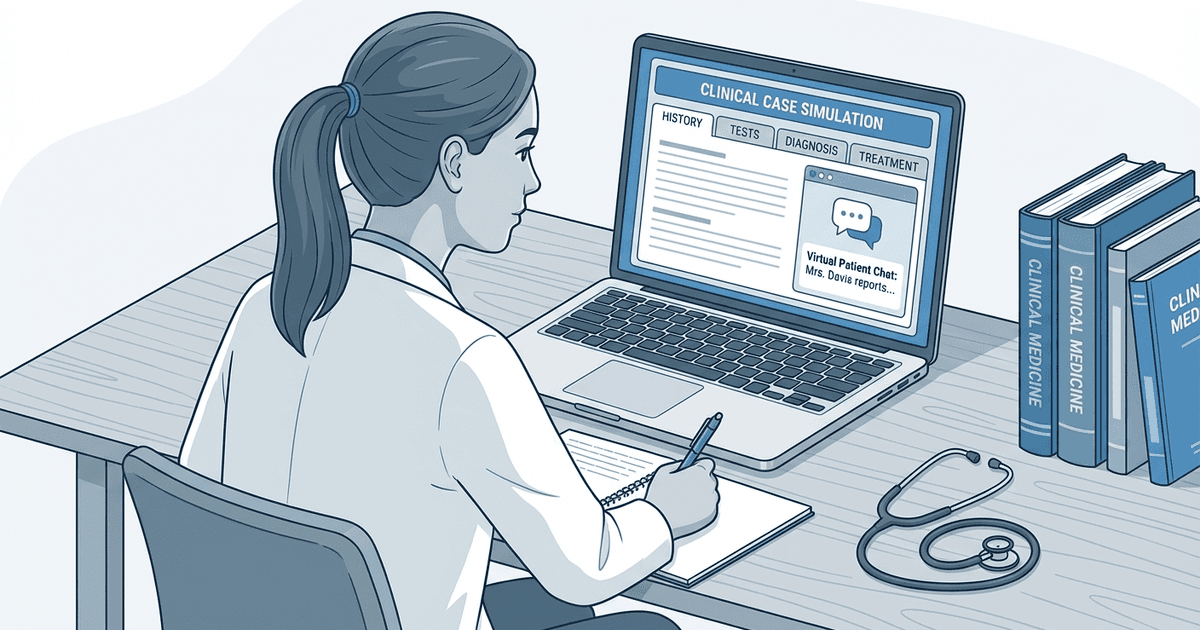
Most students think clinical reasoning is mysterious. It's not. It's a learnable sequence that Clinical Rounds breaks into four structured tabs:
History Tab: Learning to Ask the Right Questions
You dont just read a case presentation. You actively chat with a virtual patient who responds like a real person.
Patient: "I've been having this terrible headache for 2 days."
You: "Can you describe the headache? Is it the worst you've ever had?"
Patient: "Yes, it started suddenly and feels like someone hit me with a hammer."
You: "Any neck stiffness or sensitivity to light?"
Patient: "Now that you mention it, yes. Bright lights hurt my eyes."
Your brain starts connecting: sudden onset + worst headache ever + photophobia + neck stiffness = subarachnoid hemorrhage vs meningitis.
This mirrors real clinical thinking. You gather clues, form hypotheses, and ask directed questions to test them. The AI mentor provides immediate feedback on whether your history-taking captured the key elements.
Tests Tab: Strategic Investigation Ordering
Here's where most students mess up. They order everything "just to be safe."
Clinical Rounds shows you a searchable list of investigations with urgency levels (stat, urgent, routine). You cant just click randomly — the system tracks your efficiency and gives you points based on how targeted your approach is.
For the headache case, a good reasoning sequence might be:
Stat: CT head (rule out SAH)
Urgent: LP if CT negative (check for meningitis)
Routine: Basic metabolics (general workup)
Students who order 15 tests get lower scores than those who order the right 3 tests. This teaches you to think like an emergency physician — what do I need to know RIGHT NOW to make the next decision?
Diagnosis Tab: Building Your Differential
You're presented with multiple differential options, each with detailed explanations for why it fits or doesn't fit the case.
For our headache patient with negative CT but CSF showing 1000 WBCs with 90% neutrophils:
Bacterial meningitis ✓ — Fits with sudden onset, meningismus, and neutrophilic pleocytosis Viral meningitis ✗ — Would expect lymphocytic predominance Subarachnoid hemorrhage ✗ — CT negative and no RBCs in CSF
You're not just picking the right answer. You're learning why each option is right or wrong, building pattern recognition for future cases.
Treatment Tab: Closing the Loop
The final step: selecting appropriate management from a searchable treatment database.
For bacterial meningitis: empirical ceftriaxone + vancomycin + dexamethasone. The system explains why each component matters and what happens if you miss a critical element.
Students who complete all four tabs don't just know the right answer — they understand the complete reasoning pathway from presentation to treatment.
The XP System: Making Clinical Thinking Addictive
Here's why Clinical Rounds works when other methods fail: it's designed like a game that rewards good thinking.
You earn XP based on three factors:
Accuracy: Getting the diagnosis and treatment right
Speed: Moving efficiently through each tab without unnecessary delays
Efficiency: Ordering targeted tests instead of shotgun approaches
The time multiplier is crucial. Students who think decisively get bonus points, training you for NEET PG's 63-second-per-question reality.
Each case can be replayed up to 3 times for a perfect 3-star rating. Most students initially score 1-2 stars, then improve with each attempt as they internalize the reasoning patterns. The leaderboard adds peer pressure — you can see how your clinical reasoning speed compares to other NEET PG aspirants.
This gamification creates intrinsic motivation to practice clinical thinking, something traditional case books cant match.
Real NEET PG Application: From Theory to Practice
Let's trace how Clinical Rounds preparation translates to actual NEET PG performance.
Traditional approach:
Read: "Diabetic ketoacidosis presents with polyuria, polydipsia, altered sensorium. Lab shows glucose >250, pH <7.3, ketones positive."
NEET PG question: Student sees labs first, recognizes DKA, picks insulin + fluids.
Clinical Rounds approach:
Practice history: "22-year-old diabetic with 2 days of vomiting and increased urination"
Practice tests: Order glucose, ABG, ketones based on clinical suspicion
Practice diagnosis: Compare DKA vs HHS vs simple dehydration
Practice treatment: Select fluid resuscitation protocols and insulin dosing
NEET PG question: Student thinks through the complete clinical sequence even when given partial information.
The difference shows in complex cases. When NEET PG presents a diabetic patient with altered mental status but normal glucose, the Clinical Rounds-trained student thinks: "Could be HHS, uremic encephalopathy, or sepsis" and works through the differential. The textbook-trained student gets stuck because they've only memorized classic DKA presentation.
Medical decision making becomes automatic through repetitive practice with different case presentations.
Building Diagnostic Confidence Through Repetition
Clinical reasoning improves through deliberate practice, not passive reading. Clinical Rounds provides this through:
Case Variety: Different presentations of the same condition. Pneumonia might present as fever + cough in one case, confusion in an elderly patient in another, or chest pain in a third case. Difficulty Progression: Level 1 cases have classic presentations. Level 3 cases have atypical features or comorbidities that complicate the picture. Immediate Feedback: After each step, the AI mentor explains what you got right and what you missed. This closes the feedback loop that textbooks leave open.
Research shows that case-based learning significantly improves clinical reasoning skills compared to traditional lecture-based methods.
The key insight: you need to practice the thinking process, not just the final answer. Clinical Rounds forces you to work through each step of clinical reasoning in a structured way.
Emergency Case Training: Thinking Under Pressure
NEET PG isn't just about getting the right diagnosis — it's about getting it quickly under pressure. Clinical Rounds includes emergency cases with live timers that simulate the real exam stress.
When you see "45-year-old with crushing chest pain," the timer starts ticking. You have limited time to:
Ask focused history questions (chest pain character, radiation, associated symptoms)
Order appropriate tests (ECG, troponins, basic metabolic panel)
Make the diagnosis (STEMI vs NSTEMI vs unstable angina)
Select immediate treatment (dual antiplatelet therapy, heparin, cardiology consult)
The pressure training builds the mental stamina you need for NEET PG's 200-question marathon. Students report feeling more confident during the actual exam because they've practiced clinical reasoning under time pressure.
The Feedback Loop: Learning from Mistakes
The biggest advantage of Clinical Rounds over static case books? The AI-generated learning feedback after each case completion.
You get a detailed performance breakdown:
Accuracy percentage for each tab
Key strengths (e.g., "Excellent targeted history taking")
Improvement areas (e.g., "Consider inflammatory markers in fever workup")
Specific learning points relevant to that case type
This feedback becomes a personalized revision resource. Students who review their case feedback before attempting similar cases consistently improve their star ratings.
The feedback also identifies knowledge gaps you didn't know you had. Maybe you nail the diagnosis but consistently miss key management steps. Or you order the right tests but in the wrong sequence. Traditional MCQ practice doesn't reveal these thinking errors.
How to Integrate Clinical Rounds into NEET PG Prep
Clinical Rounds isn't meant to replace MCQ practice — it complements it by building the reasoning foundation that makes MCQs easier.
Optimal integration strategy: Morning (2 hours): Traditional learning
Review high-yield topics using targeted lessons
Focus on pathophysiology and key facts
Afternoon (1 hour): Clinical Rounds practice
Complete 3-4 cases related to morning's topics
Replay cases until you achieve 3-star ratings
Review AI feedback and note learning points
Evening (2 hours): MCQ consolidation
Solve topic-wise MCQs to reinforce patterns
The clinical reasoning practice makes MCQ explanations more meaningful
This sequence works because you build understanding (lessons) → practice application (Clinical Rounds) → test recall (MCQs). Each component reinforces the others.
Success Stories: What Students Report
Students using Clinical Rounds consistently report two key changes:
1. Faster Pattern Recognition
"I used to panic when I saw complex cases. Now I automatically think: what's the most likely diagnosis, what tests would confirm it, how would I treat it. The thinking process became automatic." — Priya, NEET PG 2025 topper
2. Better Emergency Medicine Performance
"Emergency cases used to scare me. After practicing timed Clinical Rounds, I could work through shock cases or arrhythmias systematically even under pressure." — Rajesh, secured Emergency Medicine residency
The confidence boost is real. When you've practiced clinical reasoning hundreds of times in a structured format, NEET PG cases feel familiar rather than overwhelming.
Students also report that Clinical Rounds helped them in clinical postings and viva exams, not just NEET PG. The reasoning skills transfer to real patient encounters.
Comparing Clinical Rounds to Other Methods
Method | Builds Reasoning | Real-time Feedback | Pressure Training | Efficiency Tracking |
|---|---|---|---|---|
Textbooks | ✗ | ✗ | ✗ | ✗ |
Video Lectures | ✗ | ✗ | ✗ | ✗ |
Static Cases | Partial | ✗ | ✗ | ✗ |
MCQ Banks | Minimal | Limited | ✗ | ✗ |
Clinical Rounds | ✓ | ✓ | ✓ | ✓ |
Traditional methods teach you WHAT to think. Clinical Rounds teaches you HOW to think.
The key difference: most study methods are passive. You read or watch, then try to recall during the exam. Clinical Rounds is active — you're constantly making decisions, getting feedback, and refining your approach.
External tools like Elsevier Clinical Cases provide static case presentations but lack the interactive reasoning practice and immediate feedback that Clinical Rounds offers.
Advanced Clinical Reasoning: Beyond Basic Cases
Once you master Level 1 cases, Clinical Rounds advances to complex scenarios that mirror NEET PG's toughest questions:
Multi-system cases: A diabetic patient with chest pain — is it MI, diabetic neuropathy, or costochondritis? Atypical presentations: Pneumonia presenting as confusion in elderly patients without fever or cough. Comorbidity interactions: Managing hypertension in a patient with COPD where beta-blockers are contraindicated.
These advanced cases teach you to think beyond textbook presentations. NEET PG loves atypical cases because they separate students who memorize patterns from those who understand underlying reasoning.
The difficulty progression ensures you're always challenged without being overwhelmed. The adaptive nature means you spend more time on case types where you're weaker.
Common Clinical Reasoning Mistakes (And How Clinical Rounds Fixes Them)
Mistake #1: Premature Closure
Seeing "young female with chest pain" and immediately thinking anxiety without considering other possibilities.
Clinical Rounds solution: Forces you to consider multiple differentials before making diagnosis selection. The system tracks whether you explored appropriate alternatives. Mistake #2: Shotgun Testing
Ordering every available test "to be thorough" instead of targeted investigations.
Clinical Rounds solution: Scores you on efficiency. Students learn that ordering CT head, MRI brain, and LP for every headache case gets lower scores than targeted workup based on clinical presentation. Mistake #3: Ignoring Red Flags
Missing danger signs that change management priorities.
Clinical Rounds solution: Emergency cases include time pressure and clear consequences for missing critical features. A chest pain case might include ST elevations on ECG — missing this dramatically affects your score.
These mistakes are hard to identify with traditional study methods but become obvious through Clinical Rounds practice with immediate feedback.
Integration with Other Oncourse Features
Clinical Rounds works synergistically with other AI-powered features on the platform:
When you complete a cardiology case in Clinical Rounds, you might get AI recommendations to review specific cardiology flashcards that reinforce key concepts from your case performance.
The spaced repetition system ensures that clinical reasoning patterns get strengthened over time, not just during active Clinical Rounds sessions.
Frequently Asked Questions
How many Clinical Rounds cases should I complete daily for NEET PG prep?
Start with 2-3 cases per day and gradually increase to 5-6 cases as you build stamina. Quality over quantity — its better to complete 3 cases with perfect 3-star ratings than rush through 10 cases with poor scores. Each case takes 15-20 minutes when done thoughtfully.
Can Clinical Rounds replace traditional MCQ practice for NEET PG?
No, Clinical Rounds complements MCQ practice rather than replacing it. Use Clinical Rounds to build reasoning foundations, then test that reasoning with targeted MCQs. The combination is more powerful than either method alone. About 30% Clinical Rounds, 70% MCQs works well for most students.
Do Clinical Rounds cases cover all NEET PG subjects?
Clinical Rounds focuses on high-yield clinical scenarios that commonly appear in NEET PG. This includes internal medicine, surgery, emergency medicine, obstetrics, and pediatrics cases. While it doesn't cover basic sciences directly, the clinical reasoning skills transfer across all subjects.
How does the difficulty progression work in Clinical Rounds?
Level 1 cases have classic presentations with clear diagnostic clues. Level 2 introduces mild atypical features or common complications. Level 3 cases have multiple comorbidities, unusual presentations, or time-critical decision points. You unlock higher levels by consistently achieving 3-star ratings.
Can I review my past Clinical Rounds performance?
Yes, your case completion history shows which cases you've completed, your star ratings, and key learning points from each session. This creates a personalized review resource for final exam preparation. Focus on replaying cases where you initially scored 1-2 stars.
How does Clinical Rounds help with NEET PG time management?
The timed emergency cases simulate NEET PG pressure, helping you practice quick decision-making. The XP system rewards efficiency — students learn to gather essential information and make decisions without overthinking. This directly translates to better time management during the actual exam.
Prepare smarter with Oncourse AI — adaptive MCQs, spaced repetition, and AI explanations built for NEET PG. Download free on Android and iOS.