NBME Practice Exams Explained: What They Are, How to Use Them, and Which Ones to Take for USMLE Step 1 and Step 2 CK (2026)
Complete guide to NBME practice exams for USMLE Step 1 and Step 2 CK. Learn which forms to take, how to interpret scores, optimal timing strategy, and how to use results for targeted improvement in 2026.
NBME Practice Exams Explained: What They Are, How to Use Them, and Which Ones to Take for USMLE Step 1 and Step 2 CK (2026)
You are probably staring at your USMLE timeline wondering when to start taking NBMEs. Should you wait until you feel "ready"? How many should you take? And why do some students swear by them while others say they are terrible predictors?
Here's what most students dont realize: NBME practice exams arent just score predictors. They are diagnostic tools. The National Board of Medical Examiners created these self-assessments to mirror the exact question style, difficulty curve, and content distribution of the real USMLE. When used correctly, they become your roadmap to targeted improvement.
NBME scores have a ±5-8 point correlation with actual USMLE performance — making them the most accurate predictor available. But the real value isnt in the number you get. Its in the systematic weak area identification that follows.
If you have ever wondered which NBME forms to take, when to take them, or how to actually use the results to improve your score, this guide breaks down everything you need to know for both Step 1 and Step 2 CK in 2026.
What Are NBME Practice Exams?
NBME self-assessments are official practice exams created by the National Board of Medical Examiners — the same organization that writes the actual USMLE. Unlike third-party question banks that try to mimic board-style questions, NBMEs contain retired questions from previous USMLE exams.
This matters more than you think. Every NBME question has been statistically validated on thousands of real test-takers. The difficulty distribution, the answer choice patterns, even the way distractors are written — everything matches what you'll see on exam day.
NBME offers two main types of self-assessments:
Comprehensive Basic Science Self-Assessment for USMLE Step 1
Comprehensive Clinical Science Self-Assessment for USMLE Step 2 CK
Each exam comes in standard-paced (mimics real exam timing) and self-paced formats. After completing any NBME, you get access to detailed performance analytics through their INSIGHTS dashboard, showing exactly where your knowledge gaps exist.
The key difference between NBMEs and other practice tests: NBMEs dont just test if you know something. They test if you know it the way the USMLE tests it.
Free vs Paid NBME Forms: What's Available in 2026
NBME pricing follows a tiered structure that can get expensive if you take multiple forms. Here's the current breakdown:
Free NBME Resources:
Free 120: 120 practice questions for both Step 1 and Step 2 CK (available on USMLE website)
Sample questions: Limited question sets available through USMLE.org
Paid NBME Forms (2026 pricing):
Single form: $60-75 per exam
Bundle packages: 2-form bundles starting at $110
Institution rates may vary
Most students end up spending $200-400 on NBME forms alone during their preparation period. The key is being strategic about which forms you take and when, rather than taking every available form.
Each form provides:
Timed or self-paced testing options
Detailed score report with probability of passing estimate
Content area breakdown showing performance by subject
Access to INSIGHTS dashboard with question-level analytics
Step 1 NBME Forms Breakdown
As of 2026, NBME offers Forms 25-31 for Step 1 preparation. Each form contains 200 questions distributed across four 50-question blocks, matching the exact format of the actual Step 1 exam.
Current Step 1 NBME Forms:
Form | Release Year | Best Used For | Key Features |
|---|---|---|---|
Form 25 | 2022 | Early baseline (4-6 weeks out) | Slightly easier, good confidence builder |
Form 26 | 2022 | Mid-dedicated checkpoint | Balanced difficulty, strong predictor |
Form 27 | 2023 | Final assessment (2 weeks out) | Most accurate predictor based on data |
Form 28 | 2024 | Backup/additional practice | Newer content focus areas |
Form 29 | 2025 | Latest question style | Updated for current exam patterns |
Form 30 | 2025 | Most current content | Reflects 2025-2026 exam changes |
Form 31 | 2026 | Brand new format | Latest content distribution |
Timing Strategy for Step 1 NBMEs:
First NBME (Form 25): 4-6 weeks into dedicated study
Second NBME (Form 26 or 27): 2-3 weeks before exam
Final NBME (Form 30 or 31): 1 week before exam (if needed for confidence)
When you identify weak areas from your first NBME, Oncourse's adaptive question bank automatically adjusts difficulty and topic weighting based on your performance, surfacing more targeted questions until you reach mastery in those specific subjects.
Step 2 CK NBME Forms Breakdown
Step 2 CK NBMEs are labeled as "Comprehensive Clinical Science Self-Assessment" forms. Each contains 318 questions across multiple blocks, designed to mirror the clinical reasoning emphasis of Step 2 CK.
Current Step 2 CK NBME Forms:
Form | Questions | Best Used For | Clinical Focus |
|---|---|---|---|
Form 9 | 318 | Mid-clerkship baseline | Internal medicine heavy |
Form 10 | 318 | Final clerkship assessment | Surgery/OB-GYN emphasis |
Form 11 | 318 | Dedicated period start | Pediatrics/Psychiatry focus |
Form 12 | 318 | Pre-exam final check | Emergency medicine cases |
Step 2 CK NBMEs tend to be more predictive than Step 1 forms because clinical reasoning patterns are more standardized. The correlation between NBME scores and actual Step 2 CK performance typically falls within ±6 points.
Recommended Timeline:
First NBME: After completing core clerkships
Second NBME: 3-4 weeks into dedicated study period
Final NBME: 1-2 weeks before exam
For targeted remediation after identifying weak clinical areas, Oncourse's performance analytics dashboard tracks your performance by organ system and question type — exactly the data you need to interpret NBME results meaningfully and build a precision study plan.
Free 120: What It Is and How to Use It
The Free 120 is NBMEs gift to medical students — 120 official USMLE questions available at no cost through the USMLE website. Updated in February 2024, it contains three 40-question blocks for both Step 1 and Step 2 CK.
What makes Free 120 valuable:
Real retired USMLE questions
Exact same interface as exam day
Free answer explanations available
Good introduction to NBME question style
How to use Free 120 strategically:
1. Take it 6-8 weeks before your scheduled exam as a baseline assessment
2. Use untimed format first to get comfortable with question style
3. Retake in timed format closer to exam day
4. Focus on wrong answers to identify early weak areas
Free 120 typically correlates less strongly with final scores compared to full-length NBMEs (±10-12 points vs ±5-8 points), but its completely free and gives you a solid introduction to official NBME content.
The biggest mistake students make with Free 120: treating it like a diagnostic tool instead of a learning tool. Use it to get familiar with NBME logic, then move to paid forms for accurate score prediction.
How NBME Scores Correlate to Actual USMLE Scores
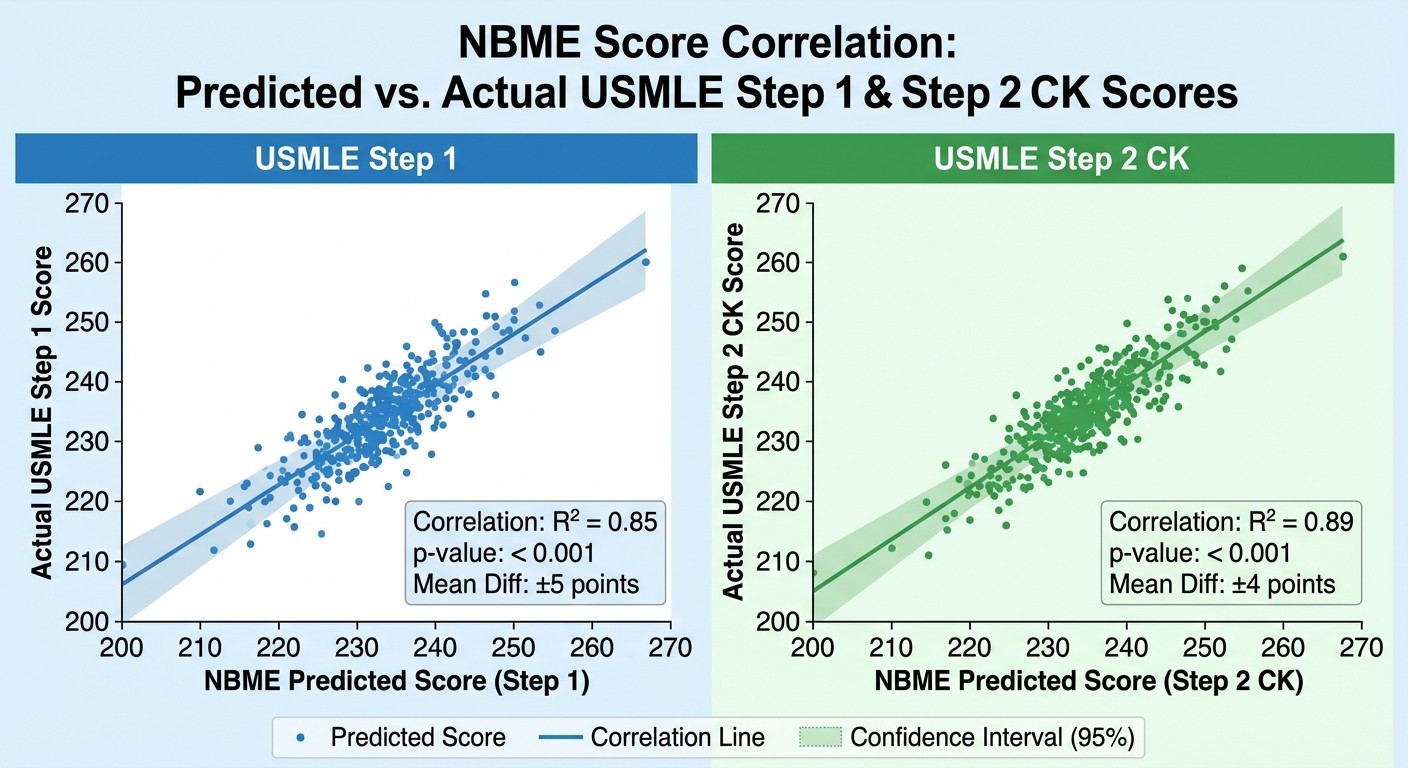
Understanding NBME score correlation is crucial for setting realistic expectations and planning your test date. Based on 2026 data analysis, heres how NBME scores translate:
Step 1 Correlation Accuracy:
Forms 25-27: ±5-8 points
Forms 28-31: ±6-10 points (newer forms have less historical data)
Confidence interval: 95% of students score within ±12 points of their final NBME
Step 2 CK Correlation Accuracy:
All current forms: ±4-7 points
Typically more accurate than Step 1 NBMEs
90% of students score within ±10 points of their last NBME
Score Conversion Guidelines:
NBME Score Range | Expected USMLE Range | Pass Probability |
|---|---|---|
200-210 | 200-215 | 65-75% |
211-220 | 210-225 | 80-90% |
221-235 | 220-240 | 95%+ |
236+ | 235+ | 99%+ |
Factors that improve correlation accuracy:
Taking multiple NBMEs (last 2-3 scores matter most)
Taking NBMEs closer to exam date
Consistent performance across forms
The most predictive approach: take your final NBME 1-2 weeks before exam day. If youre scoring consistently 15+ points above your target, you are likely ready.
When to Start Taking NBMEs in Your Study Timeline
Timing your NBMEs correctly can make the difference between useful feedback and demoralizing early scores. Heres the strategic approach based on your study phase:
Step 1 Timeline:
Weeks 1-3 of dedicated: Focus on content review, dont take NBMEs yet
Week 4: First NBME (Form 25) for baseline assessment
Week 6-7: Second NBME (Form 26 or 27) to track progress
Week 8: Final NBME (latest form available) for readiness confirmation
Step 2 CK Timeline:
End of clerkships: First NBME to identify clinical reasoning gaps
Week 2 of dedicated: Second NBME after focused content review
1 week before exam: Final NBME for confidence/date confirmation
Red flags that you arent ready for your first NBME:
Havent completed at least one pass through major resources
Scoring below 50% on UWorld or other question banks
Havent reviewed high-yield topics in your target areas
The worst mistake: taking an NBME too early and getting discouraged by a low score. NBMEs work best when you have enough baseline knowledge for the diagnostic feedback to be meaningful.
When NBMEs reveal specific weak subjects, Oncourse integrated spaced repetition ensures you review flagged concepts at optimal intervals, bridging the gap between identifying a weak area and actually locking in that knowledge before exam day.
How to Analyze NBME Results Beyond Just the Score
Your NBME score is just the starting point. The real value lies in the detailed performance breakdown available through NBMEs INSIGHTS dashboard. Heres how to extract maximum value:
Content Area Analysis:
Each NBME breaks down your performance across major subject areas. Look for:
Subjects where you scored 2+ standard deviations below average
Consistent weak areas across multiple NBMEs
Subjects where you improved significantly between forms
Question-Level Analytics:
INSIGHTS shows you:
Time spent per question (identify if youre too slow)
Your highlights and strikethroughs (review decision-making patterns)
Answer explanations for both correct and incorrect choices
Strategic Analysis Framework:
1. Identify the Bottom 20%: Focus remediation on your lowest-scoring content areas
2. Pattern Recognition: Look for systematic mistakes (misreading questions, falling for common distractors)
3. Time Management: Analyze if low scores correlate with questions you rushed through
4. Knowledge vs Application: Distinguish between not knowing facts vs not applying them correctly
Red Flags in NBME Analysis:
Scoring poorly on high-yield subjects (cardiology, infectious disease for Step 2 CK)
Consistent timing issues (spending >2 minutes per question)
Missing basic recall questions (suggests content gaps)
Falling for the same distractor patterns repeatedly
Cross-reference your NBME weak areas with Oncourse topic-specific performance data to build a precision remediation plan that targets exactly where you need improvement.
Combining NBMEs with Other Study Resources
NBMEs work best as part of a comprehensive study strategy, not as standalone preparation tools. Heres how to integrate them with other major resources:
NBME + UWorld Integration:
Use NBME results to guide UWorld subject selection
Focus UWorld practice on your NBME weak areas
Take UWorld Self-Assessments 1 week after each NBME for comparison
NBME + Anki/Flashcards:
Create targeted Anki decks based on NBME mistakes
Use spaced repetition for facts you missed on NBMEs
Review NBME flashcards daily until your next assessment
Resource Allocation Based on NBME Performance:
NBME Score | Study Focus | Resource Split |
|---|---|---|
Below 200 | Content review + basics | 60% Content / 40% Questions |
200-220 | Application + weak areas | 40% Content / 60% Questions |
220+ | Fine-tuning + test-taking | 20% Content / 80% Questions |
Study Schedule Integration:
Week 1 post-NBME: Intensive remediation of bottom 2-3 subjects
Week 2 post-NBME: Mixed practice with emphasis on weak areas
Week 3 post-NBME: Next NBME to assess improvement
The key principle: NBMEs diagnose, other resources treat. Use your NBME results to guide where you spend your limited study time, rather than studying everything equally.
Common Mistakes Students Make with NBMEs
After analyzing thousands of student NBME experiences, certain patterns of misuse emerge repeatedly. Avoid these critical mistakes:
Mistake #1: Taking NBMEs Too Early
Many students take their first NBME after just 1-2 weeks of study, get a devastating score, and panic. NBMEs are diagnostic tools, not learning tools. Take them when you have enough baseline knowledge for the feedback to be actionable.
Mistake #2: Focusing Only on the Final Score
The 3-digit score is just one data point. Students who only look at their overall score miss the detailed content breakdowns that reveal exactly where to focus their remaining study time.
Mistake #3: Taking Too Many NBMEs
Some students take 5-6 different NBME forms, spending $300-400 and burning through all available practice material. The optimal number is 2-3 NBMEs spread strategically across your study period.
Mistake #4: Not Following Up on Mistakes
Taking an NBME, noting weak areas, then continuing with the same study routine. NBMEs only help if you actually change your approach based on the results.
Mistake #5: Comparing Scores with Classmates
NBMEs assess your individual readiness, not how you stack up against peers. Focus on your own improvement trajectory rather than comparing raw scores.
Mistake #6: Ignoring Timing Issues
Students who consistently run out of time on NBMEs often focus on content review instead of addressing their pacing strategy. Time management is a separate skill that requires specific practice.
The Right Approach:
1. Take NBMEs at strategic intervals when you can act on the feedback
2. Analyze content areas, timing, and mistake patterns — not just the score
3. Spend 2-3 days intensively reviewing your mistakes before moving on
4. Use NBME results to guide your resource allocation for the following weeks
Frequently Asked Questions
How many NBMEs should I take for Step 1?
Most successful students take 2-3 NBMEs during their preparation. Take one for baseline assessment 4-6 weeks into dedicated study, another 2-3 weeks before your exam, and optionally a final one 1 week before for confidence. Taking more than 4 NBMEs is usually overkill and expensive.
Are NBMEs harder than the real USMLE?
NBMEs and the actual USMLE are written by the same organization using the same question development process. The difficulty should be nearly identical. If NBMEs feel harder, it usually means you need more content review or practice with NBME question style.
Should I take NBMEs in timed or untimed mode?
For your first NBME, untimed mode helps you focus on content knowledge without timing pressure. For subsequent NBMEs, especially ones taken closer to your exam date, use timed mode to practice pacing and simulate real exam conditions.
Can I retake the same NBME form?
Technically yes, but it defeats the purpose. Once you have seen the questions, your score will be artificially inflated. Use different forms for each assessment, and save your highest-correlation forms (27, 30, 31) for closer to exam day.
What if my NBME score drops between assessments?
Score fluctuations of 5-10 points between NBMEs are normal. Look at the trend across multiple assessments rather than worrying about single-test variations. Consistent drops might indicate fatigue, content decay, or need for strategy adjustment.
How accurate is the pass/fail prediction on NBME score reports?
NBME pass probability estimates are quite accurate for the population as a whole. However, individual results can vary based on test-taking skills, anxiety, and how well your knowledge aligns with that particular forms content distribution.
Prepare smarter with Oncourse AI — adaptive MCQs, spaced repetition, and AI explanations built for USMLE success. Download free on Android and iOS.