Back
NEET PG Preparation 2026: Complete Strategy, Study Plan and High-Yield Subject Roadmap
Master NEET PG 2026 with this definitive preparation guide covering month-by-month study plans, high-yield topics, subject weightages, and proven strategies for final-year students and interns.

NEET PG Preparation 2026: Complete Strategy, Study Plan and High-Yield Subject Roadmap
You are probably staring at the NEET PG syllabus right now - 19 subjects, 200 questions, and what feels like an impossible mountain to climb. Your WhatsApp groups are buzzing with conflicting advice: start with anatomy, no wait pathology first, actually medicine is most important. Everyone has a different strategy, and none of them seem to work for real people with real time constraints.
Here's what actually works: NEET PG 2026 has 200 questions spread across 19 subjects, but 4 subjects decide 65% of your rank. Medicine alone carries 45-50 questions. Surgery follows with 40-45. Add pathology (25 questions) and Social & Preventive Medicine (25 questions), and you have covered nearly 140 out of 200 questions.
This is your complete roadmap - not theoretical advice, but a battle-tested strategy that accounts for subject weightages, optimal study sequences, and realistic timelines. Whether you are starting fresh or restarting after a previous attempt, this guide will cut through the noise and give you a clear path forward.
When to Start NEET PG Preparation: The Reality Check
Starting Timeline Based on Your Current Status:
Your Situation | Recommended Start Time | Study Duration |
|---|---|---|
Final year MBBS (Dec 2025) | January 2026 | 12 months |
Intern (June 2025) | July 2025 | 15-18 months |
Recent graduate | Immediately | 12-15 months |
Previous attempt | 6 months before next exam | 6-12 months |
The sweet spot for serious NEET PG preparation is 12-15 months. Starting earlier than 18 months leads to burnout and information decay. Starting with less than 9 months leaves insufficient time for the consolidation phase, which is where ranks are actually made.
If you are starting late (6-8 months remaining), skip the foundation building phase and jump directly to high-yield subjects using Method B outlined below.
The 3-Phase NEET PG Preparation Framework
Every successful NEET PG journey follows this exact sequence:
Phase 1: Foundation Building (4-5 months)
Goal: Complete first read of all subjects + basic MCQ practice Focus: Understanding concepts, building knowledge base MCQ Target: 40-50 questions per day across covered subjects
Phase 2: Consolidation (4-5 months)
Goal: Strengthen weak areas + intensive MCQ practice Focus: Revision + advanced question solving MCQ Target: 80-100 questions per day
Phase 3: Peak Performance (2-3 months)
Goal: Rapid revision + full-length tests Focus: Speed, accuracy, and exam temperament Mock Test Target: 2-3 full-length tests per week
The mistake most aspirants make is extending Phase 1 indefinitely or jumping to Phase 3 without proper consolidation. Each phase serves a specific purpose and cant be skipped.
NEET PG 2026 Subject Weightage: Where Your Rank is Made
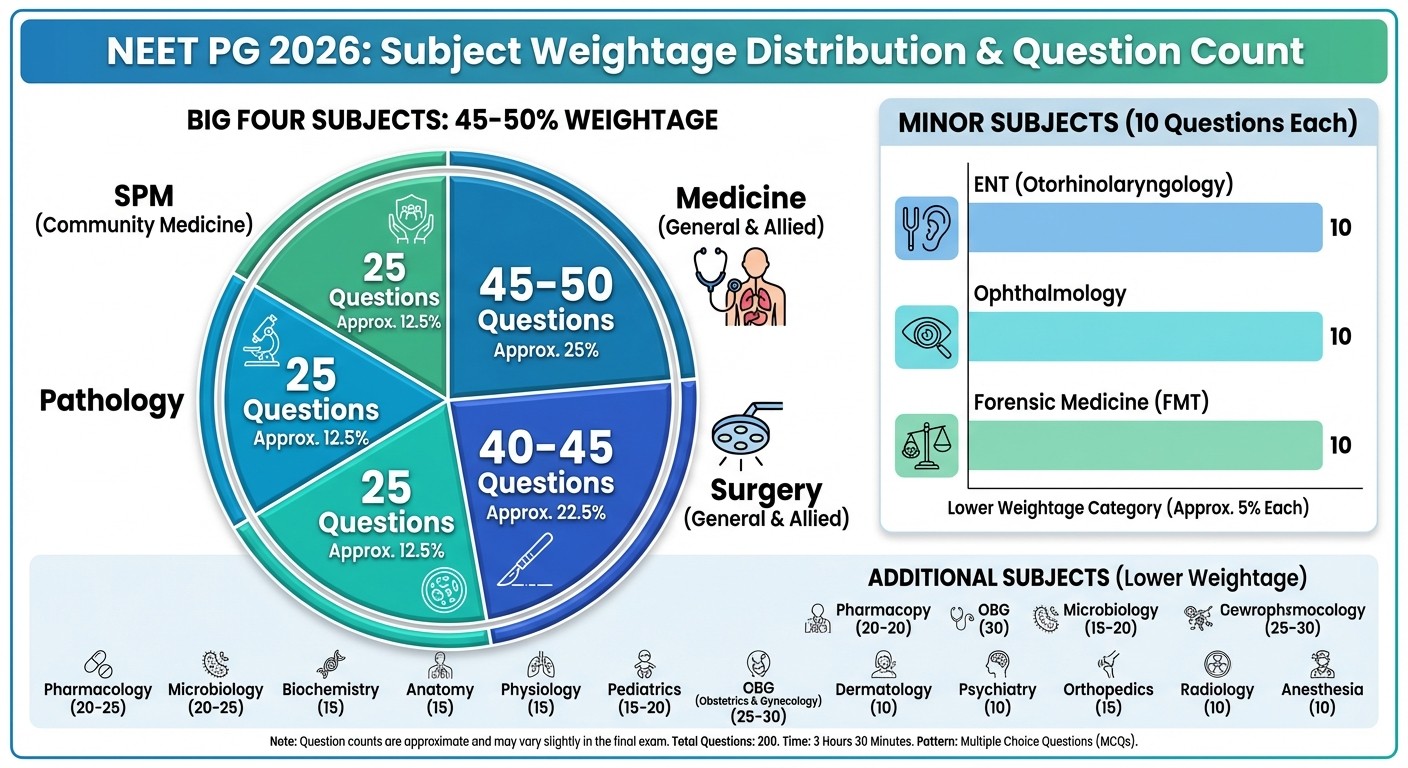
High-Yield Subjects (140+ questions total)
General Medicine (45-50 questions) - The kingmaker subject
Cardiology: 12-15 questions (ECG interpretation, heart failure, arrhythmias)
Infectious Diseases: 8-10 questions (HIV, tuberculosis, tropical diseases)
Neurology: 8-10 questions (stroke, seizures, movement disorders)
Endocrinology: 6-8 questions (diabetes, thyroid disorders)
Nephrology: 5-7 questions (glomerulonephritis, AKI/CKD)
Dermatology & Psychiatry: 6-8 questions combined
General Surgery (40-45 questions) - Second highest weightage
GI Surgery: 15-18 questions (appendicitis, bowel obstruction, peptic ulcer)
Trauma Surgery: 8-10 questions (head injury, polytrauma management)
Orthopedics: 8-10 questions (fractures, bone tumors, spine)
Anesthesia: 5-7 questions (drugs, monitoring, complications)
Pathology (25 questions) - High concept density
General Pathology: 8-10 questions (inflammation, neoplasia, cell injury)
Systemic Pathology: 10-12 questions (cardiovascular, respiratory, GI)
Hematology: 5-7 questions (anemias, leukemias, bleeding disorders)
Social & Preventive Medicine (25 questions) - Scoring subject
Epidemiology & Biostatistics: 8-10 questions
National Health Programs: 8-10 questions
Maternal & Child Health: 4-6 questions
Environmental Health: 3-4 questions
Moderate-Yield Subjects (80+ questions total)
Obstetrics & Gynecology (30-35 questions)
High-yield areas: Labor complications, gynecological malignancies, contraception
Pharmacology (20 questions)
High-yield areas: Antimicrobials, cardiac drugs, CNS drugs, side effects
Microbiology (20 questions)
High-yield areas: Bacteriology, antibiotic resistance, immunology basics
Anatomy (15-17 questions)
Focus on applied anatomy and image-based questions
Physiology (15-17 questions)
High-yield areas: Cardiovascular and respiratory physiology
Pediatrics (15 questions)
High-yield areas: Growth & development, vaccines, neonatology
Low-Yield Subjects (40+ questions total)
Biochemistry (12-15 questions) - Focus on metabolic pathways and molecular biology Radiology (12-15 questions) - X-ray, CT, MRI interpretation ENT (10 questions) - Quick revision, image-based questions Ophthalmology (10 questions) - Fundus images, glaucoma basics Forensic Medicine (10 questions) - Easy scoring if revised properly
The data is clear: Medicine + Surgery + Pathology + SPM = 135-145 questions out of 200. Master these four subjects, and you have secured 67-72% of the paper before touching the remaining 15 subjects.
The Two Starting Strategies: Pick Your Path
Method A: Foundation-First Approach
Ideal for: Recent graduates, those with 15+ months, visual learners Sequence: Anatomy → Physiology → Biochemistry → Pathology → Clinical subjects Why it works: Clinical correlations become clearer when basics are solid. Pathology makes perfect sense after physiology. Surgery concepts click faster with anatomical foundation.
Method B: High-Yield First Approach
Ideal for: Repeat aspirants, interns, those with <12 months, motivation-seekers Sequence: Medicine → Surgery → Pathology → Remaining subjects Why it works: Immediate exposure to high-weightage content. Early confidence from tackling scoring subjects. Integrated learning from day one.
Most successful candidates with limited time choose Method B. The foundation subjects get covered eventually, but clinical subjects give you the maximum return on investment from day one.
As you dive deeper into preparation, Oncourse's adaptive question bank automatically surfaces NEET PG-specific MCQs ranked by your personal weak areas - so instead of random practice, you are drilling exactly where your accuracy is lowest in the highest-weightage topics.
Month-by-Month Study Plan for NEET PG 2026
Months 1-4: Foundation Phase
Month 1: The Medicine Deep Dive
Week 1-2: Cardiology (priority #1 - practice cardiology MCQs daily)
Week 3: Infectious Diseases & Tropical Medicine
Week 4: Neurology basics + revision
Month 2: Medicine Continued + Surgery Start
Week 1-2: Endocrinology + Nephrology
Week 3-4: GI Surgery + Trauma Surgery (start surgery practice questions)
Month 3: Surgery Block
Week 1-2: Complete remaining surgery topics
Week 3-4: Orthopedics + Anesthesia basics
Month 4: Pathology Powerhouse
Week 1-2: General Pathology (inflammation, neoplasia)
Week 3: Systemic Pathology
Week 4: Hematology + Pathology revision
During this phase, Oncourse's performance analytics dashboard tracks your accuracy by subject and topic, showing exactly which areas need more time before moving to the next revision cycle - turning those vague "I think I am weak in cardiology" feelings into specific data.
Months 5-6: Coverage Completion
Month 5: OBG + High-Yield Para-Clinical
Week 1-2: Obstetrics (labor, complications, maternal health)
Week 3: Gynecology (malignancies, contraception)
Week 4: Social & Preventive Medicine (epidemiology focus)
Month 6: Remaining Core Subjects
Week 1: Complete SPM (national programs, biostatistics)
Week 2: Pharmacology (antimicrobials, cardiac drugs)
Week 3: Microbiology (bacteriology, immunology)
Week 4: Pediatrics (growth charts, vaccines)
Months 7-9: Consolidation Phase
The MCQ Marathon Period
Daily target: 80-100 questions across all covered subjects
Weekly target: 1 subject-wise test + 1 mixed test
Month 7: Focus on Medicine + Surgery MCQs (your highest scorers) Month 8: Pathology + SPM intensive (concept clarity phase) Month 9: All subjects mixed practice + weak area identification
This is where spaced repetition becomes critical. Instead of random revision, Oncourse embeds scientifically-timed flashcard reviews into your daily plan - ensuring topics you learned in Month 1 resurface exactly when you are about to forget them, maximizing retention across all 19 subjects.
Months 10-12: Peak Performance Phase
Month 10-11: Grand Revision
Rapid revision of all subjects (7-10 days per subject)
Daily mock tests (alternate between subject-wise and full-length)
Weak area drilling based on mock performance
Month 12: Final Sprint
Last 30 days: Only revision + mock tests
Last 15 days: Only mock tests + very light revision
Last 7 days: Previous year papers + confidence building
Mock Test Strategy:
Months 1-6: Subject-wise tests only (after completing each subject)
Months 7-9: 1 full-length test per week + subject-wise tests
Months 10-12: 3-4 full-length tests per week
High-Yield Topics by Subject: Your Priority List
General Medicine (Must-Master Topics)
Cardiology (12-15 questions expected):
ECG interpretation: STEMI, NSTEMI, arrhythmias, conduction blocks
Heart failure: systolic vs diastolic, treatment protocols
Hypertension: JNC guidelines, complications, drug interactions
Valvular diseases: murmur characteristics, surgical indications
Infectious Diseases (8-10 questions expected):
HIV: staging, opportunistic infections, HAART protocols
Tuberculosis: drug regimens, MDR-TB, extrapulmonary TB
Malaria: species differentiation, severe malaria management
Viral hepatitis: serological markers, chronic hepatitis B/C
Neurology (8-10 questions expected):
Stroke: types, thrombolysis criteria, secondary prevention
Seizures: classification, status epilepticus, drug choices
Movement disorders: Parkinson's vs other causes of tremor
CNS infections: bacterial vs viral meningitis, encephalitis
General Surgery (Attack These Areas)
GI Surgery (15-18 questions expected):
Acute abdomen: appendicitis vs other causes, imaging choices
Bowel obstruction: small vs large bowel, conservative vs surgical
Peptic ulcer: perforation management, Helicobacter protocols
Colorectal: malignancy screening, inflammatory bowel disease surgery
Trauma Surgery (8-10 questions expected):
Head injury: Glasgow Coma Scale, intracranial pressure management
Chest trauma: pneumothorax, hemothorax, cardiac tamponade
Abdominal trauma: FAST scan, organ injury grading
Polytrauma: ATLS protocols, damage control surgery
Pathology (Concept-Heavy Goldmine)
General Pathology (8-10 questions expected):
Cell injury: hypoxia, free radical damage, cellular adaptations
Inflammation: acute vs chronic, inflammatory mediators
Neoplasia: benign vs malignant features, carcinogenesis
Hemodynamic disorders: thrombosis, embolism, shock
Systemic Pathology (10-12 questions expected):
Cardiovascular: atherosclerosis, hypertensive heart disease, cardiomyopathies
Respiratory: pneumonia types, COPD vs asthma, lung cancers
GI: peptic ulcers, inflammatory bowel disease, liver cirrhosis
For comprehensive coverage of these high-yield pathology concepts, dive into our general pathology lessons and reinforce with pathology flashcards.
Revision Strategy That Actually Works
The 3-Tier Revision System
Tier 1: Daily Revision (15-20 minutes)
Previous day's topics via flashcards
Weak MCQ areas identified in morning practice
Tier 2: Weekly Revision (2-3 hours on weekends)
Complete subject revision every 7-10 days
Subject-wise mock test + analysis
Tier 3: Monthly Revision (4-5 days per month)
Grand revision of all covered subjects
Mixed topic tests + comprehensive analysis
The Forgetting Curve Battle
Medical education research shows that without reinforcement, you lose 80% of learned information within 30 days. The solution is not more study hours, but smarter timing.
Active Recall Schedule:
Day 1: Learn new topic
Day 3: Quick revision (10 minutes)
Day 7: Moderate revision (20 minutes)
Day 21: Deep revision (30 minutes)
Day 60: Final reinforcement (15 minutes)
This pattern, built into spaced repetition systems, increases long-term retention by 400% compared to mass revision sessions.
Resource Selection: The Minimalist Stack
Increased resources lead to increased confusion and decreased completion. Here's your complete toolkit:
Resource Type | Recommendation | Purpose |
|---|---|---|
Video Lectures | One platform only | Concept building |
Question Bank | Oncourse + one backup | MCQ practice |
|---|---|---|
Textbooks | Harrison's (Medicine) + Bailey's (Surgery) + Robbins (Pathology) | Reference only |
Mock Tests | Same as question bank platform | Performance tracking |
Revision Notes | Self-made short notes | Quick revision |
The Platform Choice Rule: Pick one primary source and stick to it for the entire preparation. Switching between multiple video sources creates concept conflicts and wastes precious revision time.
Mock Test Strategy and Performance Analysis
The Optimal Mock Test Timeline
Phase 1 (Months 1-6): Subject Completion Tests
Take a subject-wise test immediately after completing each subject
Goal: Identify initial weak areas, not score optimization
Frequency: 4-6 subject tests total
Phase 2 (Months 7-9): Mixed Practice
1 full-length test per week + 2 subject-wise tests
Goal: Cross-subject integration and endurance building
Frequency: 12-16 tests total
Phase 3 (Months 10-12): Exam Simulation
3-4 full-length tests per week in actual exam conditions
Goal: Speed optimization and anxiety management
Frequency: 40-50 tests total
Performance Analysis Framework
After each mock test, analyze these metrics in exactly this order:
1. Subject-wise accuracy: Which of your high-yield subjects dropped below 60%?
2. Topic-wise accuracy: Within weak subjects, which specific topics failed?
3. Question-type accuracy: Clinical vs factual vs image-based performance
4. Time management: Questions per minute, subject-wise time allocation
5. Silly mistakes: Misreading vs concept gaps vs calculation errors
The 70-20-10 Rule for Mock Analysis:
70% of improvement comes from drilling your weakest high-yield topics
20% comes from eliminating silly mistakes and improving speed
10% comes from learning completely new concepts
Focus your energy accordingly. Dont waste time on new topics if your Medicine accuracy is below 65%.
Common Preparation Mistakes to Avoid
The Resource Hoarding Trap
Buying every book, subscribing to multiple platforms, downloading countless PDFs. More resources create an illusion of progress while actually slowing you down. Stick to your minimalist stack.
The Perfection Paralysis
Waiting to "complete" one subject before moving to the next. In NEET PG, subjects are interconnected. Start your next subject when you achieve 60-65% accuracy in the current one, not 90%.
The Mock Test Avoidance
"I will give mocks once I complete the syllabus." This is preparation suicide. Mock tests are learning tools, not assessment tools. Start subject-wise tests from Month 1.
The Equal Time Distribution
Giving equal study time to all subjects. ENT and Ophthalmology deserve 2-3 days each, not 2-3 weeks. Reserve your prime study hours for Medicine and Surgery.
The Last-Minute Panic Shopping
Changing strategies, buying new books, or switching platforms in the final 2 months. Your strategy might not be perfect, but consistency trumps perfection in NEET PG.
Frequently Asked Questions
Is 12 months enough for NEET PG preparation?
Yes, 12 months is the optimal preparation duration for most candidates. It allows for complete coverage (4-5 months), consolidation (4-5 months), and peak performance training (2-3 months). Starting earlier often leads to burnout and information decay.
Should I focus more on theory or MCQs?
The ratio shifts during preparation: 70% theory + 30% MCQs in Phase 1, 50-50 in Phase 2, and 30% theory + 70% MCQs in Phase 3. Never do only theory or only MCQs - both are essential for different reasons.
Which subject should I start with - Anatomy or Medicine?
It depends on your timeline and learning style. Start with Anatomy if you have 15+ months and prefer building foundations first. Start with Medicine if you have <12 months or need early motivation from high-yield content.
How many hours should I study daily?
Quality over quantity always. 6-8 focused hours are better than 12 distracted hours. Include breaks, meals, and sleep in your schedule. Sustainable pace wins over unsustainable sprints.
When should I start giving full-length mock tests?
Start subject-wise tests after completing each subject (Month 1 onwards). Begin full-length tests from Month 7 when you have covered the major subjects. Never wait until syllabus completion.
Is coaching necessary for NEET PG?
Not mandatory, but helpful for structure and peer learning. Self-study with a good online platform and question bank is sufficient if you have strong self-discipline. Focus on consistency rather than coaching vs self-study debates.
The Bottom Line
NEET PG 2026 is not about studying everything perfectly. It's about studying the right things consistently and practicing them until they become second nature. Your rank depends more on accuracy in high-yield subjects than breadth of coverage across all 19 subjects.
Start with the subjects that matter most. Use data to guide your revision. Take tests regularly to identify gaps. And remember - the difference between ranks 100 and 1000 is not talent or hours studied, but strategy and execution consistency.
Prepare smarter with Oncourse AI — adaptive MCQs, spaced repetition, and AI explanations built for NEET PG 2026. Download free on Android and iOS.