Skin Tumors Indian Medical PG Practice Questions and MCQs
Practice Indian Medical PG questions for Skin Tumors. These multiple choice questions (MCQs) cover important concepts and help you prepare for your exams.
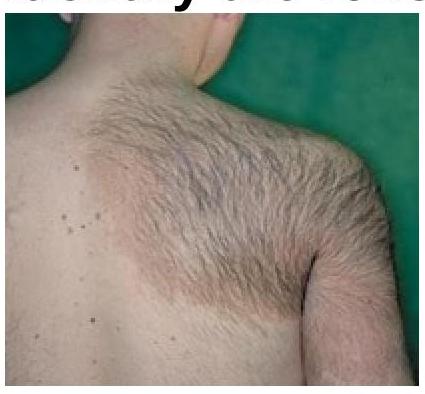
Skin Tumors Indian Medical PG Question 1: Identify the skin lesion shown in the image.
- A. Becker nevus (Correct Answer)
- B. Hypopigmented macule
- C. Spitz nevus
- D. Epidermal nevus
Skin Tumors Explanation: ***Becker nevus***
- This image clearly shows a large, **hyperpigmented patch with overlying coarse terminal hairs**, characteristic of a Becker nevus.
- Becker nevi typically develop in adolescence and are often found on the shoulder or upper trunk, as seen here.
*Hypopigmented macule*
- A **hypopigmented macule** would appear as an area of skin with **reduced pigmentation** (lighter than the surrounding skin), which is contrary to the darker lesion shown.
- There would also be no indication of **increased hair growth** within a typical hypopigmented macule.
*Spitz nevus*
- A Spitz nevus is a benign melanocytic nevus often appearing as a **dome-shaped, pink or red papule or nodule**, commonly on the face or limbs.
- It does not present as a large, hairy, **hyperpigmented patch** as depicted in the image.
*Epidermal nevus*
- An epidermal nevus is a **congenital lesion** formed by an overgrowth of epidermal cells, but its appearance is typically a **verrucous (wart-like) plaque** or linearly arranged papules.
- While it can be hyperpigmented, it generally **lacks the prominent hypertrichosis** (excessive hair growth) seen in the image.
Skin Tumors Indian Medical PG Question 2: Mohs micrographic excision for basal cell carcinoma is used for all the following Except
- A. Superficial basal cell carcinoma on the trunk (Correct Answer)
- B. Tumors with perineural invasion
- C. Tumors with aggressive histology
- D. Recurrent tumor
Skin Tumors Explanation: ***Superficial basal cell carcinoma on the trunk***
- **Mohs micrographic surgery** is generally reserved for basal cell carcinomas (BCCs) in cosmetically and functionally sensitive areas, larger tumors, or those with aggressive features.
- For **superficial BCCs** on the trunk, which is considered a low-risk area, standard excision, electrodessication and curettage, or topical therapies are often sufficient and preferred due to their less invasive nature and similar efficacy for this specific tumor type.
*Tumors with perineural invasion*
- **Perineural invasion** indicates a higher risk of recurrence and metastasis, making Mohs surgery an appropriate choice for complete tumor removal and margin control.
- The precise, margin-controlled excision of Mohs helps ensure that all microscopic extensions along nerve sheaths are identified and removed.
*Tumors with aggressive histology*
- **Aggressive histologic subtypes** such as infiltrative, morpheaform, or micronodular BCCs have a higher risk of subclinical extension and recurrence.
- Mohs surgery is highly effective for these types as it meticulously examines 100% of the surgical margins, maximizing tumor eradication while preserving healthy tissue.
*Recurrent tumour*
- **Recurrent BCCs** often have ill-defined borders and can grow more aggressively due to previous treatment altering the tissue architecture, making complete removal challenging.
- Mohs surgery offers the highest cure rates for recurrent BCCs by precisely mapping and excising the tumor while preserving surrounding healthy tissue.
Skin Tumors Indian Medical PG Question 3: Elderly man with a long-standing mole on his face that is increasing in size and showing an irregular border. Diagnosis:
- A. Superficial spreading melanoma
- B. Nodular melanoma
- C. Acral melanoma
- D. Lentigo maligna (Correct Answer)
Skin Tumors Explanation: ***Lentigo maligna***
- This type of melanoma commonly affects **elderly individuals** and presents as a **slowly enlarging, irregularly bordered, flat or slightly raised pigmented lesion** on sun-exposed areas like the face.
- It often has a **long radial growth phase** before progressing to invasive lentigo maligna melanoma.
*Superficial spreading melanoma*
- While common, it typically presents on the **trunk or extremities** and has a faster growth rate compared to lentigo maligna.
- It often appears as a **flat, asymmetrical lesion with varied colors and irregular borders**, but the age and location details point away from this.
*Nodular melanoma*
- This is an **aggressive form** that grows vertically from the start, presenting as a **dark, raised, often ulcerated nodule** and typically has a shorter history of rapid growth.
- It lacks the characteristic long-standing, flat growth pattern described in the elderly patient's face.
*Acral melanoma*
- This rare type occurs on the **palms, soles, or under the nails (subungual)**, not typically on the face.
- It often appears as a **pigmented streak or patch** in these acral locations.
Skin Tumors Indian Medical PG Question 4: A 40 year old man presented with a flat 1x1cm scaly, itchy black mole on the front of thigh. Examination did not reveal any inguinal lymphodenopathy. The best course of management would be:
- A. FNAC of lesion
- B. Incision biopsy
- C. Wide excision with inguinal lymphadenectomy
- D. Excision biopsy (Correct Answer)
Skin Tumors Explanation: ***Excision biopsy***
- A **flat, scaly, itchy, black mole** is highly suspicious for **melanoma**, and an excision biopsy provides the most accurate histopathological diagnosis and depth assessment.
- This procedure removes the entire lesion with a narrow margin of normal-appearing skin, allowing for comprehensive evaluation of its nature and determining further management.
*FNAC of lesion*
- **Fine needle aspiration cytology (FNAC)** is generally used for evaluating palpable masses or lymph nodes, not primary skin lesions like a suspicious mole.
- It provides only cellular samples, making it difficult to assess architectural features, depth of invasion, or determine definitive malignancy in skin lesions.
*Incision biopsy*
- An **incision biopsy** involves removing only a partial sample of the lesion, which can lead to sampling error and an inaccurate diagnosis if the most aggressive part is missed.
- For suspected melanoma, an incomplete biopsy can compromise subsequent staging and definitive treatment planning.
*Wide excision with inguinal lymphadenectomy*
- This is an **overly aggressive initial approach** before a definitive diagnosis of melanoma and its stage has been established.
- **Wide excision** is typically performed after an excision biopsy confirms melanoma and determines its depth, while **lymphadenectomy** is indicated for confirmed lymph node involvement.
Skin Tumors Indian Medical PG Question 5: Which of the following are correct with regard to lung cancer?
1. Surgical resection has a limited role in curative treatment of lung cancer.
2. Pattern of disease and prognosis of oat cell carcinoma are different to other varieties in the lungs.
3. Small cell lung cancer is a type of Neuroendocrine Tumour (NET).
4. Squamous cancer appears as a cavitating tumour in the lungs.
- A. 1, 3 and 4
- B. 2, 3 and 4 (Correct Answer)
- C. 1, 2 and 3
- D. 1, 2 and 4
Skin Tumors Explanation: ***2, 3 and 4***
- **Oat cell carcinoma** (small cell lung cancer) is known for its **aggressive behavior**, rapid growth, early metastasis, and distinct response to chemotherapy and radiation rather than surgery, making its pattern and prognosis different from **non-small cell lung cancer (NSCLC)** types [1].
- **Small cell lung cancer (SCLC)** originates from **neuroendocrine cells** in the lung, classifying it as a type of **Neuroendocrine Tumour (NET)**, which explains its unique biological and clinical characteristics [1].
- **Squamous cell carcinoma** is often centrally located and can undergo central necrosis, leading to **cavitation** which appears as a cavitating tumor on imaging [1].
*1, 3 and 4*
- This option is incorrect because statement 1, which suggests surgical resection has a limited role in curative treatment, is generally **false for non-small cell lung cancer (NSCLC)**, where surgery is the primary curative modality in early stages [1].
- While statements 3 and 4 are correct, the inclusion of incorrect statement 1 makes this option invalid.
*1, 2 and 3*
- This option is incorrect as statement 1 claiming a limited role for surgical resection in curative treatment is generally **false for NSCLC**, where localized tumors are ideally treated with surgery [1].
- Statements 2 and 3 are correct, but the inaccuracy of statement 1 renders this option incorrect.
*1, 2 and 4*
- This option is incorrect because statement 1, which states that surgical resection has a limited role in curative treatment, is generally **incorrect for early-stage NSCLC** [1].
- Although statements 2 and 4 are accurate, the error in statement 1 makes this combination incorrect.
More Skin Tumors Indian Medical PG questions available in the OnCourse app. Practice MCQs, flashcards, and get detailed explanations.