Forensic Medicine
1 questionsWhich of the following is the law on child sexual abuse in India?
NEET-PG 2020 - Forensic Medicine NEET-PG Practice Questions and MCQs
Question 121: Which of the following is the law on child sexual abuse in India?
- A. Protection Of Children from Sexual Offences Act (POCSO) (Correct Answer)
- B. Juvenile Justice (Care and Protection of Children) Act
- C. Indian Penal Code (IPC) Section 375
- D. Prohibition of Child Marriage Act
Explanation: ***Protection Of Children from Sexual Offences Act (POCSO)*** - The **POCSO Act** was specifically enacted in India to address and prevent child sexual abuse, providing a comprehensive legal framework for protection, prosecution, and rehabilitation. - It defines various forms of sexual offenses against children and ensures a child-friendly process for reporting and trial. *Juvenile Justice (Care and Protection of Children) Act* - This act primarily deals with the **care, protection, rehabilitation, and social reintegration of children** in conflict with law and children in need of care and protection. - While it ensures the overall well-being of children, it is not specifically focused on defining and prosecuting child sexual abuse. *Indian Penal Code (IPC) Section 375* - **IPC Section 375 defines rape** in India, but it primarily addresses sexual assault against women and does not specifically cater to children as a vulnerable group with distinct legal protections against sexual exploitation. - The POCSO Act was introduced to provide more stringent and child-specific provisions beyond the general framework of the IPC. *Prohibition of Child Marriage Act* - This act aims to **prohibit child marriages** and makes it an offense to solemnize or facilitate such marriages. - While child marriage can sometimes involve sexual exploitation, this act is not the primary legislation for addressing child sexual abuse in general.
Obstetrics and Gynecology
2 questionsA lady on treatment for infertility developed ascites, abdominal pain, and dyspnea. The ultrasound image is shown below. What is the most likely diagnosis?

What will be the Hysterosalpingogram (HSG) finding?

NEET-PG 2020 - Obstetrics and Gynecology NEET-PG Practice Questions and MCQs
Question 121: A lady on treatment for infertility developed ascites, abdominal pain, and dyspnea. The ultrasound image is shown below. What is the most likely diagnosis?
- A. PCOS
- B. OHSS (Correct Answer)
- C. Theca lutein cyst
- D. Mucinous cystadenomas
Explanation: ***OHSS*** - The clinical presentation of a woman undergoing infertility treatment who develops **ascites**, **abdominal pain**, and **dyspnea** is classic for **Ovarian Hyperstimulation Syndrome (OHSS)**. The ultrasound image showing massively enlarged, multicystic ovaries with numerous follicles further confirms this diagnosis. - OHSS is an iatrogenic complication of **ovarian stimulation**, where ovaries become hyperstimulated, leading to **capillary permeability** and fluid shifts, resulting in ascites and potentially pleural effusions causing dyspnea. *PCOS* - While Polycystic Ovarian Syndrome (PCOS) involves multiple small follicles (usually 12 or more per ovary, each 2-9 mm in diameter), it typically does not present with acute symptoms like **ascites** and **dyspnea** unless severe OHSS occurs after ovulation induction in a woman with PCOS. - The ovaries in PCOS are generally smaller or normal size compared to the massively enlarged ovaries seen in the image, and the presence of significant ascites and dyspnea is not a direct feature of PCOS itself. *Theca lutein cyst* - **Theca lutein cysts** are usually **bilateral**, **multiloculated ovarian cysts** that result from exaggerated stimulation by **human chorionic gonadotropin (hCG)**, often seen in conditions like **gestational trophoblastic disease** or **multiple gestations**. - While they can be large and multicystic, the presentation with acute ascites and dyspnea in the context of infertility treatment points more specifically to OHSS. *Mucinous cystadenomas* - **Mucinous cystadenomas** are benign **epithelial ovarian tumors** that can grow very large and be multiloculated, but they are not typically associated with infertility treatment or the acute systemic symptoms of **ascites** and **dyspnea** via capillary leak syndrome. - Their presence would be coincidental rather than a direct complication of infertility therapy, and their fluid is usually thick and mucinous, enclosed within the cyst wall rather than causing diffuse fluid extravasation.
Question 122: What will be the Hysterosalpingogram (HSG) finding?
- A. Hydrosalpinx (Correct Answer)
- B. Cornual block
- C. Normal findings
- D. Bicornuate uterus
Explanation: ***Hydrosalpinx*** - The image, likely a hysterosalpingogram (HSG), shows a **dilated and fluid-filled fallopian tube** with no spillage of contrast into the peritoneal cavity, which is characteristic of hydrosalpinx. - The **contrast media fills the tubal lumen** but is unable to egress, indicating distal tubal obstruction and fluid accumulation. *Cornual block* - A cornual block would present as **obstruction at the uterine ostium** of the fallopian tube, preventing contrast from entering the tubal lumen. - In this image, contrast has clearly entered and dilated the fallopian tube, ruling out a cornual block. *Normal findings* - Normal HSG findings would show **patent fallopian tubes** with free spill of contrast into the peritoneal cavity. - The visible **dilation** and **lack of spill** in the image are distinctly abnormal. *Bicornuate uterus* - A bicornuate uterus is a **congenital uterine anomaly** characterized by two separate uterine horns. - While the uterus appears somewhat irregular, the dominant feature is the dilated fallopian tube, which is not a hallmark of a bicornuate uterus.
Pathology
1 questionsA 5-year-old child presented with a history of blood in the stools. On examination, there was a polypoid mass in the rectum, a biopsy of which showed as below. The most probable diagnosis is?

NEET-PG 2020 - Pathology NEET-PG Practice Questions and MCQs
Question 121: A 5-year-old child presented with a history of blood in the stools. On examination, there was a polypoid mass in the rectum, a biopsy of which showed as below. The most probable diagnosis is?
- A. Villous adenoma
- B. Juvenile polyp (Correct Answer)
- C. Vascular malformation
- D. Serrated adenoma
Explanation: ***Juvenile polyp*** - The image shows **dilated, cystically appearing glands** within an inflamed lamina propria, which is characteristic of a juvenile polyp. - Juvenile polyps are the most common cause of **rectal bleeding** in children under 10 years of age and are typically benign. *Villous adenoma* - Villous adenomas are **neoplastic polyps** with a **villous (finger-like) architecture** and are more commonly seen in older adults [1]. - They typically show **dysplastic changes** and are considered premalignant [1]. *Vascular malformation* - Vascular malformations consist of **abnormally formed blood vessels** (e.g., arteriovenous malformations, hemangiomas) and would appear as dilated or aberrant vessels on histology. - While they can cause bleeding, the image does not show a predominance of vascular structures. *Serrated adenoma* - Serrated adenomas are characterized by **sawtooth-like glandular infoldings** and show varying degrees of dysplasia. - They are typically found in adults and are considered premalignant, not benign growths usually found in children. **References:** [1] Cross SS. Underwood's Pathology: A Clinical Approach. 6th ed. Common Clinical Problems From Alimentary System Disease, pp. 371-372.
Pediatrics
1 questionsWhich condition is characterized by conjunctival injection, pharyngeal injection, polymorphic rash, and cervical lymphadenopathy?
NEET-PG 2020 - Pediatrics NEET-PG Practice Questions and MCQs
Question 121: Which condition is characterized by conjunctival injection, pharyngeal injection, polymorphic rash, and cervical lymphadenopathy?
- A. Kawasaki syndrome (Correct Answer)
- B. Measles
- C. Scarlet fever
- D. Mumps
Explanation: ***Kawasaki syndrome*** - **Kawasaki syndrome** is characterized by a constellation of symptoms including **conjunctival injection**, **pharyngeal injection**, a **polymorphic rash**, and **cervical lymphadenopathy**, often described as the CRASH and burn criteria (Conjunctivitis, Rash, Adenopathy, Strawberry tongue, Hand/foot changes, and Fever). - It is an acute systemic vasculitis, primarily affecting young children, and without treatment, it can lead to **coronary artery aneurysms**. *Measles* - Measles is characterized by a maculopapular rash that typically starts on the face and spreads downwards (cephalocaudal), along with the presence of **Koplik spots** on the buccal mucosa. - While it presents with conjunctivitis and rash, the rash is not polymorphic in the same way as Kawasaki, and cervical lymphadenopathy is less prominent. *Scarlet fever* - **Scarlet fever** is caused by Group A Streptococcus and presents with pharyngitis, fever, and a characteristic **sandpaper-like erythematous rash** with circumoral pallor. - While it has pharyngeal involvement and rash, it lacks the **conjunctival injection** and **polymorphic nature of the rash** seen in Kawasaki syndrome. The rash is typically fine and blanching. - Cervical lymphadenopathy may be present but the overall constellation differs from Kawasaki. *Mumps* - Mumps is an acute viral infection primarily characterized by the swelling of the **parotid glands** (parotitis), often accompanied by fever, headache, and malaise. - It does not typically present with conjunctival injection, a polymorphic rash, or prominent cervical lymphadenopathy as seen in Kawasaki syndrome.
Pharmacology
1 questionsWhich of the following is not considered a prokinetic agent?
NEET-PG 2020 - Pharmacology NEET-PG Practice Questions and MCQs
Question 121: Which of the following is not considered a prokinetic agent?
- A. Dopamine antagonist
- B. 5HT4 agonist
- C. Macrolides
- D. Diphenylmethane (Correct Answer)
Explanation: Diphenylmethane derivatives (e.g., bisacodyl, sodium picosulfate) are stimulant laxatives, not prokinetic agents. While they do increase colonic motility, they work by direct stimulation of the colonic mucosa and myenteric plexus, causing increased water secretion and peristalsis [3]. Prokinetic agents specifically enhance coordinated gastrointestinal motility through modulation of neurotransmitters (acetylcholine, dopamine, serotonin, motilin), whereas laxatives work through different mechanisms (osmotic effects, stimulation, bulk formation). Therefore, diphenylmethane derivatives are classified as laxatives, not prokinetics. Dopamine antagonist - Dopamine antagonists like metoclopramide and domperidone block D2 receptors in the chemoreceptor trigger zone and GI tract, enhancing acetylcholine release and promoting gastric emptying [2]. - They are commonly used as prokinetic agents and antiemetics [2]. 5HT4 agonist - 5HT4 agonists (e.g., cisapride, prucalopride) stimulate serotonin receptors in the enteric nervous system, increasing acetylcholine release and enhancing colonic motility [1]. - They are effective prokinetic agents for conditions like chronic constipation and gastroparesis [1]. Macrolides - Certain macrolide antibiotics, such as erythromycin, act as motilin receptor agonists at sub-antibiotic doses. - By mimicking motilin, they stimulate gastric and intestinal contractions (phase III of migrating motor complex), functioning as prokinetic agents.
Radiology
4 questionsWhich radiological finding is shown in the image?

The chest radiograph shown below is from a 25-year-old male patient presenting with hypertension. The image demonstrates bilateral inferior rib notching. What is the most likely diagnosis?

Steeple sign is seen in which of the following conditions?

What is the angle shown in the image known as?

NEET-PG 2020 - Radiology NEET-PG Practice Questions and MCQs
Question 121: Which radiological finding is shown in the image?
- A. Intussusception (Correct Answer)
- B. Colon carcinoma
- C. Sigmoid volvulus
- D. Ileus
Explanation: ***Intussusception*** - The image clearly displays the classic "coiled spring" appearance, which is pathognomonic for **intussusception** on a barium enema study. This pattern is created by barium trapped between the intussusceptum and intussuscipiens. - The arrow specifically points to the leading edge of the intussusception, where the bowel telescopes into an adjacent segment. *Colon carcinoma* - Colon carcinoma typically presents as an **irregular narrowing** or an **apple-core lesion** on barium studies, a sign of luminal stricture due to a mass. - The radiological appearance for carcinoma would not show the distinct layered or coiled pattern seen in the provided image. *Sigmoid volvulus* - Sigmoid volvulus is characterized by a **"coffee bean" sign** on plain radiographs due to the massively dilated, inverted U-shaped loop of colon, or a **"bird's beak" appearance** on contrast studies at the twisted obstruction point. - This contrasts significantly with the concentric rings and linear striations indicative of intussusception. *Ileus* - Ileus, or paralytic ileus, involves generalized **bowel dilation** without a clear point of mechanical obstruction, often with gas present throughout the large and small bowel. - The image shows a very specific, localized abnormality with a characteristic pattern, not generalized bowel distension associated with ileus.
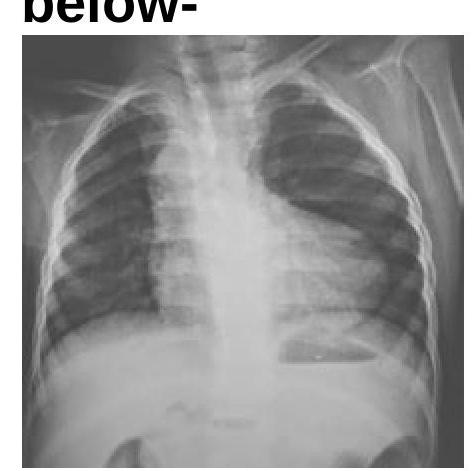
Question 122: The chest radiograph shown below is from a 25-year-old male patient presenting with hypertension. The image demonstrates bilateral inferior rib notching. What is the most likely diagnosis?
- A. Tetralogy of Fallot
- B. Ebstein's Anomaly
- C. TAPVC
- D. Coarctation of Aorta (Correct Answer)
Explanation: ***Coarctation of Aorta*** - The chest radiograph shows findings consistent with **rib notching**, which is a classic sign of coarctation of the aorta due to increased collateral circulation through intercostal arteries. - The history of **hypertension** in a male patient, especially if presenting at a younger age or with differential blood pressures between upper and lower extremities, strongly suggests coarctation of the aorta. *Tetralogy of Fallot* - Characterized by a **boot-shaped heart** due to right ventricular hypertrophy and pulmonary outflow obstruction. - Would typically present with **cyanosis** and decreased pulmonary vascular markings, not rib notching or isolated hypertension. *Ebstein's Anomaly* - Involves apical displacement of the **tricuspid valve**, leading to atrialization of the right ventricle and severe tricuspid regurgitation. - Chest X-rays often show **severe cardiomegaly** (huge heart due to right atrial enlargement) and decreased pulmonary vascularity, which are not depicted here. *TAPVC* - Total anomalous pulmonary venous connection (TAPVC) involves all pulmonary veins draining into the systemic circulation. - The classic chest X-ray finding for supracardiac TAPVC is a **"snowman" or "figure of 8" sign** due to dilated anomalous vessels and superior vena cava, which is absent in this image.
Question 123: Steeple sign is seen in which of the following conditions?
- A. Acute epiglottitis
- B. Acute laryngotracheobronchitis (Correct Answer)
- C. Laryngeal papillomatosis
- D. Bilateral abductor paralysis
Explanation: ***Acute laryngotracheobronchitis*** - The **steeple sign** on an anteroposterior (AP) neck radiograph is a classic finding in acute laryngotracheobronchitis, also known as **croup**. - This sign refers to the **subglottic narrowing** of the trachea, resembling a church steeple, due to edema caused by viral infection. *Acute epiglottitis* - Acute epiglottitis is characterized by the **thumb sign** on a lateral neck radiograph, where the swollen epiglottis appears enlarged. - This condition involves inflammation primarily of the epiglottis, not the subglottic region. *Laryngeal papillomatosis* - Laryngeal papillomatosis is characterized by **wart-like growths** (papillomas) on the vocal cords and larynx, often leading to hoarseness. - Radiographically, it typically appears as irregular soft tissue masses, not the diffuse subglottic narrowing seen in croup. *Bilateral abductor paralysis* - Bilateral abductor paralysis involves the inability of both vocal cords to abduct, leading to a **fixed, narrowed glottic opening**. - This condition presents as a smooth, constant narrowing at the level of the vocal cords rather than the subglottic, conical narrowing of the steeple sign.
Question 124: What is the angle shown in the image known as?
- A. Cobb angle (Correct Answer)
- B. Bohler angle
- C. Ferguson angle
- D. Baumann angle
Explanation: ***Correct Option: Cobb angle*** - The image displays a method for measuring the angle of a spinal curvature, which is known as the **Cobb angle** - This measurement is routinely used to assess the severity of **scoliosis** by drawing lines parallel to the vertebral endplates at the extreme ends of the curve and then determining the angle between these lines - The Cobb angle is the **gold standard** for quantifying scoliosis and monitoring curve progression *Incorrect Option: Bohler angle* - The **Bohler angle** is a measurement used in the assessment of **calcaneal fractures** - It is formed by two lines drawn on a lateral foot X-ray and is not relevant to spinal deformities *Incorrect Option: Ferguson angle* - The **Ferguson angle**, also known as the lumbosacral angle, measures the angle of the sacral base relative to the horizontal - It describes the degree of **lordosis** and is not used to quantify scoliosis as depicted in the image *Incorrect Option: Baumann angle* - The **Baumann angle** is an important measurement used in pediatric orthopedics to assess the alignment of the **distal humerus** after a supracondylar fracture - It is irrelevant to spinal imaging and curvature assessment