Pathology
5 questionsWhich of the following hematological condition is shown below?

Hysterectomy specimen from a 40-year-old lady is shown along with histology slide. The diagnosis is:

The following is a post-orchidectomy histopathological specimen. Diagnosis is:

The image shows a histological section of intestinal tissue with a granuloma. What is the most likely diagnosis?

A 40-year-old man underwent lung transplantation. The resected lung specimen is shown below. Comment on the diagnosis.

NEET-PG 2018 - Pathology NEET-PG Practice Questions and MCQs
Question 241: Which of the following hematological condition is shown below?
- A. Multiple myeloma
- B. Megaloblastic anemia (Correct Answer)
- C. CML
- D. Metastasis
- E. Myelodysplastic syndrome
Explanation: ***Megaloblastic anemia*** - The image likely displays **hypersegmented neutrophils** and **macrocytic red blood cells**, which are characteristic features of **megaloblastic anemia** [1]. - This condition results from impaired DNA synthesis, often due to **vitamin B12** or **folate deficiency**. *Multiple myeloma* - This condition is characterized by the proliferation of **plasma cells** in the bone marrow, leading to **rouleaux formation** of red blood cells and **punched-out lesions** in bones [2]. - While rouleaux can be seen, the primary features of megaloblastic anemia (hypersegmented neutrophils, macro-ovalocytes) are distinct. *CML* - **Chronic Myeloid Leukemia (CML)** is a myeloproliferative neoplasm characterized by the presence of the **Philadelphia chromosome** (BCR-ABL fusion gene) [3]. - Peripheral blood smears typically show a **leukocytosis** with a full spectrum of myeloid maturation, including increased **basophils** and **eosinophils**, which are not the defining features of the image. *Metastasis* - **Metastasis** refers to the spread of cancer cells from a primary tumor to distant sites, often involving the bone marrow. - While bone marrow involvement can lead to various hematological abnormalities, the specific features of **hypersegmented neutrophils** and **macrocytic red blood cells** are not directly indicative of metastasis but rather of a primary hematological disorder like megaloblastic anemia. **References:** [1] Cross SS. Underwood's Pathology: A Clinical Approach. 6th ed. Common Clinical Problems From Blood And Bone Marrow Disease, pp. 613-614. [2] Kumar V, Abbas AK, et al.. Robbins and Cotran Pathologic Basis of Disease. 9th ed. Diseases of White Blood Cells, Lymph Nodes, Spleen, and Thymus, pp. 606-607. [3] Kumar V, Abbas AK, et al.. Robbins and Cotran Pathologic Basis of Disease. 9th ed. Diseases of White Blood Cells, Lymph Nodes, Spleen, and Thymus, pp. 624-625.
Question 242: Hysterectomy specimen from a 40-year-old lady is shown along with histology slide. The diagnosis is:
- A. Carcinoma endometrium
- B. Leiomyoma (Correct Answer)
- C. Leiomyosarcoma
- D. Endometriosis
Explanation: ***Leiomyoma*** - Leiomyomas are **benign smooth muscle tumors** of the uterus, characterized by well-demarcated, whorled, and firm cut surfaces [1]. - Histologically, they show bundles of **smooth muscle cells** arranged in fascicles, with minimal atypia and low mitotic activity [1]. *Carcinoma endometrium* - Endometrial carcinoma typically presents as an **irregular, friable mass** originating from the endometrial lining, often with areas of necrosis or hemorrhage. - Histologically, it shows **glandular proliferation** with architectural complexity, nuclear atypia, and often invasion into the myometrium [2]. *Leiomyosarcoma* - Leiomyosarcomas are **malignant smooth muscle tumors** that are often poorly circumscribed, with areas of hemorrhage and necrosis [1]. - Histologically, they exhibit significant **nuclear atypia**, high mitotic activity (often >10 mitoses/10 HPF), and atypical mitoses [1]. *Endometriosis* - Endometriosis involves the presence of **endometrial glands and stroma outside the uterus**, often forming "chocolate cysts" in the ovaries or implants on peritoneal surfaces. - Histology would reveal **endometrial glands and stroma** surrounded by hemosiderin-laden macrophages, not a smooth muscle tumor. **References:** [1] Kumar V, Abbas AK, et al.. Robbins and Cotran Pathologic Basis of Disease. 9th ed. The Female Genital Tract, pp. 1024-1025. [2] Kumar V, Abbas AK, et al.. Robbins and Cotran Pathologic Basis of Disease. 9th ed. The Female Genital Tract, pp. 1020-1021.
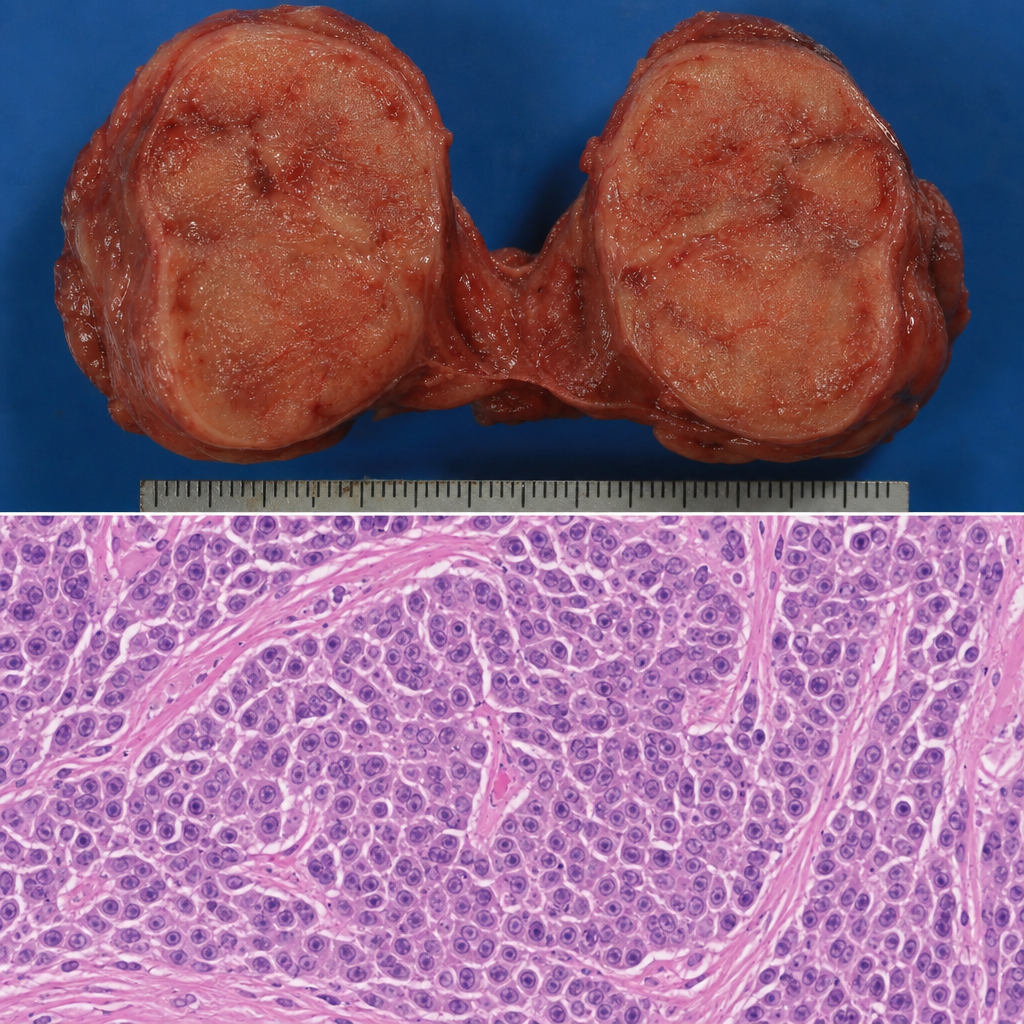
Question 243: The following is a post-orchidectomy histopathological specimen. Diagnosis is:
- A. Seminoma (Correct Answer)
- B. Teratoma
- C. Lymphoma
- D. Yolk sac tumor
Explanation: ***Seminoma*** - The image shows a **monotonous population of large, clear cells** with prominent nucleoli and distinct cell borders, arranged in lobules separated by fibrous septa with **lymphocytic infiltration** [1]. - This classic histological appearance, along with the presence of **syncytiotrophoblasts** (though not explicitly mentioned as a key feature for diagnosis from this image alone, it can be seen in some seminomas), is characteristic of **seminoma**, the most common germ cell tumor of the testis [1]. *Teratoma* - Teratomas are characterized by the presence of **multiple germ layers** (ectoderm, mesoderm, endoderm) with various differentiated tissues like cartilage, bone, neural tissue, or glandular structures [1]. - The image does not show the **heterogeneous tissue differentiation** typical of a teratoma. *Lymphoma* - Testicular lymphoma typically presents with a **diffuse infiltrate of atypical lymphoid cells**, often with a high mitotic rate, and lacks the clear cell appearance and fibrous septa seen in the image. - It is more common in **older men** and can be bilateral, unlike the typical presentation of seminoma. *Yolk sac tumor* - Yolk sac tumors (endodermal sinus tumors) are characterized by various architectural patterns, including **reticular, microcystic, solid, and papillary**, often with **Schiller-Duval bodies** (glomeruloid structures) [1]. - The image does not display these specific patterns or the characteristic Schiller-Duval bodies. **References:** [1] Kumar V, Abbas AK, et al.. Robbins and Cotran Pathologic Basis of Disease. 9th ed. The Lower Urinary Tract and Male Genital System, pp. 979-982.
Question 244: The image shows a histological section of intestinal tissue with a granuloma. What is the most likely diagnosis?
- A. TB
- B. Crohn's (Correct Answer)
- C. Cat scratch disease
- D. Syphilis
Explanation: ***Crohn's*** - Crohn's disease is characterized by **non-caseating granulomas** in the intestinal wall, which are a key diagnostic feature [1][3]. - These granulomas are typically **non-necrotizing** and can be found in any part of the gastrointestinal tract from mouth to anus [1][2]. *TB* - Tuberculosis (TB) typically forms **caseating granulomas** with central necrosis, which is distinct from the non-caseating granulomas of Crohn's. - TB granulomas often contain **Langhans giant cells** [4] and are associated with a specific infectious etiology. *Cat scratch disease* - Cat scratch disease, caused by *Bartonella henselae*, presents with **stellate or suppurative granulomas** in lymph nodes. - These granulomas are characterized by a central area of **necrosis and neutrophils**, surrounded by epithelioid cells, differing from Crohn's. *Syphilis* - Syphilis, particularly in its tertiary stage, can form **gummas**, which are granulomatous lesions. - Gummas are characterized by **coagulative necrosis** and a chronic inflammatory infiltrate, but they are not typically found in the intestinal wall as a primary feature like in Crohn's. **References:** [1] Kumar V, Abbas AK, et al.. Robbins and Cotran Pathologic Basis of Disease. 9th ed. The Gastrointestinal Tract, pp. 806-807. [2] Cross SS. Underwood's Pathology: A Clinical Approach. 6th ed. Common Clinical Problems From Alimentary System Disease, pp. 365-366. [3] Cross SS. Underwood's Pathology: A Clinical Approach. 6th ed. Common Clinical Problems From Alimentary System Disease, pp. 366-367. [4] Kumar V, Abbas AK, et al.. Robbins and Cotran Pathologic Basis of Disease. 9th ed. Inflammation and Repair, p. 109.
Question 245: A 40-year-old man underwent lung transplantation. The resected lung specimen is shown below. Comment on the diagnosis.
- A. Bronchiectasis
- B. Lung abscess
- C. Carcinoma lung
- D. Miliary TB (Correct Answer)
Explanation: ***Miliary TB*** - The image likely shows numerous small, uniform granulomas scattered throughout the lung parenchyma, characteristic of **miliary tuberculosis** [1]. - This widespread dissemination occurs when **Mycobacterium tuberculosis** spreads hematogenously, leading to a "millet seed" appearance on gross and microscopic examination [1]. *Bronchiectasis* - Bronchiectasis is characterized by **permanent dilation of bronchi** and bronchioles due to destruction of the muscle and elastic tissue [1]. - Grossly, it would show dilated, thickened airways often filled with mucus or pus, not diffuse small nodules. *Lung abscess* - A lung abscess is a **localized collection of pus** within the lung parenchyma, typically appearing as a single or a few large cavitary lesions [2]. - It would present as a well-defined cavity with necrotic debris, not numerous small, widely distributed lesions [2]. *Carcinoma lung* - Carcinoma of the lung typically presents as a **mass lesion**, nodule, or infiltrative growth, often with irregular borders [3]. - While multiple metastases can occur, the uniform, small, and widely distributed pattern seen in miliary TB is not typical for primary lung carcinoma [4]. **References:** [1] Cross SS. Underwood's Pathology: A Clinical Approach. 6th ed. Common Clinical Problems From Respiratory Tract Disease, pp. 320-321. [2] Kumar V, Abbas AK, et al.. Robbins and Cotran Pathologic Basis of Disease. 9th ed. The Lung, pp. 715-716. [3] Cross SS. Underwood's Pathology: A Clinical Approach. 6th ed. Common Clinical Problems From Respiratory Tract Disease, pp. 336-337. [4] Kumar V, Abbas AK, et al.. Robbins and Cotran Pathologic Basis of Disease. 9th ed. The Lung, pp. 723-724.
Radiology
5 questionsA 6 month infant was brought with complaints of a failure to gain weight and a large head. On examination, increased head circumference, bounding pulses and features of heart failure were noted. On cranial auscultation loud cranial bruit was heard. MRI head shows? (Recent NEET Pattern 2018-19)

Identify the marked structure in the CT abdomen section shown below? (Recent NEET Pattern 2018-19)

A 65-year-old man presents with bone pains. X-ray Skull shows? (Recent NEET Pattem 2018-19)

A 35-year-old male with history of 4 weeks of immobilization for fracture of femur develops sudden onset breathlessness and blood in sputum. CT angiography shows? (Recent NEET Pattem 2018-19)

A 9-year-old female child presents with history of headache and visual disturbances. X-Ray skull is shown below. What is the possible diagnosis? (Recent NEET Pattern 2018-19)

NEET-PG 2018 - Radiology NEET-PG Practice Questions and MCQs
Question 241: A 6 month infant was brought with complaints of a failure to gain weight and a large head. On examination, increased head circumference, bounding pulses and features of heart failure were noted. On cranial auscultation loud cranial bruit was heard. MRI head shows? (Recent NEET Pattern 2018-19)
- A. Vein of Galen malformation (Correct Answer)
- B. Arachnoid cyst
- C. Arnold-Chiari malformation
- D. Dandy-Walker syndrome
Explanation: ***Vein of Galen formation*** - The clinical presentation of **failure to thrive**, **macrocephaly**, **bounding pulses**, **heart failure**, and a **loud cranial bruit** in an infant is highly characteristic of a **Vein of Galen malformation (VOGM)**. The image would show a dilated vein of Galen. - VOGMs are high-flow arteriovenous malformations that can lead to significant hemodynamic stress on the heart and hydrocephalus due to obstruction of CSF pathways. *Arachnoid cyst* - While arachnoid cysts can cause **macrocephaly** and, less commonly, obstructive hydrocephalus, they generally do not present with **heart failure**, **bounding pulses**, or a **cranial bruit**. - MRI would show a CSF-filled cyst that follows CSF signal on all sequences and typically does not enhance. *Arnold-Chiari malformation* - Arnold-Chiari malformations involve downward displacement of cerebellar tonsils or vermis through the foramen magnum and are associated with hydrocephalus, but they do not typically cause **heart failure**, **bounding pulses**, or a **cranial bruit**. - Clinical features usually relate to brain stem compression or hydrocephalus, such as apnea, stridor, or feeding difficulties. *Dandy-Walker syndrome* - Dandy-Walker syndrome is characterized by hypoplasia of the cerebellar vermis and cystic dilation of the fourth ventricle, often leading to **hydrocephalus** and **macrocephaly**. - However, it does not explain the **bounding pulses**, **heart failure**, or **cranial bruit** seen in this patient, which point to a vascular anomaly.
Question 242: Identify the marked structure in the CT abdomen section shown below? (Recent NEET Pattern 2018-19)
- A. Aorta
- B. Superior mesenteric artery (Correct Answer)
- C. Inferior vena cava
- D. Superior mesenteric vein
Explanation: **Superior mesenteric artery** - The arrow points to a circular, **contrast-filled vessel** anterior to the aorta and posterior to the pancreatic head, characteristic of the **superior mesenteric artery (SMA)** - The SMA originates from the **anterior aspect of the aorta at L1 level** and supplies the midgut structures - In arterial phase CT, the SMA shows **bright contrast enhancement** and appears as a round structure between the aorta and pancreatic uncinate process *Incorrect: Aorta* - The **aorta** is the larger, more posterior vessel with a crescent or oval shape in axial sections - While the SMA branches from the aorta, the marked structure is clearly anterior to the main aortic lumen *Incorrect: Inferior vena cava* - The **IVC** is located to the **right of the aorta** in axial CT sections - The marked structure is **anterior and to the left**, not in the expected IVC position - The IVC would show less enhancement in arterial phase imaging *Incorrect: Superior mesenteric vein* - The **SMV** typically runs to the **right and slightly anterior** to the SMA - In arterial phase CT, the SMV shows **less intense opacification** compared to the arterial structures - The marked structure shows arterial-phase enhancement, indicating it is an artery, not a vein
Question 243: A 65-year-old man presents with bone pains. X-ray Skull shows? (Recent NEET Pattem 2018-19)
- A. Paget's disease
- B. Fibrous dysplasia
- C. Histiocytosis-X
- D. Multiple myeloma (Correct Answer)
Explanation: ***Multiple myeloma*** - The X-ray shows multiple, well-defined, lytic lesions (''**punched-out lesions**'') scattered throughout the skull, which is highly characteristic of multiple myeloma. - This condition is a **plasma cell malignancy** that commonly affects older adults and often presents with **bone pain** due to osteolytic activity. *Paget's disease* - Characterized by abnormal bone remodeling, leading to bone enlargement, thickening, and a **"cotton wool" appearance** on X-ray, which is not seen here. - While it can cause bone pain and skull involvement, the lytic pattern in the X-ray is not typical for Paget's disease. *Fibrous dysplasia* - This condition involves **normal bone marrow** being replaced by **fibrous tissue** and immature bone, often presenting as a **ground-glass appearance** or expansile lesions, usually in younger individuals. - The distinct "punched-out" lesions seen in the image are not characteristic of fibrous dysplasia. *Histiocytosis-X* - Also known as Langerhans cell histiocytosis, it can cause **lytic bone lesions**, particularly in the skull, described as a **"map-like" or "geographic" pattern**. - Although it causes lytic lesions, the pattern in the image, with its numerous small, widespread lytic lesions, is more indicative of multiple myeloma in an older adult.
Question 244: A 35-year-old male with history of 4 weeks of immobilization for fracture of femur develops sudden onset breathlessness and blood in sputum. CT angiography shows? (Recent NEET Pattem 2018-19)
- A. Acute cor-pulmonale (Correct Answer)
- B. Pulmonary oedema
- C. Aortic dissection
- D. Fat embolism
Explanation: ***Acute cor-pulmonale*** - **4 weeks of immobilization** is a major risk factor for **deep vein thrombosis (DVT)** leading to **pulmonary embolism (PE)** - **CT pulmonary angiography** is the gold standard investigation for PE, showing filling defects in pulmonary arteries - Massive or submassive PE causes acute **right ventricular strain** = **acute cor-pulmonale** - Clinical presentation of **sudden breathlessness** and **hemoptysis** is classic for pulmonary thromboembolism - The timing (4 weeks post-immobilization) fits thromboembolism, not fat embolism *Fat embolism* - Occurs **acutely within 24-72 hours** after long bone fracture (especially femur/tibia) - The **4-week delay** makes fat embolism extremely unlikely - Presents with **respiratory distress, petechial rash, and neurological symptoms** (Gurd's criteria) - CT findings show diffuse ground-glass opacities, not typical filling defects seen on CT angiography *Pulmonary oedema* - Caused by **left heart failure** or **ARDS**, showing bilateral interstitial and alveolar fluid - Would show diffuse bilateral infiltrates on imaging, not filling defects in pulmonary vessels - **Hemoptysis** is uncommon in cardiogenic pulmonary edema - No clear cardiac history or precipitant in this patient *Aortic dissection* - Involves a tear in the aortic intima with blood dissecting through the aortic wall - Presents with **sudden severe chest/back pain**, not primarily with hemoptysis - CT angiography would show **aortic flap and false lumen**, not pulmonary vascular abnormalities - Unrelated to femur fracture or prolonged immobilization
Question 245: A 9-year-old female child presents with history of headache and visual disturbances. X-Ray skull is shown below. What is the possible diagnosis? (Recent NEET Pattern 2018-19)
- A. Hypothalamic hamartoma
- B. Craniopharyngioma (Correct Answer)
- C. Histiocytosis- X
- D. Letterer-Siwe disease
Explanation: ***Craniopharyngioma*** - The X-ray skull image shows significant **intracranial calcifications**, which are a hallmark feature of **craniopharyngiomas**, especially in children (seen in 80-90% of cases). - Clinical symptoms like **headache** and **visual disturbances** are consistent with the mass effect of a suprasellar tumor like craniopharyngioma, which can compress the optic chiasm and cause hydrocephalus. - Craniopharyngioma is the **most common suprasellar tumor in children** and typically presents in this age group. *Hypothalamic hamartoma* - These are **non-neoplastic** lesions that typically do not present with diffuse calcifications on X-ray skull. - While they can cause endocrine abnormalities (precocious puberty) and gelastic seizures, headache and visual disturbances with calcifications point more toward craniopharyngioma. *Histiocytosis-X* - Histiocytosis-X (Langerhans cell histiocytosis) typically presents with **lytic bone lesions** (punched-out "geographic skull" lesions) on skull X-ray, not diffuse intracranial calcifications. - While it can affect the hypothalamic-pituitary axis causing diabetes insipidus, the dominant radiological finding would be bone destruction, not calcification. *Letterer-Siwe disease* - This is a severe, disseminated form of **Langerhans cell histiocytosis** (acute disseminated LCH) primarily affecting infants and young children under 2 years. - It usually presents with skin rash, hepatosplenomegaly, lymphadenopathy, and lytic bone lesions, but **intracranial calcifications are not a characteristic feature** on plain skull X-rays. - The age of presentation (9 years) and imaging findings make this diagnosis unlikely.