What is the clinical significance of the Vi antigen in Salmonella typhi?
Which of the following tests is not classified as an in vivo test?
Naegler's reaction is due to:
Which staining method is specifically used for the detection of mycoplasma?
Which anticoagulant is used when blood is sent for blood culture?
Which of the following media is used to identify organisms that ferment lactose?
Which of the following bacteria can be identified using phage typing?
In blood culture the ratio of blood to reagent is?
What type of test is the Paul-Bunnell reaction?
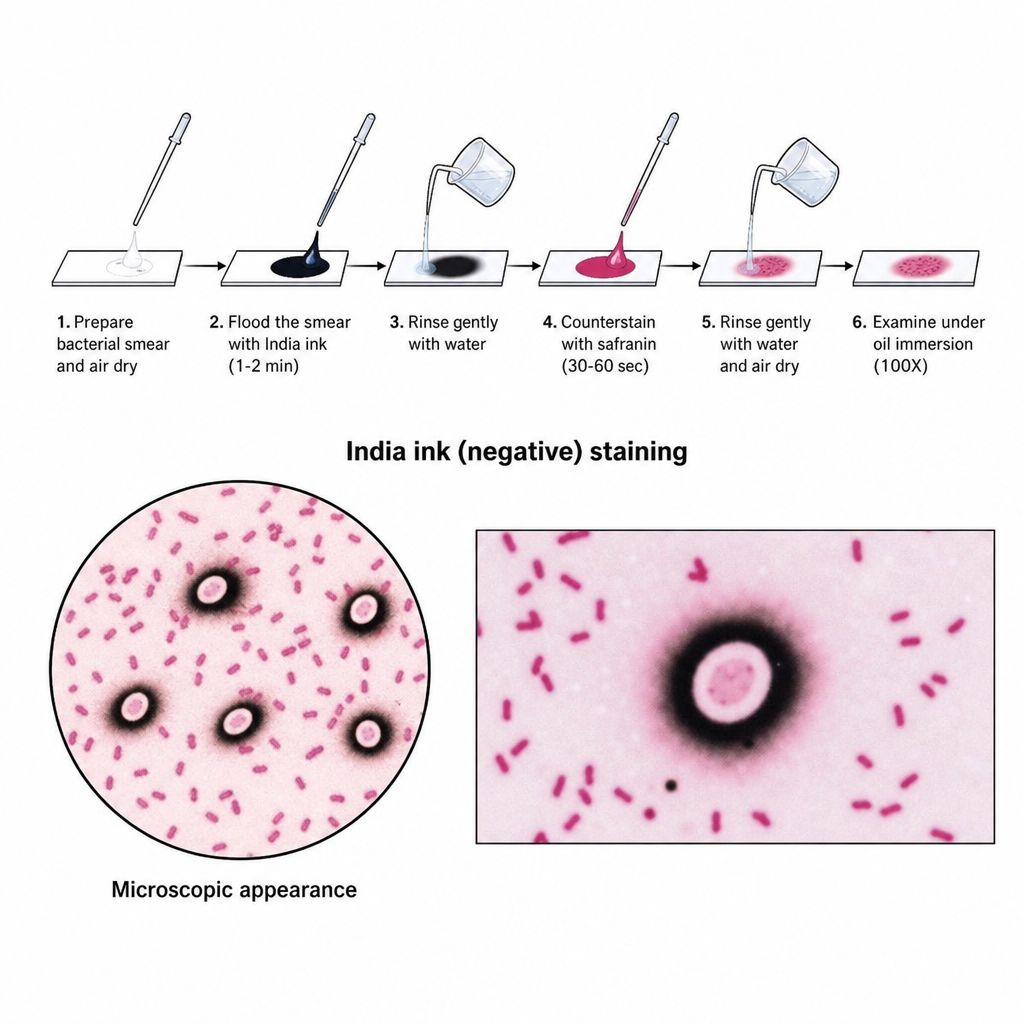
What is the principle of negative staining in microscopy?
Explanation: ***Indicates carrier status in individuals*** - The **Vi (Virulence) antigen** is a **capsular polysaccharide** found on *Salmonella typhi* that helps the bacterium evade immune responses - The presence of persistent **anti-Vi antibodies** is the **hallmark of chronic typhoid carriers**, particularly those harboring bacteria in the **gallbladder** - Vi antibody testing is specifically used for **carrier screening** and identification, as carriers maintain high anti-Vi titers even without active symptoms - This is the **primary clinical significance** of the Vi antigen in diagnostic microbiology *Used for diagnosing typhoid fever* - This is **incorrect** - the Vi antigen is NOT used for diagnosing acute typhoid fever - The standard **Widal test** detects antibodies against **O (somatic)** and **H (flagellar)** antigens, NOT Vi antigen - Acute diagnosis relies on **blood culture** and detection of O and H antibodies, not Vi antibodies - Vi antibodies appear later in infection and persist longer, making them markers of **chronic carriage** rather than acute disease *Stimulates an immune response* - While true that Vi antigen stimulates antibody production, this is not its **clinical significance** - All bacterial antigens stimulate immune responses - this doesn't distinguish Vi antigen's specific clinical utility - The key clinical value lies in its use for **carrier detection**, not merely immunogenicity *Not primarily used in Widal test* - This is a **true statement** but not the answer to what the clinical significance IS - The Widal test uses O and H antigens for acute diagnosis - While accurate, this option describes what Vi antigen is NOT used for, rather than its actual clinical significance as a **carrier marker**
Explanation: ***Elek's gel precipitation test*** - This test is an **in vitro** method used to detect the production of **diphtheria toxin** by *Corynebacterium diphtheriae* strains in a lab setting, not within a living organism. - It involves the precipitation of toxin and antitoxin in an agar gel, forming visible lines. *Schick test* - The Schick test is an **in vivo** test used to determine susceptibility to **diphtheria** by injecting diphtheria toxin subcutaneously and observing for a localized inflammatory reaction. - A positive reaction (inflammation) indicates a lack of protective antitoxin antibodies. *Lepromin test* - The Lepromin test is an **in vivo** test used to assess the type of **leprosy** a patient has and to evaluate their cell-mediated immune response to *Mycobacterium leprae*. - It involves the intradermal injection of lepromin antigen and observing for a delayed hypersensitivity reaction. *Tuberculin test* - Also known as the **Mantoux test**, this is an **in vivo** test used to screen for exposure to **tuberculosis** by injecting purified protein derivative (PPD) intradermally. - A positive reaction indicates a **cell-mediated immune response** to *Mycobacterium tuberculosis*.
Explanation: ***Lecithinase*** - The **Naegler reaction** is a bacterial identification test used to detect the production of **lecithinase** (also known as alpha-toxin) by certain bacteria, particularly *Clostridium perfringens*. - This enzyme hydrolyzes **lecithin** (a lipid found in egg yolk), resulting in a visible opaque precipitate around the bacterial colonies on egg yolk agar. *Coagulase* - **Coagulase** is an enzyme produced by some bacteria (e.g., *Staphylococcus aureus*) that causes the coagulation of blood plasma. - While it is an important virulence factor, it is not involved in the **Naegler reaction**. *Hyaluronidase* - **Hyaluronidase** is an enzyme that breaks down **hyaluronic acid**, a component of connective tissue, facilitating the spread of bacteria. - It is often referred to as a **spreading factor** but is not detected by the **Naegler reaction**. *None of the options* - This option is incorrect because **Lecithinase** is directly responsible for the **Naegler reaction**.
Explanation: ***Dienes method*** - The **Dienes staining method** is a specialized procedure used specifically to identify **Mycoplasma colonies** grown on agar medium. - It works by staining the characteristic **fried-egg appearance** of Mycoplasma colonies. *Fontana method* - The Fontana method is a **silver impregnation stain** used primarily for the visualization of **spirochetes**, such as *Treponema pallidum*. - It is not suitable for detecting Mycoplasma due to their distinct cellular structure and size differences compared to spirochetes. *Lavaditi method* - The Lavaditi method is another type of **silver stain** developed for the detection of **spirochetes** in tissue sections. - Similar to the Fontana method, it is not appropriate for the identification of Mycoplasma. *No applicable method* - This statement is incorrect as the **Dienes method** is, in fact, specifically applicable and widely used for the detection and identification of Mycoplasma colonies. - There are established microbiological techniques for identifying Mycoplasma.
Explanation: ***SPS*** - **SPS (Sodium Polyanethol Sulfonate)** is the preferred anticoagulant for blood cultures because it inhibits phagocytosis and complement activation, allowing microorganisms to survive and grow. - It also neutralizes the bactericidal effect of aminoglycoside antibiotics, which might be present in the patient's blood. *Sodium citrate* - **Sodium citrate** works by binding to calcium ions, preventing blood coagulation, and is typically used for coagulation studies. - It is not suitable for blood cultures as it does not have the anti-phagocytic or antibiotic-neutralizing properties of SPS. *EDTA* - **EDTA (Ethylenediaminetetraacetic acid)** is a strong chelator of calcium and is primarily used for hematology tests like complete blood counts (CBC) as it preserves cell morphology. - It can be toxic to some bacteria and would inhibit microbial growth, making it unsuitable for blood cultures. *Oxalate* - Various **oxalates** (e.g., potassium oxalate) also act as anticoagulants by precipitating calcium, and are commonly found in tubes for glucose testing when combined with a glycolytic inhibitor. - Oxalates are generally unsuitable for blood cultures because they can inhibit the growth of certain microorganisms.
Explanation: ***MacConkey agar*** - **MacConkey agar** is a **differential and selective medium** specifically designed to detect and differentiate **lactose-fermenting gram-negative bacteria**. - It contains **lactose** and a **pH indicator** (neutral red) that turns pink/red in the presence of acid produced by **lactose fermentation**. *Blood agar* - **Blood agar** is a **general-purpose enrichment medium** used for the isolation and detection of **hemolytic activity** (alpha, beta, gamma) of bacteria. - It does not contain pH indicators to demonstrate lactose fermentation. *Chocolate agar* - **Chocolate agar** is an **enriched non-selective medium** used for the isolation of fastidious bacteria like *Haemophilus* species and *Neisseria* species. - It is prepared by heating blood agar, which lyses red blood cells and releases growth factors like **hemin (X factor)** and **NAD (V factor)**. *LJ medium* - **Löwenstein-Jensen (LJ) medium** is a **selective egg-based medium** primarily used for the isolation and cultivation of **Mycobacterium** species, particularly *Mycobacterium tuberculosis*. - It contains **malachite green** to inhibit the growth of other bacteria and is not used to assess lactose fermentation.
Explanation: ***Salmonella*** - **Phage typing** is the most classical and widely used method for subtyping *Salmonella* species based on their susceptibility to specific bacteriophages. - This technique is extensively used in **epidemiological tracking** of outbreaks, particularly for *Salmonella typhi* and *S. enteritidis*, allowing differentiation of strains within the same species. - **Most commonly associated organism** with phage typing in clinical microbiology and medical education. *Streptococcus* - While phage typing was historically used for *Streptococcus pyogenes* (Group A Streptococcus), it has largely been replaced by **molecular typing methods** and is not the primary association when phage typing is mentioned. - *Streptococcus* species are typically identified through **Gram staining**, **catalase tests**, **hemolysis patterns** on blood agar, and **serological methods** (Lancefield grouping). *Shigella* - **Phage typing** is not routinely used for *Shigella* identification or subtyping in clinical practice. - **Serotyping** and **molecular methods** like pulse-field gel electrophoresis (PFGE) or whole genome sequencing are the standard approaches for *Shigella* differentiation. *Pseudomonas* - While **phage typing** has been used for *Pseudomonas aeruginosa* in research and outbreak investigations, it is not the primary or most commonly cited example of phage typing in medical education. - Routine identification relies on **culture characteristics** (pigment production, oxidase positive), **biochemical tests**, and **molecular methods**.
Explanation: ***1:10*** - A 1:10 ratio of **blood to reagent (culture media)** is recommended for optimal growth of microorganisms in blood cultures. - This dilution minimizes the inhibitory effect of **human antimicrobial factors** present in the blood, while still providing sufficient blood volume for pathogen detection. *1:5* - A 1:5 ratio would mean a relatively **higher concentration of blood** in the culture. - This higher concentration could lead to increased inhibition of bacterial growth by **host defense mechanisms** or **antibiotics** present in the patient's blood, potentially causing false-negative results. *1:20* - A 1:20 ratio implies a **lower concentration of blood** relative to the culture media. - While it further dilutes inhibitory factors, it also reduces the total number of microorganisms sampled, possibly leading to **false-negative results** if the bacterial load is low. *1:100* - A 1:100 ratio would result in an **extremely low concentration of blood** in the culture. - This significantly reduces the likelihood of detecting microorganisms, especially when the **bacteremia is sparse**, due to insufficient bacterial inoculum, leading to a high rate of false negatives.
Explanation: ***Agglutination*** - The **Paul-Bunnell reaction** is an **agglutination test** used to detect specific antibodies in infectious mononucleosis. - It identifies **heterophile antibodies** that agglutinate **sheep red blood cells**. *CF* - **Complement Fixation (CF) tests** measure antibody or antigen by observing the *fixation* of complement components. - This method is distinct from the **direct clumping** of cells seen in agglutination. *Precipitation* - **Precipitation reactions** involve soluble antigens and antibodies forming an **insoluble lattice** that settles out of solution. - These reactions detect soluble complexes, not the clumping of cells. *Flocculation test* - **Flocculation tests** are a type of **precipitation reaction** where *finely dispersed particles* form visible clumps (floccules). - While related to precipitation, the Paul-Bunnell reaction specifically involves the *agglutination of red blood cells*.
Explanation: ***The structure to be demonstrated is not stained*** - In **negative staining**, the background surrounding the specimen is stained with acidic dyes (e.g., **India ink** or **nigrosin**), while the specimen itself remains **unstained** - The specimen appears **bright or clear** against a **dark background**, creating contrast through the reverse principle of positive staining - This technique is particularly useful for visualizing delicate structures like **bacterial capsules** (e.g., *Cryptococcus neoformans*) and **spirochetes** that resist conventional staining or would be distorted by heat-fixing - **Key principle:** Stain repelled by specimen → background dark, structure bright *The structure to be demonstrated is stained* - This describes **positive staining** (e.g., **Gram staining**, **acid-fast staining**), where the specimen itself takes up the stain - In positive staining, the structure appears **colored** against a **lighter background** - the opposite of negative staining *The background is not stained* - If neither the background nor the structure is stained, there would be **no contrast** for visualization - This would make the specimen effectively **invisible** under light microscopy *The background and structure are stained* - If both are stained equally, there would be **no differential contrast** to distinguish the specimen from its surroundings - This would result in **poor visualization** and obscure structural details
Specimen Collection and Transport
Practice Questions
Microscopy in Microbiology
Practice Questions
Culture Methods and Media
Practice Questions
Bacterial Identification Techniques
Practice Questions
Antimicrobial Susceptibility Testing
Practice Questions
Serological Diagnosis
Practice Questions
Molecular Diagnostic Methods
Practice Questions
Rapid Diagnostic Tests
Practice Questions
Point-of-Care Testing
Practice Questions
Automation in Microbiology Laboratory
Practice Questions
Quality Control in Diagnostic Microbiology
Practice Questions
Interpretation of Microbiological Reports
Practice Questions
Get full access to all questions, explanations, and performance tracking.
Start For Free