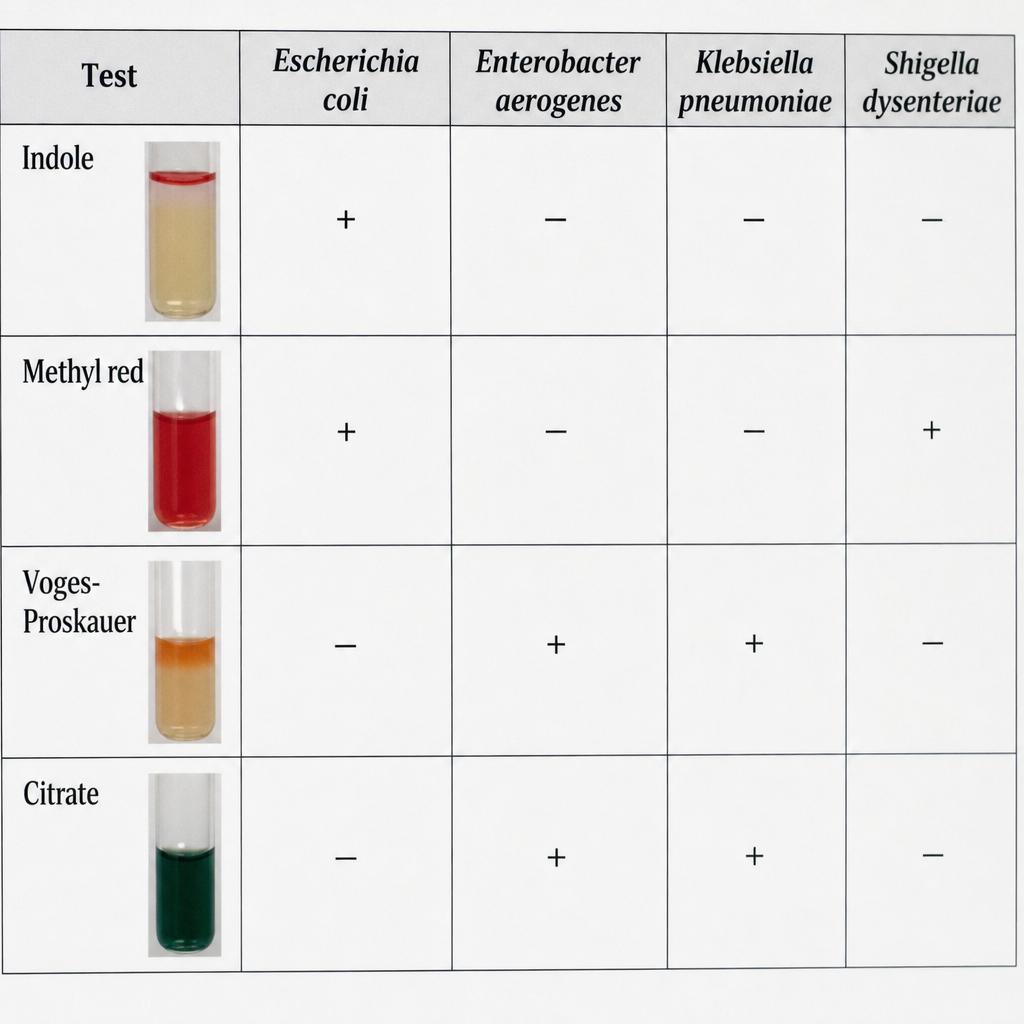
Which among the following culture media is used in the identification of Salmonella?
The culture media that is used to differentiate lactose fermenters and non-lactose fermenters is
Choose the organism identified by the satellite phenomenon shown in the image.
Blood sample of a neonate was plated on the card shown below resulting in extensive growth of B. subtilis. Name the test shown.

Which of the following is shown below?

The following logo depicts which disease?

Which of the following is responsible for green color on antibiotic disk sensitivity testing?

The following image shows presence of:

Which test is shown here?

The following gram stain shows which bacteria?

Explanation: ***Wilson and Blair medium*** - Wilson and Blair medium, also known as **Bismuth Sulfite Agar (BSA)**, is a highly selective and differential medium used primarily for the isolation of **Salmonella** species, particularly *S. Typhi*. - **Salmonella** colonies typically appear **black** on this medium due to the precipitation of **bismuth sulfite** caused by **hydrogen sulfide ($ ext{H₂S}$)** production. *PLET medium* - PLET (Polymyxin-Lysozyme-EDTA-Thallium Acetate) medium is a selective agar strictly used for the isolation of **Bacillus anthracis**. - The medium contains selective agents that suppress the growth of most contaminating bacteria while allowing the growth of *B. anthracis*. *BCYE medium* - **BCYE** (Buffered Charcoal Yeast Extract) medium is the gold standard for culturing **Legionella pneumophila**. - *Legionella* is fastidious and requires **L-cysteine** and **iron salts** which are provided by the BCYE formulation. *Stuart's medium* - Stuart's medium is a **transport medium**, not an identification or culture medium, used for preserving the viability of delicate pathogens during transit. - It is often utilized for transporting specimens containing fastidious organisms such as **Neisseria gonorrhoeae**.
Explanation: ***Mac-Conkey agar*** - MacConkey agar is a selective and differential medium containing **lactose** and a **pH indicator** (neutral red) to distinguish gram-negative bacteria based on their ability to ferment lactose. - **Lactose fermenters** (e.g., *E. coli*, *Klebsiella*) produce acid, causing the colonies and surrounding medium to turn pink/red, while **non-lactose fermenters** (e.g., *Salmonella*, *Shigella*) remain colorless or pale. *Bile salt agar* - Primarily used for the isolation and detection of **enteric pathogens** like *Salmonella* and *Shigella*. - It contains bile salts to suppress the growth of many non-enteric Gram-negative rods but is not the primary medium for differentiating lactose fermentation. *Thayer-Martin agar* - This is a **selective medium** used specifically for the isolation of *Neisseria gonorrhoeae* and *Neisseria meningitidis*. - It contains antimicrobial agents (**vancomycin**, **colistin**, **nystatin**, and **trimethoprim**) to inhibit the growth of normal flora, fungi, and other bacteria. *Sabouraud Dextrose Agar* - This is the standard medium used for the selective isolation and cultivation of **fungi** (yeasts and molds). - Its low pH (typically around 5.6) and high glucose concentration inhibit the growth of most bacteria, making it unsuitable for differentiating lactose fermentation among bacteria.
Explanation: ***Haemophilus influenzae*** - The image displays the **satellite phenomenon**, which is a classic test for identifying *Haemophilus influenzae*. - This organism requires both **Factor X (hemin)** and **Factor V (NAD)** for growth. Blood agar provides Factor X, while a helper organism like *Staphylococcus aureus* (streaked in the center) provides Factor V, allowing *H. influenzae* to grow as satellite colonies around it. *Incorrect: Streptococcus pneumoniae* - This organism grows readily on blood agar, typically showing **alpha-hemolysis** (greenish discoloration). - It is identified by its susceptibility to **optochin** and bile solubility, not by satellitism. *Incorrect: Corynebacterium diphtheriae* - This bacterium is typically cultured on special media like **Loeffler's serum slope** or **tellurite agar**, where it forms characteristic grey-to-black colonies. - It is identified by its club-shaped appearance and **metachromatic granules** when stained with Albert's stain. *Incorrect: Klebsiella pneumoniae* - This organism grows on **MacConkey agar**, producing large, mucoid, pink colonies due to lactose fermentation. - It does not require special growth factors and does not exhibit satellitism.
Explanation: ***Guthrie test*** - The image displays a **bacterial inhibition assay (BIA)** where the presence of elevated levels of a metabolite (specifically **phenylalanine**) in a blood sample allows for the growth of **B. subtilis** that is otherwise inhibited by an antagonist in the medium. - This test is specifically known as the **Guthrie test**, used for **newborn screening** of metabolic disorders like **phenylketonuria (PKU)**. - The test mechanism: *B. subtilis* spores are mixed with agar containing **β-2-thienylalanine** (a metabolic inhibitor that prevents bacterial growth). When a blood sample with **elevated phenylalanine** is placed on the medium, the phenylalanine **overcomes the inhibition** and allows *B. subtilis* to grow. The extent of growth is proportional to the phenylalanine concentration in the blood sample. - Extensive growth of *B. subtilis* indicates **elevated phenylalanine levels**, suggesting PKU. *Nagler reaction* - The Nagler reaction is used to detect the **alpha-toxin (lecithinase)** produced by *Clostridium perfringens*. - It involves inoculating the organism on **egg yolk agar** with and without *C. perfringens* antitoxin; a positive reaction shows opalescence around the growth due to lecithin hydrolysis, which is inhibited on the side with antitoxin. *Reverse CAMP test* - The reverse CAMP test is used to identify **Clostridium perfringens**, which shows **inhibition of hemolysis** (a reverse or negative CAMP effect) when streaked perpendicular to *Staphylococcus aureus* on blood agar. - Note: The standard CAMP test (positive arrowhead hemolysis) is used for **Group B Streptococcus (GBS)** identification. - This is a diagnostic test for specific bacterial interactions and not a metabolic screening method. *Stormy clot reaction* - The stormy clot reaction is a characteristic finding in **milk cultures** inoculated with certain clostridial species, most notably *Clostridium perfringens*. - It describes the rapid **acidification and gas production** by the bacteria, leading to coagulation of milk proteins and fragmentation of the clot by gas bubbles, creating a "stormy" appearance.
Explanation: ***Histogram*** - The image displays vertical bars representing the **frequency** of data values within specific **intervals** or bins - The bars are **contiguous** (touching each other), indicating that the data is **continuous** and grouped into ranges - Used to show the **distribution** of numerical data across continuous intervals - This is a characteristic feature that distinguishes histograms from other chart types *Incorrect: Bar chart* - Bar charts have **separated bars** with gaps between them, not contiguous bars - Used for **categorical data** (discrete categories), not continuous numerical data - Each bar represents a distinct category rather than a data range *Incorrect: Line graph* - Line graphs show data points **connected by lines**, not bars - Used to show **trends over time** or relationships between variables - Does not display frequency distributions using bars *Incorrect: Scatter plot* - Scatter plots display individual data points as **dots** in a coordinate system - Used to show the **relationship or correlation** between two variables - Does not use bars to represent frequency distributions
Explanation: ***Diabetes*** - The **blue circle logo** is the universal symbol for **diabetes awareness**. - It was adopted by the International Diabetes Federation (IDF) and the World Health Organization (WHO) to symbolize the global effort to combat diabetes.
Explanation: **Pyoverdine and pyocyanin** - The characteristic green color in *Pseudomonas aeruginosa* cultures, as seen in the antibiotic disk sensitivity testing agar, is due to the synergistic production of **pyoverdine** (a fluorescent yellow-green pigment and siderophore) and **pyocyanin** (a blue-green phenazine pigment). - These pigments are **excreted products** that contribute to the organism's distinctive appearance on culture media and are factors in its pathogenicity. *Pneumolysin* - **Pneumolysin** is a **cytotoxin** produced by *Streptococcus pneumoniae*, which is responsible for damaging host cells but does not produce green pigmentation in culture. - It is a key virulence factor in pneumococcal infections, contributing to inflammation and tissue injury, but its presence does not result in a green color on agar. *Optochin* - **Optochin** is an **antibiotic** used to differentiate *Streptococcus pneumoniae* (sensitive) from other alpha-hemolytic streptococci (resistant). - Its action is cidal or static against *S. pneumoniae*, creating a **zone of inhibition** around the disk, but it does not produce any color change on its own. *Alpha hemolysin* - **Alpha hemolysis** refers to the **partial lysis of red blood cells**, resulting in a greenish discoloration around bacterial colonies on blood agar, often seen with *Streptococcus pneumoniae* or viridans streptococci. - While it produces a greenish hue, the strong, pervasive green color observed across the entire agar in the context of antibiotic disk sensitivity testing for organisms like *Pseudomonas aeruginosa* is specifically due to the exopigments pyoverdine and pyocyanin, rather than solely alpha hemolysis.
Explanation: ***Optochin sensitivity*** - The image shows a **disc surrounded by a clear zone of inhibition** on a blood agar plate, indicated by the black arrow and red coloration. This pattern is characteristic of an **optochin sensitivity test**, used to differentiate *Streptococcus pneumoniae* from other alpha-hemolytic streptococci. - The **zone of inhibition** demonstrates that the bacterial growth is inhibited by optochin, indicating sensitivity, a key characteristic of *Streptococcus pneumoniae*. *Voges-Proskauer test* - The **Voges-Proskauer test** detects the production of acetoin (a neutral end-product of glucose fermentation) and would involve a liquid medium changing color, not a zone of inhibition on an agar plate. - It is often part of the **IMViC series** for differentiating Gram-negative bacteria, and its results are observed as color changes in a broth culture after reagent addition. *Coagulase test* - The **coagulase test** identifies the ability of bacteria (e.g., *Staphylococcus aureus*) to clot plasma, which is observed as the formation of a clot in a test tube, not a zone of inhibition on an agar plate. - This test is typically performed by mixing a bacterial colony with rabbit plasma and observing for **clot formation**. *Bacitracin test* - A **bacitracin test** also uses a disc on an agar plate, but it is primarily used to differentiate **Group A Streptococcus pyogenes** (sensitive) from other beta-hemolytic streptococci. - The image shows **alpha-hemolysis** (greenish discoloration around the colony), not the complete clearing seen with beta-hemolytic streptococci in a bacitracin test.
Explanation: ***Coagulase test*** - The image shows two test tubes. The top tube, indicated by the arrow, displays a **clotted appearance** in the liquid, while the bottom tube remains liquid. - This difference is characteristic of a positive coagulase test, where bacteria (like *Staphylococcus aureus*) produce **coagulase enzyme** to clot plasma. *Optochin sensitivity* - This test is used to differentiate *Streptococcus pneumoniae* from other alpha-hemolytic streptococci based on their **susceptibility to optochin**. - It involves placing an optochin disk on an agar plate inoculated with bacteria, and a **zone of inhibition** around the disk indicates sensitivity, which is not depicted here. *Voges-Proskauer test* - The Voges-Proskauer test detects the production of **acetoin** by bacteria as an intermediate in the butylene glycol pathway. - A positive result is indicated by a **red color** development after adding reagents like alpha-naphthol and KOH to the bacterial culture. *Citrate test* - The citrate test determines if bacteria can use **citrate as their sole carbon source**. - The indicator **bromothymol blue** changes from green to blue in an alkaline environment, indicating a positive result, which is not shown in the image.
Explanation: ***Staphylococcus aureus*** - The image displays clusters of **Gram-positive cocci**, which is characteristic of *Staphylococcus* species. - While visual identification from a Gram stain alone cannot definitively distinguish *S. aureus* from other staphylococci, this morphology is consistent with *Staphylococcus aureus* (which forms grape-like clusters) and is the most common pathogenic species. *Streptococcus pneumoniae* - *Streptococcus pneumoniae* typically appears as **Gram-positive cocci in pairs (diplococci)** or short chains, not grape-like clusters. - Furthermore, it is often Lancet-shaped and can have a capsule, which is not depicted in the image. *Listeria monocytogenes* - *Listeria monocytogenes* is a **Gram-positive rod**, appearing as short rods, sometimes in pairs or short chains. - The bacteria in the image are clearly cocci, not rods. *Vibrio cholerae* - *Vibrio cholerae* is a **Gram-negative curved rod** or vibrio, meaning it has a comma-like shape and stains pink/red. - The bacteria in the image are cocci and appear purple/blue (Gram-positive) rather than pink/red.
Specimen Collection and Transport
Practice Questions
Microscopy in Microbiology
Practice Questions
Culture Methods and Media
Practice Questions
Bacterial Identification Techniques
Practice Questions
Antimicrobial Susceptibility Testing
Practice Questions
Serological Diagnosis
Practice Questions
Molecular Diagnostic Methods
Practice Questions
Rapid Diagnostic Tests
Practice Questions
Point-of-Care Testing
Practice Questions
Automation in Microbiology Laboratory
Practice Questions
Quality Control in Diagnostic Microbiology
Practice Questions
Interpretation of Microbiological Reports
Practice Questions
Get full access to all questions, explanations, and performance tracking.
Start For Free