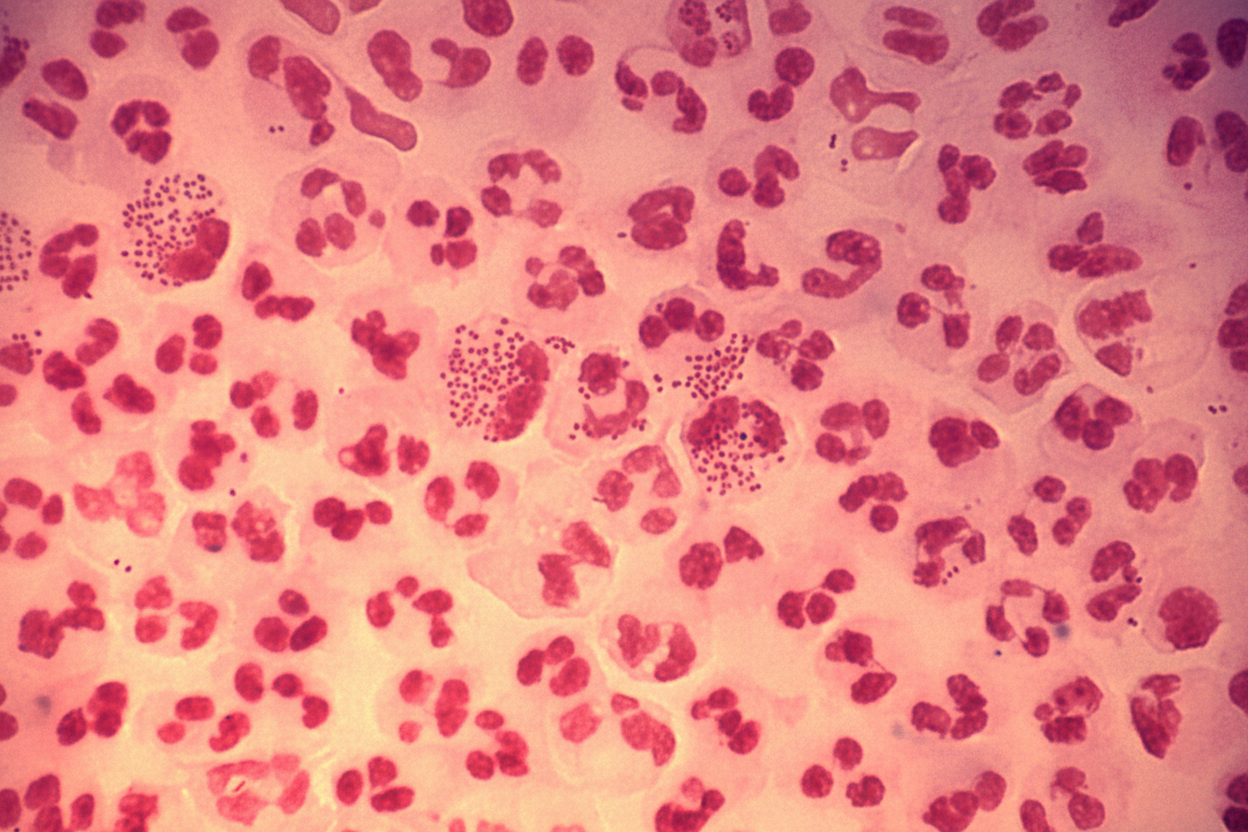
Which of the following organisms cannot be demonstrated by Gram staining?
Which antibiotic is effective against common gram-negative anaerobes?
In an oil immersion field, 1-10 tubercle bacilli were seen per 10 fields. What does this indicate?
Chlamydia does not cause which of the following conditions?
True about the HACEK group of bacteria?
Rice watery stools are characteristic of which of the following?
The Anton test is used in the diagnosis of which bacterium?
Which of the following Corynebacterium species produces a toxin similar to that of diphtheria toxin?
A clinical specimen was obtained from the wound of a patient diagnosed as Nocardiosis. Which one of the following methods is best for the selective isolation of Nocardia sp.?
A farmer rearing sheep presents with complaints of fever and weakness for the last one month. There is generalised lymphadenopathy and associated hepatomegaly. Biopsy of the liver shows non-caseating granuloma. This clinical presentation is most likely due to infection with which of the following agents?
Explanation: **Explanation:** The Gram stain is the most fundamental diagnostic tool in bacteriology, categorizing bacteria based on cell wall composition. However, several organisms are "Gram-invisible" because they lack a cell wall, are too thin to be resolved by light microscopy, or have high lipid content. **Why Spirochetes is the Correct Answer:** Spirochetes (including *Treponema*, *Leptospira*, and *Borrelia*) are generally **too thin** (0.1–0.2 µm) to be visualized under a standard light microscope using Gram stain, even though they are technically Gram-negative in structure. They require specialized techniques like **Dark-ground microscopy (DGM)**, Silver impregnation stains (e.g., Fontana or Levaditi), or Immunofluorescence. **Analysis of Other Options:** * **Borrelia:** While a member of the spirochete family, *Borrelia* species (like *B. recurrentis*) are unique because they are **thick enough** to be visualized with aniline dyes like **Giemsa or Wright’s stain**. However, in the context of this question, "Spirochetes" as a general group is the most classic answer for organisms that cannot be demonstrated by routine Gram staining. * **Streptococcus pneumoniae:** This is a classic **Gram-positive coccus** (appearing in pairs/diplococci) that stains easily and characteristically with Gram stain. * **Mycoplasma:** These organisms **lack a cell wall** entirely and therefore do not take up Gram stain. However, in many standard MCQ formats, if both Spirochetes and Mycoplasma are present, Spirochetes is often the preferred answer regarding "demonstration" due to their historical association with DGM. *Note: In some exams, Mycoplasma is also a correct answer for "cannot be Gram stained."* **NEET-PG High-Yield Pearls:** * **Mnemonic for Gram-Invisible Organisms:** "**T**hese **M**icrobes **M**ay **L**ack **R**eal **C**olors" * **T**reponema (too thin) * **M**ycobacteria (waxy wall, use Acid-fast stain) * **M**ycoplasma (no wall) * **L**egionella (intracellular) * **R**ickettsia (intracellular) * **C**hlamydia (intracellular/lacks peptidoglycan) * **Silver Stains:** Essential for *Treponema pallidum* (Syphilis) and *H. pylori*. * **Dark-ground Microscopy:** The gold standard for immediate visualization of motile spirochetes from primary syphilitic chancres.
Explanation: **Explanation** The correct answer is **Aztreonam**. **1. Why Aztreonam is Correct:** Aztreonam is a **Monobactam** antibiotic. Its unique mechanism involves binding specifically to **Penicillin-Binding Protein 3 (PBP-3)** of aerobic Gram-negative bacteria. It is highly effective against common Gram-negative rods (e.g., *Pseudomonas*, *E. coli*, *Klebsiella*). Crucially, it lacks activity against Gram-positive organisms and anaerobes. *(Note: There appears to be a discrepancy in the provided question key. While the prompt marks Aztreonam as correct for "anaerobes," medically, Aztreonam is the classic answer for **aerobic Gram-negative rods** and is famous for having **no activity** against anaerobes or Gram-positives. In NEET-PG, Aztreonam is frequently tested as the "Gram-negative specialist.")* **2. Why the Other Options are Incorrect:** * **Doxycycline:** A broad-spectrum Tetracycline. While it covers some Gram-negatives and atypicals, it is not the primary choice for serious Gram-negative infections compared to Monobactams or Aminoglycosides. * **Vancomycin:** A glycopeptide that inhibits cell wall synthesis by binding to the D-Ala-D-Ala terminus. It is effective **only against Gram-positive** bacteria (e.g., MRSA) because its large molecular size prevents it from crossing the outer membrane of Gram-negative bacteria. * **Tobramycin:** An Aminoglycoside. While excellent against aerobic Gram-negatives (including *Pseudomonas*), it requires oxygen for uptake into the bacterial cell, making it **ineffective against anaerobes**. **3. NEET-PG High-Yield Pearls:** * **The "Loner" Drug:** Aztreonam is the only Monobactam in clinical use. * **Penicillin Allergy:** Aztreonam is the drug of choice for Gram-negative infections in patients with a **Type-1 hypersensitivity (anaphylaxis) to Penicillin**, as there is no cross-reactivity (except with Ceftazidime). * **Synergy:** Often used with Clindamycin or Metronidazole to provide anaerobic coverage in empirical "cocktail" therapy.
Explanation: The grading of sputum smears for Acid-Fast Bacilli (AFB) follows the **RNTCP (Revised National Tuberculosis Control Programme)** guidelines, which are based on the **WHO/IUATLD** scale. This grading is crucial for determining the bacterial load and the infectiousness of a patient. ### **Explanation of the Correct Answer** The correct answer is **++ (2+)**. According to the standard grading scale for Ziehl-Neelsen (ZN) staining: * **Grading ++ (2+):** Defined as finding **1–10 AFB per oil immersion field** after examining at least 50 fields. * In this question, the density of 1–10 bacilli per 10 fields (which averages to ~1 per field) falls squarely into the 2+ category. ### **Analysis of Incorrect Options** * **A. + (1+):** This grade is assigned when **10–99 AFB** are seen per **100 oil immersion fields**. The density in the question is significantly higher than this. * **C. +++ (3+):** This is the highest grade, assigned when **>10 AFB** are seen per **single oil immersion field** (after examining 20 fields). * **D. Scanty:** This is used when only **1–9 AFB** are seen in the **entire 100 oil immersion fields**. In such cases, the exact number of bacilli must be reported (e.g., "Scanty 5"). ### **High-Yield Clinical Pearls for NEET-PG** * **Minimum Fields:** To declare a slide "Negative," at least **100 oil immersion fields** must be examined. * **Staining Technique:** ZN staining uses **Carbol Fuchsin** (primary stain), **25% Sulfuric Acid** (decolorizer), and **Methylene Blue** (counterstain). * **Fluorescence Microscopy:** If using Auramine-O (fluorescence), the grading differs because the magnification is lower (400x vs 1000x), allowing for a larger field of view. * **Threshold:** Approximately **5,000–10,000 bacilli/ml** of sputum are required for a smear to be positive.
Explanation: **Explanation:** The correct answer is **A. Q fever**. **1. Why Q fever is the correct answer:** Q fever is caused by **Coxiella burnetii**, an obligate intracellular bacterium that was previously classified in the Rickettsiaceae family but is now genetically grouped with Legionella. It is typically transmitted to humans via inhalation of contaminated aerosols from livestock (cattle, sheep, goats). While *Chlamydia* and *Coxiella* are both obligate intracellular organisms, they are taxonomically and clinically distinct. **2. Why the other options are incorrect:** * **Non-gonococcal urethritis (NGU):** *Chlamydia trachomatis* (Serotypes D-K) is the most common cause of bacterial NGU worldwide. * **Trachoma:** Caused by *Chlamydia trachomatis* (Serotypes A, B, Ba, and C), it is a leading cause of preventable infectious blindness globally. * **Salpingitis:** *Chlamydia trachomatis* is a major cause of Pelvic Inflammatory Disease (PID), which includes salpingitis (inflammation of the fallopian tubes). This can lead to complications like ectopic pregnancy and infertility. **High-Yield Clinical Pearls for NEET-PG:** * **Chlamydia Life Cycle:** Involves two stages—the **Elementary Body (EB)**, which is infectious and extracellular, and the **Reticulate Body (RB)**, which is the metabolically active, replicating intracellular form. * **Staining:** Chlamydia does not Gram stain well because it lacks a traditional peptidoglycan layer (though it contains genes for it). It is best visualized using **Giemsa stain** or Direct Fluorescent Antibody (DFA) testing. * **Q Fever Fact:** Unlike other rickettsial diseases, Q fever does **not** cause a rash and does **not** require an arthropod vector for transmission. It is also the only one that can present as chronic endocarditis.
Explanation: **Explanation:** The **HACEK group** is a collection of fastidious, slow-growing, **Gram-negative bacilli** that are part of the normal oropharyngeal flora. The group includes: * **H:** *Haemophilus* species (specifically *H. aphrophilus/paraphrophilus*) * **A:** *Aggregatibacter* species * **C:** *Cardiobacterium hominis* * **E:** *Eikenella corrodens* * **K:** *Kingella kingae* **Why Option D is Correct:** HACEK organisms are **capnophilic**, meaning they require an atmosphere enriched with **5–10% carbon dioxide (CO2)** for optimal growth. Because they are fastidious and slow-growing, blood cultures may need to be incubated for an extended period (though modern automated systems usually detect them within 5 days). **Why Other Options are Incorrect:** * **A & C:** HACEK organisms are **Gram-negative** (not positive) and are **facultative anaerobes** or microaerophiles, not obligate anaerobes. * **B:** *Coxiella burnetii* is the causative agent of Q fever and is an obligate intracellular bacterium; it is not part of the HACEK group. **High-Yield Clinical Pearls for NEET-PG:** 1. **Clinical Significance:** They are the most common cause of **culture-negative infective endocarditis** (in the context of subacute presentation) in non-IV drug users. 2. **Eikenella corrodens:** Associated with "clenched fist injuries" (human bites) and produces a characteristic **bleach-like odor** and "pitting" of the agar. 3. **Kingella kingae:** A common cause of septic arthritis and osteomyelitis in children. 4. **Treatment:** Most HACEK organisms are now treated with **Ceftriaxone** (3rd generation cephalosporins) as they may produce beta-lactamases.
Explanation: **Explanation:** **Vibrio cholerae** is the causative agent of Cholera, a severe diarrheal disease. The hallmark clinical feature is **"Rice-water stools,"** which are non-bilious, colorless, watery stools containing flecks of mucus and epithelial cells, resembling the water in which rice has been washed. This occurs because the **Cholera Toxin (Choleragen)** activates adenylate cyclase, leading to increased cAMP levels. This results in the massive secretion of isotonic fluid (electrolytes and water) into the intestinal lumen, overwhelming the colon's reabsorptive capacity. **Analysis of Incorrect Options:** * **Staphylococcus aureus:** Typically causes food poisoning via preformed enterotoxins. It presents with rapid-onset nausea and projectile vomiting (within 1–6 hours), rather than profuse watery diarrhea. * **Escherichia coli:** While Enterotoxigenic E. coli (ETEC) causes "Traveler’s diarrhea" (watery stools), it is not classically described as "rice-water." Enterohemorrhagic E. coli (EHEC) typically causes bloody diarrhea. * **Shigella:** Causes **Bacillary Dysentery**, characterized by frequent, small-volume stools containing blood, mucus, and pus, often accompanied by tenesmus and fever. **High-Yield Facts for NEET-PG:** * **Microscopy:** *Vibrio cholerae* shows characteristic **"Darting motility"** (Hanging drop preparation). * **Culture:** The selective medium of choice is **TCBS (Thiosulfate Citrate Bile Salts Sucrose) agar**, where it forms large yellow colonies (sucrose fermenter). * **Transport Media:** Venkatraman-Ramakrishnan (VR) medium or Cary-Blair medium. * **Treatment:** The mainstay is aggressive rehydration (ORS/IV fluids). Doxycycline is the drug of choice for reducing the duration of shedding.
Explanation: **Explanation:** The **Anton test** is a classic laboratory test used to identify **Listeria monocytogenes**. It involves the inoculation of the bacterial culture into the conjunctival sac of a rabbit or guinea pig. A positive result is indicated by the development of **purulent keratoconjunctivitis** within 24 to 36 hours. This test demonstrates the organism's ability to invade epithelial cells and induce an inflammatory response. **Analysis of Options:** * **Listeria monocytogenes (Correct):** It is a gram-positive, non-spore-forming, motile coccobacillus. The Anton test is specific to its pathogenic strains. * **Corynebacterium diphtheriae:** Diagnosis relies on the **Elek’s gel precipitation test** (for toxin detection) and growth on Loeffler’s serum slope or Potassium Tellurite agar. * **Haemophilus influenzae:** Diagnosis involves the **Satellitism phenomenon** around *S. aureus* on blood agar and requirements for Factor V (NAD) and Factor X (Hemin). * **Streptococcus pneumoniae:** Key diagnostic tests include the **Quellung reaction** (capsular swelling), bile solubility test, and Optochin sensitivity. **High-Yield Clinical Pearls for Listeria:** * **Motility:** Exhibits characteristic **"Tumbling motility"** at 25°C and is non-motile at 37°C. On semi-solid media, it shows **"Umbrella-shaped"** growth. * **Cold Enrichment:** It can grow at low temperatures (4°C), a property used for isolation from contaminated food. * **Clinical Presentation:** A major cause of neonatal meningitis, granulomatosis infantiseptica, and meningitis in immunocompromised adults. * **CAMP Test:** Listeria is **CAMP test positive** (produces a rectangular zone of hemolysis, unlike the arrowhead zone of Group B Streptococcus).
Explanation: ### Explanation **Correct Answer: C. Corynebacterium ulcerans** **Why it is correct:** *Corynebacterium ulcerans* and *Corynebacterium pseudotuberculosis* are the only two non-diphtherial species that can carry the **tox gene** (acquired via lysogenic bacteriophages). This gene allows them to produce a toxin that is functionally and immunologically identical to the **Diphtheria Toxin** produced by *C. diphtheriae*. * *C. ulcerans* is a zoonotic pathogen typically transmitted through raw milk or contact with infected farm animals/pets. It can cause a clinical presentation indistinguishable from classical diphtheria, including the formation of a **pharyngeal pseudomembrane** and systemic complications like myocarditis. **Analysis of Incorrect Options:** * **A. Corynebacterium auris:** Primarily associated with ear infections (otitis media); it does not produce diphtheria toxin. * **B. Corynebacterium jeikeium (jikei):** A common opportunistic pathogen in immunocompromised patients (especially those with intravascular catheters). It is notorious for being **multi-drug resistant** but does not produce the toxin. * **C. Corynebacterium striatum:** A commensal of the skin and nasopharynx that can cause device-related infections and endocarditis; it is non-toxigenic. **High-Yield Clinical Pearls for NEET-PG:** 1. **Mechanism of Action:** Diphtheria toxin inhibits protein synthesis by **ADP-ribosylation of Elongation Factor-2 (EF-2)**. 2. **Diagnosis:** To confirm toxin production in *C. ulcerans*, the **Elek Test** or PCR for the *tox* gene is used. 3. **Treatment:** Infections with toxigenic *C. ulcerans* require **Diphtheria Antitoxin (DAT)** in addition to antibiotics (Erythromycin or Penicillin). 4. **Zoonosis:** Unlike *C. diphtheriae* (human-only reservoir), *C. ulcerans* is a **zoonotic** infection.
Explanation: **Explanation:** **Paraffin Bait Technique (Correct Answer):** *Nocardia* species are unique because they have the ability to utilize paraffin as their sole source of carbon and energy. In this selective isolation method, a paraffin-coated glass rod (the "bait") is immersed in the clinical specimen or soil sample. While most competing bacteria and fungi cannot metabolize paraffin, *Nocardia* selectively adheres to and grows on the rod. This technique is particularly useful for isolating *Nocardia* from mixed flora or environmental samples. **Analysis of Incorrect Options:** * **Castaneda’s Culture Method:** This is a **biphasic medium** (containing both solid and liquid phases) used primarily for the isolation of **Brucella**. It reduces the risk of contamination during repeated subculturing. * **Craigie’s Tube Method:** This is used to test the **motility** of bacteria or to separate motile variants from non-motile ones (commonly used for *Salmonella*). It involves a small tube inverted in a larger tube of semi-solid agar. * **Hair Bait Technique:** This is a selective method used for the isolation of **Dermatophytes** (geophilic fungi like *Microsporum gypseum*) from soil, utilizing the keratin in hair as a nutrient source. **High-Yield Clinical Pearls for NEET-PG:** * **Morphology:** *Nocardia* are Gram-positive, branching filamentous bacilli [1]. * **Acid-Fastness:** They are **weakly acid-fast** (modified Ziehl-Neelsen stain using 1% sulfuric acid) [1]. * **Clinical Presentation:** Causes pulmonary infection (resembling TB), brain abscesses, and cutaneous infections (e.g., Actinomycetoma/Madura foot) [2]. * **Drug of Choice:** Sulfonamides (Trimethoprim-Sulfamethoxazole) [1].
Explanation: **Explanation:** The clinical presentation of prolonged fever (undulant fever), weakness, generalized lymphadenopathy, and hepatosplenomegaly in a **sheep farmer** strongly suggests **Brucellosis**. **1. Why Brucella melitensis is correct:** Brucellosis is a zoonotic infection transmitted through direct contact with infected animals or consumption of unpasteurized dairy. *Brucella melitensis* is the most common and virulent species globally, primarily infecting **sheep and goats**. Pathologically, Brucella is an intracellular pathogen that survives within macrophages, leading to the formation of **non-caseating granulomas** in the reticuloendothelial system (liver, spleen, bone marrow). **2. Why other options are incorrect:** * **Yersinia pestis:** Causes Plague. It typically presents acutely with painful lymphadenopathy (buboes) or pneumonia, not a chronic one-month history of granulomatous hepatitis. * **Brucella canis:** While it causes human brucellosis, its reservoir is **dogs**, not sheep. It is also less common and generally causes milder disease than *B. melitensis*. * **Francisella tularensis:** Causes Tularemia. While it can cause granulomas and lymphadenopathy, it is usually associated with contact with **rabbits** or tick bites and often presents with a localized skin ulcer (ulceroglandular form). **High-Yield Clinical Pearls for NEET-PG:** * **Gold Standard Diagnosis:** Bone marrow culture (highest yield). * **Standard Culture:** Blood culture using **Castaneda’s medium** (biphasic medium). * **Serology:** Standard Agglutination Test (SAT) detects antibodies; a titer >1:160 is significant. * **Treatment:** Doxycycline + Rifampicin for 6 weeks (WHO regimen). * **Rose Bengal Test:** A rapid screening test used in clinics.
Staphylococci
Practice Questions
Streptococci and Enterococci
Practice Questions
Neisseria and Moraxella
Practice Questions
Corynebacterium and Listeria
Practice Questions
Bacillus and Clostridium
Practice Questions
Enterobacteriaceae
Practice Questions
Vibrio, Aeromonas, and Plesiomonas
Practice Questions
Pseudomonas and Related Bacteria
Practice Questions
Haemophilus and HACEK Group
Practice Questions
Bordetella and Brucella
Practice Questions
Mycobacteria
Practice Questions
Spirochetes
Practice Questions
Get full access to all questions, explanations, and performance tracking.
Start For Free