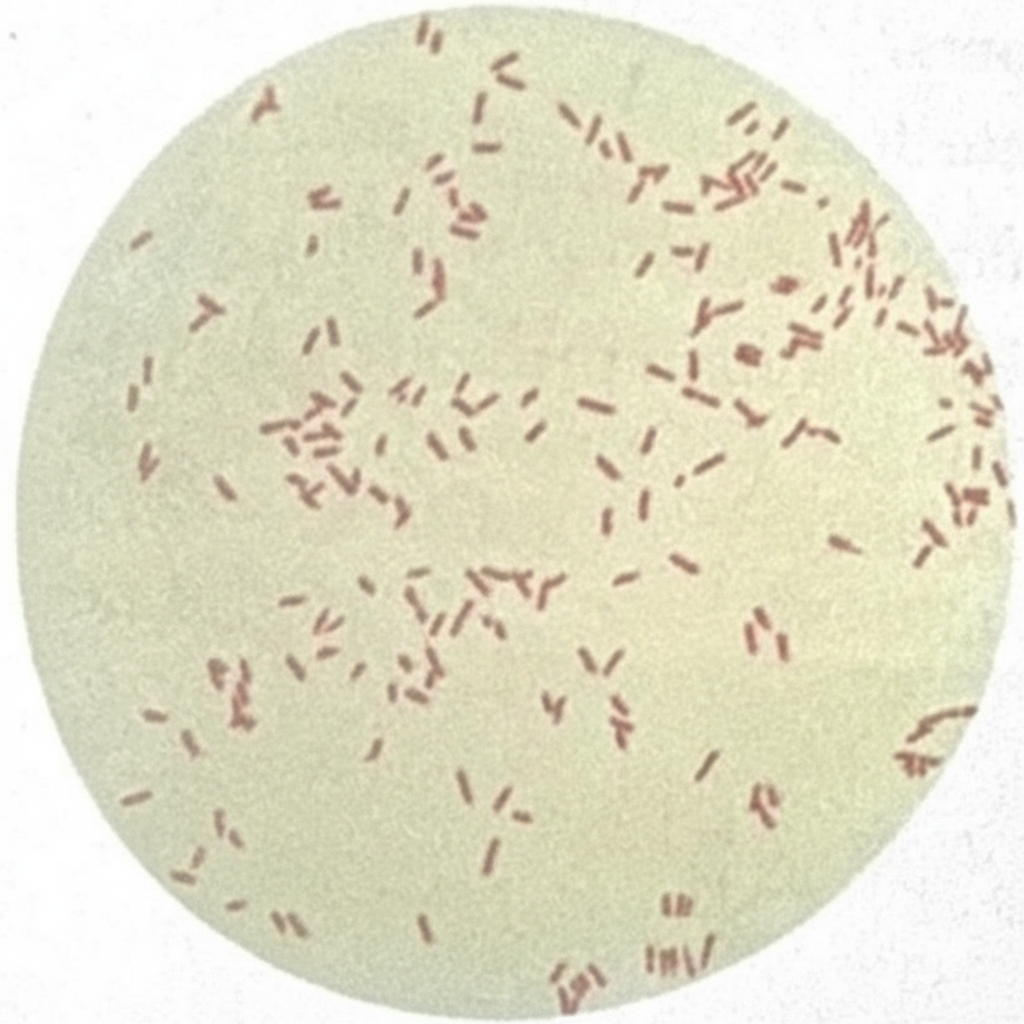
Mycobacterium tuberculosis is differentiated from other atypical mycobacteria by which test?
A microbiologist working with Mycobacteria notes specific colony morphology on Lowenstein-Jensen media. Which mycobacterium is most likely being observed?

Moraxella catarrhalis is resistant to which antibiotic?
Chancroid is caused by:
The Eiken test is which type of reaction used for E. coli?
Which of the following is responsible for antibiotic-associated colitis?
Which of the following is NOT secreted by Staphylococcus?
The capsule of Streptococcus pyogenes is made up of?
A 25-year-old heterosexual male presents with dysuria, noted pus-like urethral discharge, and penile tip tenderness. He has had multiple sexual partners in the past 6 months. Gram staining of the urethral discharge shows Gram-negative cocci. Based on the Gram stain findings, what is the probable causative organism?
What is the best way to differentiate Enterohemorrhagic E. coli from other E. coli strains?
Explanation: ### Explanation **Correct Option: A. Niacin test** *Mycobacterium tuberculosis* (MTB) lacks the enzyme **nicotinamidase**, which is required to convert niacin (nicotinic acid) into nicotinamide adenine dinucleotide (NAD). As a result, niacin accumulates in the culture medium. When tested with chemical reagents (like cyanogen bromide and aniline), a positive result is indicated by a characteristic **canary yellow color**. Most atypical mycobacteria (Non-Tuberculous Mycobacteria or NTM) possess this enzyme and do not accumulate niacin, making this a gold-standard biochemical test to differentiate MTB from NTM. **Incorrect Options:** * **B. AFB Staining:** Acid-Fast Bacilli (AFB) staining (e.g., Ziehl-Neelsen) is used to identify the genus *Mycobacterium* as a whole. Both MTB and atypical mycobacteria are acid-fast due to the high mycolic acid content in their cell walls; therefore, it cannot differentiate between them. * **C. PAS Staining:** Periodic Acid-Schiff (PAS) staining is primarily used to detect glycogen and fungal elements (like *Histoplasma*). It is not a standard diagnostic tool for differentiating mycobacterial species. **High-Yield Clinical Pearls for NEET-PG:** * **Nitrate Reduction Test:** MTB is also positive for nitrate reduction, which helps differentiate it from *M. bovis* (Nitrate negative). * **Catalase Test:** MTB is weakly catalase-positive at room temperature but becomes **catalase-negative at 68°C** (heat-labile). Most atypical mycobacteria remain catalase-positive at 68°C. * **Culture Media:** Lowenstein-Jensen (LJ) medium is the classic solid medium. MTB typically shows "rough, tough, and buff" colonies. * **Rapid Identification:** In modern practice, molecular methods like CBNAAT/GeneXpert are preferred for rapid differentiation and drug resistance testing.
Explanation: ***Mycobacterium tuberculosis*** - Exhibits characteristic **"rough, buff, tough"** (eugonic) colony morphology on **Lowenstein-Jensen media** with a wrinkled, cauliflower-like appearance. - Colonies are **non-pigmented** in light or dark conditions and grow slowly over 2-8 weeks at optimal temperature of **37°C**. *Mycobacterium bovis* - Shows **dysgonic growth** with small, smooth, flat colonies that are much smaller than M. tuberculosis. - Growth is typically **inhibited by pyruvate** and shows reduced growth on standard media compared to M. tuberculosis. *Mycobacterium avium intracellulare* - Produces **smooth, dome-shaped colonies** that are often **scotochromogenic** (pigmented in dark conditions). - Colonies appear **yellow to orange** and have a waxy, glistening surface unlike the rough texture of M. tuberculosis. *Mycobacterium kansasii* - Exhibits **photochromogenic properties**, producing bright **yellow pigment** when exposed to light. - Colonies are typically **smooth and glistening** rather than the characteristic rough morphology described in the question.
Explanation: **Explanation:** The correct answer is **Amoxicillin**. **1. Why Amoxicillin is correct:** *Moraxella catarrhalis* is a Gram-negative diplococcus that is a common cause of respiratory tract infections. The primary mechanism of resistance in *M. catarrhalis* is the production of **beta-lactamase enzymes** (specifically BRO-1 and BRO-2 types). Over **90–95% of clinical isolates** produce these enzymes, which hydrolyze the beta-lactam ring of narrow-spectrum penicillins. Therefore, amoxicillin alone is ineffective as it is easily degraded by these enzymes. **2. Why the other options are incorrect:** * **B & C (Clarithromycin and Azithromycin):** These are macrolides. *M. catarrhalis* is generally susceptible to macrolides, making them common alternative treatments for patients with penicillin allergies. * **D (Amoxicillin and Clavulanic acid):** While *M. catarrhalis* is resistant to amoxicillin alone, it is **highly susceptible** to this combination. Clavulanic acid is a beta-lactamase inhibitor that "suicidally" binds to the enzymes produced by the bacteria, protecting the amoxicillin and allowing it to exert its bactericidal effect. **3. NEET-PG High-Yield Pearls:** * **Morphology:** Gram-negative, kidney-shaped diplococci (resembles *Neisseria*). * **Key Identification Test:** It is **DNase positive** and **Butyrate esterase positive** (the "M. cat" disk test), which differentiates it from *Neisseria* species. * **Clinical Spectrum:** It is a leading cause of **Otitis media** in children and **Acute Exacerbations of COPD (AECOPD)** in adults. * **Hockey Puck Sign:** On agar, colonies can be pushed across the surface with a loop without breaking, similar to a hockey puck.
Explanation: **Explanation:** **Chancroid** is a sexually transmitted infection (STI) characterized by painful genital ulcers and regional lymphadenopathy. 1. **Why Haemophilus ducreyi is correct:** * *Haemophilus ducreyi* is a fastidious, Gram-negative coccobacillus. * **Clinical Presentation:** It causes a "soft chancre," which is a **painful**, non-indurated ulcer with ragged edges. * **Microscopy:** On Gram stain, the bacteria typically arrange themselves in parallel rows, described as a **"School of fish"** or **"Railroad track"** appearance. 2. **Why the other options are incorrect:** * **Herpes simplex virus (HSV):** Causes Genital Herpes. While painful, it typically presents as multiple small, grouped vesicles on an erythematous base rather than a single large ulcer. * **Human Papillomavirus (HPV):** Causes Genital Warts (Condyloma acuminata), which are fleshy, cauliflower-like growths, not ulcerative lesions. * **Treponema pallidum:** Causes Syphilis. The primary lesion (Chancre) is classically **painless**, indurated, and clean-based, unlike the painful ulcer of Chancroid. **NEET-PG High-Yield Pearls:** * **The "Pain" Rule:** Remember **"Ducreyi makes you cry"** (Painful = Chancroid). Syphilis is painless. * **Bubo Formation:** Chancroid is frequently associated with painful, unilateral inguinal lymphadenitis (buboes) which may suppurate. * **Culture Media:** It requires specialized media like **GC agar** with vancomycin or **Mueller-Hinton agar** with 5% heated horse blood. * **Differential Diagnosis:** Always differentiate from *Lymphogranuloma venereum* (Chlamydia trachomatis L1-L3), which presents with a transient painless ulcer followed by painful "Groove sign" lymphadenopathy.
Explanation: The **Eiken test** (also known as the Elek-like test for *E. coli*) is a specific laboratory method used to detect the production of **Heat-Labile Toxin (LT)** produced by Enterotoxigenic *Escherichia coli* (ETEC). ### Explanation of the Correct Answer: * **Precipitation:** The Eiken test is a **gel diffusion precipitation reaction**. It is based on the principle of the Elek’s gel precipitation test used for *C. diphtheriae*. In this test, an antiserum (antitoxin) is incorporated into an agar medium. When the *E. coli* strain is streaked on the agar, the secreted LT toxin diffuses and reacts with the antitoxin. A visible **line of precipitation** forms where the toxin and antitoxin meet at optimal proportions (zone of equivalence). ### Why Other Options are Incorrect: * **Agglutination:** This involves the clumping of particulate antigens (like whole bacteria or RBCs) with antibodies. The Eiken test detects soluble toxins, not whole cells. * **Toxin-Antitoxin Assay:** While the test involves toxins and antitoxins, the *type of reaction* is specifically precipitation. "Toxin-antitoxin assay" is a broad category that includes neutralization tests (like the Schick test), but the Eiken test specifically uses immunodiffusion. * **Complement Fixation Test (CFT):** This is a complex serological test used to detect specific antibodies or antigens using the consumption of complement as an indicator. It is not used for ETEC toxin detection. ### High-Yield Clinical Pearls for NEET-PG: * **ETEC Toxins:** ETEC produces two types of toxins: **Heat-Labile (LT)**, which increases cAMP (similar to Cholera toxin), and **Heat-Stable (ST)**, which increases cGMP. * **Detection of ST:** Unlike LT (detected by Eiken/ELISA), the Heat-Stable toxin is typically detected using the **Suckling Mouse Assay**. * **Gold Standard:** While the Eiken test is a classical method, modern diagnosis of ETEC often relies on **ELISA** or **PCR** for toxin genes. * **Clinical Presentation:** ETEC is the most common cause of **Traveler’s Diarrhea**.
Explanation: **Explanation:** **Clostridium difficile** (now reclassified as *Clostridioides difficile*) is the primary causative agent of **Antibiotic-Associated Colitis** and its more severe form, **Pseudomembranous Colitis**. The underlying mechanism involves the disruption of normal colonic flora by broad-spectrum antibiotics (most classically **Clindamycin**, though Cephalosporins and Fluoroquinolones are now more common triggers). This allows *C. difficile* to overgrow and release two potent exotoxins: * **Toxin A (Enterotoxin):** Causes fluid secretion and mucosal inflammation. * **Toxin B (Cytotoxin):** Causes mucosal damage and leads to the formation of "pseudomembranes" (yellowish plaques consisting of fibrin, mucus, and inflammatory cells). **Analysis of Incorrect Options:** * **A. Clostridium botulinum:** Causes **Botulism**, a paralytic illness characterized by descending flaccid paralysis due to the inhibition of Acetylcholine release at the neuromuscular junction. * **B. Clostridium perfringens:** Most commonly associated with **Gas Gangrene** (myonecrosis) and food poisoning (watery diarrhea). It is not typically associated with antibiotic-induced colitis. * **D. Actinomyces species:** Gram-positive anaerobic bacteria (not spore-forming) that cause chronic granulomatous lesions with abscesses and **"sulfur granules,"** typically in the cervicofacial region. **High-Yield NEET-PG Pearls:** * **Diagnosis:** The gold standard for diagnosis is the **Stool Cytotoxicity Assay**, but the most common rapid test is the **Enzyme Immunoassay (EIA)** for toxins A and B or **GDH (Glutamate Dehydrogenase)** antigen. * **Treatment:** The first-line treatment for *C. difficile* infection is **Oral Vancomycin** or **Fidaxomicin**. Metronidazole is now reserved for mild cases or when other options are unavailable. * **Morphology:** On colonoscopy, look for the "volcano lesion" (erupting pseudomembrane).
Explanation: **Explanation:** The correct answer is **Cellulose**. *Staphylococcus aureus* is a versatile human pathogen that produces a wide array of extracellular enzymes and toxins to invade host tissues. However, it does not produce **Cellulose**, as this enzyme is primarily found in plants, fungi, and certain environmental bacteria (like *Cellulomonas*) to break down plant cell walls. **Analysis of Options:** * **Lipase (A):** Staphylococci produce various lipases that break down lipids on the skin surface. This allows the bacteria to survive in sebaceous areas and facilitates the formation of boils and abscesses. * **Coagulase (C):** This is the hallmark enzyme of *S. aureus*. It converts fibrinogen to fibrin, coating the bacteria in a protective layer to evade phagocytosis. It is the primary laboratory test used to differentiate *S. aureus* from Coagulase-negative Staphylococci (CoNS). * **Lecithinase (D):** Also known as Alpha-toxin or Phospholipase C, this enzyme breaks down lecithin in host cell membranes, leading to cell lysis and tissue necrosis. **NEET-PG High-Yield Pearls:** * **Catalase Test:** All Staphylococci are Catalase positive (differentiates them from Streptococci). * **Golden Yellow Pigment:** Produced by *S. aureus* due to carotenoids (staphyloxanthin), which acts as an antioxidant. * **Protein A:** A key virulence factor in the cell wall that binds to the Fc portion of IgG, preventing opsonization. * **Toxic Shock Syndrome Toxin (TSST-1):** A superantigen that causes massive cytokine release.
Explanation: **Explanation:** **Correct Answer: A. Hyaluronic acid** *Streptococcus pyogenes* (Group A Streptococcus) is unique among most pathogenic bacteria because its capsule is composed of **hyaluronic acid**. This is a critical virulence factor because hyaluronic acid is chemically identical to the ground substance found in human connective tissue. This "molecular mimicry" allows the bacterium to evade the host’s immune system, as the capsule is not recognized as foreign (non-immunogenic), thereby preventing opsonization and phagocytosis. **Analysis of Incorrect Options:** * **B. Polysaccharide:** This is the most common capsule material for the majority of bacteria (e.g., *Streptococcus pneumoniae*, *Neisseria meningitidis*, and *Haemophilus influenzae*). While *S. pyogenes* has a cell wall polysaccharide (Group A antigen), its **capsule** is specifically hyaluronic acid. * **C. Polypeptide:** This is a classic "distractor." Only *Bacillus anthracis* is known for having a polypeptide capsule (made of D-glutamic acid). * **D. Glycopeptides:** This term refers to the structural components of the cell wall (peptidoglycan) or a class of antibiotics (like Vancomycin), but it does not constitute the capsule of any major human pathogen. **High-Yield Clinical Pearls for NEET-PG:** * **M-Protein:** The major virulence factor of *S. pyogenes* is the M-protein (anchored in the cell wall, not the capsule), which is also anti-phagocytic and responsible for molecular mimicry leading to Rheumatic Fever. * **Quellung Reaction:** Since the hyaluronic acid capsule is non-immunogenic, *S. pyogenes* does **not** show a positive Quellung reaction (unlike *S. pneumoniae*). * **Non-Antigenic:** Because it mimics human tissue, the capsule does not induce protective antibodies; immunity to *S. pyogenes* is instead directed against the M-protein.
Explanation: ### Explanation The clinical presentation of acute dysuria, purulent (pus-like) urethral discharge, and penile tenderness in a sexually active male is classic for **Urethritis**. The definitive clue in this question lies in the **Gram stain findings**. **Why Gonococci is correct:** * **Neisseria gonorrhoeae (Gonococci)** is a **Gram-negative diplococcus** (kidney-bean shaped) typically found within polymorphonuclear leukocytes (intracellular). * It is the primary cause of "Gonococcal Urethritis," characterized by a short incubation period (2–7 days) and thick, creamy, purulent discharge. **Why the other options are incorrect:** * **Chlamydia trachomatis:** This is the most common cause of Non-Gonococcal Urethritis (NGU). However, *Chlamydia* is an obligate intracellular bacterium that **does not show up on a standard Gram stain** because it lacks a traditional peptidoglycan cell wall and is too small to be seen under a light microscope. * **Mycoplasma hominis & Ureaplasma urealyticum:** These are also causes of NGU. Like *Chlamydia*, they **lack a cell wall** entirely, meaning they cannot be visualized by Gram staining and are inherently resistant to beta-lactam antibiotics. **High-Yield Clinical Pearls for NEET-PG:** * **Gold Standard Diagnosis:** Culture on **Thayer-Martin medium** (selective) or Chocolate agar. However, **NAAT** (Nucleic Acid Amplification Test) is now the investigation of choice for screening. * **Co-infection:** Patients with Gonorrhea are frequently co-infected with *Chlamydia*. Therefore, empirical treatment often covers both (e.g., Ceftriaxone for Gonococci + Azithromycin/Doxycycline for Chlamydia). * **Gram Stain Sensitivity:** In symptomatic males, a Gram stain of urethral discharge showing intracellular Gram-negative diplococci is >95% sensitive and specific.
Explanation: **Explanation:** **1. Why Sorbitol MacConkey (SMAC) Agar is the Correct Answer:** Enterohemorrhagic *E. coli* (EHEC), specifically the most common serotype **O157:H7**, is unique among *E. coli* strains because it **cannot ferment sorbitol** (or does so very slowly). * On standard MacConkey agar, most *E. coli* are lactose fermenters and appear pink. * On **Sorbitol MacConkey (SMAC) agar**, the lactose is replaced by sorbitol. EHEC O157:H7 produces **colorless (pale) colonies**, while other commensal *E. coli* ferment sorbitol and produce pink colonies. This is the primary screening method used in laboratories to identify EHEC from stool samples. **2. Analysis of Incorrect Options:** * **A. MacConkey Agar:** Most *E. coli* (including EHEC) ferment lactose, so they all appear as pink colonies. It cannot differentiate EHEC from normal flora. * **B. Blood Agar:** While some EHEC strains produce a niche "enterohemolysis," blood agar is non-selective and used for general growth or identifying Gram-positive cocci; it is not a specific diagnostic tool for EHEC. * **C. Nitrate Reduction Test:** All members of the *Enterobacteriaceae* family (including all *E. coli*) are nitrate-positive. It does not differentiate between strains. **3. High-Yield Clinical Pearls for NEET-PG:** * **Toxin:** EHEC produces **Shiga-like toxins (Verotoxins)** which inhibit protein synthesis by targeting the 60S ribosomal subunit. * **Clinical Triad of HUS:** EHEC is the leading cause of **Hemolytic Uremic Syndrome (HUS)**, characterized by Microangiopathic hemolytic anemia, Thrombocytopenia, and Acute Renal Failure. * **Antibiotic Caution:** Avoid using antibiotics for EHEC infections, as they may increase toxin release and worsen the risk of HUS. * **Mnemonic:** **S**orbitol for **S**higa-like toxin producing *E. coli*.
Staphylococci
Practice Questions
Streptococci and Enterococci
Practice Questions
Neisseria and Moraxella
Practice Questions
Corynebacterium and Listeria
Practice Questions
Bacillus and Clostridium
Practice Questions
Enterobacteriaceae
Practice Questions
Vibrio, Aeromonas, and Plesiomonas
Practice Questions
Pseudomonas and Related Bacteria
Practice Questions
Haemophilus and HACEK Group
Practice Questions
Bordetella and Brucella
Practice Questions
Mycobacteria
Practice Questions
Spirochetes
Practice Questions
Get full access to all questions, explanations, and performance tracking.
Start For Free