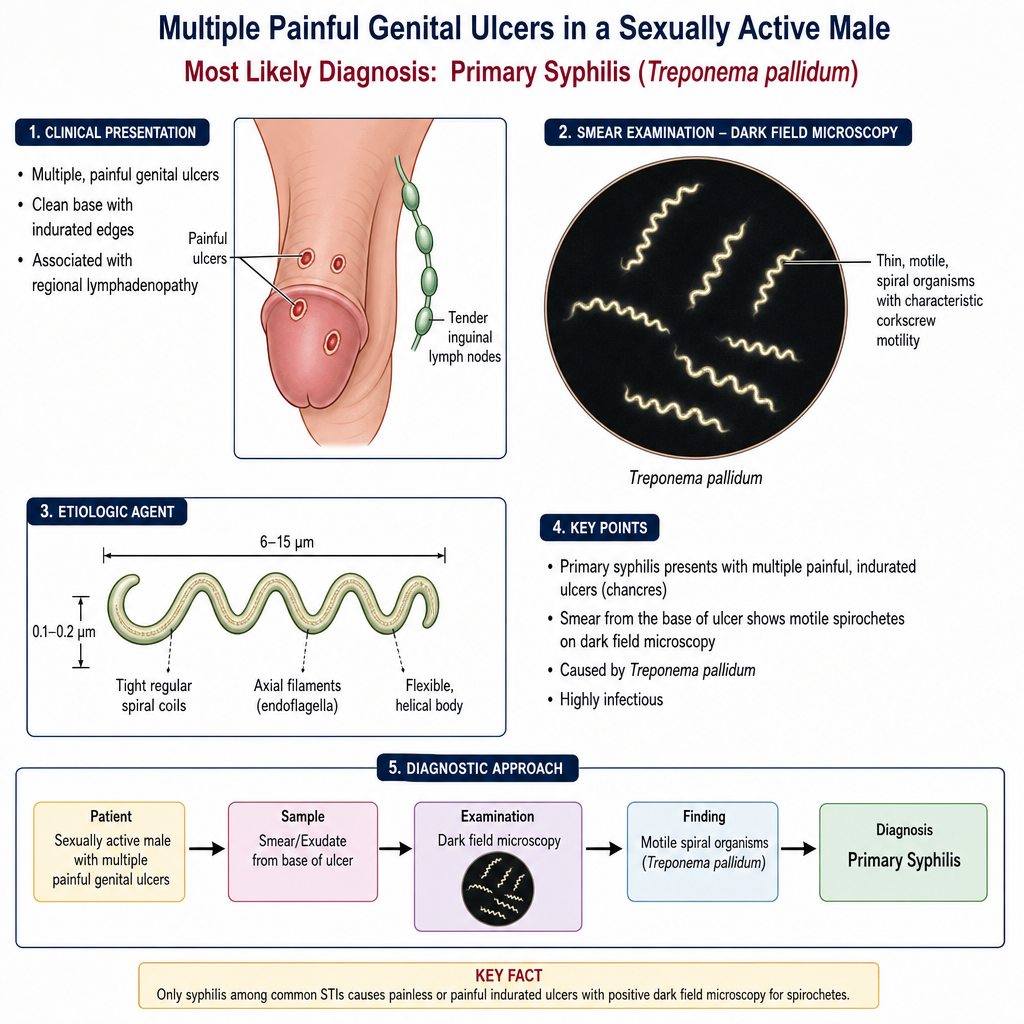
A soft sore is caused by which of the following microorganisms?
Which of the following statements about V. cholerae is false?
Trench fever is caused by:
Which vector transmits diseases caused by both Rickettsia and Orientia?
A 2-year-old boy who missed several scheduled immunizations presents to the emergency room with a high fever, irritability, and a stiff neck. Fluid from a spinal tap reveals 20,000 white blood cells per milliliter with 85% polymorphonuclear cells. Gram stain evaluation of the fluid reveals small pleomorphic gram-negative rods that grow on chocolate agar. If an inhibitor is designed to block its major virulence, which of the following would be the most likely major virulence factor?
Friedlander's bacillus is identified as which bacterium?
Which bacterium is commonly associated with food poisoning?
A 50-year-old male presented with fever, chills, and chest pain during cough. His sputum specimen was cultured on blood agar, showing the presence of alpha-hemolytic colonies the next day. Further processing of this organism is most likely to yield which of the following characteristics?
What growth factor is required for the growth of Vibrio parahaemolyticus?
Which of the following is one of the most likely pathogenic mechanisms of group B streptococcal disease in the neonate?
Explanation: **Explanation:** The correct answer is **Haemophilus ducreyi**. **1. Why Haemophilus ducreyi is correct:** *Haemophilus ducreyi* is the causative agent of **Chancroid**, clinically known as a **"Soft Sore"** or "Soft Chancre." The term "soft" refers to the characteristic painful, non-indurated (soft) ulcer, which distinguishes it from the hard, painless ulcer of syphilis. It is a gram-negative coccobacillus that typically presents with painful genital ulcers and painful inflammatory inguinal lymphadenopathy (buboes). **2. Why the other options are incorrect:** * **Calymmatobacterium granulomatis (now *Klebsiella granulomatis*):** Causes **Granuloma inguinale (Donovanosis)**. It presents as painless, beefy-red, velvety ulcers that bleed on contact. It does not cause a "soft sore." * **Chlamydia trachomatis (Serotypes L1-L3):** Causes **Lymphogranuloma Venereum (LGV)**. It typically presents with a small, transient, painless papule followed by significant, painful regional lymphadenopathy (the "Groove sign"). * **Treponema pallidum:** Causes **Syphilis**. The primary lesion is a **"Hard Chancre,"** which is classically painless, indurated (firm), and clean-based. **3. High-Yield Clinical Pearls for NEET-PG:** * **Microscopy:** *H. ducreyi* shows a characteristic **"School of fish"** or "Railroad track" appearance on Gram stain. * **Culture:** Requires enriched media like **Chocolate Agar** with Vancomycin or **GC agar**. * **Mnemonic:** "It’s so painful, you **do cry** (*ducreyi*)." * **Treatment:** Azithromycin (1g single dose) or Ceftriaxone.
Explanation: ### Explanation **Vibrio cholerae** is a highly resilient, Gram-negative, comma-shaped bacterium. The statement that it "cannot grow in ordinary media" is **false**, making it the correct answer choice. **1. Why Option B is the correct (false) statement:** Unlike fastidious organisms (like *H. influenzae*), *V. cholerae* is very easy to culture. It can grow on **ordinary media** such as Nutrient Agar and Peptone Water. In fact, it is known for its ability to grow at a very high pH (8.5–9.5), a property utilized in enrichment media like Alkaline Peptone Water (APW). **2. Analysis of other options:** * **Option A (Nonhalophilic):** While most *Vibrio* species are halophilic (require high salt), *V. cholerae* and *V. mimicus* are **nonhalophilic**. They can grow in media without added salt, though they can tolerate low concentrations (up to 1% NaCl). * **Option C (Survival outside intestine):** *V. cholerae* can survive for several days in water and moist environments. In favorable conditions (alkaline pH, organic matter), it can persist even longer, which is crucial for its water-borne transmission. * **Option D (Reservoir):** For epidemic cholera, **man is the only known reservoir**. There are no identified animal or insect hosts, though the bacteria can exist in a "free-living" state in aquatic ecosystems attached to copepods. **Clinical Pearls for NEET-PG:** * **Gold Standard Culture:** TCBS (Thiosulfate Citrate Bile Salts Sucrose) agar. *V. cholerae* produces **yellow colonies** due to sucrose fermentation. * **Darting Motility:** Characteristically seen on hanging drop preparation. * **String Test:** Positive (distinguishes *Vibrio* from *Aeromonas*). * **Cholera Toxin:** An AB-type enterotoxin that increases **cAMP**, leading to "rice-water stools."
Explanation: **Explanation:** **Trench Fever** is caused by **Bartonella quintana** (formerly known as **Rochalimaea quintana**). It is a gram-negative, fastidious coccobacillus. The disease gained prominence during World War I among soldiers living in trenches, characterized by a 5-day relapsing fever, headache, and severe bone pain (especially in the shins). **Why Option A is correct:** * **Rochalimaea quintana** is the historical name for *Bartonella quintana*. * It is unique among the Rickettsial group because it can be grown on **cell-free culture media** (blood agar) and is transmitted by the **human body louse** (*Pediculus humanus corporis*). **Why the other options are incorrect:** * **B. Rickettsia prowazekii:** Causes **Epidemic Typhus**. It is also transmitted by the body louse but presents with a characteristic rash and high fever, not the relapsing pattern of Trench fever. * **C. Rickettsia akari:** Causes **Rickettsialpox**. It is transmitted by the house mouse mite (*Liponyssoides sanguineus*) and is characterized by an initial eschar at the bite site. * **D. Rickettsia typhi:** Causes **Endemic (Murine) Typhus**, transmitted to humans by the rat flea (*Xenopsylla cheopis*). **High-Yield NEET-PG Pearls:** 1. **Vector:** The vector for Trench fever is the **Human Body Louse**. 2. **Culture:** Unlike other Rickettsiae, *B. quintana* can grow on artificial media. 3. **Clinical Triad:** Relapsing fever, severe pretibial (shin) pain, and macular rash. 4. **Modern Context:** It is now seen in homeless populations and is a cause of **culture-negative endocarditis** and **Bacillary Angiomatosis** (especially in HIV patients).
Explanation: **Explanation:** The correct answer is **Trombiculid mite** (specifically the larval stage, known as the **chigger**). **Why it is correct:** The family *Rickettsiaceae* is divided into two main genera: *Rickettsia* and *Orientia*. While most *Rickettsia* species are transmitted by ticks, fleas, or lice, **Scrub Typhus** (caused by ***Orientia tsutsugamushi***) is uniquely transmitted by the bite of the larval Trombiculid mite. Additionally, certain species of the genus *Rickettsia*, such as ***Rickettsia akari*** (the causative agent of Rickettsialpox), are also transmitted by mites (specifically the house mouse mite). Therefore, the mite is the common vector for both genera. **Why other options are incorrect:** * **Rat flea (*Xenopsylla cheopis*):** Transmits *Rickettsia typhi* (Endemic/Murine Typhus) and *Yersinia pestis* (Plague), but does not transmit *Orientia*. * **Tick:** Transmits the Spotted Fever Group (e.g., *R. rickettsii* - RMSF, *R. conorii* - Indian Tick Typhus), but not *Orientia*. * **Louse (*Pediculus humanus corporis*):** Transmits *Rickettsia prowazekii* (Epidemic Typhus), but not *Orientia*. **High-Yield Clinical Pearls for NEET-PG:** * **Scrub Typhus Triad:** Fever, headache, and a characteristic **Eschar** (a black, necrotic scab at the site of the mite bite). * **Weil-Felix Test:** Scrub Typhus shows a positive reaction with **OX-K** (Proteus antigen), while the Typhus and Spotted Fever groups react with OX-19 and OX-2. * **Drug of Choice:** Doxycycline is the gold standard treatment for all rickettsial and oriential infections. * **Transovarial Transmission:** In mites, the pathogen is passed from the adult to the egg, making the mite both a vector and a reservoir.
Explanation: ### Explanation **1. Why the Correct Answer is Right:** The clinical presentation (fever, stiff neck, high WBC count with PMN predominance) points to **acute bacterial meningitis**. The description of "small pleomorphic gram-negative rods" that "grow on chocolate agar" is pathognomonic for ***Haemophilus influenzae***. In an unimmunized child, the most likely culprit is ***H. influenzae* type b (Hib)**. The major virulence factor of Hib is its **polyribosylribitol phosphate (PRP) polysaccharide capsule**. This capsule is antiphagocytic, allowing the bacteria to survive in the bloodstream and cross the blood-brain barrier. Because the capsule is the primary determinant of invasiveness and the target of the Hib vaccine, an inhibitor blocking capsule formation would effectively neutralize its pathogenicity. **2. Why the Incorrect Options are Wrong:** * **B. Endotoxin assembly:** While *H. influenzae* possesses Lipooligosaccharide (LOS), which causes inflammation, it is not the *major* virulence factor responsible for its invasive capacity compared to the capsule. * **C. Exotoxin liberation:** *H. influenzae* does not produce potent exotoxins; its damage is primarily mediated by the host inflammatory response to cell wall components. * **D. Flagella synthesis:** *H. influenzae* is non-motile. Flagella are not a feature of this organism. **3. Clinical Pearls for NEET-PG:** * **Culture Requirements:** *H. influenzae* requires **Factor V (NAD)** and **Factor X (Hematin)**. It grows on chocolate agar (where RBCs are lysed to release these factors) but not on blood agar unless "satellitism" occurs around *S. aureus*. * **Vaccine:** The Hib vaccine is a **conjugate vaccine** (PRP capsule linked to a protein carrier like tetanus toxoid) to elicit a T-cell dependent immune response in infants. * **CSF Findings in Bacterial Meningitis:** Low glucose, high protein, and high PMN count (as seen in this case).
Explanation: **Explanation:** **Correct Answer: C. Klebsiella pneumoniae** *Klebsiella pneumoniae* is historically known as **Friedlander's bacillus**, named after Carl Friedländer, who first described it in 1882 as a causative agent of lobar pneumonia. It is a Gram-negative, non-motile, encapsulated bacillus belonging to the *Enterobacteriaceae* family. The prominent polysaccharide capsule is responsible for its characteristic mucoid colony appearance on culture media (like MacConkey agar) and its virulence. **Analysis of Incorrect Options:** * **A. Escherichia coli:** Known as the "colon bacillus." While it is the most common cause of UTIs, it is not associated with Friedländer. * **B. Pseudomonas aeruginosa:** Often referred to as the "blue-pus organism" due to the production of pigments like pyocyanin and pyoverdin. * **C. Vibrio parahemolyticus:** A halophilic (salt-loving) bacterium associated with seafood-borne gastroenteritis and the "Kanagawa phenomenon." **High-Yield Clinical Pearls for NEET-PG:** * **Clinical Presentation:** Classically causes "Friedlander’s pneumonia," characterized by a severe lobar pneumonia with **"currant jelly sputum"** (due to tissue necrosis and hemolysis). * **Risk Factors:** Most commonly affects elderly individuals, diabetics, and chronic alcoholics. * **Morphology:** It is a **mucoid** organism; on MacConkey agar, it produces large, pink, sticky colonies (Lactose Fermenter). * **Biochemicals:** It is Indole negative (usually), MR negative, **VP positive**, and Citrate positive. * **Complications:** Frequently associated with lung abscesses and bulging fissures on chest X-ray.
Explanation: **Explanation:** **Staphylococcus aureus** is the correct answer because it is a leading cause of bacterial food poisoning. The condition is mediated by the ingestion of **pre-formed heat-stable enterotoxins** (Types A-E) produced in contaminated food (typically protein-rich items like custard, mayonnaise, or processed meats). Because the toxin is pre-formed, the incubation period is very short (**1–6 hours**), leading to rapid onset of projectile vomiting and abdominal cramps. **Analysis of Incorrect Options:** * **Staphylococcus epidermidis:** Part of the normal skin flora; it is the most common cause of **prosthetic valve endocarditis** and infections related to indwelling catheters/shunts, but it does not produce enterotoxins. * **Streptococcus pyogenes (Group A Strep):** Primarily causes pharyngitis, impetigo, and immune-mediated sequelae like Rheumatic Fever. It is not associated with foodborne illness. * **Staphylococcus saprophyticus:** A common cause of **Urinary Tract Infections (UTIs)** in young, sexually active females ("honeymoon cystitis"), but it is not enterotoxigenic. **High-Yield Clinical Pearls for NEET-PG:** * **Mechanism:** S. aureus enterotoxin acts as a **Superantigen**, stimulating T-cells and causing massive cytokine release. It also acts on the vagus nerve to stimulate the vomiting center. * **Heat Stability:** The toxin can withstand boiling at 100°C for 30 minutes; thus, reheating contaminated food does not prevent the illness. * **Diagnosis:** Usually clinical. Culture of the patient's stool is often negative because the illness is an **intoxication**, not an infection. * **Differential:** For short incubation periods (<6 hours), consider *S. aureus* (vomiting predominant) or *Bacillus cereus* (emetic type, associated with fried rice).
Explanation: ### Explanation The clinical presentation of fever, chills, and productive cough (suggestive of lobar pneumonia) combined with the laboratory finding of **alpha-hemolytic colonies** on blood agar strongly points toward ***Streptococcus pneumoniae*** (Pneumococcus). **Why Option C is Correct:** *Streptococcus pneumoniae* is the most common cause of community-acquired pneumonia. Under the microscope, it appears as **Gram-positive cocci in pairs** (diplococci) that are characteristically lancet-shaped. As a member of the *Streptococcus* genus, it is **catalase-negative**. A key biochemical feature used to differentiate it from other alpha-hemolytic streptococci (like the Viridans group) is that it is **bile soluble** (it lyses in the presence of bile salts) and **optochin sensitive**. **Why the Other Options are Incorrect:** * **Option A:** Describes *Haemophilus influenzae* or *Moraxella*. While they cause respiratory infections, they are Gram-negative and do not produce alpha-hemolysis on standard blood agar. * **Option B:** Describes *Staphylococcus aureus*. It typically presents with golden-yellow colonies, is **beta-hemolytic**, and appears in clusters. * **Option C:** Describes *Enterococcus* or *Viridans streptococci*. While Viridans are alpha-hemolytic and catalase-negative, they are **bile insoluble** and optochin resistant. **High-Yield Clinical Pearls for NEET-PG:** * **Quellung Reaction:** Swelling of the capsule when treated with specific antiserum (Gold standard for identification). * **Morphology:** Lancet-shaped diplococci. * **Culture:** Shows "draughtsman" or "checkerboard" appearance (central indentation) due to autolysis. * **Vaccines:** Conjugate vaccine (PCV13) and Polysaccharide vaccine (PPSV23) are used for prevention.
Explanation: **Explanation:** **Vibrio parahaemolyticus** is a Gram-negative, halophilic (salt-loving) bacterium. The correct answer is **Saline** because this organism specifically requires a high concentration of sodium chloride (NaCl) for its growth. Unlike *Vibrio cholerae*, which can grow in media with 0% NaCl, *V. parahaemolyticus* is an obligate halophile, typically requiring **1% to 3% NaCl** to thrive, and can tolerate concentrations as high as 8%. This requirement is due to its natural habitat in marine and estuarine environments. **Analysis of Incorrect Options:** * **B. Tryptophan:** While tryptophan is an amino acid used in the Indole test (which *Vibrio* species are positive for), it is not a specific growth factor requirement for *V. parahaemolyticus*. * **C. Bile:** Bile salts are used in selective media (like TCBS agar) to inhibit Gram-positive bacteria, but they are not a growth requirement. *Vibrio* species are bile-tolerant, not bile-dependent. * **D. Citrate:** Citrate is a carbon source used in metabolic testing (Simmons Citrate test). While some *Vibrio* species can utilize citrate, it is not the primary growth factor that defines the species' physiological needs. **NEET-PG High-Yield Pearls:** * **Clinical Presentation:** *V. parahaemolyticus* is the leading cause of seafood-borne gastroenteritis worldwide, often associated with consuming raw or undercooked **shellfish/oysters**. * **Kanagawa Phenomenon:** Pathogenic strains produce a thermostable direct hemolysin (TDH), which causes β-hemolysis on **Wagatsuma agar**. * **Culture Media:** It grows on **TCBS (Thiosulfate Citrate Bile Salts Sucrose) agar**, appearing as **green colonies** because it is a non-sucrose fermenter (unlike *V. cholerae*, which produces yellow colonies).
Explanation: **Explanation:** **Group B Streptococcus (GBS)**, or *Streptococcus agalactiae*, is the leading cause of neonatal sepsis and meningitis. The primary virulence factor of GBS is its **polysaccharide capsule**, which interferes with the host's innate immune response. **Why Option D is Correct:** The GBS capsule inhibits the alternative complement pathway, preventing the deposition of C3b on the bacterial surface. In a neonate, effective clearance requires **opsonization** via the classical complement pathway. This process is strictly dependent on **maternal IgG antibodies** specific to the capsular polysaccharide, which are transplacentally acquired. If the mother lacks these antibodies, the neonate cannot effectively opsonize, recognize, or kill the bacteria via phagocytosis, leading to systemic disease. **Why Other Options are Incorrect:** * **Option A:** While C5a is a chemoattractant, GBS produces **C5a peptidase**, an enzyme that degrades C5a, thereby *inhibiting* PMN recruitment rather than activating it. * **Option B:** GBS remains highly **susceptible to Penicillin G**, which is the drug of choice for both treatment and intrapartum antibiotic prophylaxis (IAP). * **Option C:** The GBS capsule actually **inhibits** the activation of the alternative complement pathway to evade the immune system. **NEET-PG High-Yield Pearls:** * **CAMP Test:** GBS produces "CAMP factor," which enlarges the zone of hemolysis produced by *Staphylococcus aureus* (arrowhead-shaped hemolysis). * **Hippurate Hydrolysis:** GBS is positive for this test (distinguishes it from other Streptococci). * **Screening:** Pregnant women are screened at **35–37 weeks** of gestation via vaginal/rectal swabs. * **Drug of Choice:** Penicillin G (Ampicillin is an alternative).
Staphylococci
Practice Questions
Streptococci and Enterococci
Practice Questions
Neisseria and Moraxella
Practice Questions
Corynebacterium and Listeria
Practice Questions
Bacillus and Clostridium
Practice Questions
Enterobacteriaceae
Practice Questions
Vibrio, Aeromonas, and Plesiomonas
Practice Questions
Pseudomonas and Related Bacteria
Practice Questions
Haemophilus and HACEK Group
Practice Questions
Bordetella and Brucella
Practice Questions
Mycobacteria
Practice Questions
Spirochetes
Practice Questions
Get full access to all questions, explanations, and performance tracking.
Start For Free