Which of the following can be utilized by Salmonella as a sole carbon source?
Which organism causes toxic shock syndrome?
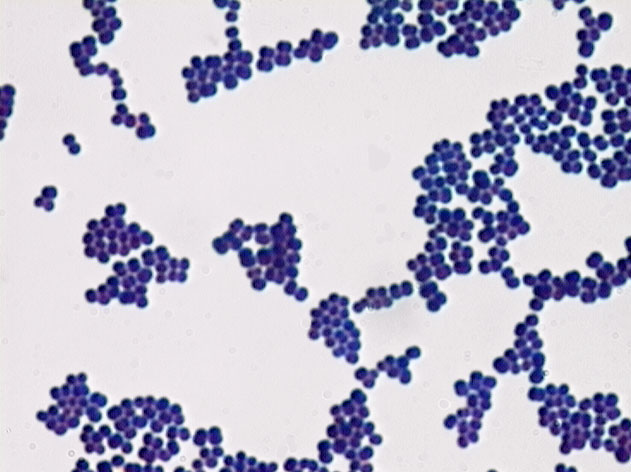
The following gram stain image shows which bacteria?
Which of the following statements about Streptococcus is false?
Explanation: ***Citrate*** - Most *Salmonella* species can utilize **citrate as a sole carbon source**, which is demonstrated by the **Simmons citrate test**. - This is a key biochemical characteristic used in the identification of *Salmonella* species, particularly in differentiating it from other Enterobacteriaceae. - The ability to utilize citrate is encoded by genes for citrate permease and citrate lyase, allowing the organism to transport and metabolize citrate even in the absence of other carbon sources. *Niacin* - **Niacin** (Vitamin B3) is a precursor to NAD and NADP, essential coenzymes for metabolic pathways. - However, most *Salmonella* species can synthesize niacin and do not require it as an exogenous growth factor or sole carbon source. - Niacin is not a characteristic metabolic substrate used for *Salmonella* identification. *Vitamin B-12* - **Vitamin B12** (cobalamin) is a coenzyme for certain metabolic reactions. - *Salmonella* can synthesize vitamin B12 and does not require it as an exogenous sole carbon source. - While *Salmonella* can acquire and use B12, it is not the characteristic substrate for identification purposes. *Tryptophan* - **Tryptophan** is an amino acid that *Salmonella* can metabolize, producing indole as a byproduct in some species. - However, tryptophan is not typically used as a sole carbon source for *Salmonella* growth. - While tryptophan metabolism is important in host-pathogen interactions, it is not the defining metabolic characteristic of *Salmonella* used in laboratory identification.
Explanation: ***Staphylococcus aureus*** - **_S. aureus_** produces **toxic shock syndrome toxin-1 (TSST-1)** or other superantigens, which are potent activators of T cells, leading to a massive cytokine release and the systemic inflammatory response characteristic of **toxic shock syndrome**. - **TSST-1** is responsible for most cases of menstrual toxic shock syndrome, often associated with tampons, while non-menstrual cases can arise from surgical wounds, burns, or other local infections. *Pneumococcus* - **_Streptococcus pneumoniae_** (Pneumococcus) is a common cause of **pneumonia**, **otitis media**, and **meningitis**, but it does not produce toxins that cause toxic shock syndrome. - Its pathogenicity is primarily due to its **capsule**, which helps it evade phagocytosis, rather than superantigen production. *E. coli* - **_Escherichia coli_** is a gram-negative bacterium primarily known for causing **urinary tract infections**, **sepsis**, and **gastroenteritis** (e.g., traveler's diarrhea) through various toxins like **Shiga toxin** or **heat-labile/stable toxins**. - While it can cause severe systemic infections, it is not associated with the production of superantigens leading to toxic shock syndrome. *Enterococcus* - **_Enterococcus_** species (e.g., **_E. faecalis_**, **_E. faecium_**) are common causes of nosocomial infections, particularly **urinary tract infections**, **endocarditis**, and **wound infections**. - They are known for their **antibiotic resistance** but do not produce the specific superantigens associated with toxic shock syndrome.
Explanation: ***Staphylococcus aureus*** - This image clearly shows **Gram-positive cocci** arranged in irregular, grape-like **clusters**, which is the classic microscopic appearance of *Staphylococcus* species, including *Staphylococcus aureus* - The purple color indicates they are **Gram-positive** bacteria - **Cluster arrangement** is the key distinguishing feature of staphylococci on Gram stain *Vibrio cholerae* - *Vibrio cholerae* is a **Gram-negative, comma-shaped bacillus** and would appear as pink/red, curved rods, not purple cocci - The morphology in the image is completely different from Vibrio species *Listeria monocytogenes* - *Listeria monocytogenes* is a **Gram-positive rod** (bacillus), not a coccus - It would appear as purple, rod-shaped bacteria, not spherical cocci - Its characteristic morphology is quite different from the cocci seen in the image *Streptococcus pneumoniae* - *Streptococcus pneumoniae* is a **Gram-positive coccus** but typically appears in **pairs (diplococci)** or short chains, often lancet-shaped - The bacteria in the image are predominantly in **clusters**, which differentiates them from *Streptococcus pneumoniae* - Streptococci arrange in chains or pairs, not grape-like clusters
Explanation: ***Group A Streptococcus is catalase positive*** - This statement is false because all species of **Streptococcus**, including Group A Streptococcus (GAS), are **catalase-negative**. - The absence of the **catalase enzyme** is a key differentiating feature between streptococci and staphylococci, which are catalase-positive. *Group B causes neonatal meningitis* - **Group B Streptococcus (GBS)**, or *Streptococcus agalactiae*, is a well-known cause of **neonatal meningitis** and sepsis. - Infants can acquire GBS during passage through the birth canal from a colonized mother, leading to severe infections. *Group B lives in female genital tract* - GBS is a common commensal organism found in the **lower gastrointestinal** and **female genital tracts** of up to 30% of healthy women. - Its presence in the female genital tract poses a risk for transmission to neonates during childbirth. *Classification by Lancefield based on carbohydrate antigen* - The **Lancefield grouping system** classifies streptococci based on the presence of specific **carbohydrate antigens** in their cell walls. - This serological classification, developed by Rebecca Lancefield, divides streptococci into groups A, B, C, D, F, and G, which helps in identifying different species and their associated pathologies.
Staphylococci
Practice Questions
Streptococci and Enterococci
Practice Questions
Neisseria and Moraxella
Practice Questions
Corynebacterium and Listeria
Practice Questions
Bacillus and Clostridium
Practice Questions
Enterobacteriaceae
Practice Questions
Vibrio, Aeromonas, and Plesiomonas
Practice Questions
Pseudomonas and Related Bacteria
Practice Questions
Haemophilus and HACEK Group
Practice Questions
Bordetella and Brucella
Practice Questions
Mycobacteria
Practice Questions
Spirochetes
Practice Questions
Get full access to all questions, explanations, and performance tracking.
Start For Free