Chlamydia causes all except:
Which of the following statements are true regarding Legionella, EXCEPT?
A girl from Shimla presented to OPD with fever, hypotension, malaise and axillary and inguinal lymphadenopathy. Culture in glucose broth shows stalactite growth. Most likely causative organism is?
What is the generation time for *M. tuberculosis*?
All of the following organisms cause gastroenteritis within 6 hours, EXCEPT:
True about lepra bacilli is
Which of the following is the aetiological agent most often associated with Epiglottitis in children -
A person working in an abattoir presented with malignant pustule on hand. What is the causative agent?
Vital staining technique is used to demonstrate:
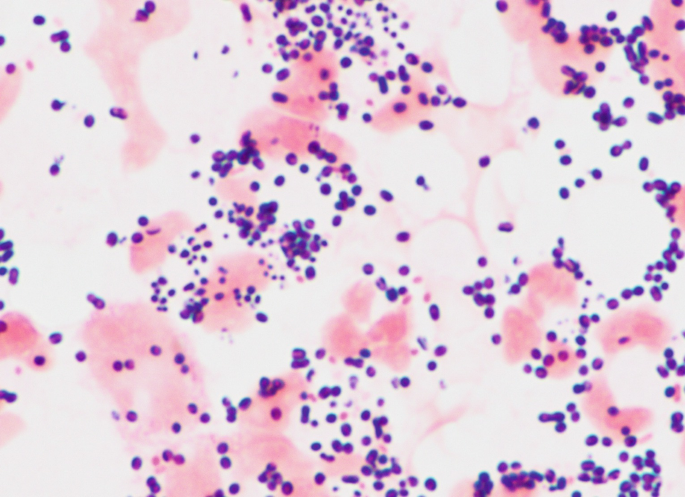
A 9 years old child presented to OPD with complaints of high grade fever, vomiting, one episode of seizure. CSF examination was done and Gram staining of the culture showed the following finding. What is the probable causative agent?
Explanation: ***Typical pneumonia*** - While *Chlamydia pneumoniae* can cause **atypical pneumonia** (walking pneumonia), it does not cause **typical bacterial pneumonia** characterized by lobar consolidation and acute onset, as would be seen with *Streptococcus pneumoniae*. - **Atypical pneumonia** is distinguished by less severe symptoms, gradual onset, and diffuse interstitial infiltrates rather than lobar consolidation. *LGV* - **Lymphogranuloma venereum (LGV)** is a severe form of chlamydial infection caused by specific serovars of *Chlamydia trachomatis* (L1, L2, L3). - It presents with genital ulcers and painful **inguinal lymphadenopathy** (buboes). *Urethritis* - *Chlamydia trachomatis* is a very common cause of **nongonococcal urethritis** in men, often presenting with dysuria, urethral discharge, and itching. - It can also lead to **cervicitis** in women, often asymptomatic. *Trachoma* - **Trachoma** is a chronic conjunctivitis caused by specific serovars of *Chlamydia trachomatis* (A, B, Ba, C) that primarily affects the eyes. - It is a leading preventable cause of **blindness worldwide**, particularly in impoverished regions.
Explanation: ***L. pneumophila lipopolysaccharide is more toxic than other gram-negative species*** - This statement is **false**. The **lipopolysaccharide (LPS)** of *Legionella pneumophila* is **less toxic** than that of other gram-negative bacteria, due to variations in its lipid A structure. - The reduced toxicity of its LPS contributes to the fact that *Legionella* infections typically do not present with the severe septic shock seen in infections with other gram-negative pathogens. *Infections are associated with aerosols* - This statement is **true**. *Legionella* infections, particularly Legionnaires' disease, are primarily acquired through the inhalation of **aerosolized water droplets** containing the bacteria. - Common sources of these aerosols include contaminated air conditioning cooling towers, showers, hot tubs, and decorative fountains. *Amoebas in fresh water habitat act as reservoir* - This statement is **true**. *Legionella* bacteria are **intracellular parasites** of **freshwater protozoa**, particularly amoebae. - Within these amoebae, *Legionella* can multiply and are protected from environmental stresses like chlorine, forming a natural reservoir in aquatic environments. *Carriers are unknown* - This statement is **true**. *Legionella pneumophila* is **not known to have human carriers**. - The transmission is typically from environmental sources to humans, and there is no evidence of person-to-person spread or asymptomatic human carriage that leads to transmission.
Explanation: ***Yersinia pestis*** - The combination of **fever**, **hypotension**, **malaise**, and **inguinal and axillary lymphadenopathy** (buboes) is highly characteristic of **bubonic plague**, caused by *Yersinia pestis*. - **Stalactite growth** in broth culture is a classic identifying feature of *Yersinia pestis* when incubated without agitation, due to the organism's **lipid A-modified LPS** which allows self-aggregation. *Brucella abortus* - *Brucella abortus* causes **brucellosis**, which presents with **undulant fever**, **arthralgia**, and **hepatosplenomegaly**, but typically not with prominent acute lymphadenopathy and hypotension to this degree. - While it is a **facultative intracellular pathogen**, it does not exhibit stalactite growth in glucose broth. *Coxiella burnetii* - *Coxiella burnetii* causes **Q fever**, which is characterized by **fever**, **headache**, and **pneumonia**, often without prominent lymphadenopathy. - It is an **obligate intracellular bacterium** and cannot be cultivated in standard glucose broth, much less show stalactite growth. *Francisella tularensis* - *Francisella tularensis* causes **tularemia**, which can manifest with **fever**, **lymphadenopathy** (ulceroglandular form), and **malaise**. - However, it typically requires **specialized culture media** like cysteine-enriched agar and does not exhibit stalactite growth in glucose broth.
Explanation: ***20-24 hours*** - *Mycobacterium tuberculosis* is characterized by a **slow growth rate**, with a generation time of approximately **20-24 hours**. - This slow growth contributes to the **prolonged incubation period** and the chronic nature of tuberculosis infections. *10-15 hours* - A generation time of 10-15 hours is still relatively slow but faster than that of *Mycobacterium tuberculosis*. - This range is more typical for some other **fastidious bacteria** or those growing in suboptimal conditions. *6-8 hours* - A generation time of 6-8 hours is too rapid for *Mycobacterium tuberculosis*. - This rate is more characteristic of **moderately fast-growing bacteria** under favorable conditions. *30-36 hours* - While *Mycobacterium tuberculosis* is a slow-growing organism, a generation time of 30-36 hours would be even slower than its typical rate. - This extremely slow growth might be seen in highly **stressed or dormant bacterial populations**.
Explanation: ***E. coli*** - **E. coli** gastroenteritis typically has a longer incubation period of **1-3 days (24-72 hours)**, as it involves bacterial colonization and toxin production or invasion of the intestinal lining. - The disease mechanism for most pathogenic *E. coli* strains (ETEC, EPEC, EHEC) involves adhesion and proliferation, which takes significantly more time than preformed toxin ingestion. *Clostridium* - **Clostridium perfringens** is NOT typically associated with onset within 6 hours. Its incubation period is **8-12 hours** (range 6-24 hours). - However, since the question asks about organisms causing gastroenteritis "within 6 hours," and C. perfringens can rarely manifest at 6 hours (lower end of range), it is considered a possible cause within this timeframe, unlike E. coli which requires days. - Symptoms result from **enterotoxin** produced in the gut after spore germination. *Staphylococcus* - **Staphylococcus aureus** food poisoning is caused by ingestion of preformed **enterotoxins** in contaminated food. - This leads to **rapid onset** of symptoms, typically within **1-6 hours** (most commonly 2-4 hours). - Classic presentation: sudden onset of severe vomiting and nausea. *Bacillus cereus* - **Bacillus cereus** emetic type is caused by preformed cereulide toxin, manifesting in **0.5-6 hours** (typically 1-5 hours). - Presents with prominent vomiting, similar to staph food poisoning. - The diarrheal type has a longer incubation of 6-15 hours.
Explanation: ***Mycobacterium leprae can be grown in foot pad of mice*** - **M. leprae** cannot be cultured on artificial media; therefore, it is grown in vivo, typically in the **footpads of mice** or armadillos. - This method allows for the study of the bacterium's growth, drug susceptibility, and the pathogenesis of **leprosy**. - This is the most distinctive laboratory characteristic of M. leprae. *Antileprosy vaccine does not provide lifelong protection* - While this statement is technically true (there is no specific leprosy vaccine, and **BCG vaccine** offers only partial protection with 20-80% efficacy that doesn't provide lifelong immunity), this is not a unique characteristic of lepra bacilli. - BCG reduces the risk but is not a complete preventative measure. *Incubation period is 3-5 years* - The **average incubation period** for leprosy is indeed **3-5 years**, making this statement technically accurate. - However, the incubation period is highly variable and can range from as short as 6 months to over 20 years. - This statement is **acceptable but less specific** than the culture characteristic. *INH does not inhibit their growth* - While this statement is true (**Isoniazid (INH)** is ineffective against **Mycobacterium leprae**), this is not the most defining characteristic of lepra bacilli. - The cell wall structure and metabolic pathways of M. leprae differ from **M. tuberculosis**, rendering INH ineffective against leprosy. - Leprosy is treated with dapsone, rifampicin, and clofazimine instead.
Explanation: ***Haemophilus influenzae type b*** - Historically, **_Haemophilus influenzae_ type b (Hib)** was the most common cause of **epiglottitis** in children. - The introduction of the **Hib vaccine** has significantly reduced its incidence, but it remains a crucial consideration. *Neisseria sp* - **_Neisseria_ species** are typically associated with infections like **meningitis** and **gonorrhea**, not primary causes of epiglottitis. - While **_Neisseria meningitidis_** can cause invasive disease, it's not a common pathogen for epiglottitis. *Moraxella catarrhalis* - **_Moraxella catarrhalis_** is a common cause of **otitis media**, **sinusitis**, and **bronchitis**, especially in children. - It is not a principal cause of acute epiglottitis. *Streptococcus pneumoniae* - **_Streptococcus pneumoniae_** is a major cause of **pneumonia**, **otitis media**, **meningitis**, and **sepsis**. - While it can cause respiratory infections, it is not the most frequent pathogen associated with epiglottitis compared to Hib pre-vaccine era.
Explanation: **Bacillus anthracis** - The presence of a **malignant pustule** on the hand, especially in an individual working in an **abattoir** (exposure to animals/animal products), is highly characteristic of **cutaneous anthrax**. - **Bacillus anthracis** is a **spore-forming bacterium** that causes anthrax, and the cutaneous form typically presents as a painless ulcer that develops into a black eschar. *Clostridium botulinum* - This bacterium causes **botulism**, a severe **neuroparalytic disease** characterized by flaccid paralysis. - It does not cause cutaneous lesions like a malignant pustule and is typically associated with **food poisoning** or wound infections leading to toxin production. *Streptococcus pyogenes* - This bacterium is a common cause of various infections, including **strep throat**, **impetigo**, **erysipelas**, and **necrotizing fasciitis**. - While it can cause skin infections, it does not typically present as a "malignant pustule" with the characteristic eschar seen in anthrax. *Clostridium perfringens* - This bacterium is a common cause of **gas gangrene** (myonecrosis) and **food poisoning**. - While it can cause severe tissue infections, it does not present as a malignant pustule.
Explanation: ***Living bacteria*** - **Vital staining** uses dyes taken up by living cells without killing them, allowing for the observation of their morphology and some physiological activities without fixation. - Examples include methylene blue and neutral red, which can stain living cells like bacteria and protozoa, helping to differentiate them from non-living matter or dead cells. *Bacterial toxins* - **Bacterial toxins** are substances produced by bacteria that can harm a host and are typically detected using immunological assays or biological functional tests, not vital staining. - Vital staining focuses on the cellular components and viability of the bacteria themselves, not on secreted products like toxins. *Dead bacteria* - **Dead bacteria** often have compromised cell membranes and would either not take up vital stains in the same way as living bacteria or might take up certain stains (like trypan blue or propidium iodide) that are specifically used to identify dead cells by penetrating their damaged membranes. - Vital staining's primary purpose is to visualize *living* structures, relying on intact cell membranes and metabolic activity. *Fungal spores* - While some **fungal spores** can be stained with various techniques, vital staining methods are generally employed to distinguish living, metabolically active cells (including some fungal cells) from dead ones or debris. - However, the question specifically refers to "vital staining technique" in general terms, and the most classic and direct association is with the demonstration of living microbial cells, especially bacteria.
Explanation: ***Gram-positive diplococci (e.g., Streptococcus pneumoniae)*** - The image displays small, purple (Gram-positive) cocci arranged in pairs (**diplococci**). - *Streptococcus pneumoniae* is a common cause of **bacterial meningitis** in children, and its characteristic morphology on Gram stain is Gram-positive diplococci. *Gram-negative coccobacilli (e.g., Haemophilus influenzae)* - While *Haemophilus influenzae* can cause meningitis in children, its Gram stain morphology would show **pink-stained coccobacillary forms**, not purple cocci. - The bacteria in the image are clearly cocci, not coccobacilli, and stain Gram-positive (purple). *Gram-negative diplococci (e.g., Neisseria meningitidis)* - *Neisseria meningitidis* is a significant cause of meningitis and appears as **Gram-negative (pink) diplococci**. - The organisms in the image are stained purple, indicating they are Gram-positive. *Gram-positive cocci in chains (e.g., Streptococcus pyogenes)* - *Streptococcus pyogenes* typically forms **chains of Gram-positive cocci**, which is not the predominant arrangement seen in the image. - Although it is Gram-positive, the characteristic arrangement in the image is diplococci, not chains.
Staphylococci
Practice Questions
Streptococci and Enterococci
Practice Questions
Neisseria and Moraxella
Practice Questions
Corynebacterium and Listeria
Practice Questions
Bacillus and Clostridium
Practice Questions
Enterobacteriaceae
Practice Questions
Vibrio, Aeromonas, and Plesiomonas
Practice Questions
Pseudomonas and Related Bacteria
Practice Questions
Haemophilus and HACEK Group
Practice Questions
Bordetella and Brucella
Practice Questions
Mycobacteria
Practice Questions
Spirochetes
Practice Questions
Get full access to all questions, explanations, and performance tracking.
Start For Free