The causative organism of Chancroid is
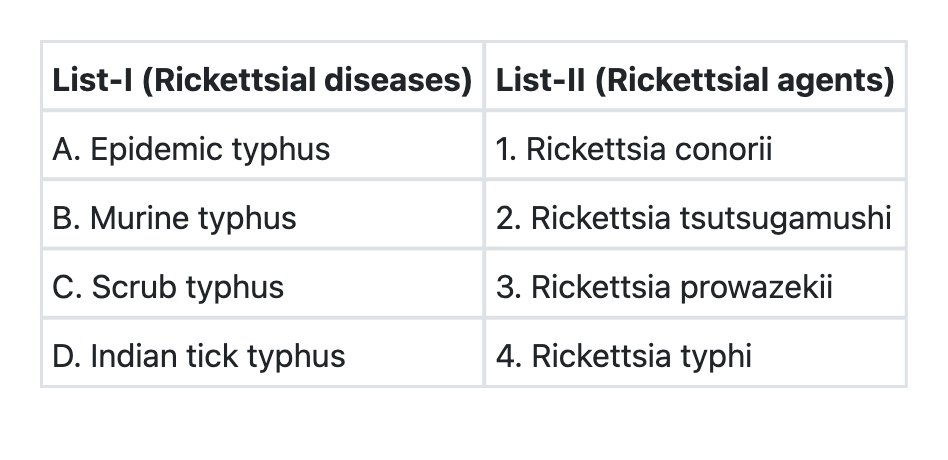
Match List-I with List-II and select the correct answer using the code given below the Lists:
Which of the following cause/causes bacterial vaginosis? 1. Gardnerella 2. Mycoplasma hominis 3. Ureaplasma urealyticum Select the correct answer using the code given below:
A surgeon told the patient’s attendant that his patient has “flesh eating bug” which is the cause of such severe infection in his dirty wound on his lower limb. Which organism was the surgeon referring to?
The most common organism causing Acute Otitis media in children is:
A 27-year-old man presents with clear urethral discharge and dysuria for 3 days. Gram stain shows numerous polymorphonuclear leukocytes without intracellular diplococci. What is the most likely pathogen?
What mechanism accounts for the neuroinvasive potential of Treponema pallidum?
Which structure of Treponema pallidum is responsible for its characteristic motility?
Which organism causes Granuloma inguinale (Donovanosis)?
What structure of Neisseria gonorrhoeae is primarily responsible for its pathogenicity?
Explanation: ***Haemophilus ducreyi*** - **Chancroid** is a sexually transmitted infection characterized by painful genital ulcers and regional lymphadenopathy, caused by the bacterium **Haemophilus ducreyi**. - This bacterium is a **Gram-negative coccobacillus** that requires specific culture media for isolation. *Chlamydia trachomatis* - **Chlamydia trachomatis** is responsible for **chlamydia**, a common STI, and can also cause **lymphogranuloma venereum (LGV)**, which presents with lymphadenopathy and sometimes genital ulcers but not typically the soft, painful ulcers seen in chancroid. - Infections with *Chlamydia trachomatis* are often **asymptomatic** or cause symptoms like urethritis, cervicitis, or proctitis. *Klebsiella granulomatis* - **Klebsiella granulomatis** (formerly *Calymmatobacterium granulomatis*) is the causative agent of **granuloma inguinale** (also known as donovanosis). - **Granuloma inguinale** presents with painless, beefy red, friable ulcerative lesions, which clinically differ from the painful ulcers of chancroid. *Psittacosis lymphogranuloma group* - This option incorrectly groups **psittacosis** (caused by *Chlamydia psittaci*) with **lymphogranuloma venereum (LGV)**, which is caused by specific serovars of *Chlamydia trachomatis*. - **Psittacosis** is primarily a pulmonary infection transmitted by birds, while **LGV** is a sexually transmitted infection distinct from chancroid.
Explanation: ***A→3 B→4 C→2 D→1*** - **Epidemic typhus** is caused by *Rickettsia prowazekii*, primarily transmitted by the **human body louse**. - **Murine typhus** is caused by *Rickettsia typhi*, transmitted by **fleas typically found on rodents**. - **Scrub typhus** is caused by *Orientia tsutsugamushi* (formerly *Rickettsia tsutsugamushi*), transmitted by the bite of **chiggers (larval mites)**. - **Indian tick typhus** is a form of spotted fever group rickettsiosis, often caused by *Rickettsia conorii*, transmitted by **ticks.** *A→2 B→4 C→1 D→3* - This option incorrectly associates Epidemic typhus with *Rickettsia tsutsugamushi* and Indian tick typhus with *Rickettsia prowazekii*. - Epidemic typhus is caused by *Rickettsia prowazekii*, and *Rickettsia tsutsugamushi* causes Scrub typhus. *A→1 B→4 C→3 D→2* - This option incorrectly identifies *Rickettsia conorii* as the agent for Epidemic typhus and *Rickettsia tsutsugamushi* for Indian tick typhus. - *Rickettsia conorii* is associated with Mediterranean spotted fever (a form of tick typhus), and *Rickettsia tsutsugamushi* causes Scrub typhus. *A→4 B→1 C→3 D→2* - This option incorrectly matches Epidemic typhus with *Rickettsia typhi* and Scrub typhus with *Rickettsia prowazekii*. - *Rickettsia typhi* causes Murine typhus, and *Rickettsia prowazekii* causes Epidemic typhus.
Explanation: ***1, 2 and 3*** - Bacterial vaginosis is a polymicrobial syndrome resulting from an imbalance in the vaginal flora, often characterized by a decrease in **Lactobacilli** and an overgrowth of various anaerobic bacteria. - **Gardnerella vaginalis** is the most commonly associated bacterium, but **Mycoplasma hominis** and **Ureaplasma urealyticum** are also frequently isolated and contribute to the pathogenesis of the condition. *1 and 3 only* - This option incorrectly excludes **Mycoplasma hominis**, which is a recognized contributor to the polymicrobial nature of bacterial vaginosis. - While *Gardnerella* and *Ureaplasma* are significant, the disease involves multiple species. *2 and 3 only* - This option incorrectly excludes **Gardnerella vaginalis**, which is considered the hallmark organism and a primary diagnostic indicator for bacterial vaginosis. - Omitting *Gardnerella* would misrepresent the key infectious agents involved. *1 only* - This option incorrectly suggests that **Gardnerella vaginalis** is the sole causative agent, overlooking the polymicrobial nature of bacterial vaginosis. - The condition is characterized by a shift in the entire vaginal microenvironment, involving multiple types of bacteria.
Explanation: ***Streptococcus pyogenes*** - *Streptococcus pyogenes* (Group A Streptococcus) is the **primary and most common cause** of **necrotizing fasciitis**, which is classically referred to as the "flesh-eating bug" due to its rapid and extensive tissue destruction. - It produces powerful **exotoxins (streptolysins O and S) and enzymes (streptokinase, hyaluronidase)** that lead to widespread tissue necrosis, systemic toxicity, and a severe inflammatory response. - The term **"flesh-eating bug"** specifically refers to this organism in medical parlance. *Clostridium difficile* - *Clostridium difficile* primarily causes **pseudomembranous colitis**, an infection of the colon typically associated with antibiotic use and disruption of normal gut flora. - While it can be life-threatening, it does not cause necrotizing soft tissue infections in open wounds on limbs. *Pseudomonas aeruginosa* - *Pseudomonas aeruginosa* is a common cause of wound infections, especially in **burn patients**, immunocompromised individuals, and nosocomial settings, characterized by **blue-green pus** and a **fruity/grape-like odor**. - While it can cause severe wound infections, it is not typically referred to as the "flesh-eating bug" and causes a different clinical picture than the rapidly spreading necrotizing fasciitis caused by *S. pyogenes*. *Staphylococcus aureus* - *Staphylococcus aureus* (including MRSA) causes various skin and soft tissue infections including cellulitis, abscesses, and surgical site infections. - While it can occasionally cause necrotizing fasciitis (especially in polymicrobial infections), the colloquial term **"flesh-eating bug"** specifically refers to *Streptococcus pyogenes*, which is the most common single pathogen causing this condition.
Explanation: ***Streptococcus pneumoniae*** - **_Streptococcus pneumoniae_** is the most frequent bacterial cause of **acute otitis media (AOM)** in children, accounting for a significant percentage of cases. - Its presence often leads to **inflammation** and **fluid accumulation** in the middle ear, characteristic of AOM. *Staphylococcus epidermidis* - While **_Staphylococcus epidermidis_** is a common **skin commensal** and a frequent cause of device-related infections, it is rarely implicated in acute otitis media. - Its role in AOM is usually limited to **contaminant cultures** rather than true infection. *Klebsiella pneumoniae* - **_Klebsiella pneumoniae_** is more commonly associated with **pneumonia**, **urinary tract infections**, and **healthcare-associated infections**, particularly in immunocompromised individuals. - It is an **uncommon cause** of typical acute otitis media in healthy children. *Escherichia coli* - **_Escherichia coli_** is a common cause of **urinary tract infections** and **gastrointestinal infections**. - It is **rarely a primary cause** of acute otitis media, especially in otherwise healthy children, unless there are underlying risk factors or specific infection pathways.
Explanation: ***Chlamydia trachomatis*** - The presentation of **clear urethral discharge** and **dysuria** in a sexually active young man, coupled with polymorphonuclear leukocytes on Gram stain but **no intracellular diplococci**, is highly characteristic of **chlamydial urethritis**. - *Chlamydia trachomatis* causes **non-gonococcal urethritis** and is a common cause of sexually transmitted infections (STIs). *Neisseria gonorrhoeae* - This pathogen typically causes **purulent urethral discharge** and would show **intracellular Gram-negative diplococci** on microscopy, which were absent in this case. - Gonococcal urethritis is usually associated with more severe symptoms and a different Gram stain finding. *Trichomonas vaginalis* - While *Trichomonas vaginalis* can cause urethritis in men, it is less common than in women and typically presents with a **foamy, greenish discharge** and may be associated with **pruritus**. - *Trichomonas* is not visible on Gram stain; diagnosis requires **wet mount microscopy** showing motile trophozoites, making this less likely given the laboratory findings. *Ureaplasma urealyticum* - *Ureaplasma urealyticum* can cause **non-gonococcal urethritis**, but it is generally associated with **milder symptoms** or can even be asymptomatic. - While it's a possibility, *Chlamydia trachomatis* is a more common and prominent cause of the described clinical picture.
Explanation: ***Penetration through endothelial tight junctions*** - *Treponema pallidum* has the ability to directly cross the **blood-brain barrier** by disrupting and passing through the tight junctions between endothelial cells. - This direct penetration allows the spirochete to invade the **central nervous system** early in the infection course, leading to neurosyphilis. - This mechanism of paracellular penetration through compromised tight junctions is the primary route of CNS invasion. *Perivascular infiltration* - While **inflammatory cells** may infiltrate the perivascular spaces in neurosyphilis, this is a consequence of the infection rather than the primary mechanism of *T. pallidum*'s entry into the CNS. - Simply infiltrating around blood vessels does not explain how the bacteria traverse the **endothelial barrier**. *Transport within infected macrophages* - Although some pathogens use a "Trojan horse" mechanism by being carried within **macrophages**, there is limited evidence that this is the primary or significant mechanism for *T. pallidum* to cross the **blood-brain barrier**. - The direct invasiveness of *T. pallidum* through endothelial cells is considered the main route. *Production of neurotoxins* - *Treponema pallidum* is not known to produce potent **neurotoxins** that directly cause its neuroinvasive potential or neurological damage, unlike some other bacteria (e.g., *Clostridium botulinum*). - The pathology in neurosyphilis is primarily due to the **inflammatory response** to the presence of the spirochetes within the CNS.
Explanation: ***Endoflagella*** - **Endoflagella** (also known as axial filaments) are located in the **periplasmic space** between the cell membrane and outer membrane of *Treponema pallidum*. - Their rotation causes the organism to move in a characteristic **corkscrew-like fashion**, allowing it to penetrate tissues. *External flagella* - *Treponema pallidum* does **not** possess external flagella. - **External flagella** are whip-like appendages that extend outward from the cell surface in many other motile bacteria, but spirochetes like *Treponema pallidum* use internal endoflagella instead. *Pili* - **Pili** (or fimbriae) are hair-like appendages primarily involved in **adhesion to host cells** and biofilm formation, as well as genetic exchange (sex pili). - They do not contribute to the type of **corkscrew motility** seen in *Treponema pallidum*. *Fimbriae* - **Fimbriae** are synonymous with pili and function mainly in **adhesion** to surfaces and host cells. - They are not responsible for the **motility** of spirochetes such as *Treponema pallidum*.
Explanation: ***Klebsiella granulomatis*** - This bacterium, formerly known as *Calymmatobacterium granulomatis*, is the causative agent of **Granuloma inguinale**, also known as **Donovanosis**. - It leads to chronic, progressive ulcerative lesions in the genital and perineal areas, characterized by the presence of **Donovan bodies** within macrophages. *Haemophilus ducreyi* - This organism is responsible for **chancroid**, a sexually transmitted infection (STI) characterized by painful genital ulcers and suppurative regional lymphadenopathy. - Its clinical presentation differs significantly from the slowly progressive, painless ulcers of Donovanosis. *Chlamydia trachomatis L1-L3* - These serovars of *Chlamydia trachomatis* cause **Lymphogranuloma venereum (LGV)**, which typically presents with transient small genital lesions followed by significant regional lymphadenopathy, often referred to as buboes. - This is distinct from the extensive, destructive ulcerations seen in Donovanosis. *Treponema pallidum* - This spirochete is the causative agent of **syphilis**, a multi-stage STI. - Primary syphilis presents as a single, painless chancre, which is different from the chronic, beefy red, friable ulcers of Granuloma inguinale.
Explanation: ***Pili*** - **Pili** enable *Neisseria gonorrhoeae* to adhere to host epithelial cells, which is crucial for colonization and initiation of infection. - They also facilitate evasion of the host immune response by undergoing **antigenic variation**, making it difficult for the immune system to recognize and eliminate the bacteria. *Capsule* - While some bacterial species use a **capsule** for immune evasion and adherence, *Neisseria gonorrhoeae* does not typically possess a prominent capsule. - Its pathogenicity is primarily attributed to other factors like pili and outer membrane proteins. *Flagella* - **Flagella** provide motility to bacteria, but *Neisseria gonorrhoeae* is a non-motile bacterium and does not possess flagella. - Therefore, flagella do not contribute to its pathogenicity. *Endotoxin* - **Endotoxin** (specifically **lipooligosaccharide, LOS**, in *Neisseria*) does contribute to the pathology of gonococcal infections by causing inflammation and tissue damage. - However, the primary factor for initial adherence and colonization, which is essential for establishing infection, is the **pili**.
Staphylococci
Practice Questions
Streptococci and Enterococci
Practice Questions
Neisseria and Moraxella
Practice Questions
Corynebacterium and Listeria
Practice Questions
Bacillus and Clostridium
Practice Questions
Enterobacteriaceae
Practice Questions
Vibrio, Aeromonas, and Plesiomonas
Practice Questions
Pseudomonas and Related Bacteria
Practice Questions
Haemophilus and HACEK Group
Practice Questions
Bordetella and Brucella
Practice Questions
Mycobacteria
Practice Questions
Spirochetes
Practice Questions
Get full access to all questions, explanations, and performance tracking.
Start For Free