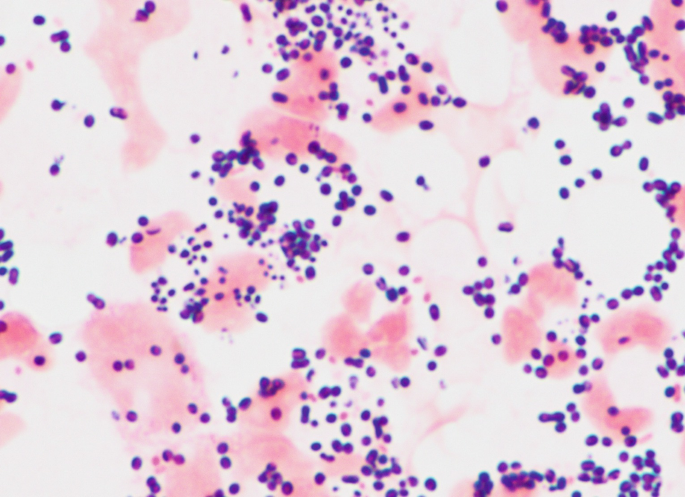
Antigenic variation is/are seen in which of the following?
Malignant pustule is seen in infection with which organism?
Niacin is required for the growth of which organism?
Regarding leprosy, which of the following statements is true?
What is the most common bacterial cause of rhinitis?
Sorbitol MacConkey agar is used for which strain of Enterohemorrhagic Escherichia coli (EHEC)?
Which of the following is NOT a medically important Streptococcus species?
All of the following regarding tetanus are true except:
A child presents with a white patch over the tonsils; diagnosis is best made by culture in which medium?
Early detection of Streptococcus pyogenes is by?
Explanation: **Explanation:** **Antigenic variation** is a survival mechanism used by pathogens to alter their surface proteins, allowing them to evade the host’s immune system and cause persistent or relapsing infections. 1. **Why the correct answer is right:** * **Borrelia recurrentis:** This is the classic example of antigenic variation. It causes **Relapsing Fever** by periodically switching its **Variable Major Proteins (VMPs)** via gene conversion. Each new antigenic variant leads to a new wave of fever as the host’s existing antibodies become ineffective. * **Treponema pallidum:** The causative agent of Syphilis utilizes a family of proteins called **TprK**. Through gene recombination, it creates extensive sequence diversity in the V1–V7 regions, allowing the bacteria to persist in the host for decades despite a robust immune response. 2. **Analysis of Incorrect Options:** * **Option B:** While *Borrelia recurrentis* is correct, it is an incomplete answer compared to Option A. * **Option C:** While *Neisseria gonorrhoeae* does show antigenic variation (via **Pilin** gene rearrangement), *Treponema pallidum* and *Borrelia* are more frequently paired in this context for competitive exams regarding spirochetes. * **Option D:** *Corynebacterium diphtheriae* does not undergo antigenic variation; its pathogenicity is primarily driven by the production of an exotoxin (Diphtheria toxin). **High-Yield Clinical Pearls for NEET-PG:** * **Other organisms showing antigenic variation:** *Neisseria gonorrhoeae* (Pili), *Trypanosoma brucei* (VSG genes), *Giardia lamblia* (VSP), and Influenza virus (Antigenic drift/shift). * **Mechanism in Borrelia:** Programmed DNA rearrangement (Gene conversion). * **Clinical Correlation:** The "relapses" in Relapsing Fever are a direct clinical manifestation of antigenic variation.
Explanation: **Explanation:** The correct answer is **Bacillus anthracis**. **Malignant Pustule** is the characteristic clinical lesion of **Cutaneous Anthrax**. Despite its name, it is neither malignant (cancerous) nor a true pustule (as it contains no pus). It begins as a painless, itchy papule that develops into a vesicle containing bluish-black fluid. This eventually ruptures to form a pathognomonic **painless, black necrotic eschar** surrounded by significant non-pitting edema. The lesion is caused by the "Edema Factor" and "Lethal Factor" toxins produced by *B. anthracis*. **Why other options are incorrect:** * **Yersinia pestis:** Causes Plague. The cutaneous manifestation is typically a "Bubo" (painful lymphadenopathy) or "Black Death" (acral gangrene/purpura), not a malignant pustule. * **Bacillus cereus:** Primarily causes food poisoning (emetic and diarrheal forms) or serious ocular infections (endophthalmitis). It does not produce the necrotic eschar seen in anthrax. * **Clostridium welchii (C. perfringens):** Causes Gas Gangrene (clostridial myonecrosis). The lesions are characterized by crepitus (gas in tissues), foul-smelling discharge, and intense pain, unlike the painless anthrax lesion. **High-Yield Clinical Pearls for NEET-PG:** * **Occupational Hazard:** Anthrax is known as **Hide Porter’s Disease** or **Wool Sorter’s Disease** due to exposure to infected animal products. * **Microscopy:** *B. anthracis* shows a characteristic **"Bamboo stick" appearance** (Gram-positive chains) and **Medusa head colonies** on agar. * **McFadyean’s Reaction:** Used for presumptive identification using polychrome methylene blue to visualize the capsule. * **String of Pearls Reaction:** Seen when grown on agar containing penicillin.
Explanation: **Explanation:** The correct answer is **Mycobacterium tuberculosis (MTB)**. **Underlying Medical Concept:** All Mycobacteria produce niacin (nicotinic acid) as a metabolic byproduct. However, most species possess an enzyme that converts niacin into niacin ribonucleotide. **Mycobacterium tuberculosis lacks this enzyme**, leading to the intracellular accumulation and subsequent excretion of free niacin into the culture medium. This characteristic is exploited in the **Niacin Test**, where the addition of cyanogen bromide and aniline (or benzidine) results in a canary yellow color, confirming the presence of MTB. **Analysis of Incorrect Options:** * **B. Mycobacterium kansasii:** This is a Photochromogen (Runyon Group I). It gives a **negative** niacin test because it metabolizes niacin further. * **C. Mycobacterium scrofulaceum (Scrofuloderma):** This is a Scotochromogen (Runyon Group II). It is niacin negative. (Note: Scrofuloderma refers to the clinical presentation of skin tuberculosis, but the causative agent is usually MTB or atypical mycobacteria, which do not share the unique niacin accumulation of MTB). * **D. Mycobacterium avium complex (MAC):** This is a Non-photochromogen (Runyon Group III). It is niacin negative and typically identified by its resistance to most antitubercular drugs and specific biochemical markers. **High-Yield Clinical Pearls for NEET-PG:** * **Niacin Test:** Positive in *M. tuberculosis*, *M. simiae*, and some strains of *M. chelonae* and *M. marinum*. * **Nitrate Reduction Test:** MTB is strongly positive, helping differentiate it from *M. bovis* (which is niacin and nitrate negative). * **Growth Characteristics:** MTB shows "rough, tough, and buff" colonies on Lowenstein-Jensen (LJ) medium and exhibits **serpentine cording** due to Cord Factor (trehalose 6,6'-dimycolate).
Explanation: **Explanation:** **Correct Answer: D. It is sensitive to isoniazid and rifampicin.** *Mycobacterium leprae* is an acid-fast bacillus that causes Leprosy (Hansen’s disease). While **Rifampicin** is the most potent bactericidal drug in the Multi-Drug Therapy (MDT) regimen, *M. leprae* also shows sensitivity to **Isoniazid (INH)**. Although INH is not used clinically for leprosy treatment (due to the superior efficacy of Rifampicin, Dapsone, and Clofazimine), experimental studies and historical data confirm its inhibitory effect on the organism. **Analysis of Incorrect Options:** * **Option A:** While *M. leprae* prefers cooler temperatures (around 30-33°C), which explains its predilection for peripheral nerves, skin, and the anterior chamber of the eye, the statement "less than 37°C" is a general characteristic rather than a defining "true" diagnostic rule in this context compared to its drug sensitivity profile. * **Option B:** *M. leprae* is an **obligate intracellular pathogen**. It has never been grown in cell-free (artificial) culture media. It can only be grown in vivo, such as in the footpads of mice or nine-banded armadillos. * **Option C:** In **Tuberculoid Leprosy (TT)**, the host has high cell-mediated immunity. This leads to a very low bacterial load (**paucibacillary**), making it extremely difficult to visualize the bacilli in biopsies or skin smears. They are typically seen in the Lepromatous (LL) pole. **High-Yield Clinical Pearls for NEET-PG:** * **Cultivation:** Footpad of mice (Shepard's technique) and 9-banded armadillos are the gold standards. * **Generation Time:** Very slow, approximately 12–13 days. * **MDT Regimen:** Includes Rifampicin, Dapsone, and Clofazimine. * **Leprids:** The characteristic skin lesions. * **Lepromin Test:** Positive in Tuberculoid (TT) leprosy (indicates good CMI) and negative in Lepromatous (LL) leprosy.
Explanation: **Explanation:** **Rhinitis** (inflammation of the nasal mucous membrane) is most commonly viral in origin (e.g., Rhinoviruses). However, when considering a **bacterial etiology**, the most frequent isolate is **Haemophilus influenzae**. 1. **Why Haemophilus influenzae is correct:** *H. influenzae* (particularly non-typeable strains) is a common commensal of the upper respiratory tract. When the local mucosal immunity is compromised (often following a viral infection), it becomes an opportunistic pathogen, leading to secondary bacterial rhinitis, sinusitis, or otitis media. 2. **Why other options are incorrect:** * **E. coli:** This is a Gram-negative coliform primarily associated with urinary tract infections and neonatal sepsis/meningitis; it is not a typical respiratory pathogen. * **Pasteurella multocida:** While it can cause respiratory infections, it is classically associated with **animal bites** (cats and dogs) or zoonotic exposure, not community-acquired rhinitis. * **Corynebacterium diphtheriae:** This causes **Diphtheria**, characterized by a thick, greyish pseudomembrane in the throat. While "nasal diphtheria" exists (presenting with serosanguinous discharge), it is rare in the post-vaccination era and is not the "most common" cause of general rhinitis. **High-Yield Clinical Pearls for NEET-PG:** * **Most common cause of Acute Sinusitis:** *Streptococcus pneumoniae* followed by *H. influenzae*. * **H. influenzae Culture:** Requires **Factor V (NAD)** and **Factor X (Hemin)**. It grows on Chocolate agar but not on blood agar (unless "Satellitism" occurs with *S. aureus*). * **Rhinoscleroma:** Caused by *Klebsiella pneumoniae subsp. rhinoscleromatis*, characterized by **Mikulicz cells** (foamy macrophages) on histology.
Explanation: **Explanation:** **Sorbitol MacConkey (SMAC) agar** is the primary screening medium used for the identification of **Enterohemorrhagic *Escherichia coli* (EHEC) O157:H7**. 1. **Why Option A is correct:** Most *E. coli* strains ferment sorbitol rapidly, appearing as pink colonies on SMAC agar. However, the specific serotype **O157:H7** is unique because it **cannot ferment sorbitol** (or does so very slowly). On SMAC agar, O157:H7 produces **colorless (pale) colonies**, allowing clinicians to differentiate it from normal fecal flora. 2. **Why Options B, C, and D are incorrect:** These serotypes (O159, O107, O55) are not the classic "Verocytotoxin-producing" strains associated with large-scale outbreaks of Hemolytic Uremic Syndrome (HUS). While other non-O157 EHEC strains exist, they often ferment sorbitol, making SMAC agar ineffective for their detection. O55 is historically linked to Enteropathogenic *E. coli* (EPEC), not EHEC. **High-Yield Clinical Pearls for NEET-PG:** * **Clinical Triad of HUS:** Microangiopathic hemolytic anemia, thrombocytopenia, and acute renal failure. * **Pathogenesis:** EHEC produces **Shiga-like toxins (Stx1 and Stx2)**, also known as Verotoxins, which inhibit protein synthesis by targeting the 60S ribosomal subunit. * **Management Warning:** Antibiotics are generally **avoided** in EHEC infections as they may trigger the release of more toxins, increasing the risk of HUS. * **Culture Characteristics:** On standard MacConkey agar, O157:H7 is a Lactose Fermenter (Pink), but on SMAC agar, it is a **Sorbitol Non-Fermenter (Colorless)**.
Explanation: **Explanation:** The question asks to identify the species that is **NOT** considered a primary medically important pathogen among the options. **Correct Answer: D. *Strep. salivarius*** While *Strep. salivarius* is a common commensal of the oral cavity and part of the Viridans group, it is generally considered a low-virulence organism. In the context of medical microbiology exams like NEET-PG, it is classified as a "non-pathogen" or an opportunistic commensal, rarely causing disease unless there is significant underlying immunosuppression or severe neutropenia. **Analysis of Incorrect Options:** * **A. *Strep. pyogenes* (Group A):** A major human pathogen responsible for pyogenic infections (pharyngitis, impetigo), toxigenic diseases (Scarlet fever, STSS), and delayed immunological sequelae (Rheumatic fever, PSGN). * **B. *Strep. agalactiae* (Group B):** A critical pathogen in neonates, being the leading cause of neonatal sepsis, meningitis, and pneumonia. It is also significant in pregnant women (UTIs) and diabetic patients. * **C. *Strep. equisimilus* (Group C/G):** This species carries Lancefield Group C or G antigens and is a recognized cause of pyogenic infections similar to Group A, including pharyngitis and skin infections. **High-Yield Clinical Pearls for NEET-PG:** * **Lancefield Classification:** Based on the C-carbohydrate antigen on the cell wall. *S. pyogenes* is Group A; *S. agalactiae* is Group B. * **Bacitracin Sensitivity:** *S. pyogenes* is sensitive; *S. agalactiae* is resistant. * **CAMP Test:** Positive for *S. agalactiae* (accentuates hemolysis of *S. aureus*). * **Viridans Group:** Includes *S. mutans* (dental caries) and *S. sanguinis* (Subacute Bacterial Endocarditis). *S. salivarius* is the least pathogenic of this group.
Explanation: **Explanation:** The question asks for the "except" statement, meaning we must identify the incorrect statement. However, in the provided options, **Option C is technically a true statement**, which suggests a potential error in the question's framing or a need to clarify the toxin's nature. In NEET-PG, *Clostridium tetani* is classic for producing **tetanospasmin**, a potent **exotoxin**. **Why Option C is the "Except" (Contextual Analysis):** While tetanospasmin is an exotoxin, it is specifically a **neurotoxin** released upon cell lysis. In some competitive exams, if a question marks this as "false," it may be a distractor focusing on the fact that the toxin is synthesized intracellularly and released when the bacteria die, or it is contrasting it with *tetanolysin* (a hemolysin). However, medically speaking, Option C is a factually correct description of the pathogenesis. **Analysis of Other Options:** * **Option A:** True. *Clostridium tetani* is a Gram-positive, anaerobic, spore-forming motile bacillus. * **Option B:** True. Spores are highly resistant and ubiquitous in **soil** and animal feces. Infection typically occurs via contaminated wounds. * **Option D:** True. Tetanospasmin blocks the release of inhibitory neurotransmitters (**GABA and Glycine**) from Renshaw cells in the spinal cord, leading to continuous muscle spasms. **NEET-PG High-Yield Pearls:** * **Morphology:** Characterized by terminal spores giving a **"drumstick" appearance**. * **Mechanism:** Tetanospasmin acts by cleaving **SNARE proteins** (synaptobrevin), preventing vesicle fusion. * **Clinical Signs:** **Risus sardonicus** (facial spasm), **Trismus** (lockjaw), and **Opisthotonus** (backward arching of the back). * **Management:** Treatment involves wound debridement, Metronidazole (preferred over Penicillin), and human tetanus immunoglobulin (TIG).
Explanation: The clinical presentation of a **white patch over the tonsils** (pseudomembrane) in a child is highly suggestive of **Diphtheria**, caused by *Corynebacterium diphtheriae*. ### **Explanation of the Correct Answer** **A. Loeffler’s Serum Slope (LSS):** This is the **enrichment medium of choice** for *C. diphtheriae*. It is preferred for initial diagnosis because it acts as a "fast-track" medium; the organism grows rapidly (within 6–8 hours), outstripping the growth of commensal oral flora. Crucially, LSS enhances the development of characteristic **metachromatic granules** (Babes-Ernst granules), which are vital for microscopic identification using Albert’s stain. ### **Analysis of Incorrect Options** * **B. LJ (Lowenstein-Jensen) Medium:** Used specifically for the cultivation of *Mycobacterium tuberculosis*. It contains egg, malachite green, and glycerol. * **C. Blood Agar:** While *C. diphtheriae* can grow on blood agar, it is non-selective. It is used primarily to rule out *Streptococcus pyogenes* (which causes follicular tonsillitis) but does not provide the rapid growth or biochemical enhancement seen with LSS. * **D. Tellurite Medium (Potassium Tellurite/McLeod’s):** This is a **selective medium**. While it is excellent for identifying biotypes (gravis, mitis, intermedius) based on black/grey colony morphology, it is **inhibitory**. Growth is much slower (24–48 hours) compared to LSS, making LSS the superior choice for immediate diagnosis. ### **High-Yield Clinical Pearls for NEET-PG** * **Morphology:** "Chinese letter" or cuneiform arrangement (due to incomplete separation during binary fission). * **Staining:** Albert’s stain shows bluish-black metachromatic granules against a green bacillary body. * **Toxin Detection:** The **Elek’s Gel Precipitation Test** is the gold standard for detecting toxin production (virulence). * **Treatment:** Immediate administration of **Anti-Diphtheritic Serum (ADS)** is the priority, even before culture results are finalized.
Explanation: **Explanation:** The correct answer is **Bacitracin (Option A)**. *Streptococcus pyogenes* (Group A Streptococcus/GAS) is characterized by its exquisite sensitivity to low concentrations of **Bacitracin**. In clinical microbiology, the **Bacitracin Sensitivity Test** (using a 0.04-unit disk) is a classic presumptive tool used to differentiate GAS from other beta-hemolytic streptococci (like *S. agalactiae*), which are typically resistant. A zone of inhibition around the disk indicates a positive result for *S. pyogenes*. **Analysis of Incorrect Options:** * **Oxacillin (B) & Methicillin (C):** These are penicillinase-resistant penicillins primarily used to test for resistance in *Staphylococcus aureus* (MRSA). They are not used for the identification of Streptococci. * **Optochin (D):** This is the specific biochemical marker used to identify ***Streptococcus pneumoniae***. *S. pneumoniae* is optochin-sensitive, whereas Viridans streptococci are optochin-resistant. **High-Yield NEET-PG Pearls:** * **PYR Test:** While Bacitracin is used for early detection, the **PYR (L-pyrrolidonyl arylamidase) test** is more specific and is now considered the "gold standard" rapid biochemical test for identifying *S. pyogenes*. * **ASO Titer:** Used for diagnosing non-suppurative sequelae (Rheumatic fever), but not for early acute detection. * **CAMP Test:** Used to identify Group B Streptococci (*S. agalactiae*), which shows "arrowhead" hemolysis when streaked with *S. aureus*. * **M Protein:** The chief virulence factor of *S. pyogenes*, responsible for inhibiting phagocytosis.
Staphylococci
Practice Questions
Streptococci and Enterococci
Practice Questions
Neisseria and Moraxella
Practice Questions
Corynebacterium and Listeria
Practice Questions
Bacillus and Clostridium
Practice Questions
Enterobacteriaceae
Practice Questions
Vibrio, Aeromonas, and Plesiomonas
Practice Questions
Pseudomonas and Related Bacteria
Practice Questions
Haemophilus and HACEK Group
Practice Questions
Bordetella and Brucella
Practice Questions
Mycobacteria
Practice Questions
Spirochetes
Practice Questions
Get full access to all questions, explanations, and performance tracking.
Start For Free