Seminal vesicles and vas deferens would be bilaterally absent congenitally in which of the following conditions?
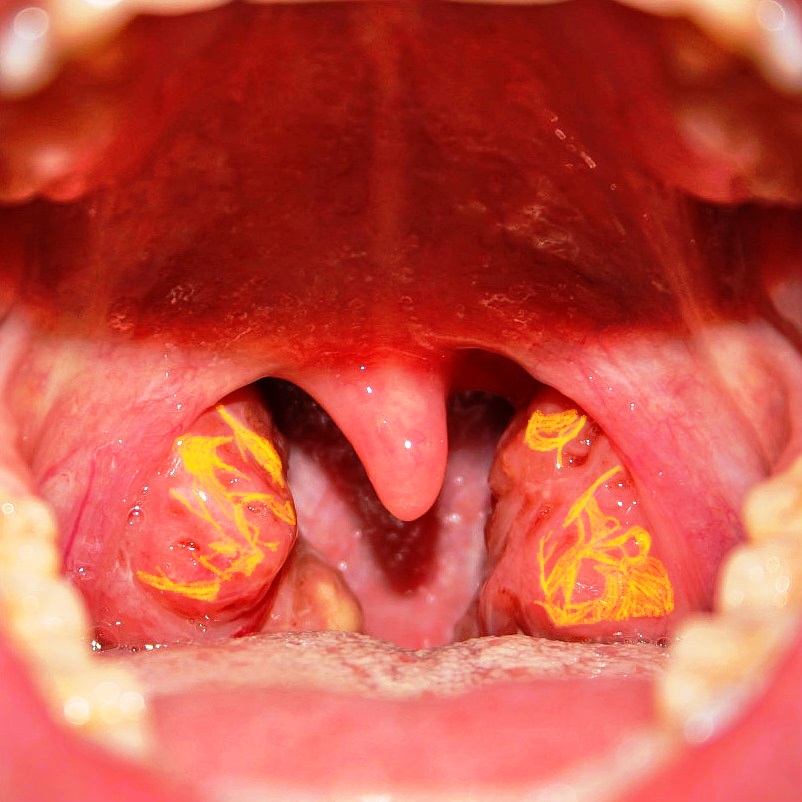
A patient presented with reduced levels of high-density lipoprotein, and ABCA1 mutation. On examination, tonsils appeared as shown in the image. What is the diagnosis?
Which of the following statements are true about familial adenomatous polyposis? 1. It is autosomal recessive 2. If not treated, 100% of the cases progress to adenocarcinoma colon. 3. It is associated with a gene mutation in KRAS 4. It is associated with congenital hypertrophy of the retinal pigment epithelium.
Which pattern of inheritance of disease is associated with consanguinity?
Which of the following is an Autosomal Dominant disease?
A child presents with abdominal pain, arthralgia, hematuria, and hypertension. What is the diagnosis?
Which of the following provide protection against malaria except
A 10-year-old girl presents with severe joint laxity, scoliosis, and a history of easy bruising. Which of the following conditions is most likely?
Most common cause of syndromic deafness is:
Submucosal neuroma is associated with
Explanation: ***Cystic fibrosis*** - **Congenital bilateral absence of the vas deferens (CBAVD)** is found in over 95% of males with cystic fibrosis, often leading to infertility. - This condition results from mutations in the **CFTR gene**, which is responsible for chloride transport, causing thick, viscous secretions that block or prevent the development of these structures. *Kartagener syndrome* - This syndrome is a subgroup of **primary ciliary dyskinesia**, characterized by a triad of *situs inversus*, chronic sinusitis, and bronchiectasis. - While it causes **infertility due to immotile sperm**, the male reproductive tract organs like the vas deferens and seminal vesicles are typically present. *Klinefelter syndrome* - Individuals with Klinefelter syndrome have a **47,XXY karyotype** and typically present with small testes, azoospermia, and hypogonadism [1]. - However, the **vas deferens and seminal vesicles are usually present**, though they may be underdeveloped or dysfunctional. *Kallmann syndrome* - This is a form of **hypogonadotropic hypogonadism** associated with anosmia or hyposmia (impaired sense of smell). - It results from a failure of GnRH-producing neurons to migrate to the hypothalamus, affecting hormone production, but the **anatomical structures of the vas deferens and seminal vesicles are usually intact**.
Explanation: ***Tangier disease*** - This condition is characterized by **very low HDL levels** due to mutations in the **ABCA1 gene**, which impairs cholesterol efflux from cells. - The classic physical finding is **enlarged, orange-yellow tonsils** due to cholesterol ester deposition, seen in the provided image. *Fabry disease* - This is an **X-linked lysosomal storage disorder** caused by a deficiency of **alpha-galactosidase A**, leading to globotriaosylceramide accumulation. - Clinical features include **neuropathic pain**, **angiokeratomas**, **corneal opacities**, and early renal and cardiac disease, not orange-yellow tonsils. *Niemann-Pick disease* - This is a group of **autosomal recessive lysosomal storage disorders** caused by deficiencies in enzymes like acid sphingomyelinase or proteins involved in cholesterol processing. - It typically presents with **hepatosplenomegaly**, **neurodegeneration** (especially type A and B), and **lung involvement**, but not oral lesions as depicted. *Gaucher disease* - This is an **autosomal recessive lysosomal storage disease** resulting from a deficiency of the enzyme **beta-glucosidase**, leading to accumulation of glucocerebroside. - Characteristic features include **hepatosplenomegaly**, **bone pain** and crises, and **pancytopenia**, without any specific tonsillar findings.
Explanation: ***2 and 4*** - Without treatment, **familial adenomatous polyposis (FAP)** leads to colorectal **adenocarcinoma** in 100% of cases, due to the accumulation of numerous adenomatous polyps throughout the colon. - FAP is strongly associated with **congenital hypertrophy of the retinal pigment epithelium (CHRPE)**, which can be an early diagnostic marker [1]. *None of the options* - This statement is incorrect because FAP does indeed involve the progression to adenocarcinoma and is associated with CHRPE. - The combination of these two true statements makes this option invalid. *1 and 4* - FAP is inherited in an **autosomal dominant** manner, not autosomal recessive [1]. - While statement 4 (association with CHRPE) is true, statement 1 being false makes this option incorrect. *2 and 3* - Although statement 2 (100% progression to adenocarcinoma) is true, statement 3 is incorrect. - FAP is primarily caused by mutations in the **APC gene**, not the KRAS gene [1]. KRAS is more commonly associated with sporadic colorectal cancer progression rather than FAP.
Explanation: ***Autosomal recessive*** - Consanguineous relationships increase the likelihood of offspring inheriting **two copies of a rare deleterious recessive allele**, one from each parent [1]. - This occurs because relatives share a greater proportion of their genes, making it more probable that both parents are **heterozygous carriers** for the same recessive disorder. *Autosomal dominant* - In autosomal dominant disorders, only **one copy of the altered gene** is needed to cause the disease, so expression is not typically influenced by consanguinity. - These conditions often manifest in every generation and are not more prevalent with increased shared genetic material. *X-linked recessive* - X-linked recessive disorders primarily affect males, as they only have one X chromosome, and are transmitted by carrier females. - While consanguinity can theoretically increase the carrier rate within a population, its direct impact on the inheritance pattern of an X-linked trait in a single family is less pronounced compared to autosomal recessive conditions. *X-linked dominant* - X-linked dominant disorders are expressed in heterozygous females and hemizygous males, with affected males often having more severe disease. - The inheritance pattern is not significantly influenced by consanguinity, as only one copy of the affected gene on the X chromosome is sufficient for disease manifestation.
Explanation: ***Von Willebrand disease*** - This is an **autosomal dominant** inherited disorder caused by a deficiency or dysfunction of **von Willebrand factor**, crucial for normal hemostasis [1], [2]. - It often presents with **mucocutaneous bleeding** like nosebleeds, easy bruising, and heavy menstrual bleeding [2]. *Wilson's disease* - This is an **autosomal recessive** disorder characterized by defective copper metabolism and accumulation in various organs, most notably the liver and brain. - Clinical features include **hepatic dysfunction**, neurologic symptoms like **tremors**, and **Kayser-Fleischer rings** in the eyes. *Cystic fibrosis* - This is an **autosomal recessive** disorder caused by mutations in the **CFTR gene**, leading to abnormal chloride transport. - It primarily affects the lungs and digestive system, causing **thick mucus production** and recurrent infections. *Friedreich's ataxia* - This is an **autosomal recessive** neurodegenerative disorder typically caused by a **GAA trinucleotide repeat expansion** in the FXN gene. - Key symptoms include progressive **ataxia**, dysarthria, and often heart problems.
Explanation: ***Hemolytic uremic syndrome*** - The combination of **abdominal pain**, **hematuria**, and **hypertension** in a child, particularly after a diarrheal illness, is highly suggestive of **hemolytic uremic syndrome (HUS)** [1], [2]. - HUS is characterized by **microangiopathic hemolytic anemia**, **thrombocytopenia**, and **acute kidney injury**, which can manifest as hematuria and hypertension [1], [2]. *Dengue* - While **abdominal pain** and **arthralgia** can be symptoms of dengue, it typically also presents with **fever**, **rash**, and **bleeding manifestations** like petechiae or mucosal bleeding. - Dengue does not typically cause **hematuria** with **hypertension** as a primary feature of renal involvement. *Rheumatic fever* - **Rheumatic fever** is characterized by **arthralgia** (migratory arthritis), but it is primarily a sequela of **Streptococcal pharyngitis** and presents with **carditis**, **chorea**, **erythema marginatum**, and **subcutaneous nodules**. - It does not typically cause the combination of **abdominal pain**, **hematuria**, and **hypertension** seen here. *Henoch-Schönlein Purpura* - **Henoch-Schönlein Purpura (HSP)** involves **abdominal pain**, **arthralgia**, and **hematuria**, and can sometimes cause hypertension. - However, the hallmark of HSP is a **palpable purpuric rash** on the lower extremities and buttocks, which is not mentioned in the patient's presentation.
Explanation: ***PNH*** - **Paroxysmal nocturnal hemoglobinuria (PNH)** is a rare, acquired clonal disorder of hematopoietic stem cells characterized by complement-mediated hemolysis. - It does not offer any known protective advantage against malaria infection; in fact, chronic hemolysis could potentially complicate malaria diagnosis or management. *Thalassemia* - Individuals with **thalassemia traits (heterozygotes)**, particularly alpha-thalassemia, have red blood cells that are more resistant to malarial parasite invasion and growth [1]. - This protection is thought to arise from altered red cell morphology, reduced parasite multiplication, and enhanced clearance of infected cells. *Sickle cell anemia* - The **heterozygous state (sickle cell trait)** provides significant protection against severe malaria, as the altered hemoglobin S in red blood cells inhibits parasite growth and promotes early clearance of infected cells [1], [2]. - Although the homozygous state (sickle cell anemia) can be severe, even carriers benefit from reduced malaria susceptibility. *Duffy blood group* - Absence of the **Duffy antigen on red blood cells**, common in West African populations, provides complete protection against infection with **Plasmodium vivax** malaria. - The Duffy antigen receptor is essential for *P. vivax* to invade human red blood cells.
Explanation: ***Ehlers-Danlos syndrome*** - This syndrome is characterized by defects in **collagen synthesis** and structure, leading to **joint hypermobility** (laxity) [1], skin hyperextensibility, and fragility, which explains the easy bruising [1]. - **Scoliosis** is a common musculoskeletal manifestation due to weakened connective tissue support [1]. *Marfan's syndrome* - While Marfan's syndrome also presents with **joint laxity** and **scoliosis**, its defining features include distinct skeletal abnormalities (e.g., **arachnodactyly**, sternal deformities) and **cardiovascular abnormalities** (e.g., aortic root dilatation), which are not mentioned here. - **Easy bruising** is not a prominent feature of Marfan's syndrome. *Rheumatoid arthritis* - This is an **autoimmune inflammatory arthritis** primarily affecting synovial joints, causing pain, swelling, and stiffness, often symmetrically. - It does not typically present with severe **joint laxity** throughout the body, **scoliosis**, or **easy bruising** as primary features in a 10-year-old. *Osteogenesis imperfecta* - This condition is characterized by **brittle bones** due to defective collagen, leading to recurrent **fractures** with minimal trauma. - While patients can have some **joint laxity** and **scoliosis**, the most prominent symptom is bone fragility, often accompanied by **blue sclerae**, which is not mentioned, and easy bruising is less indicative than in EDS.
Explanation: **Waardenburg syndrome** - This is the **most common cause of syndromic deafness**, characterized by hearing loss combined with pigmentary anomalies. - Key features include congenital sensorineural hearing loss, heterochromia iridum (different colored eyes), a white forelock, and premature graying of hair. *Pendred syndrome* - This syndrome is the **second most common cause of syndromic deafness** and is associated with goiter (enlarged thyroid gland). - It results from mutations in the **SLC26A4 gene** and is characterized by sensorineural hearing loss and inner ear malformations (Mondini dysplasia). *Usher syndrome* - This is the **most common cause of combined deafness and blindness**, affecting both hearing and vision. - It involves sensorineural hearing loss and progressive **retinitis pigmentosa**, leading to night blindness and eventual vision loss. *All of the options* - While all listed syndromes cause syndromic deafness, Waardenburg syndrome is specifically identified as the **most common single cause**. - Therefore, choosing "all of the options" would be incorrect as it doesn't pinpoint the *most common* cause.
Explanation: ***MEN 2B (Multiple Endocrine Neoplasia Type 2B)*** - **Submucosal neuromas** are a distinctive feature of MEN 2B, specifically noticeble as mucosal neuromas on the lips, tongue, and gastrointestinal tract. - This syndrome is characterized by the presence of **medullary thyroid carcinoma**, **pheochromocytoma**, and mucocutaneous neuromas, without hyperparathyroidism. *MEN 2A (Multiple Endocrine Neoplasia Type 2A)* - MEN 2A is characterized by **medullary thyroid carcinoma**, **pheochromocytoma**, and **primary hyperparathyroidism**. - It does not typically feature extensive **submucosal neuromas** as a primary diagnostic criterion. *MEN 1 (Multiple Endocrine Neoplasia Type 1)* - MEN 1 involves tumors of the **parathyroid glands**, **anterior pituitary**, and **pancreatic islet cells** (the '3 Ps'). - **Submucosal neuromas** are not a component of the MEN 1 syndrome. *None of the options* - This option is incorrect because **submucosal neuromas** are a characteristic finding in MEN 2B.
Principles of Medical Genetics
Practice Questions
Genetic Testing and Counseling
Practice Questions
Single Gene Disorders
Practice Questions
Chromosomal Disorders
Practice Questions
Mitochondrial Diseases
Practice Questions
Pharmacogenomics
Practice Questions
Cancer Genetics
Practice Questions
Genetics of Common Diseases
Practice Questions
Epigenetics and Disease
Practice Questions
Genetic Basis of Developmental Disorders
Practice Questions
Ethical Issues in Medical Genetics
Practice Questions
Gene Therapy and Precision Medicine
Practice Questions
Get full access to all questions, explanations, and performance tracking.
Start For Free